

DoorDash Business Intelligence Interview Guide: Process & Most Asked Questions (2026)


Introduction
The DoorDash business intelligence role sits at the core of one of the most complex on-demand marketplaces in the world. As DoorDash continues to scale across restaurants, grocery, retail, and new verticals, data has become the primary mechanism for balancing growth, efficiency, and marketplace health. Business intelligence professionals translate millions of orders, deliveries, and user interactions into insights that guide pricing decisions, Dasher incentives, merchant strategy, and product investments across cities and regions.
The DoorDash business intelligence interview reflects the weight of this responsibility. You are evaluated on far more than technical execution alone. Interviewers look for strong SQL fundamentals, disciplined metric design, sound experimentation judgment, and the ability to communicate insights that influence product managers, operators, and leadership teams. This guide breaks down each stage of the DoorDash business intelligence interview, the most common Doordash specific questions that candidates face, and practical strategies to help you prepare with confidence and stand out in a highly competitive analytics hiring process.
DoorDash Business Intelligence Interview Process
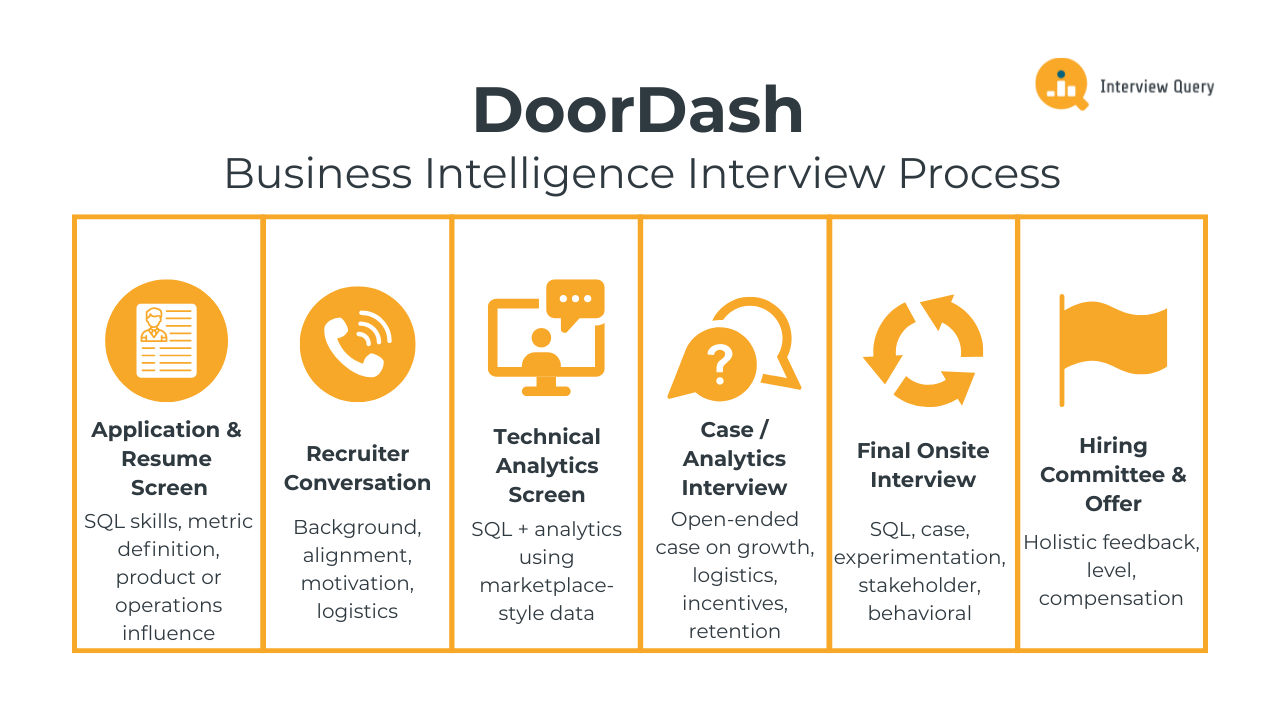
The DoorDash business intelligence interview process evaluates how well you turn data into decisions in a fast moving, multi sided marketplace. Interviewers assess your SQL depth, metric judgment, experimentation instincts, and ability to communicate insights that influence product and operations teams. Most candidates complete the full loop within three to five weeks, depending on team availability and role level.
Below is a breakdown of each stage and what DoorDash interviewers consistently look for throughout the process.
Application and Resume Screen
During the application review, DoorDash recruiters focus on evidence of strong analytical ownership rather than reporting support. Resumes that stand out highlight deep SQL experience, clear metric definition, and examples where analysis directly influenced product launches, operational changes, or strategic decisions. Experience working with marketplace, logistics, growth, or people analytics data is especially relevant, as is comfort operating in ambiguous problem spaces.
Tip: Explicitly call out decisions your analysis changed and the metrics that moved as a result. At DoorDash, this signals end to end ownership and shows you can drive impact, not just produce insights.
Initial Recruiter Conversation
The recruiter call is a short, non technical conversation focused on your background, role alignment, and motivation for DoorDash. You may be asked to walk through your experience, explain the type of problems you enjoy working on, and describe how you partner with product managers or operators. Recruiters also confirm logistics such as location preferences, timeline, and compensation expectations.
Tip: Connect your past work to DoorDash’s marketplace challenges, such as balancing speed, cost, and quality. This demonstrates product intuition and shows you understand the business context behind the data.
Technical Analytics Screen
The technical screen typically centers on SQL and analytical reasoning. You may be asked to write queries involving joins, window functions, cohort analysis, or metric calculations using marketplace style data such as orders, deliveries, or users. Interviewers care about clean logic, edge case handling, and how well you explain your approach while working through the problem.
Tip: Narrate why each step of your query exists and what business question it answers. This shows structured thinking and mirrors how analytics discussions happen internally at DoorDash.
Case or Business Analytics Interview
In this round, you will be given an open ended business problem tied to growth, logistics performance, incentives, or retention. You are expected to define success metrics, propose analyses, reason through tradeoffs, and communicate a recommendation. There is rarely a single correct answer. Interviewers evaluate how you structure ambiguity and prioritize what matters most.
Tip: Anchor your analysis around a clear objective and explicitly call out tradeoffs across consumers, Dashers, and merchants. This signals strong marketplace judgment, which is critical at DoorDash.
Final Onsite Interview
The final onsite loop is the most in depth stage of the DoorDash business intelligence interview process. It typically includes four to five interviews, each lasting about 45 to 60 minutes. These rounds evaluate your ability to solve real analytics problems, reason through ambiguity, and communicate clearly with cross functional partners.
SQL and data analysis round: You will write SQL queries against realistic marketplace datasets. Tasks may include computing retention, diagnosing delivery delays, or comparing performance across regions or cohorts. Interviewers assess query correctness, edge case handling, and how effectively you translate results into insights that could guide decisions.
Tip: Always sanity check your outputs and explain what you would expect to see before running the query. This demonstrates analytical rigor and helps prevent silent data issues, a skill DoorDash values highly.
Business case and metrics round: This interview focuses on breaking down a DoorDash specific business problem, such as improving delivery reliability or evaluating a pricing change. You will define key metrics, outline analyses, and recommend next steps. The goal is to assess your metric intuition and prioritization.
Tip: Explicitly separate leading metrics from outcome metrics and explain why each matters. This shows mature metric thinking and aligns with how DoorDash evaluates product health.
Experimentation and decision making round: You may be asked to design or evaluate an experiment, interpret results, or reason through inconclusive outcomes. Interviewers look for sound experimental judgment, awareness of biases, and the ability to balance speed with correctness in decision making.
Tip: Call out guardrail metrics and long term risks, not just short term wins. This signals responsible experimentation and strong ownership over marketplace health.
Stakeholder and communication round: This round evaluates how you work with product managers, engineers, and operators. Expect questions about influencing decisions, handling disagreement, and communicating complex analysis to non technical partners.
Tip: Frame your answers around how you adapted your communication to your audience. At DoorDash, clear storytelling is a core skill that differentiates strong analysts.
Behavioral and ownership round: Interviewers assess how you handle ambiguity, setbacks, and accountability. Questions often focus on ownership, prioritization, and learning from mistakes in fast paced environments.
Tip: Emphasize moments where you took responsibility beyond your scope. This demonstrates ownership, a trait DoorDash looks for consistently across levels.
Hiring Committee and Offer
After the onsite, interviewers submit independent written feedback. A hiring committee reviews performance across all rounds, evaluating analytical strength, judgment, communication, and role fit. If approved, the team aligns on level and compensation, and candidates may be matched to a specific business intelligence team based on experience and interest.
Tip: Be transparent about the problem spaces you are most excited about. DoorDash often considers team alignment during final decisions, and clarity here helps ensure a strong mutual fit.
Looking for hands-on problem-solving? Test your skills with real-world challenges from top companies. Ideal for sharpening your thinking before interviews and showcasing your problem solving ability.
Challenge
Check your skills...
How prepared are you for working as a Business Intelligence at Doordash?
DoorDash Business Intelligence Interview Questions
The DoorDash business intelligence interview includes a mix of SQL, analytics, experimentation, product reasoning, and stakeholder judgment. These questions evaluate how well you work with marketplace data, reason through tradeoffs across consumers, Dashers, and merchants, and communicate insights that drive real decisions. The goal is not only to assess technical skill, but to understand how you structure ambiguity, prioritize metrics, and support fast, high-impact decisions in a dynamic operating environment.
Read more: Business Intelligence Interview Questions: Complete Guide with Examples & Answers
SQL and Analytics Interview Questions
In this portion of the interview, DoorDash focuses heavily on your ability to analyze large, messy marketplace datasets using SQL. Questions often involve orders, deliveries, users, Dashers, merchants, and time-based performance metrics. Interviewers want to see clean query structure, strong metric intuition, and awareness of data quality issues that naturally arise in real-time logistics and growth analytics.
-
This question tests whether you can define a “primary” behavior, join and aggregate correctly, and translate messy user behavior into a stable metric DoorDash teams can act on, like household stickiness versus gift or office ordering. To solve it, first define each user’s primary address (commonly the most frequent shipping address, with ties broken by most recent), then count orders to that address versus all other addresses and compute the percentage per user using conditional aggregation.
Tip: When you define “primary,” state your tie-break rule out loud (frequency first, recency second). That shows metric discipline and prevents silent definition bugs that can mislead growth decisions.
Write a query to identify Dashers whose delivery completion rate declined week over week.
This question tests time-based metric construction and trend comparison, which matters at DoorDash because completion rate shifts can signal onboarding issues, incentive misalignment, or market-level operational friction. To answer, compute weekly completions and assignments per Dasher, calculate completion rate, then use a window function like
LAG()to compare each week’s rate to the prior week and flag negative changes. You should also handle weeks with very low volume so the decline is meaningful.Tip: Call out a minimum delivery threshold per week before flagging a decline. That signals statistical judgment and shows you understand how noise can create false operational alarms.
-
This question tests whether you can build a clean rollup table and compute a rate metric safely, which is exactly what DoorDash BI does when turning raw event logs into decision-ready dashboards. To solve it, group by
wishlist_id, count total items, sum fulfilled items using a conditionalCASE WHEN status = 'fulfilled' THEN 1 END, then compute fulfillment rate as fulfilled divided by total, guarding against divide-by-zero. Finally, order by fulfillment rate descending.Tip: Always protect your denominator with
NULLIF(total_items, 0)and say why. That shows production-minded SQL habits, which DoorDash values because metrics pipelines must not break on edge cases. -
This question tests segmentation logic and how you translate business rules into SQL, which matters at DoorDash for identifying low-engagement customers for reactivation, pricing tests, or churn prevention. To answer, aggregate at the user level to compute order count and total spend, then filter users who meet either condition using
HAVING COUNT(DISTINCT order_id) < 3 OR SUM(order_total) < 500. If spend is stored at item level, you also need to sum line items first to avoid double counting.Tip: Say how you would avoid counting canceled or refunded orders in both metrics. That shows business context awareness and makes your segmentation trustworthy for real targeting decisions.
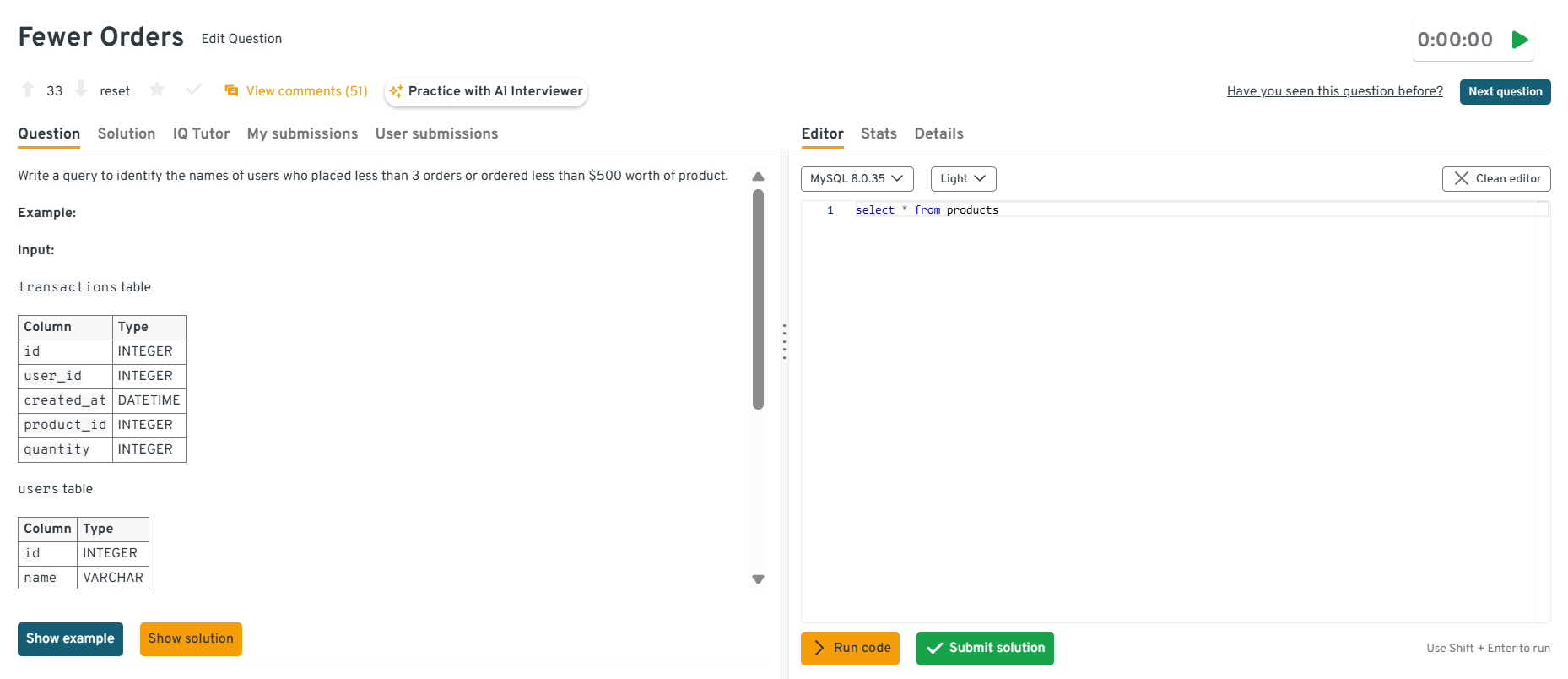
Head to the Interview Query dashboard to practice SQL, business analytics, experimentation, and stakeholder questions commonly tested in DoorDash Business Intelligence interviews. With built-in code execution and AI-guided feedback, you can sharpen your marketplace reasoning and clearly communicate tradeoffs at scale.
How would you detect merchants whose order volume suddenly dropped compared to their historical baseline?
This question tests anomaly detection thinking and baseline selection, which DoorDash uses to catch merchant outages, menu issues, or operational disruptions before they impact customer experience. To solve it, compute recent order volume for each merchant (for example last 7 days) and compare it to a historical baseline (for example prior 28 days average or rolling mean), then flag merchants where the recent period drops below a threshold like 2 standard deviations or a percent decline cutoff. Segmenting by day-of-week helps reduce seasonality noise.
Tip: Compare merchants to their own historical pattern and control for day-of-week. This signals strong causal instincts and shows you can separate real incidents from normal demand cycles.
Watch next: Business Case Study: Netflix Pricing
In this mock interview session, Ying, a data scientist, walks through how to approach a DoorDash-style business intelligence case. She demonstrates how to clarify ambiguous goals, structure metrics, and communicate tradeoffs while interacting with the interviewer. The session highlights why asking the right clarifying questions matters and how to turn analysis into clear recommendations, making it a strong resource for your DoorDash BI interview preparation.
Business and Product Analytics Interview Questions
These questions assess how well you connect data to product and operational decisions. DoorDash interviewers look for clear problem framing, thoughtful metric selection, and an understanding of marketplace tradeoffs rather than perfect numerical answers.
To improve customer experience on Doordash, what key parameters would you focus on improving?
This question tests your ability to prioritize metrics that actually drive customer satisfaction at DoorDash. A strong answer centers on delivery time reliability, order accuracy, availability, and pricing transparency, while acknowledging tradeoffs with cost and Dasher supply. You should explain how you would identify the biggest pain points using funnel metrics, repeat order behavior, and customer complaints, then focus improvement efforts where they most impact retention.
Tip: Explicitly call out which metric you would not optimize first and why. This shows decision judgment and prevents local optimizations that hurt the broader marketplace.
Order volume dropped in one city last week. How would you investigate the cause?
This question evaluates structured problem solving under time pressure, which is critical in DoorDash’s operations-heavy environment. A strong response breaks the problem into demand, supply, and execution factors, then proposes targeted analyses for each, such as traffic changes, Dasher availability, merchant uptime, or delivery times. You should sequence the investigation to rule out the most impactful causes first.
Tip: State which metric you would check in the first five minutes. This demonstrates prioritization instincts and signals you can triage issues quickly during live incidents.
-
This question tests your ability to reason about incentives in a two-sided marketplace. A strong answer explains how to measure incremental supply from incentives, isolate causal impact using experiments or quasi-experiments, and evaluate downstream effects on delivery time, cancellations, and customer satisfaction. You should also address cost efficiency and diminishing returns at higher incentive levels.
Tip: Separate short-term supply lift from long-term Dasher behavior changes. This signals marketplace maturity and avoids misleading conclusions from one-time spikes.
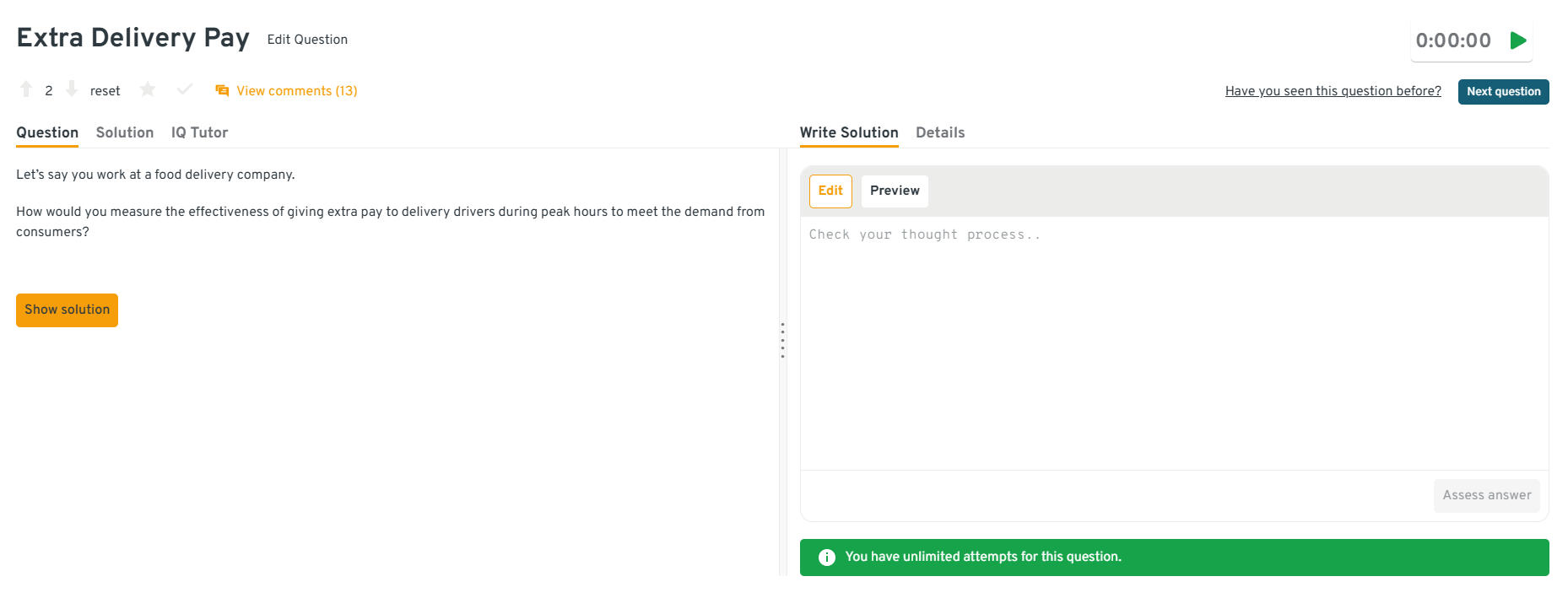
Head to the Interview Query dashboard to practice SQL, business analytics, experimentation, and stakeholder questions commonly tested in DoorDash Business Intelligence interviews. With built-in code execution and AI-guided feedback, you can sharpen your marketplace reasoning and clearly communicate tradeoffs at scale.
-
This question evaluates product evaluation and tradeoff thinking. A strong answer frames clear success metrics such as delivery time reduction and conversion, while identifying risks like selection bias, merchant burden, or quality degradation. You should explain how to compare the feature against existing flows using experiments or phased rollouts and assess whether speed gains justify operational complexity.
Tip: Call out one unintended consequence you would actively monitor. This shows foresight and reinforces that you think beyond headline metrics.
How would you prioritize analytics work when multiple teams request support at once?
This question tests stakeholder management and decision ownership. A strong response explains how you evaluate requests based on impact, urgency, reversibility, and alignment with company goals, while communicating tradeoffs transparently. At DoorDash, this often means deprioritizing lower-impact work during launches or incidents.
Tip: Explain how you reset expectations when priorities shift. This signals leadership and shows you can protect analytical focus without damaging partner trust.
Want to build up your BI interview skills? Practice real hands-on problems on the Interview Query Dashboard and start getting interview ready today.
Experimentation and Metrics Design Interview Questions
These questions evaluate how you design experiments and metrics that drive real decisions in a fast-moving, multi-sided marketplace. DoorDash interviewers look for sound causal reasoning, careful metric selection, and an ability to balance learning speed with marketplace stability and trust.
-
This question tests how you evaluate model quality beyond offline accuracy. A strong answer explains comparing predicted versus actual delivery times using error distributions, on-time rate, and tail risk, then validating improvements through controlled experiments. You should discuss segmenting by distance, merchant type, and time of day since ETA accuracy matters most during peak periods and longer trips at DoorDash.
Tip: Call out how you would monitor extreme lateness, not just average error. This shows user-centric thinking and an understanding of how ETA trust affects repeat ordering.
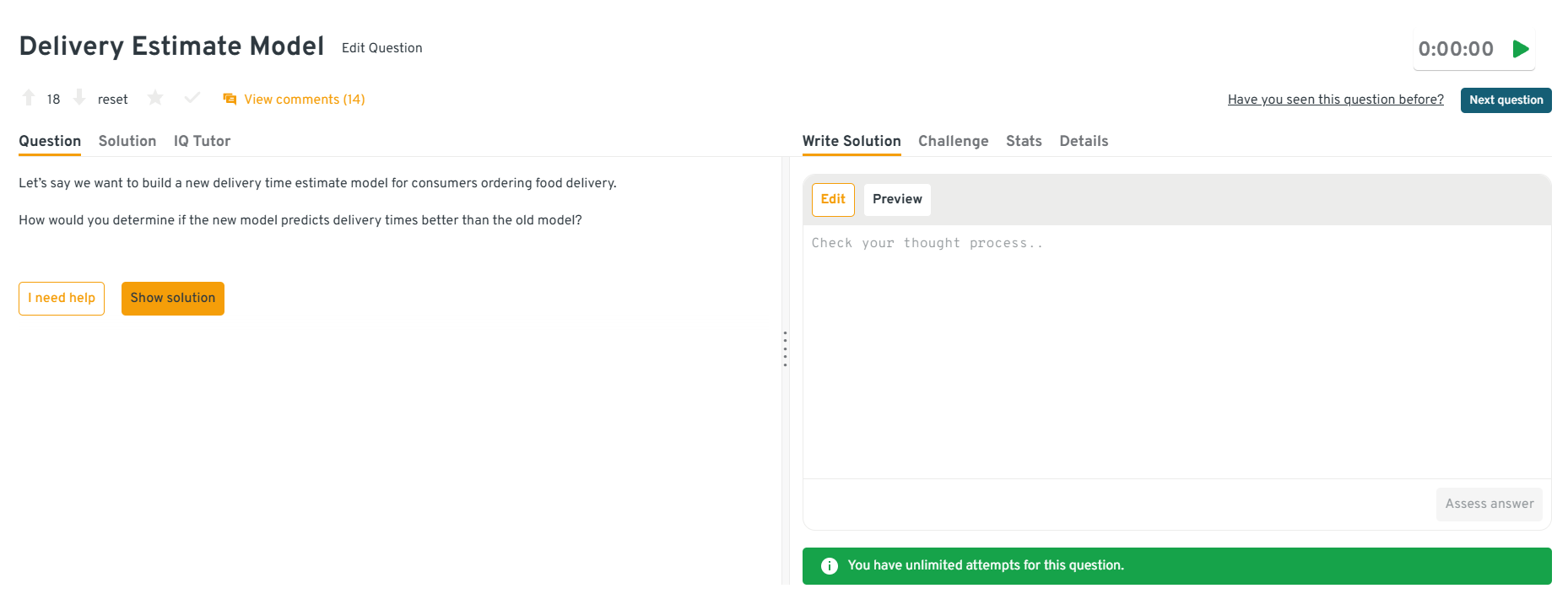
Head to the Interview Query dashboard to practice SQL, business analytics, experimentation, and stakeholder questions commonly tested in DoorDash Business Intelligence interviews. With built-in code execution and AI-guided feedback, you can sharpen your marketplace reasoning and clearly communicate tradeoffs at scale.
What pitfalls exist when running experiments in a two-sided marketplace?
This question evaluates conceptual understanding of marketplace dynamics. A strong response covers interference between users, supply rebalancing across treatments, and incentives that unintentionally shift behavior outside the experiment. At DoorDash, these effects can distort results if not accounted for, especially when testing pricing, incentives, or dispatch logic.
Tip: Explain how you would monitor spillover effects across nearby markets. This demonstrates advanced experimentation judgment and risk awareness.
What metrics would you track in real time to understand delivery demand across a city?
This question tests metric hierarchy and signal selection under time pressure. A strong answer focuses on order creation rate, unfulfilled orders, surge indicators, and backlog growth, while using guardrails like cancellation rate and ETA inflation. You should explain how these metrics help distinguish true demand spikes from temporary noise.
Tip: Describe which metric you would trust most during a sudden spike. This signals decisiveness and operational readiness, both critical at DoorDash.
-
This question evaluates multi-metric decision making and long-term thinking. A strong answer breaks impact into financial contribution, operational efficiency, and user ecosystem effects, then explains how to weigh short-term losses against long-term retention and platform expansion. DoorDash asks similar questions to assess how you reason about investments that reshape the marketplace.
Tip: Explicitly state which dimension would be your decision driver. This shows clarity of judgment when metrics conflict.
When should an experiment be stopped early?
This question tests risk management and ethical judgment. A strong response covers severe guardrail violations, user harm, or clear negative marketplace signals that outweigh learning value. At DoorDash, protecting customer trust, Dasher experience, and merchant stability takes precedence over running experiments to completion.
Tip: Mention one non-negotiable guardrail you would enforce. This signals ownership and alignment with DoorDash’s responsibility-first culture.
Behavioral and Stakeholder Interview Questions
These questions evaluate how you operate in ambiguity, influence decisions, and take ownership in fast-moving environments. DoorDash interviewers look for BI analysts who communicate clearly, earn trust with partners, and make progress even when data or direction is imperfect.
Tell me about a time you influenced a decision with imperfect data.
DoorDash BI professionals are frequently asked to guide decisions in real time, before all data sources are fully settled or edge cases are resolved. This question assesses how you frame uncertainty, quantify risk, and still move the business forward responsibly instead of waiting for perfect information.
Sample answer: During a regional logistics review, we needed to decide whether to expand peak-hour incentives, but the most recent data had ingestion delays. I used four weeks of historical data to model expected ranges, clearly labeled assumptions, and recommended a limited rollout with strict guardrails. The decision improved on-time delivery by seven percent while keeping incentive costs within forecast.
Tip: Show how you quantified uncertainty and protected downside risk. This demonstrates BI judgment and decision ownership, which DoorDash values more than perfect precision.
Describe a disagreement with a product manager over metrics.
BI roles at DoorDash often act as the arbiter when teams optimize for different outcomes. This question explores how you navigate metric disagreements, align stakeholders around business impact, and prevent teams from optimizing locally at the expense of marketplace health.
Sample answer: A product partner wanted to optimize for order volume on a new checkout flow, while I flagged rising cancellations as a risk. I presented data showing similar launches increased volume but hurt retention. We aligned on a primary metric tied to repeat orders with cancellations as a guardrail, which led to a launch that balanced growth and experience.
Tip: Anchor disagreements around long-term business outcomes, not metric preference. This signals BI maturity and cross-functional leadership.
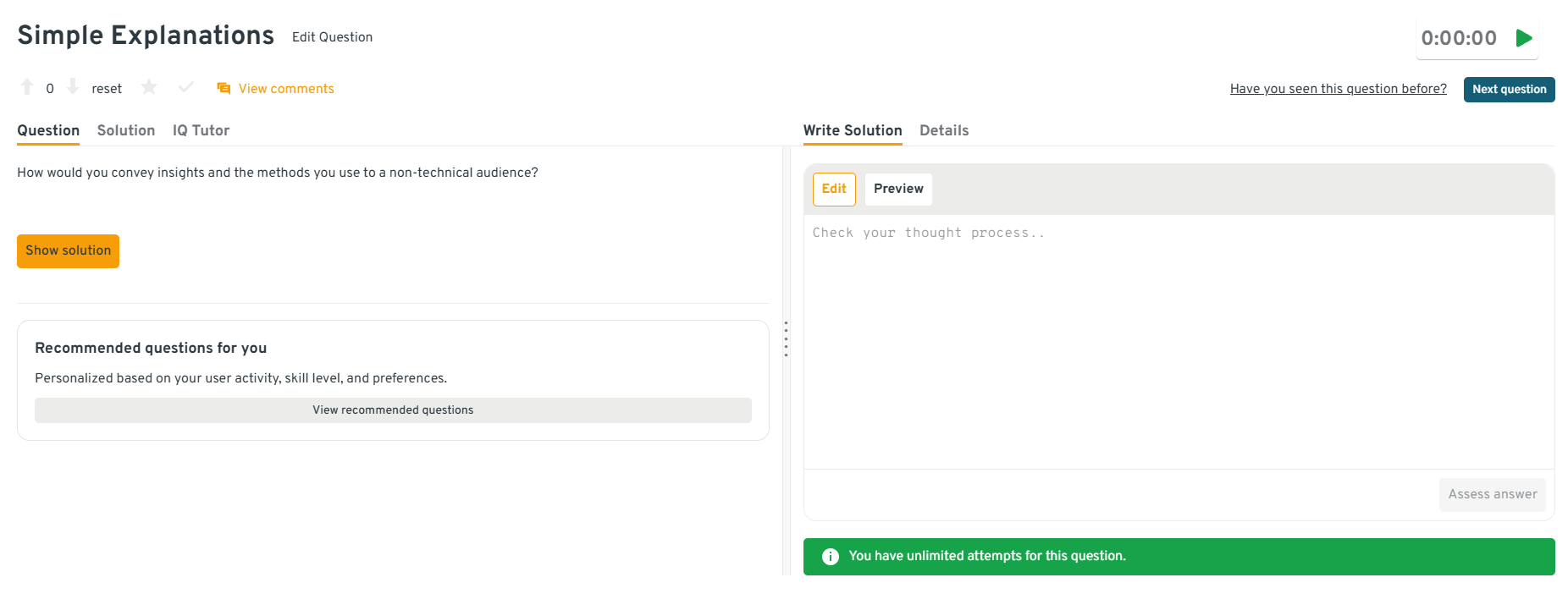
How do you explain complex analysis to non-technical stakeholders?
Business Intelligence at DoorDash exists to enable fast, confident decisions. This question evaluates whether you can translate complex analysis into clear recommendations that product, operations, and leadership teams can act on immediately.
Sample answer: When sharing a marketplace deep dive with operations leaders, I focused on what changed, why it mattered, and the decision it supported. I used one summary chart and clearly stated the recommended action and risks. That clarity helped leadership act the same day, reducing late deliveries by eight percent.
Tip: Lead with the decision and tradeoffs, then offer details if needed. This shows executive-ready communication and respect for partner time.
Head to the Interview Query dashboard to practice SQL, business analytics, experimentation, and stakeholder questions commonly tested in DoorDash Business Intelligence interviews. With built-in code execution and AI-guided feedback, you can sharpen your marketplace reasoning and clearly communicate tradeoffs at scale.
What would your current manager say about you? What constructive criticisms might he give?
DoorDash looks for BI professionals who are self-aware and continuously improving how they drive decisions. This question assesses whether you can reflect honestly on your impact and adapt your working style to better support the business.
Sample answer: My manager would say I take strong ownership of ambiguous problems and follow decisions through to impact. They’ve also noted that I sometimes go too deep before sharing early insights. I addressed this by sending directional reads sooner with clear caveats, which improved decision speed without reducing trust.
Tip: Frame growth areas around decision effectiveness, not technical gaps. This aligns with how DoorDash evaluates BI performance.
How do you handle competing priorities and tight deadlines?
BI work at DoorDash often happens during launches, incidents, or rapid experimentation cycles where everything feels urgent. This question evaluates how you prioritize based on impact, communicate tradeoffs, and maintain focus on decisions that most affect customers and marketplace health.
Sample answer: During a major product launch, I had requests from three teams. I aligned on impact and urgency, deprioritized lower-risk work, and focused on analyses tied directly to customer experience. I communicated tradeoffs upfront, which allowed the launch to proceed with fewer incidents and faster resolution.
Tip: Explain how you proactively reset scope and expectations. This demonstrates BI leadership, reliability, and execution under pressure.
Need personalized guidance on your DoorDash Business Intelligence interview strategy? Explore Interview Query’s Coaching Program, where experienced data and BI mentors help you sharpen SQL and metric judgment, practice DoorDash-style business cases, and refine how you communicate decisions under ambiguity so you can interview with confidence.
What Does a DoorDash Business Intelligence Professional Do?
A DoorDash business intelligence professional turns marketplace data into decisions that directly affect growth, efficiency, and customer experience across consumers, Dashers, and merchants. The role sits at the intersection of analytics, product strategy, and operations, supporting teams that manage pricing, incentives, logistics performance, merchant quality, and retention. Business intelligence analysts at DoorDash work with large, fast-moving datasets and partner closely with product managers and operators to define metrics, diagnose performance shifts, and recommend actions that improve marketplace health at scale.
| What They Work On | Core Skills Used | Tools And Methods | Why It Matters At DoorDash |
|---|---|---|---|
| Marketplace performance metrics | Metric definition, SQL analytics, trend analysis | SQL, Looker, internal metric layers | Ensures leaders have a single source of truth for order volume, supply, and fulfillment |
| Dasher supply and incentives | Cohort analysis, causal reasoning, experimentation | A/B testing, segmentation, statistical validation | Balances delivery speed, cost efficiency, and Dasher satisfaction |
| Merchant quality and retention | Funnel analysis, KPI design, anomaly detection | SQL pipelines, dashboards, alerting | Improves selection quality and reduces merchant churn |
| Product launches and experiments | Experiment design, metric evaluation, tradeoff analysis | Online experiments, guardrail metrics | Prevents local optimizations that harm long-term marketplace health |
| Operational diagnostics | Root cause analysis, prioritization | Deep dives, ad hoc analysis | Enables rapid response to regional or category-level issues |
Tip: DoorDash interviewers look for analysts who think in systems, not isolated metrics. When discussing past work, explain how your analysis considered downstream effects across consumers, Dashers, and merchants, which signals strong marketplace judgment and business intuition.
How to Prepare for a DoorDash Business Intelligence Interview
Preparing for a DoorDash business intelligence interview goes beyond practicing SQL or memorizing experiment definitions. You are preparing for a role that supports real-time decisions across a multi-sided marketplace where speed, cost, and quality constantly compete. Strong candidates demonstrate sound metric judgment, comfort with ambiguity, and the ability to translate analysis into clear recommendations that product and operations teams can act on immediately. Below is a focused guide to help you prepare in a way that reflects how business intelligence actually operates at DoorDash.
Build intuition for marketplace metrics and tradeoffs: DoorDash analytics rarely optimize a single metric in isolation. Strengthen your understanding of how changes to acceptance rate, delivery time, incentives, or fees affect consumers, Dashers, and merchants differently. Practice explaining which metrics matter most for a given decision and why others should be treated as guardrails rather than goals.
Tip: In interviews, explicitly state which side of the marketplace you are optimizing for and what you are willing to trade off. This shows marketplace judgment and decision clarity, two traits DoorDash values highly.
Practice structuring ambiguous business problems: Many DoorDash interview cases start vague on purpose. Train yourself to quickly define the objective, identify likely drivers, and outline a logical investigation path before touching data. Focus on sequencing analyses to narrow the problem efficiently rather than listing every possible metric.
Tip: Pause to summarize your approach before diving in. Interviewers read this as strong problem framing and confidence under ambiguity.
Refine how you communicate insights, not just results: DoorDash business intelligence exists to enable fast decisions. Practice turning analysis into a clear recommendation with context, risk, and next steps. Avoid over-explaining methodology unless it directly affects trust in the conclusion.
Tip: End explanations with a decision statement such as “Based on this, I would recommend…” This signals executive-ready communication and ownership.
Review past projects through a decision-making lens: Revisit your previous analytics work and be ready to explain what decision your analysis supported, what alternatives you considered, and what tradeoffs you accepted. DoorDash interviewers care less about perfect outcomes and more about how you reasoned through constraints.
Tip: Highlight one project where the data was messy or incomplete. This demonstrates resilience and realistic analytical judgment, which is critical in live marketplace environments.
Simulate full interview pacing with realistic practice: Practice with mock interview sessions that mirror the DoorDash loop by combining one SQL exercise, one business case, and one behavioral discussion back to back. This helps you manage context switching and maintain clarity under time pressure.
Tip: After each mock session, note where your explanations felt rushed or unfocused. Improving clarity under pressure is often the biggest differentiator between good and great candidates.
Want to level up your BI interview prep? Practice hands-on SQL problems and real take-home assignments on the Interview Query Dashboard.
Average DoorDash Business Intelligence Salary
DoorDash’s compensation framework is designed to reward analysts who drive measurable marketplace impact through strong metric judgment, experimentation insight, and cross-functional influence. Business intelligence professionals typically receive competitive base pay, annual performance bonuses, and meaningful equity grants. Total compensation varies based on level, scope of responsibility, location, and the business area you support, such as growth, logistics, merchant analytics, or people analytics. Most candidates interviewing for business intelligence roles fall into mid-level or senior bands, especially if they have experience supporting product launches or operational decision-making at scale.
Read more: Business Intelligence Salary
Tip: Confirm your target level with your recruiter early, since leveling at DoorDash directly determines compensation range and the expected scope of ownership.
| Level | Role Title | Total Compensation (USD) | Base Salary | Bonus | Equity (RSUs) | Signing / Relocation |
|---|---|---|---|---|---|---|
| BI1 | Business Intelligence Analyst I | $120K – $160K | $105K – $130K | Performance based | Standard RSUs | Limited, role dependent |
| BI2 | Business Intelligence Analyst II | $145K – $195K | $120K – $150K | Performance based | RSUs included | Offered case-by-case |
| Senior BI | Senior Business Intelligence Analyst | $175K – $240K | $135K – $170K | Above target possible | Larger RSU grants | More common at senior levels |
| Staff BI | Staff or Lead Business Intelligence Analyst | $215K – $300K+ | $150K – $200K | High performer bonuses | High RSUs + refreshers | Frequently offered |
Note: These estimates are aggregated from data on Levels.fyi, Glassdoor, TeamBlind, public job postings, and Interview Query’s internal salary database.
Tip: Focus on total compensation, not just base salary. At DoorDash, equity becomes a more meaningful portion of pay at senior and staff levels, especially after year one.
Average Base Salary
Negotiation Tips That Work for DoorDash
Negotiating compensation at DoorDash is most effective when you anchor discussions in data and clearly communicate your value. Recruiters expect candidates to understand market benchmarks and to articulate how their experience aligns with the scope of the role.
- Confirm your level early: DoorDash leveling, such as BI2 versus Senior BI, can shift compensation by tens of thousands of dollars. Always align on level before negotiating numbers.
- Use verified benchmarks and quantify impact: Anchor expectations using sources like Levels.fyi, Glassdoor, and Interview Query salaries. Frame your value around decisions you influenced, metrics you improved, or costs you helped control.
- Account for geographic differences: Compensation varies across San Francisco, New York, Seattle, and remote roles. Ask for location-specific bands so you evaluate offers accurately.
Tip: Request a full compensation breakdown including base salary, bonus target, equity vesting schedule, and any signing incentives. This signals professionalism and ensures you negotiate from a fully informed position.
FAQs
How long does the DoorDash business intelligence interview process take?
Most candidates complete the process within three to five weeks. Timelines depend on interviewer availability and whether you are being considered by more than one team. Recruiters typically share next steps within a few days after each round.
How technical is the DoorDash business intelligence interview?
The role is highly analytical but not software engineering focused. SQL depth, metric reasoning, and structured problem solving matter far more than coding in Python or building production systems. Interviewers care most about how you turn data into decisions.
Do DoorDash business intelligence roles differ by team?
Yes. Teams supporting growth, logistics, merchants, or people analytics emphasize different metrics and problem types. The interview structure is consistent, but case questions and examples often reflect the specific business area you are interviewing for.
What level of SQL proficiency is expected?
DoorDash expects strong working knowledge of joins, window functions, aggregations, and time-based analysis. Queries often resemble real marketplace problems rather than textbook exercises. Clear logic and edge case awareness matter as much as syntactic perfection.
Is experimentation experience required for this role?
Experimentation experience is important but not always required at a deep statistical level. You should be comfortable defining success metrics, interpreting results, and reasoning about tradeoffs. DoorDash values judgment around when experiments are appropriate and when they are not.
How are business intelligence roles different from data analyst roles at DoorDash?
Business intelligence roles are closer to decision making than reporting. You are expected to define metrics, guide product and operational strategy, and influence outcomes. The scope typically includes more ownership and stakeholder interaction than traditional analyst roles.
What backgrounds do successful DoorDash BI candidates come from?
Successful candidates come from analytics, consulting, operations, or product-focused data roles. Prior marketplace, logistics, or consumer product experience is helpful but not mandatory. Strong analytical judgment and communication skills matter most.
How important is stakeholder communication in the interview?
It is critical. DoorDash evaluates whether you can clearly explain insights, tradeoffs, and recommendations to non-technical partners. Many strong candidates are differentiated by how effectively they communicate decisions, not just analysis.
Become a DoorDash Business Intelligence Analyst with Interview Query
Preparing for the DoorDash business intelligence interview means building strong SQL fundamentals, sharp metric judgment, and the ability to reason through complex marketplace tradeoffs with confidence. By understanding DoorDash’s interview structure, practicing real-world SQL, refining your approach to experimentation and business cases, and strengthening how you communicate decisions, you can approach each stage with clarity and control. For targeted practice, explore the full Interview Query question bank, simulate realistic interviews with the AI Interviewer, or work one-on-one with an expert through Interview Query’s Coaching Program to refine your strategy and stand out in DoorDash’s highly competitive business intelligence hiring process.
Discussion & Interview Experiences