

Google Growth Marketing Analyst Interview: How to Stand Out Across SQL, Strategy, and Growth Rounds


Introduction
Every time Google launches a new product or enters a new market, growth marketing analysts figure out how to scale it. They drive acquisition, retention, and engagement for products like YouTube Premium, Google One, and Workspace by combining marketing intuition with analytical precision. With Google’s marketing spend exceeding $27 billion annually, analysts operate at a scale few companies can match.
They design experiments, uncover user insights, and use data to guide growth strategies. As Google expands AI-powered personalization and global reach, the role has become even more data-driven and high impact.
The Google growth marketing analyst interview tests your ability to think strategically, analyze data, and communicate insights. This guide walks you through everything you need to prepare, from the interview process and sample questions to preparation strategies and salary insights.
What does a Google marketing growth analyst do?
A growth marketing analyst at Google works at the intersection of marketing, product, and analytics. The role focuses on accelerating user and revenue growth by using data to inform strategy and improve decision-making. Every insight you generate directly impacts how Google’s products are positioned, optimized, and scaled across global markets.
In this role, you will:
- Analyze user behavior to identify patterns, opportunities, and bottlenecks in acquisition and retention.
- Design and evaluate experiments to test marketing initiatives and product features.
- Measure growth KPIs such as conversion rate, churn, lifetime value (LTV), and cost per acquisition (CPA).
- Translate findings into business recommendations that shape marketing and product strategies.
- Collaborate with cross-functional teams, including product managers, data scientists, and marketing strategists, to align goals and track performance.
The position demands both creativity and quantitative rigor. You will balance data-driven problem solving with business intuition while working on products that reach billions of users worldwide.
Why this role at Google
Becoming a growth analyst at Google means working in one of the few environments where analytical decisions directly shape how billions experience technology. You’ll work with massive datasets, design experiments that influence product growth across regions, and contribute to decisions that move key funnels and markets. The role also offers clear mobility into product management, data science, or strategy, supported by access to advanced tooling, mentorship, and cross-regional collaboration. Google’s culture rewards curiosity, experimentation, and measurable impact, so whether you’re optimizing onboarding, improving ad performance, or identifying new market opportunities, your work will directly influence how users engage with Google products.
Google Growth Marketing Analyst Interview Process
The Google marketing growth analyst interview tests more than just your technical ability. It’s designed to see how you think, communicate, and use data to drive meaningful business outcomes. Each stage challenges a different skill set, from problem-solving and statistical reasoning to storytelling and collaboration. Expect a process that feels structured, rigorous, and reflective of how Google approaches real-world decisions.
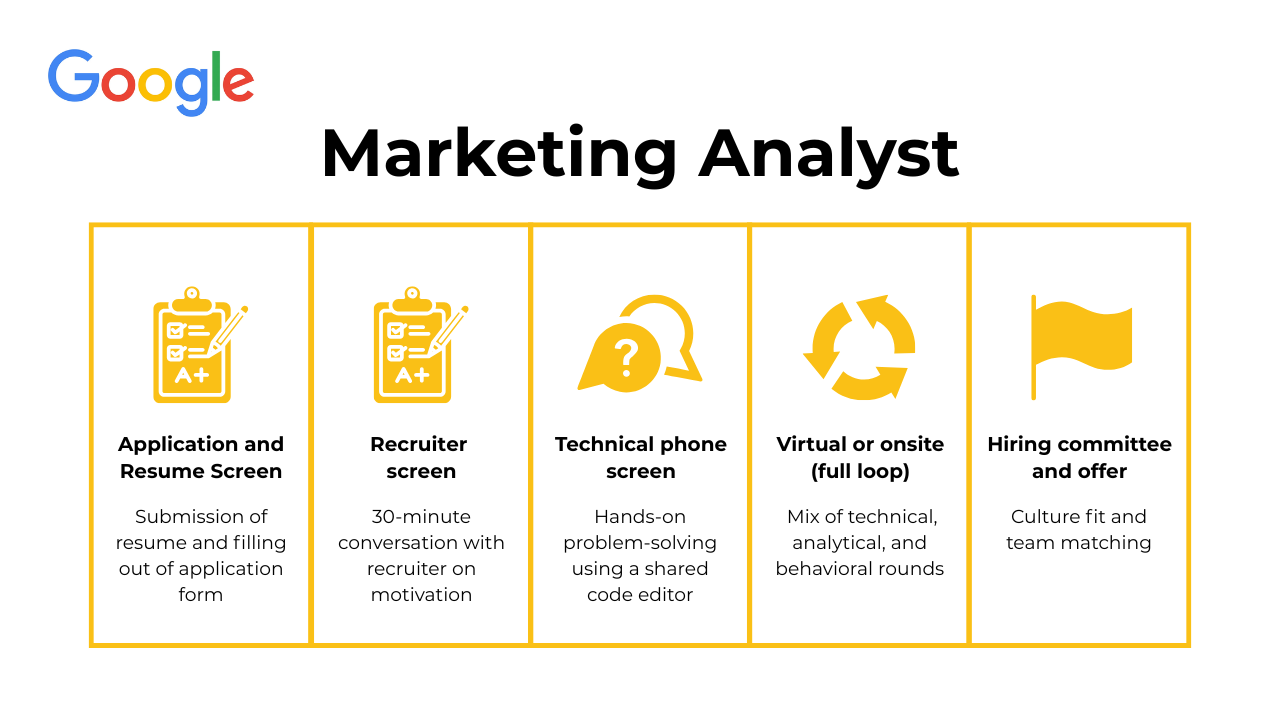
Application and resume screen
Your interview journey begins with the application and resume review. Recruiters look for evidence of analytical thinking, measurable results, and experience working with data. They pay close attention to how you describe your impact, especially in projects related to growth, marketing, or experimentation.
Instead of simply saying that you analyzed a campaign, specify what you achieved. For example, “optimized retention campaigns that improved trial-to-paid conversion by 15 percent.” Clarity and specificity matter because they show you understand not just what you did but why it mattered.
Tip: Tailor your resume to show end-to-end problem-solving. Demonstrate that you can identify a problem, analyze it using data, and deliver actionable solutions that lead to measurable improvements.
Recruiter screen
If your background looks promising, a recruiter will reach out for an initial 30-minute conversation. This round focuses on understanding your professional background, your motivation for joining Google, and how well your experience aligns with the role.
While it’s not a deeply technical interview, you may be asked about your familiarity with SQL, data visualization tools, or A/B testing. The recruiter will also describe the specific growth analyst team you’re being considered for, whether that’s YouTube, Ads, or Google Cloud.
Tip: Prepare a clear story about your background. Summarize your journey in a few sentences, highlighting how your experience with data and experimentation directly connects to Google’s growth challenges.
Technical phone screen
The technical phone interview is where your analytical ability takes center stage. Lasting around 45 to 60 minutes, this round typically includes SQL, statistics, and metrics interpretation. You’ll work through questions in a shared Google Doc while explaining your reasoning aloud.
Expect to be tested on how you design and analyze experiments, calculate metrics like churn or retention, and interpret ambiguous data. The interviewer is not just checking if you can get the answer right, but how you approach the problem, how clearly you explain your logic, and how you adapt when new information is added.
Tip: Practice thinking aloud. Walk the interviewer through each step of your logic, even if you’re unsure. Communicating your reasoning clearly is just as important as the final answer.
Virtual or onsite (full loop)
The virtual or onsite, often called the full loop, is the most in-depth stage of the interview. It usually consists of four rounds that assess your core analytical, strategic, and collaborative skills. Each session lasts about 45 minutes, with short breaks in between.
Round 1: SQL and analytics
This round dives deep into your technical foundation. You’ll be asked to write and explain SQL queries that analyze user data, calculate trends, or evaluate experiments. The problems can become progressively complex, requiring you to think about efficiency and scalability.
Tip: Focus on clarity and structure. Write queries that are easy to follow and explain what each part of your solution does. Interviewers appreciate well-organized logic over rushed perfection.
Round 2: Growth case study
The case study explores your product and marketing intuition. You may be asked to investigate a drop in user engagement, suggest how to increase adoption for a new feature, or design an experiment for a growth initiative.
Interviewers want to see how you use data to frame a problem and recommend a strategy. You’ll need to define success metrics, justify your assumptions, and discuss what you would test next.
Tip: Use a structured approach. Start with the goal, outline your hypotheses, define the key metrics, and end with how you would measure success.
Round 3: Funnel metrics and KPI design
This round evaluates your ability to design and optimize user journeys. You may be asked to build a funnel, such as signup to purchase, and identify where users drop off and why. The interviewer will look for how well you connect metrics to real product or marketing decisions.
Tip: Be precise when defining metrics. Show that you understand what each metric reveals about user behavior and how it can guide action.
Round 4: Behavioral and collaboration (Googlyness)
The final round focuses on teamwork, adaptability, and communication. You’ll discuss how you’ve handled challenges, collaborated with others, and navigated projects with competing priorities. Expect open-ended questions about how you respond to feedback or balance technical rigor with creativity.
Tip: Use the STAR method (Situation, Task, Action, Result) to keep your stories focused. Choose examples that highlight collaboration, initiative, and measurable results.
Each interviewer will focus on one area, but may ask follow-up questions that test your broader thinking. Be ready to connect your answers to real-world business impact. After completing these four sessions, your recruiter will brief you on the next steps and what to expect from the hiring committee review.
Hiring committee and offer
Once you’ve completed your interviews, all feedback is compiled and reviewed by Google’s hiring committee. This independent group ensures that every candidate is evaluated fairly and consistently across teams. The committee looks for patterns in performance—strong problem-solving skills, consistent collaboration, and technical depth that align with the expectations for the role.
If the committee approves your application, you’ll move into the team-matching stage. This part is more conversational and helps determine which specific product or business unit fits you best. You might speak with potential managers about current priorities, growth goals, and the team’s culture. These conversations are just as much about your preferences as theirs.
Once you’ve found a good fit, Google will extend an offer. Compensation typically includes a base salary, annual performance bonus, and stock grants that vest over several years. Offers can vary based on experience, level, and location, but every candidate receives a detailed breakdown of their package before acceptance.
Tip: Approach team matching with curiosity. Ask about what problems the team is trying to solve, what success looks like for them, and how your skills can contribute to their mission. This shows genuine engagement and helps you find a team where you’ll thrive.
Curious what it’s like to be a Google growth marketing analyst? Explore the role of a marketing analyst in this insightful video. You’ll get an inside look at the day-to-day responsibilities, core analytical skills, and cross-functional collaboration that define this role.
We’ll also break down the career growth opportunities, highlight what makes marketing analytics at Google unique, and share expert tips on navigating common interview questions for aspiring analysts. Whether you’re exploring marketing analytics for the first time or preparing for your next big interview, this video will help you understand exactly what it takes to succeed in one of tech’s most data-driven marketing roles.
Challenge
Check your skills...
How prepared are you for working as a Marketing Analyst at Google?
Google Growth Marketing Analyst Interview Questions
The Google growth analyst interview tests both your ability to think critically and your technical skill in analyzing large-scale data. Questions span SQL problem-solving, business strategy, and communication. You’ll be expected to connect the dots between user behavior, product performance, and measurable impact on growth.
Below are sample questions that reflect the kinds of challenges Google analysts solve every day.
SQL and analytics interview questions
SQL and analytics questions form the technical foundation of the Google growth analyst interview. These assess your ability to extract insights from raw data, identify trends, and build queries that connect directly to business outcomes. You’ll often be asked to write SQL code in a collaborative document without an IDE, explain your reasoning out loud, and interpret your results in plain language.
In this section, expect questions that test your fluency with joins, window functions, aggregations, and cohort analyses. Strong candidates not only write correct queries but also connect their findings to growth implications such as user retention, engagement, or monetization.
How would you find the top three highest salaries by department?
This question evaluates your understanding of SQL window functions, ranking, and partitioning. It mirrors the type of analysis you might perform to identify top-performing campaigns, high-value customers, or high-spending markets. The interviewer wants to see if you can use ranking logic efficiently and clearly.
Tip: Use
RANK()orDENSE_RANK()partitioned by department, ordered by salary in descending order, and filter for ranks less than or equal to three.How would you return all neighborhoods that have no users?
This question tests your ability to identify missing relationships or inactive entities using joins and filters. It’s a common scenario in growth analytics, especially when identifying untapped markets or inactive user segments. Interviewers are looking for clean, logical query structure.
Tip: Apply a
LEFT JOINbetween neighborhoods and users, then filter for records whereuser_id IS NULL.How would you get the last transaction of each day from a table of financial transactions?
This question assesses how you handle ordered datasets and extract time-based insights. It’s often used to evaluate your ability to summarize daily data or detect recurring events efficiently. Clear logic and performance-aware SQL structure are key.
Tip: Use
ROW_NUMBER()partitioned by transaction date, ordered bycreated_at DESC, and filter for rank equals one.How would you calculate the monthly retention rate for YouTube Premium users?
This question tests your understanding of cohort analysis and retention tracking. You’ll need to group users by signup month, then calculate how many remain active in subsequent months. It evaluates how well you interpret user lifecycle data and connect metrics to growth outcomes.
Tip: Build cohorts using signup month, count distinct users retained after 30 days, and divide by the total users in that cohort.
How would you identify users who are likely to churn based on their recent activity?
This question measures how effectively you can translate behavioral data into predictive insights. You’ll need to define signals such as session frequency, inactivity periods, or purchase decline. It tests both your business intuition and your analytical structure.
Tip: Define clear behavioral thresholds using recency, frequency, and engagement indicators to flag high-risk users.
-
This question checks your ability to visualize data meaningfully and highlight the right metrics for leadership teams. You’re expected to prioritize KPIs that align with product health and growth opportunities. The goal is to show that you understand how data informs strategy.
Tip: Include acquisition, retention, and conversion metrics segmented by region and product, supported by visual trends for key time frames.
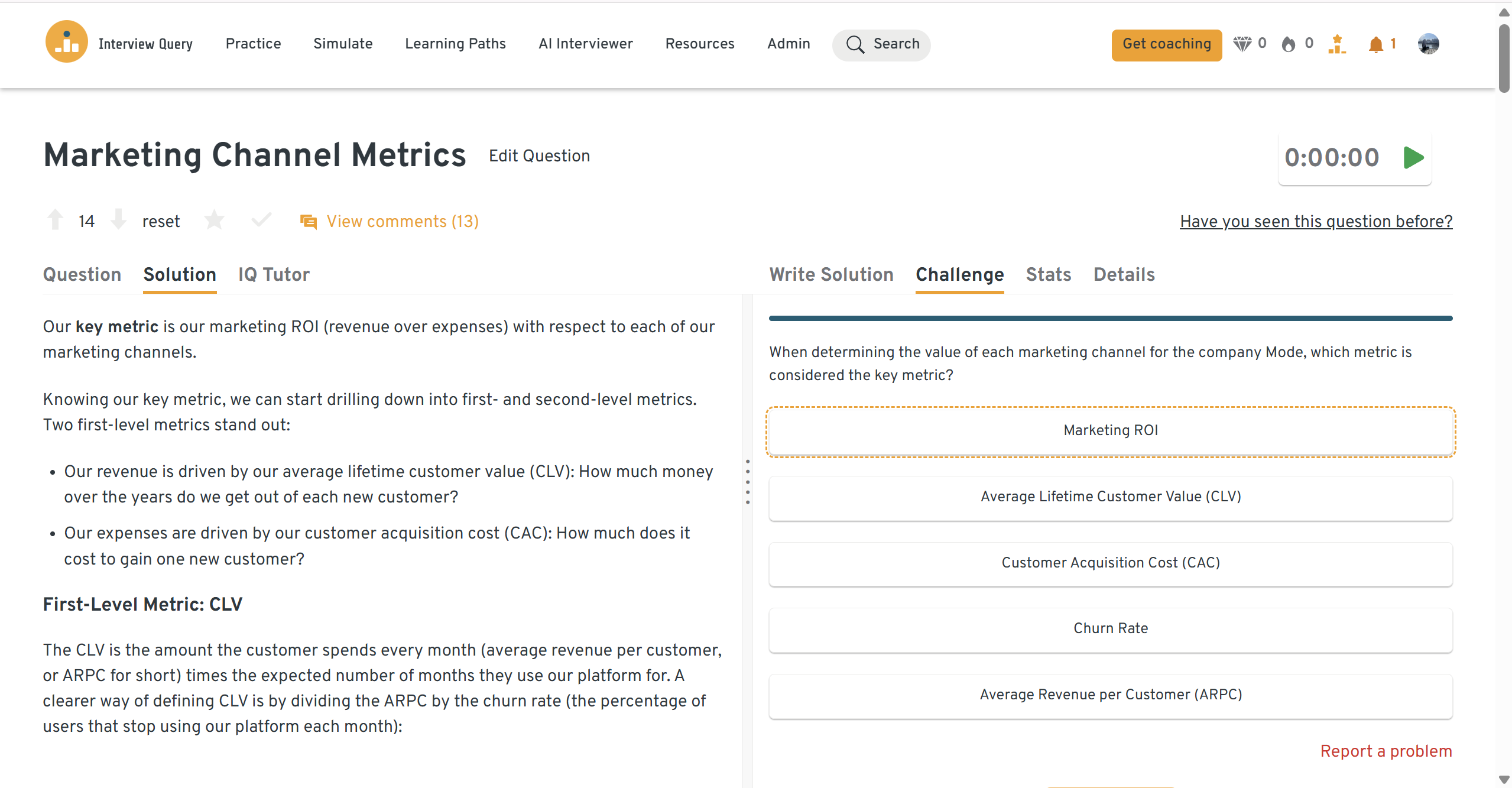
You can practice this exact problem on the Interview Query dashboard, shown below. The platform lets you write and test SQL queries, view accepted solutions, and compare your performance with thousands of other learners. Features like AI coaching, submission stats, and language breakdowns help you identify areas to improve and prepare more effectively for data interviews at scale.
Product and growth strategy interview questions
Product and growth strategy questions test how you think about scaling Google’s products, designing experiments, and measuring impact. You’ll be asked to diagnose product issues, evaluate business trade-offs, and propose metrics that align with user and company goals. These questions combine business reasoning with data literacy, requiring you to explain both what to measure and why it matters.
Strong answers connect insights to product outcomes, demonstrating your ability to prioritize experiments, interpret KPIs, and make data-driven recommendations that enhance growth.
How would you measure the success of Facebook Groups?
This question assesses your ability to identify success metrics for a community-driven product. Interviewers want to see if you can distinguish between engagement metrics and true value metrics that represent user satisfaction and retention. Think about both quantitative and qualitative indicators.
Tip: Focus on metrics like active members, posts per user, meaningful interactions, and long-term group retention to represent sustainable engagement.
-
This question tests how you handle conflicting product signals and identify underlying behavioral trends. You need to explain how different metrics interact and where potential trade-offs may exist. The best answers demonstrate curiosity and structured problem-solving.
Tip: Investigate segmentation differences, timing of notifications, and shifts in user engagement patterns to identify causal relationships between the two metrics.
-
This question evaluates your ability to balance user experience with operational efficiency. Interviewers look for a clear analytical approach that uses both data and user sentiment to guide decision-making.
Tip: Compare current user behavior (frequency of restore actions) with storage cost trends and user satisfaction metrics to assess potential impact before implementation.
How would you measure the success of the Instagram TV product?
This question focuses on defining and prioritizing product success metrics. You’re expected to demonstrate how to balance engagement metrics (like watch time) with retention and growth indicators.
Tip: Track metrics such as average view duration, session frequency, content creator retention, and viewer-to-creator conversion rates.
-
This question tests your understanding of ROI evaluation and marketing efficiency. You’ll need to think critically about attribution, conversion tracking, and long-term acquisition cost implications.
Tip: Compare ROI across platforms using consistent attribution windows, while accounting for acquisition cost, user retention, and lifetime value.
-
This question measures your ability to reason through short-term gains versus long-term health. It tests if you can evaluate trade-offs between monetization and user experience.
Tip: Discuss balancing user satisfaction and engagement retention against short-term revenue, emphasizing sustainable growth as the long-term goal.
-
This question evaluates your ability to segment users, identify behavioral trends, and propose retention strategies. Interviewers want to see structured reasoning from diagnosis to action.
Tip: Segment by region, plan type, or engagement history, identify churn triggers, and test targeted reactivation campaigns to recover high-value users.
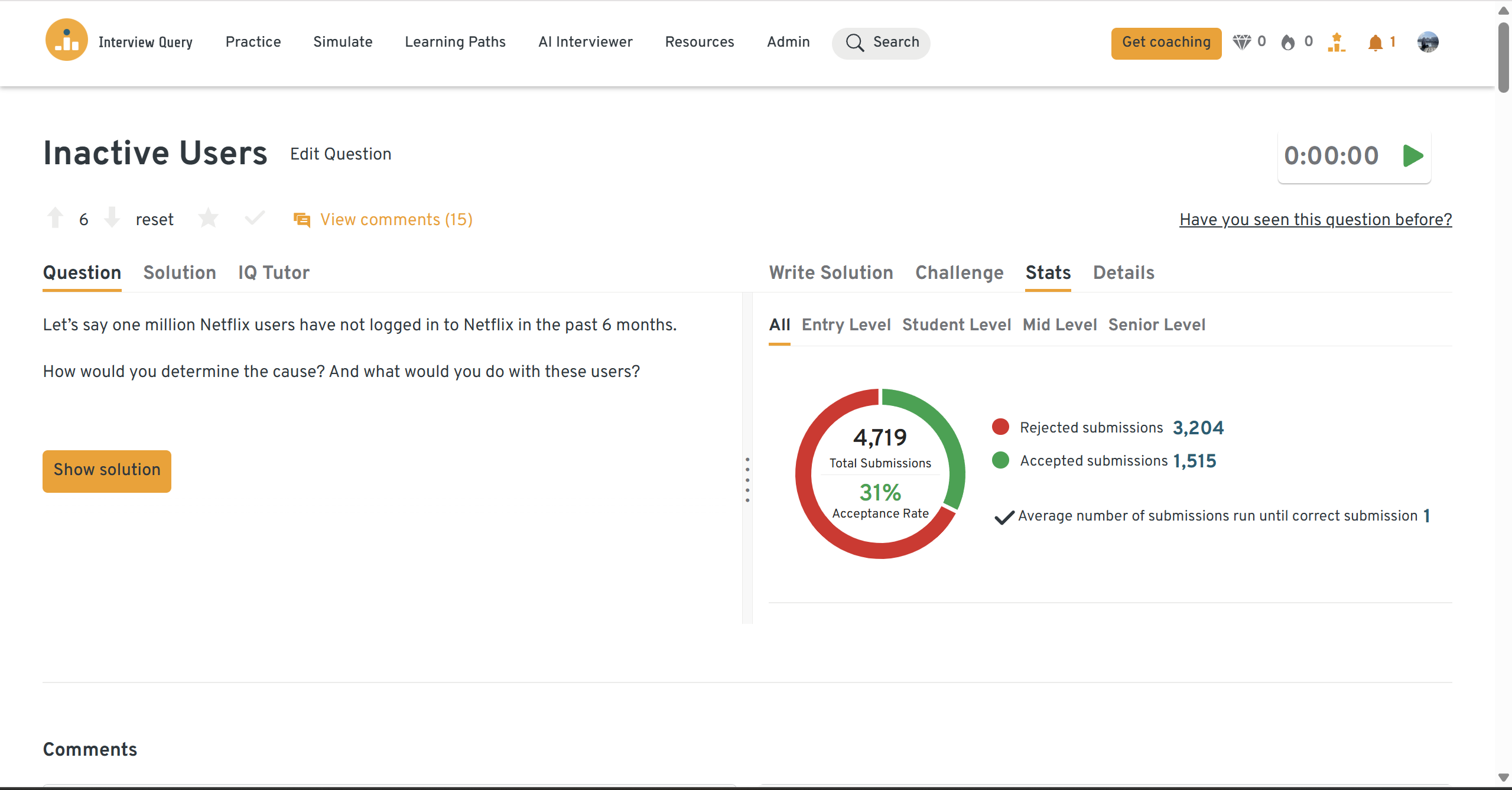
You can practice this question on Interview Query, where you can test SQL, see accepted answers, and get AI-powered feedback on your performance.
Behavioral and collaboration questions
Behavioral and collaboration questions evaluate how you think, communicate, and work with others in a fast-paced, data-driven environment. Google looks for candidates who balance analytical depth with empathy, adaptability, and a strong sense of ownership. You’re expected to share real stories that show how you’ve solved problems, navigated ambiguity, and contributed to team success.
Use the STAR method (Situation, Task, Action, Result) to structure your responses clearly. Be sure to highlight measurable outcomes whenever possible, since growth roles at Google emphasize both experimentation and impact.
Why do you want to work at Google?
This question helps the interviewer understand your motivation and how it aligns with Google’s culture. Avoid generic answers about prestige. Instead, show that you understand the scope of the role and how your analytical skills fit Google’s mission to make technology universally accessible.
Tip: Reference a specific Google initiative or product that resonates with you, and connect it to your professional goals.
Sample Answer: I’ve always admired how Google uses experimentation and data to improve global user experiences. My experience running data-driven growth tests aligns closely with this culture. I’m excited about the opportunity to apply my skills to a platform that reaches over a billion users, scaling insights at a global level.
How comfortable are you presenting your insights?
This question gauges your communication skills and ability to tailor insights to different audiences. As a growth analyst, you’ll present findings to product managers, marketers, and executives, so clarity and storytelling are key.
Tip: Describe how you adapt your communication style for technical versus business teams.
Sample Answer: I enjoy presenting insights because it’s where data becomes action. For a recent campaign, I used visuals to show how our retention rate lagged behind engagement, which helped leadership reallocate budget. The resulting adjustments improved user retention by 11 percent within two months.
Describe a data project you worked on. What challenges did you face, and how did you overcome them?
This question tests how you handle ambiguity and problem-solving under pressure. Interviewers look for both technical resilience and collaboration.
Tip: Emphasize how you used structure, communication, and iteration to move the project forward.
Sample Answer: In one project, I built a churn model that initially underperformed due to incomplete data. I collaborated with the engineering team to improve data quality and added behavioral features, boosting model accuracy by 17 percent. This helped the marketing team better target at-risk users.
Tell me about a time when a growth experiment didn’t go as planned. What did you learn?
Interviewers use this question to see how you learn from failure and iterate quickly. Show maturity by focusing on the insight, not the setback.
Tip: Frame the lesson as a turning point that improved your process or perspective.
Sample Answer: We launched an onboarding test that failed to increase activation. After reviewing session recordings, I realized the issue wasn’t copy length but clarity. We simplified the sign-up flow and reduced drop-off by 23 percent the following month.
Describe a time you had to persuade a stakeholder who disagreed with your analysis.
This question examines your communication and influence skills in cross-functional settings. The key is to demonstrate empathy while maintaining analytical integrity.
Tip: Focus on how you used evidence and collaboration to build trust, not just how you “won” the argument.
Sample Answer: A PM disagreed with my attribution model for ad spend. Instead of pushing back, I walked her through the dataset and alternative methods. After validating the results together, we adjusted campaign targets, improving ROI by 9 percent.
Tell me about a time you led an initiative that directly impacted growth.
This question helps interviewers see how you take ownership beyond your immediate responsibilities. Emphasize outcomes that reflect scale or measurable improvement.
Tip: Quantify the result clearly and highlight collaboration with other teams.
Sample Answer: I led a cross-functional project to redesign the referral funnel, which had a 5 percent conversion rate. By segmenting high-intent users and introducing incentive tiers, we increased conversions to 12 percent and lifted referral-driven revenue by $1.2M annually.
How do you handle competing priorities or multiple projects with tight deadlines?
This question assesses organization, focus, and your ability to balance analytical rigor with business urgency.
Tip: Show how you prioritize based on impact and communicate progress effectively to stakeholders.
Sample Answer: I use an impact-effort matrix to prioritize tasks. When managing two A/B tests and a growth forecast simultaneously, I focused on the experiment with the largest projected revenue impact and delegated monitoring tasks to teammates. This ensured delivery without compromising quality or timelines.
How to Prepare for a Growth Marketing Analyst Role at Google
Preparing for a growth marketing analyst interview at Google requires a mix of technical skill, product intuition, and strong communication. The role is highly cross-functional, meaning you’ll need to move easily between coding problems, data interpretation, and business discussions. The best candidates show both analytical depth and an understanding of how growth metrics connect to user impact.
Here’s how to prepare effectively for each stage of the process:
Master SQL and data analytics fundamentals
SQL is the foundation of nearly every technical interview at Google. Expect questions on joins, aggregations, window functions, and cohort analysis. Practice writing queries without an IDE and explaining your logic clearly as you go.
Tip: Solve SQL problems on Interview Query and rehearse explaining your reasoning aloud to simulate real interview conditions.
Develop a deep understanding of growth metrics
Growth analysts use frameworks like AARRR (Acquisition, Activation, Retention, Referral, Revenue) to measure performance across the funnel. You’ll be expected to link these metrics to user behavior and product goals.
Tip: Review metrics used in products like YouTube Premium or Google One and practice defining KPIs for each stage of the user journey.
Practice experiment design and A/B testing
Experimentation is core to Google’s decision-making. You should know how to set up a test, define primary and secondary metrics, and interpret results statistically.
Tip: Study A/B testing interview questions and prepare to explain what you’d do if a test’s results were inconclusive or counterintuitive.
Strengthen your product intuition
Google values analysts who can think like product managers. You’ll be asked to evaluate product ideas, identify success metrics, and make recommendations backed by data.
Tip: For practice, pick any Google product and answer: “How would I improve this, and how would I measure success?” Keep your response structured and user-focused.
Refine your data storytelling skills
Communicating insights clearly is just as important as the analysis itself. You’ll often need to present findings to non-technical teams or executives.
Tip: When explaining results, emphasize clarity over complexity. Focus on actionable insights, and use simple visual summaries or metric snapshots when possible.
Review your past projects in depth
You’ll likely be asked about previous work with growth metrics or experiments. Be ready to discuss both your technical approach and the impact of your findings.
Tip: Prepare short summaries for 2–3 key projects using the format: problem → approach → result → impact. Quantify the outcome whenever possible.
Simulate peer-style mock interviews
Google interviews are designed to feel like problem-solving sessions with peers. Mock interviews can help you practice your pacing, collaboration, and communication style.
Tip: Try mock interviews to test your readiness across different question types and receive feedback on your approach.
Stay updated on Google’s latest products and growth initiatives
Awareness of Google’s current projects shows curiosity and preparation. Interviewers often appreciate candidates who relate their answers to real company initiatives.
Tip: Read the Google Blog and identify one or two recent product launches or growth initiatives that genuinely interest you.
Build confidence through repetition and structure
Consistency and clarity matter more than memorization. Interviews reward structured thinking and calm delivery.
Tip: Practice verbalizing your reasoning step by step. Use structured frameworks like “problem → approach → insight → impact” to stay organized under time pressure.
FAQs
How long does the Google growth marketing analyst interview process take?
The process typically takes four to six weeks, depending on your availability and the number of interview rounds. You’ll move through the recruiter screen, technical interviews, and virtual onsite loop before reaching the hiring committee stage. Team matching can sometimes extend the timeline by one or two additional weeks.
How many interview rounds should I expect?
Most candidates go through four to five rounds, including a recruiter screen, one technical phone interview, and three to four virtual onsite interviews. Each onsite round tests a different competency, such as SQL, experimentation, product thinking, and behavioral collaboration.
What growth marketing skills are most important for success at Google?
Google looks for analysts who can combine technical depth with product and business understanding. Strong SQL skills, knowledge of A/B testing, and comfort interpreting growth metrics are essential. Communication, curiosity, and structured thinking are equally important because you’ll often present data to cross-functional teams.
Do I need a data science or computer science degree to become a growth analyst?
No. While many growth marketing analysts have quantitative backgrounds, Google focuses on skill demonstration over formal credentials. Experience with data analytics, product metrics, or digital marketing is often enough if you can show strong analytical reasoning and real-world impact.
What marketing tools should I know while interviewing?
You should be comfortable using SQL for querying, Excel or Google Sheets for quick analyses, and data visualization tools like Tableau or Looker. Familiarity with Python or R can help, but it’s not required. Focus on clear reasoning and business context rather than advanced coding.
What is the average compensation for a growth marketing analyst at Google?
According to Levels.fyi, the estimated total annual compensation for a growth marketing analyst in the United States is around $160K, including base salary, stock, and bonuses. Compensation can vary by location, seniority, and specific team assignment.
Where can I find growth marketing analyst job openings at Google?
You can explore current listings directly on Interview Query’s job board or on the Google Careers site. Both let you filter roles by location, skill focus, and experience level.
Take Your First Step Toward Becoming A Google Growth Marketing Analyst
Breaking into a growth marketing analyst role at Google takes more than analytics knowledge. It requires structured thinking, creativity, and the ability to turn insights into measurable growth. The interview process is designed to find candidates who can bridge data with product strategy and influence decisions through clear communication.
To stand out, focus on mastering the fundamentals. Practice SQL, experiment design, and growth-focused case questions until you can explain your reasoning clearly and confidently. Review past projects, quantify your impact, and be ready to turn your experience into measurable results. When you’re ready to level up, explore our data analytics learning path, browse more Google growth marketing interview questions, and read candidate success stories to learn how others succeeded.
Start preparing today, stay consistent, and take your first step toward becoming a growth marketing analyst at Google.
Google Interview Questions
| Question | Topic | Difficulty | ||||||||||||||||||||||
|---|---|---|---|---|---|---|---|---|---|---|---|---|---|---|---|---|---|---|---|---|---|---|---|---|
SQL | Easy | |||||||||||||||||||||||
We’re given two tables, a Write a query that returns all neighborhoods that have 0 users. Example: Input:
Output:
| ||||||||||||||||||||||||
SQL | Easy | |||||||||||||||||||||||
SQL | Medium | |||||||||||||||||||||||
SQL | Easy | |
Machine Learning | Medium | |
Statistics | Medium | |
SQL | Hard | |
Machine Learning | Medium | |
Python | Easy | |
Deep Learning | Hard | |
SQL | Medium | |
Statistics | Easy | |
Machine Learning | Hard |
Discussion & Interview Experiences