

Google Research Scientist Interview Guide (2025–2026): Process, Questions & Salary


Introduction
Every major innovation at Google, from Gemini’s reasoning breakthroughs to DeepMind’s protein predictions, starts with a research scientist. They’re the thinkers and builders who turn bold ideas into technology that changes how billions use information. This year, Google is doubling down on generative AI, multimodal systems, and responsible AI, and its research scientists are leading the charge.
The Google Research Scientist interview is one of the toughest in tech. It tests how you think, reason, and communicate under ambiguity, not just what you know.
This guide covers everything you need: what to expect, how to prepare, and the kinds of questions you’ll face. If you’re ready to take on one of the hardest interviews in tech, this is where you start.
What does a Google research scientist do?
As a research scientist at Google, you work on problems the world hasn’t solved yet and build solutions that scale to billions. Your role blends deep research with real-world impact.
You’ll design new algorithms, run large-scale experiments, publish findings, and collaborate with engineers to turn ideas into products. That could mean advancing Gemini’s reasoning, improving model efficiency, or developing fair and responsible AI systems.
Day to day, you’ll:
- Develop new models: Push progress in ML, NLP, vision, quantum computing, and AI ethics.
- Do original research: Publish papers, prototype systems, and drive applied innovation at scale.
- Collaborate with product teams: Translate theory into production features across Google’s ecosystem.
- Ensure responsible AI: Embed fairness, interpretability, and sustainability into every project.
- Communicate clearly: Share results internally, publish externally, and guide interdisciplinary teams.
The culture is open, collaborative, and research-driven, where curiosity meets impact, and bold ideas turn into breakthroughs.
Why this role at Google
Joining Google as a research scientist means stepping into one of the few places where ideas can directly influence the future of global technology. You won’t just be testing theories. You’ll be applying them at scale. The role gives you access to massive datasets, advanced hardware like TPUs, and specialized platforms designed for rapid experimentation. This lets you move from concept to measurable impact faster than in most academic or corporate labs.
Beyond the technical resources, what makes this role special is the freedom to explore. Google encourages its scientists to pursue independent research while staying connected to product teams. You’ll have the flexibility to publish in top conferences, contribute to cross-team initiatives, and push boundaries in areas like AI ethics, quantum computing, or multimodal modeling. If you’re looking for a place that combines deep research with tangible outcomes, this is one of the most exciting positions in the world.
Google Research Scientist Interview Process
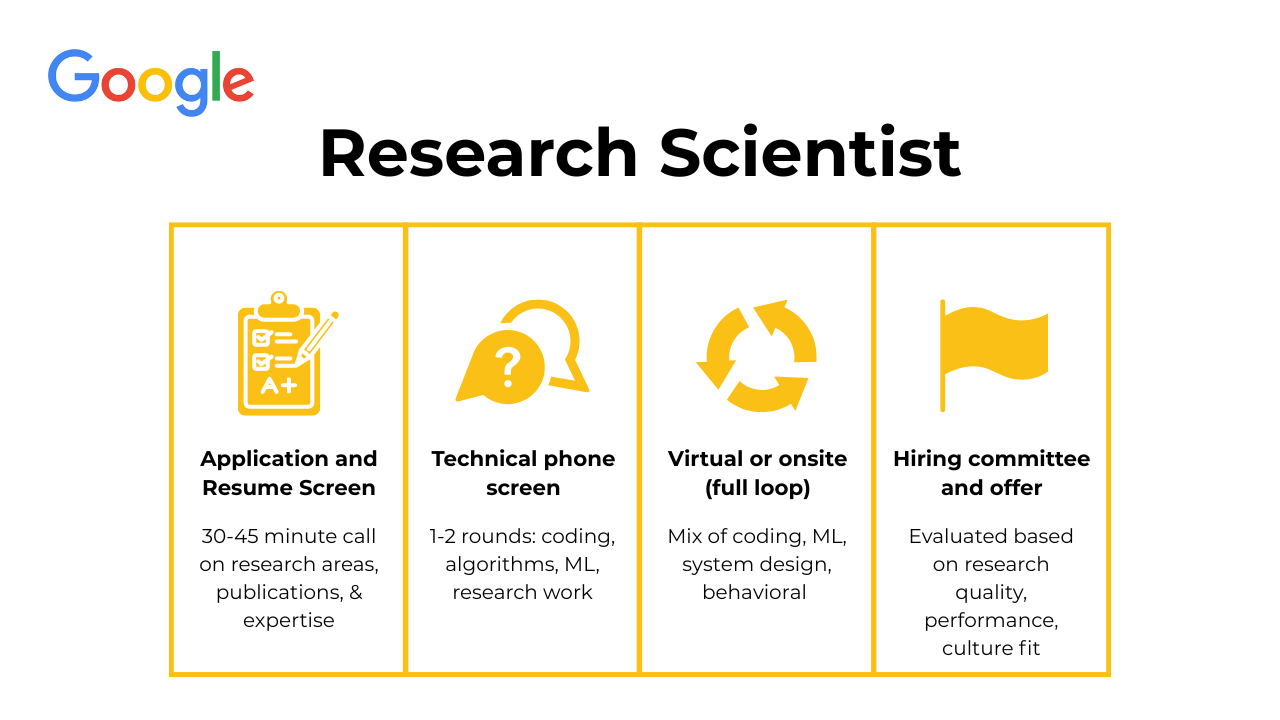
The interview is designed to test not just your technical depth, but also your ability to think like a scientist. Expect questions that go beyond coding. You’ll discuss your past research, defend your experiments, and demonstrate how you can apply theory to solve complex real-world problems.
The entire process can take anywhere from four to six weeks, depending on your availability, team matching, and whether your role leans toward applied or theoretical research. Here’s what each stage typically looks like:
Application and recruiter screen
Your journey starts with the online application or a referral. If shortlisted, you’ll have a 30 to 45-minute recruiter call. The recruiter will ask about your research area, publications, and how your expertise aligns with Google’s ongoing projects. They’ll also clarify logistics, timeline, and compensation expectations.
This is your chance to show that your academic background translates to practical impact. Mention how your work connects with real-world problems that Google is tackling, such as scaling foundation models or improving fairness in AI systems.
Tip: Be concise and specific when describing your research. Highlight outcomes, metrics, or collaborations that demonstrate both depth and applied relevance.
Technical and research phone screen
This stage usually includes one or two rounds lasting 45 to 60 minutes each. Expect a mix of coding, algorithmic, and theoretical ML questions. For research-focused roles, you’ll also be asked to explain the motivation, methods, and results of your recent work.
You might code in a shared Google Doc or in an online IDE without autocomplete, so clarity and structure matter more than syntax perfection. Some candidates are also asked to walk through how they would improve or replicate one of their published papers under new constraints.
Tip: Treat this like a research defense. Speak aloud as you reason, walk through trade-offs, and show awareness of alternative methods. Interviewers value clear, research-backed logic over brute-force coding.
Virtual onsite or full loop
The virtual onsite typically consists of five to six interviews, each targeting a different aspect of your expertise. The focus is to evaluate how well you connect scientific rigor with engineering practicality. Here’s what to expect:
Coding and algorithms: You’ll solve data structure or ML-related coding problems. Think of questions involving optimization, matrix operations, or probabilistic reasoning.
Tip: Keep your code modular and narrate your thought process. Google values clarity and collaboration even under pressure.
Machine learning and research theory: Expect deep dives into core ML concepts, including generalization, overfitting, and optimization. You may also be asked to critique a paper or design an experiment to test a hypothesis.
Tip: Reference known research frameworks or methods. Citing relevant papers or techniques shows awareness of the broader academic landscape.
Applied ML system design: For applied research roles, you’ll design large-scale systems like distributed training pipelines or model serving architectures.
Tip: Focus on scalability and experiment reproducibility. Google looks for scientists who understand both theory and production constraints.
Research deep dive: You’ll present and defend one of your past projects. Expect follow-up questions that test the originality, impact, and rigor of your methodology.
Tip: Quantify impact wherever possible. Highlight improvements in performance metrics, user outcomes, or computational efficiency.
Behavioral and collaboration: The “Googleyness” round explores teamwork, curiosity, and ethical decision-making. Expect questions about how you handle feedback, mentorship, or research disagreements.
Tip: Use specific examples to show humility, openness, and integrity. Google values scientists who elevate the team, not just their own work.
Hiring committee and team matching
Once you complete the interviews, your results are consolidated and reviewed by a hiring committee. They evaluate your overall research quality, technical performance, and alignment with Google’s mission. Successful candidates then move into team matching, where you meet with potential managers to find the best fit based on your interests and skills.
Compensation, level (typically L4 to L7), and project focus are finalized during this phase. For example, an L4 research scientist might focus on algorithmic innovation, while an L6 may lead cross-functional research efforts or publish under Google Research.
Tip: During team matching, treat discussions like mutual evaluations. Ask about the team’s current research goals, publication track record, and how they measure success. If you reach the offer stage, prepare to negotiate stock options or research resources confidently and respectfully.
Need 1:1 guidance on your interview strategy? Interview Query’s Coaching Program pairs you with mentors to refine your prep and build confidence. Explore coaching options.
Challenge
Check your skills...
How prepared are you for working as a AI Research Scientist at Google?
Google Research Scientist Interview Questions
Google tests not only what you know but how you think. You’ll be evaluated on your ability to move fluidly between theory, coding, and experimentation. Each question type reveals a different side of your skill set: how you reason through uncertainty, how you express ideas in code, and how you connect evidence to conclusions.
Typically, interviews cover four major areas: coding and algorithms, machine learning fundamentals, experimentation and statistical reasoning, and behavioral collaboration. The mix may vary depending on whether your focus is applied or theoretical, but every round is designed to uncover the same thing: how you reason like a scientist while building like an engineer.
Coding and algorithms interview questions
Even though research scientists at Google spend most of their time experimenting, coding is still a critical part of the interview. You’re expected to show that you can translate theoretical reasoning into clean, efficient code. This section tests how you think through algorithms, structure logic, and handle scale, not just whether your syntax is perfect.
Here are examples of coding questions you might encounter in a Google research scientist interview, along with what each one reveals about your problem-solving approach:
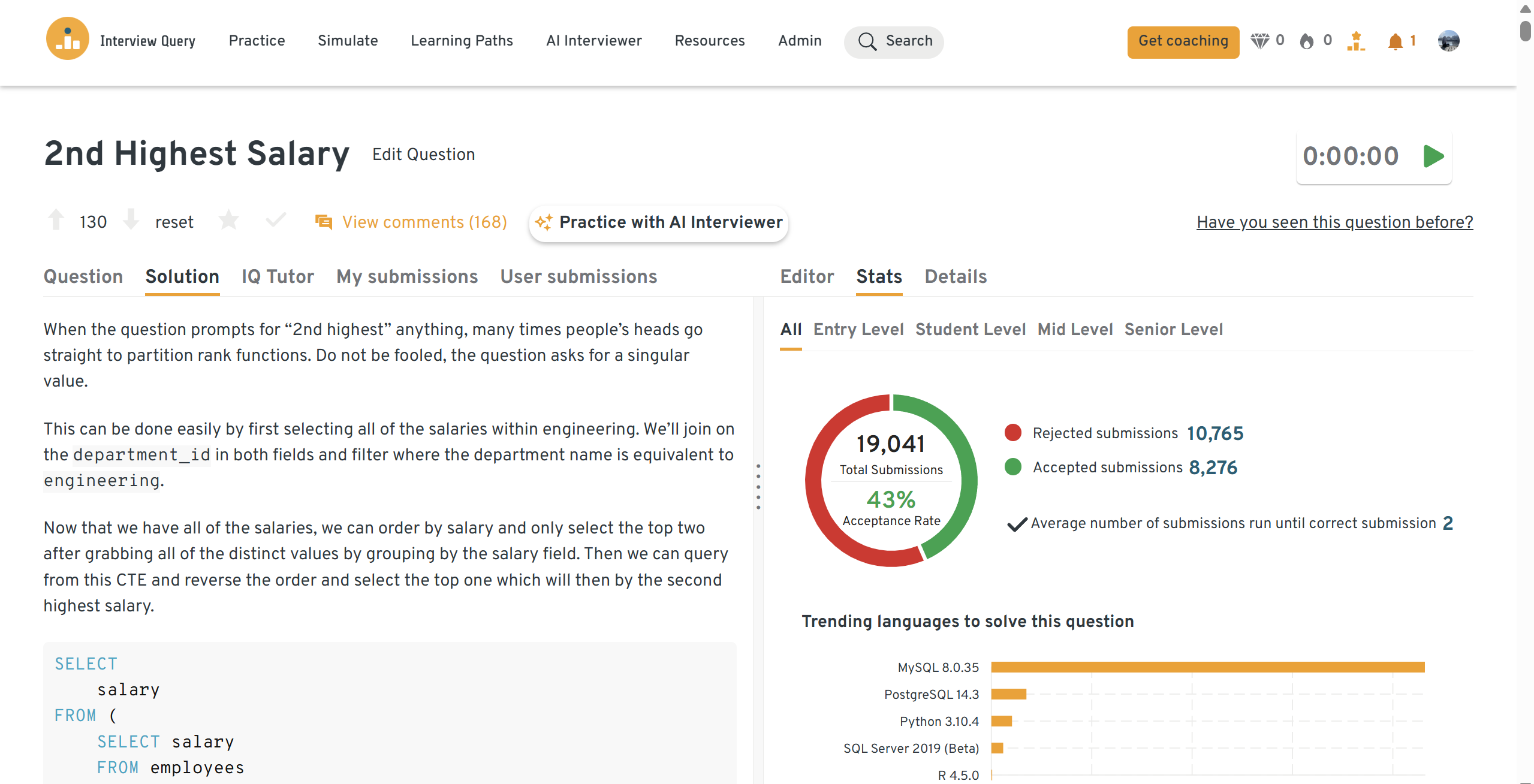
How would you write a SQL query to select the second highest salary in the engineering department?
This question checks your understanding of SQL queries and ranking logic. You’ll need to identify and return the second highest salary while handling duplicate maximum values. The challenge is to ensure the query performs efficiently on large datasets and reflects careful use of window functions or subqueries.
Tip: Go beyond writing the SQL. Explain how your query avoids redundant scans, and describe how you’d optimize it if this were part of a real analytics pipeline analyzing millions of rows of employee data.
You can practice this question on Interview Query, where you can test SQL, see accepted answers, and get AI-powered feedback on your performance.
How would you rank the top three users by daily downloads using SQL?
You’ll be asked to use the
RANK()orDENSE_RANK()window function to display the top three users by downloads for each day. The goal is to correctly group and order results by date and user activity, ensuring your query handles ties consistently. This problem tests your grasp of analytical SQL and your ability to extract meaningful insights from structured data.Tip: Clarify why you chose
RANK()overDENSE_RANK()or vice versa. At Google, you’ll often work with datasets where ranking precision impacts downstream metrics, so being able to justify your design choices shows maturity in your data reasoning.How would you write a function to generate a sample from a Bernoulli trial?
This problem tests your grasp of probability and random sampling. You’ll build a simple function that takes a probability
pand returns 1 or 0 accordingly. What interviewers care about most is your understanding of randomness, bias, and reproducibility — key concepts in both machine learning and experimental design.Tip: Use this question to talk about reproducibility in research. Mention why setting random seeds matters and how you’d validate results from stochastic processes to ensure experimental consistency.
How would you build a function to automatically generate a histogram from a list of integers?
You’ll create a function that groups integer values into evenly distributed bins and outputs a dictionary showing the frequency of each range. Bins with zero counts should be excluded. This question tests your ability to handle data transformations cleanly without relying on high-level libraries.
Tip: Explain how you’d apply this function to real ML workflows. For example, you could use it to visualize feature distributions or detect skew in input data before training a model. Showing this awareness connects your code to real research contexts.
-
This question involves grid traversal and pathfinding. You’ll need to design an algorithm that identifies the shortest path through the building layout, given directional constraints. It tests your ability to reason systematically under limitations and structure a search algorithm that can fail gracefully when no valid path exists.
Tip: Talk through your reasoning aloud. Mention how you’d represent states, track visited nodes, and evaluate time complexity. At Google, interviewers look for candidates who reason out loud and think collaboratively when solving complex algorithmic problems.
Machine learning fundamentals interview questions
This section of the interview digs into how well you understand the theory behind machine learning algorithms and your ability to reason about them rigorously. Google isn’t just looking for someone who can apply models; they want scientists who can explain why those models work, how they can break, and what assumptions they rely on. The questions can range from high-level conceptual discussions to mathematical reasoning and model trade-offs.
Here are a few examples that mirror the kind of machine learning interview questions asked in the Google research scientist interview:
-
This question tests your ability to explain both the intuition and mathematics behind classical ML algorithms. You’ll need to describe how LDA works by projecting data onto a lower-dimensional space that maximizes class separability. Discuss how it differs from PCA and when you’d use it for dimensionality reduction or classification.
Tip: Google values depth of reasoning. Go beyond the textbook definition and discuss where LDA might fail, such as when class distributions are non-Gaussian or when within-class covariance is not consistent across groups.
How can you prove that the k-Means clustering algorithm converges in a finite number of steps?
This is a conceptual and mathematical reasoning problem. You’ll need to show that, since there are a finite number of possible cluster assignments and each iteration of k-Means decreases the total within-cluster variance, the algorithm must eventually converge. The proof is not about efficiency but about logical completeness.
Tip: Walk the interviewer through your reasoning step by step. Even if you don’t recall the full proof, explaining the structure of the convergence argument demonstrates research-level thinking and comfort with formal reasoning.
How would you compare logistic regression and neural networks when applied to a small, noisy dataset?
This question assesses your ability to choose the right model for the right context. You’ll need to explain that logistic regression works better when data is limited and interpretable, while neural networks can overfit in small-data regimes unless properly regularized. Discuss trade-offs in explainability, performance, and robustness.
Tip: Connect your answer to real-world decision-making. Mention how you’d validate both models experimentally and use cross-validation or Bayesian approaches to estimate uncertainty in small-sample scenarios.
How would you explain overfitting and underfitting to a non-technical collaborator, and how would you detect and fix them in a research setting?
This question measures your ability to balance technical precision with clarity. Define overfitting as a model learning noise instead of signal and underfitting as a model being too simple to capture the data pattern. Then, describe diagnostic tools like learning curves, cross-validation, and regularization techniques.
Tip: Use this to show that you can communicate research clearly. Relating the concept to your own published work or past projects helps you stand out as both an educator and a collaborator.
How would you evaluate the fairness and bias of a machine learning model trained on global datasets?
Since Google’s research is highly focused on responsible AI, you might be asked about fairness, transparency, and social implications. Discuss how you’d measure bias, such as using demographic parity or equalized odds, and how you’d mitigate it through reweighting or data balancing.
Tip: Frame your answer within Google’s ethical AI mission. Explain how you would design experiments to quantify harm or bias, and show awareness of how fairness intersects with scalability and product deployment.
Experimentation and statistical reasoning interview questions
For a research scientist at Google, knowing how to design and interpret experiments is just as important as building models. This part of the interview focuses on your ability to reason about data quality, statistical significance, and causal inference. You’ll often be given a real-world scenario and asked to describe how you would test hypotheses, collect data, and measure results accurately.
Here are examples of experimentation and analysis questions that reflect what to expect in the Google research scientist interview:
-
This question tests your understanding of sample size imbalance and how it affects inference. The correct answer involves explaining that unequal group sizes don’t inherently create bias as long as sampling is random, but they can increase variance and reduce statistical power. You’ll also be expected to discuss how to adjust analysis methods to account for unequal variances.
Tip: In your response, emphasize experimental validity. Mention techniques like weighted analysis or stratified sampling to handle imbalance, and explain how you’d communicate uncertainty in real-world A/B test reports.
How would you design an A/B test to evaluate the impact of a price increase on subscriptions?
You’ll be asked to design a controlled experiment to measure how a price increase affects conversion rates, retention, or overall revenue. Your answer should include how you’d randomize user assignment, define key metrics, set the test duration, and interpret trade-offs between short-term and long-term effects.
Tip: Highlight your business reasoning as much as your statistical one. At Google, research scientists are expected to translate experimental results into product and revenue implications, not just p-values.
If your A/B test results are not normally distributed, how would you determine which variant won?
This problem assesses your grasp of non-parametric methods and robustness testing. You’ll need to explain how traditional t-tests may not apply and suggest alternatives like bootstrapping or the Mann–Whitney U test. The interviewer wants to see that you can still produce reliable conclusions even when assumptions break down.
Tip: Show awareness of real-world data imperfections. Mention that at Google scale, heavy tails, zero inflation, and skew are common. Explaining how you’d visualize and diagnose data distributions adds credibility.
-
This question measures your understanding of hypothesis testing. You’ll need to describe how to set up null and alternative hypotheses, calculate p-values or confidence intervals, and interpret whether observed differences are significant. You might also be asked to discuss error rates and the risk of false positives.
Tip: Don’t stop at the math. Talk about practical decision-making. For example, mention how you’d pair statistical significance with business significance to justify rolling out a product change.
How would you determine the right sample size and power for an A/B test?
This question evaluates your understanding of statistical power and experiment design sensitivity. You’ll need to explain how sample size, effect size, and variance interact, and how increasing power allows detection of smaller differences between variants.
Tip: Use this question to demonstrate your experimental intuition. Discuss how you’d balance test length with available traffic, and mention tools or formulas (like power analysis) that you use to plan data collection responsibly.
Behavioral and collaboration
The behavioral round of the Google research scientist interview explores how you collaborate, communicate, and approach research within a team setting. Google isn’t only looking for intellectual brilliance, they want scientists who can work well with others, explain complex ideas clearly, and handle feedback with maturity.
Expect questions that test your ability to resolve conflicts, mentor others, and uphold Google’s culture of open, responsible research. As with any behavioral round, structure your answers using the STAR method (Situation, Task, Action, Result) and quantify your impact whenever possible.
Why do you want to work at Google as a research scientist?
This question helps the interviewer understand your motivation and whether it aligns with Google’s mission to make AI useful for everyone. Avoid generic statements about prestige. Instead, connect your research interests with specific Google projects like Gemini, DeepMind, or Google Research. Show that you’re motivated by innovation and global impact.
Sample Answer: I’ve always admired Google’s commitment to advancing AI responsibly. In my previous role, I led a project on reinforcement learning for adaptive healthcare, which reduced diagnostic latency by 12 percent. Joining Google would let me scale that kind of work using cutting-edge infrastructure while collaborating with experts in deep learning and fairness.
Tip: Reference a team or project you’re genuinely excited about. Showing awareness of Google’s ongoing research signals that you’re prepared to contribute meaningfully from day one.
Describe a data project you worked on. What were some of the challenges you faced?
Google wants to see how you handle complexity, resource constraints, and ambiguous results. Talk about a research project that tested your creativity and problem-solving. Highlight how you identified the problem, overcame data limitations, and measured impact.
Sample Answer: I led a multimodal project combining text and image embeddings for document classification. Our main challenge was dataset imbalance, which caused the model to overfit to text-heavy samples. I addressed this by augmenting low-frequency image data and applying transfer learning. The final model improved F1 score by 19 percent and was published at ACL.
Tip: Focus on what you did. Google interviewers listen for initiative, technical rigor, and collaboration rather than just end results.
How would you convey insights and the methods you use to a non-technical audience?
As a research scientist, you’ll need to present findings to product teams, executives, and sometimes the public. The goal is to show you can simplify without oversimplifying.
Sample Answer: When presenting interpretability results for a medical AI project, I avoided jargon and used visuals comparing model confidence to doctor accuracy. I framed it like improving the “second opinion” rate in healthcare rather than explaining cross-entropy loss. This helped stakeholders understand reliability without diving into equations.
Tip: Tie your communication style to measurable outcomes, such as faster project approvals or improved team alignment. Google values researchers who can make their science actionable.
Tell me about a time you disagreed with a teammate on a technical decision. How did you resolve it?
This question evaluates collaboration and your ability to handle intellectual disagreements.
Sample Answer: During a project on graph neural networks, my teammate wanted to use a larger model that exceeded compute limits. I proposed running smaller ablations first to test scalability. After comparing performance, my approach cut training time by 40 percent with negligible accuracy loss. We merged our insights into a hybrid model for the final paper.
Tip: Show that you prioritize collaboration over ego. Google appreciates candidates who can defend their views logically while staying flexible and data-driven.
Tell me about a time you had to make a decision with incomplete information.
Research often involves uncertainty. This question tests your ability to make rational, evidence-based choices even when data is limited.
Sample Answer: While studying fairness in recommendation systems, I noticed bias signals but didn’t have demographic labels. Instead of waiting for new data, I used proxy features to approximate diversity and validated the results through sensitivity analysis. The paper was later cited for its robust design approach.
Tip: Emphasize transparency. Explain how you communicated limitations to your collaborators and how you balanced progress with ethical responsibility.
Want more challenges? Test your skills with real-world analytics challenges from top companies on Interview Query. Great for sharpening your problem-solving before interviews. Start solving challenges.
How to Prepare for a Google Research Scientist Interview
Preparing for the interview means going beyond technical skills. You’ll need to combine research depth, coding fluency, and strong experimental design with the ability to communicate ideas clearly. Here’s how to get ready for one of the most challenging interview processes in AI research:
Master the fundamentals behind your publications and projects
Google interviewers often ask detailed questions about your past research. You’ll be expected to explain your methods, defend your assumptions, and describe trade-offs in your experiments. Review your key papers, experiments, and codebases thoroughly.
Tip: Be ready to discuss alternative approaches you didn’t take. Interviewers look for how you reason, not just what you built.
Be prepared to connect theory to real-world applications
Expect questions that test how your research scales to production or contributes to Google products. For example, a discussion about self-supervised learning could lead to how it might improve YouTube recommendations.
Tip: Frame your answers with measurable outcomes, like model efficiency gains or improvements in prediction quality.
Build a mental library of common ML proofs and algorithms
You might be asked to explain or derive results for optimization algorithms, convergence proofs, or statistical estimators. These questions evaluate both mathematical reasoning and conceptual clarity.
Tip: Practice “whiteboard proofs” for algorithms like SGD, PCA, or k-Means so you can explain intuitively under time pressure.
Design experiments like a scientist, not a data analyst
Google expects you to think beyond basic A/B testing. Be ready to talk about hypothesis formation, sample power, control group setup, and potential confounders.
Tip: Use frameworks like “hypothesis → experiment → validation → iteration.” This shows you approach problems scientifically, not mechanically.
Keep up with Google Research papers and conferences
Google’s research culture moves fast, and familiarity with recent breakthroughs like Gemini, Muse, or DeepMind’s AlphaFold helps you stand out. Review recent publications from NeurIPS, ICML, and CVPR that list Google authors.
Tip: Mention a paper that inspired you and connect it to your research interest. It shows curiosity and alignment with Google’s scientific vision.
General preparation tips
Practice coding without an IDE
Many technical rounds use plain-text environments like Google Docs. Practice writing clean Python or C++ code while explaining your logic out loud.
Tip: Use coding platforms or mock interviews that mimic Google’s real setup to build fluency.
Develop a strong narrative for your research journey
Prepare to summarize your academic path, publications, and major contributions in under three minutes. This helps during the recruiter screen and behavioral rounds.
Tip: Tie your story to impact — not just results, but how your work advanced a field or solved a meaningful problem.
Simulate peer-style discussions, not interrogations
Google interviews are collaborative. Interviewers often guide or challenge your thinking mid-question to see how you react.
Tip: Practice explaining your reasoning to peers and mentors, then refine your clarity and pacing based on feedback.
Use Interview Query’s resources for mock research interviews
Leverage tools like mock interviews and machine learning case studies to simulate pressure and get feedback on your reasoning.
Tip: Focus on communication and structure more than perfection because how you think matters as much as your final answer.
Average Google Research Scientist Salary
Google research scientists in the United States earn some of the highest compensation packages in the industry, reflecting the role’s technical depth, publication record, and influence across AI research and product innovation. According to Levels.fyi, total annual pay ranges from $188K per year for L3 to $893K per year for L8, with the median total compensation around $323K annually. Compensation includes base salary, stock options, and annual bonuses, each scaling with experience and academic background.
- L3 (Entry-Level Research Scientist): $188K per year ($144K base + $41K stock + $3K bonus)
- L4 (Mid-Level Research Scientist): $396K per year ($192K base + $168K stock + $36K bonus)
- L5 (Senior Research Scientist): $408K per year ($204K base + $168K stock + $36K bonus)
- L6 (Staff Research Scientist): $720K per year ($252K base + $420K stock + $48K bonus)
- L7 (Senior Staff Research Scientist): $743K per year ($288K base + $444K stock + $72K bonus)
Average Base Salary
Average Total Compensation
Regional salary comparisons
Compensation for research scientists varies by location, driven by cost of living and proximity to Google’s key AI research hubs.
- San Francisco Bay Area: Median annual compensation is $474K, reflecting the city’s central role in Google DeepMind and Brain Team collaborations. (Levels.fyi)
- New York City: Research scientists earn around $323K annually, with higher bonuses and cost-adjusted base salaries. This office focuses on Google Research’s Language and Ethics in AI groups. (Levels.fyi)
- Greater Los Angeles Area: Compensation averages $400K annually, largely tied to applied ML projects in YouTube and DeepMind collaboration spaces. (Levels.fyi)
- Greater Seattle Area: Median total pay is around $397K, reflecting Google Cloud AI and Responsible AI teams. (Levels.fyi)
- Greater Denver and Boulder Area: Total compensation averages $309K per year, with growing investment in Google’s Research Climate and Sustainability divisions. (Levels.fyi)
Google’s compensation strategy rewards both individual innovation and long-term research impact. Many research scientists receive recurring stock grants that grow with tenure and performance, emphasizing contribution to Google’s broader AI ecosystem through publications, patents, and deployed models.
FAQs
How many rounds are in the Google research scientist interview process?
Most candidates go through four to five interview rounds. These include a recruiter screen, a technical or coding interview, a research presentation and deep dive, and one or two behavioral or cross-functional interviews. Some candidates may also face an additional publication review or experimental design round depending on their research background.
What should I expect in the research presentation round?
You will present one of your most impactful research projects to a panel of scientists, engineers, and product managers. They will assess the originality, scalability, and real-world applicability of your work. Expect questions about your methodology, data quality, experiment design, and reproducibility.
Does Google hire research scientists directly from academia?
Yes. Many research scientists at Google come from postdoctoral or PhD programs. The company values candidates with strong academic credentials and publication records in top-tier conferences like NeurIPS, ICML, ACL, and CVPR. However, Google also hires researchers from industry backgrounds who have proven experience in large-scale experimentation or applied ML systems.
Do I need to publish papers to qualify for this role?
Having publications in peer-reviewed journals or conferences is highly beneficial but not required. Google looks for candidates who demonstrate research maturity and scientific thinking—meaning you can design hypotheses, run controlled experiments, and validate results. Strong contributions to open-source projects or internal research can substitute for formal publications.
What coding languages and tools should I focus on for the interview?
Python is the most common language used in Google’s research and ML teams, followed by C++ and Java. You should also be familiar with TensorFlow, JAX, PyTorch, and NumPy, as well as statistical tools and SQL for data analysis. During interviews, you’ll be asked to write clean, structured code without relying on an IDE.
How much do Google research scientists make?
According to Levels.fyi, research scientists at Google earn between $188K and $893K per year, depending on seniority. The median total compensation is around $323K annually, which includes base salary, stock grants, and performance bonuses. Senior researchers and principal scientists can earn well over $700K annually when long-term equity is included.
How long does the Google research scientist interview process take?
The entire process typically takes four to eight weeks. This can vary depending on scheduling, the number of interview rounds, and how many teams are considering your profile. Candidates interviewing for multiple research areas or senior positions may experience a slightly longer process.
Can I negotiate my offer as a research scientist?
Yes. Google’s compensation structure allows room for negotiation, especially for candidates with unique expertise or patents. You can negotiate across base pay, stock options, and signing bonuses. It’s best to present competing offers or salary benchmarks when doing so.
What makes a successful Google research scientist candidate?
Successful candidates combine strong theoretical knowledge with practical application. They can connect their research to product outcomes, communicate complex ideas clearly, and collaborate effectively across teams. Google looks for scientists who not only advance the state of AI but also make it useful for billions of users.
Start Your Google Research Journey with Confidence
Landing a research scientist role at Google is about more than proving your technical expertise. It’s about showing curiosity, creativity, and a deep understanding of how science translates into impact. Every round of the interview tests your ability to think critically, challenge assumptions, and communicate complex ideas with clarity. If you can blend strong theoretical grounding with applied innovation, you’ll already be ahead of most candidates.
To sharpen your preparation, explore our machine learning interview questions and research scientist learning path to build the right foundation. You can also practice with mock interviews or read real candidate success stories from those who made it into Google Research. With structure, consistency, and a scientific mindset, your next research breakthrough could start with your interview.
Google Interview Questions
| Question | Topic | Difficulty | ||||||||||||||||||||||
|---|---|---|---|---|---|---|---|---|---|---|---|---|---|---|---|---|---|---|---|---|---|---|---|---|
SQL | Easy | |||||||||||||||||||||||
Write a SQL query to select the 2nd highest salary in the engineering department. Note: If more than one person shares the highest salary, the query should select the next highest salary. Example: Input:
Output:
| ||||||||||||||||||||||||
Data Structures & Algorithms | Easy | |||||||||||||||||||||||
A/B Testing | Medium | |||||||||||||||||||||||
SQL | Easy | |
Machine Learning | Medium | |
Statistics | Medium | |
SQL | Hard | |
Machine Learning | Medium | |
Python | Easy | |
Deep Learning | Hard | |
SQL | Medium | |
Statistics | Easy | |
Machine Learning | Hard |
Discussion & Interview Experiences