

DoorDash Interview Guide: Process, Questions & Case Studies


Introduction
DoorDash continues to grow rapidly in the U.S. and international markets, reshaping how people access local goods and services—from food to flowers to convenience store items. As one of the most sought-after tech companies for roles in engineering, analytics, operations, and product management, DoorDash attracts thousands of applicants each month.
If you’re preparing for a role, understanding the DoorDash interview questions and navigating the DoorDash interview process can give you a serious edge. In this guide, we break down exactly what to expect across interview stages and role types, so you can walk in with clarity and confidence.
Why Work at DoorDash?
DoorDash stands out not just for its scale, but for its culture of ownership, fast execution, and deep cross-functional learning. Let’s look at what makes it a top choice for engineers, analysts, PMs, and operators alike.
Mission-Driven Impact
At its core, DoorDash is about expanding access and economic opportunity. Whether you’re optimizing delivery times or working on fraud detection, every project ladders up to helping local economies thrive. This purpose-driven mindset is baked into the DoorDash engineering values, which emphasize experimentation, velocity, and measurable customer impact.
Hyper-Growth & Cross-Functional Collaboration
DoorDash operates at massive scale—with millions of daily orders, real-time logistics, and new verticals launching every quarter. That pace creates daily opportunities to collaborate across teams. From PMs to designers to operations managers, everyone works together to solve real-world marketplace problems.
Ownership Culture and Equity Upside
DoorDash rewards accountability. Employees—from entry-level to executive—are trusted with autonomy and given equity that scales with performance. The company’s ownership culture encourages bold thinking, rapid execution, and learning from both wins and failures.
What’s DoorDash’s Interview Process Like?
The DoorDash interview process is designed to evaluate candidates across technical expertise, structured problem-solving, and cultural fit. Whether you’re applying to be a software engineer, data analyst, PM, or ops manager, expect a five-stage funnel:
- Application & recruiter screen
- Take-home or case round
- Final interviews (technical or behavioral)
Here’s how the full DoorDash hiring process breaks down across roles:
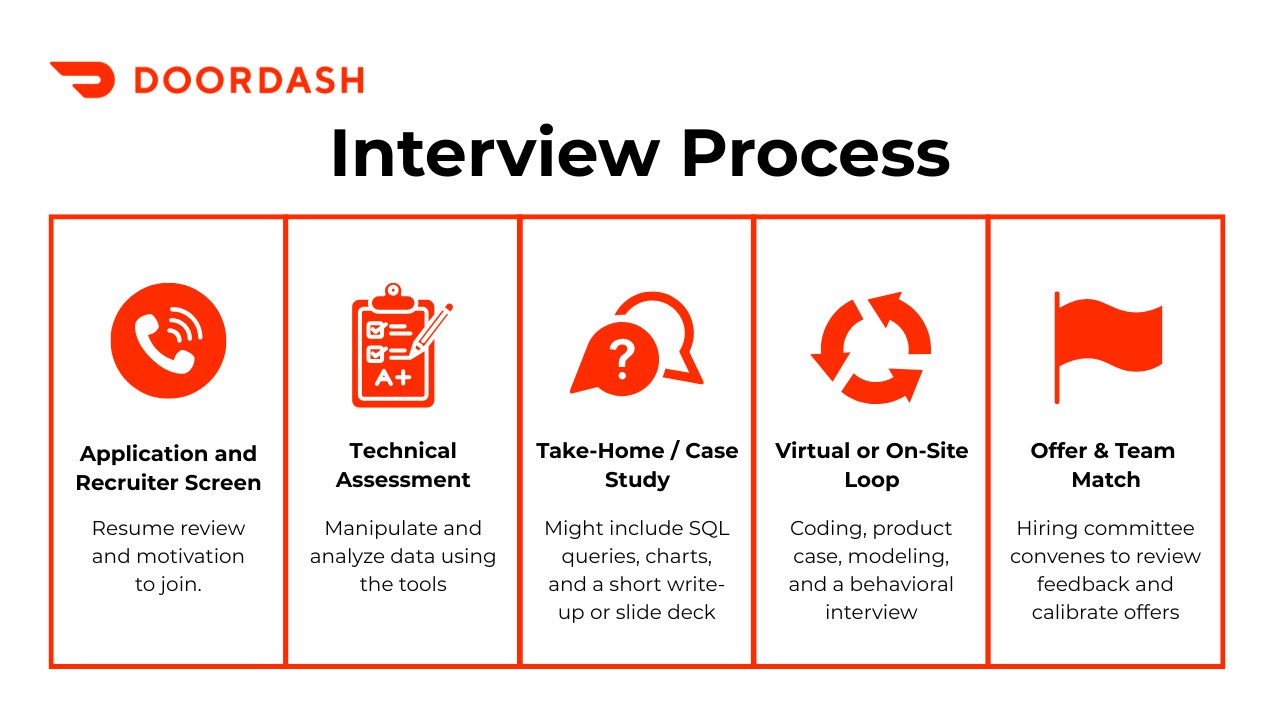
Recruiter Screen & Online Application
Most journeys begin with a quick application and a 30-minute screen with a recruiter. You’ll talk through your background, interest in DoorDash, and role fit. Expect some high-level questions around impact and scope. This is also your first checkpoint in the DoorDash hiring process, so be prepared with thoughtful, concise answers.
Take-Home Assessment Round
Depending on the role, you’ll receive a prompt for a timed project—typically a 24- to 48-hour turnaround. For instance, analysts might complete a metric deep dive, while PMs might outline product trade-offs. Engineers may get a short coding or system design challenge. These DoorDash take-home assessments aim to simulate the real day-to-day, and are often followed by a presentation or walkthrough.
Case Study / Case Interview
For strategic roles like Product Manager, BizOps, or Strategy & Planning, you’ll face a structured problem-solving session. In this DoorDash case interview, you’ll be asked to scope a solution for a delivery bottleneck or expansion play. In some cases, it will be a formal DoorDash case study interview with a deck and discussion.
Technical Interview(s)
If you’re applying for a technical role, expect multiple rounds of hands-on interviews. Engineers will code live (in tools like CoderPad) and walk through systems thinking questions. Analysts will query SQL tables or analyze a data set. The DoorDash engineering team values velocity, so many prompts focus on real-world tradeoffs in performance, scalability, or feature accuracy.
Final Behavioral & Values Interview
The last round is designed to assess alignment with DoorDash’s culture and values. You’ll be asked to reflect on past projects, cross-functional challenges, and tradeoff decisions. Be prepared for pointed DoorDash behavioral interview questions that test grit, humility, and accountability—like “Tell me about a time you moved fast and broke something” or “When did you push back on a stakeholder?”
Challenge
Check your skills...
How prepared are you for working at Doordash?
Most Common DoorDash Interview Questions
Whether you’re applying for Software Engineer, Product Manager, Data Analyst, or Operations Associate roles, the types of DoorDash interview questions you’ll encounter are tailored to the scope and impact of each position.
- DoorDash Product Manager Interview Guide
- DoorDash Software Engineer Interview Guide
- DoorDash Machine Learning Engineer Interview Guide
- DoorDash Data Analyst Interview Guide
- DoorDash Data Scientist Interview Guide
- DoorDash Data Engineer Interview Guide
Below is a breakdown of common question types seen across the DoorDash interview process, with insights into how each one assesses core competencies like strategic thinking, technical skill, and culture fit.
DoorDash Case Study Questions
In most strategic or product-facing roles, the DoorDash case interview evaluates how you break down ambiguous problems. You might be asked to launch a new vertical, analyze a delivery bottleneck, or model marketplace trade-offs. The DoorDash case study format often mirrors real-world decision-making and is used to assess prioritization, hypothesis framing, and stakeholder thinking.
-
Use this prompt to show how you translate city-level constraints—traffic, parking, vehicle mix—into a scoring system for reliability and coverage. Walk through data you’d pull (historic on-time rates, peak-hour density) and explain how you’ll iterate criteria after the soft launch.
-
Interviewers want a disciplined experiment design: geo-split A/B, primary metrics (earnings per active hour, acceptance rate), and guardrails on fulfillment cost. Discuss how you’ll spot unintended gaming and quantify LTV impact on Dasher retention.
-
The case tests your ability to balance market-entry subsidies with sustainable contribution margin. Expect to model fee elasticity, competitor benchmarks, and a phased glide path from launch discounts to steady-state pricing.
-
Focus on segmenting incident severity, tying refund tiers to reorder probability, and embedding fraud checks. Explain how you’ll monitor policy health via post-refund retention and CS ticket trends.
-
Show how you’d synthesize rider backlog, Dasher available minutes, and ETA inflation into a composite index. Then outline automated surge or incentive levers activated when the index crosses a pre-defined limit.
-
Demonstrate how you turn qualitative pain points (missing items, cold food) into quantifiable KPIs—late-delivery rate, order-accuracy score—and build a roadmap that tackles the highest-impact drivers of NPS.
-
A strong answer outlines a full P&L model—including cross-sell lift to other lines—then layers scenario analyses on marketing spend, courier incentives, and market-maturity curves to inform strategic investment decisions.
DoorDash Take-Home Assessment Prompts
Many roles begin with a DoorDash take home assessment, usually time-boxed between 24 to 48 hours. These projects simulate realistic deliverables—such as a slide deck on a market analysis, a SQL-based data exploration, or a product spec proposal. Your ability to synthesize data, structure logic, and communicate clearly is key. In some cases, the DoorDash take home project is revisited in later rounds.
Design an hourly-update subway-ridership prediction system for NYC Transit.
A typical take-home asks you to convert an open-ended brief into a concise tech proposal. For this problem, you’d outline data ingestion, model refresh cadence, latency targets, and stakeholder dashboards, packaging everything in a short slide deck or PRD.
Create an ETL pipeline that moves Stripe payment data into an analytics warehouse.
DoorDash uses this prompt to gauge your data-engineering depth: schema design, incremental vs. full loads, failure recovery, and lineage tracking. Deliverables often include ER diagrams, transformation SQL, and a written run-book.
Architect an unstructured-video data pipeline for a computer-vision model.
The assignment tests your ability to reason about storage tiers, feature extraction at scale, and cost controls. Expect to submit a short technical memo plus annotated diagrams showing ingestion, preprocessing, and model-training stages.
Draft a machine-learning risk-assessment model that flags high-cost medical claims.
Here you’ll synthesize domain constraints (HIPAA, fairness), feature strategy, and evaluation metrics into a three-to-five-page spec aimed at cross-functional review.
Define a framework to detect “good” investors on a retail-trading platform.
A strong submission includes KPI definitions, cohort segmentation logic, label-generation methodology, and a roadmap for online scoring—delivered as a Jupyter notebook or executive summary.
Design a distributed facial-authentication system for employee clock-in/out.
Take-home variants require threat-model diagrams, latency budgets, and fallback flows; clarity of written trade-off reasoning is weighted as heavily as architectural detail.
-
Candidates download a CSV excerpt, build queries in a supplied notebook, and narrate insights in 3–5 slides. Reviewers look for clean code, sound statistical tests, and crisp storytelling.
Behavioral & Culture-Fit Questions
Across all roles, expect DoorDash behavioral interview questions that probe your ability to take ownership, move quickly, and learn from mistakes. These are rooted in DoorDash engineering values, such as “Make room at the table” or “One percent better every day.” You’ll need strong STAR-format stories around stakeholder collaboration, failures, feedback, and personal growth.
-
DoorDash looks for the “Own the problem” mindset. Use a concise STAR story to show how you diagnosed the root cause, rallied cross-functional partners, and iterated quickly—then close with a metric that moved and a lesson that made you “one percent better” for the next sprint.
-
Whether you built a self-serve Looker dashboard or launched a data-literacy workshop, highlight how you “Make room at the table” by democratizing information, reducing ad-hoc requests, and accelerating decision cycles.
When has stakeholder mis-alignment jeopardized a deliverable, and how did you realign everyone?
Focus on rapid feedback loops: agenda-driven syncs, shared OKRs, and written decision logs. The interviewers want evidence that you collaborate under pressure yet keep velocity high—true to DoorDash’s bias for action.
What constructive criticism would your current manager give you, and how are you addressing it?
Honest self-reflection signals growth mindset. Pick a real but coachable weakness—perhaps over-indexing on perfection—and describe concrete habits (time boxing, peer reviews) that have already moved the needle.
Tell us about a time multiple deadlines collided. How did you prioritize and stay organized?
Interviewers want to see structured triage—ICE or RICE scoring, stakeholder impact mapping, and transparent trade-off communication—demonstrating disciplined execution in DoorDash’s fast lane.
Why DoorDash, and how does our mission resonate with your personal career story?
Ground your answer in the company’s goal of empowering local economies, then link it to a concrete achievement or passion in your background. Authentic alignment beats generic enthusiasm.
Describe a moment you shipped something imperfect to hit a critical deadline. What debt did you take on, and how did you pay it down afterward?
This unlinked prompt tests your comfort with DoorDash’s “speed versus polish” trade-offs. Show that you can make pragmatic calls, document debt, and schedule remediation—reinforcing continuous improvement without sacrificing accountability.
Recount a situation where you challenged a senior leader’s approach based on data. How did you present evidence, and what was the outcome?
The story should illustrate courage tempered by respect—leveraging clear visuals or prototypes to persuade, and accepting the final call gracefully if the decision went another way. It signals that you value truth over hierarchy while maintaining strong partnerships.
Operational & Logistics Scenarios
If you’re interviewing for operations, fleet, or warehouse roles, you’ll likely face execution-heavy questions that simulate real logistics issues. Common DoorDash driver questions include route optimization or Dasher incentives, while DoorDash warehouse associate interview prompts may focus on inventory flow or shift planning.
Before diving into specific questions, remember that mastering DoorDash interview questions isn’t just about knowing answers—it’s about practicing frameworks, clarifying assumptions, and showcasing structured thinking. Now, let’s explore how to prepare.
Preparation Tips for a DoorDash Interview
Cracking the DoorDash interview process means going beyond generic prep—you’ll need to understand the business model, move fast under pressure, and deliver clear, data-driven answers. Below are five targeted strategies to help you stand out in any interview round:
Know DoorDash’s Marketplace Metrics
Familiarize yourself with operational KPIs like delivery completion rate, average delivery time, and monthly active users. These metrics often show up in case studies or execution interviews—knowing them helps ground your answers in reality.
Practice Product Sense Daily
Whether you’re applying for PM, Analyst, or Ops roles, running through one product-sense or case question daily can build the structured thinking needed for high-pressure prompts. Time yourself to simulate the real DoorDash interview questions environment.
Master the STAR Framework
For the behavioral round, use the STAR format—Situation, Task, Action, Result—to organize your stories. Focus on moments where you resolved stakeholder conflict, owned outcomes, or turned failure into learning.
Research Recent Launches
Review major feature launches like DashMart, Drive, and Storefront. Referencing them in case or strategy discussions shows initiative and familiarity with DoorDash’s evolving priorities.
Simulate the Interview Experience
Use a mock interview or AI simulation to refine your pacing, verbal clarity, and adaptability. It’s one of the fastest ways to surface blind spots before your real DoorDash interview.
Salaries at DoorDash
Average Base Salary
Average Total Compensation
While total compensation varies by level and role, DoorDash is known for offering competitive base pay, annual performance bonuses, and equity refreshers. Salary bands differ across teams—engineering, data, PM, and ops—but roles with higher ownership or platform scope often receive more generous equity packages. Public compensation data (e.g. Levels.fyi, Blind) offers rough benchmarks.
Conclusion
Mastering the DoorDash interview questions means more than just studying past prompts—it’s about aligning with the company’s mission, values, and fast-moving culture. As you continue your prep, don’t forget to explore the individual role guides linked above for deep dives and tailored insights.
- DoorDash Product Manager Interview Guide
- DoorDash Software Engineer Interview Guide
- DoorDash Machine Learning Engineer Interview Guide
- DoorDash Data Analyst Interview Guide
- DoorDash Data Scientist Interview Guide
- DoorDash Data Engineer Interview Guide
Want to go a step further? Book a mock interview, simulate the experience with our AI Interviewer, or follow our structured learning paths to target key competencies. For inspiration, check out Alex Dang’s success story.
FAQs
How hard is the DoorDash interview process?
The DoorDash interview process is considered moderately challenging, with a heavy emphasis on structured thinking and strong communication. Each stage is designed to simulate real-world scenarios, whether technical or strategic.
What is the typical DoorDash hiring timeline?
The DoorDash hiring process typically spans 2 to 3 weeks from application to offer, depending on role and availability. Feedback is usually shared within 24 hours of each round.
What questions do DoorDash drivers and Dashers face?
Applicants interested in becoming Dashers often search for DoorDash how to become a dasher questions or prep for DoorDash driver questions around navigation, safety, and incentive structure.
How should I approach a DoorDash take-home assessment?
Your best approach to a DoorDash take home assessment is to structure your response clearly, focus on actionable insights, and revisit the company’s current priorities. Look up sample DoorDash take home assessment answers on forums for reference.
What are DoorDash’s core engineering values?
The DoorDash engineering values center on ownership, experimentation, empathy, and data-driven decision-making. Review the full list before your interview to frame your behavioral responses accordingly.
Discussion & Interview Experiences