


DoorDash Product Analyst Interview: Top Questions, Tips & 2026 Breakdown


Introduction
The product analytics market is projected to reach $84.3 billion by 2032, making a role like product analyst experience a faster-than-average growth in both demand and employment. This growth is evident at DoorDash, which operates one of the most complex logistics marketplaces. As the company coordinates consumers, merchants, and Dashers for services such as restaurant delivery, grocery, convenience, and retail, it increasingly relies on product analysts to make decisions based on rigorous experimentation, metric design, and data-driven judgment.
This is where the DoorDash product analyst interview becomes especially competitive and intentional. Since product analysts at DoorDash influence decisions like DashPass adoption, delivery speed optimization, and marketplace balance, the interview evaluates your ability to move fluently between SQL analysis, experiment results, and product strategy. Interviewers look for analysts who understand not just how to calculate metrics, but why those metrics matter in a logistics-driven business. In this guide, you will learn about the DoorDash product analyst interview process, the most asked DoorDash interview questions (reported by 1000+ interview experiences), and effective preparation strategies with Interview Query.
DoorDash Product Analyst Interview Process
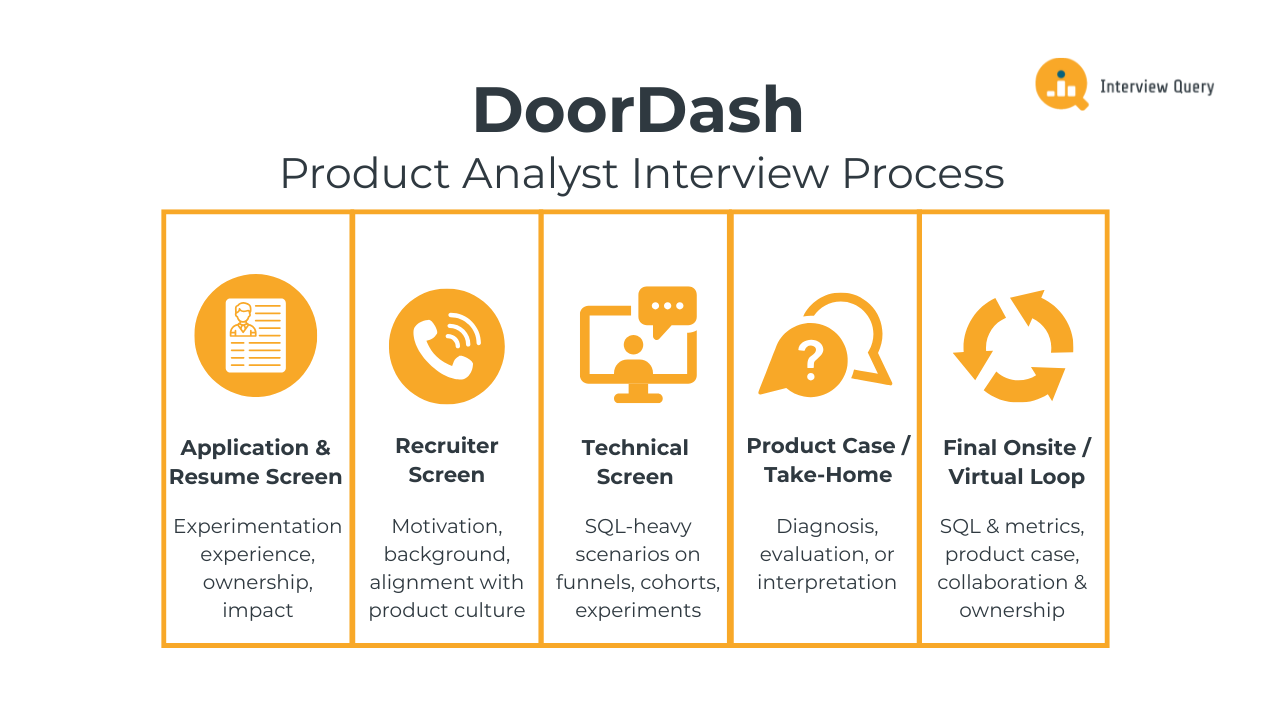
DoorDash’s product analyst interview process is reflective of how analysts actually work inside the company: partnering with product managers, reasoning through ambiguous marketplace problems, and translating messy data into clear decisions. Rather than testing isolated technical skills, the loop evaluates how you combine analytics, product judgment, and communication in a fast-moving, two-sided marketplace. While exact steps can vary by team, most candidates move through a consistent sequence from resume screening to a final interview loop centered on real DoorDash product scenarios.
Application and resume screen
The process begins with an application and resume review led by DoorDash recruiters and hiring managers. At this stage, they look for clear evidence that you have worked on product or business problems where metrics influenced decisions. Strong resumes highlight experimentation experience, ownership over key dashboards or analyses, and measurable impact tied to growth, retention, or efficiency.
Generic analytics descriptions rarely pass this screen. Instead, recruiters favor resumes that show how your work changed a product decision, improved a funnel, or resolved an operational bottleneck. Experience working with marketplaces, logistics, or consumer products is especially relevant, but not strictly required. Candidates from fintech, SaaS, or growth analytics backgrounds can still stand out if they clearly articulate how their work scaled and informed trade-offs.
Tip: Frame your bullet points around decisions and outcomes related to conversion, churn, and operational efficiency (e.g., “led analysis that changed X”) rather than outputs (“built dashboard”). This is exactly how DoorDash product analysts are evaluated on the job.
Recruiter phone screen
The recruiter phone screen is typically a 30-minute conversation focused on motivation, background, and alignment with DoorDash’s product culture. Expect questions about your career path, why product analytics appeals to you, and why you chose DoorDash specifically beyond surface-level brand interest. This is not a technical interview, but it does test how clearly you can explain your work and connect it to DoorDash’s business.
Logistics like team preferences, location, and compensation are often discussed here, but the primary goal is to determine whether you’re a strong candidate to invest further interview time in.
Tip: Even if your prior role was in a different industry, connect your experience to marketplace-style problems, such as matching supply and demand, reducing friction in funnels, or balancing trade-offs between users.
Technical analytics screen
The technical analytics interview is where DoorDash evaluates your core product analytics skill set. This round is usually SQL-heavy and grounded in realistic product scenarios, such as funnel analysis, cohort retention, or experiment evaluation. Expect questions that reference DoorDash’s ecosystem, including consumers, Dashers, and merchants, and how changes to one side affect the others.
Interviewers care deeply about how you approach the problem. You’ll be asked to define metrics, write queries, and interpret results, often with follow-up questions that challenge your assumptions or introduce edge cases. Simply getting the “right” answer isn’t enough; you need to explain why your approach makes sense and how you would validate it before sharing results with a product manager.
Tip: Practice explaining your SQL logic out loud and tying results back to a product decision. Interview Query’s role-specific SQL and analytics questions are designed to replicate this exact format.
Product case or take-home exercise
Some teams include a live product case or a short take-home assignment. These exercises typically simulate a real DoorDash problem: diagnosing a drop in conversion, evaluating a feature launch, or interpreting experiment results with incomplete data.
You may receive a small dataset, a written scenario, or a prompt asking how you’d approach the problem. The emphasis is not on advanced modeling or statistical complexity. Instead, interviewers look for structured thinking, prioritization, and your ability to recommend a clear next step. Strong candidates focus on what decision needs to be made, which metrics matter most, and what additional data would reduce uncertainty.
Tip: Resist the urge to overanalyze to avoid making an exhaustive but unfocused analysis. Interview Query’s AI Take-home Review can provide detailed feedback to ensure your recommendations are clear and backed by well-chosen metrics.
Final onsite or virtual loop
The final loop usually consists of multiple interviews covering analytics, product thinking, and behavioral alignment. You may rotate through sessions focused on SQL and metrics, product case discussions, and collaboration or ownership scenarios.
Across all rounds, interviewers evaluate how you explain your thinking and respond to feedback. This stage mirrors real working relationships at DoorDash, where product analysts partner closely with product managers and engineers.
Tip: Treat every answer as if you’re advising a product manager who has to make a real trade-off under time pressure. Structure your response, state your recommendation clearly, and explain why.
If you want to practice each stage under realistic conditions, from SQL screens to DoorDash-style product cases, Interview Query’s mock interviews can help you refine both your analytics execution and your product storytelling through peer feedback.
Challenge
Check your skills...
How prepared are you for working as a Product Analyst at Doordash?
Most Asked DoorDash Product Analyst Interview Questions
DoorDash product analyst interview questions are designed to test how effectively you use data to guide marketplace-based product decisions. Interviewers are not looking for theoretical answers or textbook metrics. Instead, they focus on how you reason through ambiguity, structure analyses, and communicate insights that product managers can act on quickly.
Across the interview loop, questions typically fall into four categories: SQL and data analysis, product metrics, experimentation, and behavioral judgment. Each category reflects a core responsibility of the DoorDash analytics role, from diagnosing marketplace health to influencing trade-offs between growth, cost, and user experience.
Watch Next: 7 Types of Product Analyst Interview Questions
In this video, Interview Query founder Jay Feng breaks down common categories you’ll encounter in analytics interviews like the one at DoorDash, giving you a practical lens on how questions are structured and what interviewers are looking for. He highlights several core types of product analyst questions to help you anticipate the logic behind what’s being asked and how to frame your answers in a way that aligns with what hiring teams value.
The approaches discussed in the video are helpful for answering the sample questions below.
SQL and data analysis interview questions
SQL interviews emphasize practical querying over syntax trivia. Questions are framed around real marketplace datasets, such as orders, deliveries, Dashers, merchants, and timestamps. You are expected to translate a business question into clean, efficient queries and explain how you would validate results.
Rank DoorDash users by total delivery distance traveled using ride-level data.
This question tests basic aggregation, joins, and ranking logic in SQL. The solution involves summing total distance per user from the rides table, grouping by user ID, and ordering results in descending order. A strong answer also considers how to handle users with zero rides or incomplete trip records.
Tip: Go one step further and explain why distance might matter, such as identifying inefficient delivery patterns or unusually long routes that could signal batching or supply gaps. Framing the output as something an ops or logistics team could act on immediately earns extra points.
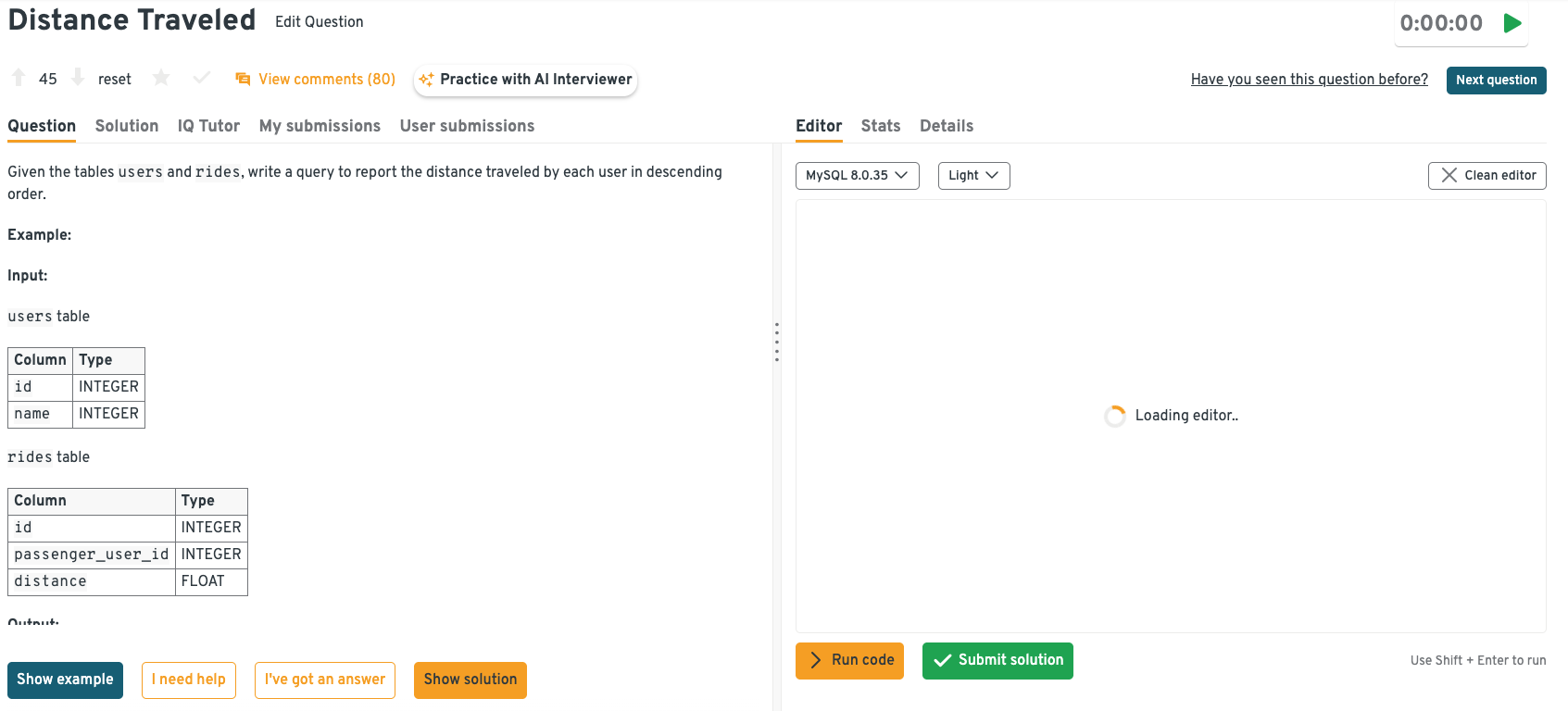
Practice this and additional SQL questions by head to the Interview Query dashboard. Use the built-in text editor, compare your solution against multiple approaches, and walk through step-by-step explanations to reinforce both correctness and clarity exactly how DoorDash interviews evaluate SQL thinking.
-
Here, the focus is on window functions, percentile calculations, and cohort-style filtering. You would first limit rides to the rolling 90-day window, aggregate completed trips per user and city, then compute the 95th percentile within each city to establish the power-user threshold. Edge cases, such as cities with very small user counts, must be explicitly handled to ensure consistent labeling.
Tip: Interviewers are impressed when candidates explain how this segmentation might be used, e.g., powering loyalty perks, targeted promotions, or Dasher prioritization. Calling out how percentile-based thresholds adapt across cities shows strong marketplace intuition.
-
This problem evaluates multi-table joins, conditional filtering, and optimization logic. The approach requires identifying missing ingredients, filtering to acceptable brands, and selecting the minimum-priced option per ingredient before summing costs at the recipe level. Feasibility checks are crucial, as any missing ingredient without an acceptable brand invalidates the entire recipe.
Tip: Discuss failure states and downstream impact, such as how infeasible recipes should be surfaced to users or removed from recommendations. This shows that you think beyond correctness and anticipate user-facing consequences.
-
This question assesses time-based analysis and the use of window functions like
LAG. The key is to pair each user message with the immediately preceding system message, calculate the time difference, and then average those intervals per user. Careful ordering and filtering ensure that only valid system-to-user transitions are included.Tip: Mention validating whether response time distributions are skewed and whether medians or percentiles might be more meaningful. Demonstrating awareness of metric robustness signals strong analytical judgment.
How would you calculate week-over-week retention for new DashPass users?
This prompt tests cohort analysis, date logic, and retention metric design. You would define a signup cohort by week, track whether users return or remain subscribed in subsequent weeks, and compute retention as a percentage of the original cohort size. Also clarify how cancellations, pauses, or free trials affect the retention definition.
Tip: The best answers clearly distinguish between behavioral retention (orders placed) and subscription retention (active membership). Calling out which metric matters for a given business question demonstrates product maturity and alignment with DoorDash’s subscription goals.
If you want structured practice that builds your SQL skills from fundamentals to interview-ready proficiency, check out Interview Query’s SQL Learning Path. It has hands-on exercises that helps you develop the exact querying and analytical thinking DoorDash expects.
Product metrics and analytics interview questions
Product metrics questions focus on whether you understand what success looks like for DoorDash features. Interviewers want to see structured metric trees, thoughtful trade-offs, and a clear connection between metrics and decisions. Vague answers that list dozens of metrics without prioritization tend to score poorly.
How would you measure the success of a new DashPass feature?
This question tests metric definition, experimentation thinking, and alignment with business goals. A strong approach starts by clarifying the feature’s primary objective, such as increasing retention, order frequency, or perceived value, and selecting leading and lagging metrics that reflect that goal. Supporting analysis might include A/B testing results and guardrail metrics to ensure the feature doesn’t negatively impact margin or delivery quality.
Tip: Explicitly call out how success metrics might differ between new and existing DashPass subscribers. Showing awareness that DashPass features often shift who benefits, and not just how much, signals strong subscription product intuition.
-
This prompt evaluates statistical intuition and metric robustness. When lateness is right-skewed, median or percentile-based metrics (like P90 lateness) better represent the typical customer experience than averages. An effective answer also explains what the tail of the distribution reveals about operational breakdowns and when those extreme cases warrant separate investigation.
Tip: Strong answers often distinguish between customer-facing metrics and internal ops metrics. Highlighting that long-tail lateness might matter more for support volume or refunds than for overall CX shows practical DoorDash experience.
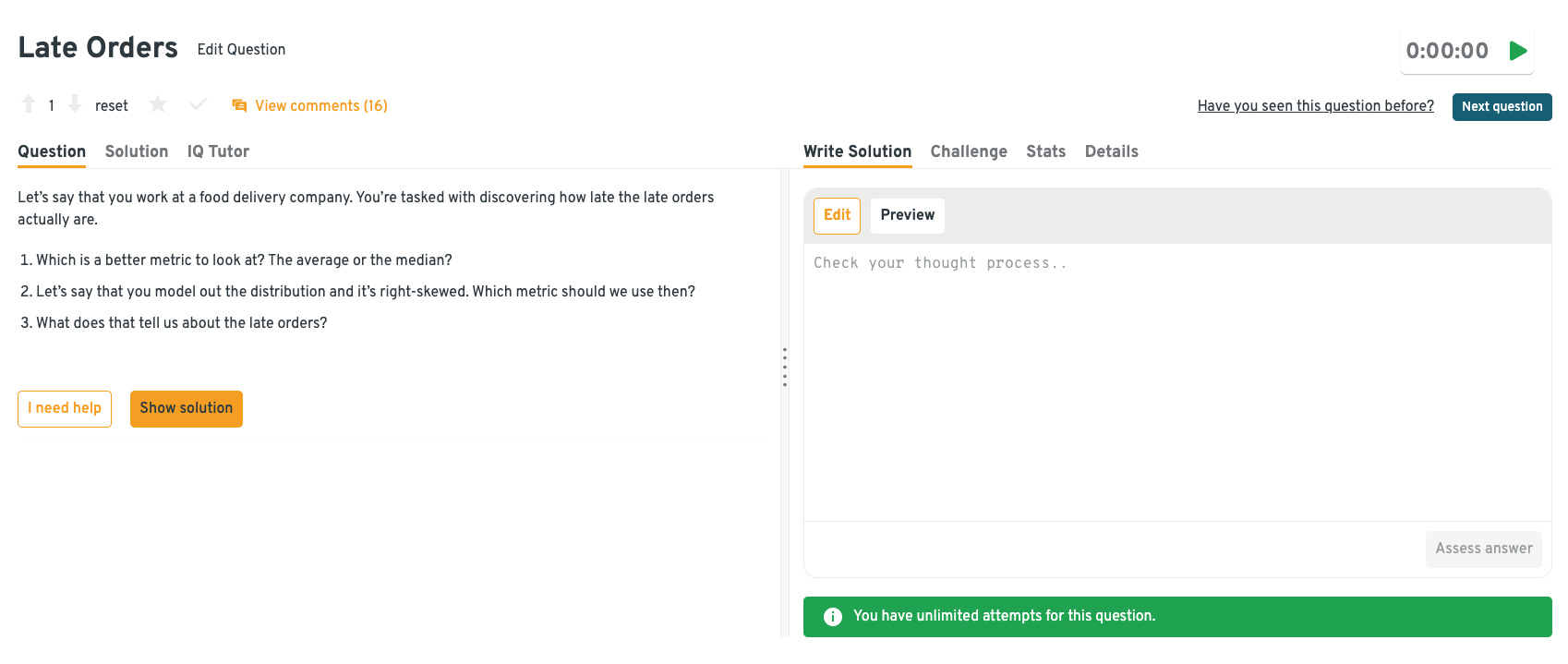
Keep sharpening your product metrics intuition by exploring the Interview Query dashboard for more product analytics questions. You can test your thinking and get real-time guidance from IQ Tutor, along with clear explanations that mirror how DoorDash evaluates metric-driven decisions.
-
This question focuses on hypothesis-driven analysis and cohort segmentation. The investigation would begin by defining “younger users” clearly, then comparing acquisition, retention, and engagement metrics across age cohorts over time. Changes should be validated against external factors like seasonality or channel mix to ensure the trend reflects real behavior shifts rather than data artifacts.
Tip: Mention how product surface usage differs by age group, such as pickup vs. delivery or promo sensitivity, and how that affects interpretation. This shows the ability to connect demographic analysis to product strategy.
-
Here, interviewers are assessing product intuition and the ability to connect metrics to user journeys. A strong answer walks through the lifecycle, from discovery to post-delivery, and highlights key metrics like conversion, on-time delivery rate, order accuracy, and support contact rate. Prioritization should be guided by which stage most strongly correlates with repeat usage and long-term retention.
Tip: Explain how you would sequence metric improvements rather than treating all stages equally. Calling out that fixing reliability issues often unlocks gains elsewhere reflects real-world product prioritization.
How would you know if a merchant onboarding change was successful?
This question tests causal reasoning and end-to-end metric thinking. Success can be evaluated by measuring changes in activation time, first-order conversion, and early merchant retention before and after the onboarding change. A thoughtful approach also includes monitoring downstream effects, such as menu quality or fulfillment issues, to ensure faster onboarding doesn’t reduce long-term merchant quality.
Tip: The strongest responses mention balancing merchant growth with marketplace health. Acknowledging trade-offs, like faster onboarding increasing support load or order errors, demonstrates mature marketplace thinking that DoorDash values.
Experimentation and A/B testing interview questions
Experimentation questions evaluate how you design tests in a complex, real-world environment. DoorDash interviewers care about hypothesis clarity, metric selection, and practical constraints like interference and supply shifts.
-
This question tests experimental design, causal reasoning, and marketplace intuition. The approach would involve running a controlled experiment where peak-hour pay is varied by market or time window and measuring changes in acceptance rate, fulfillment rate, and delivery time. A strong answer also accounts for secondary effects, such as increased labor cost or shifts in Dasher behavior outside peak periods.
Tip: Explain how you would segment results by market maturity or density. Showing awareness that peak pay behaves very differently in suburban versus dense urban markets reflects real DoorDash operational nuance.
Practice more A/B testing and experimentation questions like this in the Interview Query dashboard, where you can get step-by-step help from IQ Tutor and learn from user comments that highlight common pitfalls and strong approaches.
-
This prompt evaluates model comparison, metric selection, and user experience awareness. The solution involves an A/B test that compares prediction accuracy metrics (e.g., absolute error) alongside behavioral signals like order completion, cancellations, or support contacts. Interpreting results requires balancing statistical improvements with whether users actually perceive estimates as more reliable.
Tip: Call out how expectations differ by order type or merchant category. Mentioning that accuracy gains matter more for longer or scheduled orders shows product intuition beyond raw model performance.
-
This question assesses experiment setup, funnel thinking, and metric interpretation. Start by defining a clear primary metric such as completed orders, establishes guardrails like payment failure rate or fraud, and ensures proper randomization at the user level. Analysis should confirm statistical significance while checking for unintended downstream effects on order quality or refunds.
Tip: Discuss experiment duration and traffic allocation, especially around paydays or weekends. Demonstrating awareness of DoorDash’s demand cycles signals practical experimentation experience.
How would you test a new pricing model without hurting user trust?
This question tests risk-aware experimentation and customer-centric thinking. A thoughtful approach might involve gradual rollouts, geo-based experiments, or shadow pricing to understand impact before exposing users directly. Success depends on monitoring not just conversion or revenue, but also trust indicators like churn, complaints, or sudden drops in repeat usage.
Tip: Stand out by articulating how messaging and transparency affect experiment outcomes. Acknowledging that pricing tests are as much about perception as math shows strong cross-functional judgment.
How would you handle experiment interference in a marketplace?
This prompt evaluates understanding of complex systems and experimental validity. Addressing interference often requires higher-level randomization, such as at the market or cohort level, to prevent treatment effects from spilling across users. Clear documentation of assumptions and limitations is essential, especially when interpreting results in two-sided marketplaces like DoorDash.
Tip: The best answers include a brief explanation of when not to run an experiment at all. Knowing when observational analysis or simulations are safer than live testing reflects senior-level analytical maturity.
If you want to master the statistical thinking and experiment design skills DoorDash expects, explore Interview Query’s Statistics & A/B Testing Learning Path. It walks you through real-world testing scenarios with guided lessons and helps you build the intuition to design clean experiments in marketplace environments.
Behavioral and product judgment interview questions
Behavioral questions assess how you work with others and take ownership. DoorDash values analysts who can influence decisions without authority and communicate clearly under pressure.
Why do you want to work at DoorDash?
DoorDash asks this to assess candidate motivation, alignment with the company’s mission, and understanding of its marketplace dynamics. Strong answers tie personal interest to specific DoorDash problems and reference metrics DoorDash cares about (e.g., conversion, retention, delivery quality, marketplace efficiency).
Sample answer: “I’m excited about DoorDash because of its complex three-sided marketplace and the opportunity to improve local commerce at scale. In my last role, I worked on improving order conversion by 4% through funnel analysis, which feels directly relevant to DoorDash’s consumer and merchant challenges. I’m particularly interested in problems like balancing Dasher supply and delivery time SLAs. The chance to drive measurable impact across millions of weekly orders strongly motivates me.”
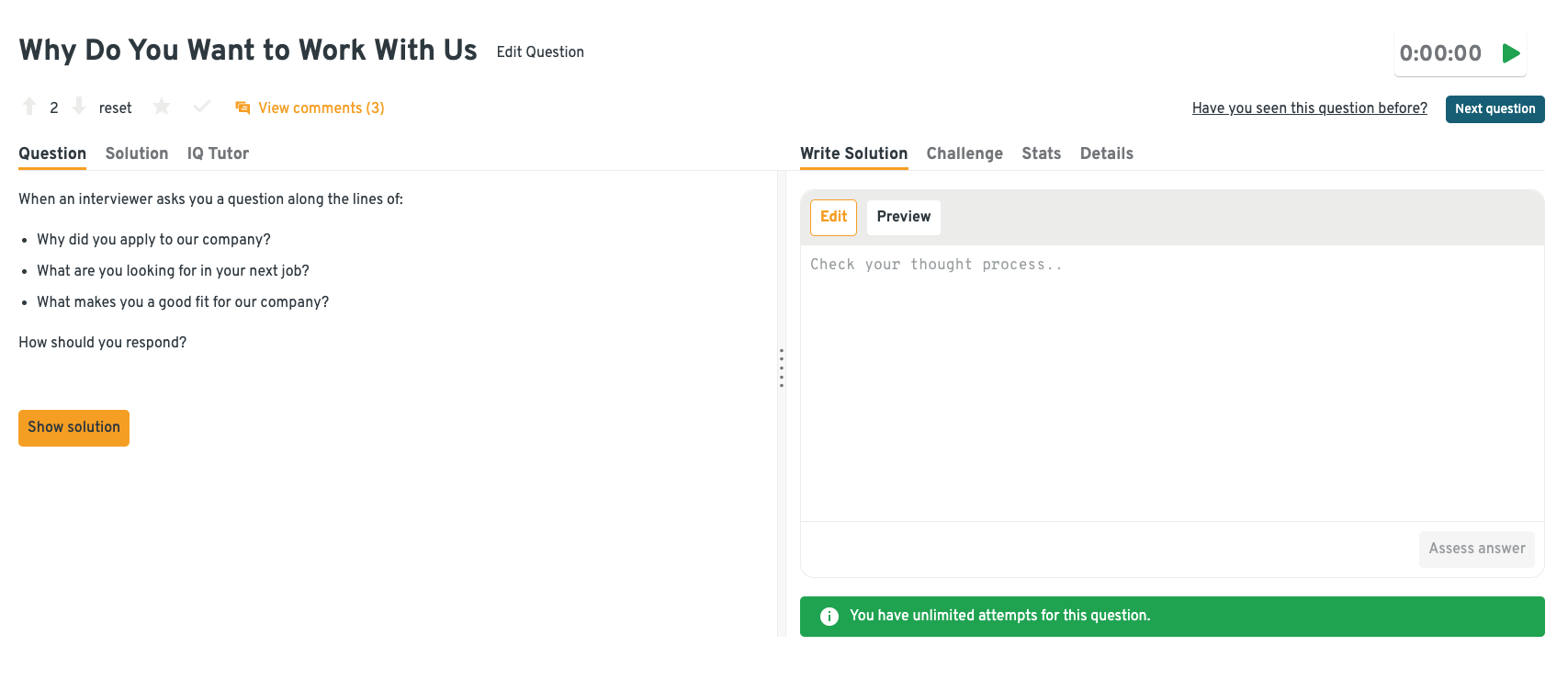
Visit the Interview Query dashboard to refine your story and practice more behavioral questions. Review strong sample responses and polish your answers with the help of IQ Tutor until they clearly connect your experience to business impact and product judgment.
Tell me about a time your analysis changed a product decision.
This evaluates whether candidates can influence decisions using data, not just produce analyses. High-quality answers clearly show before vs. after decisions, reference metrics shifted, and explain how analysis altered product direction.
Sample answer: “On a subscription feature, the team planned to expand free trials to boost sign-ups. I analyzed cohort retention and found trial users had 20% lower 30-day retention than paid sign-ups. Based on this, we shifted to targeted discounts instead of free trials, which increased net subscriber growth by 8% quarter-over-quarter. The analysis directly changed the launch strategy and improved long-term retention.”
Describe a time you disagreed with a product manager.
DoorDash looks for analysts who can challenge decisions constructively while staying data-driven and collaborative. Strong responses focus on evidence-based disagreement, alignment on goals, and measurable outcomes, rather than personal conflict.
Sample answer: “A PM wanted to prioritize a feature based on qualitative feedback, but usage data showed only 5% of users would be affected. I shared an analysis showing that addressing a checkout friction point could reduce drop-off by 3%, impacting a much larger user base. We aligned on testing both ideas, and the checkout fix increased completed orders by 2.5%. The discussion stayed focused on shared metrics and customer impact.”
How comfortable are you presenting your insights?
This question assesses communication skills and stakeholder influence, which are critical at DoorDash. Strong answers highlight the ability to translate data into decisions, mention audience type, and reference actions or results driven by presentations.
Sample answer: “I’m very comfortable presenting insights to both technical and non-technical audiences. In my last role, I regularly presented experiment results to product and leadership teams, focusing on clear takeaways and recommendations. One presentation led to pausing a rollout that would have increased support tickets by an estimated 15%. I always anchor presentations on metrics and business impact rather than raw analysis.”
How do you handle ambiguous problem statements?
DoorDash operates in fast-moving, ambiguous environments, so this tests structured thinking and initiative. Strong answers show how candidates clarify goals, define success metrics, and narrow scope, while still driving measurable outcomes.
Sample answer: “When faced with ambiguity, I start by clarifying the business objective and defining success metrics with stakeholders. For example, when asked to “improve engagement,” I broke it down into session frequency and order frequency, then analyzed drivers for each. This led to prioritizing a notification experiment that increased weekly active users by 6%. Creating structure early helps ensure the analysis leads to action.”
To deepen your preparation and practice role- and company-specific questions from SQL and experimentation to product metrics and behavioral rounds, explore Interview Query’s comprehensive question bank. It offers realistic prompts, guided solutions, and structured drills designed to mirror the actual interview experience.
6 Easy Steps to Prepare for a DoorDash Product Analyst Interview
Preparing for a DoorDash product analyst interview requires more than general analytics practice. The role sits at the intersection of data, product strategy, and real-time logistics, so interview preparation should mirror how decisions are actually made at DoorDash. Strong candidates focus on sharpening core technical skills while practicing how to communicate insights clearly in ambiguous, fast-moving scenarios.
Anchor your SQL practice in marketplace questions. DoorDash interviewers care far more about what you query than how **fancy the query looks. You should be comfortable writing queries that analyze funnels, cohorts, retention, and experiment results without relying on overly complex syntax. Be ready to talk through assumptions, edge cases, and what you’d check next if the data looked off.
Tip: Practice SQL by recreating DoorDash-style scenarios, such as identifying where orders drop off between cart and checkout or measuring reorder rate by delivery time bucket. You can use Interview Query’s product-focused SQL questions to simulate how these problems are asked in interviews.
Develop product intuition around delivery speed, reliability, and cost. Unlike many consumer tech companies, DoorDash’s core product is constrained by physical logistics. Practice product cases that force trade-offs, such as faster delivery vs. higher cost, more Dashers vs. lower utilization, promotions vs. long-term retention. Always tie recommendations back to concrete metrics such as on-time delivery rate, order frequency, contribution margin, or Dasher acceptance rate.
Tip: When practicing cases, explicitly state which stakeholder you are optimizing for (consumer, Dasher, or merchant) and how that choice changes the metric you prioritize.
Treat metrics as decision tools, not scorecards. Go beyond defining metrics and practice diagnosing why they move. Analyze whether pricing, ETA accuracy, inventory availability, or Dasher supply is involved if conversion drops. Interviewers want to see that you can break metrics into drivers, prioritize which ones matter most, and avoid vanity metrics that don’t change decisions.
Tip: For any metric you mention in practice, force yourself to name at least two upstream drivers and one concrete action you’d take if it moved. This mirrors how questions are evaluated in Interview Query’s Product Metrics Interview learning path.
Get comfortable designing and critiquing experiments under real-world constraints. DoorDash runs experiments constantly, but not every question can be A/B tested cleanly. Practice explaining when an experiment is appropriate, how you’d choose guardrail metrics, and how you’d interpret noisy or inconclusive results. Bonus points if you can articulate risks like interference between users, regional effects, or operational limitations.
Tip: Practice framing experiments around geographic markets or time windows (e.g., lunch vs. dinner), and be ready to explain how you’d validate results. Such skills are reinforced in Interview Query’s Statistics and A/B Testing learning path.
Study DoorDash as a business, not just a product. Familiarize yourself with DashPass economics, merchant commissions, Dasher incentives, and how profitability varies by market. Understanding how DoorDash makes money (and where it loses money) will make your answers sharper and more realistic.
Tip: When preparing, map every product or metric question back to revenue or cost impact. You can build your intuition for this by studying DoorDash’s public resources, such as its company blog and product announcements.
Practice communicating insights the way DoorDash teams operate. Your answers should sound like a Slack message or a quick readout to a PM, not a classroom lecture. Lead with the takeaway, quantify impact, and end with a recommendation. If your analysis wouldn’t help someone make a decision in the next meeting, it’s not finished yet.
Tip: After each practice question, summarize your answer in one sentence starting with “I recommend…” to mirror the concise communication style expected in DoorDash interviews. You can also model this approach and ask for feedback to ensure clarity when doing mock interviews on Interview Query
To prepare effectively across these areas, Interview Query’s real-world product and case challenges offer targeted, company-specific practice that mirrors the structure and depth of real interviews. It’s one of the fastest ways to turn general analytics skills into DoorDash-ready product thinking.
What Does a DoorDash Product Analyst Do?
The DoorDash product analyst role focuses on using data to guide product decisions across a complex, multi-sided marketplace. Product analytics at DoorDash spans several domains, including consumer growth, Dasher supply and earnings, merchant tools, pricing, and logistics efficiency. The work is fast-paced, highly collaborative, and grounded in the reality that every decision has downstream operational consequences.
Read more: What Is a Product Analyst?
While responsibilities vary by team, most DoorDash Product Analysts spend their time on a mix of the following:
- Defining and monitoring product success metrics tied to growth, retention, delivery quality, and unit economics
- Analyzing funnels and user behavior to identify friction points across ordering, fulfillment, and post-delivery experiences
- Evaluating experiments and feature launches, including A/B tests, phased rollouts, and market-level changes
- **Collaborating closely with product managers and engineers** to translate insights into product decisions and next steps
- Communicating findings through concise narratives, dashboards, and decision-focused readouts
DoorDash’s culture rewards ownership and bias toward action. Perfect data is rare, and analysts are trusted to make recommendations with incomplete information, clearly communicate risks, and iterate as new data comes in. Because the platform operates at massive scale, even small improvements can have outsized effects. A modest lift in conversion or delivery reliability can impact millions of orders, which is why analytical rigor paired with business judgment is so highly valued.
Over time, this role offers multiple growth paths, including senior analytics leadership, product management, and strategy roles. The exposure to end-to-end decision-making and cross-functional collaboration makes the role a strong launchpad for long-term product-focused careers.
To learn more about how DoorDash’s product culture shows up across teams and roles, explore the full DoorDash interview guide for deeper insights into the company and its analytics-driven approach.
Average DoorDash Product Analyst Salary
DoorDash offers some of the most competitive compensation packages for product analysts in the consumer tech and marketplace space. Pay is designed to reward analysts who influence core product decisions, such as pricing, logistics optimization, and growth experiments. Compared to similar roles at Uber, Instacart, or Lyft, DoorDash compensation tends to skew slightly higher at the senior level due to stronger equity grants and faster scope expansion.
Based on aggregated data from sources like Levels.fyi, total compensation varies by level, location, and ownership area, with base salary forming the foundation and equity playing an increasingly important role after the first year. For candidates interviewing this year and beyond, understanding how these components scale is critical for evaluating offers and negotiating effectively.
Compensation by level
| Level | Total / Year | Base / Year | Stock / Year | Bonus / Year |
|---|---|---|---|---|
| Product Analyst I | ~$145K | ~$120K | ~$20K | ~$5K |
| Product Analyst II | ~$175K | ~$140K | ~$30K | ~$5K |
| Senior Product Analyst | ~$215K | ~$165K | ~$40K | ~$10K |
Early-career product analysts can expect strong base pay with lighter equity, while senior product analysts see a meaningful shift toward stock compensation. Equity value becomes especially important once vesting accelerates in year two, often pushing total compensation well above initial offer numbers.
Regional salary comparison
| Region | Salary range | Notes |
|---|---|---|
| San Francisco Bay Area | $170K–$225K | Highest base and equity bands |
| Seattle | $155K–$210K | Strong tech demand, slightly lower base |
| New York City | $150K–$205K | Competitive base with moderate equity |
| Remote (U.S.) | $135K–$190K | Cost-of-living adjusted |
Location still plays a role in base salary, but DoorDash’s compensation philosophy increasingly emphasizes role impact over geography, particularly for senior and remote-friendly positions. Analysts owning high-leverage product surfaces (search, fulfillment, pricing, or growth) often land toward the top of their regional bands.
Understanding DoorDash’s compensation structure helps you do more than just “accept or reject” an offer—it equips you to negotiate equity, evaluate long-term upside, and align your level with scope expectations. Many candidates leave meaningful compensation on the table by focusing only on base pay instead of total package value.
If you’re preparing for a DoorDash product analyst interview, use Interview Query’s role-specific compensation insights to benchmark your offer, understand leveling expectations, and evaluate long-term upside.
FAQs
How difficult is the DoorDash product analyst interview?
The DoorDash product analyst interview is challenging, but very manageable with the right preparation. It emphasizes real-world product analytics skills, including SQL, metric intuition, experimentation, and communication. Most candidates who find it difficult aren’t missing technical ability; they’re usually missing structure, marketplace context, or practice applying analytics to product decisions. With targeted prep and familiarity with DoorDash’s marketplace dynamics, the interview becomes far more predictable.
How long does the DoorDash interview process take?
Most candidates complete the process within three to five weeks. Timelines vary by team and role urgency, but delays often occur between the technical screen and final loop.
Are DoorDash product analyst interviews remote or onsite?
DoorDash supports both remote and hybrid interviews. Final loops are often conducted virtually, even for candidates who later join hybrid teams.
What are the most common reasons candidates fail?
The most frequent issues include weak SQL fundamentals, unclear metric definitions, and difficulty translating analysis into product recommendations. Candidates also struggle when they fail to account for marketplace trade-offs.
What background is required for this role?
DoorDash product analysts typically come from analytics, economics, engineering, or business backgrounds. Prior experience with marketplaces, experimentation, or consumer products is helpful but not mandatory if core analytics skills are strong.
Become a DoorDash Product Analyst with Interview Query
Succeeding in the DoorDash product analyst interview requires strong SQL skills, sharp product intuition, and the ability to communicate insights clearly in ambiguous, high-impact situations. Throughout the process, interviewers evaluate how you structure problems, reason through trade-offs, and support product decisions with data.
Interview Query helps you prepare for every stage of the loop with a comprehensive question bank for targeted practice, the Product Analytics 50 study plan for structured preparation, and mock interviews that simulate real DoorDash scenarios. With focused practice and the right strategy, you can approach the DoorDash interview with confidence and clarity.
Discussion & Interview Experiences