
Walmart Machine Learning Engineer Interview Guide (2025)


Introduction
You’re stepping into one of the most exciting times to interview at Walmart as a machine learning engineer. In 2025, Walmart continues to scale its AI-first transformation, investing heavily in ML to streamline operations and personalize the customer journey. Your role here could shape pricing strategies, reduce stockouts, or power next-gen retail media. With Walmart Connect growing 40% year-over-year and platforms like Wallaby driving intelligent recommendations, your impact won’t just be technical—it will be deeply business-critical. You’ll collaborate across teams, turn massive datasets into real-time decisions, and help reimagine how over 240 million customers shop each week. This guide will help you prepare for the questions that matter most.
Role Overview & Culture
As a machine learning engineer at Walmart, you’ll work at the intersection of deep technical challenges and real-world impact. You’ll design, deploy, and scale models that drive intelligent pricing, personalized experiences, and AI-powered logistics across a global retail ecosystem. You won’t just write code—you’ll build systems that serve over 240 million weekly customers, powered by a stack that includes TensorFlow, PyTorch, and Walmart’s in-house Element platform. You’ll collaborate with engineers, data scientists, and business leaders in a culture rooted in innovation, mentorship, and continuous learning. Whether you’re refining a generative AI chatbot or optimizing supply chains with predictive models, your work will help transform Walmart into a truly AI-first retailer. Let’s explore the questions that will help you land this role.
Why This Role at Walmart?
Joining Walmart as a machine learning engineer means more than building world-class models—it means accelerating your personal and professional growth. You’ll earn top-tier compensation, with total packages often reaching $260K to $320K and senior engineers exceeding $350K. You’ll contribute to GenAI projects, LLM development, and large-scale optimization systems that directly impact millions of customers and thousands of associates. Hybrid work flexibility, RSUs, generous PTO, and resume-defining responsibilities make this role as rewarding as it is challenging. Whether you’re looking to scale your skills or secure long-term financial stability, Walmart offers the best of both. Now that you know what’s at stake, let’s walk through the questions you’re most likely to face—and how to prepare for them.
What Is the Interview Process Like for a Machine Learning Engineer Role at Walmart?
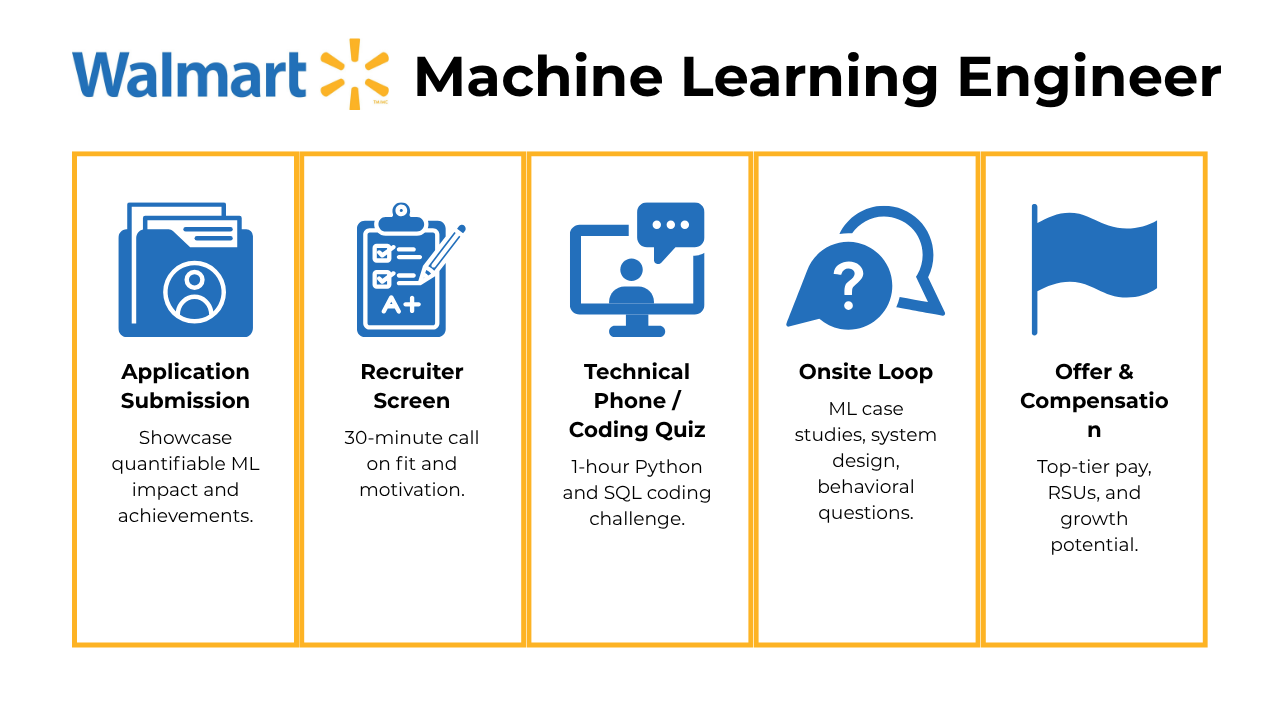
If you’re preparing for Walmart machine learning engineer interview questions, understanding the process is your first step to success. Walmart’s interview process is structured to assess both your technical depth and your ability to thrive in a collaborative, fast-paced environment. You’ll encounter a mix of coding, machine learning, system design, and behavioral questions throughout these rounds:
- Application Submission
- Recruiter Screen
- Technical Phone / Coding Quiz
- Onsite Loop (modeling, system design, behavioral)
- Offer & Compensation
Application Submission
Your journey begins with submitting a detailed application through Walmart’s careers portal. Here, you’ll highlight your machine learning experience, technical skills, and relevant projects. Tailor your resume to showcase quantifiable achievements—think model performance improvements, business impact, or innovative solutions you’ve delivered. Walmart values applicants who can demonstrate both technical expertise and a passion for transforming retail through technology. A strong application sets the stage for the rest of the process, so use this opportunity to make your story shine.
Recruiter Screen
If your application stands out, you’ll be invited to a recruiter screen. This is a 30-minute conversation focused on your background, motivations, and understanding of the ML engineer role at Walmart. The recruiter will ask about your experience, clarify role expectations, and give you a chance to ask questions about the team, culture, and interview logistics. This is your moment to express why you’re excited about Walmart’s scale and mission, and to show that you’re both technically sharp and a strong cultural fit. Be ready to discuss your resume and explain how your skills align with Walmart’s needs.
Technical Phone / Coding Quiz
Next, you’ll take a technical assessment, often a one-hour coding challenge on platforms like HackerRank. You’ll solve 1–2 medium-to-hard problems, typically involving Python and SQL, data structures, algorithms, and data manipulation. Expect questions that test your ability to process large datasets, optimize code, and apply statistical and machine learning concepts. This round is about demonstrating your technical fundamentals and problem-solving approach under time constraints. Practicing coding problems and reviewing ML basics will help you excel here235.
Onsite Loop (modeling, system design, behavioral)
The onsite (or virtual) loop is the heart of the process, consisting of several one-hour interviews with engineers, managers, and cross-functional partners. You’ll tackle real-world ML case studies, coding challenges, and system design problems, such as designing scalable ML pipelines or optimizing business processes with AI. You’ll also face behavioral interviews, where you’ll discuss past projects, teamwork, and how you handle challenges. Walmart’s interviewers want to see your ability to translate business needs into technical solutions, communicate clearly, and fit into a collaborative, innovative culture. Prepare to explain your thought process, justify your decisions, and show how you drive impact at scale.
Offer & Compensation
If you impress throughout the process, you’ll receive an offer that includes a competitive base salary, performance-based bonuses, equity (RSUs), and a comprehensive benefits package. Walmart’s compensation for ML engineers is among the best in the industry, with top performers earning well above $250K annually. You’ll also enjoy perks like health coverage, 401(k) match, paid leave, and hybrid work flexibility. The offer stage is your chance to negotiate and ask about growth opportunities, ensuring your package matches your skills and aspirations.
Challenge
Check your skills...
How prepared are you for working as a ML Engineer at Walmart?
What Questions Are Asked in a Walmart Machine Learning Engineer Interview?
To succeed in your interview, you need to be ready for a range of Walmart machine learning engineer interview questions that test your technical skills, system thinking, and ability to work across functions.
Coding / Technical Questions
In this round, you’ll tackle Walmart machine learning engineer interview questions focused on core coding skills like algorithms, data structures, and working with large-scale or streaming data—skills essential for building efficient, production-ready ML systems:
1. Write a function to rotate an array by 90 degrees in the clockwise direction
To rotate a matrix by 90 degrees clockwise, first transpose the matrix and then reverse the order of its columns. Transposing swaps rows and columns, and reversing the column order rotates the matrix as desired. The provided solution uses NumPy for efficient matrix operations.
To solve this problem, use recursion to break the problem into smaller subproblems. For each integer, subtract its value from the target N and recursively find combinations that sum to the new target. Append the current integer to each combination found in the recursive call, and ensure combinations are not repeated by limiting the integers list passed to the recursive call.
To solve this problem, you can either use logical iteration or a mathematical formulation. For logical iteration, create a set from the input array and iterate through the range from 0 to n, checking for any missing number in the set. For the mathematical approach, calculate the sum of numbers from 0 to n using the formula (n(n+1)/2), subtract the sum of the input array, and return the missing number.
4. Write a function to simulate drawing balls from a jar
To solve this, create a new list where each ball color is repeated according to its count in n_balls. Then, use the random.choice function to randomly select a ball from this expanded list, simulating the drawing process.
5. How would you interpret coefficients of logistic regression for categorical and boolean variables?
For boolean variables, the sign of the coefficient indicates whether the variable has a positive or negative influence on the outcome, while the magnitude reflects the strength of this effect. For categorical variables, one-hot encoding is recommended to avoid implying a ranking among categories, and the interpretation of coefficients follows the same guidelines as boolean variables.
The model would not be valid because the removal of decimal points introduces significant errors in the independent variable, distorting the relationship between the variable and the target label. To fix the model, you can visually identify and correct errors using histograms or apply clustering techniques like expectation maximization to detect and resolve anomalies in cases with a large data range.
ML & System Design Questions
This section tests how well you can design machine learning systems that scale across Walmart’s global operations, often blending real-time predictions, feature stores, and online-offline data synchronization:
To design an ML system for detecting unsafe content, first define the types of unsafe content (e.g., hate speech, violent imagery). Collect and preprocess data specific to each category, extract relevant features (e.g., word embeddings for text, face detection for images), and select appropriate models (e.g., RNNs for text, CNNs for images). Address imbalanced data challenges using resampling, class weighting, or threshold adjustments, while monitoring bias and legal compliance. Finally, deploy the model with user feedback mechanisms for continuous improvement.
To build a fraud detection model, you would start by selecting a suitable classification model, such as logistic regression or support vector machines, which are effective for binary classification tasks. You must also address the bias-variance tradeoff by balancing model complexity to avoid overfitting or underfitting, and consider the class imbalance by using metrics like the F1 score instead of accuracy to evaluate model performance.
The system should meet functional requirements like initial registration and accurate time tracking, and non-functional requirements such as distributed registration and auto-scaling during peak usage. Use hardware (cameras) and software components (a facial recognition model, secure databases, and middleware for integration). Employ a triplet-loss network for dynamic enrollment and use metadata to manage employee status. Utilize stateless backends, remote storage, and orchestration tools for system scalability and reliability.
To scale the training of a recommender system for millions of movies and users, distributed computing frameworks like Apache Spark or TensorFlow can be leveraged for parallelizing computations. Techniques such as mini-batch gradient descent can be employed to process large datasets efficiently, alongside dimensionality reduction methods like PCA or matrix factorization to reduce computational load.
Design a system with a data ingestion layer to collect financial data, a streaming pipeline for real-time updates, and a data store for low-latency access. Integrate ML models for personalization and NLP for conversational logic, ensuring responses are contextually relevant. Optimize latency with caching and pre-computation, and implement monitoring tools for fault tolerance and compliance with security standards.
Behavioral & Collaboration Questions
Here, you’ll reflect on past experiences and demonstrate how you solve problems, collaborate across teams, and communicate insights—especially in high-impact retail environments like Walmart:
12. How would you convey insights and the methods you use to a non-technical audience?
At Walmart, machine learning engineers often collaborate with business leaders, supply chain managers, and store operations teams who may not have technical backgrounds. To effectively communicate insights in this environment, you need to start by understanding the stakeholder’s primary objectives, whether that’s reducing stockouts, optimizing delivery routes, or improving customer experience. Use relatable examples, such as explaining model accuracy in terms of cost savings or time reduction. Visualization tools like dashboards or trend graphs can help make complex outputs more digestible. Moreover, always focus on the “so what” — how the insights impact key business decisions.
13. Describe a data project you worked on. What were some of the challenges you faced?
Walmart’s data projects often involve massive datasets, such as transaction logs across thousands of stores or inventory records across distribution centers. When answering this question, consider discussing a project where you built a demand forecasting model or optimized pricing using machine learning. Challenges may include dealing with incomplete data, integrating data from legacy systems, or aligning model outputs with real-time operations. Emphasize how you collaborated with cross-functional teams and adjusted your approach to reflect operational constraints, such as latency requirements or cost of errors.
14. How do you prioritize multiple deadlines?
In a fast-paced retail tech environment like Walmart, machine learning engineers juggle multiple initiatives. For example, you might be fine-tuning a recommendation engine while also responding to a high-priority ad-hoc analytics request. To manage this, describe how you evaluate the business impact and urgency of each task. Mention tools you use, such as Jira for tracking sprint deliverables or shared calendars to manage meetings. Discuss how you stay flexible, adjust priorities based on leadership input, and communicate effectively with your team to keep projects on track.
15. Why Do You Want to Work With Us
Walmart presents a unique opportunity to apply machine learning at scale in one of the world’s largest supply chains. Tailor your response to reflect admiration for Walmart’s use of AI in areas like last-mile delivery, store automation, or personalized shopping. You might also mention how you value the company’s commitment to sustainability or its focus on employee well-being and diversity. Explain how your own goals — such as working on real-world impact or improving accessibility through tech — align with Walmart’s mission to help people save money and live better.
At Walmart, you may work with merchandising managers, logistics directors, or data privacy teams who each have different priorities and levels of technical understanding. Share a scenario where you initially struggled to explain a model’s limitations or gain buy-in for a technical approach. Perhaps the stakeholder expected deterministic outcomes from a probabilistic model. Describe how you realized the disconnect, simplified your explanations, and used examples relevant to their domain. Show that you are proactive about refining communication and committed to building strong, collaborative relationships across departments.
How to Prepare for a Machine Learning Engineer Role at Walmart
Preparing for your Walmart machine learning engineer interview means getting ready for a role that blends deep technical complexity with enormous real-world impact. You’ll be part of the engine behind systems that serve over 240 million weekly customers and power decisions across pricing, inventory, logistics, personalization, and advertising.
Walmart’s machine learning engineers don’t just build models—they architect full-stack solutions, from data ingestion to model deployment and performance monitoring, often using tools like PyTorch, TensorFlow, Spark, and Walmart’s in-house Element platform. You’ll collaborate with engineers, data scientists, and product managers to ship models that run at a global scale and deliver measurable business outcomes.
The culture is fast-moving and deeply collaborative. Teams are encouraged to experiment, share insights, and continuously improve the tech stack. You’ll have access to internal programs like Walmart Global Tech Academy and stretch opportunities that help you grow your expertise in LLMs, GenAI, and applied AI at scale.
Mentorship is baked into the culture, with senior engineers guiding technical direction and supporting skill development. You’ll also benefit from hybrid flexibility, high compensation, strong equity, and a work environment focused on innovation, inclusion, and human-centered technology. The interview process is designed to reflect all of this, testing not just your knowledge of ML but also your system design thinking, experimentation rigor, and ability to work cross-functionally. If you’re ready to make an outsized impact with your skills and want to grow in one of the most advanced AI ecosystems in retail, this role is built for you.
FAQs
What salary range can Machine Learning Engineers expect at Walmart?
Average Base Salary
Average Total Compensation
Are ML engineers asked mostly research or production questions?
The interview is heavily focused on production-level problem solving, rather than academic research. While you should be comfortable with core machine learning theory, the questions you’ll encounter lean toward system design, model deployment, scalability, and business alignment. Expect questions about how to design robust ML pipelines, experiment responsibly, and deliver reliable models into production environments. There may be some exploration of LLMs or GenAI depending on the team, but expect Walmart to prioritize practical applications over theoretical depth.
How long is the entire interview timeline?
The typical Walmart ML engineer interview process spans four to six weeks from initial contact to offer. After a recruiter screen, you’ll usually have a technical phone interview, followed by a virtual or onsite loop with four to five interviews. These often include system design, applied ML, data analysis, and a behavioral round. Some timelines can move faster for high-priority roles, especially if you’re responsive and well-prepared.
Conclusion
If you’re preparing for a Walmart machine learning engineer interview, the smartest thing you can do next is dive into focused practice. Review real-world Walmart machine learning engineer interview questions to sharpen your technical and strategic thinking. Follow our structured ML learning path that covers system design, A/B testing, and production ML. You can also gain confidence from reading Jayandra Lade’s success story, who landed an offer and shared their strategies. When you’re ready to drill down into the most commonly asked technical, behavioral, and design prompts, check out our complete ML system design questions collection. With preparation and clarity, you can walk into this interview ready to deliver impact at scale.
Walmart Interview Questions
| Question | Topic | Difficulty |
|---|---|---|
Data Structures & Algorithms | Hard | |
Consider a trip from one city to another that may contain many layovers. Given the list of flights out of order, each with a starting city and end city, write a function Example: For a trip from Bombay to Beijing: Input: | ||
Machine Learning | Easy | |
Statistics | Easy | |
SQL | Easy | |
Machine Learning | Medium | |
Statistics | Medium | |
SQL | Hard | |
Machine Learning | Medium | |
Python | Easy | |
Deep Learning | Hard | |
SQL | Medium | |
Statistics | Easy | |
Machine Learning | Hard |
Discussion & Interview Experiences