
Walmart Product Analytics Interview Guide (2025) – Salary, Process, and Prep


Introduction
Walmart product analytics in 2025 is transforming the way retail decisions are made. As a product analyst, you are entering a space where agentic AI and generative AI are core to innovation. Walmart’s focus on real-time insights, predictive modeling, and automation empowers you to make a measurable impact every day. The latest “Retail Rewired Report 2025” shows that 27 percent of customers now trust AI recommendations more than influencer advice. This shift creates exciting opportunities for you to design smarter, faster, and more personalized experiences. With proprietary tools like Element and Trend-to-Product, your ability to influence product launches, optimize customer journeys, and guide strategic decisions is more vital than ever.
Role Overview & Culture
As a Walmart product analyst, you will dive deep into data to shape product decisions that impact millions. Your day involves designing A/B tests, uncovering user behavior patterns, and building predictive models using tools like SQL, Python, and Tableau. You will work closely with engineering, marketing, and product teams to influence feature development and long-term roadmaps. This role blends technical depth with strategic thinking, giving you the chance to directly guide customer experience improvements through data. Walmart product experience management thrives on your insights to continuously refine what customers see and use. You will be part of a culture that values inclusivity, rapid learning, and collaboration. While the environment moves fast, it rewards initiative, curiosity, and clear communication with real impact.
Why This Role at Walmart?
If you are looking for a role that maximizes your upside, the Walmart product analyst position delivers on every front. You could earn up to $236K per year, with a median of $175K, combining base salary, stock, and performance bonuses. That kind of financial strength gives you real freedom. Add in a 100% 401(k) match on the first 6 percent, stock purchase plans, and company-paid life insurance, and you are building long-term wealth while you work. You also get flexibility with your schedule, robust health coverage, and paid time off that actually works for your life. You will grow fast too, working with massive datasets and top-tier tools, gaining prestige and marketable skills that keep opening doors, even years down the line.
What Is the Interview Process Like for a Product Analytics Role at Walmart?
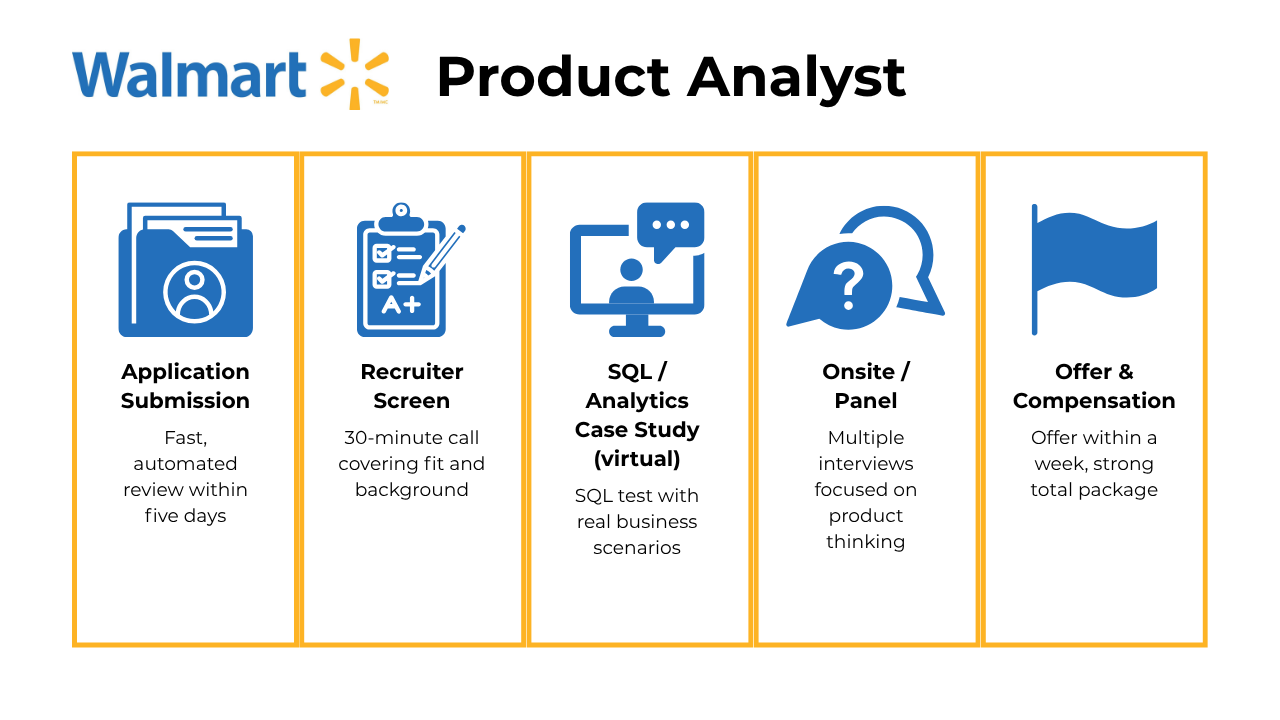
Walmart’s data-driven PM and analytics hiring loop—often called a selection lifecycle—emphasizes rigor, structure, and measurable outcomes. You’ll experience a process designed to objectively assess technical depth, business acumen, and culture fit, using interviewer scorecards and bar-raiser alignment to ensure only top-tier candidates move forward. The process usually entails:
- Application Submission
- Recruiter Screen
- SQL / Analytics Case Study (virtual)
- Onsite / Panel (product sense, exec read-out, behavioral)
- Offer & Compensation
Application Submission
You’ll start by submitting your resume and completing an online assessment on Walmart’s careers portal. This step is automated and can be completed in under an hour. Your application is then reviewed by a personnel associate or recruiter, who shortlists candidates based on role fit and business needs. Expect to hear back within 2–5 business days if you’re moving forward. For highly competitive roles, this stage may take up to a week due to volume, but Walmart’s system is optimized for speed, especially for tech and analytics positions.
Recruiter Screen
Within 1–3 days of being shortlisted, you’ll have a 30-minute video or phone call with a recruiter. This conversation is your chance to showcase your background, motivation, and alignment with Walmart’s values. You’ll be asked about your resume, past projects, and why you’re interested in Walmart. The recruiter will also gauge your communication skills and clarify the role’s expectations. If you’re a good fit, you’ll be scheduled for the technical assessment within a week. This is also the best time to ask about team structure, culture, and next steps.
SQL / Analytics Case Study (virtual)
Usually within a week of your recruiter screen, you’ll receive a technical assessment—either a timed online test or a take-home case study. Expect SQL challenges, data manipulation tasks, and scenario-based questions on A/B testing, statistics, and product metrics. You might be asked to analyze a dataset, design an experiment, or solve a real-world business problem using Python or SQL. For some roles, you’ll present your findings in a follow-up video interview. This stage tests your ability to extract insights, communicate clearly, and connect analytics to business outcomes. The turnaround is rapid: feedback is often provided within 2–4 days.
Onsite / Panel (product sense, exec read-out, behavioral)
If you pass the technical round, you’ll be invited to a panel or onsite interview, typically scheduled within 1–2 weeks. This round consists of 3–5 interviews with product managers, analysts, engineers, and sometimes senior leadership. You’ll tackle product sense case studies, present executive-level read-outs of your analyses, and answer behavioral questions using the STAR method. Expect deep dives into your past projects, problem-solving approach, and ability to influence without authority. The process is highly structured, with interviewer scorecards and bar-raiser alignment to ensure consistency and fairness. Results are consolidated within 2–5 business days.
Offer & Compensation
If you clear the panel, you’ll receive a verbal offer within 3–7 days, followed by a written offer package. Compensation discussions include base salary, performance bonus, stock grants, and benefits. For most product analytics roles, total compensation is highly competitive, with rapid negotiation timelines—offers are often finalized within a week. After acceptance, you’ll complete background checks and onboarding, typically starting within 2–4 weeks of your offer.
Behind the Scenes: Interviewer Scorecards & Bar-Raiser Alignment
Each interviewer completes a scorecard evaluating your technical, analytical, and leadership skills. One bar-raiser ensures you meet Walmart’s high standards and can veto a hire. After interviews, a debrief panel reviews all scorecards to make a fair, data-driven decision. This structured process reduces bias and ensures consistency.
Differences by Level: Junior Analyst vs. Manager vs. Principal Analyst
Junior analysts face technical and skills-based questions with a focus on coachability, usually completing the process in 2–3 weeks. Managers are tested on product sense and stakeholder leadership. Principal analysts undergo the most rigorous process—lasting 4–6 weeks—with executive meetings and emphasis on strategic influence and long-term impact.
Challenge
Check your skills...
How prepared are you for working as a Product Analyst at Walmart?
What Questions Are Asked in a Walmart Product Analytics Interview?
In a typical interview for Walmart’s e-commerce product analytics, you’ll face a mix of technical, product, and communication-based questions designed to assess how you extract insights, shape decisions, and drive business outcomes through data.
SQL / Quantitative Questions
Expect hands-on SQL questions and quantitative challenges that test your ability to manipulate large datasets, calculate metrics, and draw actionable conclusions using analytical tools:
1. Find the second longest flight between each pair of cities
To solve this, use a Common Table Expression (CTE) to normalize the source and destination locations, ensuring each pair of cities is treated as the same regardless of order. Then, calculate the flight duration and rank the flights by duration within each city pair. Finally, filter for the second-ranked flight and order the results by flight ID.
2. Find the five lowest-paid employees who have completed at least three projects
To solve this, join the employees and projects tables using an INNER JOIN to associate employees with their projects. Use GROUP BY and HAVING to filter employees who completed at least three projects (End_dt is not NULL). Finally, order the results by salary in ascending order and limit the output to the lowest five employees.
3. Given a table exam_scores, form a new table to track the scores for each student
To solve this, use SQL’s conditional aggregation to pivot the data. Apply IF or CASE WHEN statements to filter scores for specific exams, and then use SUM to aggregate these scores grouped by student_id. This ensures each student has a single row with their scores for all exams.
To solve this, transform the payments table to combine sender and recipient data into one column. Then calculate the time difference between transactions and user sign-up dates, filter for users who signed up in January 2020 and transactions within their first 30 days, and sum successful transactions. Finally, count users whose total transaction volume exceeds $100.
To solve this, join the events and transactions tables to count transactions for users who interacted (liked or commented). Then, compare this with transactions for users who did not interact by using a LEFT JOIN and filtering for NULL values in the events table. Ensure equal sample sizes for statistical significance and consider potential causation issues like time spent on the website.
Product Sense & Experiment Design Questions
You’ll be asked to break down ambiguous product problems, design experiments, and define success using clear hypotheses, user metrics, and thoughtful trade-offs:
6. How would you make a control group and test group to account for network effects?
To account for network effects in testing the close friends feature on Instagram Stories, a per-user assignment fails due to higher-order effects. Instead, a per-community assignment can be used, where communities are defined using social graph partitioning algorithms to isolate groups. Alternatively, masking the feature for control users or simulating spillover effects can help maintain a traditional testing framework.
To recommend UI changes, analyze user event data to identify patterns in user behavior, such as drop-off points, frequently accessed features, and navigation paths. Use metrics like session duration, click-through rates, and heatmaps to pinpoint areas of improvement. Combine quantitative data with qualitative insights to propose actionable UI enhancements.
To validate this change, analyze user behavior data to understand how often items in the trash are restored, the average number of items in the trash, and the percentage of users recovering items after 30 days. Additionally, assess the cost savings from reduced storage needs and potential revenue impact from users upgrading storage plans due to the change.
9. How would you determine the overall impact of the integration on Prime Music subscriptions?
To measure the impact, analyze subscription trends before and after the integration using metrics like subscription growth rate, retention rate, and user engagement. Conduct A/B testing or compare regions with Alexa integration to those without, and assess changes in user behavior and subscription numbers.
To address this issue, investigate factors such as cultural differences, language barriers, marketing strategies, and user behavior in the new country. Analyze app usage data, user feedback, and competitor performance to identify specific challenges and opportunities for improvement.
Executive Storytelling Questions
This section evaluates how clearly you communicate complex findings, influence stakeholders, and frame insights to align with business strategy and decision-making needs:
11. How comfortable are you presenting your insights?
At Walmart, product analysts frequently collaborate with stakeholders across merchandising, supply chain, and tech teams. Therefore, strong communication skills are essential. In your answer, explain how you prepare insights that align with business goals. Describe how you tailor your message depending on whether you are speaking to an engineer, a store manager, or a senior executive. Mention tools you might use like Power BI, Tableau, or Google Slides. Include an example where you presented a data story, either in-person or remotely, that led to a decision on product assortment, pricing, or inventory planning.
12. Describe an analytics experiment that you designed. How were you able to measure success?
Walmart relies heavily on data experimentation to drive changes in product placement, online features, or promotions. A good response would describe a clear hypothesis, such as testing whether a personalized product recommendation increased online conversions. Then, walk through how you defined key success metrics like click-through rate, average basket size, or gross margin. Describe how you designed an A/B test or used pre-post analysis. Finally, explain how you interpreted the results and communicated your recommendation to stakeholders.
Given Walmart’s large and diverse teams, misalignment can easily happen between data teams and business units. A strong answer would describe a situation where technical language or assumptions led to confusion. For instance, maybe you shared a dashboard with store operations leaders who needed simpler insights. Describe how you recognized the gap, clarified terminology, and adjusted your approach. Emphasize how you learned to anticipate your audience’s needs and use accessible visuals or summaries in future meetings.
14. How would you convey insights and the methods you use to a non-technical audience?
At Walmart, many stakeholders are not data experts but make decisions based on your analysis. Start by explaining how you identify the audience’s business goals first. Then, describe how you simplify complex methods. For example, when using clustering to segment customers, you could say, “We grouped similar shopping behaviors to understand who prefers curbside pickup versus in-store visits.” Visual aids and analogies also help make methods relatable. End by showing how these simplified explanations helped teams make actionable decisions.
15. How do you prioritize multiple deadlines?
Walmart’s fast-paced environment means product analysts must juggle multiple competing tasks, such as building dashboards, analyzing experiments, and answering ad hoc business questions. In your answer, describe how you list tasks, assess urgency and impact, and communicate with stakeholders to align on priorities. Mention how you use tools like JIRA, Excel trackers, or Notion to stay organized. Include an example of how you managed time during a peak season like Black Friday, when demand for insights is especially high.
How to Prepare for a Product Analytics Role at Walmart
To excel in a Walmart product analytics interview, you need a blend of technical mastery, business acumen, and communication finesse. Begin by mastering advanced SQL and BigQuery—these are essential for extracting, joining, and transforming large datasets, as you’ll be tested on complex queries and real-world data manipulation. Dedicate at least two weeks to daily SQL practice, focusing on window functions, subqueries, and optimization. Walmart’s technical screens often include scenario-based SQL questions and live coding, so simulate these conditions in your prep.
Next, study key retail KPIs such as conversion rate and basket size. Understand how to calculate, interpret, and use them to drive business decisions. Spend several days reviewing retail analytics case studies and practice articulating how metrics like average transaction value, inventory turnover, and gross profit inform product strategy at scale. Walmart values candidates who can link data insights to tangible business outcomes. Practice those with our AI Interviewer.
Practice metric-driven product cases by working through A/B testing scenarios, experiment design, and product sense questions. Allocate a week to solving mock analytics cases, emphasizing clear hypotheses and actionable recommendations. Build executive-level read-out decks summarizing your findings—Walmart’s interview loop often includes a presentation segment, so rehearse concise, visually compelling slides with a strong narrative.
Finally, schedule mock interviews with peers or mentors and seek targeted feedback. Aim for at least three rounds, focusing on both technical and behavioral questions. Iterative practice and honest critique will sharpen your responses and boost your confidence for the real interview.
FAQs
What salary range can Product Analysts expect at Walmart?
Average Base Salary
Average Total Compensation
Does the role overlap with Product Experience Management?
Yes, there is meaningful overlap with Walmart product experience management. As a product analyst, you will often partner with experience managers to analyze user behavior, optimize features, and align product insights with customer experience goals. Your work directly influences how Walmart designs and evolves digital and in-store experiences.
How long is the interview timeline?
The typical interview timeline spans 3 to 5 weeks from initial screening to final decision. Junior roles may move faster, while more senior roles—especially those involving executive interviews—can take longer.
Conclusion
Preparing for a Walmart product analytics interview takes more than just technical know-how. You need sharp SQL skills, clear product thinking, and strong communication. To see what success looks like, check out Hanna Lee’s Success Story. If you’re unsure where to start, follow our step-by-step analytics learning path designed to build your confidence and skills. And when you’re ready to test yourself, dive into this full product analyst question collection to practice across SQL, product sense, and storytelling. With the right prep, you’re not just ready—you’re positioned to stand out.
Walmart Interview Questions
| Question | Topic | Difficulty | ||||||||||||||||||||||
|---|---|---|---|---|---|---|---|---|---|---|---|---|---|---|---|---|---|---|---|---|---|---|---|---|
SQL | Easy | |||||||||||||||||||||||
Write a SQL query to select the 2nd highest salary in the engineering department. Note: If more than one person shares the highest salary, the query should select the next highest salary. Example: Input:
Output:
| ||||||||||||||||||||||||
SQL | Easy | |||||||||||||||||||||||
SQL | Medium | |||||||||||||||||||||||
SQL | Easy | |
Machine Learning | Medium | |
Statistics | Medium | |
SQL | Hard | |
Machine Learning | Medium | |
Python | Easy | |
Deep Learning | Hard | |
SQL | Medium | |
Statistics | Easy | |
Machine Learning | Hard |
Discussion & Interview Experiences