
Roblox Data Analyst Interview Guide: Process, Tips & Questions (2026)


Introduction
Roblox data analysts play a key role in understanding platform behavior across millions of daily active users, from creator marketplace trends to real time safety signals. The demand for skilled analysts continues to rise across the broader tech industry, with the U.S. Bureau of Labor Statistics projecting more than 30 percent growth in data roles through 2032. At companies operating at Roblox’s scale, this growth is paired with increasing selectivity.
The Roblox data analyst interview tests whether you can reason clearly through event data, design thoughtful metrics, and connect analytical insights to user experience and platform integrity. This guide simplifies that preparation by breaking down each stage of the Roblox data analyst interview, the most common Roblox interview questions , and the strategies top candidates use to succeed. It is designed to give you clarity, direction, and the confidence to walk into every round fully prepared.
Roblox Data Analyst Interview Process
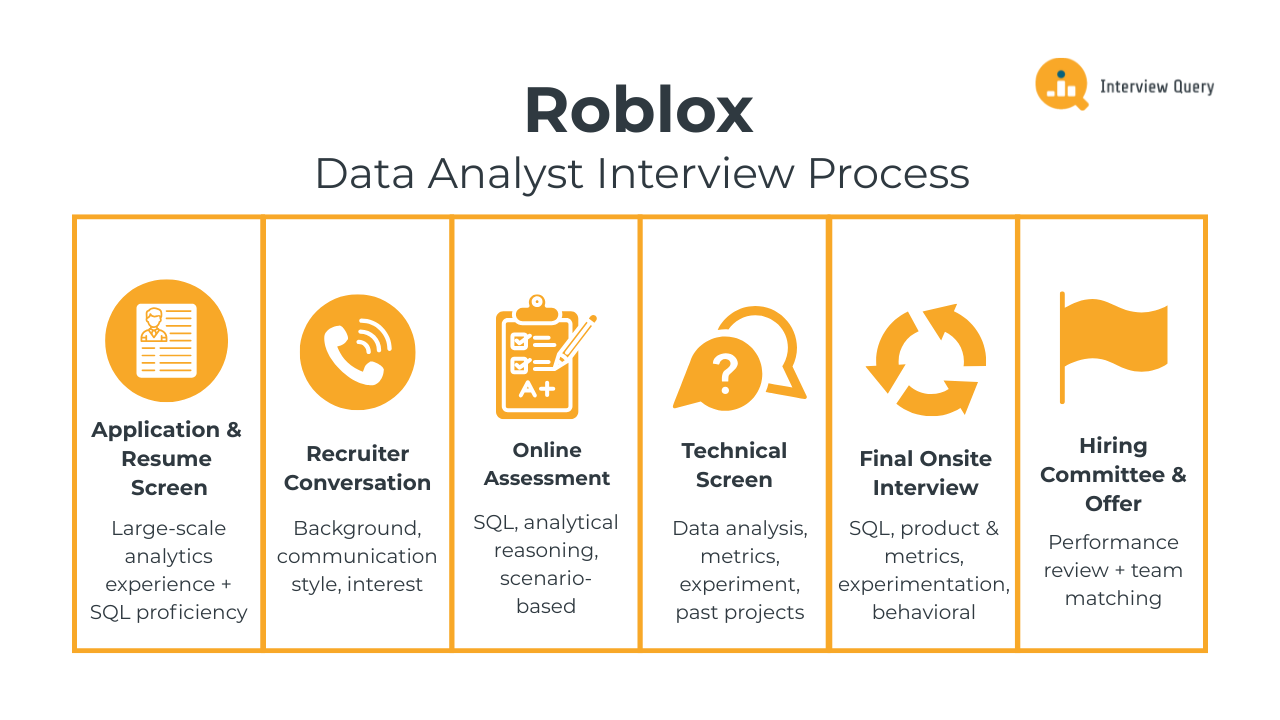
The Roblox data analyst interview process evaluates how well you can interpret complex event data, design meaningful metrics, reason about platform and user safety, and communicate insights that influence product decisions. Candidates typically move through several rounds focused on SQL, experimentation, applied analytics, and behavioral alignment with Roblox’s collaborative and safety driven culture. Most applicants complete the full process within three to six weeks depending on team availability and role level. Below is a breakdown of each stage and what Roblox interviewers look for throughout the process.
Application and Resume Screen
Recruiters begin by looking for experience with large scale analytics, strong SQL proficiency, familiarity with experimentation, and exposure to user behavior analysis or trust and safety domains. Resumes that show measurable impact, such as improvements to engagement, funnel performance, anomaly detection, or real time reporting, tend to move forward more quickly. Since Roblox relies heavily on event based telemetry, showcasing work with similar datasets is valuable.
Tip: Quantify your accomplishments with clear metrics such as retention improvements, reduced false positives in anomaly detection, or increased accuracy in experiment measurement.
Initial Recruiter Conversation
This conversation is a short, non technical discussion focused on your background, communication style, and interest in Roblox. Recruiters confirm your experience with SQL, dashboards, experimentation, and cross functional collaboration. They may also ask about location preferences, team interests, and salary expectations. The goal is to assess whether your experience aligns with the type of analytical work done at Roblox.
Tip: Prepare a concise two minute narrative that connects your past analytics work to why you want to help understand user behavior and platform health at Roblox.
Online Assessment
Many candidates complete Roblox’s online assessment early in the process. This timed evaluation includes SQL challenges, analytical reasoning, and scenario based questions that mimic Roblox’s real data environment. You may analyze funnel steps, interpret anomalous patterns, or compare engagement across user segments. The assessment tests both correctness and structured thinking under time constraints.
Tip: Practice SQL in a plain text environment and review common patterns such as window functions, conditional aggregations, and event log analysis.
Technical Screen
The technical phone interview typically includes SQL data analysis, metric definition, experiment reasoning, and discussion of prior analytics projects. Interviewers assess your ability to write organized queries, break down ambiguous problems, and clearly explain your assumptions. Expect questions around session behavior, creator marketplace health, or safety related anomalies.
Tip: Before writing any query, restate the problem, list the steps you plan to take, and confirm your interpretation with the interviewer.
Final Onsite Interview
The onsite loop, conducted virtually or in person, is the most comprehensive stage. It often includes four to five interviews covering SQL, applied analytics, product thinking, experiment design, and behavioral fit.
SQL and data analysis round: You will work through multi step queries on event based datasets, examine retention trends, or diagnose issues related to platform health. Interviewers look for clean logic, edge case awareness, and the ability to extract actionable insights.
Tip: Think aloud as you structure your query. It shows clarity and reduces mistakes.
Product and metrics round: This interview focuses on defining success metrics, proposing improvements, and reasoning through user behavior. Common scenarios include evaluating changes in onboarding, assessing creator marketplace features, or defining metrics for a new communication tool.
Tip: Tie every metric to a user group, an objective, and a business or safety impact.
Experimentation and case interview: You may design an experiment, analyze unexpected treatment effects, or investigate shifts in platform usage. Interviewers evaluate how you reason through uncertainty and how well you structure your approach.
Tip: Begin by clarifying the goal, the user segment involved, and the primary and secondary metrics.
Behavioral and collaboration round: These conversations assess communication, ownership, and teamwork. Expect questions about handling ambiguous requirements, navigating disagreements, or leading analysis under deadlines. Roblox values proactive communication and user centric thinking.
Tip: Use the STAR method to provide clear, structured stories and emphasize what you learned.
Hiring Committee and Offer
After all interviews are complete, a hiring committee reviews your performance holistically. They consider your technical strength, problem solving ability, communication clarity, and alignment with Roblox’s culture. If approved, you are matched to a team and extended an offer with level and compensation based on experience.
Tip: If you have strong preferences for particular product or safety teams, communicate them early so recruiters can factor them into the matching process.
Want realistic interview practice without scheduling or pressure? Try Interview Query’s AI Interviewer to simulate Roblox style data analyst interviews and get instant, targeted feedback before the real interview.
Challenge
Check your skills...
How prepared are you for working as a Data Analyst at Roblox?
Roblox Data Analyst Interview Questions
The Roblox data analyst interview includes a mix of SQL, event driven analytics, experimentation design, product reasoning, and scenario based safety and economy questions. These evaluate your ability to interpret complex behavioral data, define meaningful metrics, and communicate insights clearly in a fast moving environment. The goal is to understand not only your technical ability but also how you structure ambiguity, reason through platform scale challenges, and align decisions with user safety and experience quality.
Read more: Top 100+ Data Analyst Interview Questions
SQL and Technical Analytics Interview Questions
This part of the interview focuses on your ability to analyze large event logs, compute user behavior metrics, identify anomalies, and work with Roblox scale datasets. SQL questions often include retention tracking, funnel analysis, anomaly detection, and creator economy insights.
-
This question tests your ability to reason about ordered user state transitions, which is critical at Roblox when analyzing role progression, creator maturity, or user lifecycle stages. Roblox asks this to see if you can work with temporal data, identify sequential events, and avoid misattributing prior states. To solve it, you would partition user records by user ID, order by timestamp, use a window function like
LAG()to identify the previous role, filter users whose current role is “Data Scientist” and prior role is “Data Analyst,” then divide by the total number of users who became data scientists to compute the percentage.Tip: At Roblox, lifecycle questions often break when candidates ignore noisy or missing events. Call out how you handle duplicate titles, late arriving data, or users with gaps in history. This shows interviewers you think like someone who has worked with imperfect, real platform data.
-
This question evaluates your ability to construct sessions from raw event logs, a core task for Roblox analysts analyzing gameplay, onboarding, or engagement patterns. Roblox asks this because most platform insights depend on accurately grouping actions into sessions rather than treating events independently. The solution involves ordering events by user and timestamp, using
LAG()to calculate time gaps, flagging new sessions when the gap exceeds 60 minutes, and then applying a cumulativeSUM()over that flag to generate session IDs.Tip: Go beyond mechanics and explain why Roblox cares about sessionization. Strong candidates tie session logic directly to downstream metrics like retention, monetization, and safety signals, showing they understand how one definition can shift business conclusions.
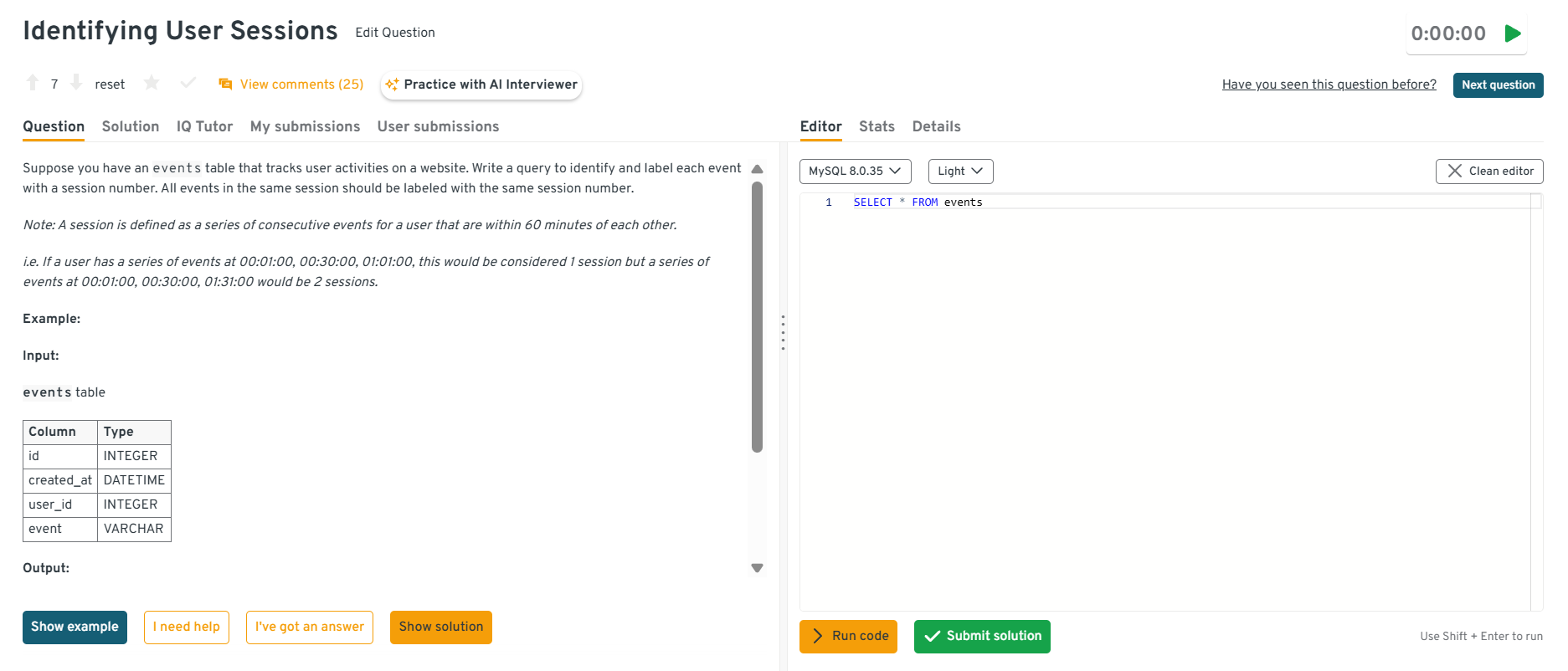
Head to the Interview Query dashboard to practice the full set of Roblox interview questions. With built-in code testing, performance analytics, and AI-guided tips, it’s one of the best ways to sharpen your skills for Roblox’s data analytics interviews.
How would you detect experiences with abnormal drops in purchase conversion compared to the previous week?
This question tests your ability to monitor platform health and identify early warning signals in the Roblox economy. Analysts are expected to detect issues like broken monetization flows, pricing bugs, or unintended experiment effects. To answer, you would calculate weekly conversion rates per experience, join current and prior weeks, compute percentage change, and flag experiences whose drop exceeds a defined threshold. You should also explain validating whether the drop is localized or platform wide before escalation.
Tip: Roblox interviewers want to hear how you separate signal from noise. Mention minimum volume thresholds, confidence intervals, or comparing against experience specific baselines rather than global averages. This demonstrates judgment in deciding what is actually worth escalating.
-
This question assesses your ability to bucket users into meaningful engagement segments, which Roblox uses to understand casual versus power players. Roblox asks this to see whether you can translate raw counts into interpretable segments that drive product decisions. The solution involves aggregating game play counts per user, applying conditional logic using
CASE WHEN, and counting users in each bucket.Tip: Explain why these buckets matter, not just how to compute them. At Roblox, engagement segments often map to different retention curves and monetization behavior. Showing awareness of how segmentation informs decisions makes your answer feel grounded in real analysis.
-
This question evaluates your understanding of window functions for leaderboard style analytics, which are common at Roblox for creators, experiences, and feature usage. Roblox uses this pattern to identify top contributors or detect unusual activity spikes. You would partition by date, order users by download count descending, apply
ROW_NUMBER()orRANK(), and filter to the top three per day.Tip: Call out how leaderboards can be misleading at Roblox scale. Mention tie handling, volatility, or how you would smooth rankings over time to avoid reacting to one day spikes. This signals maturity in interpreting ranked outputs, not just generating them.
If you want to master SQL interview questions, join Interview Query to access our 14-Day SQL Study Plan, a structured two-week roadmap that helps you build SQL mastery through daily hands-on exercises, real interview problems, and guided solutions. It’s designed to strengthen your query logic, boost analytical thinking, and get you fully prepared for your next data analytics interview.
Experimentation and A/B Testing Interview Questions
Roblox runs experiments across onboarding, safety systems, marketplace discovery, and engagement features at massive scale. These questions evaluate how well you design controlled tests, reason about noisy results, and protect user experience in environments where metrics can shift quickly.
How would you design an experiment to test whether a new onboarding tutorial improves early retention?
This question tests your ability to design clean experiments around first time user experiences, which are critical to Roblox’s long term growth. Roblox asks this to see if you can define retention clearly, randomize users correctly, and set guardrails for performance and safety. To answer, you would define the target cohort, assign users randomly to control and treatment, measure day one and day seven retention, and track guardrails like latency or error rates. Segment analysis by age group is essential because onboarding behavior varies widely.
Tip: At Roblox, onboarding experiments often fail when candidates ignore cohort leakage and novelty effects. Call out how you would freeze the cohort at first touch and evaluate retention alongside later quality signals like session depth. This shows you understand long term player value, not just short term lifts.
-
This question evaluates your understanding of hypothesis testing for proportion based metrics, which Roblox uses frequently for feature discovery and onboarding surfaces. Roblox asks this to ensure you can distinguish real impact from random noise. You would define null and alternative hypotheses, calculate standard errors for both groups, run a two proportion test or z test, and interpret p values and confidence intervals while checking randomization balance.
Tip: Strong Roblox candidates go beyond p values and discuss practical significance. Mention how small CTR lifts can be misleading at scale and why confidence intervals and expected downstream impact matter more than binary significance decisions.
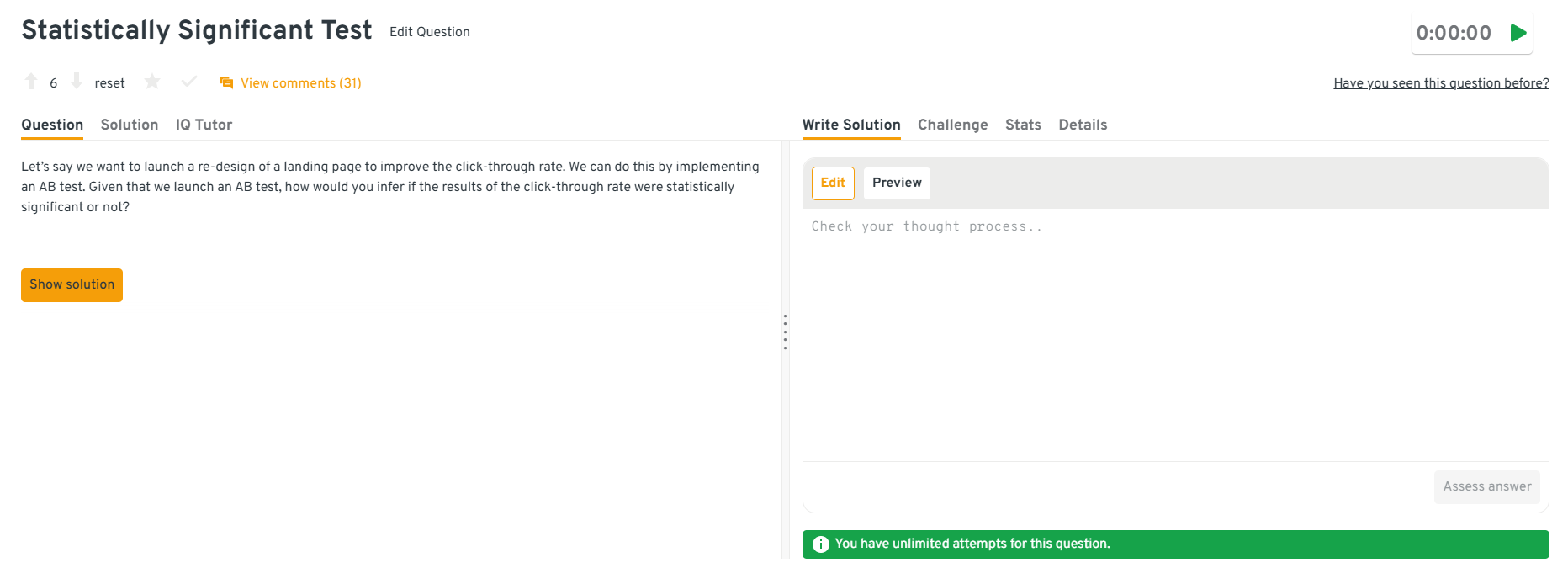
Head to the Interview Query dashboard to practice the full set of Roblox interview questions. With built-in code testing, performance analytics, and AI-guided tips, it’s one of the best ways to sharpen your skills for Roblox’s data analytics interviews.
-
This question tests your ability to reason about trends in metrics that naturally fluctuate, such as daily active users or purchases. Roblox asks this to see if you can separate real shifts from seasonality or noise. To answer, you would model historical variance, compare the current change against expected variation, and use confidence intervals or hypothesis tests while controlling for seasonality effects.
Tip: Roblox interviewers look for analysts who respect time series structure. Explicitly mention adjusting for seasonality, launch cycles, or school calendar effects. This signals that you will not overreact to normal platform volatility.
-
This question assesses your ability to define success for complex product systems like experience discovery. Roblox asks this because search quality affects engagement, fairness, and creator visibility. A strong answer outlines online metrics such as click through rate, downstream engagement, and retention, along with offline relevance metrics and guardrails like latency. You would compare performance using controlled experiments and segment results by user type.
Tip: Emphasize trade-offs rather than a single winner metric. At Roblox, improving search relevance for a few experiences can harm discovery for others. Calling out how you monitor creator diversity and long tail exposure demonstrates ecosystem-level thinking.
How would you evaluate whether a new recommendation module improves creator marketplace fairness?
This question tests your ability to think beyond engagement and consider ecosystem health, which is a core Roblox priority. Roblox asks this to see if you can reason about exposure distribution and long term incentives. To solve it, you would track how impressions, clicks, and revenue are distributed across creators, measure changes in concentration, and compare incremental gains for smaller creators versus top performers.
Tip: Roblox interviewers expect you to articulate fairness quantitatively. Mention tracking exposure concentration over time and validating that gains persist beyond initial rollout. This shows maturity in evaluating systemic effects, not just one-time experiment results.
Watch next: Top 5 Insider Interview Questions Data Analysts Must Master Before Any Interview!
This breakdown by Interview Query founder Jay Feng covers the five most common data analyst interview questions and how to answer them with clarity, structure, and insight. For Roblox data analysts, it is especially useful for strengthening fundamentals around metric definition, event driven reasoning, and communicating insights clearly, all of which are heavily tested in Roblox interviews focused on user behavior, platform health, and experimentation.
Roblox Specific Scenario Based Interview Questions
These scenario questions test domain awareness of Roblox’s platform, creator economy, and safety systems. They also evaluate how well you reason through ambiguous real world problems.
How would you identify unfair monetization patterns in the creator marketplace?
This question tests your ability to analyze marketplace fairness, which is critical to sustaining Roblox’s creator ecosystem. Roblox asks this to ensure analysts can detect whether a small subset of creators is receiving disproportionate value due to ranking bias or system effects. To answer, you would analyze revenue, impressions, and engagement distributions while controlling for creator size, experience category, and session quality, then look for concentration shifts over time.
Tip: Call out how you would quantify concentration risk using distribution metrics like Gini or top-percent share. This shows Roblox interviewers that you can reason about ecosystem health and incentives, not just surface-level revenue metrics.
How would you detect if a sudden spike in sessions is driven by bots instead of real users?
This question evaluates anomaly detection and platform safety reasoning. Roblox asks it because artificial activity can distort metrics and harm trust. You would analyze session frequency, event timing patterns, device and network signatures, and funnel completion rates, then compare them to historical baselines for real users. Combining multiple signals helps distinguish automation from organic growth.
Tip: Emphasize triangulating multiple weak signals instead of relying on one heuristic. This demonstrates safety-minded thinking and statistical skepticism, both critical for Roblox’s trust and platform integrity teams.
If avatar rendering latency increases by fifteen percent, how would you diagnose the root cause?
This tests your ability to investigate performance regressions that directly impact user experience. Roblox asks this to see if you can isolate issues across a complex client ecosystem. You would segment latency by device type, operating system, geography, and recent feature launches, then compare against historical benchmarks to identify correlated changes.
Tip: Explain how you would isolate variables before forming conclusions. This highlights structured root-cause analysis, a key skill for analysts working on performance regressions at Roblox’s scale.
What metrics would you track to evaluate chat safety interventions?
This question assesses how you balance safety effectiveness with user experience. Roblox asks this because safety systems must reduce harm without over penalizing normal behavior. You would track flagged message rates, precision and false positives, mute or ban actions, appeal outcomes, and downstream engagement to ensure interventions are accurate and proportionate.
Tip: Explicitly discuss the trade-off between enforcement accuracy and user experience. This signals judgment and responsibility, showing you understand that safety metrics must balance harm reduction with player trust.
How would you forecast daily active users across different age groups?
This question tests cohort based forecasting and domain awareness. Roblox asks it because age groups behave differently and require tailored analysis. You would segment users by age, analyze historical seasonality and growth trends per cohort, and build separate forecasts that account for lifecycle changes and platform initiatives.
Tip: Stress why cohort-specific models outperform global forecasts. This shows statistical maturity and domain awareness, especially important at Roblox where age drives behavior, engagement, and safety policies.
Need personalized guidance on your interview strategy? Explore Interview Query’s Coaching Program that pairs you with mentors to refine your prep and build confidence.
Behavioral Interview Questions
Roblox behavioral interview questions for data analysts focus on how you think and operate beyond technical execution, especially in situations where data informs decisions that affect player experience, creator trust, and platform safety. Interviewers look for clear reasoning, ownership, and the ability to turn analysis into aligned action across teams.
Tell me about a time you used data to identify a problem impacting user experience.
Interviewers ask this to understand how you use data to uncover real issues, prioritize impact, and drive change. At Roblox, analysts are expected to proactively identify friction in user journeys and influence product or safety decisions with evidence.
Sample Answer: In a previous role, I noticed a drop in early session completion for new users. After analyzing event logs, I found that load times on older devices had increased by roughly 18 percent following a recent release. I partnered with engineering to isolate the cause and prioritize fixes. After deployment, day one retention for affected users improved by 24 percent compared to the previous week, versus a 7 percent lift in the control cohort.
Tip: Always quantify the before-and-after impact. Roblox interviewers expect concrete metrics, comparisons, and time frames to validate your results.
How would you convey insights and the methods you use to a non-technical audience?
This question tests your ability to translate complex analysis into clear, actionable insights. Roblox analysts regularly present findings to product managers, designers, and safety teams who need outcomes, not technical detail.
Sample Answer: When presenting an analysis, I start with the question we were trying to answer and the decision it supports. I use simple visuals and plain language to explain what changed and why it matters, avoiding technical jargon unless asked. This keeps stakeholders focused on impact rather than methodology.
Tip: Quantify business impact, not just clarity. Numbers help non-technical stakeholders understand why your work matters.
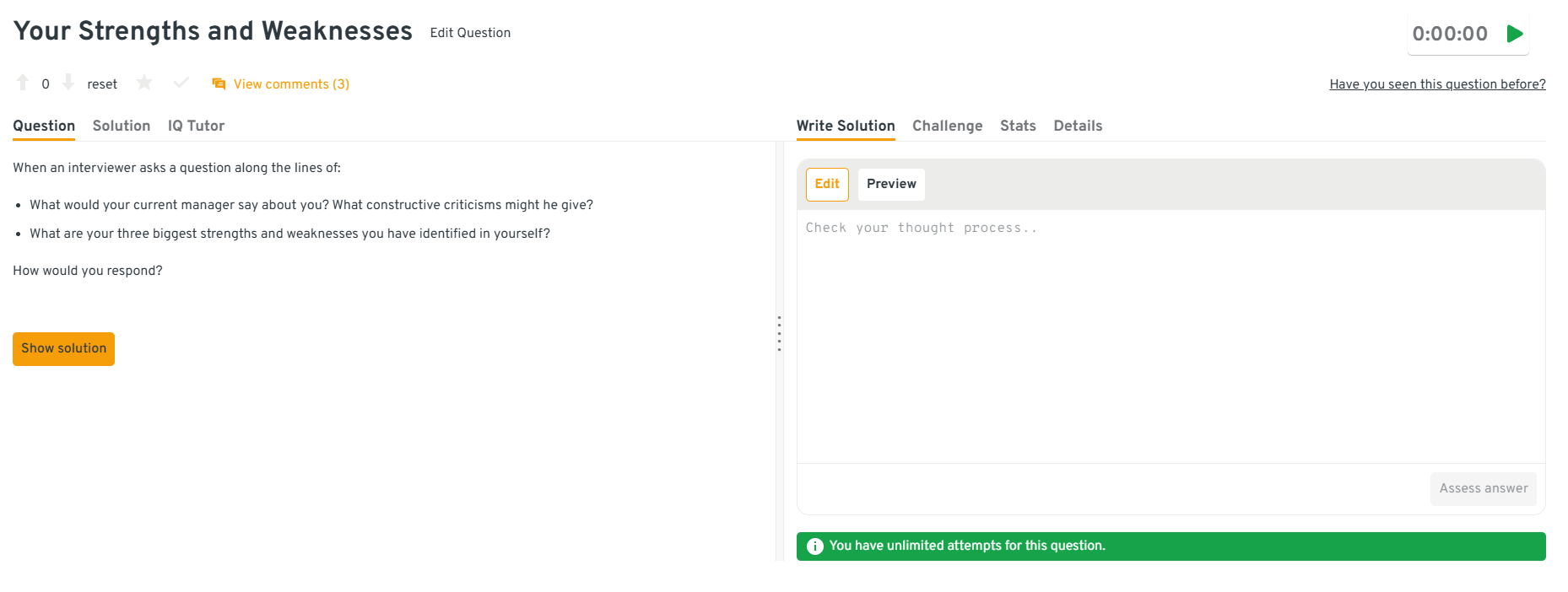
What do you tell an interviewer when they ask you what your strengths and weaknesses are?
Interviewers ask this to assess self awareness and growth mindset. Roblox values analysts who know where they excel and actively work on areas for improvement.
Sample Answer: One of my strengths is breaking down ambiguous problems into structured analyses, which helped reduce investigation time on platform issues by about 30 percent. A weakness I identified early was over-polishing analyses. I addressed this by aligning earlier with stakeholders, which shortened delivery timelines without sacrificing accuracy.
Tip: Tie strengths to measurable outcomes and show clear progress on weaknesses. Growth without evidence feels theoretical.
Head to the Interview Query dashboard to practice the full set of Roblox interview questions. With built-in code testing, performance analytics, and AI-guided tips, it’s one of the best ways to sharpen your skills for Roblox’s data analytics interviews.
Describe how you collaborate with engineering when data quality issues arise.
This question evaluates cross functional collaboration and ownership. Roblox analysts often partner closely with engineers to resolve data gaps that affect metrics and decisions.
Sample Answer: When I encounter a data issue, I first validate it with concrete examples and quantify the impact. In one case, incorrect event logging affected about 12 percent of sessions. I worked with engineering to trace the root cause, confirm expected behavior, and validate the fix before dashboards were updated.
Tip: Quantifying impact shows judgment and helps teams prioritize fixes faster.
Tell me about a time you navigated conflicting priorities between teams.
Interviewers ask this to see how you balance competing needs using data and communication. Roblox analysts often sit between product, safety, and growth teams with different goals.
Sample Answer: I once worked with two teams that wanted opposing changes to the same metric. I modeled the expected impact for each approach and showed that one option improved short-term engagement by 5 percent but increased safety flags by 18 percent. We agreed on a phased rollout that preserved safety while testing engagement gains.
Tip: Use numbers to frame trade-offs. Roblox interviewers look for analysts who quantify consequences, not just mediate opinions.
Looking for hands-on problem-solving? Test your skills with real-world challenges from top companies. Ideal for sharpening your thinking before interviews and showcasing your problem solving ability.
What Does a Roblox Data Analyst Do?
A Roblox data analyst helps shape the systems, features, and safety frameworks that support one of the largest user generated content platforms in the world. Analysts work across product, economy, trust and safety, and growth teams to interpret large scale event data and uncover insights that guide product decisions. The role centers on clarity, statistical rigor, and an ability to translate complex behavioral signals into actions that improve player experiences and creator success.
How Roblox Data Analysts Turn Work into Impact
| What They Work On | Core Skills Used | Tools And Methods | Why It Matters At Roblox |
|---|---|---|---|
| Player behavior and engagement analysis | SQL analysis, cohort analysis, metric definition | Event logs, window functions, funnels | Helps improve retention, session quality, and overall player experience |
| Creator marketplace and monetization insights | Segmentation, distribution analysis, fairness reasoning | Aggregations, percentile metrics, dashboards | Ensures sustainable creator incentives and marketplace health |
| Experiment design and evaluation | Experimentation design, statistical reasoning | A/B testing frameworks, confidence intervals | Validates product changes without harming safety or engagement |
| Trust and safety analytics | Anomaly detection, pattern recognition | Time series analysis, alerts, dashboards | Detects abuse, spam, and harmful behavior early |
| Performance and platform health monitoring | Root cause analysis, trend analysis | Monitoring dashboards, baseline comparisons | Identifies regressions that impact gameplay and reliability |
| Cross functional decision support | Communication, storytelling, prioritization | Visualizations, written insights | Aligns product, engineering, and safety teams around data driven decisions |
How to Prepare For a Roblox Data Analyst Interview
Preparing for the Roblox data analyst interview means strengthening how you reason through data, think about platform dynamics, and communicate insights clearly. Since Roblox deals with real time user behavior, creator economy signals, and safety sensitive data, top candidates show structured thinking, domain awareness, and strong analytical judgment.
Build platform and domain intuition: Learn how Roblox’s user sessions, creator marketplace, and safety systems interact so you can reason through real scenarios with confidence. Focus on understanding age based behavior differences, creator exposure patterns, and common safety signals such as spam or rapid message bursts.
Tip: Don’t just read posts. Practice explaining one Roblox system end to end, such as how a player discovers an experience and how data would surface issues along that path. This shows platform-level thinking, not memorization.
Understand how Roblox teams use metrics: Many interview questions assess how you define and interpret metrics. Practice framing metrics by objective, user segment, and time horizon so you can explain not only what to measure but why it matters.
Tip: Build a simple checklist for metric design including primary metric, guardrails, and possible unintended effects. For every metric you propose, mention how it could be misleading and what guardrail you would add. This signals analytical judgment.
Strengthen structured problem solving: Roblox interviewers look at how you break down ambiguous problems before touching any data. Practice outlining hypotheses, first steps, and expected outcomes in a clear, linear way.
Tip: Time yourself explaining a case question to simulate interview pacing. Say your structure out loud before solving. Interviewers care more about how you think than whether you land on the perfect answer.
Refine your experiment intuition: Roblox experiments span onboarding, performance, and safety interventions. Review the essentials of experiment framing, metric selection, and handling conflicting segment results.
Tip: Practice mapping out a simple experiment on any feature you use regularly and explain the trade offs. At Roblox scale, a lift in one segment can harm another. Calling this out shows senior-level experimentation thinking.
Improve clarity in communication: Strong communication is essential because analysts partner with engineering, product, and safety teams. Focus on simplifying explanations and summarizing conclusions in a way that drives decisions.
Tip: Record a two minute summary of a past analytics project and refine it until it feels crisp and structured. End every explanation with a recommendation. Roblox interviewers expect analysts to move conversations forward, not just report findings.
Practice realistic interview simulations: Mock interviews reveal patterns in your reasoning and communication that you can quickly correct. Use them to test your pacing, structure, and clarity under pressure.
Use Interview Query’s Coaching Program to rehearse Roblox style cases with targeted feedback.
Tip: Treat mocks like real interviews. After each one, write down where you hesitated or rambled. Eliminating those moments is often the biggest improvement lever.
Struggling with take-home assignments? Get structured practice with Interview Query’s Take-Home Test Prep and learn how to ace real case studies.
Average Roblox Data Analyst Salary
Roblox’s compensation structure rewards analysts who can interpret large scale event data, support product and safety teams, and drive insights across the creator economy. Data analysts typically receive a competitive base salary, performance based bonuses, and substantial equity grants. Your total compensation depends on level, location, team scope, and experience working with complex analytical environments. Most candidates interviewing for data analyst roles fall into mid level bands due to the cross functional nature of analytics at Roblox.
Read more: Data Analyst Salary
Tip: Confirm the target level with your recruiter early, because leveling determines compensation bands and expectations for technical depth.
Roblox Data Analyst Compensation Overview (2025-2026)
| Level | Role Title | Total Compensation (USD) | Base Salary | Bonus | Equity (RSUs / Year) | Signing / Relocation |
|---|---|---|---|---|---|---|
| IC1 | Data Analyst I (Entry Level) | $140K – $165K | $110K–$125K | Performance based | $20K–$30K | Occasional for specific roles |
| IC2 | Data Analyst II / Mid Level | $165K – $200K | $130K–$150K | Performance based | $30K–$50K | Offered case by case |
| IC3 | Senior Data Analyst | $200K – $255K | $150K–$175K | Above target possible | $50K–$75K | More common for senior candidates |
Note: These ranges are aggregated from 2025 data on Levels.fyi, Glassdoor, public Roblox job postings, and Interview Query’s internal salary database.
Tip: Anchor your value through measurable impact such as improvements to onboarding metrics, safety insights, or creator engagement, to receive competitive packages.
Average Base Salary
Negotiation Tips That Work For Roblox
Negotiating with Roblox works best when you approach discussions with data and clarity. Roblox evaluates compensation holistically, including long term equity potential, so understanding the full structure of the offer is essential.
- Clarify your level early: Compensation varies significantly between IC1, IC2, and IC3, especially in equity size. Leveling often has a larger effect on total pay than any individual component.
- Use market benchmarks: Reference verified sources such as Levels.fyi and Interview Query salary data when framing expectations.
- Factor in location adjustments: Pay differs across the Bay Area, Seattle, and remote roles. Confirm the location specific band before negotiation and ask how equity refreshers are determined.
Tip: Request a full breakdown including base, bonus target, annual equity value, vesting schedule, and any signing incentives so you can negotiate from an informed position.
FAQs
How Long Does The Roblox Data Analyst Interview Process Take?
Most candidates complete the process within three to six weeks, depending on team availability and the number of interview stages involved. Timelines can extend if multiple teams are reviewing your profile or if additional calibration is required. Recruiters typically share clear next steps after each round so you know what to expect.
Does Roblox Use Online Assessments?
Yes, many candidates are asked to complete the online assessment, which focuses on SQL, analytical reasoning, and structured problem solving. This step is more common for early career roles, while mid level and senior candidates may move directly to live technical interviews. The format can vary slightly by team.
Do I Need Gaming or Roblox Experience To Get The Role?
No, prior gaming or Roblox specific experience is not required. Roblox hires analysts from industries like e commerce, fintech, social platforms, and marketplaces. What matters most is your ability to reason through user behavior, define metrics clearly, and communicate insights effectively.
How Hard Are Roblox’s SQL Questions?
Roblox’s SQL questions are moderately challenging and heavily grounded in real world scenarios. Expect problems involving event logs, retention windows, funnels, and anomaly detection rather than abstract puzzles. Interviewers care more about structured thinking and clean logic than advanced syntax.
Does Roblox Use Take Home Assignments?
Some teams include a short take home exercise or case study, usually centered on exploratory analysis or metric definition. These assignments are evaluated on clarity, reasoning, and how well you communicate assumptions and next steps. They are designed to mirror real analytical work at Roblox.
What Background Do Most Roblox Data Analysts Come From?
Roblox data analysts commonly come from product analytics, growth analytics, trust and safety, and marketplace focused roles. Experience working with experimentation, user behavior data, or large scale event streams is especially valuable. Domain depth can vary by team.
How Much Product Knowledge Do I Need Before Interviewing?
You should understand Roblox’s core user journey, creator ecosystem, and major platform features at a high level. Interviewers do not expect deep domain expertise but look for curiosity, logical reasoning, and the ability to ask the right clarifying questions during cases.
What Does Roblox Look For Beyond Technical Skills?
Roblox places strong emphasis on communication, collaboration, and judgment. Analysts are expected to influence decisions across product, engineering, and safety teams, often under ambiguity. Showing ownership, clarity, and user focused thinking can significantly strengthen your candidacy.
How Should I Prepare For Roblox’s Safety And Platform Focus?
You should be comfortable reasoning about metrics that affect user trust, fairness, and experience quality. This includes thinking about false positives, unintended side effects, and long term ecosystem health. Interviewers value candidates who balance growth with responsibility.
Become a Roblox Data Analyst with Interview Query
Preparing for the Roblox data analyst interview means building strong analytical reasoning, clear communication, and a deep understanding of how large scale user behavior informs product, safety, and creator economy decisions. By studying Roblox’s interview structure, practicing event driven analytics, honing your experimentation intuition, and refining your ability to explain insights clearly, you can approach every stage with confidence.
For targeted practice, explore the full Interview Query question bank, try the AI Interviewer, or work with a mentor through Interview Query’s Coaching Program to sharpen your approach and stand out in Roblox’s data analyst hiring process.
Roblox Interview Questions
| Question | Topic | Difficulty |
|---|---|---|
A/B Testing | Easy | |
A team wants to A/B test multiple different changes through a sign-up funnel. For example, on a page, a button is currently red and at the top of the page. They want to see if changing a button from red to blue and/or from the top of the page to the bottom of the page will increase click-through. How would you set up this test? | ||
Statistics | Easy | |
Product Sense & Metrics | Medium | |
SQL | Easy | |
Machine Learning | Medium | |
Statistics | Medium | |
SQL | Hard | |
Machine Learning | Medium | |
Python | Easy | |
Deep Learning | Hard | |
SQL | Medium | |
Statistics | Easy | |
Machine Learning | Hard |
Discussion & Interview Experiences