
Roblox Machine Learning Engineer Interview Guide: Process, Tips & Questions (2026)


Introduction
Machine learning engineering is experiencing rapid expansion, with the global machine learning market projected to grow at more than 38 percent annually through 2030. At companies like Roblox, this demand rises even faster as the platform scales personalization, safety modeling, and content understanding for more than seventy million daily users. The result is a highly competitive hiring environment where only a small share of applicants progress past initial screens due to Roblox’s focus on real time systems, safety centric modeling, and strong engineering fundamentals.
Most candidates are not held back by technical skill, but by uncertainty about what Roblox evaluates and how its interview process differs from traditional machine learning roles. This interview guide resolves that gap and clearly breaks down the Roblox machine learning engineer interview, outlines the most asked Roblox specific interview questions, and highlights the preparation strategies that help top candidates stand out with confidence.
Roblox Machine Learning Engineer Interview Process
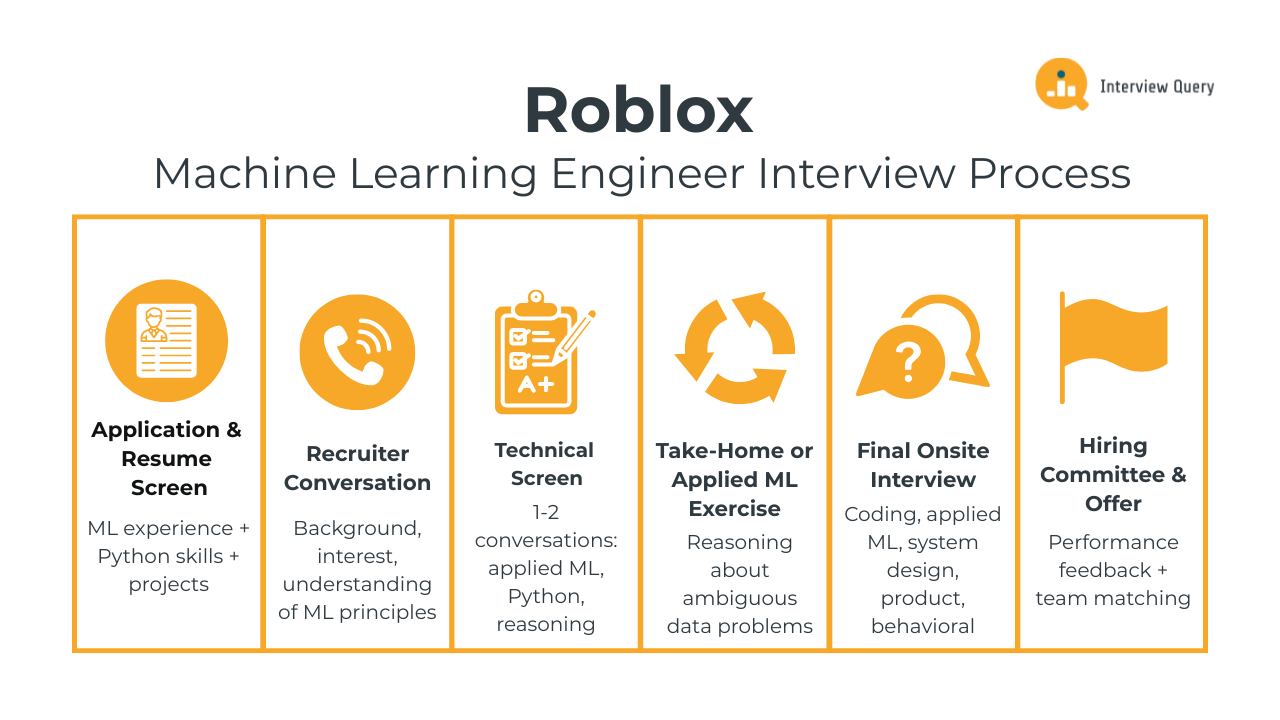
The Roblox machine learning engineer interview process evaluates your ability to build scalable models, work with unstructured and fast evolving data, and design systems that operate reliably for millions of concurrent users. Candidates are assessed on machine learning fundamentals, system thinking, analytical clarity, and communication. The full process typically spans several rounds and evaluates how you approach modeling, safety, experimentation, and large scale engineering challenges. Below is a breakdown of each stage and what Roblox interviewers consistently look for throughout the process.
Application and Resume Screen
Recruiters look for experience building machine learning models at scale, strong Python skills, and familiarity with ranking systems, recommendation pipelines, or trust and safety classification. Projects that highlight measurable impact, such as improved model accuracy, latency reductions, or meaningful safety improvements, stand out. Roblox also values experience working with unstructured data such as text, images, and 3D assets, since their ecosystem requires multimodal modeling.
Tip: Quantify impact in terms Roblox actually cares about. Instead of generic accuracy improvements, frame results around ranking quality, creator exposure, moderation precision, or latency at scale.
For example, “reduced false positives in a safety classifier by X percent” or “cut inference latency under peak traffic by Y milliseconds.” These signals map directly to Roblox’s production constraints.
Initial Recruiter Conversation
This call is a short, non technical discussion about your background, interest in Roblox, and understanding of machine learning principles. Recruiters confirm alignment with team needs, such as personalization, search, or safety modeling. They may also ask about your experience working in collaborative environments, your familiarity with large scale data, and your expectations regarding location or compensation.
Tip: Recruiters listen closely for whether you understand Roblox as a platform, not just a company. A candidate who can explain why ML decisions affect creators and players differently immediately stands out from those giving generic personalization answers.
Technical Screen
The technical screen typically includes one or two conversations focused on applied machine learning, Python coding, and reasoning through data driven problems. You may be asked to walk through an end to end modeling project, demonstrate how you design features for noisy data, implement a simple function in Python, or analyze how you would measure model quality. Interviewers often explore your approach to handling drift, choosing evaluation metrics, and debugging production behavior.
Tip: When walking through past projects, explicitly call out what broke in production and how you fixed it. Roblox interviewers care deeply about failure modes because our data shifts constantly.
Take Home Assignment or Applied ML Exercise
Some teams include a short take home assignment to evaluate how you reason about ambiguous data problems. You might outline a modeling approach for content understanding, propose signals for a ranking model, or describe how you would evaluate a safety classifier. The emphasis is on clarity, structure, and thoughtful trade offs rather than building a perfect model.
Tip: Treat the assignment like an internal design doc, not a homework submission. Clearly state what you would not ship yet, where human review is required, and what metrics you would watch after launch. At Roblox, good ML engineers are judged as much by what they choose to delay as what they build.
Final Onsite Interview
The onsite loop consists of four to five interviews that explore your technical depth, collaboration style, and ability to build robust systems. Each round focuses on a different dimension of the role.
Coding and data manipulation round: Expect Python exercises involving data cleaning, feature extraction, or implementing components of a modeling workflow. Interviewers look for readable code, structured thinking, and awareness of edge cases.
Tip: Optimize for readability over cleverness. Roblox codebases are large and collaborative, and interviewers prefer a clear, debuggable solution to a dense one. Explicit variable names and simple control flow signal that your code will survive real production debugging.
Applied machine learning round: This round focuses on end to end modeling. You may design a classification or ranking pipeline, discuss trade offs between model families, or explain how you would monitor performance at scale.
Tip: Always articulate how you would validate a model after launch. Roblox systems frequently behave differently online due to player behavior, creator incentives, or adversarial misuse. Interviewers expect you to discuss shadow testing, guardrails, and rollback plans, not just training metrics.
ML system design round: You will design a large scale machine learning system such as a real time personalization service, safety detection pipeline, or multimodal embedding service. Interviewers evaluate your ability to design for latency, scalability, and reliability.
Tip: Design with traffic spikes in mind. Roblox usage is highly bursty around launches, events, and trends. Explicitly mention backpressure, graceful degradation, and fallback heuristics. Candidates who ignore these realities signal academic thinking rather than platform readiness.
Product and collaboration round: This session evaluates how you communicate with cross functional teams and translate technical decisions into user or business outcomes. Expect questions about trade offs, prioritization, and partnering with engineering and product teams.
Tip: Frame decisions in terms of ecosystem impact. Roblox interviewers want to hear how a change affects creators, players, and trust simultaneously. Showing that you understand second order effects, such as how ranking changes influence creator behavior, is a strong differentiator.
Behavioral and values round: Roblox values collaboration, clarity, and responsible decision making. Interviewers assess how you handle ambiguity, navigate challenges, and work with diverse partners across engineering, trust and safety, and product.
Tip: Use the STAR method to structure stories clearly and emphasize what you learned. Choose examples where you slowed things down, not just shipped fast. Roblox values responsible decision making, especially around safety and fairness. Stories where you paused a launch, added guardrails, or challenged assumptions resonate far more than speed-only wins.
Hiring Committee and Offer
After the onsite, each interviewer submits feedback independently. A hiring committee reviews the full packet, evaluates your performance across all rounds, and determines the final recommendation. Successful candidates receive an offer that reflects level, experience, and team fit. You may be matched to groups focused on recommendation systems, search, creator tools, or trust and safety depending on your strengths and interests.
Tip: Be transparent about which problems you want to work on. Roblox teams value strong alignment, and candidates who clearly articulate interest in search, safety, personalization, or creator tooling are easier to place successfully. Vague preferences often delay offers more than technical gaps.
Want to build up your machine learning interview skills? Practice real hands-on problems on the Interview Query Dashboard and start getting interview ready today.
Challenge
Check your skills...
How prepared are you for working as a ML Engineer at Roblox?
Roblox Machine Learning Engineer Interview Questions
The Roblox machine learning engineer interview includes a mix of applied modeling questions, machine learning fundamentals, large scale system reasoning, and collaborative problem solving. These questions evaluate how well you understand the complexities of a massive user generated platform, including safety detection, search relevance, recommendation quality, and real time inference under heavy load. The goal is not only to assess your technical depth but also to understand how you reason through ambiguity, structure your approach, and communicate decisions clearly.
Read more: 80+ Python ML Interview Questions
Machine Learning Fundamentals and Modeling Questions
Machine learning questions at Roblox focus on your ability to design, evaluate, and improve models that operate in dynamic environments with constantly changing user behavior. Roblox interviewers assess whether you can justify modeling decisions for real world systems that support discovery, safety, and creator ecosystems at massive scale.
How would you justify the complexity of building a neural network?
This question tests whether you can explain complex modeling choices in a product driven, stakeholder facing environment. At Roblox, neural networks are often justified when simpler models fail to capture non linear interactions in multimodal data such as text, images, and 3D assets. A strong answer explains that neural networks are chosen only when they produce meaningful gains in ranking quality, safety detection, or personalization that translate to better user experience or platform health. You should emphasize trade offs like interpretability, latency, and maintenance, and explain how you would validate that the added complexity is worth the cost.
Tip: At Roblox, justify neural networks only when simpler models fail across diverse creators and content types. Call out the specific nonlinear interactions captured and how you validated gains through online metrics, not just offline accuracy.
-
This question evaluates your understanding of training instability and reproducibility. At Roblox scale, models are sensitive to random initialization, sampling order, feature preprocessing, and hyperparameter choices. A strong answer explains sources of variance such as stochastic optimization, data shuffling, or feature leakage, and how these factors affect performance in production. You should also discuss how Roblox engineers mitigate this through controlled experiments, repeated training runs, robust validation, and monitoring to ensure consistent outcomes across deployments.
Tip: Mention how randomness becomes amplified at Roblox scale. Strong answers explain running multiple seeded trainings and shipping only models whose performance is stable across retrains, not best on a single run.
How would you handle concept drift for a model that adapts to fast changing creator content or player behavior?
This question tests whether you can maintain model reliability in a constantly evolving ecosystem. Roblox asks this because new games, assets, and behaviors appear daily, making drift unavoidable. A strong answer explains how you would detect drift through distribution monitoring, performance decay, or feature stability checks, then respond with retraining schedules, rolling windows, or adaptive features. You should also explain how to avoid overreacting to short term noise while still responding quickly to real shifts.
Tip: Talk about event driven drift. Roblox sees sharp shifts after launches or trends, so explain how you monitor feature distributions tied to events and retrain selectively instead of on fixed schedules.
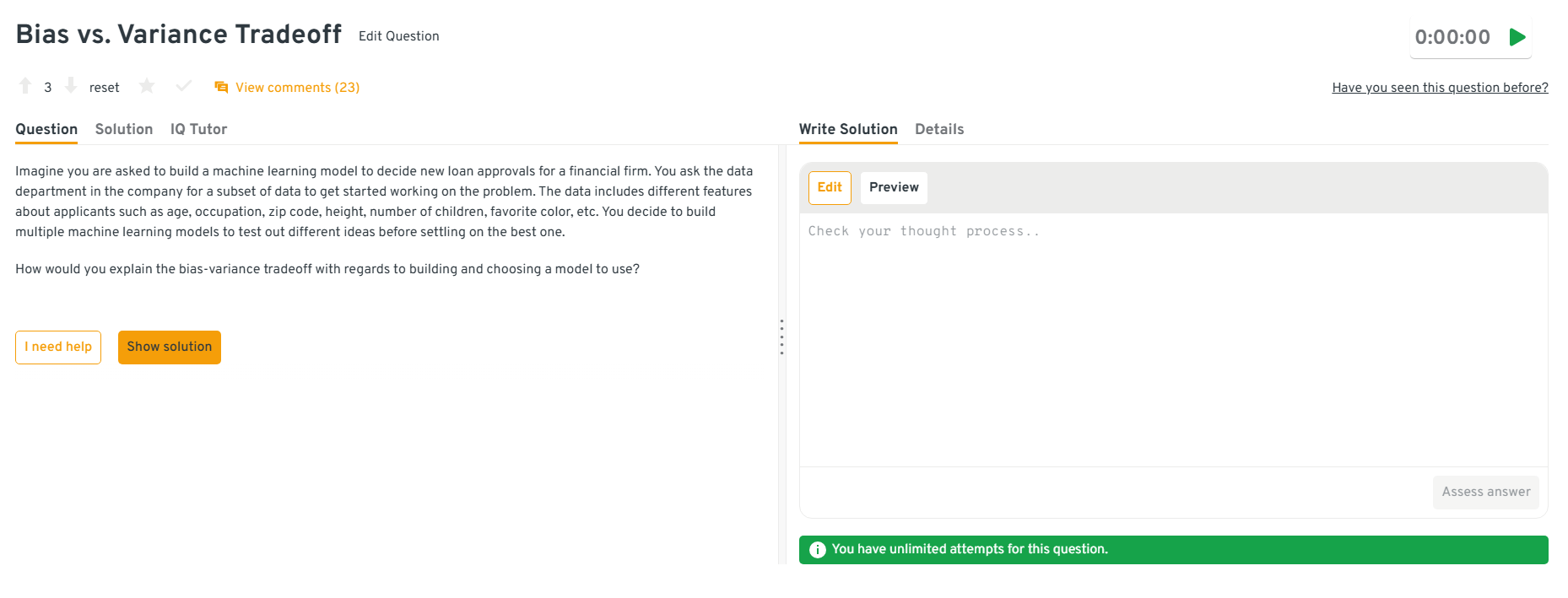
-
This question assesses whether you can balance model complexity with generalization. At Roblox, overly simple models may miss nuanced behavior across diverse user groups, while overly complex models risk instability and poor performance on new content. A strong answer explains how you would choose complexity based on data volume, noise level, and downstream risk, using validation curves and online testing to find the right balance. Roblox values engineers who can align model choices with platform scale and safety constraints.
Tip: Tie this to creator trust. At Roblox, high variance models can destabilize rankings overnight, so engineers often accept slightly higher bias to preserve consistency and ecosystem stability.
Head to the Interview Query dashboard to practice the full set of Roblox interview questions. With built-in code testing, performance analytics, and AI-guided tips, it’s one of the best ways to sharpen your skills for Roblox’s machine learning interviews.
How would you assess a clustering algorithm without pre-labeled data?
This question tests your ability to evaluate unsupervised learning in practical settings. Roblox uses clustering to understand creators, players, or content types where labels may not exist. A strong answer explains using internal metrics like silhouette score or cohesion, combined with qualitative inspection and downstream validation, such as whether clusters improve recommendation diversity or safety workflows. The key is showing that evaluation is tied to usefulness, not just mathematical separation.
Tip: Roblox cares less about silhouette scores and more about actionability. Explain how you would validate clusters by whether they improve moderation routing, discovery diversity, or creator segmentation decisions.
You have a categorical variable with thousands of distinct values; how would you encode it?
This question evaluates your ability to handle high cardinality features at scale. Roblox asks this because many platform signals, such as item IDs or creator attributes, have massive cardinality. A strong answer explains why naive one hot encoding fails and discusses alternatives like embeddings, hashing, or target based encodings depending on use case and leakage risk. You should explain how your choice balances memory, performance, and model stability in production systems.
Tip: Discuss operational impact. At Roblox, embedding choices affect memory, latency, and cold start behavior, so explain how you monitor embedding growth and serving cost, not just model accuracy.
Watch Next: How to Ace a Machine Learning Mock Interview - Design a recommendation engine
In this mock interview session, Ved, a PhD student and ML research scientist intern at LinkedIn, walks through a Roblox-style ML problem and demonstrates how to structure an answer the way Roblox interviewers expect. He breaks the prompt down into user signals, systemic feature design, modeling choices, evaluation metrics, and rollout considerations, while clearly explaining trade offs around scale, latency, and reliability. The walkthrough mirrors how Roblox machine learning engineers reason about real production problems, making it a strong reference for practicing clear, end-to-end thinking in ML interviews.
ML System Design and Scalability Questions
These questions evaluate how you design machine learning systems that operate reliably at Roblox scale, where latency, consistency, and safety directly affect live user experiences. Interviewers focus on your ability to reason end to end, make realistic trade offs, and design systems that can evolve as the platform grows.
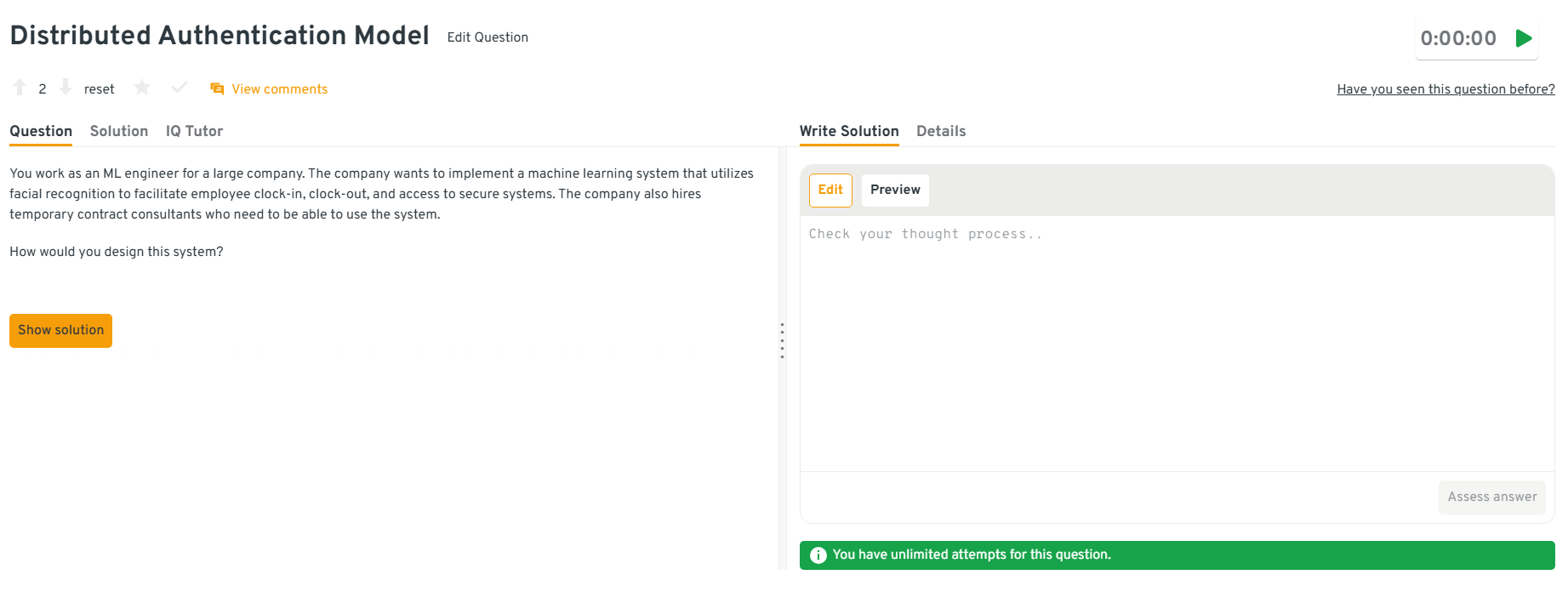
-
This question tests your ability to design a secure, distributed ML system with strict reliability and privacy constraints. Roblox asks this to evaluate how you think about authentication pipelines, model inference, data storage, and auditability at scale. A strong answer outlines identity enrollment, feature extraction, secure embedding storage, real time inference, fallback mechanisms, and monitoring for false accept and false reject rates. You should also address privacy safeguards, model updates, and failure handling to ensure access control remains safe and dependable.
Tip: At Roblox, reliability beats sophistication. Emphasize strict latency budgets, auditability, and safe fallbacks when models fail. Interviewers expect you to prioritize access safety and human override paths over model cleverness.
Head to the Interview Query dashboard to practice the full set of Roblox interview questions. With built-in code testing, performance analytics, and AI-guided tips, it’s one of the best ways to sharpen your skills for Roblox’s machine learning interviews.
How would you build a scalable vector search system for retrieving similar user generated items?
This question evaluates your understanding of large scale retrieval systems. Roblox relies on similarity search to power discovery across millions of assets. A strong answer explains embedding generation, approximate nearest neighbor indexing, sharding strategies, and balancing recall with latency. You should also discuss how new content is indexed continuously without disrupting queries and how retrieval quality is validated through downstream ranking performance.
Tip: Focus on freshness at scale. Roblox content changes constantly, so explain how you reindex incrementally, handle cold starts for new items, and prevent stale embeddings from degrading discovery quality.
Explain your approach to building an inference pipeline that handles millions of concurrent sessions.
This question tests your ability to design for peak traffic and reliability. Roblox asks this because inference latency directly affects live gameplay and discovery. A strong answer covers model serving architecture, horizontal scaling, request batching, caching hot predictions, and graceful degradation during spikes. You should also explain how you monitor latency, error rates, and model health across regions.
Tip: Design for spikes, not averages. Roblox traffic surges during launches and trends, so highlight graceful degradation, caching strategies, and clear latency monitoring tied directly to user experience.
How would you build the recommendation algorithm for type-ahead search model?
This question evaluates how you combine retrieval, ranking, and real time signals. At Roblox, type ahead search must be fast, relevant, and safe. A strong answer explains candidate generation using prefix matching or embeddings, lightweight ranking models optimized for low latency, and the use of contextual signals like recent activity or trending experiences. You should also discuss filtering unsafe or low quality results before ranking.
Tip: Latency is the product. At Roblox, type ahead must feel instant, so emphasize lightweight ranking, aggressive pruning, and early filtering of unsafe or low quality content before deeper scoring.
-
This question tests whether you understand evaluation beyond offline accuracy. Roblox asks this to assess how you monitor classifiers that affect trust and communication. A strong answer explains using precision, recall, false positive rates, and user impact metrics, combined with ongoing monitoring for drift and feedback loops. You should also discuss how thresholds are tuned to balance safety with user experience.
Tip: Prioritize trust over precision. Roblox cares deeply about false positives that disrupt communication, so explain how you tune thresholds conservatively and monitor long term user impact, not just short term accuracy.
Want realistic ML interview practice without scheduling or pressure? Try Interview Query’s AI Interviewer to simulate Roblox style coding, modeling, and system design questions and get instant, targeted feedback.
Coding and Algorithmic Exercises
Coding questions at Roblox evaluate whether you can translate machine learning concepts into clean, reliable implementations that would actually hold up in production systems. Interviewers focus on clarity, vectorized thinking, numerical stability, and how you reason about performance and correctness at scale.
-
This question tests whether you understand optimization beyond library calls. Roblox asks this to assess how well you reason about training loops, convergence, and numerical behavior, which matter when debugging real models at scale. A strong answer explains vectorized computation of gradients, iterative updates of parameters, and tracking loss across epochs to confirm convergence. You should also discuss learning rate choice and stopping conditions to ensure stability as data distributions shift.
Tip: Roblox cares about training loop hygiene. Mention vectorized gradients, loss tracking per epoch, and a clear stopping rule so you can debug convergence when data shifts or scaling changes.
-
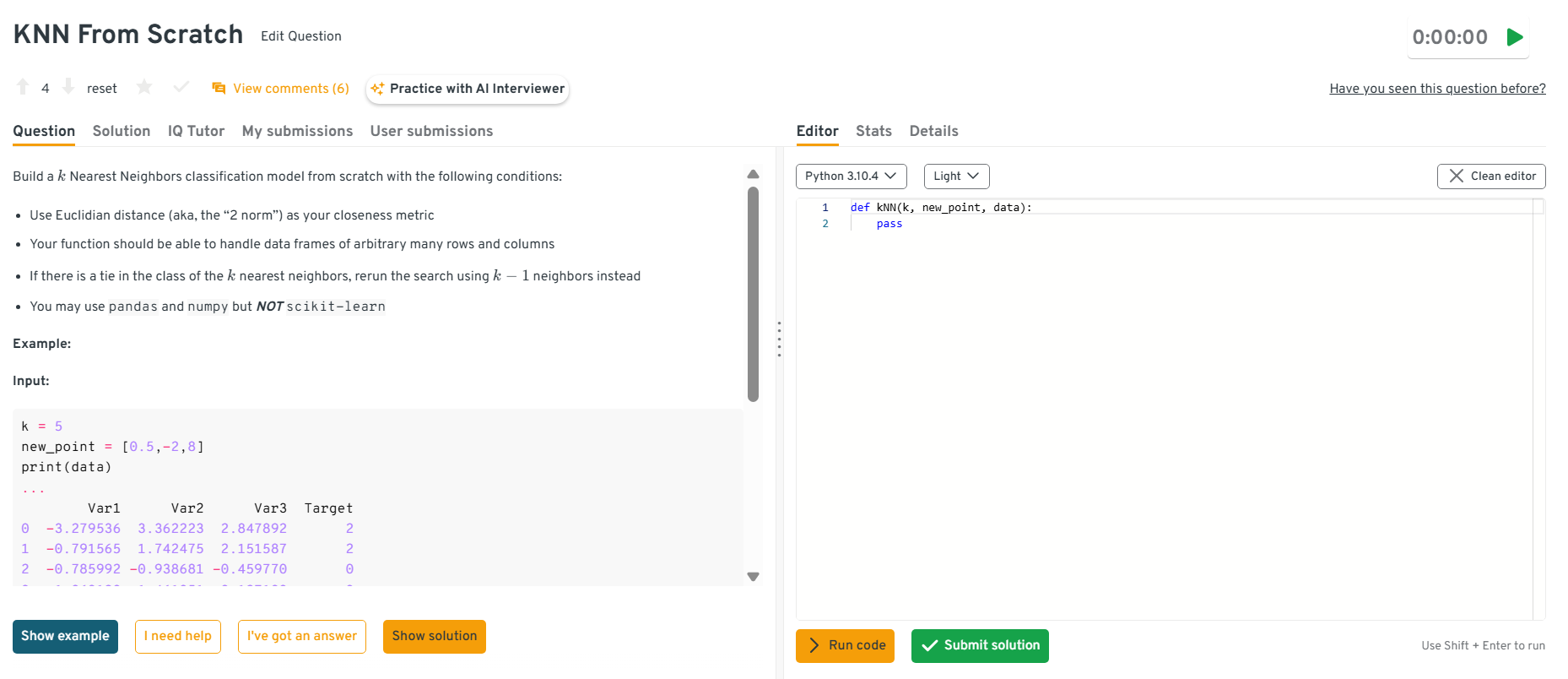
This question evaluates your grasp of distance based methods and computational trade offs. At Roblox, nearest neighbor style logic appears in similarity search, retrieval, and fallback ranking strategies. A strong answer walks through computing pairwise distances efficiently, sorting or selecting top k neighbors, and performing majority voting. You should also explain why naive implementations do not scale and how indexing or approximation would be needed in real systems.
Tip: Call out why naive KNN breaks at Roblox scale. Explain how you would avoid full pairwise distance computation in practice, such as approximate neighbors or candidate pruning for retrieval-style use cases.
Head to the Interview Query dashboard to practice the full set of Roblox interview questions. With built-in code testing, performance analytics, and AI-guided tips, it’s one of the best ways to sharpen your skills for Roblox’s machine learning interviews.
-
This question tests your ability to connect algorithms to real world constraints. Roblox asks this to see if you can justify model choice based on data complexity and interpretability. A strong answer explains bootstrapping, feature randomness, and variance reduction, then contrasts this with logistic regression’s simplicity and speed. You should explain when non linear interactions justify extra complexity and when latency or interpretability concerns favor simpler models.
Tip: Anchor the choice in production constraints. At Roblox, random forests can be great for fast, robust baselines, but you should mention when you would prefer logistic regression for interpretability, latency, or easier monitoring.
-
This question evaluates your understanding of probabilistic modeling and training mechanics. Roblox values engineers who can debug and modify core training logic when needed. A strong answer explains computing logits, applying the sigmoid function, calculating log likelihood, and updating weights via gradient descent. You should also mention numerical stability techniques and regularization hooks to prevent overfitting in noisy data environments.
Tip: Roblox interviewers love numerical stability awareness. Mention stable sigmoid or log-loss handling, regularization hooks, and how you would verify gradients and convergence before trusting the weights.
-
This question tests algorithmic thinking and convergence reasoning. Roblox uses clustering for user behavior analysis and content grouping where labels may not exist. A strong answer explains centroid initialization, vectorized distance computation, reassignment, and convergence checks. You should also address edge cases like empty clusters and explain how initialization affects stability and runtime.
Tip: Focus on stability across runs. Mention initialization strategy, handling empty clusters, and a convergence check that prevents oscillation, since Roblox cares about consistent outputs in repeated pipelines.
Looking for hands-on problem-solving? Test your skills with real-world challenges from top companies. Ideal for sharpening your thinking before interviews and showcasing your problem solving ability.
Behavioral Interview Questions
Roblox uses behavioral questions to evaluate how you collaborate, communicate, and make decisions in a fast moving, safety sensitive environment. Interviewers want to understand how you handle ambiguity, take ownership, and balance technical judgment with user and creator impact.
Tell me about a time you managed risk or uncertainty in a modeling decision.
Interviewers ask this to assess how you make responsible decisions when data is incomplete or signals conflict. At Roblox, modeling choices can affect player safety, creator visibility, or trust across the platform, so engineers are expected to reason carefully about risk.
Sample Answer: I worked on a content ranking model designed to improve discovery for new creators, and while offline results showed a 6 percent engagement lift, early shadow testing revealed a 1.5 percent increase in safety false positives. Rather than pushing a full rollout, I proposed a staged launch limited to low risk segments, added real time monitoring on moderation metrics, and implemented a human review fallback for edge cases. This approach allowed us to retain a 4 percent engagement gain while keeping safety regressions below baseline, and we later expanded rollout once thresholds were refined.
Tip: At Roblox, risk is rarely theoretical. Anchor your answer in how you protected players or creators while learning safely, such as staged rollouts, guardrails, or human review, rather than just improving a metric.
Describe a challenging collaboration with engineering or product and how you resolved it.
This question evaluates your ability to work cross functionally under competing priorities. Roblox engineers frequently partner with product, infrastructure, and safety teams, where trade offs are common. Interviewers want to see how you align on outcomes rather than winning arguments.
Sample Answer: Product wanted to launch a personalization update ahead of a seasonal event, while engineering raised concerns about missing monitoring coverage. I aligned both sides by presenting data from past launches that showed short term regressions without guardrails, proposed a phased rollout with clearly defined success metrics, and worked with engineering to set alert thresholds. We shipped to 30 percent of traffic on schedule, avoided regressions, and safely expanded within two weeks.
Tip: Roblox values engineers who de-escalate with data. Show how you reframed disagreements around shared success metrics or user impact instead of pushing a purely technical preference.
Tell me about a time a model deployment failed or underperformed. What did you learn?
Interviewers ask this to assess accountability and learning mindset. At Roblox scale, even well tested models can fail due to drift or unexpected user behavior. They want to see how you respond when things go wrong.
Sample Answer: I deployed a behavior classification model that performed well offline but underperformed in production, so I investigated and found feature leakage caused by delayed event logging. I rebuilt the validation pipeline to better mirror production timing and added stricter checks before launch. As a result, subsequent models improved online precision by 12 percent and reduced rollout risk across future deployments.
Tip: Focus on what you changed in the process afterward. Roblox interviewers care less about the failure and more about how you reduced future risk through better validation, monitoring, or rollout strategy.
-
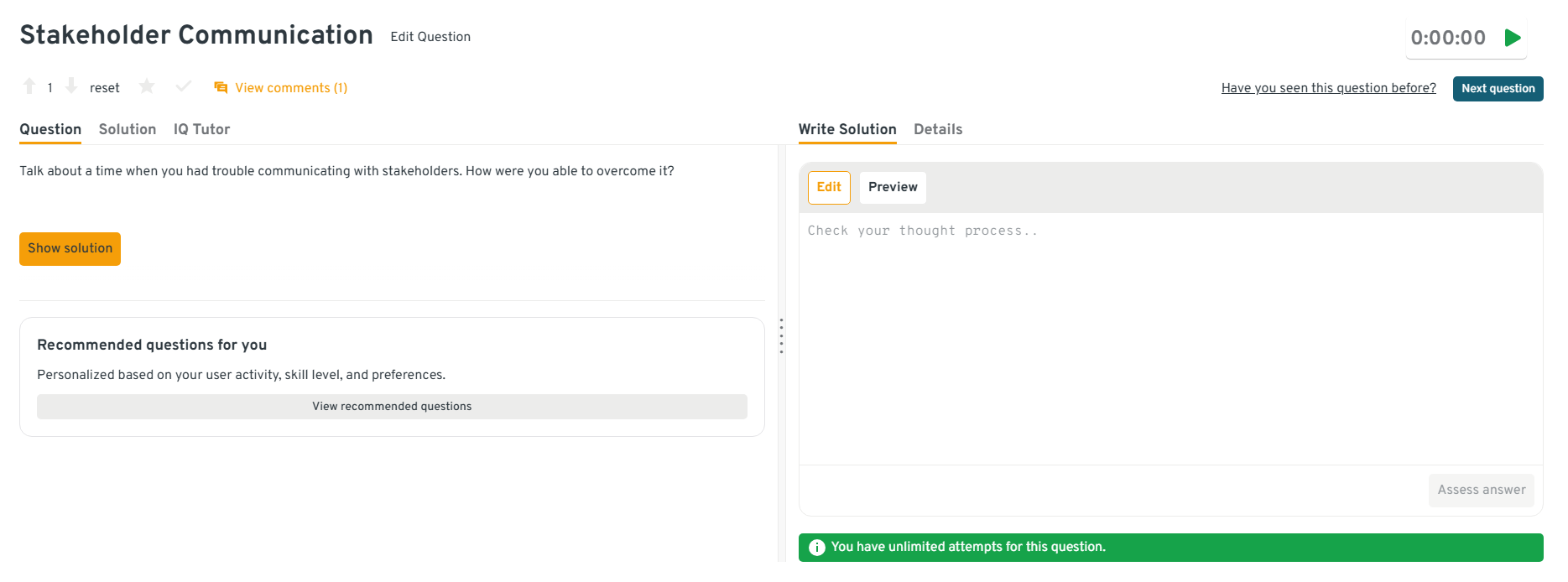
This question tests your ability to translate technical complexity into clear decisions. Roblox values engineers who can explain ML trade offs to non technical partners like safety or product teams.
Sample Answer: Stakeholders were pushing to launch a safety model despite incomplete data coverage, so I reframed the discussion away from technical metrics and toward potential player impact. I used simple visuals to show how false positives could affect communication flows and proposed a short delay to collect additional data. This led to a two week delay and a 20 percent reduction in false positives after launch.
Tip: Strong candidates show they can translate ML risk into product language. Emphasize how you shifted from technical metrics to player, creator, or trust impact to unlock alignment.
Head to the Interview Query dashboard to practice the full set of Roblox interview questions. With built-in code testing, performance analytics, and AI-guided tips, it’s one of the best ways to sharpen your skills for Roblox’s machine learning interviews.
Describe a time you mentored someone through a complex modeling problem.
Interviewers ask this to understand how you support others and raise the technical bar. Roblox values collaborative engineers who help teammates navigate complexity.
Sample Answer: A junior engineer was struggling to choose between two modeling approaches for a ranking problem, so I helped them break the decision down into data quality, evaluation metrics, and deployment constraints. I encouraged small experiments instead of committing early, which led them to deliver a model with a 5 percent engagement lift and apply the same framework to future projects.
Tip: Roblox values leverage. Highlight how you taught structured thinking or decision frameworks so the person could solve future problems independently, not just the one at hand.
Want to master the entire ML pipeline? Explore our ML Engineering 50 learning path to practice a curated set of machine learning questions designed to strengthen your modeling, coding, and system design skills.
What Does a Roblox Machine Learning Engineer Do?
A Roblox machine learning engineer builds the models and systems that power personalization, search relevance, safety moderation, content understanding, and creator ecosystem insights across the platform. The role sits at the intersection of large scale data, real time inference, and user generated content, supporting experiences for more than seventy million daily users. Engineers work across modeling, infrastructure, and experimentation to ensure every recommendation, ranking, and safety signal is accurate, fast, and reliable.
How Roblox Machine Learning Engineers Turn Work into Impact
| What They Work On | Core Skills Used | Tools And Methods | Why It Matters At Roblox |
|---|---|---|---|
| Search ranking and discovery | Ranking models, feature engineering, evaluation metrics | Offline validation, online experiments | Determines which games and creators are surfaced to players |
| Personalization and recommendations | Representation learning, embeddings, real time inference | Retrieval systems, lightweight ranking models | Drives engagement while balancing novelty and creator fairness |
| Trust and safety modeling | Classification, imbalance handling, risk reasoning | Threshold tuning, monitoring, staged rollouts | Protects players and maintains platform trust at scale |
| Multimodal content understanding | Deep learning, multimodal representations | Text, image, and 3D embeddings | Enables discovery and moderation across diverse content formats |
| Large scale ML infrastructure | System design, scalability, reliability | Model serving, caching, load balancing | Ensures low latency predictions during traffic spikes |
Tip: Roblox machine learning engineers are evaluated on judgment as much as technical skill. In interviews, emphasize how you balance model performance with safety, latency, and long term creator and player impact, not just accuracy improvements.
How to Prepare for a Roblox Machine Learning Engineer Interview
Preparing for the Roblox machine learning engineer interview requires more than reviewing algorithms or brushing up on system design patterns. You are preparing for a role that supports real time personalization, safety modeling, search relevance, and creator ecosystem intelligence across a massive user generated platform. Success in this interview depends on blending strong modeling instincts with scalable thinking, clear communication, and awareness of how machine learning shapes user experience at platform scale.
Below is a concise, structured guide to help you prepare effectively.
Deepen your understanding of real time and safety centric modeling: Roblox relies heavily on models that make rapid decisions in dynamic environments. Strengthen your intuition for handling noisy, fast changing data, designing guardrails, and evaluating safety sensitive predictions. Review approaches for drift detection, multimodal features, and low latency model selection.
Tip: Be ready to explain how you would stage, monitor, and roll back a safety model if creator behavior shifts unexpectedly after launch.
Study large scale ML system design principles: Roblox evaluates whether you can think in terms of high traffic, low latency infrastructure. Review concepts like feature storage, candidate retrieval, load balancing, caching layers, and monitoring strategies. Focus on the end to end reasoning rather than specific tools.
Tip: Practice narrating how your system behaves during traffic spikes from game launches or viral creator trends, not just steady state load.
Strengthen your product and user reasoning: Machine learning at Roblox supports discovery, safety, and creator success. Build intuition for how ranking changes affect user satisfaction, how false positives impact creators, and how personalization strategies shape engagement.
Tip: Frame every ML decision in terms of player experience and creator incentives, since Roblox interviewers listen closely for ecosystem awareness.
Refine how you present past ML projects: Roblox values clarity, structure, and practical decision making. Review your previous work and prepare to explain it through the lenses of data challenges, feature construction, iteration, and real world trade offs.
Tip: Prepare two polished stories that highlight how you approached ambiguity and delivered measurable impact. Emphasize what you chose not to ship yet and why, since Roblox values judgment as much as execution.
Simulate realistic interview loops: Recreate the pacing and structure of the Roblox interview by practicing one ML round, one system design round, one coding exercise, and one behavioral session back to back through simulated mock interviews. Reflect on where your reasoning slowed or where explanations felt unclear.
Use Interview Query’s Coaching Program to rehearse Roblox style cases with targeted feedback.
Tip: Treat mocks like real interviews. After each one, write down where you hesitated or rambled. Eliminating those moments is often the biggest improvement lever.
Struggling with take-home assignments? Get structured practice with Interview Query’s Take-Home Test Prep and learn how to ace real case studies.
Average Roblox Machine Learning Engineer Salary
Roblox machine learning engineers earn competitive compensation across levels, reflecting the company’s need for experts who can build safe, scalable, and low latency models for a massive user generated ecosystem. Total compensation varies significantly by level, team, and location. Roles supporting real time inference, trust and safety, or ranking systems often receive higher equity due to their platform wide impact. Most offers include a strong base salary, annual bonuses, and meaningful restricted stock units that vest over four years. Stock compensation is a major part of total pay, especially at mid and senior levels.
Read more: Machine Learning Engineer Salary
Roblox Machine Learning Engineer Compensation Overview (2025-2026)
| Level | Total Compensation (USD) | Base Salary (USD) | Stock (RSUs / Year) | Bonus |
|---|---|---|---|---|
| MLE I (Entry Level) | $160K – $200K | ~$135K – $155K | ~$15K – $25K | Performance based |
| MLE II (Mid Level) | $200K – $260K | ~$150K – $175K | ~$25K – $45K | Performance based |
| Senior MLE | $260K – $350K | ~$170K – $200K | ~$45K – $75K | Above target possible |
| Staff / Lead MLE | $330K – $450K+ | ~$185K – $225K | ~$80K – $130K+ | Higher bonus potential |
Note: These estimates reference 2025 compensation data aggregated from Levels.fyi, public job postings, and Interview Query’s internal salary database. Compensation typically rises significantly after year two as equity vesting accelerates.
Negotiation Tips for Roblox
Negotiating compensation at Roblox is most effective when you understand how leveling drives expectations and offer ranges. Communicate your target level with your recruiter early, since leveling influences both base pay and equity by large margins.
- Leverage verified benchmarks: Use data from Levels.fyi, Glassdoor, and Interview Query’s salary database to anchor expectations with real market information.
- Emphasize measurable impact: Highlight contributions such as latency reductions, scalable system design, improved model reliability, or safety improvements to strengthen your negotiation position.
- Consider location bands carefully: Compensation differs across regions, especially between San Mateo and remote roles. Ask for the exact range tied to your expected location and level.
Tip: Request the full compensation breakdown, including vesting schedules, refreshers, bonus targets, and any signing incentives. Clear details help you compare offers accurately and negotiate confidently.
Need help with your Roblox machine learning engineer interview? Explore Interview Query’s Coaching Program to work directly with experienced mentors who help sharpen your strategy and build confidence.
FAQs
How long does the Roblox machine learning engineer interview process take?
Most candidates complete the process in three to five weeks from initial screen to offer. Timelines vary based on team availability, interview scheduling, and whether more than one team is evaluating your profile. Recruiters typically share clear next steps after each round to keep candidates aligned.
Does Roblox use online assessments or coding tests?
Online assessments are more common for early career roles and usually focus on applied reasoning rather than algorithm puzzles. Mid level and senior candidates generally move straight into live interviews where coding, modeling, and system design are evaluated through real world scenarios.
Do I need gaming or metaverse experience to interview at Roblox?
No prior gaming experience is required. Roblox looks for machine learning engineers who understand large scale platforms, personalization, safety, or search systems. Interviewers care far more about your ability to reason about user generated content and platform trade offs than industry specific background.
How important is safety, trust, or content moderation experience?
Safety experience is a strong plus but not a hard requirement. Roblox evaluates whether you can reason responsibly about risk, false positives, and user impact. Candidates without direct safety background can succeed by demonstrating strong judgment and structured decision making.
How difficult are the machine learning questions at Roblox?
The questions are moderately challenging and focused on practical application. Expect to explain modeling choices, evaluation strategies, drift handling, and trade offs using real world examples rather than academic proofs or memorized definitions.
Does Roblox ask system design questions for ML roles?
Yes, system design is a core part of the interview. You will be asked to design ML systems that handle high traffic, low latency, and evolving data. Interviewers evaluate clarity of structure, trade off reasoning, and how well your design maps to production constraints.
How much coding should I expect in the interview?
Most candidates complete at least one Python based coding round. These exercises emphasize data manipulation, feature logic, and correctness under edge cases rather than complex algorithms. Clear structure and explainable logic matter more than speed.
Can I apply to multiple machine learning teams at Roblox?
Yes, candidates are often considered across multiple teams such as personalization, search, trust and safety, or creator analytics. Sharing your interests early helps recruiters guide team matching and can increase your chances of finding the right long term fit.
Become a Roblox Machine Learning Engineer with Interview Query
Preparing for the Roblox machine learning engineer interview means strengthening your applied modeling skills, sharpening your system design intuition, and understanding how machine learning shapes discovery, safety, and creator success at massive scale. By learning how Roblox structures its interviews, practicing real world ML reasoning, and refining your communication, you can approach each stage with clarity and confidence.
For targeted preparation, explore the full Interview Query question bank, try the AI Interviewer, or work with a mentor through Interview Query’s Coaching Program to refine your approach. With focused practice, you will be well equipped to stand out in Roblox’s machine learning engineering hiring process.
Discussion & Interview Experiences