
Roblox Interview Questions & Hiring Process (2025) – All Roles & Stages Explained


Introduction
Roblox empowers millions of creators to build immersive, user-generated experiences on a platform that serves over 70 million daily users. Whether you’re aiming for a role in engineering, data, or product, mastering the Roblox interview questions and navigating the Roblox interview process is key. This guide will demystify each stage of hiring and point you to role-specific deep dives so you can focus on what matters most.
Why Work at Roblox?
Joining Roblox means more than just writing code—it’s about shaping the future of play and creativity on a global scale. Below are the four pillars that make Roblox a unique and rewarding place to grow your career:
Freedom & Community Culture
At Roblox, our core values—“Respect the Community” and “Take the Long View”—translate into real autonomy. You’ll work in small, cross-functional teams where you own features end to end, make decisions quickly, and directly see the impact of your work on creators and players worldwide.
Global Scale & Impact
Every service you build or optimize handles millions of requests per second and supports a diverse, real-time 3D ecosystem. From match-making to social interactions, the systems you design must perform at internet-scale, giving you rare exposure to high-throughput, low-latency challenges.
Data-Driven Innovation
Our platform thrives on rapid experimentation—teams run hundreds of A/B tests weekly, leveraging petabyte-scale analytics to refine engagement mechanics and personalization. If you’re driven by metrics and love iterating on data insights, you’ll find a home here.
Growth & Compensation
Roblox offers competitive salaries, generous RSU packages, and clear promotion paths (IC3 through IC7 and beyond). High performers are recognized early, with ample opportunities to advance into leadership or technical-expert tracks, shaping both product direction and company strategy.
What’s Roblox’s Interview Process Like?
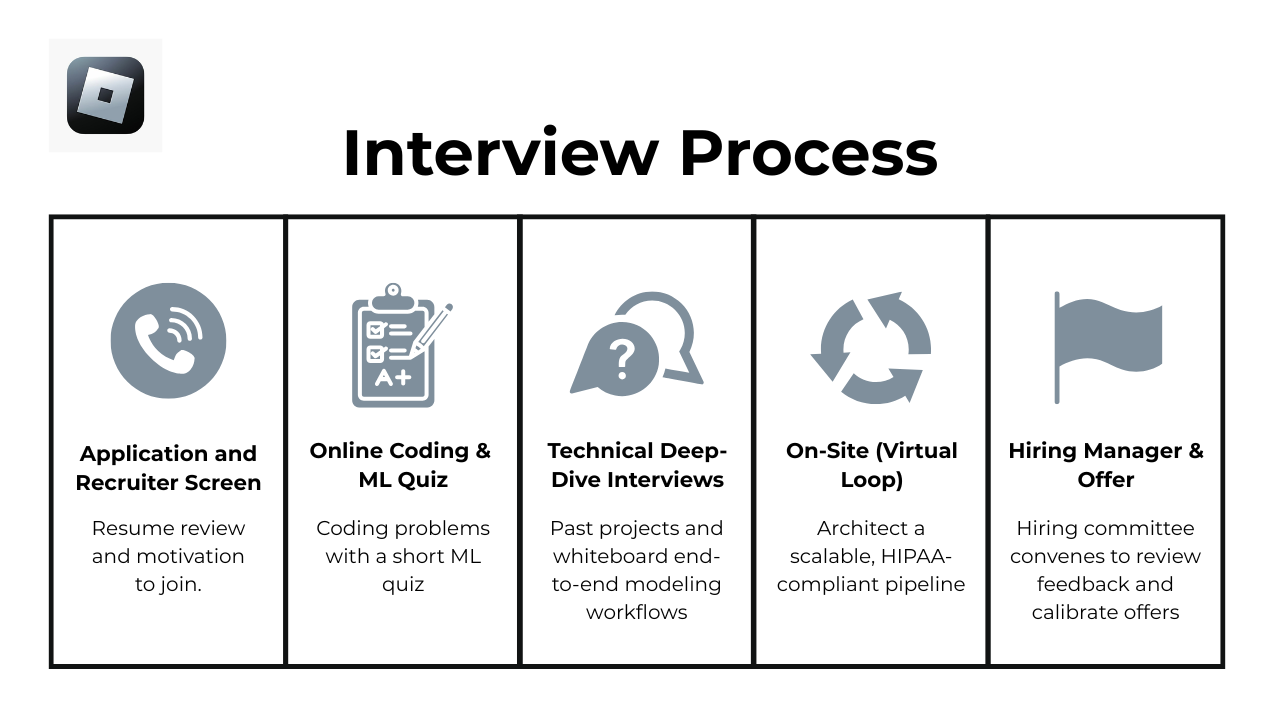
The Roblox hiring process is designed to evaluate both technical excellence and cultural fit, while the Roblox interview process ensures you understand our platform’s unique challenges—from real-time systems to community-driven features. Below is the end-to-end flow you’ll encounter, with each stage tailored to the role you’re pursuing.
Application & Online Assessment
After submitting your résumé, you’ll receive a link to complete the Roblox online assessment—typically a Codesignal-style quiz that blends coding problems, algorithmic challenges, and a communication prompt. This usually takes 60–90 minutes and must be completed within a set window, so plan accordingly.
Recruiter Phone Screen
Next, you’ll have a 30-minute conversation with a recruiter to review your background, motivations, and alignment with Roblox values. Expect questions about your past projects, your understanding of our community-first culture, and logistical details like availability and compensation expectations.
Technical / Functional Rounds
In the Roblox technical interview, you’ll dive deep into role-specific challenges—live coding for SWE, system-design for backend, or analysis problems for data roles. This stage often spans 1–2 sessions, each lasting 45–60 minutes, and may include take-home assignments for specialized functions.
On-Site Loop
The Roblox onsite interview is a half-day or full-day block of 3–5 back-to-back interviews. You’ll tackle whiteboard system-design, product-sense discussions, and behavioral questions, all with a focus on how you’d architect and operate at internet scale while respecting community safety and performance constraints.
Hiring Manager Interview
This 45-minute session with your prospective manager centers on high-level strategy, past impact, and team dynamics. The goal is to gauge your ability to drive long-term value—expect exploratory questions in the Roblox hiring manager interview about vision alignment, leadership style, and roadmap planning.
Final Team Match & Offer
In the last step, you’ll meet potential teammates for a culture-add discussion, finalize compensation details, and complete reference checks. Here, you may participate in a brief Roblox final interview that confirms mutual fit before an offer is extended.
Each role introduces its own nuances—see our Roblox Software Engineer Interview Guide, Roblox Data Scientist Interview Guide, and Roblox Product Manager Interview Guide for detailed, role-specific breakdowns.
Challenge
Check your skills...
How prepared are you for working at Roblox?
Most Common Roblox Interview Questions
Candidates frequently search for Roblox interview questions, seeking clarity on what to expect across roles and stages. Below is an overview of the major categories to focus your preparation on.
Role-Specific Interview Guides
- Software Engineer → Roblox SWE Interview Guide
- Data Scientist → Roblox Data Scientist Interview Guide
- Data Engineer → Roblox Data Engineer Interview Guide
- Product Manager / APM → Roblox Product Manager Interview Guide
Mission & Values Questions
Roblox’s interviewers often probe your alignment with the platform’s five core values—Take the Long View, Respect the Community, Build with Heart, Be Bold, and Make It Real. In a Roblox behavioral interview, you’ll craft STAR responses around scenarios like advocating for player safety, making data-driven trade-offs, and demonstrating long-term thinking.
Tell me about a time you deliberately chose a slower, more scalable approach instead of a quick win.
Evaluates “Take the Long View.” Roblox favors engineers who protect future velocity and platform stability even when short-term pressure is intense. Interviewers listen for how you estimated future costs, influenced stakeholders, and validated that the long-term path paid off.
Describe a situation where you surfaced a potential safety risk to the player community and how you addressed it.
Measures “Respect the Community.” They want proof you’ll champion user well-being over metrics, outlining the signals you monitored, the mitigation you proposed, and how you balanced openness with protection.
Give an example of building a feature or tool that delighted users beyond the basic functional spec.
Maps to “Build with Heart.” Roblox rewards engineers who sweat the craft details—animations, latency polish, or thoughtful defaults—that create emotional impact. Expect follow-ups on user research and iteration loops.
Tell us about a bold technical bet you pushed for and how you de-risked it.
Connects to “Be Bold.” Interviewers look for vision + execution: how you gathered data, rallied allies, and staged rollouts so the company could stomach the risk.
Describe a project where you personally shipped an end-to-end solution that moved a KPI.
Hits “Make It Real.” They value leaders who own outcomes, not just ideas. Articulate hands-on contributions, cross-team hand-offs, and the quantitative lift you measured after launch.
When have you had to disagree with product or design to defend an engineering quality bar?
Shows your ability to protect platform integrity and user trust while still collaborating—a blend of “Respect the Community” and “Be Bold.”
Walk me through how you’d embed Roblox’s safety and civility principles into a new voice-chat feature.
Tests principled decision-making: proactive moderation, real-time ML filters, parental controls, and transparent policies—all core to “Respect the Community.”
Tell us about mentoring someone and the long-term impact it had on the team.
Demonstrates taking the long view on talent growth and multiplying impact—key for senior levels where nurturing future leaders is part of the role.
Recall a time data contradicted your intuition. How did you respond?
Illustrates that “Build with Heart” still relies on evidence. They look for humility, debugging rigor, and updating beliefs quickly.
Describe a cross-org initiative where you aligned diverse stakeholders around a shared technical roadmap.
Validates the “Make It Real” ethos at scale—showing you can turn bold concepts into shipped realities by building consensus across engineering, design, and safety teams.
Technical Depth Questions
Across engineering and analytics tracks, expect deep dives into algorithmic problem-solving, distributed data modeling, and experimentation frameworks. References to Roblox interview coding appear commonly in forums, highlighting challenges like stream-processing architectures, real-time state synchronization, and latency-sensitive optimizations.
Rotate a matrix 90° clockwise in-place.
Forces you to reason about layer-by-layer swaps, memory usage, and off-by-one edges—skills that map to Roblox’s real-time rendering and physics loops.
Compute the maximum profit from at most two stock trades.
Tests dynamic-programming intuition, constant-space optimizations, and clear state design—essential when writing latency-sensitive marketplace code.
Convert a list of integers (≤ 1000) to Roman numerals.
Simple on the surface, but good signal on clean control flow, edge handling (e.g., 900→“CM”), and modular testable helpers.
Return the last node of a singly-linked list, or
nullif empty.Screens fundamental pointer traversal, null-safety habits, and O(1) memory reasoning—building blocks for any C++/Lua container work at Roblox.
Select a random element from an infinite stream using O(1) space.
Probes reservoir sampling; interviewers use it as a proxy for mathematical rigor plus practical telemetry-sampling savvy.
Build a kNearest-Neighbors classifier from scratch (no scikit-learn).
Exposes fluency in distance metrics, vectorization, and tie-breaking—all foundations before scaling to Roblox’s multi-modal embedding space.
A/B test shows a new UI wins by 5 %; what lift do you expect after 100 % rollout?
Checks understanding of sample-ratio mismatch, regression to mean, and interaction effects once the feature hits the full ecosystem.
Design a global e-commerce ETL & reporting architecture.
Tests schema design, ingestion strategy, GDPR/latency trade-offs, and how you’d surface metrics to both execs and game studios.
Declare a winner in an A/B test when data is non-normal and sample size is small.
Interviewers look for bootstrapping, Mann-Whitney, or Bayesian approaches—key when creator cohorts are highly skewed.
Outline a system that auto-generates Spotify-like “Discover Weekly” playlists.
Gauges recommender-system depth: embeddings vs. recall trees, freshness penalties, and offline/online evaluation loops.
Design a cost-efficient two-year click-stream analytics stack for 600 M events/day.
Reveals judgment on lakehouse vs. warehouse, tiered storage, partitioning, and query-acceleration—all vital at Roblox scale.
Create a schema & optimizations for a Tinder-style swiping app.
Tests ability to balance write-heavy swipe events with millisecond read latency, dedupe logic, and privacy partitions.
Propose an ML & data-pipeline solution to minimize DoorDash wrong orders.
Assesses real-time feature engineering, anomaly detection, and closed-loop feedback for logistics quality.
Explain why OLAP cubes slow down on monthly/quarterly reports & propose an aggregation fix.
Looks for roll-up tables, pre-materialized partitions, and incremental refresh tactics that keep dashboards snappy.
Write a SQL query that builds a “flight routes” table—unique city pairs, direction-agnostic.
Demonstrates window-function mastery and deduping logic—a direct parallel to session-graph or social-graph pipelines.
Collaboration & Leadership Questions
Roblox values collaborative problem-solving at scale. You may be asked to discuss cross-functional projects—how you resolved conflicts between design and performance teams, influenced product roadmaps with data insights, or mentored junior teammates to achieve collective goals.
-
Roblox interviewers rely on this to gauge end-to-end ownership, grit, and your ability to navigate ambiguity in a creator-platform environment. A strong story shows how you defined success metrics, rallied cross-functional partners, and iterated when reality diverged from plan.
-
Scaling any Roblox feature means balancing trust & safety, infra, growth, and creator economics. The panel looks for negotiation skills, empathy, and data-backed mediation that preserved timelines and relationships.
-
This tests mission alignment—passion for immersive co-experience, platform safety, and user-generated economies. A tailored answer signals commitment beyond a generic FAANG pitch.
-
Self-awareness and coachability are must-haves for leaders who will mentor others while still learning. Concrete growth plans outweigh canned humility.
How do you juggle multiple deadlines and keep yourself plus partners organized?
Expect follow-ups on frameworks (RICE, Kanban, OKRs), risk surfacing, and how you protect focus while shipping weekly.
Tips When Preparing for a Roblox Interview
Before you dive into role-specific prep, it’s crucial to understand Roblox’s unique engineering culture and platform challenges. Whether you’re targeting a SWE, DS, or PM role, these broad strategies will set you on the right path.
Master the Online Assessment Mechanics
Roblox’s coding assessments are typically delivered via a Codesignal-style platform with 60–90 minute sessions covering data structures, algorithms, and problem‐solving under time pressure. Familiarize yourself with the input/output format, practice reading from standard input, and simulate at least three full OA runs using our sample problems to build confidence.
Pair Roblox’s Values With STAR Stories
In every behavioral round, you’ll need to demonstrate alignment with Roblox’s values—Respect the Community, Take the Long View, and Build with Heart. Prepare 6–8 STAR examples that showcase how you’ve driven impact, collaborated across teams, and made data-driven decisions, explicitly tying each story back to one of these core principles.
Build a Mini-Experience on Roblox Studio
Nothing shows genuine interest like hands-on work in the product itself. Spend a few evenings creating or tweaking a simple Roblox game or tool in Roblox Studio, then discuss your process during interviews to illustrate curiosity, technical versatility, and a deep understanding of the platform’s capabilities.
Study Recent Engineering Blog Posts
Roblox’s engineering blog publishes deep dives into systems like the Avatar Rendering Pipeline and Private Cloud infrastructure. Reviewing a handful of posts will help you speak fluently about platform challenges—drop mentions of the Roblox engineering blog in your discussions to show you’re up to date with the latest technical innovations.
Network With Current Robloxers
Join Roblox developer communities on Discord or LinkedIn groups to ask role-specific questions, learn about day-to-day workflows, and get insider tips on the interview loop. Building genuine connections can surface feedback on what to expect and may even lead to internal referrals.
Salaries at Roblox
Average Base Salary
Average Total Compensation
Roblox offers competitive pay across roles and levels, with bonuses and RSUs that reward long-term commitment. Here’s a high-level view of typical compensation bands:
Conclusion
Landing a role at Roblox means mastering both the Roblox hiring process and the nuanced challenges of the platform itself. Detailed, role-specific question banks live in our guides for Software Engineers, Data Scientists, Data Engineers, and Product Managers—each tailored to what you’ll face on loop day. When you’re ready to take your prep to the next level, schedule a mock interview, follow our Learning Paths for structured study, and draw inspiration from success stories like Dania Crivelli’s journey .
- Software Engineer → Roblox SWE Interview Guide
- Data Scientist → Roblox Data Scientist Interview Guide
- Data Engineer → Roblox Data Engineer Interview Guide
- Product Manager / APM → Roblox Product Manager Interview Guide
FAQs
What is the Roblox job application process timeline?
The Roblox job application process typically spans 4–6 weeks from application submission to offer acceptance, including online assessments, multiple interview rounds, and committee reviews.
How hard is the Roblox interview?
According to Glassdoor and candidate surveys, the Roblox interview experience rates around 3.3 out of 5, reflecting a mix of challenging technical assessments and behavioral deep-dives.
Does Roblox still do a final round interview?
Yes—candidates who advance past the virtual loop participate in a Roblox final round interview, which often includes a hiring-manager discussion and team-match session.
Are there game-specific interview questions?
Absolutely; expect questions tagged Roblox interview game that probe your understanding of real-time rendering, physics simulation, or social features unique to the gaming platform.
What if I get a hypothetical design prompt?
When faced with a hypothetical Roblox scenario—such as redesigning the matchmaking service—follow a structured framework: clarify requirements, propose alternatives, diagram your solution, and discuss trade-offs.
Discussion & Interview Experiences