
Garner Health Interview Guide: Process, Questions, and Preparation


Introduction
Preparing for a Garner Health interview means getting ready to demonstrate how you think about data in one of healthcare’s most complex and high-impact settings. Garner Health operates in employer-sponsored healthcare, helping organizations reduce costs and improve outcomes by steering employees toward high-quality providers. As healthcare continues shifting toward value-based care, the company relies heavily on analytics to evaluate provider performance, interpret claims data, and guide evidence-based decision-making at scale.
That focus shapes the Garner Health interview process. Interviews are intentionally rigorous, designed to test not only your technical skills, but also your ability to reason through ambiguous healthcare data, define defensible metrics, and communicate insights that influence real business and clinical decisions. Whether you are interviewing for a data analyst or data scientist role, you can expect a mix of SQL questions, analytics-driven case studies, and behavioral discussions grounded in realistic healthcare scenarios.
Candidates who succeed are those who can balance precision with judgment. Interviewers look for structured thinking, clear assumptions, and an understanding of how data choices affect cost, quality, and patient outcomes. Knowing what to expect at each stage, and how Garner evaluates analytical impact, can make a meaningful difference in your preparation.
This guide outlines each stage of the Garner Health interview, highlights common questions, and shares proven strategies to help you stand out and prepare effectively with Interview Query.
What does Garner Health do, and how do data roles fit in?
Garner Health is a healthcare technology company focused on helping employers reduce healthcare costs while improving patient outcomes. Its core mission centers on identifying high-quality providers and guiding employees toward evidence-based care. Rather than optimizing solely for lower prices, Garner Health emphasizes clinical quality, appropriate treatment, and long-term value, aligning closely with the broader shift toward value-based care in the United States healthcare system.
This mission is powered by healthcare analytics. Garner Health data analysts and Garner Health data scientists work with large, complex datasets such as medical claims, provider performance records, and utilization patterns to evaluate how care is delivered and where inefficiencies exist. Their work supports provider scoring models, cost and quality benchmarks, and insights shared with employers and members. These roles require careful metric design, strong analytical judgment, and the ability to translate messy healthcare data into clear recommendations.
Data analysts at Garner Health typically focus on querying and validating claims data, defining performance metrics, and answering business-critical questions around cost variation and outcomes. Data scientists often take this further by building scoring methodologies, conducting deeper analyses across populations, and partnering closely with product teams to embed insights into member-facing experiences. Across both roles, success depends on strong SQL skills, comfort with ambiguity, and the ability to explain findings to non-technical stakeholders.
What sets these roles apart from more generic healthcare startups is the emphasis on accountability. Analyses are expected to drive real decisions that affect patient behavior and employer spend, not just exploratory insights.
Challenge
Check your skills...
How prepared are you for working at Garner health?
Why work at Garner Health?
If you are asking is Garner Health a good company to work for, the answer often comes down to impact and ownership. Garner Health operates in a part of healthcare where better data directly influences patient outcomes and employer costs. The company’s mission to steer members toward high-quality providers gives employees a clear sense of purpose, and analytics work is closely tied to decisions that matter in the real world.
From a culture standpoint, Garner Health culture reflects a growth-stage startup environment. Teams are small, and individual contributors are expected to take ownership of problems end to end. Data analysts and data scientists work cross-functionally with product managers, engineers, and clinical experts, collaborating on how provider quality is measured, how insights are surfaced, and how recommendations ultimately reach members. This level of exposure gives you visibility into both the technical and business sides of healthcare decision-making.
With that ownership comes ambiguity. Priorities can shift quickly, data is often imperfect, and there is rarely a single correct answer. Successful employees are those who can move fast without sacrificing rigor, make thoughtful tradeoffs, and communicate clearly when information is incomplete. Garner values people who can balance speed with responsibility, especially in a domain where decisions affect patient care.
Garner Health interview process
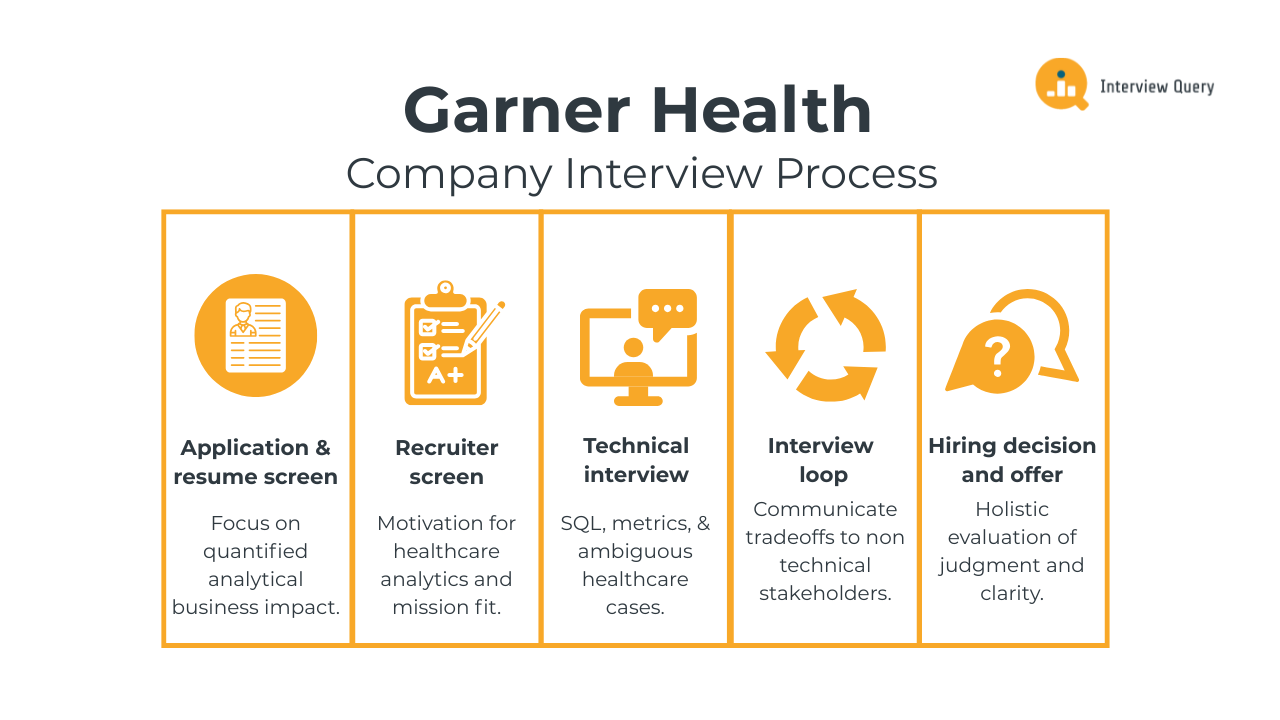
The Garner Health interview process is designed to evaluate how you think about healthcare problems, not just how well you code or analyze data. Across roles, the process typically spans two to three weeks and emphasizes structured reasoning, comfort with ambiguity, and clear communication. Candidates are assessed on technical fundamentals, healthcare intuition, and their ability to translate analysis into decisions that affect cost, quality, and patient outcomes. While the exact flow can vary by role and seniority, the core stages remain consistent.
Interview process overview
Most Garner Health interviews follow a multi-stage structure that begins with resume screening and recruiter conversations, followed by technical or analytical interviews and a final loop with cross-functional stakeholders. The evaluation focuses on three themes: analytical rigor, judgment in imperfect data environments, and communication. Interviewers are less interested in trick questions and more focused on how you frame problems, define assumptions, and explain tradeoffs in a healthcare context.
Application and resume screen
The process starts with a resume review by recruiters and hiring managers. Garner Health looks for candidates who demonstrate strong analytical foundations, especially SQL fluency, experience working with metrics, and evidence of business impact. Prior healthcare exposure is helpful but not required if you can show disciplined thinking and ownership in complex problem spaces.
Resumes that perform well clearly quantify outcomes. Recruiters pay close attention to how your work influenced cost, quality, efficiency, or decision-making rather than the tools you used.
Tip: Quantify results tied to measurable outcomes, such as cost reduction, efficiency gains, or improved decision quality.
Recruiter screen
The recruiter screen is typically a 30-minute conversation focused on background, motivation, and role fit. You can expect questions about your experience, what attracts you to Garner Health, and how you think about working in healthcare analytics. While this round is not deeply technical, it sets the tone for the rest of the process.
Recruiters are evaluating alignment with the company’s mission and your ability to articulate why healthcare analytics specifically interests you. Clear, thoughtful answers matter here.
Tip: Be explicit about why healthcare analytics motivates you, not just a general desire for “impact.”
Technical interview or case study
The technical stage often includes SQL questions, statistics fundamentals, and healthcare-style case studies. Depending on the role, you may be asked to write queries related to claims data, reason about ratios or rates across providers, or interpret metrics tied to utilization and outcomes.
Case studies are usually open-ended. Interviewers want to see how you structure the problem, choose appropriate metrics, and reason through uncertainty. Some candidates report scenarios that resemble Garner’s product domain, such as comparing provider performance or interpreting rates across different sample sizes.
Tip: Always define your assumptions clearly before querying or modeling, and explain why your approach is appropriate for the data.
Onsite or virtual interview loop
The final loop typically consists of several interviews conducted in one day, either virtually or onsite. These interviews combine technical discussions, analytical case studies, and stakeholder-focused conversations. You may be asked to walk through prior projects, critique an analysis, or explain how you would present findings to non-technical audiences.
This stage tests your ability to communicate tradeoffs clearly. Interviewers often probe how you would explain results to clinicians, product managers, or business leaders who rely on data but may not be technical.
Tip: Communicate tradeoffs as if you are presenting to non-technical healthcare partners who need clarity, not complexity.
Hiring decision and offer
After the interview loop, feedback is reviewed holistically. Garner Health looks for consistent signals across analytical skill, judgment, and communication rather than perfection in any single round. Candidates who demonstrate structured thinking, healthcare awareness, and strong collaboration skills tend to perform best.
If you advance to the offer stage, recruiters are generally transparent about next steps and timelines. At this point, thoughtful questions about team priorities and success metrics can help you evaluate fit on both sides.
Garner Health Interview Questions
You can access role-specific questions in our individual pages here:
- Garner Health Data Analyst Interview Questions + Guide in 2025
- Garner Health Data Engineer Interview Questions + Guide in 2025
- Garner Health Data Scientist Interview Questions + Guide in 2025
- Garner Health Product Manager Interview Questions + Guide in 2025
- Garner Health Software Engineer Interview Questions + Guide in 2025
SQL & Data Engineering Interview Questions for Garner Health
SQL and data engineering interview questions at Garner Health evaluate how well you ensure data correctness, performance, and reliability in healthcare analytics systems. These questions focus on writing precise queries, understanding join behavior, handling missing or duplicate records, and optimizing queries that power claims analysis, provider scoring, and care navigation workflows.
Identify Duplicate Rows in a Table
This question tests your ability to detect and reason about duplicate records using SQL, which is fundamental for maintaining data quality in relational systems. Garner Health asks this because duplicate claims, eligibility records, or provider entries can directly impact downstream analytics and care recommendations if not handled correctly in healthcare data pipelines.
Input:
userstableColumn Type idINTEGER nameVARCHAR created_atDATETIME Explain How Different SQL Join Types Affect Result Size
This question evaluates your understanding of how joins influence row counts and data integrity when combining tables. For a data engineering role at Garner Health, this matters because incorrect join logic across claims, member, and provider datasets can silently distort metrics used for cost optimization and clinical decision support.
Describe How You Would Generate a Random Sample Using SQL
This question tests your knowledge of SQL-based sampling techniques and their implications for performance and bias. Garner Health uses this to assess whether you can safely create representative samples from large healthcare datasets for analysis, testing, or validation without compromising accuracy.
Input:
big_tabletableColumns Type idINTEGER nameVARCHAR Diagnose the Cause of a Slow SQL Query
This question focuses on your ability to reason about query performance, execution plans, and data access patterns. Interviewers at Garner Health ask this to ensure you can optimize queries that run on large-scale claims and eligibility tables where inefficiencies quickly translate into delayed insights or higher infrastructure costs.
Retrieve the Previous Non-Null Value in a Column
This question tests your understanding of window functions and time-ordered data handling in SQL. Garner Health asks this because healthcare data often arrives with gaps or missing values, and data engineers must correctly reconstruct longitudinal member or provider states for accurate analysis and reporting.
code
Calculate Monthly Product Sales
This question tests your ability to aggregate time-based data and define clear monthly performance metrics using analytical queries. Garner Health asks this to evaluate whether you can translate raw utilization or revenue data into consistent monthly views that support healthcare cost tracking and performance monitoring.
Determine Each Year’s Percentage Contribution to Total Revenue
This question evaluates how well you can compute relative metrics and reason about trends over time rather than just absolute values. At Garner Health, this skill is critical for understanding long-term shifts in revenue drivers across healthcare products, payers, or provider partnerships.
Set and Evaluate Campaign Goals Using Data
This question tests your ability to connect campaign objectives to measurable outcomes and interpret results objectively. Garner Health looks for this skill to ensure analysts can evaluate outreach, engagement, or care-navigation initiatives using metrics that reflect real healthcare impact rather than vanity numbers.
Data Analytics & Metrics
Garner Health data analytics and metrics interview questions focus on how well you define, calculate, and interpret metrics that matter in healthcare decision-making. These questions test your ability to translate raw utilization, revenue, or behavior data into defensible insights that support cost control, provider quality evaluation, and employer reporting.
Analyze a User Journey Across Multiple Steps
This question tests your ability to model multi-step user behavior and identify drop-offs or friction points in a funnel. Garner Health uses this to assess whether you can analyze how members, clinicians, or internal users move through healthcare workflows and where interventions may improve outcomes.
Define and Measure Success for a Product or Initiative
This question focuses on metric selection, alignment with goals, and distinguishing leading versus lagging indicators. Interviewers at Garner Health ask this to see if you can define success in a healthcare context where impact, cost, and quality must be balanced rather than optimized in isolation.
Statistics & Experimentation Interview Questions for Garner Health
Statistics and experimentation questions in the Garner Health interview assess how rigorously you design experiments, interpret results, and reason under uncertainty. Because healthcare data is noisy and interventions can have downstream effects, interviewers look for candidates who understand assumptions, limitations, and statistical tradeoffs rather than relying on surface-level significance.
Evaluate the Results of a Button A/B Test
This question tests your understanding of experimental design, hypothesis testing, and interpreting statistical significance in controlled experiments. Garner Health asks this to assess whether you can evaluate product or care-flow changes rigorously, where small interface decisions can influence member engagement and downstream healthcare outcomes.
Explain How and When to Use R Squared
This question evaluates your ability to interpret model fit metrics and understand their limitations in real-world data. At Garner Health, interviewers want to see that you can judge predictive models built on noisy healthcare data without over-relying on a single summary statistic.
Describe the Assumptions Behind Linear Regression
This question tests whether you understand the conditions under which linear regression results are valid and interpretable. Garner Health uses this to ensure analysts can recognize when healthcare data violates assumptions due to skew, missingness, or correlated outcomes and adjust their analysis accordingly.
Reason About Bounds for Overlapping Populations
This question focuses on logical reasoning and probabilistic bounds when exact distributions are unknown. Interviewers at Garner Health ask this to evaluate how you reason about incomplete or aggregated healthcare data, where precise counts are often unavailable but decisions still need defensible estimates.
Handle Hundreds of Simultaneous Hypothesis Tests
This question tests your understanding of multiple testing, false positives, and statistical rigor at scale. Garner Health asks this because analysts frequently evaluate many care interventions, provider comparisons, or population segments at once and must avoid drawing misleading conclusions from noisy results.
Behavioral & Stakeholder Communication Interview Questions for Garner Health
Behavioral and stakeholder communication questions at Garner Health evaluate how effectively you work with cross-functional teams and communicate insights to non-technical audiences. These questions are designed to ensure you can influence decisions, explain tradeoffs, and build trust when working with clinicians, product leaders, and operations teams in a complex healthcare environment.
Why Do You Want to Work With Us
This question tests your motivation, values alignment, and understanding of the company’s mission beyond surface-level interest. Garner Health asks this to see whether you genuinely connect with improving healthcare outcomes through data and can articulate why that mission matters in the context of your role.
Explain How You Communicate Data Insights to Stakeholders
This question evaluates your ability to translate complex analyses into clear, actionable messages for non-technical audiences. Garner Health emphasizes this skill because stakeholders like clinicians, product leaders, and operations teams must trust and act on insights drawn from imperfect healthcare data.
Present Data Insights to Drive Decisions
This question tests how well you structure narratives, prioritize insights, and guide decision-making through data presentations. Interviewers at Garner Health ask this to ensure you can move beyond analysis and help teams make informed choices about care delivery, cost management, or product direction.
Describe Your Experience Cleaning Messy Data
This question focuses on your hands-on experience dealing with incomplete, inconsistent, or unreliable datasets. Garner Health values this because healthcare data from claims, providers, and eligibility systems is rarely clean, and strong analysts must communicate limitations while still delivering usable insights.
Discuss Challenges You Have Faced in Data Projects
This question tests self-awareness, problem-solving, and resilience when projects encounter obstacles. Garner Health asks this to understand how you navigate ambiguity, stakeholder constraints, and data limitations in high-impact healthcare environments.
How to prepare for the Garner Health interview
Strong Garner Health interview prep starts with sharpening core analytics fundamentals and learning how to apply them in a healthcare context. SQL is essential, especially writing clear aggregation queries, filtering large datasets, and validating results. Practice explaining not just what your query does, but why it answers the business question correctly. Interviewers care deeply about logic, assumptions, and edge cases.
Metric definition is equally important. Spend time thinking through how you would measure provider quality, cost efficiency, or patient outcomes using imperfect data. In healthcare analytics, raw numbers are rarely enough. You should be comfortable adjusting for context, explaining limitations, and defending why one metric is more appropriate than another. Practice talking through tradeoffs between cost, quality, and access, since these tensions often appear in Garner Health interviews.
You should also prepare for open-ended case discussions. Focus on structuring your approach before jumping into solutions. Clearly state assumptions, outline possible paths, and explain how you would validate conclusions. Interviewers value candidates who can reason carefully and communicate uncertainty, not those who rush to definitive answers.
Behavioral preparation matters as well. Review examples where you worked with ambiguous data, influenced stakeholders, or made decisions under time pressure. Be ready to explain how you balanced speed with accuracy and how your analysis drove real outcomes.
To practice these skills in realistic scenarios, explore Interview Query’s analytics challenges, mock interviews, and coaching resources. They are designed to help you refine both technical execution and decision-focused communication.
Average Garner Health salary
Garner Health roles earn competitive compensation across levels, reflecting the company’s emphasis on high-impact technical and analytical work in healthcare. According to Levels.fyi, publicly available compensation data for Garner Health is limited to a small number of technical role submissions. As a result, company-level salary expectations are best understood using available Garner Health compensation entries on Levels.fyi as a proxy for overall technical compensation, rather than role-specific bands. Total compensation typically includes a strong base salary and meaningful equity, which becomes more valuable over time as vesting begins.
Compensation by level (company-level proxy)
The table below reflects company-wide compensation signals for technical roles at Garner Health, based on available Levels.fyi submissions and adjusted to represent general expectations across analytics, data science, and engineering-adjacent roles.
| Level | Total / Year | Base / Year | Stock / Year | Bonus / Year |
|---|---|---|---|---|
| Entry to mid-level | ~$130,000 | ~$110,000 | ~$15,000 | ~$5,000 |
| Mid-level | ~$155,000 | ~$125,000 | ~$25,000 | ~$5,000 |
| Senior | ~$185,000 | ~$145,000 | ~$35,000 | ~$5,000 |
Compensation typically increases after the first year as equity begins vesting, with senior contributors seeing the largest gains through stock refreshes and expanded scope.
Regional salary comparison
| Region | Salary range | Notes | Source |
|---|---|---|---|
| New York City | ~$150,000–$190,000 | Highest compensation due to cost of living and headquarters proximity | Levels.fyi |
| San Francisco Bay Area | ~$155,000–$195,000 | Competitive with healthcare and data-focused startups | Levels.fyi |
| Remote United States | ~$125,000–$175,000 | Location-adjusted base with equity helping close gaps | Levels.fyi |
Overall, Garner Health compensation aligns with other growth-stage healthcare technology companies where analytics and technical roles directly influence product outcomes and customer value. Candidates evaluating offers should consider not only base pay, but also equity structure, vesting schedules, and long-term growth potential as the company scales.
Final takeaway
Garner Health interviews stand out for their emphasis on healthcare context, structured analytical thinking, and clear communication under uncertainty. To succeed, you need to demonstrate how you define meaningful metrics, reason through imperfect data, and explain tradeoffs that affect cost, quality, and outcomes. With focused, structured preparation, you can confidently show how your skills translate into real healthcare impact.
Prepare next: Explore Interview Query’s interview guides and analytics preparation hub to practice company-specific questions, case studies, and communication strategies.
Discussion & Interview Experiences