
Garner Health Data Analyst Interview Guide: Process, Questions & Prep (2025)


Introduction
Preparing for a Garner Health data analyst interview means stepping into one of the fastest-growing areas of modern health care. As health technology companies increasingly focus on outcomes, cost transparency, and smarter care navigation, demand for analysts who can turn complex claims and clinical data into clear decisions has accelerated. Garner Health sits squarely at this intersection, building data-driven tools that help employers and members make better health care choices.
Garner Health is a health technology startup using analytics and clinical expertise to improve how people navigate the health care system. Its platform evaluates provider quality and cost using large-scale data, then translates those insights into practical guidance for members and employers. According to Levels.fyi, Garner Health has grown its analytics and data teams alongside this product expansion, reflecting how central data is to the company’s strategy.
As a data analyst at Garner Health, you support product development, research initiatives, and business decisions by analyzing health care data and presenting insights to cross-functional stakeholders. Interviewers look closely at how you structure analyses, communicate findings, and connect data to real-world impact. The interview process typically includes an initial screening, a take-home case study, a presentation round, and final technical and behavioral interviews, each designed to test both analytical rigor and communication skills.
This guide outlines each stage of the Garner Health Data Analyst interview, highlights common questions, and shares proven strategies to help you stand out and prepare effectively with Interview Query.
What Garner Health looks for in a data analyst
Garner Health looks for data analysts who combine strong technical fundamentals with the ability to drive clear, real-world impact in a complex health care environment. At a baseline level, interviewers expect fluency in SQL and Python, with comfort working across large datasets, building clean data models, and creating visualizations that make trends and trade-offs easy to understand. These skills are treated as table stakes rather than differentiators.
Beyond tools, Garner places heavy emphasis on analytical thinking and data storytelling. You are expected to frame ambiguous problems, choose the right metrics, and explain not just what the data shows, but why it matters for patients, employers, or internal teams. Strong candidates consistently tie their analyses back to decisions, whether that is improving a product feature, shaping a research insight, or influencing operational strategy.
Cross-functional collaboration is another core signal. Data analysts at Garner work closely with product managers, clinicians, engineers, and business leaders, so interviewers assess how well you communicate with non-technical stakeholders and adapt your message to different audiences. Clear explanations, structured presentations, and thoughtful assumptions matter as much as technical correctness.
Finally, cultural fit plays a meaningful role. Garner Health values mission alignment with transforming health care outcomes, along with direct, courageous communication. The strongest candidates demonstrate an intention to deliver actionable business insights, not just technically impressive analyses, and show they can operate with ownership in a fast-moving health technology environment.
Challenge
Check your skills...
How prepared are you for working as a Data Analyst at Garner health?
Interview process overview
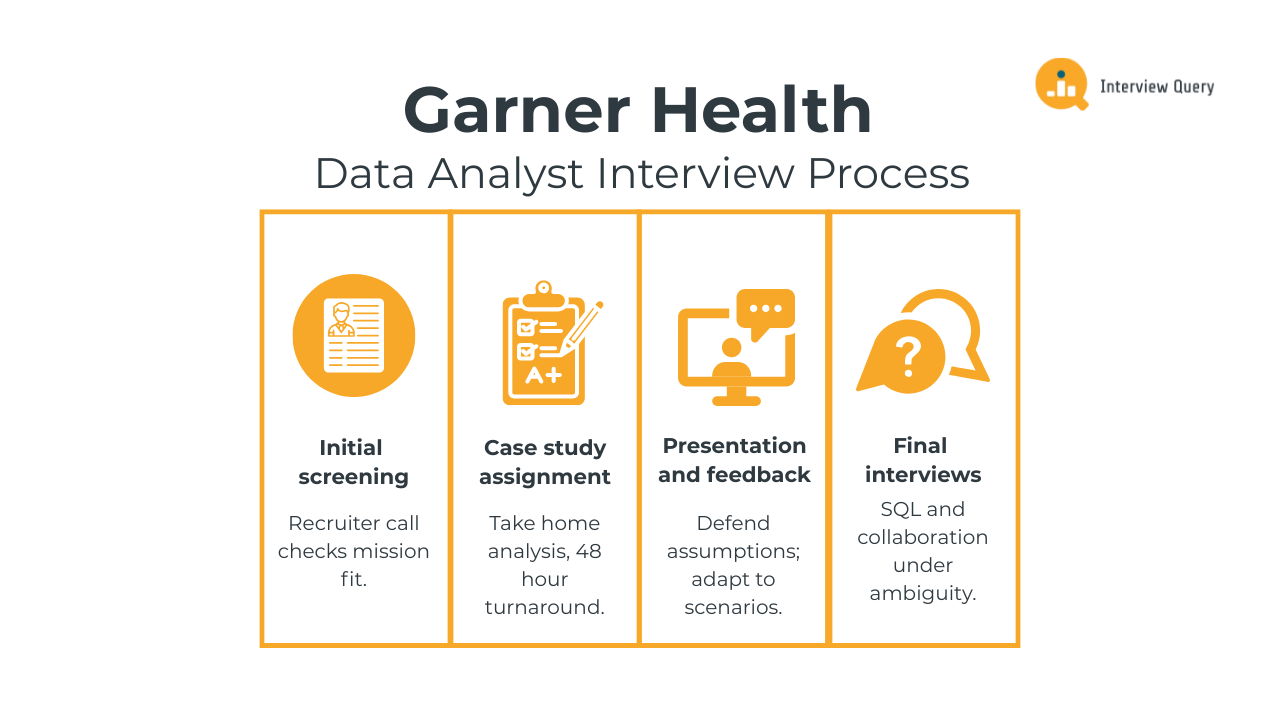
The Garner Health data analyst interview process is designed to evaluate how you think with data, communicate insights, and apply analysis to real health care decisions. The process is relatively fast-moving, often completed within two to three weeks, and emphasizes practical reasoning over abstract theory. Each stage builds on the last, moving from motivation and fit to hands-on analysis and stakeholder communication.
Initial screening
The process typically begins with a short recruiter screen conducted over video. This conversation focuses on your background, interest in Garner Health’s mission, and overall communication style. You may be asked to walk through your past analytical work, explain why you are interested in health care analytics, and describe the types of problems you enjoy solving. This stage is not technical, but clarity and alignment matter. Recruiters use this call to confirm baseline fit before advancing candidates to the case study.
Garner Health–specific tip: Be ready to clearly connect your past analytical work to health care, outcomes, or decision-making, even if you have not worked directly in the health care industry.
Case study assignment
Candidates who pass the screen are typically given a take-home case study with a 48-hour turnaround. This assignment mirrors the day-to-day work of a Garner Health data analyst. You are asked to analyze a dataset, evaluate trade-offs, and develop a clear recommendation. The final deliverable is usually a short slide deck intended for a non-technical audience, such as product or business stakeholders. Interviewers pay close attention to how you frame the problem, choose metrics, and justify your conclusions.
Garner Health–specific tip: Focus on clarity and reasoning over complexity. Simple, well-explained analysis is valued more than advanced techniques without a clear takeaway.
Presentation and feedback
Next, you present your case study to a cross-functional panel, often including data analysts and business partners. This session tests your ability to tell a data-driven story, respond to questions, and defend your assumptions. Candidates report that this discussion is conversational, with follow-up scenarios that probe how your recommendation might change under different conditions.
For example, one candidate described being asked to compare two doctors using visit ratios and explain which provider performed better across multiple scenarios. The emphasis was on reasoning and communication rather than arriving at a single “correct” answer.
Garner Health–specific tip: Talk through your logic step by step and proactively address alternative interpretations of the data.
Final interviews
The final stage typically consists of deeper technical discussions and additional analytical working sessions. These rounds focus on SQL or Python fundamentals, problem-solving approach, and how you collaborate with others. Behavioral questions may be lighter than at larger companies, but interviewers still assess how you work through ambiguity and engage with teammates.
Garner Health–specific tip: Treat technical questions as collaborative problem-solving exercises. Explain your thinking clearly and show how you would partner with others to reach a decision.
Technical preparation, presentation, and culture fit
Garner Health evaluates data analysts on more than technical execution alone. Interviewers look for candidates who can apply core analytical skills, communicate insights clearly, and align their work with the company’s mission to improve health care outcomes.
From a technical standpoint, strong fundamentals are essential. You should be comfortable using SQL to join multiple tables, apply aggregations, and work with window functions to analyze trends, cohorts, or comparisons over time. In Python, interviewers expect fluency with pandas for data cleaning, exploratory analysis, and light modeling. Code should be readable, logically structured, and focused on answering the business question at hand rather than showcasing complexity for its own sake. Data visualization is equally important, as analysts are expected to communicate findings through clear charts or simple dashboards that highlight what matters most to stakeholders.
Technical skills are most often assessed through case-style work. Successful candidates structure analyses around impact, clearly define assumptions and metrics, and explain how results would influence product or business decisions.
Communication plays a central role throughout the process. Slide decks should follow a clear narrative, starting with the problem and leading quickly to key insights and recommendations. Interviewers value concise delivery, plain-language explanations, and the ability to frame insights in terms of business or product impact rather than raw numbers.
Finally, Garner Health places real weight on culture fit and mission alignment. Expect questions about collaboration, handling ambiguity, and working across functions. Strong answers reflect direct communication, thoughtful reasoning, and a genuine interest in using data to improve health care outcomes.
Garner Health Data Analyst Interview Questions
Analytical Questions
These questions assess how you frame ambiguous healthcare problems, define meaningful metrics, and draw insights that connect data to real outcomes. Garner Health uses them to evaluate whether you can reason across complex datasets and translate analysis into signals that reflect care quality, access, and long-term impact.
How Would You Define and Calculate a Meaningful Session?
Here, the focus is on turning an abstract behavioral idea into a precise, auditable metric using event data. Garner Health uses this prompt to see if candidates can design engagement definitions that accurately reflect member intent in healthcare navigation and decision support workflows.
How Would You Analyze Insights Across Multiple Data Sources?
This prompt centers on how you structure analysis when insights depend on combining datasets with different schemas, granularity, and reliability. At Garner Health, it reflects the reality of working across claims, eligibility, provider performance, and engagement data while maintaining analytical integrity.
How Would You Investigate a Retention Rate Disparity?
The underlying skill being tested is your ability to identify meaningful differences between cohorts and reason about potential drivers without jumping to conclusions. Garner Health cares about this because disparities in engagement or retention may point to access issues, care friction, or population specific challenges rather than simple product defects.
How Would You Diagnose a Decline in Payments?
This evaluates how you approach unexplained movement in a critical business metric by forming hypotheses and narrowing root causes. For Garner Health, the signal is whether you can connect payment trends to claims flow, provider behavior, or member utilization and communicate implications clearly to healthcare stakeholders.
SQL/Python Coding Prompts
These prompts test your ability to work accurately and efficiently with real-world healthcare data using SQL and Python. Garner Health focuses on practical skills here, ensuring you can build reliable queries, handle imperfect data, and produce trend metrics that support cost, utilization, and operational decisions.
Estimate Output Row Counts for Different SQL Join Types
This evaluates whether you can reason about join cardinality and how duplicates and nulls affect row counts before running a query. Garner Health cares because analysts frequently join claims, eligibility, providers, and encounters, where a single join mistake can silently distort utilization or cost metrics.
Input:
Column Type idINTEGER nameVARCHAR Output:
Column Type join_typeVARCHAR number_of_rowsINTEGER Sample a Truly Random Row From a Large SQL Table
This tests practical SQL judgment around randomness, performance tradeoffs, and working with large datasets. At Garner Health, this skill matters when analysts need fast, unbiased data checks on massive healthcare tables without impacting production systems.
Input:
big_tabletableColumns Type idINTEGER nameVARCHAR Calculate Each Year’s Percentage Contribution to Total Revenue
This measures your ability to perform time based aggregation and compute relative contribution metrics accurately. Garner Health asks this because healthcare finance and claims analysis relies on precise period comparisons to track cost trends and program impact.
Interpolate Missing Values in a Time Series Using Python
This evaluates whether you can clean incomplete time series data while respecting grouping logic and assumptions about missingness. At Garner Health, similar techniques are used when handling gaps in member activity, provider metrics, or claims related timelines.
Compute Month Over Month Changes Across Transactions and Products
This tests your ability to build reliable trend metrics from raw transactional data using joins and period comparisons. Garner Health values this skill because month over month analysis is core to monitoring healthcare costs, utilization shifts, and operational performance.
Behavioral Questions
Behavioral questions evaluate how you communicate, collaborate, and align with Garner Health’s mission. Interviewers use these to understand how you present insights to non-technical stakeholders, navigate disagreement, and connect your analytical work to improving healthcare outcomes.
How Do You Present Data Insights to Non Technical Stakeholders?
This evaluates your ability to translate analysis into a clear narrative that highlights implications rather than raw numbers. Garner Health asks this to see whether you can communicate care quality, cost, or utilization insights to healthcare operators and partners who rely on clarity to make decisions.
How Would You Design a Model Deployment Pipeline?
This tests your understanding of how analytical or machine learning work moves from experimentation into production systems. At Garner Health, interviewers use this to assess whether candidates appreciate reliability, monitoring, and real world constraints when models influence healthcare recommendations or workflows.
How Do You Communicate Findings When Stakeholders Disagree?
This prompt focuses on your ability to manage conflicting perspectives while staying grounded in data. Garner Health values this skill because analysts frequently work across clinical, product, and operations teams where priorities differ and evidence must be framed carefully and responsibly.
How Would You Explain a Complex Concept in Simple Terms?
This assesses whether you truly understand an idea well enough to strip it down without losing accuracy. Garner Health asks this to ensure analysts can explain healthcare analytics concepts to employers, members, or partners who may not have technical backgrounds.
Why Do You Want to Work at Garner Health?
This evaluates motivation, mission alignment, and how well you understand the company beyond surface level talking points. Garner Health uses this to identify candidates who are genuinely driven by improving healthcare outcomes and who can connect their analytical work to the company’s purpose.
Salary expectations & role outlook
There is limited public compensation data specifically for a Data Analyst at Garner Health on Levels.fyi, but broader salary information and related role ranges can help you set expectations.
Compensation at Garner Health: According to Levels.fyi, reported salaries at Garner Health range widely by role, with total compensation spanning from approximately $99,495 for Customer Service Operations up to about $160,000 for Software Engineers, based on anonymous submissions.
While Levels.fyi does not currently list a dedicated Data Analyst title for Garner Health, other postings and industry sources provide relevant context:
- A Data Analyst II job listing indicates a target salary range of roughly $126,000 – $150,000 for that level of analyst role at Garner Health.
- A Data Analyst I listing shows a target base range of about $80,000 – $110,000 depending on experience and skills.
Data analysts at Garner Health operate at the intersection of healthcare, analytics, and business strategy, supporting reporting, metric development, and insight generation that informs both internal decisions and client outcomes. Salaries typically reflect a combination of base compensation plus equity incentives and benefits, especially in early to mid-stage health tech companies.
Conclusion
Preparing for the Garner Health data analyst interview comes down to a few repeatable fundamentals. Make sure you can clearly explain your analytical approach, write clean and accurate SQL and Python, and translate results into concise recommendations for non-technical stakeholders. Reviewing common analytical patterns, practicing cohort and trend analysis, and tightening your data storytelling will go a long way.
To build confidence, spend time working through realistic case studies and practicing how you would present your findings out loud. Mock interviews are especially valuable for simulating the case presentation and follow-up questioning you can expect during the process. This is also a good stage to sharpen core skills with targeted practice, such as SQL exercises focused on joins and aggregations or Python notebooks centered on data cleaning and exploratory analysis.
Interview Query offers structured SQL practice, Python-based analytics challenges, and mock interviews that mirror real data analyst interview scenarios. Using these resources together helps you reinforce fundamentals, practice under realistic constraints, and walk into your Garner Health interview with a clear, confident plan.
Garner health Interview Questions
| Question | Topic | Difficulty |
|---|---|---|
Analytics | Medium | |
You have access to a set of tables summarizing user event data for a community forum app. You’re asked to conduct a user journey analysis using this data with the eventual goal of improving the user interface. What kind of analysis would you conduct to recommend changes to the UI? | ||
Business Case | Medium | |
SQL | Easy | |
SQL | Easy | |
Machine Learning | Medium | |
Statistics | Medium | |
SQL | Hard | |
Machine Learning | Medium | |
Python | Easy | |
Deep Learning | Hard | |
SQL | Medium | |
Statistics | Easy | |
Machine Learning | Hard |
Discussion & Interview Experiences