
Atlassian Machine Learning Engineer Interview Questions, Process, and Salary Guide


Introduction
Atlassian builds the collaboration tools relied on by more than 300,000 customers worldwide, creating one of the most extensive data ecosystems in modern software. Every workflow across Jira, Confluence, Trello, and Bitbucket produces signals that can be transformed into smarter search, better recommendations, and increasingly powerful AI-assisted experiences. As Atlassian expands its investment in machine learning and generative AI, the machine learning engineer role plays a central part in shaping how millions of users plan, write, and collaborate.
What does an Atlassian machine learning engineer do?
Atlassian machine learning engineers design, build, and deploy models that enhance how teams work across Jira, Confluence, Trello, and other products. They focus on real product challenges, from search relevance and recommendation ranking to generative AI features that automate user workflows. The role requires a balance of strong ML fundamentals, pragmatic engineering, and clear communication with cross functional partners.
Key responsibilities include:
- Translating product or business questions into clear machine learning problems and measurable success criteria
- Building models for recommendation, personalization, ranking, forecasting, and anomaly detection
- Developing generative AI features and LLM powered experiences that help users discover information, summarize content, or automate routine tasks
- Evaluating model performance through offline metrics, experiments, and error analysis
- Collaborating with product managers, data scientists, and engineers to align ML solutions with user needs
- Writing clean, maintainable production code in Python or Scala and working with distributed compute frameworks such as Spark
- Supporting the development of shared ML infrastructure, tools, and best practices that improve reliability and scalability across teams
- Ensuring model performance is monitored, documented, and continually improved as products evolve
Atlassian ML engineers operate in a distributed, collaborative environment where curiosity, structured thinking, and learning agility matter just as much as technical depth.
Why this role at Atlassian?
The machine learning engineer role at Atlassian is ideal for someone who wants to apply ML in ways that directly shape how millions of users work every day. You help build the intelligence behind core experiences such as search ranking, content recommendations, workflow automation, and generative AI features across Jira and Confluence. The scale is meaningful, and the problems are grounded in real user behavior rather than isolated research datasets.
Atlassian’s Grad++ environment and early careers programs also provide structured mentorship, technical onboarding, and opportunities to rotate across teams. You work with engineers who value open communication, thoughtful problem-solving, and a willingness to explore new approaches. For early career ML engineers looking to grow quickly in a product-driven environment, Atlassian offers a mix of impact, support, and long-term career potential that is difficult to match early-career.
If you’re starting your prep from scratch, our complete library of machine learning interview questions can help you benchmark your fundamentals before diving deeper.
Atlassian Machine Learning Engineer Interview Process
Atlassian’s machine learning engineer interview process evaluates how you think through problems, communicate tradeoffs, and build ML systems that serve real product needs. Rather than relying on language specific puzzles, Atlassian focuses on problem solving ability, learning agility, and the clarity of your reasoning. Early career candidates typically go through a mix of coding interviews, ML focused technical rounds, and values based conversations that assess collaboration and communication.
Below is the general structure of the interview for an ML engineer role.
| Stage | Primary Focus |
|---|---|
| Recruiter Screen | Background alignment, motivation, communication |
| Online Assessment | Coding skills, data structures, algorithmic reasoning |
| Technical Interviews | ML fundamentals, modeling, coding, problem solving |
| ML System Design Interview | Architecture, tradeoffs, scaling, applied ML thinking |
| Manager Interview | Collaboration, growth mindset, ways of working |
| Values Interview | Alignment with Atlassian’s core values |
Initial recruiter screen
The recruiter screen introduces you to the process and gives Atlassian insight into your background, interests, and experience with machine learning projects. Recruiters look for clarity when you describe your academic or internship work, your exposure to ML techniques, and your understanding of the role. They also assess whether you have the right graduation timeline and whether your goals align with early career engineering at Atlassian.
This stage helps determine whether you move forward to the technical rounds. Strong candidates show interest in Atlassian’s product ecosystem, speak concretely about ML coursework or projects, and demonstrate the ability to explain technical concepts clearly.
Tip: Prepare one concise example of an ML project you contributed to, including the problem, model choice, and what you learned.
Online assessment
The online assessment evaluates your coding foundations. For ML engineer roles, this typically includes a timed coding test that covers data structures, algorithms, and clean implementation. You may be given problems that require writing efficient, readable solutions in the language of your choice. Atlassian emphasizes how you think and how you weigh tradeoffs rather than language specific tricks.
This assessment establishes your baseline readiness for deeper technical interviews. It also gives interviewers a sense of how you approach complexity, abstraction, and debugging.
Tip: Practice writing clean, structured solutions and narrate your logic even when working alone, as this mirrors how you will communicate later in live interviews.
Technical interviews
Technical interviews assess your ability to apply machine learning concepts in practical scenarios. You may discuss model design, feature engineering, evaluation strategies, and tradeoffs involved in building a recommendation or ranking system. Interviewers often explore how you would handle ambiguous signals, missing data, or noisy labels. Coding questions may involve implementing core algorithms, writing Python utilities, or translating conceptual ML steps into executable code.
Atlassian interviewers look for structured thinking, sound fundamentals, and the ability to communicate reasoning step by step. Expect questions that touch on linear models, trees, embeddings, regularization, optimization, error analysis, and experiment design.
Tip: Explain your assumptions upfront. Clear reasoning is valued as highly as the final solution. If you want to benchmark your readiness for coding and modeling screens, try practicing with our curated machine learning interview questions, which include real questions asked at top tech companies.
ML system design interview
The ML system design interview mirrors Atlassian’s emphasis on real world problem solving. Rather than expecting perfect architectures, the interviewer wants to see how you explore an open problem, identify constraints, and make justified tradeoffs. You may design a recommendation engine, outline a pipeline for deploying a model, or discuss how to scale a feature as traffic grows. The conversation centers on data flow, model selection, feature stores, evaluation, monitoring, and how the system would evolve over time.
This interview is intentionally collaborative. Interviewers may ladder the question upward to see how you adapt when new information or constraints appear. They look for learning agility, communication, and the ability to make principled design decisions.
Tip: Treat this interview as a conversation. Ask clarifying questions and verbalize your reasoning as you layer complexity. For additional system-design style preparation, review patterns from the AI engineer interview guide, which covers end-to-end ML pipeline thinking that overlaps strongly with ML engineer onsite loops.
Manager interview
The manager interview explores how you work with others and how you approach growth. Hiring managers want to understand how you collaborate across roles, how you handle feedback, and how you make progress when requirements shift. You may walk through past projects and explain the decisions, tradeoffs, and obstacles involved. Managers also assess whether the environment aligns with your long term goals.
This round reflects Atlassian’s distributed first culture. They look for candidates who can communicate proactively, manage ambiguity, and engage constructively with cross functional partners.
Tip: Choose one project you can explain end to end, including both the technical details and the reasoning behind key decisions.
Values interview
The values interview ensures that your working style aligns with Atlassian’s five core values. Interviewers are often from outside the engineering team and focus on how you collaborate, make decisions, and remain customer centric. The conversation is designed to be open and reflective, centered on past experiences and how you think about teamwork.
This round underscores that Atlassian hires for both technical skill and shared principles. They want engineers who communicate openly, work thoughtfully with partners, and maintain a user first perspective.
Tip: Use authentic, specific examples and end each story with one clear outcome or learning.
Once you understand the stages, you can rehearse with mock interviews or simulate real conversations using our interactive AI interviews to reinforce timing, clarity, and technical communication.
Challenge
Check your skills...
How prepared are you for working as a ML Engineer at Atlassian?
Atlassian Machine Learning Engineer Interview Questions
Atlassian machine learning engineer interviews focus on how you think about models and systems, not just how many algorithms you can list. Expect a mix of coding, data structures, ML theory, and ML system design questions, along with behavioral interviews that assess how you collaborate in a distributed, values driven culture. The questions are designed to mirror real Atlassian work: building recommendation and search systems, working with noisy product data, and designing ML powered features across Jira, Confluence, and Trello.
Below are the most common categories of questions you will encounter, starting with coding and data structures.
Coding and data structures interview questions
Coding is central to Atlassian’s machine learning engineer interviews. You will typically work in Python and use core data structures such as arrays, hash maps, linked lists, and trees. Interviewers look for correctness, clear structure, and the ability to reason about complexity and edge cases.
For hands-on practice, browse our full set of Python data science interview questions to strengthen implementation skills specific to ML work. You can also drill role-specific scenarios in our ML Engineer interview question bank, which includes real questions from candidates at top tech companies.
Write a function that outputs the sample variance given a list of integers.
This question tests your ability to implement basic statistics from first principles, handle numeric stability, and write clean code. You are expected to compute the mean, accumulate squared deviations, and return a rounded result.
Tip: Walk through a small example out loud to show that you understand both the math and the implementation.
Find the index at which the sum of the left half of the list is equal to the right half.
This problem evaluates your comfort with prefix sums and linear time solutions. The key is to compute total sum once, then iterate while maintaining a running left sum and deriving the right sum from the total.
Tip: State the time and space complexity explicitly to show that you are reasoning about performance.
-
Here you need to traverse the array and keep only elements that remain maxima when scanning from right to left. It tests your ability to reason about ordering, monotonic patterns, and single pass algorithms.
Tip: Mention how you would handle equal values and document that choice clearly.
Search for a target in a rotated sorted array and return its index.
This question checks whether you can adapt binary search to a slightly more complex setting. You must identify which half of the array remains sorted at each step and narrow the search accordingly.
Tip: Explain your decision at each branch of the search; good narration matters as much as the final code.
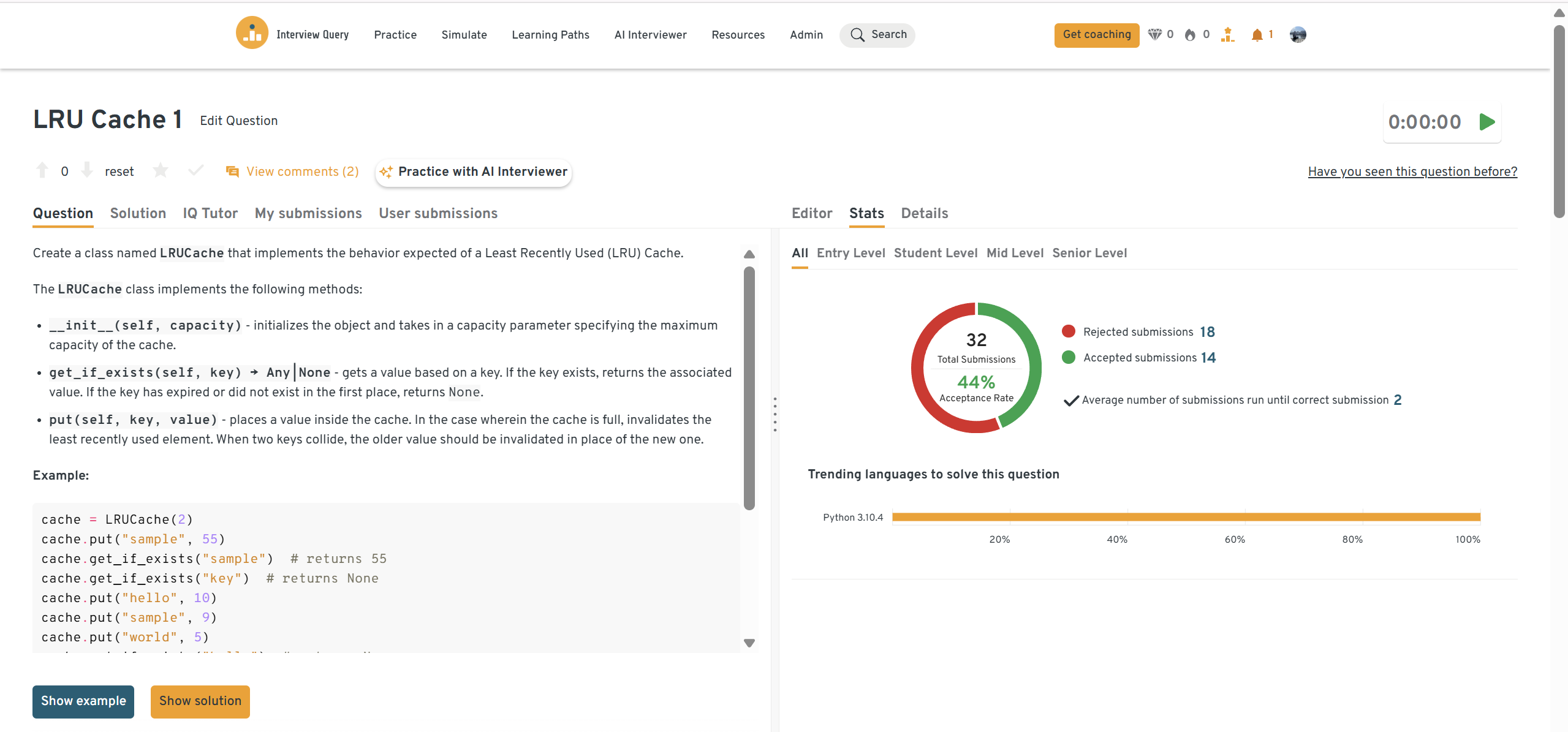
Create an LRU cache class that supports get and put operations.
This evaluates your understanding of how to combine a hash map with a doubly linked list to guarantee O(1) access and updates. It is directly relevant to ML serving, where caching features or predictions is common.
Tip: Highlight how your design handles eviction, concurrent access assumptions, and any invariants you maintain.
You can practice this exact problem on the Interview Query dashboard, shown below. The platform lets you write and test SQL queries, view accepted solutions, and compare your performance with thousands of other learners. Features like AI coaching, submission stats, and language breakdowns help you identify areas to improve and prepare more effectively for data interviews at scale.
To strengthen your coding intuition for the Atlassian machine learning engineer interview, practice problems that combine data structures, numeric reasoning, and production oriented design patterns rather than only textbook algorithm puzzles. You can also drill role specific practice from our machine learning engineer interview questions library.
Machine learning theory and modeling interview questions
ML system design interviews at Atlassian test how you architect data flows, models, and serving layers around real world use cases. The focus is on clear reasoning, practical tradeoffs, and the ability to design systems that can evolve over time. If you want more practice with this style of question, work through our machine learning system design interview questions collection to see how real ML scenarios are framed.
-
Interviewers want to see that you understand regularization as a way to control model complexity and overfitting, and cross validation as a way to estimate generalization performance. The best answers explain how these techniques complement each other rather than treat them as substitutes.
Tip: Use a concrete example, such as tuning a regularization parameter with cross validation, to keep your explanation grounded.
-
This problem checks your understanding of simple time series assumptions and how to translate them into code. You need to reason about linear interpolation, ensure the total matches the target, and handle rounding or numeric issues.
Tip: Explain how you would validate the forecast and what error metrics or sanity checks you would use.
How would you choose between logistic regression, decision trees, and gradient boosting for a new classification problem at Atlassian
Strong answers frame this in terms of data size, feature types, interpretability needs, training time, and robustness to noise. You might start with a simple baseline like logistic regression, then move to trees or boosted ensembles for more complex decision boundaries.
Tip: Emphasize the value of starting with simple baselines to create a clear performance reference.
How would you evaluate a recommendation model that suggests Jira issues or Confluence pages to users
You should discuss both offline and online evaluation. Offline you might use ranking metrics like precision at K, recall at K, or NDCG. Online you might consider click through rate, time to find relevant work, or downstream productivity metrics.
Tip: Mention guardrail metrics such as user dissatisfaction or error reports so you show a balanced, product oriented mindset.
ML system design and infrastructure interview questions
ML system design interviews at Atlassian test how you architect data flows, models, and serving layers around real world use cases. The focus is on clear reasoning, practical tradeoffs, and the ability to design systems that can evolve over time.
Design an ML system that recommends relevant Jira issues to a user on their backlog view.
This scenario mirrors a real Atlassian use case where teams want help prioritizing work. A strong answer breaks the problem into candidate generation (for example, pulling issues from the same project, component, or recent activity), ranking (using features like recency, assignee, labels, historical interactions, and team conventions), and feedback loops (clicks, comments, transitions). You should also consider how to log interactions, retrain the model, and handle cold start cases for new projects or users.
Tip: Explicitly separate what runs offline (feature generation, training) from what runs online (serving, caching, and real time signals) to show clear system thinking.
-
This question asks you to define data ingestion, feature engineering, model selection, retraining, and evaluation. It also tests whether you think about latency, batch versus streaming updates, and how predictions will be consumed downstream.
Tip: Separate functional requirements from non functional ones such as scalability, reliability, and monitoring.
-
You are expected to discuss API endpoints, autoscaling, model hosting, and integration with logging and metrics. Good answers also cover canary deployments, model versioning, and rollback strategies.
Tip: Call out specific monitoring signals such as latency, error rate, and drift between training and serving data.
How would you design the YouTube video recommendation algorithm
Interviewers are not looking for a perfect system, but for a structured decomposition of candidate generation, ranking, and feedback loops. For Atlassian, similar patterns apply to recommending Jira issues, Confluence pages, or marketplace apps.
Tip: Clearly distinguish between candidate retrieval and ranking stages, and talk about how you would close the loop with user feedback.
-
This tests your understanding of the difference between offline and online features, consistency guarantees, and feature reuse across models. You should describe how raw data flows into the store, how features are materialized, and how training and serving stay in sync.
Tip: Emphasize point in time correctness and avoiding training serving skew.
How would you build the type ahead recommendation algorithm for Netflix search
You should describe how you would index queries, rank suggestions, and personalize results based on user history. This maps naturally to Atlassian use cases such as type ahead search in Jira or Confluence for issues, projects, or pages.
Tip: Discuss latency constraints and how you would precompute or cache results to keep interactions fast.
-
This scenario assesses ownership, simplicity, and your ability to design a minimal yet reliable pipeline. You might propose scheduled retraining, simple CI workflows, model artifact versioning, and health checks for the serving endpoint.
Tip: Show that you can balance ideal MLOps patterns with pragmatic constraints, which is important even in a larger environment like Atlassian.
Behavioral and values-based interview questions
Atlassian’s behavioral interviews for machine learning engineers focus on collaboration, communication, and alignment with Atlassian’s values. You will be asked to describe how you worked through ambiguity, shipped ML projects, and handled challenges with stakeholders.
-
This question explores how you handle obstacles such as messy data, changing requirements, or model performance issues. Interviewers are interested in your problem solving process and how you involve others to move forward.
Tip: Highlight a specific challenge and end with a clear outcome or learning.
Sample Answer: In a course project on click prediction, our dataset had severe class imbalance, which caused our baseline models to overpredict the majority class. I experimented with resampling and class weighted loss functions, then worked with my teammates to adjust our evaluation metrics to focus on recall at high precision. The final model was more aligned with the business goal of catching rare but important events.
What are your strengths and weaknesses
Atlassian values self awareness and growth mindset. Interviewers want to see that you can name concrete strengths that help teams and acknowledge areas where you have actively improved.
Tip: Tie strengths to collaboration or engineering quality and frame weaknesses in terms of specific actions you are taking.
Sample Answer: One of my strengths is breaking down complex ML problems into small, testable steps, which helps teams make progress without getting stuck on perfect solutions. A weakness I have been working on is overloading myself with too many experiments at once, so I now prioritize a smaller set of hypotheses and time box each iteration.
-
This question evaluates your ability to adapt your communication style to different audiences. For ML engineers, that often means translating model metrics or tradeoffs into language that PMs or designers can act on.
Tip: Show empathy for the stakeholder and explain how you changed your approach based on their perspective.
Sample Answer: While working on a recommendation model, I initially presented only AUC and loss curves, which confused a non technical PM. I shifted to showing examples of before and after recommendations and tied improvements to click through rate. This made the impact clearer and led to a more focused discussion on which user segments to prioritize.
Why do you want to work with us
Interviewers want to know that you have a specific interest in Atlassian’s products and the ML problems they pose. Strong answers connect your experience to collaboration tools, recommendation systems, or generative AI features Atlassian is exploring.
Tip: Mention particular products or values that resonate with you rather than giving a generic answer about liking technology.
Sample Answer: I am interested in Atlassian because its products sit at the center of how engineering teams plan and collaborate, which creates unique opportunities for ML in search, recommendations, and content understanding. I also appreciate the emphasis on openness and teamwork, which fits how I like to build and iterate on models with cross functional partners.
What are some effective ways to make data and insights more accessible to non technical people
Even as an ML engineer, you will often need to explain model behavior and impact to non technical stakeholders. Interviewers look for concrete strategies such as visualizations, examples, and simple narratives.
Tip: Give one or two specific techniques you have used, such as feature importance visuals or scenario based explanations.
Sample Answer: I like to pair quantitative summaries with concrete user journeys, for example showing how a recommendation model changes what a new Jira user sees on their first visit. I also use simple charts that compare key metrics before and after a change and avoid algorithm names unless the audience asks for more detail.
Tell me about a time you shipped a machine learning model that did not work as expected at first. What did you do
Atlassian wants engineers who treat unexpected results as learning opportunities and who communicate issues early. You should describe how you diagnosed the problem, what you changed, and how you involved your team.
Tip: Emphasize ownership, transparency, and the improvements you made to your process afterward.
Sample Answer: In an internship, a churn model I helped deploy underperformed because the training data had an outdated definition of churn. I worked with the data team to correct the label logic, retrained the model, and added a validation step that compares key label distributions before any future training run. The updated model performed better and our process became more reliable.
Describe a situation where you raised a concern about fairness, bias, or responsible use of a model. How did you handle it
As Atlassian expands its use of AI, responsible ML becomes increasingly important. Interviewers want to see that you can identify potential issues and raise them constructively.
Tip: Show that you can balance business needs with user impact and that you are willing to propose practical mitigations.
Sample Answer: In a group project that ranked users based on engagement, I noticed that the model penalized users in regions with lower bandwidth. I raised this with the team and suggested we include region level controls and evaluate performance separately by geography. We redefined the objective to focus on relative engagement within each region, which reduced the bias and aligned better with the project’s goals.
How to Prepare for an Atlassian Machine Learning Engineer Interview
Preparing for an Atlassian machine learning engineer interview requires strong ML fundamentals, coding fluency, and the ability to design practical ML systems that improve collaboration across Jira, Confluence, and Trello. Atlassian evaluates how you reason through ambiguity, communicate tradeoffs, and work in a distributed, values oriented environment. Below are the most effective strategies to prepare for the interview loop.
If you prefer to start with a quick visual overview, watch this guide on how to become a machine learning engineer by Jay Feng, co-founder of Interview Query. It’s a concise walkthrough of the skills, benefits, and differentiation strategies for aspiring ML engineers.
Strengthen your coding and data structures foundation
ML engineers at Atlassian must write clean, maintainable Python that handles arrays, hash maps, trees, and common algorithmic patterns. Coding interviews focus on clarity, structure, and complexity awareness rather than obscure tricks. If you need a structured path, use our data science learning paths which break down weekly practice plans.
Tip: Practice solving problems by narrating your reasoning out loud to mirror real interview expectations.
Master core machine learning fundamentals
Interviewers expect comfort with supervised learning, feature engineering, regularization, cross validation, embeddings, and evaluation metrics. You should understand not only how algorithms work but why you would choose one over another for Atlassian’s real product signals. You can also explore our AI engineer interview questions to compare modeling expectations across adjacent roles.
Tip: Refresh concepts using your own words and prepare simple examples for interpretability.
Develop familiarity with Atlassian’s product ecosystem
ML engineers work on search ranking, recommendations, and generative AI features that power Jira issues, Confluence pages, and team workflows. Understanding how users interact with these products helps you reason more concretely about model choices and metrics.
Tip: Explore a Jira project or Confluence workspace and think about what signals an ML model could use.
Practice ML system design with a product oriented mindset
Atlassian’s ML interviews often involve designing pipelines for ranking, type ahead search, or LLM powered features. Interviewers look for structured thinking across ingestion, feature stores, training, evaluation, and serving.
Tip: Separate functional and non functional requirements early to keep your design organized.
Prepare to explain tradeoffs clearly
Many ML problems at Atlassian involve noisy data, ambiguous labels, or evolving user behavior. Interviewers want to hear how you balance simplicity, performance, latency, and maintainability.
Tip: For every design choice, offer one alternative and explain why you did not select it.
Review how generative AI and LLMs fit into Atlassian workflows
Atlassian is actively building AI assisted features for writing, summarizing, and searching content. Having a grounded understanding of prompting, retrieval strategies, evaluation, and safety makes your answers more relevant.
Tip: Be ready to discuss when classical ML, retrieval augmented generation, or fine tuning would be appropriate.
Prepare one ML project you can walk through end to end
In manager and technical interviews, you are often asked to explain a past project. Interviewers want to understand your problem framing, modeling approach, evaluation, and how you collaborated with teammates.
Tip: Structure your walkthrough as problem, approach, result, and learning within 90 seconds.
Practice communicating complex ideas to non technical stakeholders
ML engineers collaborate frequently with PMs, designers, and analysts. You will be evaluated on how well you translate model behavior, tradeoffs, or limitations into clear narrative form. A great way to practice delivery is by trying our AI interviews, which simulate real interviewers and provide instant feedback.
Tip: Summarize each explanation with one sentence that communicates why it matters for the product.
Demonstrate ownership and data quality instincts
Atlassian manages large volumes of product signals. Showing that you naturally think about label correctness, drift, missing events, and validation steps signals maturity as an ML engineer.
Tip: Mention simple checks such as comparing train and serve distributions or validating label generation logic.
Simulate the interview loop with timed practice
Practicing full coding sessions, ML theory drills, and system design walkthroughs makes the real interview feel more natural. Mock interviews help sharpen communication and pacing.
Tip: Use scenario based practice questions to build intuition for how Atlassian frames ambiguous problems.
FAQs
How competitive is the Atlassian Machine Learning Engineer interview?
Atlassian’s ML interview process is selective because it evaluates both technical depth and practical problem solving across coding, ML fundamentals, and system design. Candidates who demonstrate structured reasoning and strong communication tend to stand out. Showing familiarity with Atlassian’s products and real world ML use cases also makes a meaningful difference in competitiveness.
What is the typical timeline for the Atlassian ML interview process?
Most candidates move from recruiter screen to final decision within three to five weeks. Timed assessments and take home tasks can add a few days, and scheduling for system design rounds may vary by team. Atlassian recruiters generally provide consistent guidance throughout the process.
Do I need deep knowledge of deep learning or LLMs for this role?
You do not need cutting edge research expertise, but you should understand the fundamentals of neural networks, embeddings, and how transformer based models are used in modern applications. Atlassian values engineers who can apply ML techniques pragmatically to search, recommendations, and generative AI features rather than only discussing theory.
How much Python do I need to know for the coding rounds?
Coding interviews expect fluency in writing clean, maintainable Python that uses core data structures effectively. You should be comfortable implementing algorithms, manipulating arrays or dictionaries, and writing functions that handle edge cases clearly. Performance and readability are both important.
What type of ML problems does Atlassian focus on?
Most ML teams work on search relevance, ranking, personalization, anomaly detection, and generative AI features across Jira, Confluence, and Trello. You will also encounter work involving embeddings, text models, and retrieval strategies that enhance user productivity. System level thinking is essential because these features must integrate directly into product workflows.
How important is ML system design in the interview loop?
System design is a core component of the Atlassian ML engineer interview. You will be asked to outline how models are trained, deployed, monitored, and iterated in production. Interviewers look for clarity in how you separate data ingestion, feature engineering, model serving, evaluation, and long term maintenance.
Does Atlassian hire ML engineers into specific product teams?
Early career candidates may join a centralized ML group or a product aligned team depending on business needs. ML engineers often rotate across recommendation systems, search teams, or generative AI initiatives as products evolve. Atlassian values learning agility and encourages movement between teams over time.
Is Atlassian a good environment for early career ML engineers?
Yes. Programs like Grad++ offer structured mentorship, hands-on exposure to real ML systems, and clear opportunities for growth. The distributed first culture places a strong emphasis on collaboration, documentation, and thoughtful communication, which supports early career engineers as they develop.
Do Atlassian ML engineers work closely with product and design teams?
Very much so. ML engineers collaborate directly with PMs, designers, data scientists, and platform engineers to frame problems, refine success metrics, and ship features that influence user workflows. Clear communication is essential because ML decisions often shape product behavior.
Does Atlassian support remote work for ML roles?
Many ML teams operate in a distributed first model, although some early career roles may require in office presence depending on location and mentorship needs. Candidates should confirm expectations with their recruiter early in the process to understand team specific requirements.
Start Your Atlassian ML Engineer Interview Prep Today
Preparing for an Atlassian machine learning engineer interview is much easier when you practice with problems that mirror the real loop. The role rewards clear thinking, strong coding fundamentals, and the ability to design practical ML systems across ranking, recommendations, and generative AI features. With the right preparation, you can show interviewers how you translate complex ideas into models that meaningfully improve the Atlassian product ecosystem.
You can build this confidence by working through targeted practice sets on Interview Query. Explore hands on problems in the machine learning interview questions library, sharpen your fundamentals with the coding interview questions collection, or build end to end intuition through our system design interview guide. Each resource helps you master the skills Atlassian evaluates so you can walk into the interview loop ready to perform at your best.
If you prefer live practice, join our peer mock interviews to rehearse technical and behavioral questions with real candidates.
Atlassian Interview Questions
| Question | Topic | Difficulty | ||||||||||||||||||||||||||||
|---|---|---|---|---|---|---|---|---|---|---|---|---|---|---|---|---|---|---|---|---|---|---|---|---|---|---|---|---|---|---|
Data Structures & Algorithms | Medium | |||||||||||||||||||||||||||||
Given the integer list nums with length n, create a function that converts each integer in the list into its corresponding Roman numeral representation. The Roman numeral symbols and corresponding values are provided in the table below. The function must be able to handle integers up to 1000.
Examples:Input: Output: | ||||||||||||||||||||||||||||||
Data Structures & Algorithms | Medium | |||||||||||||||||||||||||||||
Concurrent & Distributed Systems | Hard | |||||||||||||||||||||||||||||
SQL | Easy | |
Machine Learning | Medium | |
Statistics | Medium | |
SQL | Hard | |
Machine Learning | Medium | |
Python | Easy | |
Deep Learning | Hard | |
SQL | Medium | |
Statistics | Easy | |
Machine Learning | Hard |
Discussion & Interview Experiences