
Atlassian Business Analyst Interview Guide & Jira Questions


Introduction
Atlassian powers how teams plan, build, and collaborate through products such as Jira, Confluence, Trello, and Bitbucket. With more than 300,000 customers and millions of daily users, every workflow, issue, and customer interaction generates data that shapes product strategy and business performance. Business analysts help make sense of this ecosystem by analyzing trends, improving processes, and guiding teams toward clearer, data-informed decisions.
If you are preparing for the Atlassian business analyst interview, this guide explains the role, what Atlassian evaluates, and how the interview process works. Many candidates also refresh their analytics foundations through the data science interview learning path, since business analyst interviews often include SQL and structured problem solving.
What does an Atlassian business analyst do?
Business analysts support product, operations, finance, and go-to-market teams by structuring ambiguous problems and turning data into clear recommendations.
Key responsibilities include:
- Analyzing product, operational, and financial performance
- Mapping business processes and identifying workflow gaps
- Building dashboards and recurring business reports for stakeholders
- Supporting product decisions with customer and usage insights
- Defining metrics and driving alignment on data definitions
- Partnering with engineering, product management, design, and GTM teams
- Translating complex findings into clear, actionable narratives
Many candidates practice their communication and reasoning skills through mock interviews to mirror Atlassian’s discussion-based style.
Why this role at Atlassian
The Atlassian business analyst role is a strong fit if you enjoy working at the intersection of data, operations, and product strategy. You help shape decisions that affect how teams collaborate, how products evolve, and how the business grows.
Reasons candidates choose this role:
- Direct impact on product and operational decisions
- Exposure to multiple teams, regions, and problem types
- Modern analytics environment with a strong data culture
- Values-driven company that emphasizes teamwork and openness
- Clear growth paths into product, strategy, operations, or analytics leadership
If you want to deepen adjacent skills such as SQL and analytical modeling before interviewing, you can also explore the SQL interview learning path to build confidence in common technical components of business analyst loops.
If you’re also exploring other roles, you can compare this process with the broader Atlassian interview guide, which covers Atlassian’s interview patterns across data, product, and engineering positions.
Atlassian Business Analyst Interview Process
Atlassian uses a multi-stage interview process to evaluate your analytical thinking, structured communication, collaboration, and business intuition. Each step mirrors the cross-functional nature of the role. You’ll be expected to convert ambiguous information into clear, actionable insights. Many candidates also review fundamentals through the takehomes page because the process often includes analytical tasks and case-based reasoning.
Interview Stages Overview
| Stage | What it focuses on |
|---|---|
| Recruiter screen | Background fit, communication style, motivation |
| Technical assessment | SQL, analytical reasoning, light take-home work |
| Technical interviews | Business cases, metrics, product reasoning, communication |
| Behavioral interviews | Collaboration, ownership, alignment with values |
| Final interview | Strategic thinking, stakeholder alignment, long-term fit |
Recruiter screen
The recruiter screen is designed to confirm whether your background aligns with Atlassian’s expectations for a business analyst role. Recruiters look for clarity of communication, genuine motivation, and an understanding of how your experience translates into the responsibilities of the role. This stage also sets expectations for timelines, team fit, and the overall interview flow so you can prepare confidently.
| What they check | Examples |
|---|---|
| Background fit | Coursework, internships, analytics exposure |
| Communication clarity | Explaining projects simply and logically |
| Motivation | Why Atlassian and why a business analyst role |
| Logistics | Availability, role details, location requirements |
Tip: Use concrete numbers and outcomes when describing your experience so the recruiter immediately sees your impact.
Technical assessment
The technical assessment evaluates how you approach analytical problem solving in a structured and efficient way. Atlassian uses this stage to understand how comfortably you can handle SQL or light analytical tasks without overcomplicating the problem. Even simple questions allow interviewers to assess clarity of thought, data intuition, and how well you communicate your reasoning from start to finish.
- SQL tasks that require joins, aggregates, filtering, and logic
- Short analytical or business cases that involve structured reasoning
- Basic data cleaning or metric interpretation exercises
- Optional take-home designed to evaluate clarity and communication
- Graded on correctness, structure, interpretation, and clarity
Tip: Talk through your thinking step by step so interviewers can follow your approach easily.
Technical interviews
Technical interviews simulate real business analyst work by testing how you break down ambiguous problems and translate insights into recommendations. Atlassian teams care deeply about structured communication, so these interviews highlight whether you can take messy, incomplete information and organize it into a clear approach. Interviewers also evaluate your understanding of metrics, product reasoning, and the trade-offs behind decisions.
| Focus area | What it looks like |
|---|---|
| Business case | Breaking down unclear or open-ended problems |
| Metrics | Choosing KPIs and explaining what they represent |
| Product reasoning | Understanding how Atlassian products create value |
| Communication | Turning insights into clear and actionable explanations |
Tip: Always begin your response with a quick framework so the interviewer sees your structure immediately.
Behavioral interviews
Behavioral interviews explore how you work with others, handle ambiguity, and embody Atlassian’s values in real situations. Interviewers want to see how you navigate conflict, collaborate across functions, and take ownership of work that may not be perfectly defined. This stage also assesses whether your communication style aligns with Atlassian’s culture of openness, clarity, and teamwork.
- STAR-format scenarios that highlight ownership, teamwork, and clarity
- Examples of improving processes or solving unclear problems
- Stories involving cross-functional collaboration
- How you handle shifting priorities or incomplete information
Tip: Keep every STAR story tightly structured so each detail supports your result.
Final interview
The final interview focuses on long-term potential, strategic thinking, and communication at a higher decision-making level. Interviewers want to see how you think about problems beyond the immediate task, including trade-offs, stakeholder alignment, and the broader product ecosystem. This stage helps determine whether your approach, mindset, and style fit the long-term needs of the team.
| Category | What they evaluate |
|---|---|
| Strategic thinking | How you approach long-term decisions and trade-offs |
| Stakeholder alignment | How you justify recommendations and gain buy-in |
| Business intuition | Understanding impact, cost, value, and prioritization |
| Role fit | Whether you can scale and grow with the team |
Tip: Tie each answer back to customer value or business outcomes to show high-level reasoning.
Challenge
Check your skills...
How prepared are you for working as a Business Analyst at Atlassian?
Atlassian Business Analyst Interview Questions and Answers
Atlassian business analyst interviews focus on how you structure problems, work with data, and communicate clearly with cross-functional partners. You can expect a mix of SQL and data manipulation, metrics and dashboard design, Jira interview questions for business analysts, product and business case prompts, and values-driven behavioral questions.
The examples below draw from real Interview Query questions where relevant and from Atlassian-style scenarios that mirror how business analysts support product, operations, and go-to-market teams.
SQL and data manipulation interview questions
Atlassian business analysts often write SQL to pull product usage data, revenue trends, or internal operational metrics, so many Jira interview questions for business analyst roles focus on realistic analytics scenarios. Interviewers look for clarity of logic, awareness of data quality issues, and the ability to translate ambiguous business definitions into precise queries. You can target this skill set directly with our business analyst SQL interview questions collection and then go deeper with the SQL interview learning path to get comfortable with the style and difficulty level.
Calculate first touch attribution for each user who converted.
This problem tests whether you understand user journeys and can join session data to conversion events in a disciplined way. A strong answer joins sessions with conversions, filters to users who converted, and then uses
ROW_NUMBER()orMIN(timestamp)to find the earliest session per user. You should explain what defines a session, which timestamp you rely on, and how you deal with overlaps or missing data. Interviewers use this to see if you can set up attribution rules that marketing and product teams can trust. At Atlassian, similar logic might be used to understand which acquisition channels lead to workspace creation or long-term retention.Tip: Always state the grain of your final table, such as “one row per converting user,” so your logic stays consistent throughout the query.
Write a query to get the number of customers that were upsold.
Here you need both SQL skills and clear business thinking, because “upsold” is not defined in the question. You should start by choosing a definition, such as customers moving to a higher pricing tier or expanding the number of seats in their subscription. Then you would group by customer, compare their earlier and later states, and count those who meet your upsell criteria. Interviewers evaluate whether your assumptions make sense in a SaaS context and whether you explain how you would handle customers with multiple changes over time. This maps directly to Atlassian scenarios like understanding how teams expand from a few Jira seats to an enterprise-wide rollout.
Tip: Say your upsell definition out loud before writing SQL so the interviewer sees that your logic aligns with how the business tracks revenue growth.
Write a query to get the current salary for each employee after an ETL error duplicated records.
This question checks how you handle data quality issues, which are common in real internal reporting. You need to identify the correct “current” row per employee, often by ordering records by an effective date or update timestamp and using
ROW_NUMBER()in a window function. Then you filter to the row with rank one and return that as the canonical record. Interviewers look for whether you mention the need to understand the source of duplication and how you would prevent it going forward. This reflects Atlassian’s expectation that business analysts do not just fix numbers but also think about pipeline robustness.Tip: When you see duplicated records, always describe both your immediate fix and one prevention step you would recommend to data engineering or operations.
How would you join noisy usage logs to an account-level table to create a clean workspace activity dataset?
This is a generated question that mirrors how Atlassian aggregates event data into workspace or account-level metrics. A strong answer starts by clarifying the keys that link events to accounts, such as workspace ID or site ID, and then describes how you handle missing or malformed IDs. You might explain how you would filter out bot traffic, test for duplicates, and decide on a grain such as “one row per workspace per day.” Interviewers want to see that you are comfortable moving from raw logs to a reliable dataset that stakeholders can use for dashboards. This is especially important for business analysts who support product and customer success teams.
Tip: Always define the grain of your final dataset and describe at least one data quality check you would run before trusting the numbers.
-
This question evaluates whether you can aggregate data at the department level and compute a meaningful ratio that leaders can use. You need to group by department, calculate the percentage of high earners, and filter out departments with fewer than ten employees to avoid noisy samples. Using a window function such as
DENSE_RANK()lets you rank departments by this percentage while handling ties correctly. Interviewers will also notice if you structure your query with CTEs so each step is readable and debuggable. Finally, they care about how you would validate the results, since headcount data often has missing or outdated records.Tip: When computing ratios, explicitly call out how you would treat null salaries or inactive employees so stakeholders know your numbers are trustworthy.
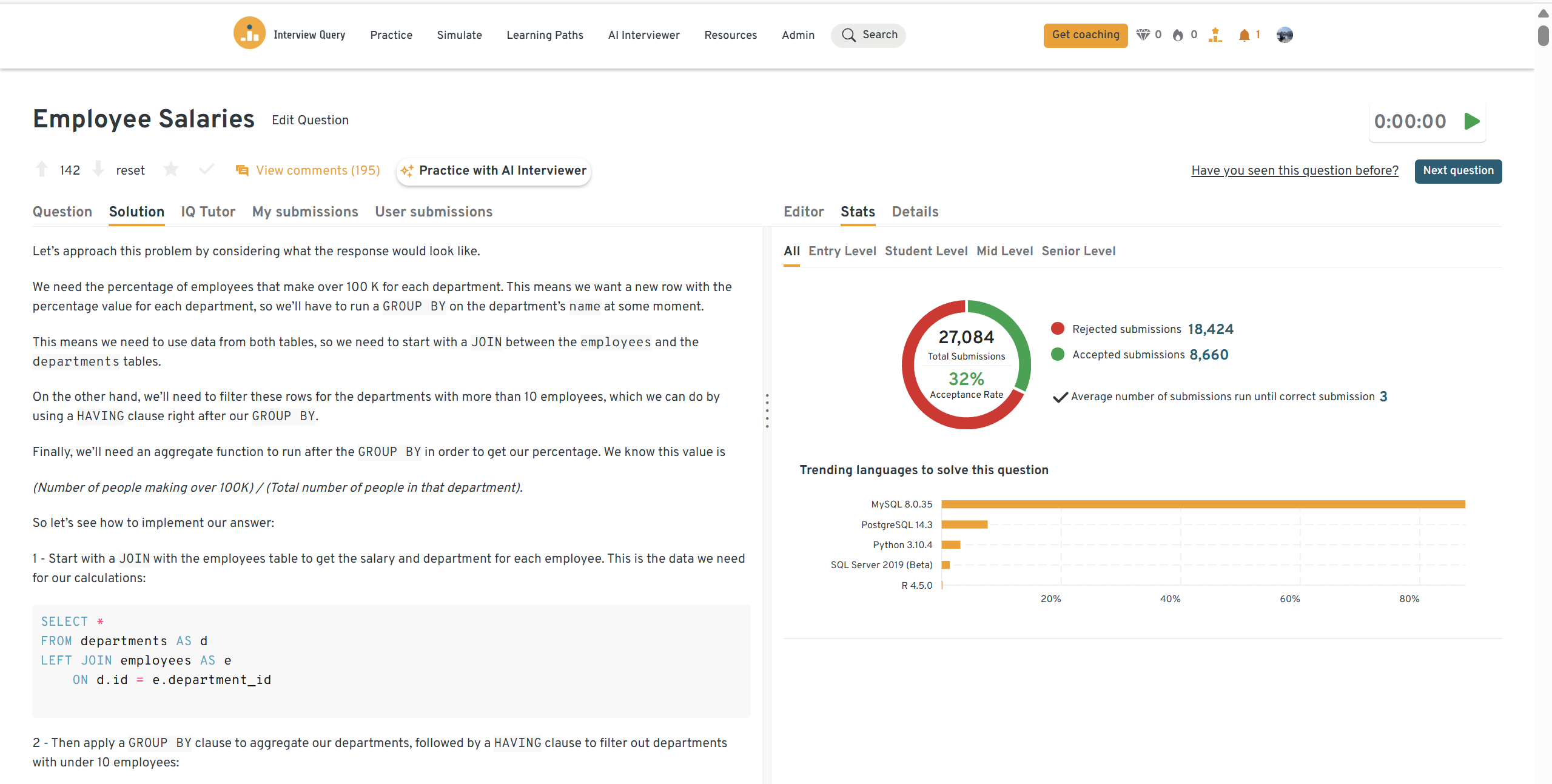
You can practice this exact problem on the Interview Query dashboard, shown below. The platform lets you write and test SQL queries, view accepted solutions, and compare your performance with thousands of other learners. Features like AI coaching, submission stats, and language breakdowns help you identify areas to improve and prepare more effectively for data interviews at scale.
Metrics, analytics, and dashboarding interview questions
Business analysts at Atlassian spend significant time defining metrics, diagnosing funnel drop-offs, and building dashboards that product and business leaders use to make decisions. Interviewers want to see that you can balance depth and simplicity, pick guardrail metrics, and explain trade-offs clearly. Reviewing case-style problems and metric questions through the modeling and machine learning interview learning path can help you practice how to reason about metrics even if you are not in a pure data science role.
How would you analyze an approval rate drop in a key funnel?
This question tests your ability to investigate a top-line metric that suddenly worsens. You should start by confirming that the drop is real, not an artifact of tracking changes or data issues. Then you would segment the funnel by cohorts such as geography, customer size, product plan, or time period to localize the issue. Interviewers also expect you to consider external factors like seasonality or policy changes that may explain the shift. You should close by outlining potential next steps, such as targeted experiments or UX reviews, that could improve the metric.
Tip: Always summarize your diagnosis in one clear sentence before listing details, so stakeholders can remember your core insight.
How would you design a KPI dashboard to track conversion funnels across Jira, Confluence, and Trello?
This generated question checks your ability to structure a multi-product view without overwhelming stakeholders. A strong answer defines the core funnel stages first, such as sign-up, workspace creation, first value event, and active usage. Then you would explain how you would segment by product, workspace type, or account size, and which filters matter most to PMs and business leaders. Interviewers want to see that you understand the audience for the dashboard and can prioritize clarity over visual complexity. You can also mention time trends, comparison views, and alerting thresholds for when metrics deviate from normal ranges.
Tip: Explicitly name who the dashboard is for and what decisions it should support so the interviewer sees that you design with users in mind.
How would you define a north star metric for Jira issue creation quality, not just volume?
This question evaluates how you think beyond simple counts and toward metrics that reflect real customer value. You might propose a primary metric such as “issues created that are moved out of backlog within X days” or “issues with a complete set of required fields that reach resolution.” You should then add guardrail metrics, such as time to resolution or reopening rate, so teams do not optimize for volume at the expense of quality. Interviewers look for whether you can tie the metric back to collaboration outcomes, such as smoother sprints or fewer blocked tasks. This kind of thinking is important at Atlassian, where metrics inform product roadmaps and team workflows.
Tip: When defining any north star metric, always state one risk or blind spot to show that you are thinking critically about what the metric ignores.
How would you measure the impact of a new recommendation module on the Atlassian Marketplace homepage?
This question blends experimentation thinking with business metrics. You should propose a comparison between users who see the new module and those who do not, tracking outcomes such as click-through rate, app installs, revenue per visit, and long-term retention. Interviewers expect you to mention guardrail metrics, such as page speed or bounce rate, that protect the overall user experience. You should also discuss how you would segment results by customer type, such as admin versus end user or small versus enterprise accounts. This shows that you can move from a local UI change to a broader view of business impact.
Tip: Make sure you name both a primary success metric and at least one guardrail metric so your answer feels balanced.
How would you design a weekly business review for Atlassian’s self-serve subscription funnel?
This question reveals how you prioritize metrics and storytelling across a recurring monitoring ritual. A strong answer starts with a small set of headline metrics such as sign-ups, workspace creations, conversions to paid, and churn or downgrades. Then you add diagnostic cuts, such as performance by geography, plan type, or key acquisition channels. Interviewers want to see that you can propose a repeatable structure that highlights exceptions rather than just showing a static dashboard. You should also mention how you would incorporate narrative context so that leaders understand not just what changed, but why it matters.
Tip: Emphasize how you would keep the review focused on decisions and follow-ups rather than simply walking through charts.
Product and business case interview questions
Atlassian business analysts frequently support product managers and operations leaders on structured problems that do not always have perfect data. These questions test how you frame ambiguous prompts, identify data sources, and propose practical next steps. Many candidates practice this style of thinking with mock interviews or case-style challenges to get comfortable speaking through their approach in real time.
A Jira team sees a decline in new project creation over the last quarter. How would you investigate the cause?
This question evaluates your ability to structure an open-ended product problem. You should begin by clarifying whether the decline is absolute or relative to traffic, and whether it is concentrated in specific segments such as geography or customer size. Then you would outline a plan that includes data checks, segmentation, product change audits, and qualitative inputs like customer feedback. Interviewers also want to hear how you would prioritize hypotheses, for example distinguishing between pricing, onboarding friction, and competing tools. Finally, they are listening for how you would communicate findings and propose experiments or UX changes.
Tip: Always move from validation to segmentation to hypotheses, so your investigation feels systematic rather than ad hoc.
Atlassian is considering introducing a new pricing tier for small teams. What analysis would you run before recommending whether to launch it?
This question tests your mix of quantitative and strategic thinking. You could start with market sizing and current customer distribution by seats and revenue, then move into modeling potential migration patterns from existing plans. Interviewers expect you to consider risks such as cannibalization, complexity in billing, and support overhead. You should also mention the need to test different price points or feature bundles through experiments or pilots. This shows that you are not just building a static model but thinking about how the company can learn before fully committing.
Tip: Clearly separate your pre-launch analysis from your post-launch measurement plan so interviewers can see both sides of your thinking.
Customer support volume for Confluence has spiked around permissions and access issues. How would you identify the root causes and propose improvements?
This question looks at how you combine quantitative data with qualitative insights. You might start by clustering support tickets by topic, severity, and customer segment, and then join these to product usage data to identify patterns. Interviewers will appreciate if you discuss looking at recent product changes, documentation gaps, or UI confusion as potential drivers. You should describe how you would size the impact of different root causes, for example by ticket volume or churn risk. Finally, you would propose a set of concrete changes, such as UI tweaks, help content, or targeted outreach to admins.
Tip: Mention at least one way you would quantify impact, such as ticket volume, time-to-resolution, or customer satisfaction, so your recommendations feel prioritized.
A cross-functional team wants to track “collaboration health” across Jira and Confluence. How would you define and measure it?
This prompt tests whether you can turn a vague concept into a measurable framework. You could suggest a bundle of behavioral metrics such as number of active contributors, comments per issue or page, and the proportion of issues that move stages within a given time window. Interviewers want to see you acknowledge that no single metric captures “collaboration health,” so you may propose a composite or dashboard view. You should also flag potential risks, such as encouraging noisy activity instead of meaningful progress. This kind of thinking aligns with Atlassian’s focus on improving how teams actually work together rather than just counting logins.
Tip: When facing fuzzy concepts, break them into 2–3 concrete behaviors and anchor your metrics there.
How would you prioritize a backlog of analytics requests from different teams when you have limited time?
This question focuses on prioritization and stakeholder management. A strong answer describes criteria such as business impact, urgency, alignment with strategic goals, and the effort required. You might explain how you would gather context from requesters, push back on low-value asks, and group similar requests into larger projects. Interviewers also expect you to mention communication, such as maintaining a simple intake process and updating stakeholders on status. This is central to the business analyst role at Atlassian, where analysts are often shared resources across multiple teams.
Tip: Describe at least one simple prioritization framework, such as an impact versus effort matrix, so your approach feels reproducible.
How would you improve the onboarding flow for new Jira users who create their first issue?
New users often struggle with Jira’s complexity, especially around issue types, fields, and workflows. This question evaluates whether you can diagnose friction points in a high-impact funnel. Strong answers validate data quality first, segment users by team type (software vs. business), and analyze drop-off between steps like “sign-up → create project → create first issue → resolve issue.” Interviewers also look for thoughtful recommendations that balance usability with power-user flexibility.
Tip: Anchor your answer in Atlassian’s “first value event,” such as “successfully creating and transitioning an issue.”
Behavioral and cross-functional interview questions
Behavioral interviews at Atlassian evaluate how you collaborate across teams, communicate insights, and handle ambiguity. Interviewers look for structured STAR stories that demonstrate ownership, problem solving, and a user-focused mindset. Strong answers show that you can explain decisions clearly while working with product, engineering, design, and go-to-market partners.
Tell me about a time you encountered hurdles in a data project. What challenges did you face?
This question tests your ability to manage incomplete data, shifting requirements, or technical blockers while still driving a project forward. Interviewers want to see that you can communicate early, scope impact, and collaborate with partners to unblock progress. Show how your decision improved the project outcome.
Tip: Mention both the technical hurdle and the cross-functional alignment hurdle.
Sample Answer: In a churn analysis project, I noticed data gaps for one region due to missing historical logs. I quantified the impact and shared a concise risk summary with the PM. I then worked with engineering to backfill part of the dataset and built a temporary heuristic so we could continue analysis. This helped us deliver insights on time and guided onboarding improvements that later reduced churn.
What are some effective ways to make data more accessible to non-technical people?
This question reveals how well you can democratize data. The interviewer wants to know whether you simplify analyses, adapt communication, and design insights for real decisions, not just dashboards. Highlight how you reduce cognitive load and enable independence.
Tip: Connect your answer to decision clarity, not dashboard complexity.
Sample Answer: I begin by understanding which decisions stakeholders need support for. I simplify dashboards to a few KPIs, add inline definitions, and choose visualizations that are easy to interpret. I also record short walkthrough videos for new users and gather feedback on whether the insights are actionable. This makes data adoption smoother across teams.
What would your manager say about your strengths and weaknesses?
Interviewers want an honest, balanced view of yourself. Pick strengths that match the role and weaknesses that you are actively addressing. Avoid weaknesses tied to core job requirements.
Tip: Support each trait with a concrete example.
Sample Answer: My manager would highlight structured problem solving and communication as my strengths. I make complex findings easy for cross-functional partners to act on. A weakness I am improving is spending too long exploring edge cases. I now use time-boxing and share early drafts sooner, which keeps projects moving efficiently.
Talk about a time you had trouble communicating with stakeholders. How did you overcome it?
This question tests adaptability and collaboration. Atlassian expects analysts to tailor communication styles to different audiences. Focus on how you diagnosed the misalignment and adjusted.
Tip: Emphasize how your change improved the relationship or workflow.
Sample Answer: I once worked with a PM who preferred headline insights, while I initially provided deep-dive analyses. I shifted to a concise one-page format with clear recommendations and optional detail sections. This immediately improved alignment and reduced review time. The PM later adopted this structure across multiple projects.
Why do you want to work with us?
Interviewers want a specific, authentic answer grounded in Atlassian’s mission and your analytical interests. Connect your motivation to Atlassian’s collaboration tools, data culture, and values.
Tip: Mention products, how you use them, or how your work would shape user workflows.
Sample Answer: I want to join Atlassian because the products meaningfully help teams collaborate. I am excited about working on analytics that improve workflows across Jira, Confluence, and Trello. I also appreciate Atlassian’s open culture and focus on real user problems. The business analyst role aligns with how I like to work: partnering with PMs and engineers to uncover insights and drive product decisions.
Tell me about a time you used data to change a stakeholder’s mind.
This evaluates persuasion, clarity, and your ability to frame insights in a way that shifts decisions. Interviewers want to see how you structure evidence and anticipate counterarguments.
Tip: Emphasize the decision impact, not just the analysis.
Sample Answer: A sales lead believed pricing drove cancellations. I analyzed churn by plan type, cohort, and customer size and found the real issue was onboarding drop-off. Presenting this visually helped shift the discussion. The team redirected resources to activation, which reduced churn in targeted segments.
How To Prepare For An Atlassian Business Analyst Interview
Preparing for an Atlassian business analyst interview means showing structured thinking, clear communication, and strong alignment with Atlassian’s core values. Business analysts work across product, operations, engineering, and leadership, so interviewers look for candidates who can turn ambiguous needs into clear requirements and measurable outcomes. It also helps to strengthen your foundations in problem solving and analytical reasoning through the data science interview learning path, especially for roles with an analytics component. The goal is to demonstrate how you partner with teams, frame decisions, and improve workflows that power products like Jira and Confluence.
If you prefer a quick video breakdown first, watch this video by Jay Feng, co-founder of Interview Query and former data scientist at Nextdoor and Monster. It’s a fast way to understand what hiring managers look for before you dive into deeper practice.
Demonstrate strong problem structuring and decomposition
Business analysts at Atlassian often face ambiguous prompts such as improving an onboarding flow, clarifying requirements for a new workflow, or diagnosing operational bottlenecks. Your ability to break down vague problems into clear steps, drivers, and decision points matters more than producing a perfect answer. Interviewers listen for how you frame tradeoffs and identify the information you need.
Tip: Start every response by defining the problem, stating assumptions, and outlining your approach before going deeper.
Build familiarity with Atlassian products and real customer workflows
Teams expect business analysts to understand how customers use Jira for issue tracking, Confluence for documentation, and Trello for planning. Knowing these workflows helps you reason about friction points, team behavior, and business impact during case questions. This also makes your examples more grounded and practical.
Tip: Create a test Jira project or Confluence space and think through what requirements, dependencies, or metrics you would track for a feature rollout.
Show that you can translate business goals into measurable metrics
Atlassian values clear success definitions for product updates, operational improvements, and cross-functional initiatives. You should be able to explain how to define KPIs, supporting diagnostics, and guardrails that reflect long-term customer and business value. Strong answers balance both context and measurable outcomes.
Tip: When proposing a metric, mention one limitation or blind spot to demonstrate balanced thinking.
Illustrate how you collaborate with cross-functional partners
Business analysts work closely with PMs, engineering, design, operations, and customer teams. Interviewers want to understand how you gather requirements, facilitate alignment, and ensure shared expectations across teams. Clear communication is essential because the role often creates structure that others depend on.
Tip: Practice explaining complex concepts in simple terms as if presenting to a non-technical stakeholder.
Strengthen your analytical reasoning and SQL basics when relevant
Some Atlassian business analyst roles involve light data work to support decision making. SQL fundamentals help with scenario questions based on product usage or operational datasets. You can practice patterns through the sql interview questions page or try realistic examples in the sql scenario-based questions.
Tip: Focus on reasoning steps and clean logic rather than advanced syntax since interviewers assess clarity, not trick solutions.
Prepare one detailed project or improvement story you can explain end to end
Final rounds often involve walking through a previous project where you improved a process, clarified a requirement, or drove alignment across teams. Choose an example that highlights your structure, stakeholder management, and business impact. Keep the walkthrough concise and outcome oriented.
Tip: Use a structure such as problem, approach, collaboration, and measurable impact.
Practice behavioral stories aligned with Atlassian’s values
Values interviews are a core part of Atlassian’s process. You should be ready with examples that show openness, teamwork, customer focus, and ownership. Strong candidates demonstrate how they handle disagreements, adapt to changing requirements, and improve processes around them. Practicing with guided prompts in the mock interviews section or real-world problems in challenges can help refine your delivery.
Tip: End each STAR story with a clear outcome so interviewers understand the impact of your actions.
FAQs
How competitive is the Atlassian business analyst interview?
Atlassian’s process is competitive because business analysts support decisions across product, operations, and customer teams. Interviewers expect structured reasoning, strong communication, and alignment with Atlassian’s core values. Practicing with realistic scenarios through the mock interviews page can help strengthen your preparation.
What is the typical interview timeline for this role?
Most candidates move from recruiter screen to final decision within three to five weeks. The timeline varies depending on scheduling across technical, functional, and values interviews. Take-home tasks or case studies may extend the process slightly.
Do I need SQL for an Atlassian business analyst role?
Some roles require light SQL for validating data or supporting business decisions. While SQL is not the main focus, knowing basic joins, filters, and aggregations can be beneficial. You can review essentials in the SQL interview questions learning path.
What types of case questions should I expect?
Expect questions about improving workflows, defining requirements, analyzing friction points, or structuring decisions across Jira or Confluence. Atlassian looks for clear problem framing, thoughtful tradeoff analysis, and customer-centered reasoning. Scenarios are often grounded in real collaboration workflows.
How important are Atlassian’s values in the interview?
Values are a central part of the process, and you will take a dedicated values interview. Interviewers assess openness, teamwork, customer focus, and balanced decision making. Strong stories demonstrate collaboration, ownership, and how you guide partners toward better outcomes.
Do business analysts work closely with product teams at Atlassian?
Yes. Business analysts often partner with PMs, engineering leads, design, finance, and customer support teams. Much of the role involves converting business needs into clear definitions, metrics, requirements, and recommendations.
Is this role fully remote or hybrid?
Atlassian maintains a remote-first approach for many roles. Some teams may follow a hybrid model depending on location, but most business analyst roles support distributed collaboration. You can clarify expectations with your recruiter early in the process.
What background do most successful candidates have?
Candidates often come from product operations, consulting, analytics, or business systems roles. Strong performers demonstrate structured problem solving, clear communication, stakeholder alignment, and a customer-focused mindset. Experience working with cross-functional teams is a major plus.
Start Your Atlassian Business Analyst Prep With Confidence
Preparing for an Atlassian business analyst interview is ultimately about showing clarity, structure, and a strong sense of how great teams make decisions. When you understand the workflows behind Jira and Confluence, communicate requirements cleanly, and ground your reasoning in customer value, you already stand out. The best candidates practice with intention and build the habits of structured thinking that Atlassian expects.
Interview Query gives you the tools to prepare with purpose. You can strengthen your skills with learning paths, sharpen your communication through mock interviews, and build confidence by solving real problems in challenges. Start practicing today and walk into your Atlassian interview ready to perform at your best.
Atlassian Interview Questions
| Question | Topic | Difficulty | ||||||||||||||||||||||
|---|---|---|---|---|---|---|---|---|---|---|---|---|---|---|---|---|---|---|---|---|---|---|---|---|
SQL | Easy | |||||||||||||||||||||||
Write a SQL query to select the 2nd highest salary in the engineering department. Note: If more than one person shares the highest salary, the query should select the next highest salary. Example: Input:
Output:
| ||||||||||||||||||||||||
Data Structures & Algorithms | Medium | |||||||||||||||||||||||
Product Sense & Metrics | Medium | |||||||||||||||||||||||
SQL | Easy | |
Machine Learning | Medium | |
Statistics | Medium | |
SQL | Hard | |
Machine Learning | Medium | |
Python | Easy | |
Deep Learning | Hard | |
SQL | Medium | |
Statistics | Easy | |
Machine Learning | Hard |
Discussion & Interview Experiences