

Atlassian Business Intelligence Engineer Interview Questions, Process, and Skills Guide


Introduction
Atlassian builds the tools that keep work moving for more than 300,000 customers worldwide, from Jira and Confluence to Trello and Bitbucket. Every issue created, sprint planned, and page published generates data that leaders rely on to make decisions about growth, product strategy, and operational performance. Business intelligence engineers sit at the center of this ecosystem by shaping how data is modeled, surfaced, and translated into decisions that influence product teams and executives across the company.
What does an Atlassian business intelligence engineer do?
Atlassian business intelligence engineers build the data foundations that product, finance, go-to-market, and leadership teams use to make decisions. They own the pipelines, models, and BI layers that power dashboards, self-serve analytics, and standardized metrics across products like Jira and Confluence. Instead of only creating one-off reports, BI engineers design scalable systems that make high quality data available to stakeholders across the company.
Key responsibilities include:
- Partnering with product, engineering, and business teams to translate questions into clear metrics and data requirements
- Designing and maintaining data models and ETL pipelines that power core BI tables and semantic layers
- Building dashboards and reports that track company, product, and functional KPIs
- Defining and governing key business metrics so teams measure performance consistently
- Identifying and resolving data quality issues across source systems, warehouses, and BI tools
- Enabling self-serve analytics by building reusable datasets and training stakeholders how to use them
- Collaborating with data engineers and data scientists on shared infrastructure and analytic projects
- Communicating insights, tradeoffs, and data limitations to both technical and non-technical audiences
BI engineers at Atlassian work as both builders and translators. They understand data infrastructure deeply, but they also shape narratives that help teams act on insights.
Why this role at Atlassian?
The business intelligence engineer role at Atlassian is a strong fit for someone who wants to operate at the intersection of data, tools, and strategy. You are not just building dashboards—you are designing the measurement systems that affect decisions across a global product suite. Because Atlassian runs at scale, the models and definitions you build influence how millions of users are analyzed and supported.
It is also a compelling opportunity for candidates who value strong mentorship and long-term growth. Atlassian’s engineering interview approach emphasizes problem solving and learning agility rather than rigid stack requirements. As a BI engineer, you gain experience across modern warehouses, analytics tools, and cross-functional teams while contributing to a culture built around clarity, openness, and continuous improvement.
Atlassian Business Intelligence Engineer Interview Process
Atlassian’s interview process is designed to understand how you structure complex data problems, reason through ambiguity, and collaborate with teams across product, engineering, and finance. Clear thinking is more important than memorizing SQL tricks. Many candidates prepare using structured resources like the data science interview learning path or the SQL interview learning path because they mirror the analytical thinking Atlassian expects.
To explore more Atlassian interview resources, you can also review the broader Atlassian interview guide, which breaks down interview patterns across data, product, engineering, and analytics roles.
Interview stages
| Stage | Focus |
|---|---|
| Recruiter screen | Experience and communication |
| Initial technical assessment | SQL and modeling fundamentals |
| Technical interviews | Data modeling, ETL, metrics, debugging |
| Behavioral and values interview | Collaboration and ownership |
| Final hiring manager interview | Strategic fit and long-term growth |
Initial recruiter screen
The recruiter screen is a conversational checkpoint that looks at how clearly you explain your work and how well your background fits Atlassian’s BI environment. Instead of technical depth, recruiters focus on communication clarity and your ability to describe business impact.
What they look for:
- Clear explanations of past BI or analytics work
- Understanding of your role in building dashboards, pipelines, or metrics
- Interest in Atlassian’s mission and product ecosystem
- Evidence that you can collaborate with product managers and engineers
Tip: Pick one project you can explain in under 60 seconds. Focus on the decision it enabled rather than the tool you used.
Initial technical assessment
This stage evaluates your foundational BI skills. Tasks may include writing SQL over product usage data, building a simple KPI summary, or cleaning inconsistent event logs. You may also be asked to explain your assumptions, especially when the data is messy. For BI-focused SQL and scenario practice, you can use the curated problems in our business intelligence interview questions library.
Typical elements of the assessment:
- Multi-step SQL with joins and window functions
- Cleaning duplicates or timestamp gaps
- Aggregating monthly or weekly metrics
- Translating an ambiguous requirement into a clear definition
If you want to simulate real cases, many candidates practice with scenario-based SQL challenges or browse Atlassian ML engineer questions to strengthen their ability to break down open-ended prompts.
Tip: Use CTEs and descriptive names. Atlassian values clarity over clever shortcuts.
Technical interviews
Technical interviews resemble working sessions with data engineers, analysts, or PMs. Instead of rapid-fire questions, interviewers walk through a scenario where you design a data model, outline an ETL pipeline, or diagnose a metric discrepancy.
A typical session may include:
- Sketching a data model for a new Jira or Confluence feature
- Designing an ETL flow from raw events to a curated reporting table
- Defining guardrail metrics for a new KPI
- Debugging mismatches between two dashboards
- Balancing freshness, latency, and storage needs
Here is an example of the kind of tradeoffs you may be asked to analyze:
| Option | Advantage | Risk |
|---|---|---|
| High refresh frequency | Better real-time accuracy | Higher compute cost |
| Heavy transformation upfront | Simplifies BI layer | Longer pipeline run time |
| Wide aggregate table | Faster dashboards | Less flexibility for new metrics |
This section often tests your ability to think beyond query writing. Reviewing the modeling and machine learning interview learning path can help you develop stronger end-to-end reasoning.
Tip: Always narrate your thought process. Atlassian wants to see how you weigh constraints, not just your final answer.
Behavioral and values interview
The behavioral stage evaluates collaboration, ownership, and alignment with Atlassian’s values. Expect situational questions about handling ambiguity, coordinating with technical partners, or navigating stakeholder conflict.
What interviewers pay attention to:
- How you simplify complexity when working with non-technical partners
- How you create structure when requirements are unclear
- How you handle conflicting priorities
- How you communicate when data quality issues arise
Questions usually follow a scenario format. Using stories practiced through mock formats, like Interview Query coaching or mock interviews, helps candidates deliver concise and reflective answers.
Tip: Emphasize outcomes. Atlassian favors candidates who highlight how their actions improved clarity, performance, or decision-making.
Final hiring manager interview
The final conversation focuses on long-term fit and how you think about the BI function as a strategic lever. Hiring managers want to understand your approach to problem framing, stakeholder alignment, and prioritization.
You may be asked about:
- A project you owned from end to end
- How you decide which metrics matter most
- How you balance immediate needs with scalable BI design
- How you partner with PMs, engineering, or finance
- What kind of growth you are seeking at Atlassian
This interview is less about technical correctness and more about judgment. Managers want to see that you can build durable systems, not one-off dashboards.
Tip: Show that you think in systems. Atlassian values BI engineers who build solutions that last beyond a single team or quarter.
Challenge
Check your skills...
How prepared are you for working as a Business Intelligence at Atlassian?
Atlassian Business Intelligence Engineer Interview Questions
Atlassian business intelligence engineer interviews focus on structured thinking, data reliability, and the ability to turn large volumes of product and operational data into trusted insights. You can expect SQL transformations, data modeling scenarios, metric reasoning, and values-based conversations that reflect how BI teams support products like Jira, Confluence, Trello, and Bitbucket. The questions mirror real Atlassian work such as building clean data foundations, creating self-serve dashboards, supporting experimentation, and partnering with cross-functional teams.
If you want to strengthen core skills before diving in, explore practice sets in the SQL interview learning path or the modeling and machine learning interview path for structured preparation.
SQL and data manipulation interview questions
SQL is central to Atlassian’s BI interviews. You will work with event data, product usage logs, financial tables, and operational datasets, and interviewers evaluate your ability to write correct, efficient, and clear queries while reasoning about messy real-world data.
Write a query to get the current salary for each employee after an ETL error duplicated records.
Use ROW_NUMBER or MAX(id) within each employee partition to isolate the most recent salary entry. This question checks your ability to recover from pipeline issues, which is important in BI roles that manage data quality. You must consider how timestamps or IDs indicate recency. Explain how you validate consistency across departments or employee groups.
Tip: Connect your solution to data quality practices such as deduplication or audit logging.
Determine the percentage of users who held the title Data Analyst immediately before Data Scientist.
Start by filtering roles to Data Analyst and Data Scientist, then use window functions or self joins to identify sequences. The challenge tests how you work with chronological data and interpret career pathways at the user level. You need to ensure you do not count users who had another title between the two roles. Return a single percentage computed from the total user base.
Tip: Clarify what counts as the valid population for the denominator before computing the percentage.
List all flights between Mumbai and Delhi that use aircraft with capacity greater than the average.
Join flights with aircrafts, compute the global average aircraft capacity, and filter to those above it. This problem tests multi-table joins and aggregate filtering, both common tasks in BI roles that combine operational and product data. Be sure to use airport codes correctly and choose the right aggregate window.
Tip: Explain how you would validate outliers such as unusually large aircraft.
Calculate the number of days between each user’s first and last session for the year 2020.
Use MIN and MAX session timestamps per user filtered to the target year. Subtract the earliest date from the latest to get the duration. This question checks temporal reasoning and the ability to filter properly without excluding important data. Confirm how you treat users with only one session.
Tip: Clarify time zone assumptions when dealing with global products.
Write a query to detect duplicate Jira issue_created events within a 24-hour period.
Group issue_created events by issue_id and creation timestamp, then use window functions to flag duplicates within a 24-hour window. This simulates real BI debugging work when Jira instrumentation produces unexpected duplicate events. Tip: Clarify timestamp handling and how you ensure consistent event logging.
Retrieve the running total of sales for each product since its last restocking event.
Join sales with restocking data and identify each restocking window using window functions. Compute the cumulative sum within each window, ordered by date. The challenge evaluates your ability to segment data by restocking cycles and calculate time-based aggregates.
Tip: Explain how you would handle overlapping or missing restock entries.
How would you update a billion-row table by adding a column without affecting the user experience?
You should outline an approach using backfilling in batches, performing online schema changes, or using a shadow table. Atlassian expects BI engineers to appreciate operational constraints when altering large data stores. Discuss index management, retries, and validation checks.
Tip: Emphasize safe migration patterns rather than one-step updates.
How would you calculate Jira issue churn for teams across a 30-day window?
Use issue_created and issue_resolved timestamps, then identify reopen events using window functions. Compute churn as reopened issues divided by resolved issues. Tip: Clarify Jira’s status transition model before writing SQL.
Write a SQL query to identify Confluence page publish events without matching page_created events.
Use an anti-join between publish events and create events by page_id and user_id. This tests whether you can spot missing instrumentation. Tip: Explain how instrumentation gaps affect KPI reporting.
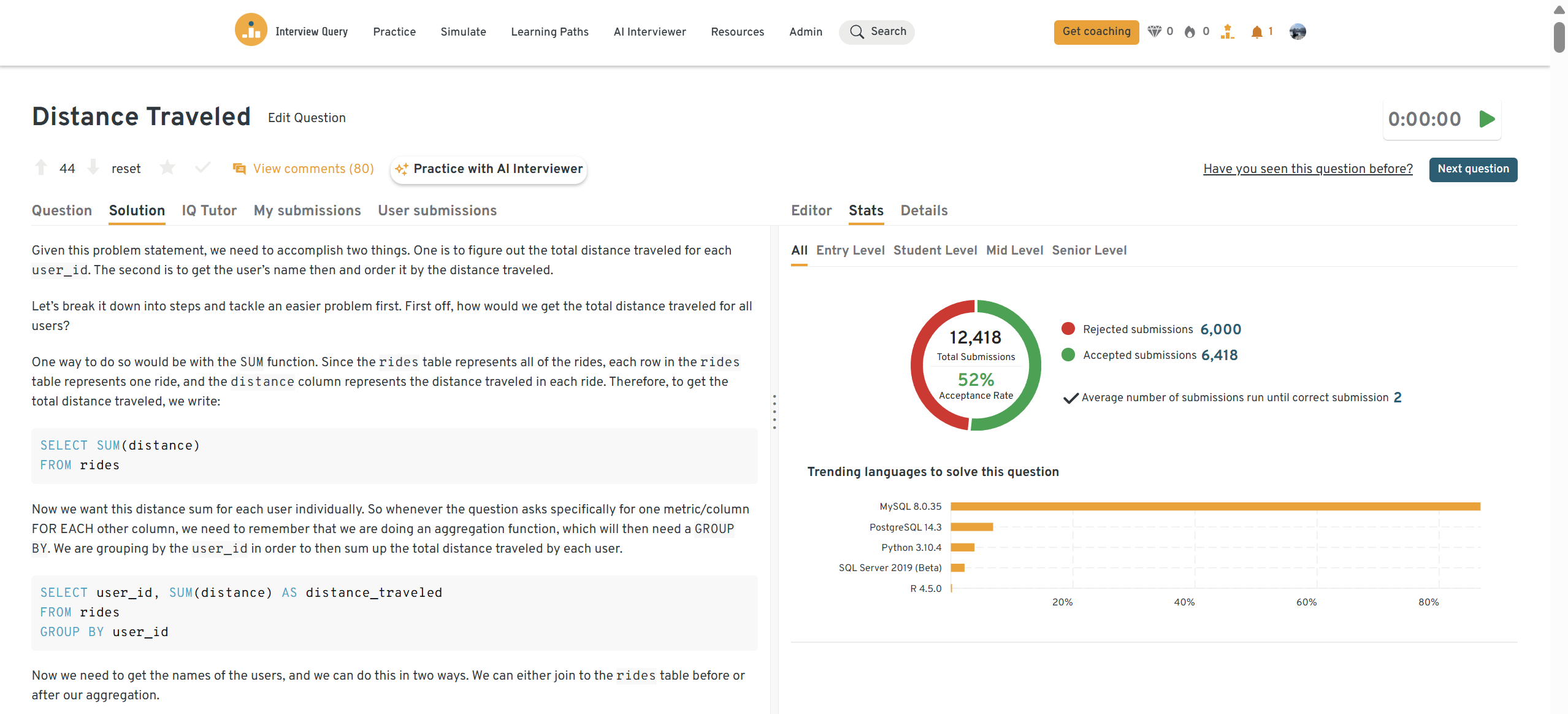
Write a query to report the total distance traveled by each user in descending order.
Solve this by grouping the rides table by user_id and summing up the distance column. Order the results in descending order so users with the highest total distance appear first. This type of aggregation is common at Atlassian when analyzing usage depth, workflow duration, or activity intensity. Confirm that the distance metric is additive and does not require deduplication or filtering by status.
Tip: State the grain of your final output before writing the query to avoid double counting.
You can practice this exact problem on the Interview Query dashboard, shown below. The platform lets you write and test SQL queries, view accepted solutions, and compare your performance with thousands of other learners. Features like AI coaching, submission stats, and language breakdowns help you identify areas to improve and prepare more effectively for data interviews at scale.
System design and data architecture interview questions
Atlassian BI engineers work with large, event-driven datasets, and interviewers want to see how you design systems that scale, stay reliable, and support downstream analytics.
How would you design an end-to-end architecture for a global e-commerce warehouse system?
Begin by asking clarifying questions around product catalogs, inventory updates, region-specific rules, and latency requirements. Then outline ingestion pipelines, storage layers, transformation steps, and reporting models. Discuss how you would support daily, weekly, and monthly reporting with consistent definitions.
Tip: Explain how you ensure data quality monitoring across regions.
Design a data mart or data warehouse for a new online retailer.
Sketch a star schema with fact tables for sales and dimensions for products, customers, and dates. Explain how you manage slowly changing dimensions and support analytics such as retention or repeat purchases. Atlassian looks for engineers who balance flexibility with long-term maintainability.
Tip: Mention partitioning or clustering strategies that improve read performance.
How would you build a database for a file storage company like Dropbox?
Define entities such as files, users, versions, and permissions. Explain how you would track version history and metadata while supporting efficient queries. This problem tests your ability to model complex hierarchical data.
Tip: Show awareness of tradeoffs between normalization and fast retrieval.
How would you design a relational database for storing song metadata?
Identify tables for songs, albums, artists, and genres, and connect them with primary and foreign keys. Discuss how you track updates, handle duplicates, and query common analytics such as popularity trends. Atlassian values engineers who think through future use cases.
Tip: Describe indexing strategies that improve query speed for high-volume tables.
How would you debug a pipeline producing inconsistent aggregates across Jira, Confluence, and Bitbucket?
Start by checking raw event logs and confirming ingestion completeness. Inspect transformation logic for mismatched grains or filters. Compare outputs across products and investigate any divergent patterns.
Tip: Emphasize root-cause isolation before fixing symptoms.
How would you design a self-serve semantic layer for Atlassian teams?
Explain how you define certified metrics, govern dimensions, and enforce naming consistency across dashboards. Discuss tools, validation layers, and access control.
Tip: Highlight how a semantic layer reduces ad hoc data dependencies.
How would you design a unified activity fact table for Jira, Confluence, Trello, and Bitbucket?
Normalize each product’s event schema into a shared model with fields like user_id, product, action_type, object_id, and timestamp. Address schema mismatches, naming conventions, and unified KPI definitions. Tip: Emphasize long-term scalability and metric governance.
How would you build a near real-time dashboard for tracking Jira incident response metrics across multiple teams?
This question checks system design + BI integration. Speak about streaming ingestion (Kafka/Kinesis), TTL caching, denormalized tables for fast reads, and alerting thresholds. Mention tradeoffs between latency, cost, and load on production systems. Interviewers want to see whether you understand operational constraints and how to design BI that doesn’t overload transactional databases.
Tip: Clarify what “near real-time” means (e.g., 1–5 minutes) before proposing architecture.
Metric definition and insights interview questions
BI engineers help teams measure product health, diagnose changes, and create shared definitions that guide decision-making.
How would you define a north star metric for Jira project success?
Start by clarifying what drives user value, such as issue completion, collaboration depth, or workflow efficiency. Propose a primary metric tied to this value and include guardrails like churn or completion time. Atlassian values metrics that influence long-term behavior, not short-term spikes.
Tip: Make the metric traceable to underlying events.
How would you analyze a funnel drop in Confluence page publishing?
Break down the funnel steps from page creation to publish and compute drop-off rates. Segment by workspace size, user type, or page type. Investigate potential confounders like new templates or editor performance issues.
Tip: Summarize your interpretation clearly before proposing actions.
How would you design a KPI dashboard to track onboarding health across Atlassian products?
Outline funnel stages like sign-up, activation events, and first successful action. Segment by geography, product, or team size. Include drill-down capabilities for PMs and engineering leads.
Tip: Specify who the dashboard is built for before choosing components.
How would you measure the impact of a new recommendation engine in Trello?
Compare treatment and control users on engagement metrics such as board usage, card creation, and retention. Consider whether the algorithm shifts long-term satisfaction.
Tip: Mention guardrail metrics that catch unintended harms.
How would you diagnose inconsistent usage trends across Jira and Confluence?
Check instrumentation differences, product updates, and user behavior changes. Look for anomalies in specific segments like new teams or enterprise customers.
Tip: Use a structured debugging checklist that separates data issues from behavioral shifts.
How would you identify friction in the Jira issue creation workflow?
Map each workflow step and compute drop-off or time spent. Segment by project configuration or role type. This helps pinpoint which input fields or permission settings create the most friction.
Tip: Recommend actionable follow-ups tied to product changes.
How would you measure the health of Jira projects across an entire enterprise account?
This question evaluates your ability to translate messy issue-level data into high-value insights. Interviewers want to see how you structure metrics around workflow efficiency, throughput, cycle time, and SLA adherence. A strong answer defines what “healthy” means for different teams and identifies which Jira fields (e.g., issue types, transitions, assignees, resolutions, epics) matter most. You should also cover how you’d aggregate issue-level events into reliable KPIs. An excellent response explains tradeoffs between real-time and batch analytics, especially for large enterprise tenants.
Tip: Start by clarifying the business outcome (speed, predictability, workload balance) before choosing the metrics.
How would you analyze bottlenecks in a Jira team’s workflow using BI tools?
This question tests how well you can connect raw event logs to operational insights. Explain how you’d use transition histories to identify slow steps, queue buildups, or frequent reopen cycles. You should also mention how custom fields or workflow variations may affect data quality. Interviewers look for awareness of sampling bias, inconsistent naming, and missing transition events. A strong answer walks through preprocessing, feature extraction, and visualizations that clearly communicate root causes.
Tip: Emphasize your approach to normalizing workflows across multiple teams or projects.
If Atlassian asked you to build a Jira productivity dashboard for engineering managers, what KPIs would you include and why?
This question checks your ability to balance business context with data modeling. Discuss metrics such as throughput, work-in-progress, bug ratio, reopens, mean time to resolution, and cycle time. Walk through how you would compute each from issue-level data while handling edge cases such as bulk updates and bot-generated events. The interviewer wants to assess your ability to design clear, actionable dashboards that support planning, forecasting, and resource allocation.
Tip: Always justify each KPI by tying it back to a specific decision an engineering manager needs to make.
Behavioral and values based interview questions
Atlassian’s values emphasize openness, collaboration, customer focus, and thoughtful communication. Behavioral interviews test how you operate with teams, handle ambiguity, and learn from experience.
What are your strengths and weaknesses?
This question assesses your self-awareness and how you adapt your working style to support teams. Strong answers tie strengths to team outcomes and frame weaknesses as areas you actively improve.
Tip: Connect your strengths to collaborative habits that align with Atlassian’s culture.
Sample Answer: One of my strengths is structured communication, which helps align teams quickly during data reviews. A weakness I have worked on is over-refining dashboards before sharing them. I now circulate early drafts to gather feedback sooner.
Why do you want to work with us?
Interviewers want to understand whether you genuinely connect with Atlassian’s mission and BI philosophy. Reference the company’s values, its open culture, and the impact BI teams have across products.
Tip: Mention specific tools or collaboration principles that fit your style.
Sample Answer: I am drawn to Atlassian because BI plays a critical role in shaping how teams collaborate across products like Jira and Confluence. I value how open communication and shared ownership drive decisions here.
Talk about a time when you had trouble communicating with stakeholders. How did you overcome it?
This question tests your ability to simplify complex data concepts for different audiences. Strong answers show empathy, active listening, and clear adaptation.
Tip: Describe how you changed your communication method to meet stakeholder needs.
Sample Answer: I worked with a non-technical stakeholder who struggled to understand a data quality issue. I reframed the explanation using visuals and examples, which helped resolve the issue faster.
Describe a data project you worked on and the challenges you faced.
Interviewers look for your approach to problem-solving, prioritization, and long-term improvement. Show how you balanced technical constraints with stakeholder needs.
Tip: Highlight how you communicated blockers and aligned expectations.
Sample Answer: In one project, I had to reconcile conflicting product definitions. I partnered with PMs to create a shared glossary, which improved the reliability of dashboards across teams.
What are effective ways to make data more accessible to non-technical people?
Your answer should show your ability to democratize data through dashboards, documentation, and training. Atlassian values BI engineers who help teams make informed decisions.
Tip: Focus on clarity, self-serve tools, and consistent definitions.
Sample Answer: I simplify dashboards by focusing on three core metrics and providing glossary terms within the report. This reduces confusion and boosts adoption.
Tell me about a time you influenced a decision using data.
Atlassian looks for BI engineers who partner with PMs, engineering, and design to drive product improvements. Good answers focus on actionable insights, not just reports.
Tip: Highlight both the insight you produced and the impact on the final decision.
Sample Answer: I found that new users were dropping off during a hidden onboarding step. After presenting the data, we redesigned the flow and saw improved activation.
Give an example of how you worked through ambiguity and created structure.
BI engineers often operate with incomplete requirements, and Atlassian values people who create clarity.
Tip: Show how you established alignment quickly.
Sample Answer: For an undefined KPI project, I drafted initial metric proposals, reviewed them with stakeholders, and finalized the definition in less than a week.
Tell me about a time you discovered a major data quality issue.
Atlassian relies on high-quality data, so interviewers want to know how you respond to anomalies.
Tip: Cover both the immediate fix and the long-term prevention.
Sample Answer: I detected duplicated events after a pipeline update. I paused reporting, fixed the logic, and added automated checks to prevent future issues.
If you want to practice real BI interview problems and build confidence before your interview, explore hands-on challenges in the Interview Query challenge library or prepare with guided mock sessions through coaching.
How To Prepare For An Atlassian Business Intelligence Engineer Interview
Preparing for an Atlassian business intelligence engineer interview means demonstrating strong SQL foundations, clear analytical thinking, data modeling experience, and communication aligned with Atlassian’s values of openness, teamwork, and customer focus. The interview loop evaluates how you structure problems, collaborate with stakeholders, and design data solutions that improve product and business decisions.
If you want a quick primer before diving deeper, watch 10+ Business Intelligence Interview Questions! by Jay Feng, co-founder of Interview Query and former data scientist at Nextdoor and Monster.
Below are seven preparation strategies.
Strengthen your SQL fundamentals and pattern recognition
You will write queries involving joins, window functions, event tables, segmentation logic, and quality checks. Interviewers look for clarity, correctness, and performance awareness, not shortcuts.
Tip: Before writing any query, state your assumptions and the expected grain to avoid inconsistencies downstream.
Review core BI concepts such as modeling, metrics, and pipelines
Atlassian evaluates how you design data models, define metrics, and think about data reliability at scale. Expect questions on dimensional modeling, ETL patterns, and debugging inconsistent datasets.
Tip: For each metric you define, include one possible failure mode to show balanced reasoning.
Practice building and evaluating dashboards with purpose
BI teams support product, finance, and operations partners. Interviewers want to see how you translate a business question into actionable dashboards with clear KPIs, segments, and context.
Tip: Think through who the dashboard is for and how each chart supports a decision.
Prepare for end to end data pipeline design questions
The loop often includes designing ingestion flows, transformation layers, and validation steps. Atlassian prioritizes maintainability, documentation, and long term data quality.
Tip: Include idempotency, provenance tracking, and error handling in every pipeline discussion.
Strengthen SQL for BI scale and training data creation
Business intelligence engineers often support analytics and machine learning teams by preparing clean datasets. Practicing advanced SQL structures helps reinforce your fundamentals. You can use the SQL interview learning path to simulate realistic scenarios.
Tip: Show how you would validate row counts, deduplicate data, and check timestamp integrity.
Develop familiarity with Atlassian products and their data workflows
Understanding how teams use Jira, Confluence, and Trello helps you reason about event structures, collaboration metrics, and the type of insights BI engineers deliver.
Tip: Explore a workflow inside Jira and think through which events you would track to measure feature success.
Prepare one BI or analytics project you can walk through clearly
Final rounds often include an analysis or modeling walkthrough. Choose a project where you defined metrics, cleaned data, built a model or dashboard, and influenced a decision.
Tip: Keep the walkthrough structured as problem, data, logic, insight, and impact within ninety seconds.
FAQs
How competitive is the Atlassian business intelligence interview?
Atlassian is selective because business intelligence engineers influence decisions across product, go-to-market, finance, and customer operations. Candidates are evaluated on SQL depth, metrics reasoning, data modeling fundamentals, and clarity in communication. Practicing multi-step SQL and BI problems from realistic datasets is one of the best ways to prepare, and Interview Query’s BI and SQL learning paths are helpful for this.
What technical skills does Atlassian look for in BI engineers?
Strong SQL is essential, especially window functions, segmentation logic, and event-level analysis. Candidates are also expected to understand dimensional modeling, operational reporting, and how to design scalable dashboards. Experience with experimentation or product analytics is a plus. You can deepen foundational skills with Interview Query’s modeling and machine learning learning path.
Do I need Python for a business intelligence role at Atlassian?
Python is useful for data transformation, automation, and ad hoc analysis, but SQL remains the primary skill for BI roles. Python is typically relevant for more complex analysis or tying data pipelines together, not for the core interview flow. Atlassian tends to prioritize clarity of logic over the number of tools you know.
What is the typical timeline for the Atlassian BI interview process?
Most candidates move from recruiter screen to final decision in three to five weeks. Stages usually include a technical screen, SQL or case assessment, interviews with BI partners, and a final conversation with the hiring manager. Timelines may shift depending on team availability or take-home assessments.
How important are Atlassian’s values in the BI interview?
Very important. Business intelligence engineers work with PMs, engineering, analytics, marketing, finance, and customer teams, so interviewers look for transparency, balanced judgment, and a customer-first mindset. Reviewing Atlassian’s open culture and collaboration principles can help shape your behavioral answers.
Does Atlassian allow remote or hybrid work for BI roles?
Many teams support remote-first or hybrid setups depending on location and business needs. Most job postings specify whether remote candidates are accepted. It is best to clarify expectations with the recruiter early in the process.
What type of SQL questions does Atlassian ask in BI interviews?
Expect multi-step analysis questions that mimic real BI work, such as funnel calculations, data quality debugging, cohort comparisons, and reporting logic. Problems often require restructuring messy data into clear insights rather than solving trick queries. Practicing scenario-style SQL challenges, such as those in the Interview Query SQL library, helps you recognize patterns you will see in the interview.
Do BI engineers at Atlassian work closely with product teams?
Yes. Although BI engineers often sit between analytics and operational reporting, they regularly collaborate with PMs, engineering leads, designers, revenue teams, and customer-facing groups. Much of the job involves refining metrics, identifying performance drivers, and supporting strategic decisions.
Build Your Atlassian Business Intelligence Engineer Prep With Intent
Preparing for an Atlassian business intelligence engineer role means sharpening both your technical instincts and your ability to translate data into decisions that shape how millions of teams work. The most effective way to prepare is to balance realistic SQL practice, thoughtful data modeling work, and clear communication that reflects Atlassian’s values of openness and teamwork.
If you want to take your prep further, explore Interview Query’s resources designed for data and BI roles. Work through real scenarios in the SQL interview learning path, challenge yourself with hands-on analytics problems in take-home exercises, or test your communication and reasoning through live mock interviews.
Build a preparation flow that mirrors the job, and walk into your Atlassian interview ready to think clearly, structure ambiguity, and solve real product and data problems.
Atlassian Interview Questions
| Question | Topic | Difficulty | ||||||||||||||||||||||
|---|---|---|---|---|---|---|---|---|---|---|---|---|---|---|---|---|---|---|---|---|---|---|---|---|
SQL | Easy | |||||||||||||||||||||||
Write a SQL query to select the 2nd highest salary in the engineering department. Note: If more than one person shares the highest salary, the query should select the next highest salary. Example: Input:
Output:
| ||||||||||||||||||||||||
Data Structures & Algorithms | Medium | |||||||||||||||||||||||
Data Structures & Algorithms | Hard | |||||||||||||||||||||||
SQL | Easy | |
Machine Learning | Medium | |
Statistics | Medium | |
SQL | Hard | |
Machine Learning | Medium | |
Python | Easy | |
Deep Learning | Hard | |
SQL | Medium | |
Statistics | Easy | |
Machine Learning | Hard |
Discussion & Interview Experiences