


DoorDash Data Analyst Interview Guide: Process & Actual Questions (2026)


Introduction
Data analytics has expanded into a $82.23 billion industry this year, sustaining the demand for data analysts in logistics marketplaces like DoorDash. As DoorDash sharpens its focus on profitability, advertising growth, and logistic efficiency across restaurant delivery, convenience, and retail, analytics has become central to nearly every decision. The company’s data analysts are essential in translating marketplace data into actionable insights for consumer demand, Dasher supply, merchant performance, and product experimentation.
The DoorDash data analyst interview reflects the scale and influence of this work. Interviewers look for analysts who can define the right metrics, write clean SQL, interpret experiments, and communicate trade-offs that balance growth with efficiency. In this guide, you will learn how the DoorDash interview process is structured, the types of SQL, analytics, and behavioral questions you can get asked, and how you can tailor your preparation to DoorDash’s data-driven culture and priorities using Interview Query’s resources.
DoorDash Data Analyst Interview Process
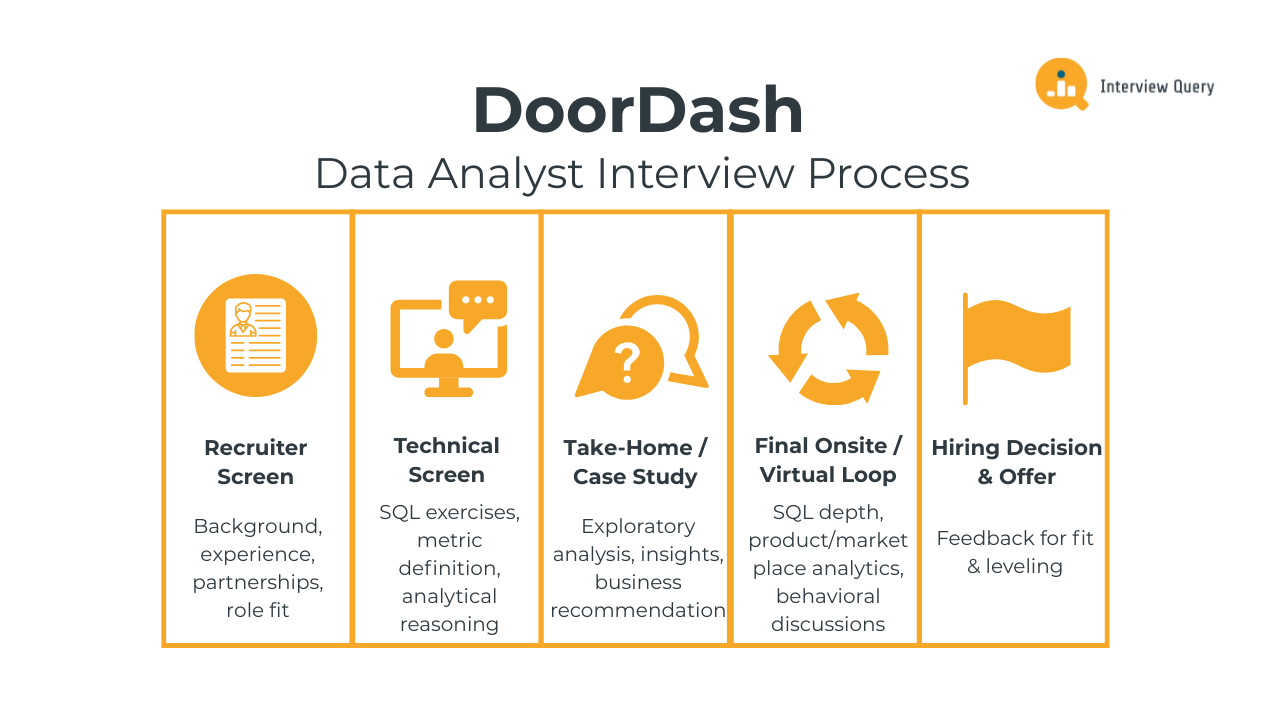
The DoorDash data analyst interview process is designed to evaluate how well you can reason through a two-sided marketplace, make smart metric decisions, and translate analysis into actions that move the business forward. The loop typically runs over several weeks and progresses from high-level role alignment to hands-on analytics work and stakeholder-facing discussions.
While exact formats vary by team, the overall structure is consistent: early screens assess fundamentals and fit, mid-stage interviews probe SQL and analytical judgment, and final rounds evaluate how you apply data to real DoorDash problems involving consumers, Dashers, merchants, and cost trade-offs.
Recruiter screen
The recruiter screen is usually a 30-minute conversation focused on role fit rather than technical depth. Expect questions about your analytics background, experience with SQL and experimentation, and how you’ve partnered with product, operations, or engineering teams.
Rather than listing tools, strong candidates frame their experience around outcomes. You should be ready to explain how your work influenced decisions, whether that meant improving conversion, reducing delivery delays, optimizing incentives, or shaping product roadmaps. You may also be asked about your interest in DoorDash and the specific product areas you are excited to support, such as consumer experience, logistics, or merchant analytics.
Tip: Prepare two to three concise stories where your analysis directly changed a business decision. Read Interview Query’s full DoorDash interview guide to learn how to tie your impact to the metrics DoorDash actually cares about, such as order volume, delivery time, cost efficiency, or retention.
Technical screen (SQL and analytics)
The technical screen focuses on your core analytics skill set. This round typically includes live SQL exercises, metric definition questions, and analytical reasoning tied to marketplace scenarios. You might be asked to analyze funnel drop-offs, cohort retention, Dasher utilization, or marketplace performance using realistic tables and constraints. Interviewers pay close attention to how you structure queries, validate assumptions, and interpret edge cases.
Beyond SQL syntax, DoorDash evaluates how you think about metrics. Expect questions that probe how you would define success for a new feature, diagnose a drop in orders, or interpret conflicting experiment results.
Tip: Practice talking through your SQL as you write it, as interviewers want to hear how you think about demand vs. supply trade-offs, cost implications, and customer experience. Interview Query’s SQL questions are especially valuable for helping you structure your answers logically.
Take-home assignment or case study
Some DoorDash teams include a take-home assignment or structured case study to assess deeper analytical thinking. These exercises usually involve exploratory analysis, written insights, and business recommendations rather than advanced modeling. You may be asked to analyze a dataset, summarize trends, define key metrics, and propose next steps as if presenting to a product or operations partner.
Strong submissions are concise, well-organized, and focused on decision-making. Interviewers look for clear narratives that explain what matters, what does not, and why. Clean SQL, simple visuals, and a tight narrative often outperform overly complex approaches.
Tip: Treat this like a stakeholder readout by leading with the “so what,” explaining why it matters for the marketplace, and ending with clear recommendations or follow-up questions. Practicing real-world analytics case challenges ahead of time can significantly improve clarity and confidence.
Final onsite or virtual loop
The final loop usually consists of multiple interviews covering SQL depth, product or marketplace analytics, and behavioral competencies. You may be asked to critique metrics, walk through past projects, or reason through ambiguous scenarios involving pricing, delivery times, incentives, or marketplace balance.
DoorDash places strong emphasis on how analysts partner and communicate with stakeholders. Interviewers assess whether you can adapt your communication style, defend analytical decisions, and guide teams toward data-informed outcomes.
Tip: When answering, explicitly connect analysis to action. Instead of stopping at insights, explain how your recommendation would change a product decision, operational policy, or experiment design.
Hiring decision and offer
After the loop, interviewers calibrate feedback to determine overall fit and leveling. Decisions consider technical strength, analytical judgment, communication, and alignment with DoorDash’s operating principles. Candidates typically hear back within one to two weeks. Meanwhile, offer discussions cover level, compensation structure, and start timing.
Candidates who rehearse end-to-end interview scenarios across SQL, product cases, and behavioral discussions, tend to perform more consistently across the loop. Structured practice that mirrors DoorDash-style questions can make a measurable difference at this stage.
To prepare confidently for every stage, explore Interview Query’s mock interviews, which simulate the DoorDash-style interview environment and help refine your answers through peer feedback.
Challenge
Check your skills...
How prepared are you for working as a Data Analyst at Doordash?
What Questions Are Asked in a DoorDash Data Analyst Interview?
DoorDash data analyst interview questions focus on how well you apply analytics to real marketplace decisions. Beyond SQL correctness, interviewers evaluate your ability to reason through trade-offs, define meaningful metrics, interpret experiments, and clearly communicate insights that affect consumers, Dashers, merchants, and costs.
Note: These questions are handpicked by our data analysts based on 1000+ real DoorDash interview experiences reported by our learners.
Before diving into sample questions, the video below walks through how DoorDash-style analytics interviews are structured and what interviewers are really looking for in strong answers.
Watch Next: Top 5 Insider Interview Questions Data Analysts Must Master Before Any Interview!
In this video, Interview Query cofounder and data scientist Jay Feng breaks down how data analyst interviews are designed and what separates average answers from strong, business-impactful ones. Since interviewers at top companies like DoorDash prioritize clear thinking and decision-oriented analysis over perfect technical execution, strong candidates explain why a metric matters, how results affect different sides of the marketplace, and what action they would recommend based on the data.
Now, let’s dive into the most common question types you can expect, along with guidance on how DoorDash interviewers evaluate strong answers.
SQL and data analysis interview questions
In SQL-focused interviews, DoorDash evaluates how you translate business questions into clean, efficient analysis. Interviewers care less about obscure syntax and more about your ability to define the right metrics, structure logical queries, and explain what the results mean for the marketplace. Expect questions rooted in delivery efficiency, retention, cancellations, and operational performance.
-
This question tests multi-table SQL joins, conditional aggregation, and the ability to translate business constraints into query logic. A strong approach involves filtering out ingredients already in the pantry, joining to acceptable brands, and calculating the minimum price per missing ingredient. Feasibility is determined by checking whether every missing ingredient has at least one valid brand, with total cost aggregated only when that condition is met.
Tip: Call out how this logic would scale to DoorDash problems like merchant availability or item substitutions. Interviewers respond well when candidates explicitly flag how edge cases (e.g., zero acceptable options) affect downstream metrics and decision-making.
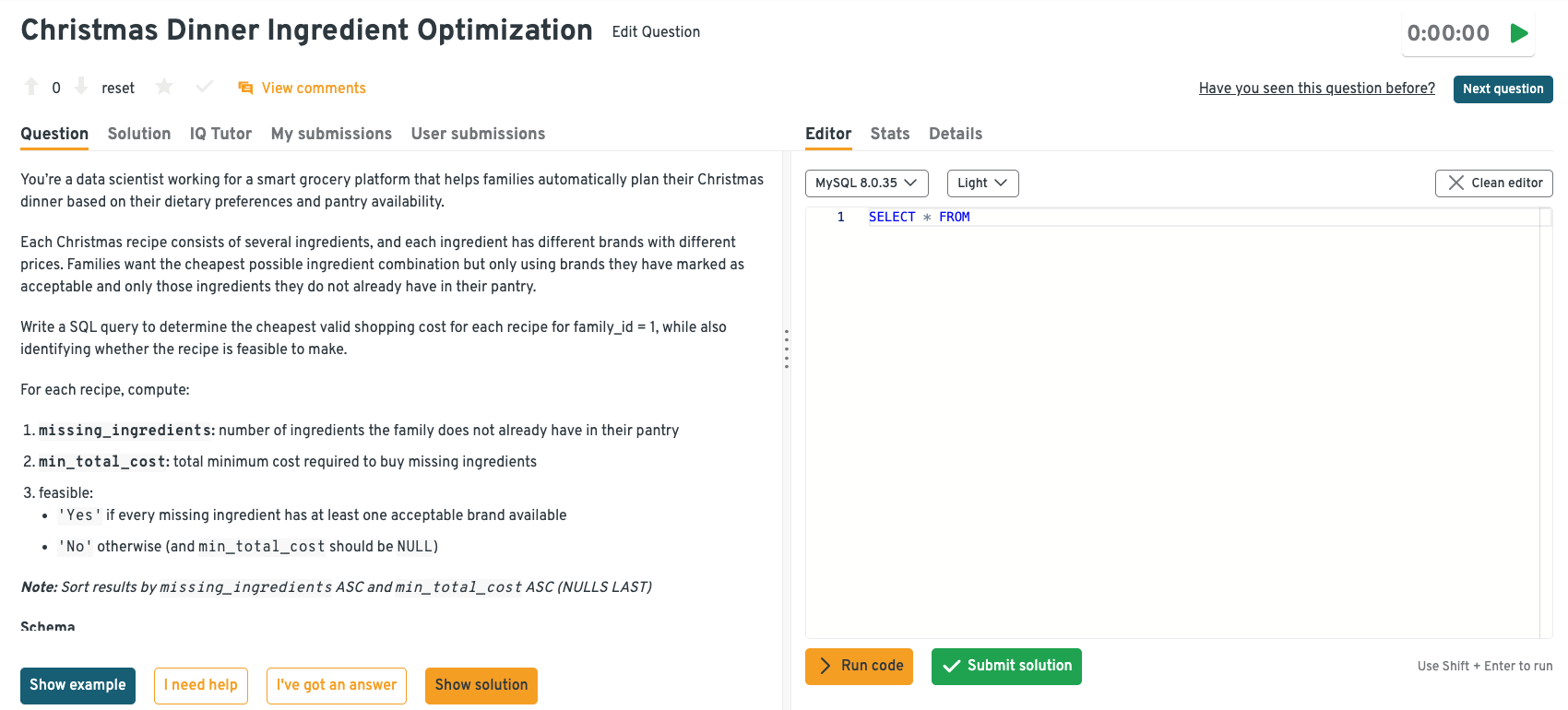
Explore the Interview Query dashboard to solve more SQL interview questions like this. Use a built-in text editor and instantly compare your approach against detailed solutions to build confidence for the technical interviews.
Compute average order value (AOV) by customer gender using transaction and user tables.
Here, the focus is on aggregation, joins, and clean metric definition. You would join orders to users, restrict the population to customers who have placed at least one order, and compute total spend divided by order count for each gender. Rounding at the final step ensures numerical precision without distorting intermediate calculations.
Tip: Be ready to explain when AOV is the wrong metric to use, such as during heavy promotions or onboarding periods. Strong candidates often earn points by discussing complementary metrics like order frequency or contribution margin.
How would you calculate Dasher utilization using delivery data?
This question evaluates marketplace intuition and metric construction rather than just SQL mechanics. The typical approach is to define utilization as active delivery time divided by total available or online time per Dasher, aggregated over a relevant window. Careful handling of session boundaries, idle time, and outliers is key to producing a metric that reflects true supply efficiency.
Tip: Interviewers often probe what decisions this metric would inform. Stand out by linking utilization shifts to concrete actions, such as adjusting Dasher incentives, scheduling, or market expansion strategies.
-
This tests economic reasoning, data intuition, and the ability to connect theory to real marketplace signals. Start by explaining how dynamic pricing balances supply and demand by adjusting incentives or prices based on real-time conditions. Estimating supply and demand often involves analyzing order volume, fulfillment rates, Dasher availability, and price elasticity through historical data or experiments.
Tip: Avoid staying purely theoretical; anchor your explanation in observable signals like cancellation rates, delivery ETAs, or acceptance rates. DoorDash interviewers value candidates who can translate economic concepts into measurable levers.
How do you detect anomalies in marketplace performance metrics?
This question assesses statistical thinking and monitoring discipline. An effective approach combines baseline comparisons, rolling averages, and threshold-based alerts to flag unusual behavior. More advanced analyses may layer in seasonality adjustments or control charts to distinguish real issues from normal volatility.
Tip: Emphasize triage, not just detection. High-impact analysts clearly articulate how they would validate an alert, identify root causes across the marketplace, and communicate urgency to cross-functional partners.
Product and experimentation interview questions
Product and experimentation questions test whether you can reason through ambiguous changes and measure real business impact. DoorDash interviewers expect analysts to think beyond metrics and explain how experiments affect customers, Dashers, and merchants simultaneously.
How would you evaluate a change to delivery fees?
This question tests product judgment, causal reasoning, and the ability to balance short-term metrics with long-term marketplace health. Start by defining primary and guardrail metrics such as order conversion, order frequency, Dasher supply, and cancellation rates. Analysis should segment by customer type, market maturity, and fee sensitivity to understand where the change helps or hurts.
Tip: Call out second-order effects explicitly, such as how fee changes influence batching, Dasher wait times, or merchant prep behavior. Interviewers notice candidates who proactively think through downstream marketplace reactions.
-
This question assesses model evaluation skills and an understanding of how prediction quality affects user trust. The approach involves comparing offline accuracy metrics like MAE or calibration across key segments, followed by an online experiment to observe downstream effects such as conversion or cancellations. Special attention should be paid to systematic bias, especially during peak demand or long-distance deliveries.
Tip: Stand out by mentioning how misestimation hurts trust asymmetrically; late deliveries are usually more damaging than early ones. Analysts who discuss directional error and customer expectations signal real DoorDash experience.
-
This question evaluates experimental design, marketplace intuition, and metric selection across multiple stakeholders. A strong answer outlines a randomized test at the Dasher level, with success measured through improved Dasher utilization, reduced delivery delays, and stable consumer experience. Guardrails are essential to ensure the feature does not oversaturate supply or degrade earnings for Dashers already online.
Tip: Mention how rollout sequencing matters, such as piloting in supply-constrained markets first. Interviewers value candidates who think about experiment risk management, not just measurement.
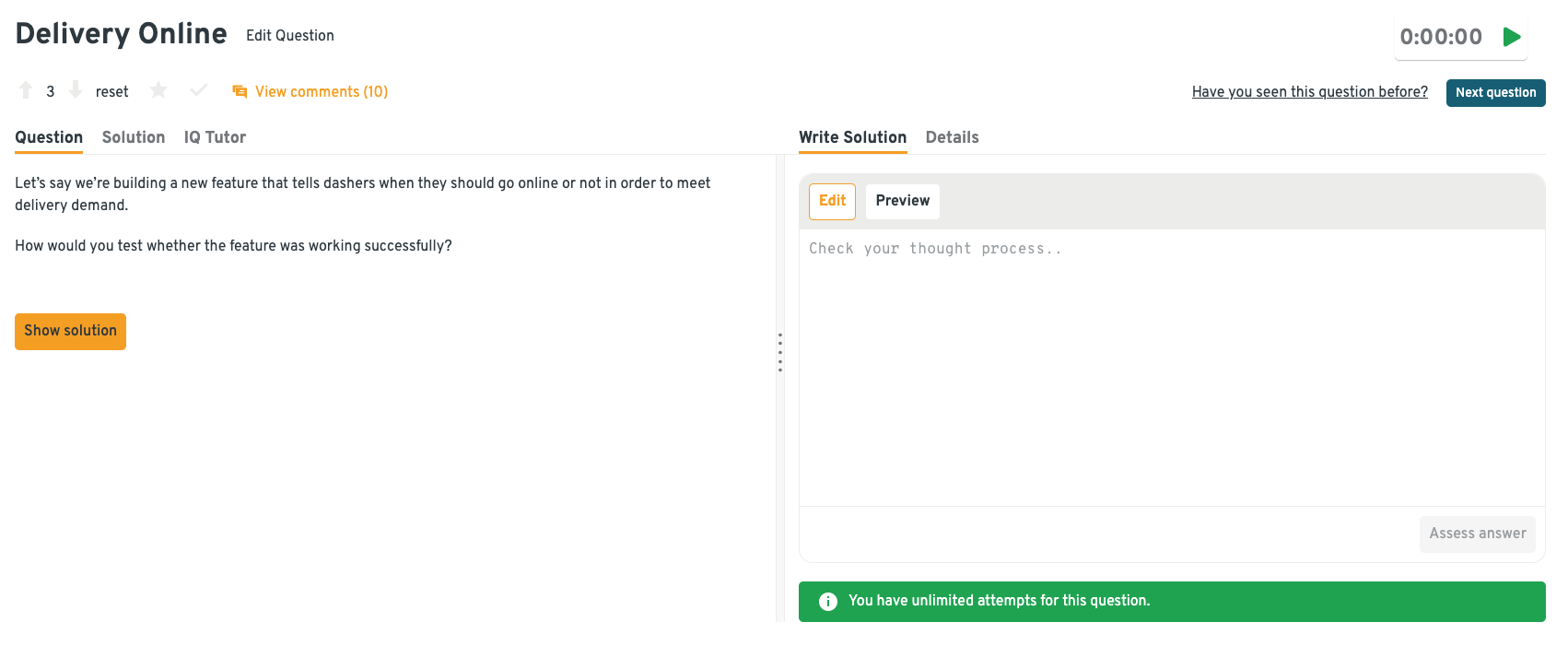
Visit the Interview Query dashboard to work through more product and experimentation scenarios with guidance from IQ Tutor, which helps you structure hypotheses, metrics, and trade-offs. It’s a practical way to refine decision-making skills that DoorDash interviewers consistently look for.
Interpret how a 5% lift from a DoorDash consumer UI experiment would translate after full rollout.
This question tests statistical reasoning and the ability to interpret experiment results beyond surface-level metrics. The analysis should consider factors like treatment targeting, interaction effects, and whether the tested population is representative of all users. Evaluating secondary metrics and potential regression to the mean helps determine whether the observed lift will persist at scale.
Tip: Acknowledge that experimentation often overestimates impact in high-intent users. Calling out differences between power users and casual customers shows practical product judgment.
How would you assess the impact of DashPass on retention?
This question measures long-term thinking, cohort analysis skills, and familiarity with subscription dynamics. The approach typically involves comparing retention curves between DashPass members and matched non-members while controlling for selection bias. Looking at behavioral changes such as order frequency and churn timing provides deeper insight into whether DashPass drives true loyalty or simply accelerates short-term usage.
Tip: Go beyond retention curves by discussing post-churn behavior, such as whether former DashPass users permanently downshift usage. Interviewers appreciate analysts who think in terms of lifetime value, not just subscription tenure.
Want to deepen your experimentation skills? Check out the Statistics & A/B Testing Interview learning path on Interview Query. It walks you step-by-step through hypothesis testing, power analysis, and experiment interpretation so you can confidently tackle questions that require both analytical rigor and business judgment.
Behavioral interview questions
Behavioral interviews at DoorDash focus on influence, prioritization, and collaboration. Analysts are expected to guide decisions through data, even when stakeholders disagree or timelines are tight.
Tell me about a time you influenced a product decision with data.
DoorDash asks this to assess whether candidates can move beyond analysis and meaningfully shape decisions across product, operations, or marketplace teams. Quantify impact by tying insights to concrete actions, such as changes in conversion, delivery time, or cost efficiency.
Sample answer: In a prior role, an analysis showed that late deliveries were driving a 6% drop in repeat orders in dense urban markets. The findings led to a product change that adjusted batching logic during peak hours. After launch, on-time delivery improved by 9% and repeat order rate increased by 3% over the following month.
Describe a time you disagreed with a stakeholder’s interpretation of data.
This question evaluates communication skills, analytical confidence, and the ability to challenge assumptions without damaging relationships. Candidates stand out by reframing disagreement around metrics, alternative cuts of data, or controlled comparisons.
Sample answer: During a pricing experiment, a stakeholder believed higher revenue per order meant the test was successful. A deeper cut of the data showed order volume dropped 8% in price-sensitive segments, leading to flat total revenue. Sharing this breakdown helped the team revise the rollout and focus on targeted pricing instead.
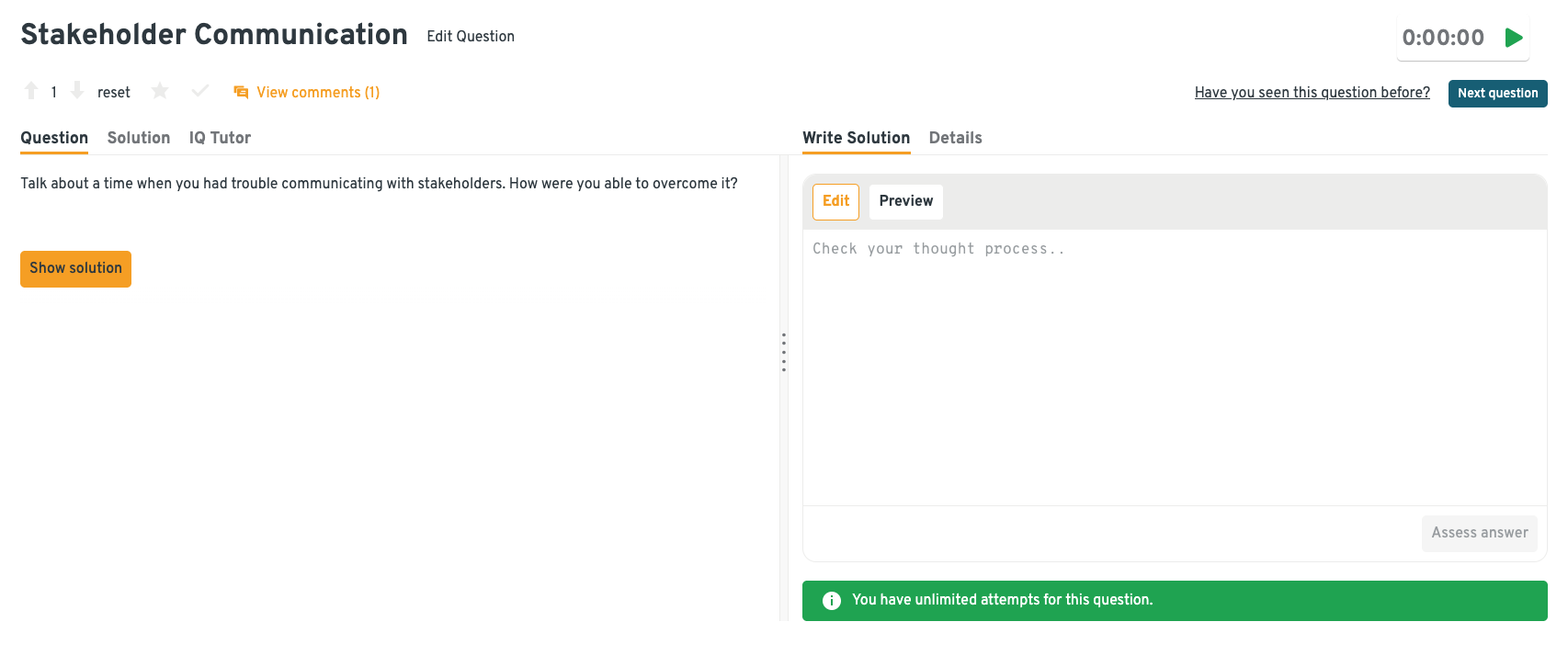
Head to the Interview Query dashboard to practice additional behavioral questions and learn from user comments that show how other candidates frame influence, disagreement, and impact. Reviewing multiple perspectives can help you refine your own stories and communicate them more effectively in interviews.
Describe a time you had to explain a complex analysis to a non-technical audience.
DoorDash values analysts who can translate complexity into clear, decision-ready insights for partners across the business. Effective answers highlight how simplifying the narrative led to faster alignment or better outcomes.
Sample answer: An analysis of delivery delays involved multiple regression outputs and supply constraints. The findings were reframed into three clear drivers with simple visuals showing impact on customer experience. This helped leadership approve an incentive change that reduced average delivery time by 5 minutes.
How do you prioritize when multiple teams need analysis support?
This question probes judgment, stakeholder management, and the ability to align analytics work with business impact. Quantification comes from referencing how prioritization improved outcomes or resource efficiency.
Sample answer: When facing competing requests, projects were ranked based on potential impact, urgency, and alignment with quarterly goals. One high-impact analysis was prioritized that identified a retention issue affecting 15% of active users. Addressing it delivered a measurable lift, while lower-impact requests were scheduled for later.
Tell me about a time you worked with ambiguous requirements.
DoorDash operates in fast-moving, imperfectly defined environments, making comfort with ambiguity essential. Strong answers show how candidates clarify goals, test assumptions, and iterate using data.
Sample answer: In one project, success criteria were unclear for a new feature launch. Early exploratory analysis surfaced key usage patterns, which helped define success metrics around engagement and repeat behavior. Those metrics guided iteration and contributed to a 4% increase in feature adoption over six weeks.
The sample SQL, product experimentation, and behavioral questions above reflect how DoorDash evaluates analytical rigor alongside judgment and influence. To sharpen these skills, use Interview Query’s question bank for DoorDash-style analytics roles for targeted practice on rehearsing realistic problems, refining structured thinking, and answering interview questions confidently.
How to Prepare for a DoorDash Data Analyst Interview
Strong DoorDash interview prep focuses on demonstrating analytical fundamentals while showing you can think in terms of marketplace trade-offs. Because DoorDash data analysts operate close to the business, interviewers expect candidates to combine clean technical execution with clear judgment about metrics, experiments, and stakeholder impact. The strongest preparation blends technical fluency with product intuition and crisp communication.
Also read: How to Prepare for a Data Analyst Interview
Build SQL fluency with a business lens. Focus on writing queries that are not only correct, but easy to follow and easy to defend. Practice joins, aggregations, window functions, and cohort analyses using realistic scenarios, then rehearse how you would explain the results to a product manager. DoorDash interviewers often dig into validation logic, null handling, and whether numbers “make sense” given marketplace dynamics, so get comfortable narrating your thought process out loud.
Tip: Practice SQL questions that mirror marketplace data (orders, deliveries, cancellations, cohorts) and time yourself explaining each step. This is where Interview Query’s guided SQL Interview learning path can significantly accelerate improvement.
Study marketplace metrics, not just formulas. Refresh core concepts like conversion, retention, utilization, and fulfillment, but anchor them in a two-sided marketplace. Be ready to explain how a change might benefit consumers while hurting Dashers, or vice versa, and how you’d measure those trade-offs. Strong candidates frame analyses around hypotheses, success metrics, and guardrails, which mirrors how decisions are evaluated in real production environments.
Tip: When reviewing metrics, force yourself to ask “who wins and who loses?” for each change. Practicing with Interview Query’s marketplace-style case challenges helps build this habit quickly.
Practice experimentation as decision-making, not statistics. DoorDash product questions emphasize interpreting results and anticipating what happens after launch. Practice discussing why experiment lifts may shrink at scale, how targeting affects outcomes, and which secondary metrics signal risk. Clear reasoning around rollout decisions often matters more than citing the perfect statistical test.
Tip: Focus on experiment readouts that end with a decision recommendation. Structured practice through the Statistics & A/B Testing learning path is especially useful for learning how to balance statistical rigor with business judgment.
Practice thinking in trade-offs, not absolutes. Nearly every DoorDash problem involves balancing cost, speed, and experience across consumers, Dashers, and merchants. Candidates who explicitly call out second-order effects, such as how faster delivery might increase costs or reduce Dasher utilization, consistently stand out in interviews.
Tip: During practice, explicitly verbalize at least one downside or risk for every proposed improvement. Reading DoorDash’s blog for news and announcements can also help build real-world analytical maturity.
Sharpen behavioral stories with measurable outcomes. Prepare concise examples that show influence, not just execution. Each story should connect your analysis to a decision and end with a concrete outcome, such as percentage lifts, cost savings, improved delivery times, or avoided risks. Interviewers consistently favor candidates who show how data changed direction for a product, policy, or strategy.
Tip: Reframe past projects using a clear “problem → analysis → decision → impact” structure. Mock interviews and story frameworks can help tighten these narratives.
Use Interview Query’s analytics-focused learning paths to practice SQL, experimentation, and realistic interview scenarios that capture how marketplace teams evaluate data analysts.
What Does a DoorDash Data Analyst Do?
The DoorDash data analyst role is deeply embedded in day-to-day decision-making across one of the world’s largest logistics marketplaces. Rather than operating as a downstream reporting function, analysts are responsible for designing metrics, writing SQL analyses, reading experiment results, and building dashboards that guide product, operations, and strategy teams.
While responsibilities vary by team, most DoorDash data analysts spend their time on a mix of analysis, experimentation, and stakeholder decision support:
- Define and maintain core metrics that track marketplace health
- Write SQL-heavy analyses to diagnose performance shifts, investigate anomalies, and answer open-ended business questions
- Analyze A/B tests and feature launches to translate experimental results into clear go/no-go recommendations.
- Build and maintain dashboards to support ongoing monitoring and executive decision-making
- Partner with product managers and operators to scope problems, prioritize work, and align on success metrics
- Communicate insights clearly through written summaries, slide decks, and live discussions
Culturally, DoorDash emphasizes customer-first thinking, ownership, and speed. Analysts are expected to take responsibility for their analyses end-to-end, from defining the metric correctly to ensuring stakeholders understand the implications. The environment favors clear judgment and bias toward action; a timely, well-reasoned recommendation often beats a perfectly polished but late analysis.
Overall, as DoorDash continues expanding into grocery, retail, advertising, and logistics efficiency, candidates who thrive here are business-oriented, comfortable with ambiguity, and confident explaining trade-offs across consumers, Dashers, and merchants.
Sharpen your analytics and communication skills through Interview Query’s 1:1 coaching sessions. Personalized feedback from experienced analysts can help you prepare for high-impact, business-facing roles like the data analyst position at DoorDash.
FAQs
How difficult is the DoorDash data analyst interview?
The DoorDash data analyst interview is considered moderately to highly challenging, but very manageable with structured preparation. Candidates are expected to show strong SQL fundamentals, sound metric judgment, and the ability to reason through real marketplace trade-offs. The interviews focus on applied, business-facing analytics rather than academic theory, which means that with targeted practice in SQL, experimentation, and product thinking, most candidates can significantly improve their performance and confidence going in.
Are DoorDash data analyst interviews remote or onsite?
DoorDash conducts both virtual and onsite interviews, depending on location and team needs. Most technical and behavioral rounds can be completed remotely, while some final loops may include virtual onsite-style sessions with multiple interviews scheduled in a single day.
How hard is the SQL portion of the interview?
The SQL difficulty is intermediate to advanced. Questions focus on joins, aggregations, window functions, and cohort-style analysis rather than obscure syntax. More important than speed is the ability to explain logic and interpret results in a business context.
What is the typical DoorDash interview timeline?
The interview process usually takes three to five weeks from recruiter screen to offer. Timelines vary by team and hiring urgency, but candidates typically complete a recruiter call, technical screen, case or take-home, and a final loop.
How does DoorDash compare to Uber or Instacart for data analysts?
Compared to Uber, DoorDash places slightly more emphasis on marketplace efficiency and experimentation tied to logistics and delivery economics. Relative to Instacart, DoorDash roles often involve broader exposure to consumer, merchant, and Dasher metrics across multiple verticals like grocery, retail, and advertising.
Ace the DoorDash Data Analyst Interview with Interview Query
Overall, succeeding in the DoorDash data analyst interview requires more than technical skill. It’s important to cultivate your skills in approaching SQL problems, defining and interpreting metrics, reasoning through experiments, and communicate insights that drive real marketplace decisions.
Interview Query helps you prepare for every part of that journey. Use the question bank to practice DoorDash-style SQL and analytics problems, follow the Data Analytics 50 study plan to build structured preparation, and schedule mock interviews to refine communication under realistic interview conditions. With focused practice and the right preparation strategy, you can confidently stand out in the DoorDash data analyst interview process.
Discussion & Interview Experiences