


Database Design Interview Questions Guide: Concepts, Examples & Practice Problems


Introduction
Database design interviews can be intimidating. You’re often asked to model a system on the spot or explain how you’d structure data for real-world scale. The upside is that these interviews follow clear patterns. At their core, they’re evaluating how you think about entities, relationships, normalization, and the trade-offs behind building a schema that’s efficient, scalable, and easy to maintain.
And with the global datasphere projected to reach 394 zettabytes by 2028, according to the IDC Global DataSphere forecast, the need for professionals who can design robust data systems has never been sharper. Whether you’re preparing for a data, backend, or full-stack role, strong database-design skills are a real differentiator.
In this guide, you’ll learn the most common database design interview questions, how to solve schema-design scenarios, and the concepts hiring managers expect you to master, from normalization to indexing strategy. We’ll also walk through step-by-step examples and real practice problems so you can build confidence before you walk into your interview. Whether you’re preparing for a data role, backend role, or full-stack role, strong database design skills set you apart.
What is Database Design and Why Employers Test It
Database design is the process of organizing data into clear, consistent structures that make applications scalable, reliable, and easy to maintain. In an interview, it’s a direct window into how you think about systems. Employers want to know that you can take an open-ended problem, break it into components, and design a schema that supports real-world workloads without creating unnecessary complexity.
Well-designed databases influence everything from query performance to system stability. A strong schema reduces redundancy, avoids costly data errors, and keeps application logic simple. That’s why interviewers rely on database design questions to understand how you model data, reason through trade-offs, and communicate your approach under pressure.
What Employers Test
- Your ability to translate requirements into entities and relationships
- How you reason about normalization and denormalization trade-offs
- Your understanding of primary keys, foreign keys, constraints, and indexing
- How you design for scalability, performance, and future growth
- Your ability to explain your design clearly and justify decisions
- Your awareness of real-world bottlenecks like write-heavy vs read-heavy workloads
Tip: Before drawing any schema, restate requirements in your own words. It shows clarity and prevents major redesigns later in the interview.
If you want to master SQL and database design interview questions, join Interview Query to access our 14-Day SQL Study Plan, a structured two-week roadmap that helps you build SQL mastery through daily hands-on exercises, real interview problems, and guided solutions. It’s designed to strengthen your query logic, boost analytical thinking, and get you fully prepared for your next database design interview.
How Database Design Interviews are Structured
Database design interviews typically follow a consistent pattern, even when the problem varies from company to company. The goal is to understand how you turn ambiguous requirements into a logical, scalable schema. Interviewers evaluate not just the final design but also how you break down the problem, ask clarifying questions, and defend your decisions. Think of the interview as a walkthrough of your reasoning, not a speed test.
Most interviews include a mix of conceptual modeling, schema construction, SQL reasoning, and performance trade-offs. Understanding the stages helps you approach questions methodically and avoid jumping into design too quickly.
Typical Stages in a Database Design Interview
- Requirements clarification: Interviewers expect you to ask what the system must support, the core entities involved, edge cases to consider, and any performance constraints.
- Conceptual modeling: You define the high-level data model: entities, attributes, and relationships. This is where ER diagrams or rough sketches are most helpful.
- Logical schema design: You translate the conceptual model into structured tables, keys, constraints, and relationship mappings such as one-to-many or many-to-many.
- Normalization and integrity checks: Interviewers may ask you to identify redundant data or update anomalies and rework the schema into 1NF, 2NF, 3NF, or BCNF.
- Performance and scaling decisions: You walk through indexing choices, partitioning or sharding, handling read-heavy vs write-heavy workloads, and when denormalization makes sense.
- SQL or query-based reasoning: Some interviews pair schema design with SQL tasks such as validating constraints, writing joins, or demonstrating how the schema supports key queries.
Tip: Interviewers care far more about your sequence of reasoning than a flawless diagram. Narrate your decisions as you go to make your approach easy to follow.
Core Database Design Concepts You Must Know
Before you walk into a database design interview, you need a solid grasp of the fundamentals that shape how real systems store and manage data. These concepts help you move from a vague problem statement to a clean, reliable schema that scales. Interviewers expect you to understand how data moves through a system, how tables relate to each other, and how to keep information consistent without sacrificing performance.
Strong foundations also make it easier to explain your decisions clearly. When you reference the right concepts at the right time, like why a many-to-many relationship requires a bridge table or when denormalization becomes useful, you show that you’re designing with intention, not guesswork.
Here are the essential ideas every candidate should know:
- Entities and attributes: The building blocks of any system. You should be comfortable identifying core objects (like Users, Orders, Messages) and the fields that describe them.
- Relationships: One-to-one, one-to-many, and many-to-many mappings—and when to apply each.
- Primary and foreign keys: How tables connect and how to maintain referential integrity.
- Normalization: The process of reducing redundancy and avoiding anomalies. At a minimum, you should know 1NF through 3NF and understand BCNF.
- Denormalization: When to intentionally combine data for performance reasons, especially in read-heavy systems.
- Indexes: How indexing works, when it helps, and how it can slow down write-heavy workloads.
- Constraints: Unique, check, not-null, and foreign key constraints that enforce data quality.
- Transactions and ACID properties: The foundation for consistency and safe multi-step operations.
- ER diagrams and schema representation: How to visually map entities and relationships during design.
- Performance and scaling patterns: Partitioning, sharding, and caching strategies used in large systems.
Tip: Build the habit of starting every design with a quick ER sketch. Even a rough diagram helps you stay organized and explain your decisions with clarity.
Need 1:1 guidance on your interview strategy? Explore Interview Query’s Coaching Program that pairs you with mentors to refine your prep and build confidence.
Common Database Design Interview Questions
Most database design interviews use a mix of conceptual questions, schema critiques, and scenario-based modeling prompts. These questions help employers understand how you think about data structure, consistency, scalability, and long-term maintainability. Instead of memorizing answers, focus on recognizing the patterns behind these questions so you can adapt your reasoning to any system.
Read more: Top 32 Data Modeling Interview Questions
Below are the core categories interviewers draw from, along with what each type of question is testing and how you should approach them during an interview.
Conceptual Modeling and Requirements Gathering Interview Questions
Interviewers want to see how well you clarify ambiguous prompts and convert real-world problems into clean data structures. These questions evaluate your ability to identify core entities, define relationships, and reason about what data actually matters.
How would you identify the main entities in a system like a ride sharing app?
Interviewers ask this to understand how you extract meaningful components from an open ended prompt. A strong answer begins by clarifying the core user actions, such as riders requesting trips and drivers fulfilling them. From these workflows, you identify natural entities like Users, Drivers, Vehicles, Trips, Locations and Payments. This demonstrates that your modeling process is grounded in real behaviors rather than guesswork, which is exactly what employers want to see in early discovery stages.
Tip: State your assumptions as you go because it signals clarity and structure.
-
Interviewers ask this to evaluate whether you understand how requirements shape database structure and security in systems handling sensitive financial data. A strong answer begins by listing functional needs such as securely storing API keys, logging transactions, linking users to payment methods, and enabling retrieval of payment history. Then outline non-functional requirements like strong encryption, low latency for transaction lookups, strict access control, high availability, and compliance with standards like PCI. This demonstrates that you can think beyond tables and design for operational safety and reliability.
Tip: Emphasize encryption, access patterns and audit trails because these are critical differentiators in payment systems.
What questions would you ask before starting a database design?
This question tests your ability to prevent future schema issues by gathering the right information upfront. A thoughtful answer includes clarifying system goals, identifying primary data flows, estimating expected scale, understanding read and write patterns, and checking whether historical tracking is required. Interviewers want to see that you recognize that strong design comes from context rather than jumping straight into tables.
Tip: Highlight that understanding usage patterns shapes indexing or denormalization choices later on.
How do you decide whether something should be an entity or an attribute?
Interviewers ask this to confirm that you can distinguish between independent objects and descriptive properties. A strong answer explains that entities represent real concepts that have their own lifecycle, such as Users or Orders, while attributes describe those concepts, such as usernames or order totals. You can also note that if something needs its own relationships or if it changes independently of the parent object, it should become an entity.
Tip: Use the simple test of whether the item needs its own unique identifier because it often clarifies the choice.
-
Interviewers use this question to see if you can evolve an existing schema without breaking historical data or performance patterns. A strong answer explains that a single “Likes” table must expand to support multiple reaction types, which means replacing a boolean or single-reaction field with a Reactions table storing user identifier, post or comment identifier, reaction type and timestamp. You can highlight how this structure supports new reactions without schema changes and offers flexibility for analytics. This demonstrates that you understand schema extensibility and backward compatibility.
Tip: Mention preserving the original like data during migration because it shows practical awareness of real production constraints.
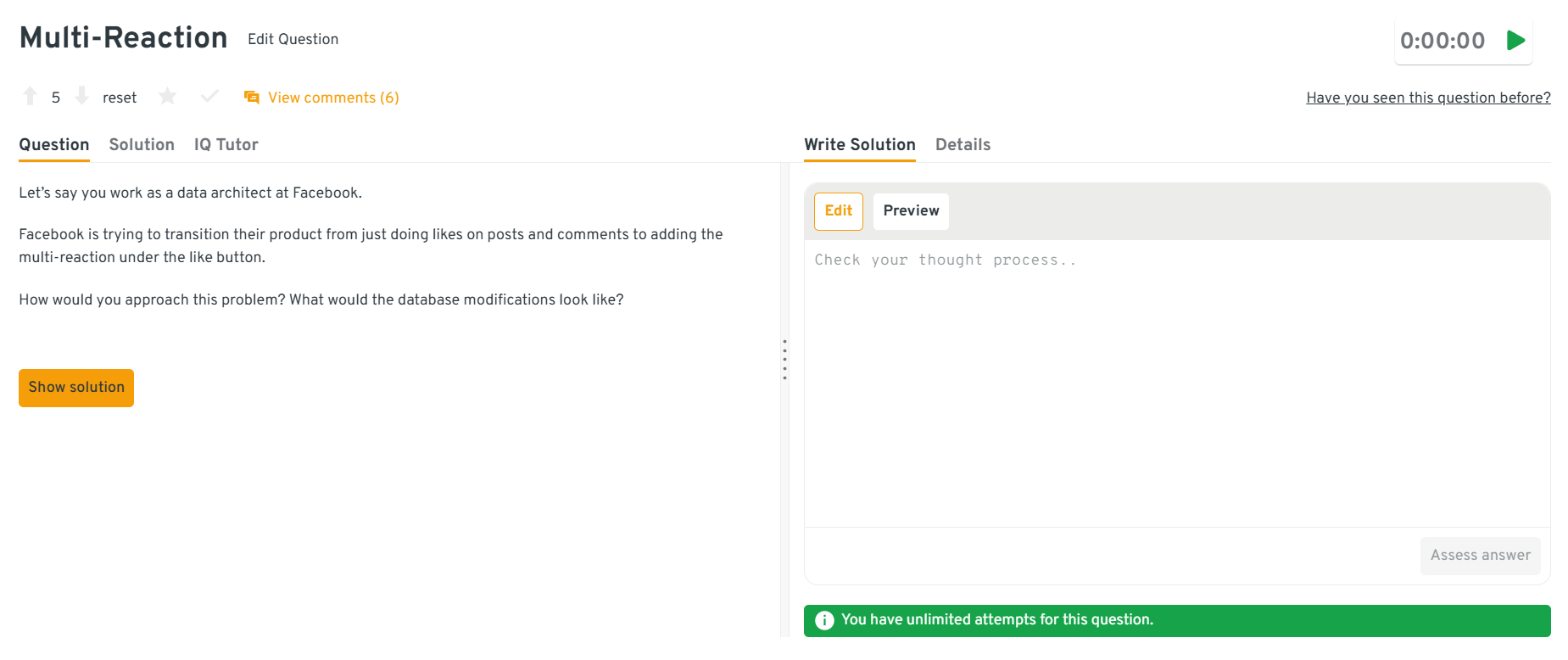
Explore the Interview Query dashboard that lets you practice real-world SQL and database design interview questions in a live environment. You can write, run codes, and submit answers while getting instant feedback, perfect for mastering database problems across domains.
Walk me through how you would gather requirements for designing a messaging database.
This question evaluates your ability to structure a design problem instead of jumping straight to tables. A strong answer highlights how you would identify the primary flows such as sending messages, grouping them into conversations, storing metadata like timestamps or read receipts, and handling attachments. Demonstrating curiosity by asking clarifying questions shows that you do not assume requirements and that you value correctness and longevity in the schema.
Tip: Explain how early clarification avoids redesign work later in the interview and in real projects.
What makes a database schema scalable from the beginning?
Interviewers use this question to understand how you think about long term growth. A strong answer covers reducing redundancy, enforcing constraints, choosing appropriate keys, and designing tables that support new use cases without constant refactoring. You can also explain how a normalized structure keeps data consistent even as the system grows.
Tip: Use a simple example such as separating Users and Orders to show how clean relationships avoid future complexity.
Normalization and Schema Structuring Interview Questions
Normalization questions test whether you understand how to reduce redundancy and prevent update anomalies. These often involve reworking an inefficient schema or identifying violations of normal forms.
Normalize this schema into 2NF or 3NF and explain your steps.
This question tests your understanding of dependency rules and your ability to restructure tables that contain redundant data. A strong answer walks through identifying the dependency issues, such as attributes depending on only part of a composite key or depending on another non key attribute. You then split the original table into new relations that remove these issues and link them with foreign keys. Interviewers want to see both the reasoning and the final structure.
Tip: Explicitly name the rule that is violated so the interviewer sees that you understand the theory behind your decisions.
What problems occur in a denormalized schema?
Interviewers ask this to confirm that you understand the hidden costs of convenience based structures. A strong answer explains how duplicated data leads to inconsistent updates, how redundant storage increases maintenance overhead, and how write operations become more complex. You can also mention that denormalization has valid use cases such as analytics workloads, but it should be done carefully.
Tip: Use a concrete example like a product name stored in multiple places to show how errors spread easily.
What is the difference between 1NF, 2NF, 3NF, and BCNF?
This question evaluates your conceptual understanding of formal design rules. A clear answer defines each. First normal form removes repeating groups. Second normal form removes partial dependencies. Third normal form removes transitive dependencies. BCNF ensures that every determinant is a candidate key. Keeping the explanation simple but accurate shows both clarity and confidence.
Tip: Keep the definitions short and relate each rule to a real world issue such as update anomalies.
When would you intentionally denormalize a schema?
Interviewers use this question to test whether you can balance correctness with performance. A strong answer explains that denormalization helps in read heavy systems where speed matters more than strict consistency, such as dashboards or caching layers. You should mention that denormalization introduces maintenance overhead and requires clear ownership of updates.
Tip: Mention strategies for keeping data in sync because it shows you think beyond design and into operations.
How would you fix partial or transitive dependencies in a schema?
This question checks whether you know how to correct a flawed design. A good answer walks through finding the violating attributes, splitting the table into smaller relations that isolate those dependencies, and linking the new tables with foreign keys. You should emphasize validating the result once the split is complete because it shows a thorough approach.
Tip: Say that you double check the schema after restructuring since it proves attention to detail.
Looking for hands-on problem-solving? Test your skills with real-world challenges from top companies. Ideal for sharpening your thinking before interviews and showcasing your problem solving ability.
Interview Questions on Keys, Indexes and Constraints
These questions assess your understanding of how databases enforce data integrity and speed up access. They often involve scenarios about designing primary keys, choosing composite indexes, or structuring constraints.
When would you use a composite primary key?
Interviewers ask this to understand how you model natural relationships. A strong answer explains that composite keys make sense when two attributes together uniquely identify a record, such as in enrollment or mapping tables. This design often prevents duplicates without requiring artificial identifiers.
Tip: Mention that composite keys can increase index complexity but often simplify relational logic.
What foreign key constraints would you add to a schema?
This question tests your ability to enforce integrity. A clear answer explains that foreign key constraints ensure related data exists, prevent orphaned records, and maintain relational meaning. You should mention optional cascading actions that help maintain consistency when parent records are updated or deleted.
Tip: If the requirements are unclear, say that you would trace each relationship back to the business rules because it shows methodical reasoning.
-
Interviewers ask this to confirm that you understand how databases maintain relational integrity and prevent silent data corruption. A strong answer explains that explicit foreign key constraints ensure referenced records actually exist, enforce valid relationships and stop orphaned rows from appearing, which plain BIGINT fields cannot do. When deleting parent records, cascade delete is appropriate only when child records have no independent meaning and should disappear with the parent, while set null is safer when the child record should remain but lose its association. This question shows whether you can design relationships that reflect real business rules rather than relying on application logic alone.
Tip: Emphasize that constraints serve as a safety net when code changes or multiple services write to the database, which signals practical production awareness.
How does indexing affect read and write performance?
This question evaluates your understanding of performance trade-offs. A strong answer explains that indexes improve read performance by speeding up lookups, but they slow down writes because the database must update both the table and the index for every change. Understanding this balance shows that you know how to design for real workloads.
Tip: Frame your answer around expected usage such as read heavy or write heavy because it shows practical judgment.
What are the trade-offs between unique constraints and application level validation?
Interviewers ask this to see how you think about correctness and responsibility. A strong answer explains that database constraints guarantee consistency even if the application has bugs, while application validation provides flexibility but less protection. You should emphasize that relying solely on application checks can lead to data corruption.
Tip: Mention that many mature teams use both layers because it signals an experienced point of view.
How would you choose the right index for a frequently filtered column?
This question checks how you design for query performance. A strong answer discusses selecting an index type based on the query pattern and the column’s cardinality, along with ensuring the index matches the operators used in filters. You can also mention that indexing very low cardinality columns is rarely helpful.
Tip: Reference a quick example such as indexing an email column for user lookups because it makes the answer concrete.
ER Diagrams and Schema Representation Interview Questions
These questions test your ability to visualize a system and present your design clearly. Even if you’re not drawing a full ER diagram, you should be able to articulate relationships cleanly.
Draw an ER diagram for a product review system.
Interviewers ask this to evaluate how you translate a simple product into a structured model. A strong answer identifies entities such as Users, Products and Reviews, then describes how they connect through one to many relationships. You should clearly explain each relationship to show that your schema reflects real interactions rather than arbitrary choices.
Tip: Always state the cardinality since it shows you can communicate structure clearly.
Model the relationships between users, posts, comments and likes.
This question tests your ability to recognize standard social patterns and map them into a relational design. A strong answer describes the one to many relationship between Users and Posts, the one to many relationship between Posts and Comments, and the many to many nature of Likes through a join table. Interviewers use this to check whether you naturally reach for correct relational structures.
Tip: Call out that the join table can include metadata such as timestamps because it shows deeper modeling skills.
How would you represent a many to many relationship?
Interviewers ask this to confirm that you know the standard approach. A strong answer states that you create a separate mapping table with foreign keys to each side of the relationship, which prevents duplication and preserves flexibility. You can also mention that the mapping table can store additional details about the relationship.
Tip: Mention when the mapping table becomes an entity of its own since that shows maturity.
Explain the difference between logical and physical database models.
This question evaluates how you move from design to implementation. A strong answer explains that logical models describe entities and relationships in an abstract way, while physical models include data types, storage details, partitioning and indexing choices. Interviewers want to see that you understand how conceptual decisions become actual structures.
Tip: Tie the models together by explaining that the logical design guides the physical one.
Show how you would map a hierarchical structure such as categories and subcategories.
Interviewers ask this to check whether you understand recursive relationships. A clear answer describes using a self referencing table where each category stores a reference to its parent category. This approach supports unlimited depth and keeps the structure flexible. You can also mention that alternative modeling techniques exist for systems that need faster tree traversal.
Tip: Briefly reference adjacency lists or nested sets to show that you understand more than one approach.
If you want to simulate real interview pressure, use Interview Query’s Mock Interviews to test your skills live in a coding environment with real feedback.
Scenario Based Database Design Interview Questions
Scenario based database design questions are the closest simulation of real work in a technical interview. Instead of testing isolated facts, these exercises show how well you can break down complex problems, identify the right entities, and design schemas that support long term scalability and reliability. Interviewers want to see whether you can translate real product behavior into a structured, efficient database model. They also want to evaluate how you think through trade-offs such as performance, consistency, and storage cost.
These questions reveal your ability to reason beyond tables and keys. You are expected to demonstrate clear problem framing, strong decision making, and the ability to communicate your logic under pressure.
Read more: Top 45 MySQL Interview Questions You Must Know
Let’s walk through several examples of what these scenarios look like in practice.
Design a Schema to Track Database Updates
A common scenario is:
“Create or modify a schema to keep track of address changes.”
Start by clarifying the core requirement: the system must store a history of addresses rather than overwriting the current one. Identify key entities such as Users and Addresses, then introduce a User Addresses table that captures each address record along with effective start and end dates. This allows the system to maintain historical accuracy for billing, shipping and compliance needs.
Interviewers ask this to see whether you recognize when data needs versioning and how to structure history correctly without losing past information.
Tip: Mention that adding an index on user identifier and start date supports fast lookups for the most recent address.
Design a Review App Database
A common prompt might be:
“Design the database schema for a Yelp-like app”
Begin by breaking down how users interact with the platform: they search businesses, leave reviews and browse categories. From this flow, identify entities such as Users, Businesses, Reviews and Categories. Explain relationships like each business belonging to one or many categories and each user writing multiple reviews.
Include attributes such as ratings, review text and timestamps. Interviewers use this question to evaluate whether you can design a schema that supports heavy read traffic, filtering by category, sorting by ratings and scalability as businesses and reviews grow.
Tip: Highlight that indexing by business identifier, category and rating significantly improves search performance.
Design a Notification App Database
You may encounter a scenario like:
“Design the data model for the notification system of a Reddit-style app”
Start by clarifying the workflow: users receive notifications when others reply to their posts, comment on threads or mention them. Identify entities such as Users, Notifications and possibly Notification Types. Each notification stores recipient identifier, triggering action, status and timestamps.
Discuss how notifications often need to be marked as read and filtered by type. Interviewers ask this question to assess whether you can design systems that handle high volume, time ordered events and support efficient querying across millions of notifications per user.
Tip: Mention indexing on recipient identifier and creation timestamp because it supports fast loading of a user’s unread notifications.
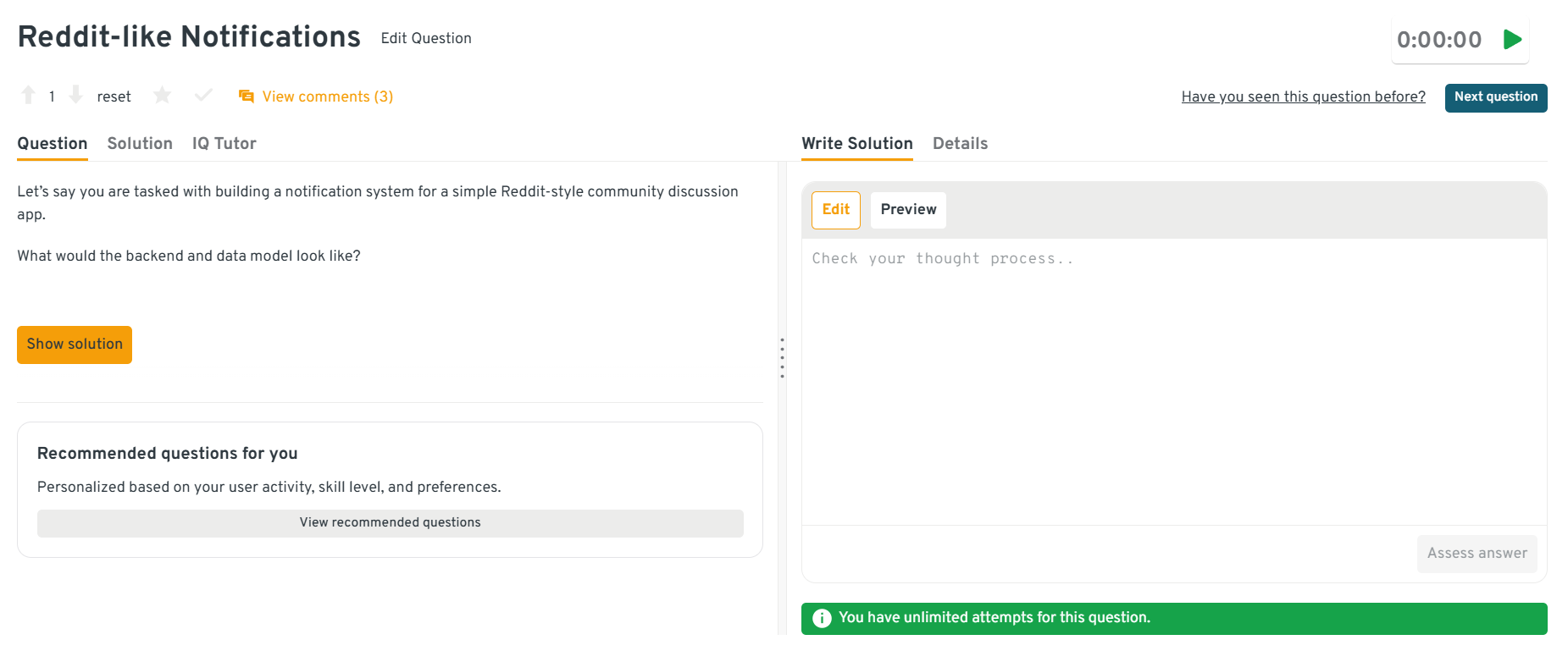
Explore the Interview Query dashboard that lets you practice real-world SQL and database design interview questions in a live environment. You can write, run codes, and submit answers while getting instant feedback, perfect for mastering database problems across domains.
Design a Fast Food Restaurant Database
Another interview prompt might be:
“Design a database for a stand-alone fast food restaurant”
Begin with the operational flow: customers place orders, orders contain menu items and each item has pricing and inventory details. Identify entities such as Orders, Order Items, Menu Items and Inventory. Explain relationships like each order having multiple line items and menu items referencing categories such as meals, sides or drinks. You can also include a simple tracking table for inventory adjustments during the day. Interviewers use this question to see whether you can model transactional systems that need accuracy, quick lookups and consistent order history.
Tip: Emphasize storing menu item price at the time of purchase because prices change regularly and historical orders must remain accurate.
Design a User Product Review System
A common prompt might be:
“Design the database for a product review system similar to Amazon.”
Start by defining the purpose of the system, which is enabling users to leave reviews on products and allowing the platform to show those reviews in an organized way. Identify the core entities such as Users, Products and Reviews. Then explain how the relationships work, for example each user can create many reviews and each product can have many reviews. Add attributes such as rating value, review text and timestamps.
You can optionally include tables for Votes or Comments if the platform allows users to mark reviews as helpful. Interviewers use this question to evaluate whether you can design a schema that supports high read volume, efficient filtering and secure integrity across user generated content.
Tip: Mention indexing strategies such as indexing on product identifier and rating because it signals performance awareness.
Design a Ride Sharing Matching System
An interviewer might ask:
“Design the database for matching riders and drivers in a ride sharing platform.”
Start by clarifying the flow. A rider requests a trip, a driver is matched, and the system tracks movement and payment. Identify key entities such as Users, Drivers, Vehicles, Trips and possibly Locations. Explain how a trip links a rider and a driver and how trip state changes over time.
You may also mention that driver location updates are frequent and often stored separately to avoid bloating the core transactional tables. Interviewers use this question to evaluate whether you can handle fast changing data and time sensitive events.
Tip: Suggest storing frequent location updates in a dedicated table to improve performance and manage retention policies.
Design a Dating App Schema
Another common scenario is:
“Design the schema for a dating application that supports profiles, matches and messages.”
Start with core interactions. Users create profiles, match with others and exchange messages. Identify entities such as Users, Profiles, Matches and Messages. A match typically links two users and has attributes like match date and status. Messages reference both the sender and the specific match. This question tests whether you know how to combine static profile data with dynamic relationship based interactions in a single schema that maintains data integrity and performance.
Tip: Note that soft deleting matches or messages is useful for user privacy without losing analytic history.
Design a Logging or Event Tracking Database
A typical real world question might be:
“Design the schema for an event tracking or application logging system.”
Start by describing the primary need which is to store large volumes of immutable events generated by an application. Identify an Events table with attributes like event type, timestamp, user identifier, metadata fields and possibly a payload column to store additional details.
You can mention partitioning events by time and indexing by event type to support efficient queries. Interviewers ask this to see how you handle scale and whether you understand the difference between transactional data and high throughput analytical data.
Tip: Include the use of a JSON or semi structured column for flexible metadata because event formats often change over time.
Want to build up your database design interview skills? Practicing real hands-on problems on the Interview Query Dashboard and start getting interview ready today.
SQL Questions for Database Design Interviews
Database design interviews often include SQL questions that test how well your schema choices support real queries. Interviewers want to see whether you can connect design decisions to practical data retrieval, indexing, and constraint enforcement. These questions evaluate your ability to work across the full lifecycle of a database, from modeling to querying and optimization. Strong answers show that you understand not only how to write SQL, but why certain patterns matter for performance and reliability.
Read more: Top 57 PostgreSQL Interview Questions + Answers
Below are common SQL questions that appear alongside database design prompts, each with descriptive explanations and clear guidance on how to respond.
Common SQL Questions in a Database Design Interview
-
Interviewers ask this to evaluate whether you can combine multiple compensation fields into a clean reporting query. A strong answer groups by role, computes the sum of
salaryandovertime_pay, and derives total compensation using an expression such assalary + overtime_pay. This tests your ability to build accurate financial summaries, which are common in HR, payroll, and workforce analytics.Tip: Mention that you would validate totals with sample records because financial queries demand accuracy.
-
This question tests your ability to filter event logs, deduplicate users and build a daily activity metric. A strong answer filters records to
YEAR(event_date) = 2020, groups by platform and date, and counts distinct users usingCOUNT(DISTINCT user_id). This shows that you understand how to convert raw logs into daily active user KPIs.Tip: Note that indexing
event_dateoruser_idimproves performance when logs are large. Select the student name combination that is higher in the alphabet.
This question tests self joins and window functions. It focuses on finding the closest SAT score to a target value by computing
ABS(score - target)and ranking rows usingRANK()or ordering withORDER BY ABS(score - target). Interviewers want to see that you can combine ordering logic with comparison functions to extract the most relevant record.Tip: Mention using
LIMIT 1after ordering, which keeps the solution simple and efficient.Sample every 4th row ordered by the date.
This question checks whether you can use ordering and row numbering to extract evenly spaced samples. A strong answer orders records by date, assigns row numbers with
ROW_NUMBER(), and filters using a modulo expression likeROW_NUMBER() % 4 = 0. Interviewers use this to see how well you work with time series sampling and structured window logic.Tip: Highlight that window functions simplify sampling patterns compared to nested subqueries.
-
This question tests filtering, comparison logic and the ability to compute ratios in SQL. A strong answer filters accounts with
status = 'active'on2019-12-31andstatus = 'closed'on2020-01-01, then calculates the percentage withCOUNT(*) / total_accounts * 100. Interviewers want to see whether you can perform date-specific state checks and produce accurate churn metrics.Tip: Note that using a subquery or CTE for state snapshots keeps the logic clean.
Write a query to sample transactions into weekly time series
This question evaluates your understanding of date bucketing, which is essential in analytics and trend reporting. A strong answer uses
DATE_TRUNC('week', transaction_date)(or an equivalent function) and groups by the truncated week to produce weekly counts or aggregates. This demonstrates your ability to transform granular data into structured time windows.Tip: Mention that weekly buckets help smooth noisy daily data in dashboards.
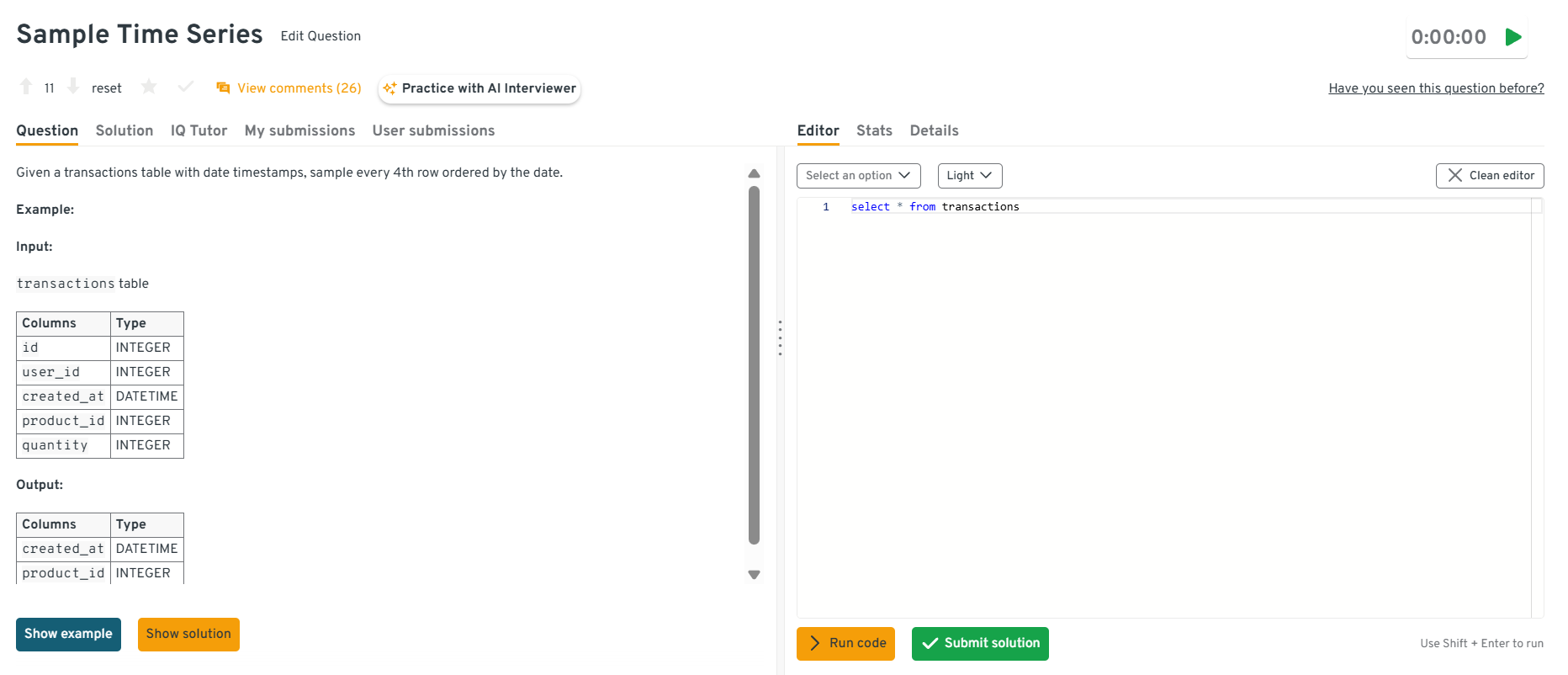
Explore the Interview Query dashboard that lets you practice real-world SQL and database design interview questions in a live environment. You can write, run codes, and submit answers while getting instant feedback, perfect for mastering database problems across domains.
How would you write a query to identify products that have never been reviewed?
Interviewers use this question to test your understanding of joins, null filtering and relationship validation. A strong answer explains using a
LEFT JOINbetweenProductsandReviews, then filtering wherereview_id IS NULLto surface products with no matching reviews. You can also mention the alternativeNOT EXISTSpattern, which often performs better in large datasets. This question highlights your ability to detect missing relationships, a critical skill in quality checks and analytics workflows.Tip: If the table is large, mention indexing
product_idto speed up join performance.How would you enforce uniqueness for a combination such as user identifier and product identifier in a review system?
Interviewers ask this to see whether you understand how SQL constraints enforce business rules. A strong answer mentions creating a composite unique constraint on
(user_id, product_id)to guarantee one review per user per product. This protects data integrity regardless of application level checks and prevents duplicate reviews from slipping through due to race conditions or bugs.Tip: Bring up validating the same rule in the application to provide immediate user feedback.
How would you write a query to paginate results in a large table?
This question evaluates your ability to retrieve large datasets efficiently and support real user-facing features. A strong answer describes using
LIMITandOFFSETfor basic pagination, then explains why cursor based pagination using a comparison filter likeWHERE id > last_seen_idscales better for large tables. Interviewers want to see that you understand how pagination patterns affect performance and memory usage.Tip: Mention adding an index on the sort column, such as
idorcreated_at, to keep pagination fast.How would you write a query to detect orphaned records in a relational schema?
Interviewers use this question to confirm that you understand foreign key relationships and can diagnose integrity issues. A strong answer uses a
LEFT JOINfrom the child table to the parent table and filters forparent.id IS NULLto surface orphaned rows. This identifies records that reference nonexistent parents, helping catch bugs in ingestion pipelines or missing constraint enforcement.Tip: Mention scheduling automated integrity checks if the system does not enforce constraints strictly.
Want to master SQL interview questions? Start with our SQL Question Bank to drill real-world scenario questions used in top interviews.
NoSQL vs Relational Design Questions
Modern systems rarely rely on a single type of database. Instead, engineers choose between relational databases and NoSQL systems based on consistency needs, query patterns, scalability expectations, and data shape. Interviewers ask questions in this area to understand whether you know how to choose the right tool for the problem. They also want to see whether you recognize the trade-offs between structured relational tables and flexible schema approaches used in distributed systems.
A strong candidate demonstrates not only knowledge of each model but also an ability to justify design choices with clear reasoning.
Difference Between SQL (Relational Databases) and NoSQL
Before answering design questions, interviewers want to see that you understand the core distinctions between relational and non relational systems. This sets the foundation for making correct architectural choices.
SQL databases prioritize structured schemas, strong consistency guarantees and complex relational queries. NoSQL databases focus on horizontal scale, flexible schemas and high performance for distributed workloads. Understanding where each excels helps you decide which model fits a given set of requirements.
SQL vs NoSQL Comparison Table
| Feature | SQL (Relational) | NoSQL (Non Relational) |
|---|---|---|
| Data model | Structured tables with defined schema | Flexible documents, key value pairs, graphs or wide columns |
| Schema | Strict and enforced | Schema optional with dynamic or nested fields |
| Relationships | Strong support through joins and foreign keys | Typically modeled through embedding or referencing |
| Consistency | Strong ACID guarantees | Often eventual consistency, depends on the system |
| Scaling | Vertical scaling with limited horizontal options | Native horizontal scaling and partitioning |
| Query language | SQL structured queries | Varies by system, often JSON based or API driven |
| Best for | Transactional systems, financial data, normalized models | High volume distributed systems, unstructured or semi structured data |
| Examples | PostgreSQL, MySQL, SQL Server | MongoDB, Cassandra, DynamoDB, Redis |
Tip: When comparing SQL and NoSQL, always tie the choice back to specific workload patterns such as high write volume, strict consistency needs or flexible document shapes. Interviewers care about the reasoning, not just the facts.
SQL Focused Design Questions
How would you design a relational schema to support complex reporting queries?
This question tests whether you understand normalization and indexing. A good answer explains splitting data into well defined tables, using foreign keys to model relationships and indexing columns used in aggregates or joins. Interviewers want to see that your design supports both performance and clarity.
Tip: Mention materialized views when workloads require repeated heavy queries.
How do you handle many to many relationships in SQL?
Interviewers ask this to ensure you know how to design join tables. A strong answer explains creating a mapping table with two foreign keys referencing the parent tables and possibly storing additional metadata. This shows you know relational modeling basics.
Tip: Mention indexing both foreign key columns for faster joins.
How would you scale a relational database that is hitting read limits?
This question evaluates whether you can extend a relational system before migrating to NoSQL. A solid answer mentions read replicas, caching layers and optimizing slow queries. Interviewers want to see that you understand horizontal strategies that work within SQL.
Tip: Bring up analyzing slow query logs to find bottlenecks.
How would you enforce data integrity across interconnected tables?
This question tests your understanding of constraints. A strong answer includes foreign keys, check constraints and unique constraints to maintain valid relationships. Interviewers want to see that you use database level rules instead of relying only on application logic.
Tip: Explain how constraints prevent corruption even if the application has bugs.
How would you join a Users table and a Messages table to show the last message sent by each user?
This question tests your understanding of joins, grouping, and subqueries. A strong answer describes joining
UserstoMessages, grouping by user identifier, and selecting the maximum timestamp. You can also mention using window functions for cleaner logic. Interviewers want to see if you can navigate typical communication or activity feed patterns.Tip: Explain which columns you would index to support this query, such as sender identifier and timestamp.
See a step-by-step solution for this question:
In this mock SQL interview, Jitesh, a data engineering coach with 10 years of experience, walks through how to compute the daily distribution of user-initiated conversations in a chat. He demonstrates how to interpret interaction patterns, structure the SQL correctly, and avoid double counting—core skills you can apply directly in your own interview prep.
NoSQL Focused Design Questions
How would you design a high volume event tracking system?
Interviewers ask this because NoSQL databases often handle append only, large scale workloads better than relational systems. A strong answer involves storing events as documents with flexible metadata fields, partitioning by time and using a system like DynamoDB or MongoDB to support high write throughput. This demonstrates that you understand distributed ingestion patterns.
Tip: Mention TTL (time to live) expiration for old events to manage storage cost.
How would you model user profiles with nested fields and flexible attributes?
This question evaluates your understanding of document oriented models. A strong answer describes storing each profile as a document with nested objects for preferences or settings, avoiding the need for multiple joins. Interviewers want to see that you know when flexible schemas are beneficial.
Tip: Emphasize that flexible schemas reduce migration overhead as user attributes evolve.
How would you design a global application that needs fast reads from multiple regions?
Interviewers ask this to check whether you know how NoSQL databases support replication and low latency. A solid answer discusses multi region replication, eventual consistency and partitioning strategies used in systems like DynamoDB or Cassandra. This shows awareness of distributed systems design.
Tip: Mention choosing consistency levels based on business needs such as read after write accuracy.
How would you store and retrieve hierarchical or nested data?
This question tests the strengths of NoSQL document structures. A strong answer describes embedding nested objects inside a single document to reduce reads and avoid multiple table joins. Interviewers want to see that you can design for simplicity and speed.
Tip: Mention the trade-off between embedding for speed and the risk of large document growth.
How would you design a user feed or timeline system?
This question evaluates your understanding of high throughput systems. A strong answer describes storing each user’s feed entries in a partitioned collection or using a fan out on write or fan out on read strategy depending on performance goals. Interviewers ask this because NoSQL databases are often used for real time social features.
Tip: Mention choosing partition keys carefully to avoid hotspots.
Are you interviewing at Meta, Amazon, or Stripe? Use our curated company specific guides (Meta SQL Guide, Amazon SQL Questions, Stripe Interview Questions) to prep like the pros.
Database Design Exercises
Preparing for database design interviews is much easier when you practice solving complete problems from start to finish. Interviewers want to see that you can move from vague requirements to a clean schema, identify the right entities, define relationships and justify the trade-offs you make. Working through full exercises helps you build the structured thinking and communication skills that interviewers value the most.
Below are several practice exercises that mirror the type of problems you will face in technical interviews. Each includes a guided walkthrough to help you understand the steps behind a strong solution.
Exercise 1: Design a Subscription and Billing Database
A common exercise is:
“Design the schema for a subscription based product like Netflix or Spotify.”
Step-by-step walkthrough
- Identify the main workflows: Users sign up, choose a plan, make payments and may upgrade or cancel. This helps reveal the core business actions that your schema needs to support.
- Define the main entities: Users, Plans, Subscriptions and Payments. Plans store price and billing cycle. Subscriptions link a user to a plan and include start date, end date and status. Payments store transaction details.
- Map the relationships: A user can have multiple subscriptions over time, each subscription can generate many payments and each subscription references exactly one plan. This structure allows tracking of historical changes and avoids overwriting past records.
- Add necessary attributes: In Subscriptions you include attributes such as renewal date, cancellation date and current status. In Payments you include amount, currency, method and transaction timestamp.
- Ensure data integrity: Use foreign keys to link subscriptions to users and plans. Add constraints so each payment references a valid subscription. This helps maintain a complete financial history.
Tip: Mention that storing historical plan pricing in each subscription avoids inconsistencies when plan prices change later.
Exercise 2: Design a Restaurant Reservation System
A typical prompt is:
“Create a database schema that supports restaurant reservations.”
Step-by-step walkthrough
- Start with the problem definition: Customers book tables for specific time slots. The system must prevent double booking and track reservation status changes such as confirmed, cancelled or completed.
- Identify entities: Restaurants, Tables, Customers and Reservations. Tables include capacity. Reservations include reservation time, party size and status.
- Define relationships: A restaurant has many tables. A customer can have many reservations. Each reservation references both a table and a customer. This makes it easy to query availability across tables.
- Address availability and conflicts: Explain that preventing double booking requires indexing on table identifier and time. You may also mention using constraints or application checks to catch overlapping time windows.
- Include optional enhancements: You can add attributes such as special requests, seating preferences or reservation source to make the schema more realistic.
Tip: Explain how checking table capacity against party size ensures better data quality and prevents invalid reservations.
Exercise 3: Design a Learning Management System (LMS)
Another interview favorite:
“Design the database for an online learning platform with courses, lessons and student progress.”
Step-by-step walkthrough
- Understand the goals: Students enroll in courses, consume lessons and complete assessments. The platform needs to track engagement and progress over time.
- Identify the main entities: Users, Courses, Lessons, Enrollments and Progress. Lessons belong to courses, and progress links a user to a lesson with completion status.
- Map the relationships: A course contains many lessons. Users can enroll in many courses. Each enrollment can have multiple progress records, one for each lesson in the course.
- Add meaningful attributes: Courses include title and description. Lessons include content type and duration. Progress includes completion state, timestamp and score if applicable.
- Address performance and reporting: Explain how indexing on user identifier and lesson identifier improves tracking and reporting. Mention that storing both aggregate course completion and per lesson progress helps support analytics.
Tip: Highlight the need to store timestamps for progress updates because learning platforms often measure engagement trends.
Want to level up your database design interview prep? Practice hands-on SQL problems and real take-home assignments on Interview Query Dashboard.
How to Prepare for a Database Design Interview (Step-by-Step)
Preparing for a database design interview means strengthening both your technical depth and your ability to communicate structured reasoning clearly. These interviews are not just about knowing tables and keys. They test how well you gather requirements, model real systems, reason about trade-offs, and write SQL that aligns with your schema. The strongest candidates practice full design exercises, revisit foundational concepts, and refine the way they explain decisions to interviewers. Below is a step-by-step plan to help you prepare with confidence and clarity.
Review database design fundamentals thoroughly
Start by revisiting core concepts such as normalization, denormalization, keys, relationships, indexing strategies, and ACID transactions. Make sure you understand why each concept matters in real systems. Interviewers expect you to recognize design flaws, rewrite schemas, and explain how your structure prevents data anomalies or performance issues.
Tip: Practice explaining normalization and relationships out loud. Clear communication is just as important as technical accuracy.
Work through real system design prompts
Choose 3 to 5 real-world scenarios such as designing a ride sharing app, messaging system, reservation system or review platform. Walk through requirements, list entities, map relationships and consider edge cases like soft deletes, versioning or high write volume. Interviewers look for your ability to break down ambiguous prompts into structured steps.
Tip: Redraw your schemas on paper before typing them. Visual thinking helps refine your structure and storytelling.
Strengthen your SQL across common interview patterns
Practice writing queries tied to your database designs, including joins, aggregations, window functions and subqueries. Make sure you can write queries for top users, missing relationships, filtering by date and paginating large datasets. Interviewers test SQL to verify that your schema decisions translate into efficient queries.
Tip: When practicing SQL, highlight which indexes you would expect to exist. Interviewers love when you connect design to performance.
Study performance trade-offs and scaling strategies
Review how indexing affects reads and writes, how to partition or shard data, when to cache results, and when to switch from relational to NoSQL systems. Interviewers want to see that you understand real-world scalability constraints, not just textbook design.
Tip: Use simple phrases like “this helps under high write volume” or “this keeps reads fast as data grows” to show practical judgment.
Practice scenario-based thinking
Interviewers often ask how your schema handles updates, deletes, bulk inserts, or data growth. Work through questions like how to avoid double booking, how to store historical values or how to prevent inconsistent state between two tables. Thinking through scenarios improves your ability to reason out loud in interviews.
Tip: Build a habit of stating assumptions early. This signals clarity and reduces misunderstandings.
Refresh consistency, transactions, and concurrency concepts
Review what ACID means, how locking works, when to use transactions and how isolation levels protect data. Many candidates struggle here, so strong foundational knowledge helps you stand out in advanced interviews.
Tip: Come prepared with one real example of when a transaction prevented a bug or corruption. It adds credibility.
Simulate full interview practice sessions
Work through design prompts under timed conditions and practice speaking through your decisions from start to finish. Many candidates know the material but cannot communicate it clearly under pressure. Practicing delivery helps refine your pacing, assumptions and structure.
Tip: Record yourself explaining a schema and listen back for clarity gaps. This alone can improve your performance significantly.
Database Design Mistakes to Avoid
Even strong candidates lose points in database design interviews because of small but meaningful mistakes that reveal unclear reasoning or weak fundamentals. Interviewers care not only about the schema you create but also about the pitfalls you avoid. Poor assumptions, missing constraints or inefficient modeling choices can suggest challenges in real production environments. Focusing on the most common mistakes helps you design cleaner models and communicate your decisions confidently.
Read more: Common SQL Interview Mistakes and How to Avoid Them
Below is a streamlined table highlighting the six issues interviewers see most frequently, along with why they matter and what to do instead.
Common Database Design Mistakes
| Mistake | Why it Hurts Your Design | How to Avoid It |
|---|---|---|
| Skipping normalization | Produces redundant data and leads to update anomalies | Normalize to at least third normal form unless there is a clear performance reason not to |
| Over-normalizing the schema | Creates excessive joins and slows down common queries | Balance normalization with expected query patterns and denormalize intentionally when needed |
| Choosing the wrong relationship type | Results in incorrect cardinality and confusing or invalid joins | Validate whether relationships are one-to-one, one-to-many or many-to-many during requirements gathering |
| Forgetting indexing strategy | Causes slow lookups, scans and filtering in high-traffic systems | Identify high-frequency queries early and design indexes around those access patterns |
| Not planning for historical or changing data | Breaks reporting, auditing and long-term accuracy | Store snapshots or versioned records for fields that change over time |
| Relying only on application logic for data integrity | Leaves the system vulnerable to corrupted or inconsistent data | Use database-level constraints such as foreign keys, check constraints and unique constraints |
Tip: Before finalizing any schema, walk through the top five queries the system must support. If the schema makes those queries slow, complex or fragile, rework the design early.
Want to practice with peers to avoid interview mistakes? Use Interview Query’s Mock Interviews to test your skills live in a coding environment with real feedback.
Database Design Question (Full Walkthrough)
Seeing a full database design example from beginning to end is one of the most effective ways to prepare for the interview. Interviewers want to see how you think, not just the final schema. They evaluate how you gather requirements, justify decisions, identify trade-offs and communicate your reasoning clearly. Walking through a structured solution helps you build a reusable framework you can apply to any new prompt.
Below is a sample question that mirrors what you will see in real interviews, along with a structured breakdown of how to approach it.
Sample Prompt
“Design a database for a fitness tracking application where users can track workouts, log exercises and view progress over time.”
Step-by-Step Walkthrough
Clarify the problem and gather core requirements
Start by summarizing the system at a high level. Users will log workouts, track individual exercises within each workout, and view historical stats. Ask clarifying questions such as:
- Can a workout contain multiple exercises?
- Do exercises have predefined types, or can users create custom movements?
- Should progress be tracked daily, weekly or per exercise?
These questions help you define correct boundaries and ensure the schema supports real user behavior.
Identify the key entities
A clean solution includes the following tables:
- Users: Stores basic user information.
- Workouts: Captures each workout session with date, duration, and workout type.
- Exercises: Defines each exercise performed during a workout.
- Exercise Types: Stores metadata like exercise name, muscle group or equipment.
- Progress (optional): Tracks summary statistics for dashboards or analytics.
Interviewers look for your ability to separate static reference data from dynamic user logged data.
Map the relationships
A user has many workouts. A workout contains many exercises. Each exercise references an exercise type. If progress is included, it references both users and exercise types.
This structure supports queries such as “show all exercises for this workout” or “summarize bench press progress over time.”
Add meaningful attributes
For Workouts, include attributes like start time, end time, notes and workout category.
For Exercises, add sets, reps, weight, and difficulty.
For Exercise Types, include muscle group, equipment type, and category.
For Progress, store metrics such as max weight, volume lifted, or total reps.
Interviewers evaluate whether your attributes match real use cases.
Consider performance and growth
Mention indexing strategies such as indexing by user identifier and workout date to support dashboards and activity feeds. For large systems, you can separate exercise logs into partitioned tables by date or user segments. Interviewers appreciate when you think ahead about scale, even in a small project.
Address historical accuracy
If exercise types change over time, store static snapshots in the exercise record so past logs remain accurate. Data that evolves must be handled carefully to avoid an inaccurate history. Showing awareness of this earns credibility.
Summarize your schema clearly
Conclude by summarizing the tables, their primary keys and the key foreign key relationships. This final recap shows confidence and clarity, which interviewers value highly.
Tip: Practice describing your schema as if you are teaching someone new to the system. Clear communication often matters more than having the perfect design on the first attempt.
Additional Database Design Resources
Strengthening your database design skills is much easier when you rely on trusted documentation, interactive tools and real-world engineering case studies. Below is a curated list of concise, high-quality resources to help you deepen both conceptual understanding and practical modeling skills.
Official Documentation
- PostgreSQL Docs: Clear explanations of indexing, constraints, transactions, and performance tuning.
- MySQL Reference Manual: Useful for relational behavior, storage engine,s and SQL fundamentals.
- MongoDB Manual: Covers document modeling, aggregation pipelines, and NoSQL schema patterns.
Hands-On Learning and Practice
- Interview Query Data Modeling & SQL Questions: Practice real schema design prompts and SQL interview scenarios.
- SQLBolt: Interactive SQL lessons and practice queries.
- DBDiagram.io: Simple ERD tool for practicing schema visualization.
Real-World Engineering Blogs and Case Studies
Learn how real companies design and scale production data systems.
- Uber Engineering Blog: Deep dives into geospatial indexing, schema evolution, and large-scale storage patterns.
- Netflix Tech Blog: Strong coverage of distributed systems, microservices, caching, and storage decisions.
- Airbnb Engineering: Focused on schema migrations, reliability work, and data scaling challenges.
Tip: Use these resources while building a small side project where you design a schema and write queries for real features. Applying ideas in context helps the concepts stick much faster.
FAQs
What should I focus on first when preparing for a database design interview?
Start with the fundamentals: normalization, relationships, indexing, transactions, and common SQL patterns. Once you are comfortable with the basics, practice full design scenarios so you can walk through requirements, entities and trade-offs clearly.
How detailed should my schema be in an interview?
You do not need production-level detail. Aim for the right entities, key relationships, and essential attributes. Interviewers care more about your reasoning, your ability to structure the problem and how well you communicate design decisions.
How do I know when to normalize vs. denormalize?
Normalize by default to reduce redundancy and keep data consistent. Consider denormalization only when you identify repeated heavy read queries that can be sped up by storing data in fewer joins. Always explain the trade-offs behind your choice.
Do I need to draw ER diagrams during the interview?
You do not have to, but sketching a simple ER diagram is often helpful. It makes your thought process clear and helps interviewers follow your structure. Even a rough outline of tables and relationships can significantly improve communication.
How do I handle uncertainty or missing requirements in a design prompt?
State your assumptions early and explain why they are reasonable. Interviewers expect you to clarify ambiguity rather than guess silently. Clear assumptions help frame your design choices and show structured thinking.
What is the most common mistake candidates make in database design interviews?
The biggest mistake is jumping into tables too quickly without clarifying the workflow or requirements. Strong candidates always begin by identifying the core actions, entities and constraints before discussing schema structure.
Should I talk about performance or scaling even if the prompt seems simple?
Yes. Mentioning indexing, query patterns or growth considerations shows maturity and real-world awareness. You do not need a deep dive, but acknowledgments of scale make your design feel grounded and practical.
How do I explain trade-offs without sounding indecisive?
Be concise and intentional. Highlight the main options, note the key pros and cons, and explain which path you would choose and why. Interviewers want to see judgment, not perfection.
Do I need to know NoSQL databases for relational design interviews?
You do not need expertise, but you should understand the basic differences in schema flexibility, consistency models and scaling patterns. Many companies combine SQL and NoSQL systems, so familiarity helps you stand out.
How can I practice effectively on my own?
Pick real apps you use daily and design their schemas from scratch. Then write SQL queries that those apps would run. This helps build both modeling intuition and query fluency in a realistic way.
Conclusion
Database design interviews reward clarity, structured thinking, and a strong grasp of the fundamentals. Whether you are modeling a simple review system or designing a high-volume application, the core skills stay the same: gather requirements, identify entities, map relationships, reason about trade-offs, and communicate your decisions clearly. With consistent practice across real scenarios, SQL queries, and end-to-end schema walkthroughs, you will build the confidence to handle any prompt an interviewer presents. Use this guide as a roadmap, work through the exercises, and return to the fundamentals regularly. The more you practice, the more natural and intuitive your database design instincts will become.
Your Next Step
If you want structured practice, explore Interview Query’s data modeling and SQL challenges, system design walkthroughs, and our library of database design interview questions. These resources help you test your reasoning, learn from real-world examples, and prepare confidently for your next technical interview.
Keep modeling. Keep refining. And keep building schemas that scale.