

LinkedIn: AI Engineering, Prompting & Model Tuning Are the Fastest-Growing Skills in 2026


The New Reality of AI Skills in 2026
As AI continues to reshape jobs across tech and beyond, it’s increasingly proving to no longer be optional. According to LinkedIn’s Skills on the Rise 2026 report, AI-related capabilities, especially AI engineering, prompting, and model optimization, are seeing dramatic growth across industries.
Drawing from LinkedIn’s Economic Graph and platform-wide talent insights, AI engineering skills are now among the fastest-growing globally. This signifies a structural shift in what employers expect from engineers, analysts, and even product teams.
For those navigating job hunts, technical interviews, or career pivots in 2026, understanding this shift can be essential to landing interviews and future-proofing careers.
LinkedIn’s Data: Why AI Engineering Dominates Skill Growth
LinkedIn’s latest datasets show AI engineering, prompt engineering, and specialized model tuning surging ahead of other AI-related skill categories, like AI business strategy. This trend reflects demand for production-ready AI talent, going beyond theory as companies move from AI experimentation to systematic approaches.
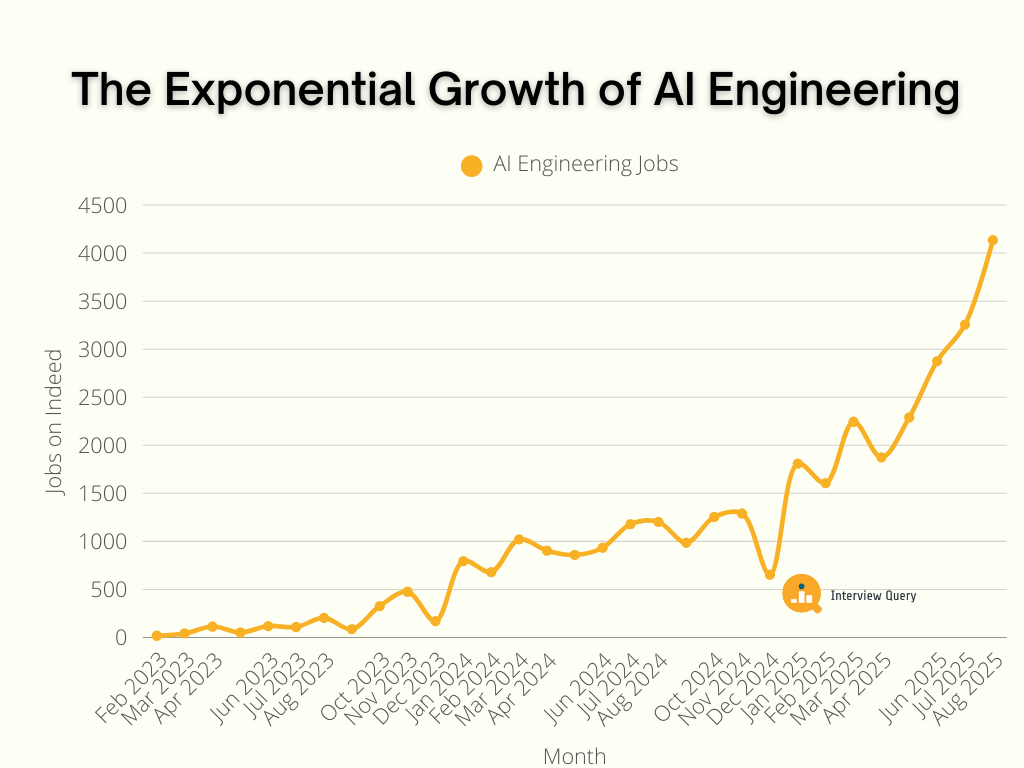
Other job market analyses support this trend. Data cited in a previous Interview Query article shows AI engineering roles have grown exponentially over the past two years, with monthly openings surging beyond 4,000 listings and outpacing traditional software engineering. Some AI-specific roles have seen triple-digit percentage growth as companies rush to integrate generative AI into products and workflows.
There’s also a pay signal; roles mentioning AI skills frequently command salary premiums compared to similar roles without them.
For candidates, this isn’t abstract data. These trends directly influence who gets shortlisted, interviewed, and promoted. Demonstrating that you can build, evaluate, and optimize AI systems is increasingly more valuable than simply listing a degree or general programming knowledge.
AI Skills That Employers Actually Value
This recent report on the fastest-growing AI skills means saying “AI” on your resume isn’t enough.
Employers are looking for engineers who can:
- Design, fine-tune, and evaluate AI models
- Build and maintain data pipelines for training and inference
- Optimize performance, latency, and cost in real-world systems
- Troubleshoot model failures and edge cases
Practical skill examples showing up in fast-growing LinkedIn categories include:
- Prompt design and optimization for LLM workflows
- Experience with orchestration frameworks like LangChain
- Model tuning techniques, including parameter optimization and reinforcement learning approaches
- Evaluation frameworks for hallucination reduction and model robustness
We’re also seeing growth in hybrid roles. As previously reported, forward-deployed engineers (FDEs) are also in-demand, with job postings reportedly growing by over 800% in 2025. By combining engineering depth with client-facing problem solving, FDEs deploy AI systems directly into business environments. These roles require both technical strength and strong communication skills.
Big Tech Is Reinforcing the AI Engineering Trend
The hiring signal also transcends LinkedIn dashboards, as it becomes increasingly visible in how major tech companies are restructuring.
For instance, Meta recently announced the creation of a new applied AI engineering organization within its Reality Labs division. The goal is to scale AI model development and improve real-world performance across products.
More than just internal rebranding, it represents a deliberate allocation of engineering headcount toward applied AI systems, across infrastructure, model tooling, performance feedback loops, rather than traditional feature development.
Meta’s internal messaging also emphasized the need for strong data pipelines, robust tooling, and continuous model evaluation. In other words: hands-on AI engineering.
When companies competing at the frontier of AI are reorganizing entire divisions around applied AI engineering, that’s a structural labor market shift. It tells job seekers that AI engineering isn’t a niche specialty anymore but is quickly becoming a strategic priority.
What This Means for Your Job Search & Career
If AI engineering skills are filtering candidates, your resume and LinkedIn profile need to reflect specifics, not buzzwords.
Instead of “interested in AI,” specify:
- Frameworks you’ve deployed
- Models you’ve fine-tuned
- Datasets you’ve trained on
- Performance improvements you’ve achieved
Recruiters rely heavily on keyword filters tied to these exact capabilities.

Interview formats are also evolving in line with this demand. Many AI roles now include live debugging, system design discussions around model deployment, or evaluation-based exercises, ultimately testing systems thinking more than textbook recall.
Lastly, your portfolio matters more than ever. Public GitHub repos, demo applications, and open-source contributions demonstrate credibility. If you’re unsure where to start, curated AI project ideas, such as building retrieval-augmented generation systems, fine-tuning domain-specific models, or creating model evaluation dashboards for specific industries, can help you practice exactly the skills employers are demanding.
The ROI is clear: investing in AI-centric tooling and applied methodologies now increases interview callbacks and strengthens salary negotiation leverage later.
The Bottom Line for Tech Workers
Overall, demand for AI engineering skills is no passing trend. Data from LinkedIn and organizational shifts at companies like Meta show that this movement is structural.
Whether you’re coding models, crafting prompts, tuning performance, or deploying AI systems into production, these are the capabilities employers are prioritizing in 2026.
For tech workers and career changers alike, there is no better time to adapt than now. More than just about staying relevant, it’s about positioning yourself ahead of the next wave of engineering hiring, where AI fluency isn’t a bonus skill, but the baseline.