
Why are AI Engineering Jobs Exploding?


Introduction
Two years ago, the title “AI Engineer” barely existed on LinkedIn.
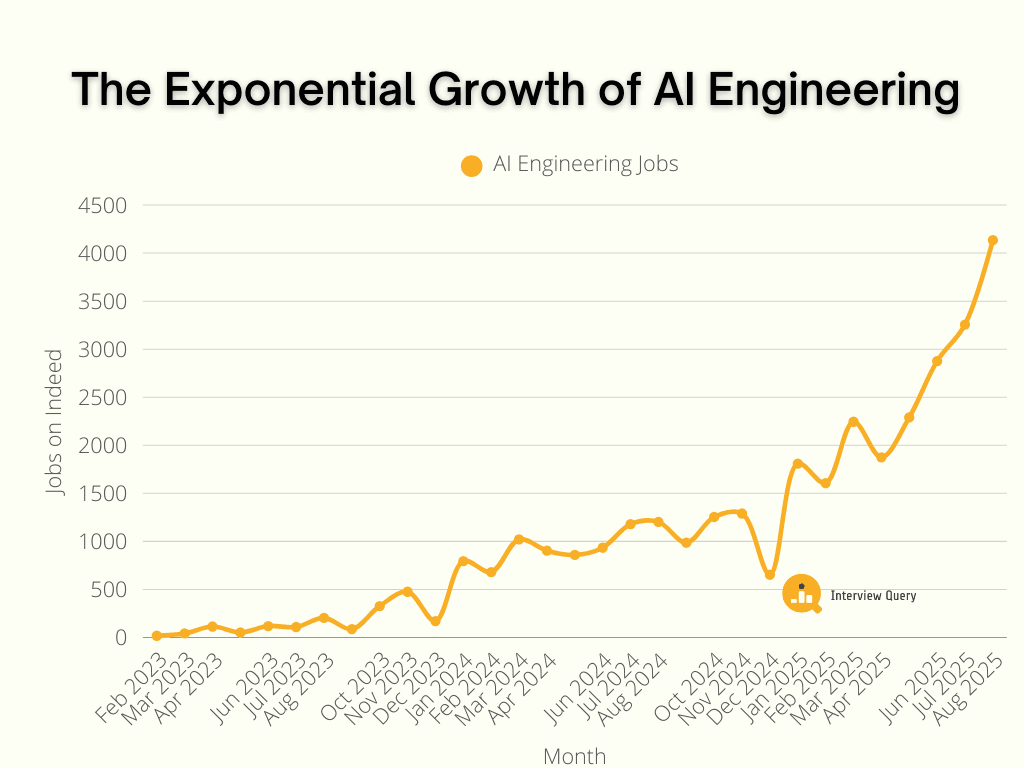
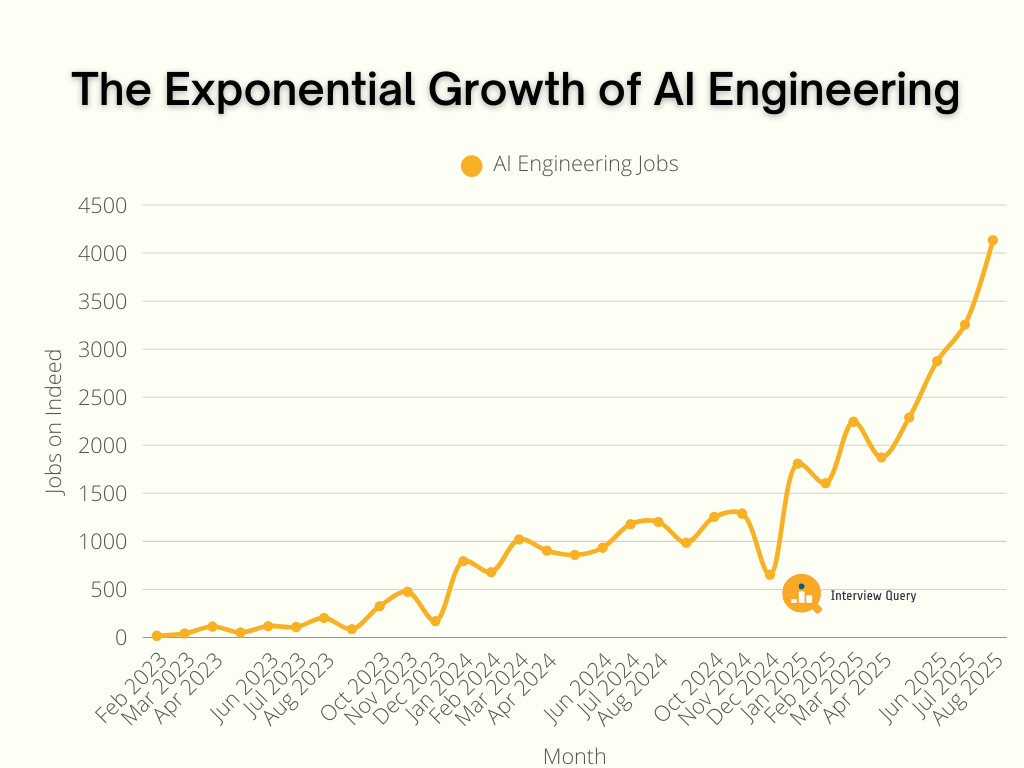
At the start of this year, there were only a few hundred job postings for the role. Fast forward to today, and AI engineering has become one of the most aggressively recruited positions in tech. Salaries are now spiking past $300K, and monthly openings have surged beyond 4,000 listings.
What changed?
AI engineering has moved from a niche curiosity into a mainstream, must-have function for every company building the next generation of intelligent products. In just a short span, it’s gone from an experimental job title to a critical bridge between machine learning research and real-world applications.
In this article, we’ll explore why AI engineering is growing so fast, how the role is evolving, and what it means for the future of tech careers.
What Does an AI Engineer Actually Do?
Before we dive into why this role is exploding, it’s important to clear up one big misconception: most people misunderstand what AI Engineers actually do.
When people hear “AI Engineer,” they often imagine researchers training massive language models inside billion-dollar data centers or earning multi-million-dollar packages at companies like Meta.
But that’s not the real picture.
AI Engineers aren’t the ones building models from scratch. They’re the ones applying those models to real products — turning cutting-edge research into usable tools that power everyday business operations.
Think of it this way:
- A researcher at OpenAI might train GPT-4.
- But an AI Engineer at Stripe integrates GPT-4 into fraud detection systems.
- Another one at Shopify builds a feature that auto-generates product descriptions at scale.
AI Engineers are the bridge between research and reality — the builders who transform billion-dollar models into billion-dollar products.
Trend #1: Everyone’s Fighting to Dominate AI
The first reason why AI Engineers are suddenly everywhere is simple — AI itself has taken over the world.
Unless you’ve been completely offline, you’ve seen the shift: AI has become the centerpiece of nearly every conversation in tech, business, and even politics. What used to be experimental research has turned into a full-blown global race.
1. Companies Finally Went All-In
For years, AI lived quietly inside research labs. Then came multimodal models like Google’s Gemini 2.0, which made AI truly practical — capable of handling text, images, and video in a single workflow (Google Blog, 2025).
A few years after ChatGPT’s release, industries from law to logistics decided they couldn’t afford to sit on the sidelines. Consulting giants doubled their AI teams, and job boards became flooded with listings that mentioned “generative AI” (Indeed Hiring Lab, 2025).
AI stopped being an experiment. It became infrastructure.
2. Big Tech Triggered the Arms Race
Once Big Tech stepped in, things escalated fast. Microsoft, Google, Amazon, and Meta unleashed record-breaking budgets to dominate AI infrastructure and talent (JD Supra, 2025).
Meta made headlines for offering $300M packages to lure top researchers (Wired, 2025), while Microsoft funneled funds from layoffs directly into new AI labs (Reuters, 2025).
Across most of tech, hiring froze. But in AI? Demand skyrocketed.
3. Governments Turned AI into a Global Power Game
Then the race went international.
The U.S. launched “Stargate,” a national-security-level AI initiative worth hundreds of billions (Reuters, 2025).
China fired back with DeepSeek, a home-grown model designed to rival Western systems (WIRED, 2025; TechRadar, 2025).
AI stopped being just a product — it became a question of power.
4. Startups Smelled Opportunity — and Desperation
As the giants waged their AI wars, startups saw their chance.
Funding poured into AI-native companies like Anthropic, Hugging Face, and Infinite Reality, each raising record-breaking rounds (Crunchbase, 2025). Flush with capital, they went on hiring sprees, offering huge salaries and equity packages to attract top engineers.
Soon, every startup realized the same thing: if you wanted to compete, you needed an AI Engineer.
The result? This role didn’t just appear — it was born out of necessity. Every company, from Fortune 500s to seed-stage startups, came to the same conclusion: adapt or die.
Trend #2: Businesses Can Finally Measure the Impact of AI Engineers
What turned the AI Engineer from a buzzword into a real budget line wasn’t hype — it was proof.
Within months, companies began tying their AI experiments to measurable business outcomes:
- Faster code reviews
- Leaner customer support
- Automated reporting
- Entirely new revenue streams
Once executives could see those results reflected in metrics and margins, AI investment stopped being experimental. It became strategic.
How Companies Proved the ROI of AI Engineers
In 2025, CEOs and CTOs finally got the visibility they needed. AI Engineers weren’t just “building cool demos” anymore — they were directly improving KPIs across teams.
To understand how the role evolved, we analyzed the top companies hiring for AI Engineers:
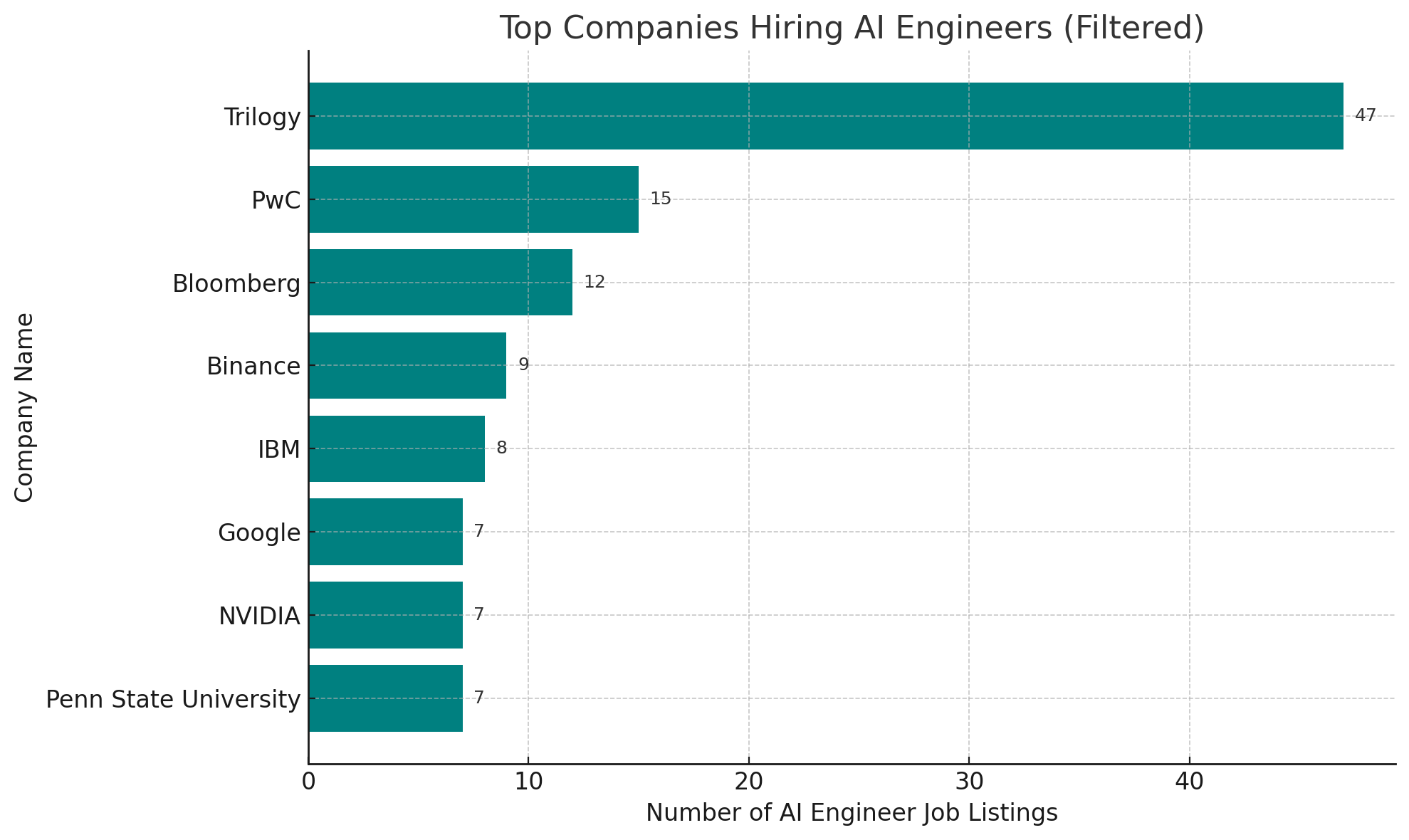
These listings reveal a clear pattern. The companies hiring most aggressively aren’t necessarily the biggest names in AI research — they’re the ones building AI into the core of their business.
- Trilogy and PwC are scaling enterprise AI deployments — hiring engineers who can implement and maintain production-grade systems for clients.
- Bloomberg, Google, NVIDIA, and IBM are deepening AI infrastructure and model integration, blending software and ML skill sets.
- Binance, meanwhile, applies AI to high-stakes financial operations, optimizing processes at massive scale.
In every case, the same principle holds: AI Engineers ship visible outcomes.
When an AI Engineer cuts customer response time by 80%, leadership notices.
When they automate a $5M manual process, finance feels it.
That kind of visibility makes their work easier to justify, measure, and reward — which is why AI engineering is no longer an experiment, but a line item.
The Rise of the “Founding AI Engineer”
But here’s the part most people miss: the real explosion in demand isn’t just from tech giants — it’s from hundreds of startups hiring their first AI Engineer.
This “long-tail” trend shows a distributed boom: a few large firms hiring dozens, and thousands of smaller ones each hiring one or two key engineers.
For these early-stage companies, the first hire — the Founding AI Engineer — is often a senior software developer building everything from scratch. They’re the ones designing data pipelines, integrating APIs, and shipping LLM-powered products end-to-end.
Roles at startups like Weave and Bild AI, as well as listings on LinkedIn and ZipRecruiter, show just how fast this title is spreading.
The Founding AI Engineer has quietly become one of the most in-demand startup roles of 2025 — and for good reason. It’s easier to measure ROI when one engineer owns the entire stack and ships intelligent systems from day one.
Trend #3: Software Engineers Are Becoming AI Engineers
Here’s the final trend that ties everything together: where are all these AI Engineers coming from?
To find out, we analyzed thousands of recent job descriptions — and the results make one thing clear:
AI Engineers aren’t emerging from research labs. They’re evolving out of software engineering.
The Role Has Expanded Across the Stack
Unlike most tech titles that stay in neatly defined lanes, the AI Engineer role stretches across the entire stack.
You’ll find one job posting that sounds like a machine learning engineer, and another that reads like a software developer integrating GPT into customer-facing tools.
Here’s what consistently shows up in AI Engineer job postings:
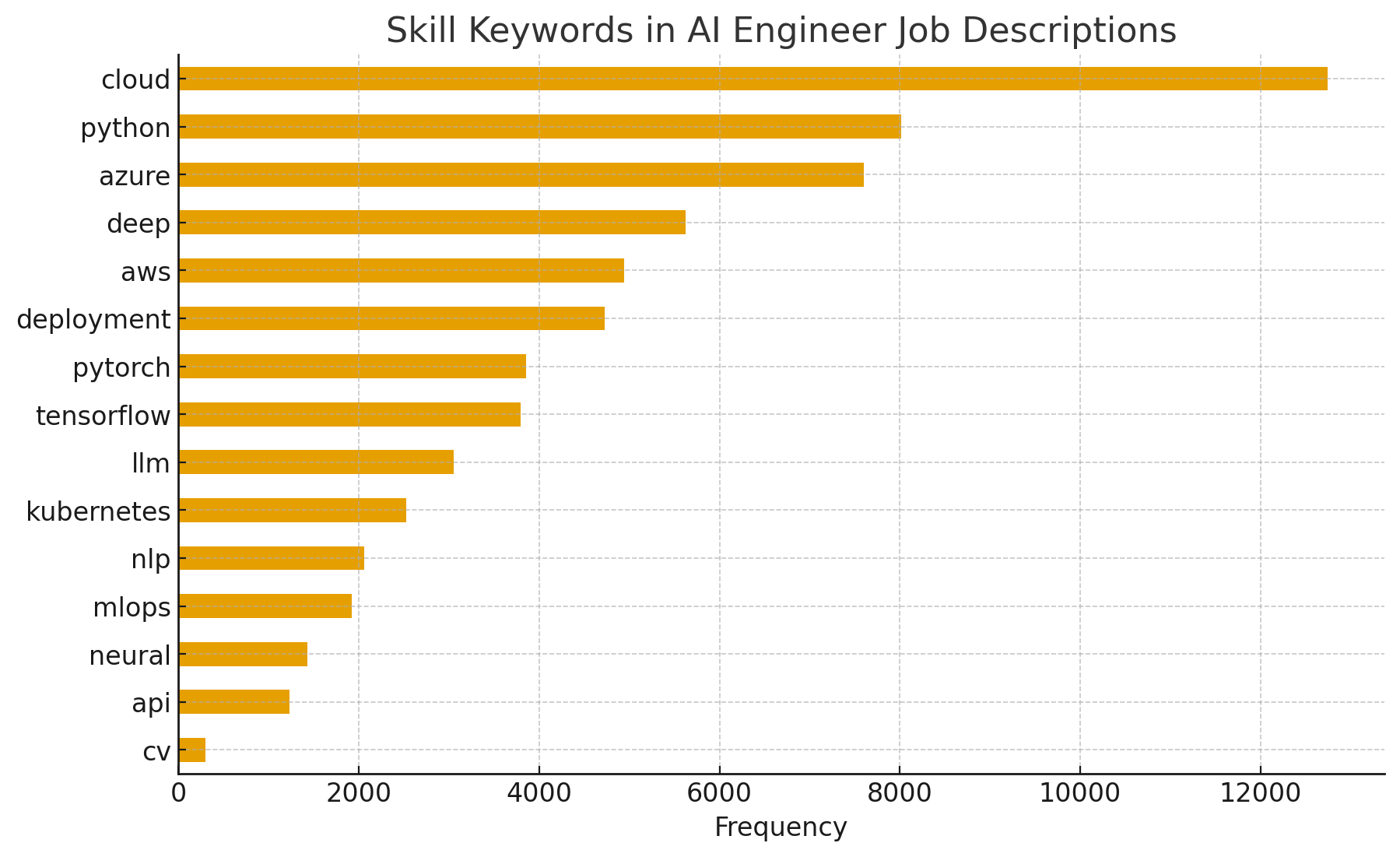
The skill mix tells an important story:
- Cloud, Python, and Deployment dominate — signaling a foundation in traditional software and infrastructure work.
- PyTorch, TensorFlow, and MLOps still appear, but they’re no longer the center of gravity.
- LLMs, APIs, and NLP appear further down, showing that generative AI is being layered on top of existing engineering skills.
In short, companies aren’t confused — they just want engineers who can do it all.
Senior Software Engineers Are Leading the Shift
Adding another layer to our analysis, around 80% of AI Engineer job listings specify that they’re senior-level roles.
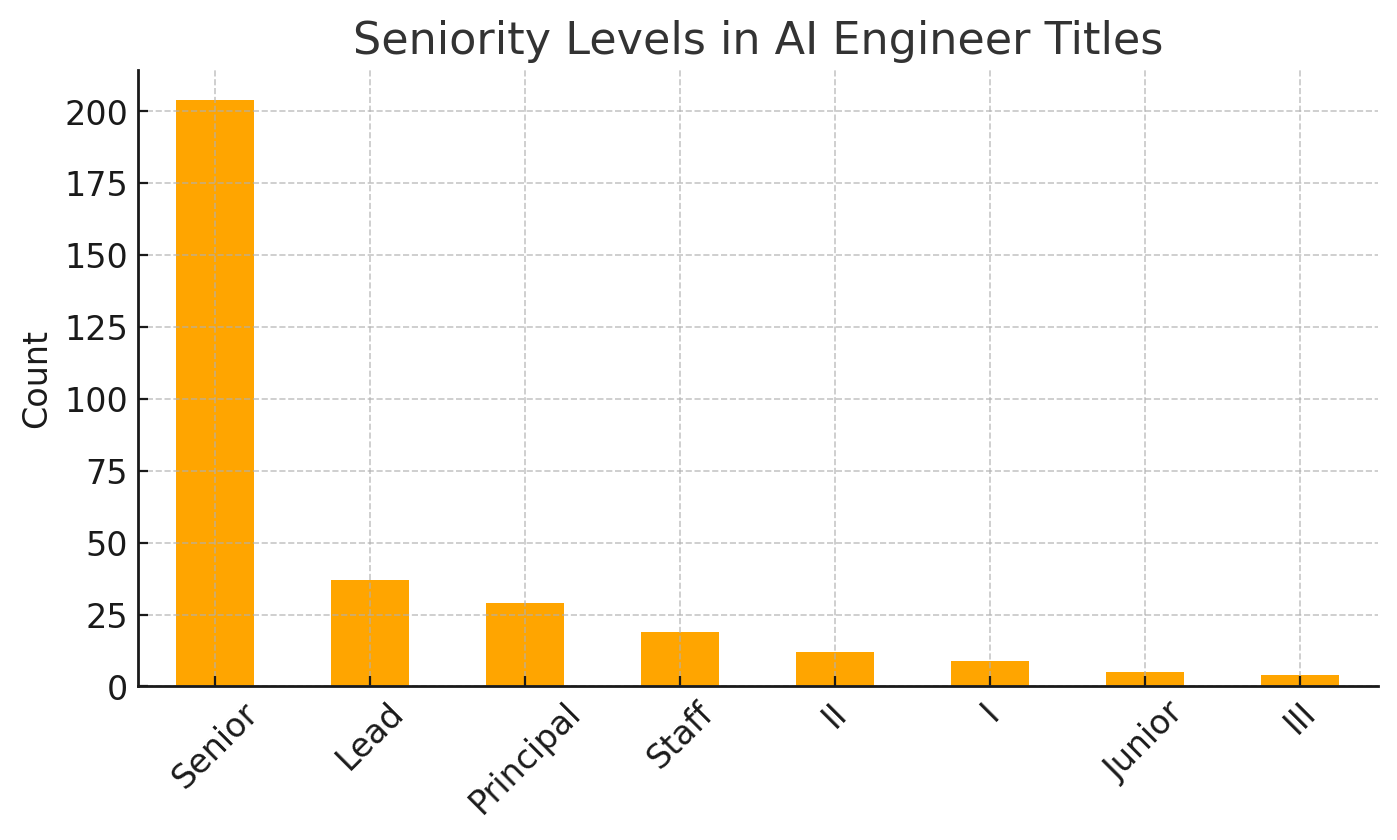
And when you dig into real listings, you start to see why. Most “AI Engineer” openings look a lot like advanced software engineering jobs that have absorbed AI responsibilities.
| Company & Role | Verbatim Excerpt | Type of Work Described |
|---|---|---|
| Leidos – GenAI Data Automation Engineer (Leidos Careers) | “Build intelligent, scalable data pipelines and integrate cloud services, enterprise tools, and Generative AI.” | AI-enabled data automation and API integration using GenAI. |
| Dell Technologies – AI/ML Software Engineer (Dell Careers) | “Design, develop, and deploy AI/ML solutions that drive innovation across Dell’s product portfolio.” | Embedding AI features within existing software systems. |
| PMG – AI & Software Engineer Lead (Backend) (PMG Careers) | “Work with AI technologies like OpenAI, Bedrock, Vertex, and LangChain to explore and implement innovative backend solutions.” | Backend software engineering with integrated AI frameworks. |
| Cotiviti – Lead Software Engineer, Artificial Intelligence (AI) (Cotiviti Careers) | “Design and build modular, reusable chatbot components that can be embedded across different SaaS products.” | Building product-integrated AI modules for SaaS tools. |
| Wells Fargo – Lead Software Engineer, Internal Generative AI UX (Wells Fargo Jobs) | “Experience integrating Large Language Models (LLMs) into user-facing tools to create engaging, productive experiences.” | Product-facing development integrating LLMs into enterprise tools. |
Across all of them, the core responsibilities look familiar: build, deploy, and scale production-grade systems — only now, those systems happen to be intelligent.
The New Definition of “AI Engineer”
Strip away the buzzwords and the AI Engineer isn’t a brand-new kind of technologist.
They’re the same senior software engineers who’ve evolved to design, integrate, and scale systems that make AI models actually useful in the real world.
In other words, the AI Engineer is today’s full-stack engineer for the AI era — someone who understands how to bridge code and cognition.
Role Outlook: How to Become an AI Engineer
If you’ve made it this far and you’re thinking, “This sounds incredible — but where do I even start?” here’s the truth: you don’t need a PhD to become an AI Engineer, but you do need focus.
The role may sound intimidating, but most AI Engineers started as software developers who learned how to apply AI tools effectively. The path is clear — and very achievable — if you focus on three key steps:
1. Master Your Software Fundamentals
At its core, AI engineering is still software engineering.
The best AI Engineers know how to build, deploy, and scale systems that run reliably in production. Before chasing the latest model, strengthen your foundation in Python, cloud infrastructure, and system design.
2. Learn to Use Models — Not Build Them
You don’t have to be the one training multimodal models from scratch. Companies already have those.
What they need are builders who can take existing models like GPT, Claude, or Gemini and integrate them into real products — automating workflows, enhancing user experiences, or improving decision-making.
3. Build and Ship Projects Fast
In this field, progress is proven by execution.
Forget perfect research papers — focus on launching something useful. Build an AI-powered tool, deploy it, and share it publicly. That real-world proof of skill will open more doors than any certificate ever could.
Conclusion: The Future Belongs to AI Engineers
The rise of the AI Engineer isn’t just another hiring trend — it’s a signal that the entire software industry is evolving.
In the past, coding meant building static systems that followed instructions. Today, it means designing intelligence that learns, adapts, and interacts. The engineers who can bridge that gap — between what models can do and what businesses actually need — are the ones shaping the next decade of technology.
Whether you’re a seasoned software engineer looking to level up or someone just starting your tech career, this shift isn’t on the horizon — it’s already here.
And if you want to go beyond theory and start building these skills — not just for interviews, but for real-world impact — check out AI Engineering 50.
It’s a six-week, personalized program designed to turn your curiosity into shipped AI projects.
If this breakdown helped, drop a comment with what you’d like us to dissect next — and don’t forget to subscribe for more deep dives into the future of tech work.