

New CompTIA Data Shows Where Tech Hiring Is Actually Growing in 2026


Early Signs of Tech Jobs Recovery
After two years of layoffs, hiring freezes, and “ghost jobs,” the tech labor market may finally be stabilizing.
Earlier this year, jobs data analyzed by Toptal suggested a “cautious recovery” in U.S. tech hiring, driven largely by remote roles and highly specialized positions. More recent analysis from CompTIA now reinforces that trend, showing modest but meaningful growth across tech employment.
Across the broader U.S. economy, tech occupations increased by roughly 60,000 jobs last month, while the tech sector itself added several thousand new roles in IT, systems design, and software services.
At the same time, there are still over 500,000 active tech job postings in the U.S., indicating that employers continue to hire, even if the pace is slower than during the 2021 boom.
But the most interesting insight doesn’t begin and end with job growth. It’s where demand is concentrated, particularly across experience levels.
Tech Hiring Is Still Happening, Just More Selectively
The latest CompTIA analysis shows several signals that hiring demand remains active:
- 505,000+ active tech job postings
- Roughly 230,000 new listings added during the month
- Tech unemployment (3.8%) still below the national average (4.4%)
Those numbers suggest that hiring demand continues to become more targeted.
In addition, many companies are still investing in roles tied to mission-critical areas:
- Cloud infrastructure
- Cybersecurity
- AI and data engineering
- Enterprise software development
What’s changed is employer behavior. Instead of broad hiring sprees across entire engineering teams, companies are prioritizing roles tied directly to revenue generation, infrastructure reliability, or automation initiatives.
For job seekers, this explains why the market can feel contradictory. On paper, the macro numbers look healthy, but landing interviews can still be difficult as competition remains high and employers move more cautiously through hiring decisions.
Mid-Career Engineers Appear to Be in the Sweet Spot
Source: CompTIA Tech Jobs Report
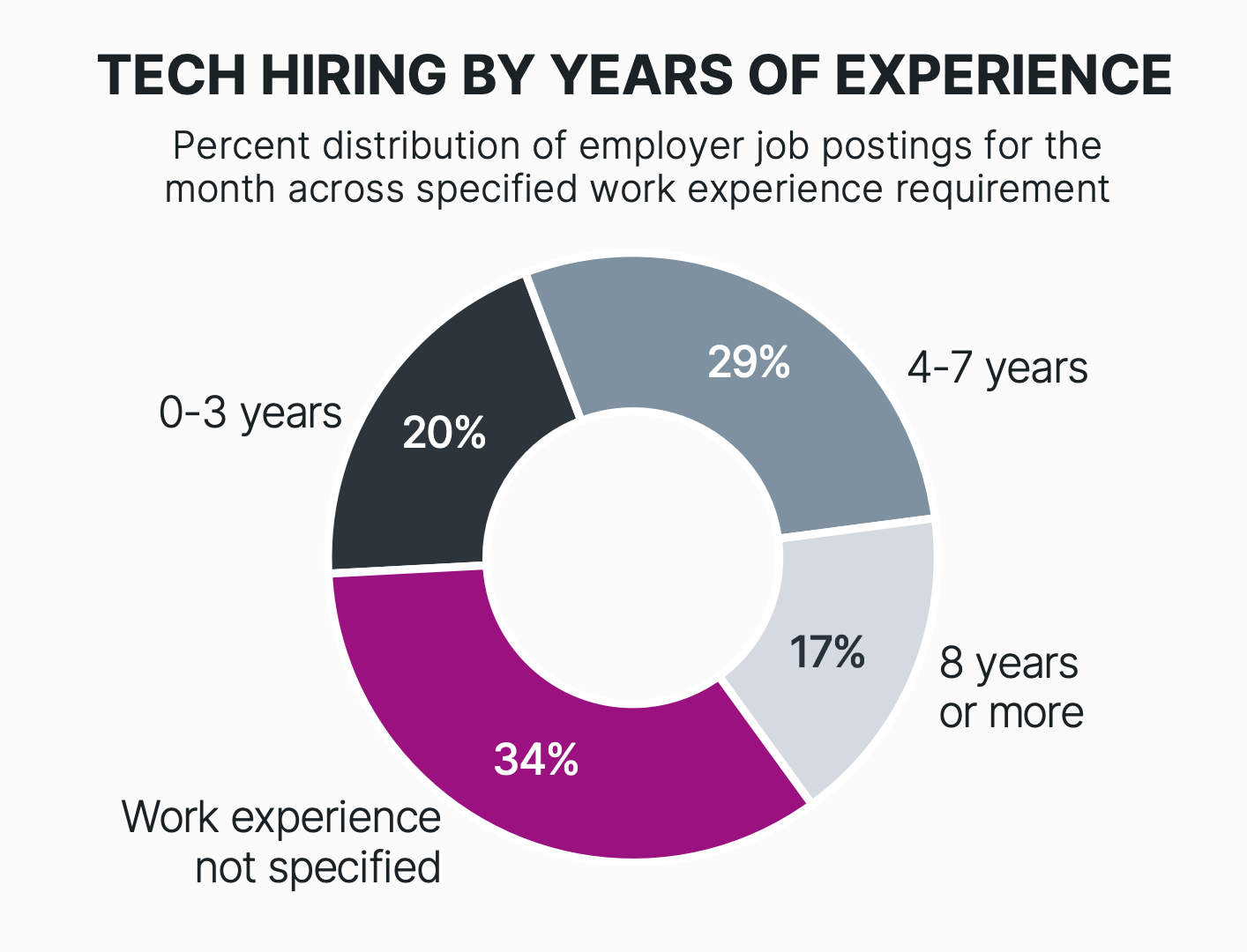
One of the most revealing insights in the CompTIA report is how job postings break down by years of experience.
Although more than a third (34%) of job openings do not specify an experience requirement, a large share of openings (29%) cluster around mid-career professionals, typically requiring 4–7 years of experience.
Companies rebuilding teams after layoffs often want engineers who can contribute quickly without requiring long onboarding periods. Mid-career professionals offer an appealing balance:
- Enough experience to handle complex systems
- Lower compensation costs compared to senior staff
- Faster ramp-up time than junior hires
At the same time, entry-level roles remain more limited, as many companies prioritize productivity and operational efficiency during uncertain economic conditions.
This helps explain why early-career developers often feel that the market feels unusually tight. Meanwhile, mid-level engineers often report more recruiter outreach and interview opportunities.
The report also notes that demand spans multiple experience tiers, meaning opportunities still exist across the spectrum, just not evenly.
Skills Are Starting to Matter More Than Degrees
Another signal emerging from the hiring data is the continued shift toward skills-based hiring.
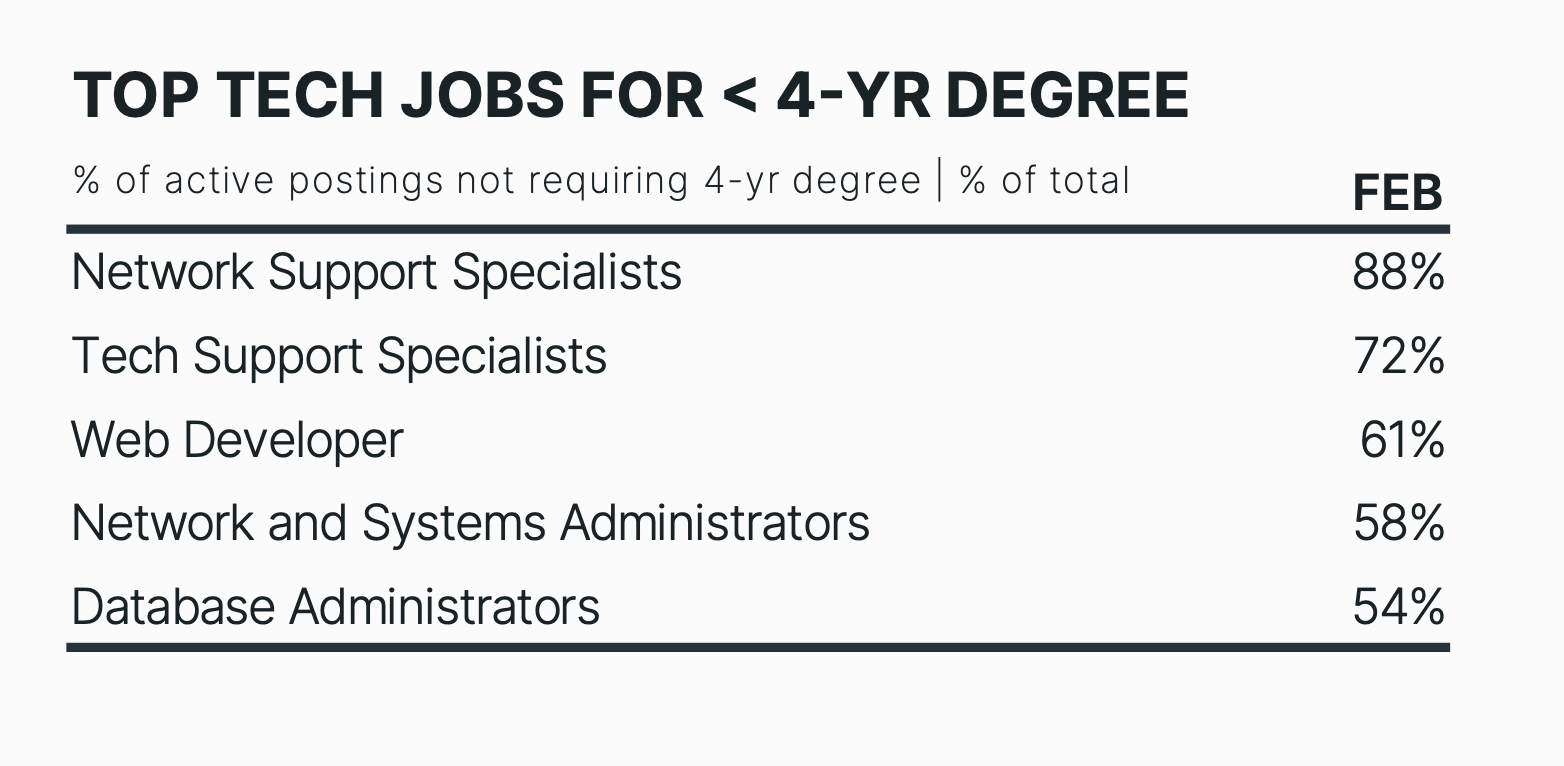
A growing share of tech job postings now emphasize demonstrated capabilities rather than strict academic requirements. In some roles, employers are increasingly open to candidates who do not hold a traditional four-year computer science degree.
Source: CompTIA Tech Jobs Report
This trend is especially visible in areas like tech and network support, web development, network and systems administration, and database administration
In alignment with broader workforce shifts across the tech industry, companies increasingly evaluate candidates based on practical signals of ability, such as:
- Technical interview performance
- Portfolio projects and GitHub contributions
- Certifications and specialized skills
- Real-world engineering experience
For many candidates, especially self-taught developers and career switchers, this shift could open more pathways into the industry.
But it also raises the bar for practical skills. Employers are less interested in credentials alone and more focused on whether candidates can actually solve engineering problems.
What This Means for Tech Workers and Job Seekers
For tech workers navigating the current market, the data points to a few clear takeaways.
1. Mid-level experience is highly valued right now.
If you’re approaching the 4–7 year range, you may be in the most favorable hiring band.
2. Specialized skills still drive demand.
Fields like cloud, cybersecurity, and AI-related infrastructure continue to generate hiring demand.
3. Entry-level candidates may need stronger portfolios.
Because junior roles are fewer, projects, open-source contributions, and real-world demonstrations of skill can help bridge the experience gap.
4. The market is stabilizing, but it’s not returning to 2021 levels.
Hiring is happening, just with more scrutiny and fewer speculative roles.
For job seekers, the key shift is clear: employers are prioritizing impact-ready engineers who can contribute quickly to critical systems and products.
The Bottom Line: A Stabilizing, But More Selective, Job Market
The latest hiring data from CompTIA suggests the tech labor market is gradually stabilizing after a turbulent period. Job growth remains modest but real, and demand continues to exist mainly across specialized technical roles.
At the same time, hiring has become more targeted. Mid-career engineers appear to be in the strongest position, while early-career candidates may face a more competitive landscape.
For job seekers, the takeaway isn’t that opportunities are disappearing. Instead of panicking, candidates must adapt to the the market is evolving toward skills-driven, impact-focused hiring, where practical ability matters more than ever.