

Hands-On IT Certifications Are Reshaping Tech Hiring in 2026


The Shift: From Paper Certs to Proof of Skill
Tech hiring is tighter. As AI reshapes roles and even the recruitment process itself, hiring managers are more skeptical than they were a few years ago.
Among the biggest shifts in today’s hiring are certifications, which are moving away from multiple-choice exams toward hands-on, skills-based validation to meet changing industry demands.
According to reporting from CIO, IT certifications are increasingly emphasizing practical, real-world assessments instead of theory-heavy testing. Instead of asking what a command does, exams are starting to ask candidates to actually run it, troubleshoot it, or deploy something with it.
That evolution reflects how employers now care most about applied skill, as memorized knowledge and detailed resumes cannot capture the full picture of a candidate’s capabilities to step into a role.
For job seekers, this changes how you prepare for interviews, and which certifications are actually worth your time and money.
Why Employers Are Moving Toward Practical Certifications
1. AI and Automation Are Raising the Bar
Routine technical tasks are increasingly automated. AI tools can now generate scripts, write queries, and even draft infrastructure configurations.
While that doesn’t eliminate tech jobs altogether, it does raise expectations. Employers now need professionals who can troubleshoot ambiguous issues, deploy systems under constraints, and adapt when automation fails.
Since those skills can’t be tested through multiple-choice exams, certifications have become more hands-on to better simulate the messy, real-world scenarios companies face daily.
2. Skill Gaps Are Still a Major Concern
Industry groups like CompTIA continue to report skills shortages in areas like cybersecurity, cloud, and AI-adjacent roles.
Candidates themselves are also feeling the pressure. LinkedIn’s workforce data shows that nearly two-thirds of job seekers (65%) say finding a job has become harder. While job applications have doubled since 2022, there remains uncertainty about role fit and skills gaps. This signifies that volume isn’t the issue; demonstrable competency is.
When employers are overwhelmed with resumes, what they want are clearer signals that someone can actually do the job.
3. Resume Inflation and Certification Fatigue
Hiring managers have seen too many candidates with certifications who freeze in technical interviews. This observation has led to “certification fatigue”, in which a credential doesn’t reliably predict performance and thus loses its value.
Practical exams reduce that risk by forcing candidates to implement solutions under time pressure. They narrow the gap between certification and capability, which is exactly what skeptical recruiters want in this competitive hiring landscape.
What “Hands-On” Certifications Actually Mean
While traditional certification exams rely on short answers to theoretical questions or multiple-choice tests, the new face of IT certifications means more challenging and rigorous, but also more credible, exams. Candidates configure environments, debug broken systems, or deploy working solutions in sandbox environments.
Vendors like Red Hat have long emphasized performance-based exams that require real configuration and troubleshooting. As this model spreads, it increasingly mirrors what happens in interviews, for example:
- Software engineering: building or debugging live code
- Data science: cleaning messy datasets and building models under constraints
- Business/data analysis: writing queries, interpreting ambiguous business metrics, or presenting insights
- DevOps/cloud: deploying infrastructure and resolving simulated failures
In other words, the exam becomes a mini technical screen, which requires more effort among candidates but also increases their practical readiness for tech roles.
Do Practical Certifications Actually Improve Job Outcomes?
Before you decide on which certifications to take, you may be wondering whether it actually boosts your job prospects. To start, recruiters view hands-on certifications as stronger signals because they reduce uncertainty. This is particularly useful for career switchers, self-taught candidates, and early-career professionals.
As covered in a previous article on how degrees are no longer a job guarantee, these types of candidates can use certifications to fill that credibility gap created by the absence of a relevant IT degree or extensive field experience. Certifications demonstrate applied skill, which are increasingly valued now that traditional credentials don’t carry the same weight they once did.
Certifications aligned with in-demand areas, such as cloud architecture, cybersecurity, AI ops, data engineering, can also help candidates pass resume filters faster. They won’t replace real-world experience, but they can validate capability enough to secure the first conversation.
Source: PearsonVue’s 2025 Value of IT Certification Candidate Report
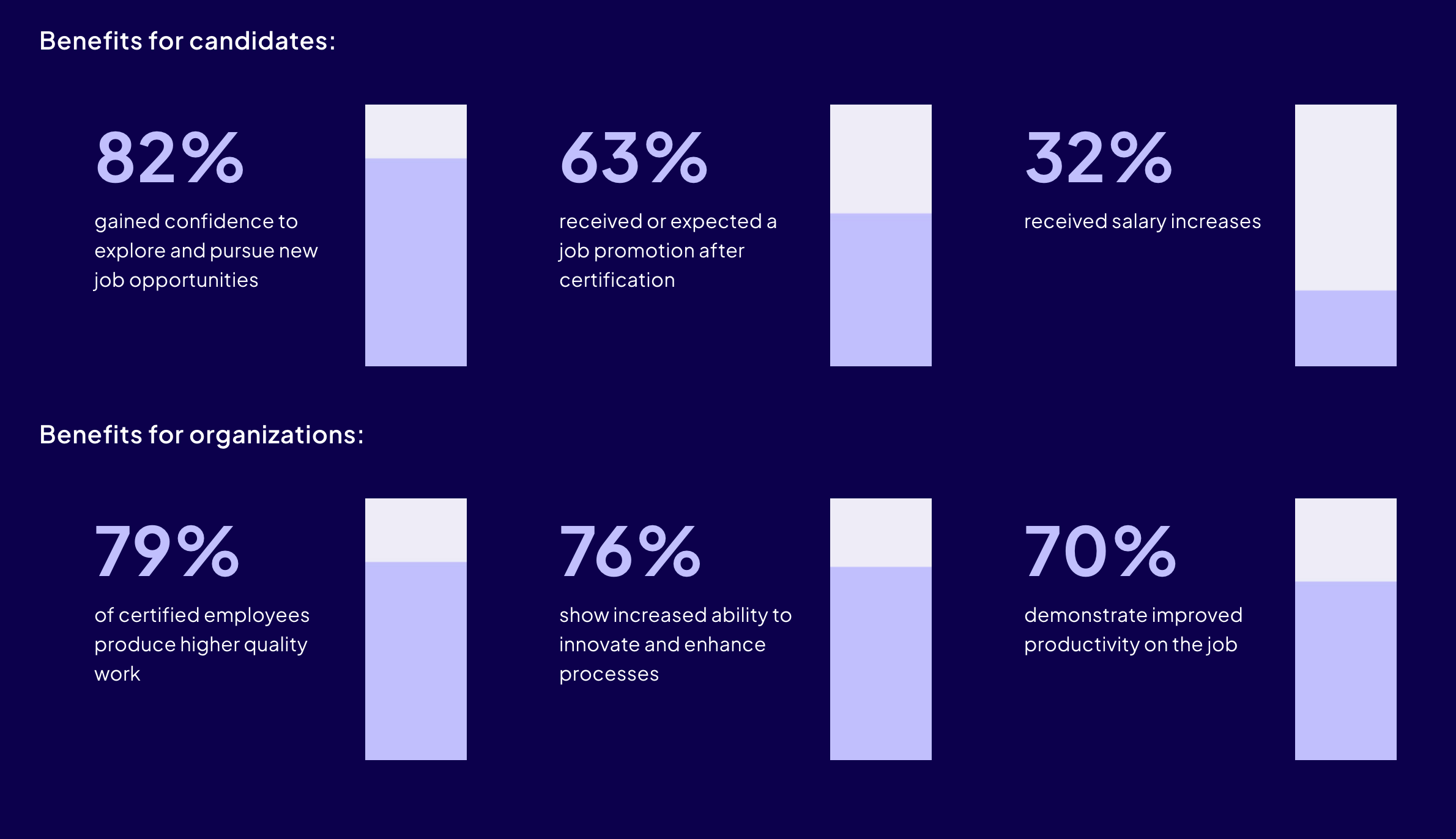
Lastly, industry reporting consistently shows certified professionals often experience stronger earning potential and career mobility. A 2025 survey from PearsonVue found that nearly a third (32%) of IT cert-holders received pay raises for earning a certification, with the increase averaging from 6-20%.
However, the type of certification matters more than ever. A hands-on, performance-based credential in a high-demand area carries more weight than a generic, theory-based exam.
How to Adjust Your Job Search Strategy in 2026
1. Don’t Chase Logos; Chase Skills
Prioritize certifications that:
- Include labs or performance testing
- Align directly with your target role
- Reflect active market demand
For data roles, that might mean cloud data engineering, AI infrastructure, analytics engineering, or applied machine learning workflows, ultimately going beyond introductory theory badges.
2. Use Certification Prep as Interview Prep
Treat lab practice as:
- Coding or system design rehearsal
- Debugging reps
- Scenario-based thinking practice
If you approach prep intentionally, you’re not just earning a credential but also building interview fluency.
3. Pair Certs with Public Proof
A certification alone is stronger than nothing. But combined with visible work, it’s far more powerful. This means you must also consider:
- Building GitHub projects
- Documenting what you learned
- Sharing breakdowns of technical challenges
- Connecting your credential to tangible outcomes
Overall, combining credentials from your certifications with a strong portfolio and holistic interview practice is a much stronger signal than any one piece alone.
Conclusion: The New Job Ticket? Only If You Use It Right
Like hiring, certifications are quickly evolving to help candidates meet skills-based priorities. This evolution from theoretical to practical aligns with the job market, which has shifted from “Can you pass a test?” to “Can you do the job?”
For tech workers navigating layoffs, AI disruption, or career pivots, practical certifications may be one of the few signals that still carry weight. But only if you use them strategically by choosing the ones that align with your target role and current industry demand.
As AI widens the skills gap and hiring becomes more competitive and performance-based, workers must adapt. Building both technical depth and applied problem-solving skills through hands-on certifications and real-world practice is one way to stay ahead of the curve.