

LinkedIn: Job Applications Have Doubled Since 2022, Yet Recruiters Still Can’t Find Talent


Why Hiring Feels Broken on Both Sides
Talk to almost anyone involved in hiring right now and you’ll hear the same frustration from opposite ends. Job seekers feel invisible, as they keep sending out applications but hear nothing in return. Recruiters, meanwhile, say they’re overwhelmed and still can’t find the “right” candidates.
According to LinkedIn’s Talent Connect 2026 research, job applications have surged dramatically since 2022, yet hiring has become slower and more difficult. What’s more, over half are planning to look for a job this year, but 80% remain unprepared.
AI was supposed to fix this by making hiring more efficient. Instead, it may be widening the gap between the recruiters and candidates. Rather than a talent shortage, the hiring market’s biggest struggle is a misalignment by scale, AI adoption, and growing trust gaps.
The Struggle to Find Talent
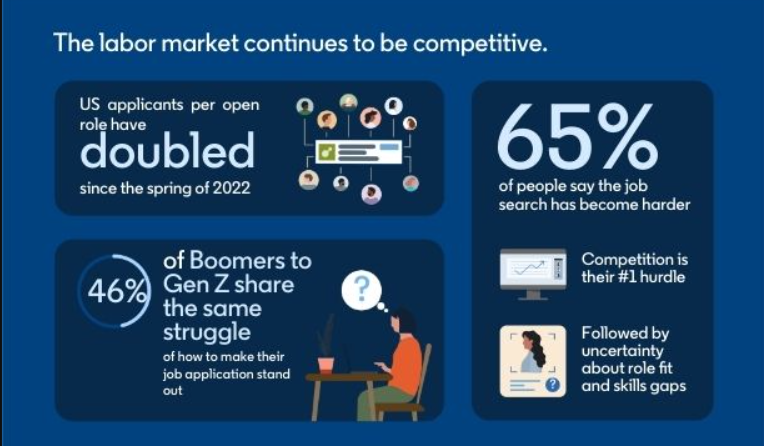
LinkedIn’s data shows that job applications have more than doubled since 2022, and nearly two-thirds of job seekers (65%) say finding a job has become harder, citing competition as the key contributing factor. At first glance, more applicants should mean better matches. In practice, the opposite often happens.
Source: LinkedIn Research
For one, one-click applications make it easy to apply to dozens of roles in minutes. Remote and hybrid work have also expanded candidate pools globally. On top of that, AI-assisted resumes and cover letters have increased application volume even further, resulting in noise left for recruiters to sift through.
On the job seekers’ end, this feels like being ignored. Qualified candidates get lost in the vast amount of resumes and automated rejections. On the other hand, recruiters are burdened with hundreds, sometimes even thousands, of applications for a single role.
LinkedIn’s research thus shows that recruiter workloads are rising while candidate confidence declines. More applications reduce visibility for the very people hiring teams want to find.
The Trust Gap in AI-Driven Hiring
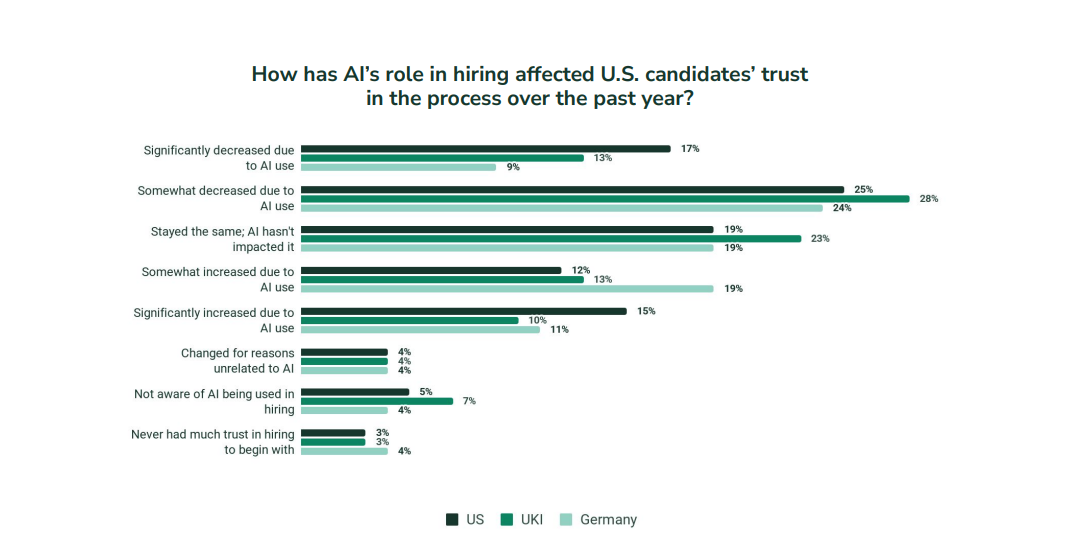
As AI becomes embedded in the hiring process, trust is where things break down. About 59% of recruiters use AI, according to the Greenhouse AI in Hiring report. Yet only 8% of job seekers believe AI-driven hiring is fair.
Source: Greenhouse AI in Hiring 2025 Report
Recruiters rely on AI to screen resumes, rank candidates, and speed up early-stage decisions. From their perspective, these tools are necessary to cope with volume. Candidates, however, experience AI as opaque and unaccountable. They don’t know why they were filtered out or what the system prioritized.
This distrust has led some tech workers to actively “game” AI hiring tools, from padding up resumes with keywords to optimizing applications for algorithms rather than humans, as highlighted by our previous report on tech hiring trends.
In more ways than one, AI has made the hiring process all the more invisible and unexplainable. Instead of streamlining the process for candidates, it feels more like a loop designed to drive them into frustration, burnout, and disengagement.
Delving into the Disconnect
This leads to the biggest crisis in today’s hiring: recruiters insist they can’t find qualified people, while qualified people struggle to get interviews in the first place. Furthermore, “qualified” often means something very specific: exact skill matches, minimal ramp-up time, and proven experience with narrow tools or stacks.
When application volume is high and AI is involved, recruiters are incentivized to tighten filters even more, prioritizing speed and precision. But this approach locks out opportunities from strong candidates who don’t match perfectly on paper, such as career switchers, adaptable generalists, or people with adjacent experience.
What This Means for Job Seekers Right Now
If you’re job hunting and feeling demoralized, that reaction is rational. Silence doesn’t mean you’re unqualified; rejections don’t mean you’re bad at your job. Hiring systems are optimized for speed, not fairness, and that tradeoff has real human consequences.
Thus, in this age of AI-driven hiring, applying to fewer roles where your experience clearly matches the role’s priorities often works better than mass applying. As you lose trust and confidence in the job search, it also helps to remember that this isn’t a personal failure. The problem is systemic, and understanding that can help you reframe the process and your overall approach without internalizing the damage.
Can The System Still Be Fixed?
Both job seekers and recruiters are reacting logically to a system that’s out of sync. Considering AI amplifies the gap between both ends of the hiring process, fixing hiring means rebuilding trust, improving transparency, and designing systems that balance efficiency with fairness.
If employers want sustainable talent pipelines and less burnout on both sides, they’ll need to fix the system. And that’s possible by increasing human oversight and involvement at every step of the process—not by adding more tools and solely relying on them.