

AI Exposure Is Highest in These 10 Professions, Anthropic Research Finds


AI Is Already Transforming Knowledge Work
AI debates often focus on whether the technology will replace jobs entirely. But a more useful question may be: which jobs are already exposed to AI tasks today?
New research from Anthropic analyzed millions of real-world AI interactions to understand how people are using AI systems across different occupations.
The study introduces a labor-market exposure framework, estimating how much of a job’s tasks AI could potentially assist with or automate. Instead of relying on purely theoretical forecasts, the research looks at actual usage patterns of AI tools within professional workflows.
One key takeaway is that many white-collar jobs already contain tasks that AI can partially automate, particularly work involving writing, data analysis, and document processing. However, the findings also suggest that full job replacement remains unlikely in the near term.
Rather than eliminating entire professions, AI appears more likely to significantly transform how work gets done inside them.
The Jobs Most Exposed to AI Tasks
The research identifies several professions where AI systems can perform a large share of daily tasks, particularly roles centered on digital information processing.
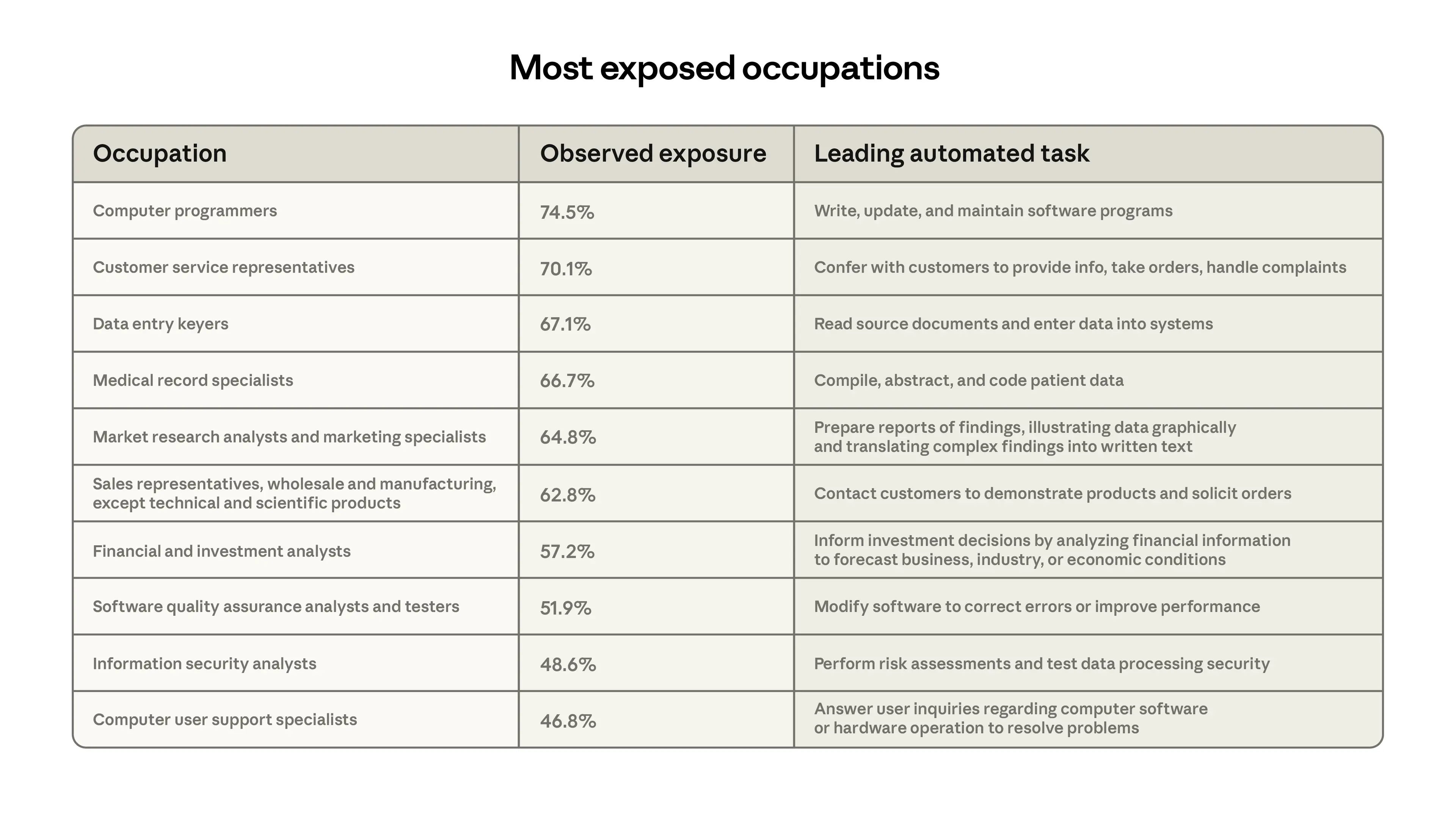
Source: Anthropic’s Labor market impacts of AI report
Among the occupations showing the highest AI exposure are:
- Software developers and programmers
- Customer service representatives
- Data entry keyers
- Medical record specialists
- Market research analysts and marketing specialists
- Sales representatives
- Financial analysts
- Software quality assurance analysts
- Information security analysts
- Computer user support specialists
These jobs share a common characteristic: a significant portion of their work involves text, structured data, or digital information, which are areas where modern AI systems perform especially well.
According to the analysis, AI could assist with or automate up to roughly 70% of tasks in certain occupations, particularly tasks involving drafting text, analyzing documents, summarizing information, or generating explanations.
But the study emphasizes an important distinction. High AI exposure does not necessarily mean a profession disappears. Many of these roles still require judgment, oversight, and contextual understanding that current AI systems cannot reliably replicate.
AI Is Automating Tasks, Not Entire Jobs
As previously highlighted, a key insight from the research is the distinction between task automation and job automation.
Most occupations consist of dozens of different tasks. While AI may perform some of them effectively, others still require human elements like decision-making, creativity, or interpersonal interaction, making it unlikely for the roles to be fully replaced.
To elaborate, the research found that in many professions:
- AI augments 30–50% of tasks rather than replacing them outright
- Only a smaller portion of jobs face near-complete automation risk
- Human oversight remains essential in complex or high-stakes workflows
Examples among tech and knowledge workers illustrate how this plays out in practice.
Software developers may use AI tools to generate code snippets or documentation, but they still design systems and review the output. While analysts may rely on AI to summarize datasets, they still interpret results and communicate insights. Customer service teams may also generate AI-assisted responses but remain responsible for handling nuanced or sensitive conversations.
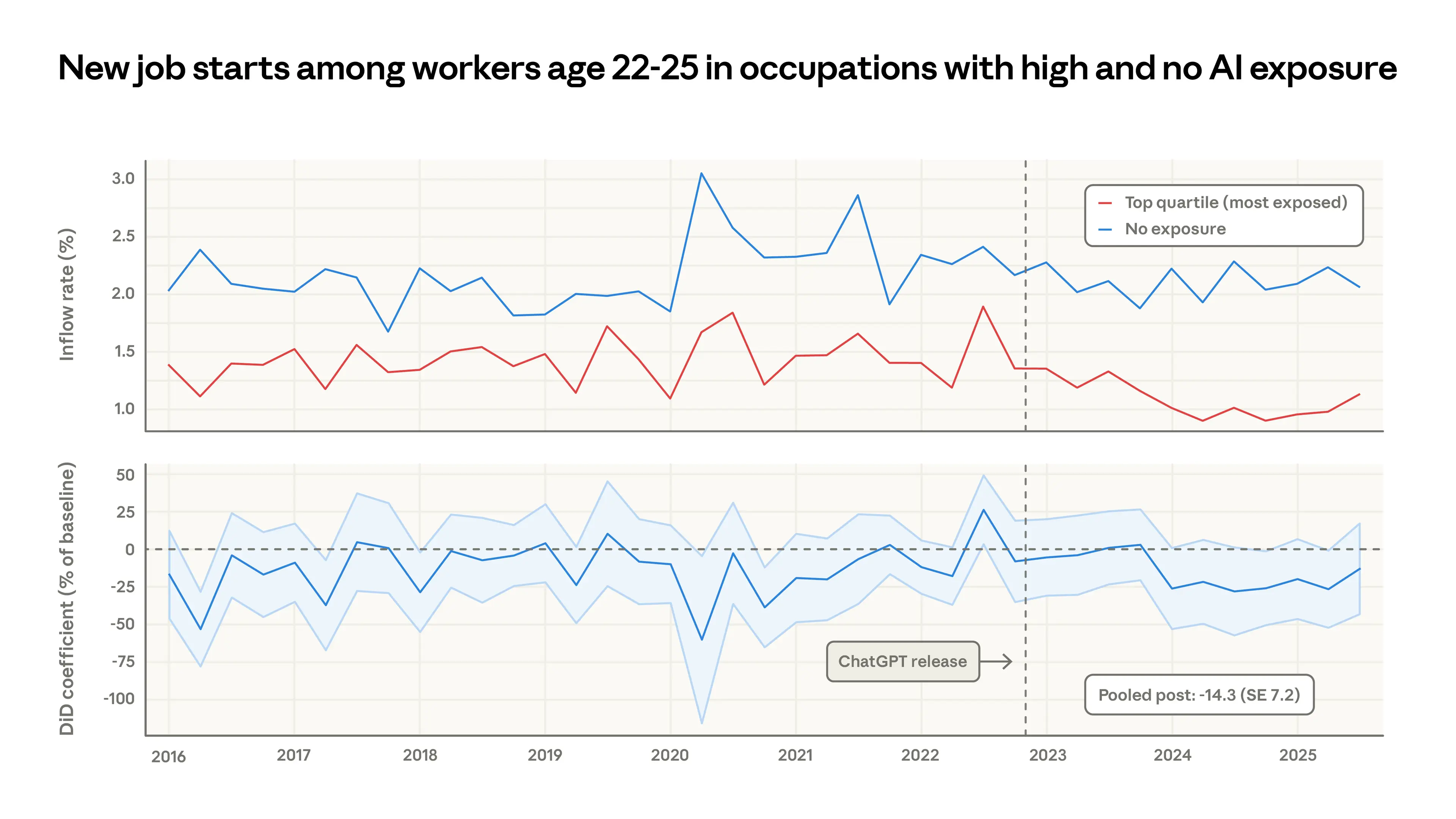
The researchers also examined labor market data alongside AI exposure. Using U.S. survey data, the report found systematic increase in unemployment rates among the occupations most exposed to AI. However, there is evidence that suggests a decline in the hiring of younger workers aged 22–25 in such occupations.
This suggests that the short-term impact of AI may be more about shifts in hiring patterns and productivity than immediate job losses.
Why White-Collar Work Is More Exposed to AI
As the research suggests that AI exposure is higher in many white-collar professions than in manual labor jobs, it’s also worth noting why this trend emerges.
A key factor is that modern AI systems excel at language processing, pattern recognition, and structured data analysis, all of which are core components of knowledge work.
Many roles in fields such as finance, marketing, research, and software engineering regularly involve tasks like:
- Writing reports or documentation
- Analyzing datasets
- Drafting communications
- Summarizing large documents
- Generating technical explanations
These activities map closely to the strengths of large language models.
Research and commentary across the industry have pointed to similar trends. Analysts discussing the impact of AI on white-collar automation, including reporting cited by Microsoft’s AI leadership, suggest that information-heavy jobs are among the first to feel the effects of generative AI tools due to repeatable tasks.
Meanwhile, occupations requiring physical dexterity, real-world navigation, or specialized equipment remain far harder for software alone to automate.
As a result, the early effects of AI adoption appear concentrated in information-driven roles, even though the technology is still evolving rapidly.
What Tech Workers and Knowledge Professionals Should Know
For professionals in technology and other knowledge industries, the research reinforces a growing reality: AI is becoming part of everyday work tools.
While AI is less likely to eliminate jobs than simply reshape workflows across many professions, this shift still carries several implications.
1. AI literacy is quickly becoming a baseline skill.
Understanding how to prompt, evaluate, and collaborate with AI systems is increasingly valuable in many technical and analytical roles.
2. Higher-level skills become more important.
Strategic thinking, system design, and critical judgment remain difficult for AI to automate, making them all the more valuable in the job market.
3. Productivity expectations may rise.
Research on “AI workload creep” suggests that workflow compression doesn’t always mean less work or shorter work days. When tools make tasks faster, companies may expect employees to handle more output in the same amount of time.
In practical terms, professionals who learn to integrate AI into their workflows may gain a productivity advantage, while those who ignore the technology risk falling behind.
Adapting to the Labor Market Shift
Since AI is becoming increasingly capable of performing specific tasks within many white-collar jobs, this shift signals adaptation.
While full job replacement remains unlikely in the short term, it’s crucial for professionals in AI-exposed fields like software development, finance, and research to learn how to integrate AI tools into their daily workflows.
Rather than treating AI as a threat, there’s greater value in understanding these shifts in hiring patterns and employer expectations when updating skills and navigating today’s job market.