
Rivian Business Intelligence Interview Guide: Process, Questions & Preparation Tips (2026)


Introduction
The Rivian business intelligence role sits at the center of how the company scales production, controls costs, and makes faster, better operational decisions. As Rivian continues to grow its manufacturing footprint and global supply chain, business intelligence analysts are responsible for turning complex data from finance, operations, and logistics into insights that leaders rely on every day. The work is highly applied, close to the business, and directly tied to execution on the factory floor and beyond.
The Rivian business intelligence interview reflects that reality. You are evaluated on more than SQL correctness or dashboard polish. Interviewers look for clear metric thinking, strong business judgment, and the ability to communicate insights that influence cross-functional partners. This guide outlines each stage of the Rivian business intelligence interview, highlights the most common business intelligence interview questions, and shares proven strategies to help you stand out and prepare effectively with Interview Query.
Rivian Business Intelligence Interview Process
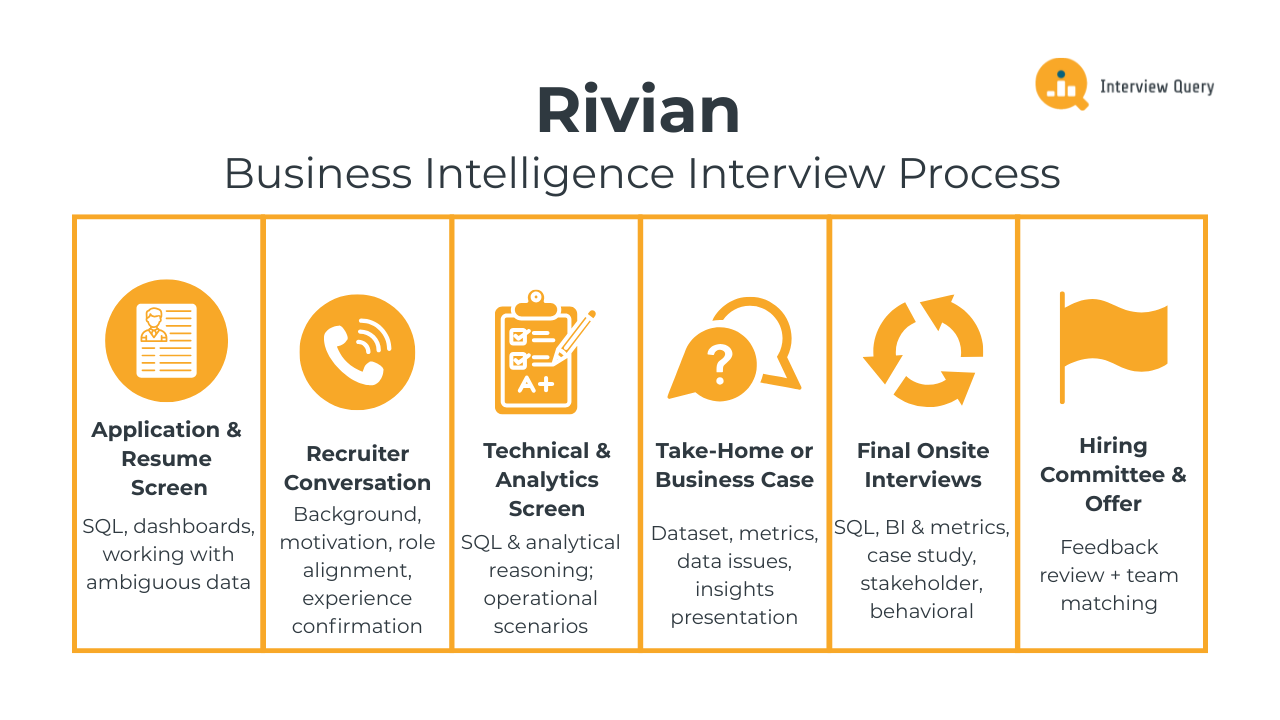
The Rivian business intelligence interview process evaluates how well you turn data into decisions in a fast-moving, operationally complex environment. The process focuses on SQL proficiency, metric judgment, business reasoning, and your ability to communicate clearly with cross-functional partners in manufacturing, finance, and supply chain. Most candidates complete the full loop within three to five weeks, depending on team needs and interview scheduling. Below is a breakdown of each stage and what Rivian interviewers consistently evaluate throughout the process.
Application and Resume Screen
During the resume review, Rivian looks for candidates who have worked close to operations and business stakeholders. Strong resumes highlight experience with SQL-heavy analysis, building dashboards that influence decisions, and working with messy or incomplete data. Roles tied to finance analytics, supply chain, or facilities technology place particular emphasis on metric ownership, cost analysis, and operational reporting. Clear examples of driving action through data stand out more than long tool lists.
Tip: Highlight one or two projects where your analysis directly changed a business decision. This signals ownership and shows you understand how analytics creates impact at Rivian.
Initial Recruiter Conversation
The recruiter call is a short, non-technical conversation focused on your background, motivation for Rivian, and role alignment. Recruiters confirm your experience with business intelligence tools, SQL, and stakeholder-facing analytics work. You may also discuss team preferences, location expectations, and compensation range. This stage sets context for the rest of the process and helps ensure mutual fit.
Tip: Be explicit about why you want to work on operational or financial analytics at Rivian. Clear motivation shows commitment and helps recruiters match you to the right team.
Technical and Analytics Screen
The technical screen typically includes one interview focused on SQL and analytical reasoning. You may be asked to write queries involving joins, aggregations, or window functions, then explain how you would validate results or define metrics. Questions often use operational scenarios such as tracking production output, analyzing cost variances, or identifying supply chain delays. Interviewers evaluate both correctness and clarity of thought.
Tip: Talk through your logic before writing the query. This demonstrates structured thinking and mirrors how analysts work through problems internally at Rivian.
Take Home Assignment or Business Case
Some Rivian business intelligence teams include a take home assignment or live business case. These exercises usually involve analyzing a dataset, defining key metrics, identifying issues, and presenting insights in a concise format. The focus is less on advanced modeling and more on decision quality, assumptions, and communication. Clean structure and clear recommendations matter more than complexity.
Tip: Treat this like a leadership-facing deliverable. Clear assumptions and a strong narrative show that you can operate independently and responsibly.
Final Onsite Interviews (Panel-Style Interviews)
The final onsite loop is the most in-depth stage of the Rivian business intelligence interview process. It typically includes four to five interviews, each lasting about 45 to 60 minutes. These rounds assess technical execution, business judgment, and collaboration across real Rivian use cases.
SQL and data analysis round: You will work through SQL problems tied to operational or financial data. Expect tasks like calculating efficiency metrics, identifying cost drivers, or analyzing trends across facilities. Interviewers assess how cleanly you write queries, handle edge cases, and interpret results in a business context.
Tip: Always explain how you would sanity-check results. This shows analytical rigor and reliability, which are critical in Rivian’s reporting environment.
Business intelligence and metrics round: This interview focuses on metric definition, dashboard design, and insight prioritization. You may be asked how you would track manufacturing performance or present data to leadership. Interviewers look for strong judgment around what matters and why.
Tip: Tie every metric back to a decision it enables. This demonstrates strategic thinking and alignment with how Rivian leaders consume data.
Case study or operational scenario round: You will analyze an ambiguous business problem such as a production slowdown or rising logistics costs. The goal is to see how you structure problems, identify drivers, and propose next steps.
Tip: Start by clarifying the goal and constraints. Clear framing shows maturity and reduces wasted analysis.
Stakeholder and communication round: This round evaluates how you communicate insights to non-technical partners. You may role-play explaining findings to finance or operations leaders.
Tip: Focus on clarity over detail. Strong communication signals leadership readiness and cross-functional effectiveness.
Behavioral and collaboration round: Interviewers explore how you handle ownership, feedback, and cross-team work. Expect questions about influencing decisions, managing ambiguity, and learning from mistakes.
Tip: Emphasize accountability and learning. Rivian values analysts who take responsibility and continuously improve.
Hiring Committee and Offer
After interviews conclude, feedback from each interviewer is reviewed collectively. The hiring team evaluates technical strength, business judgment, and cultural alignment before finalizing a decision. If approved, Rivian extends an offer aligned with role scope, team needs, and experience level. Team matching often happens during this stage.
Tip: If you have a strong preference for a specific domain like finance or supply chain, communicate it clearly. This helps Rivian place you where you can have the most impact.
Want to build up your BI interview skills? Practice real hands-on problems on the Interview Query Dashboard and start getting interview ready today.
Challenge
Check your skills...
How prepared are you for working as a Business Intelligence at Rivian?
Rivian Business Intelligence Interview Questions
The Rivian business intelligence interview includes a mix of SQL, analytics, business reasoning, operational case studies, and behavioral questions. These questions evaluate how well you work with operational and financial data, define and trust metrics, reason through ambiguity, and communicate insights to cross-functional partners. The goal is not just to test technical ability, but to understand how you use data to drive decisions in a manufacturing and supply chain environment.
Read more: Business Intelligence Interview Questions: Complete Guide with Examples & Answers
SQL and Analytics Interview Questions
In this part of the interview, Rivian focuses on your ability to work with real operational data that directly affects manufacturing output, cost control, and execution. SQL questions are grounded in production metrics, labor efficiency, inventory flow, and time-based trends. Interviewers want to see clean query structure, strong validation instincts, and the ability to translate raw numbers into insights that operations and finance leaders can trust.
Write a query to calculate daily production output by facility and identify days with abnormal drops.
This question tests how well you aggregate operational data, establish a baseline, and detect anomalies that matter in a manufacturing environment. At Rivian, sudden production drops can signal equipment issues, staffing constraints, or data reporting gaps. To solve this, you would group output by facility and date, calculate historical averages or rolling baselines, and flag days that fall materially below expectations. The key is explaining not just how to surface the drop, but how you would interpret it.
Tip: Always describe how you would validate the anomaly against shift schedules or downtime logs. This shows operational judgment and builds trust in your analysis.
-
This question tests whether you understand randomness, deduplication, and fairness in selection logic. For Rivian, similar logic appears when sampling vehicles, suppliers, or facilities for audits or quality checks. The solution involves selecting distinct manufacturers first, then applying a random ordering and limiting to one result so each make has equal probability, regardless of row counts.
Tip: Explain why selecting distinct values before randomization matters. This shows awareness of bias and statistical fairness in operational analytics.
-
This question evaluates data modeling fundamentals and time-based analysis. Rivian asks questions like this to assess whether you can design schemas that support reliable metric computation, such as cycle time or throughput. You would propose a table capturing vehicle ID, timestamps, and model, then calculate durations using time differences and aggregate by model. Clear schema design is as important as the query itself.
Tip: Call out how you would prevent partial or duplicate records. This signals foresight and an understanding of data quality risks in time-based metrics.
-
This question tests segmentation logic, percentile calculations, and edge case handling. At Rivian, similar logic is used to identify high-impact suppliers, facilities, or processes without letting small sample sizes skew results. The solution involves grouping by city, calculating trip counts, applying percentile thresholds, and adding minimum data volume rules to avoid false signals in small cities.
Tip: Always explain how you guard against misleading percentiles in low-volume groups. This shows strong metric judgment and statistical maturity.
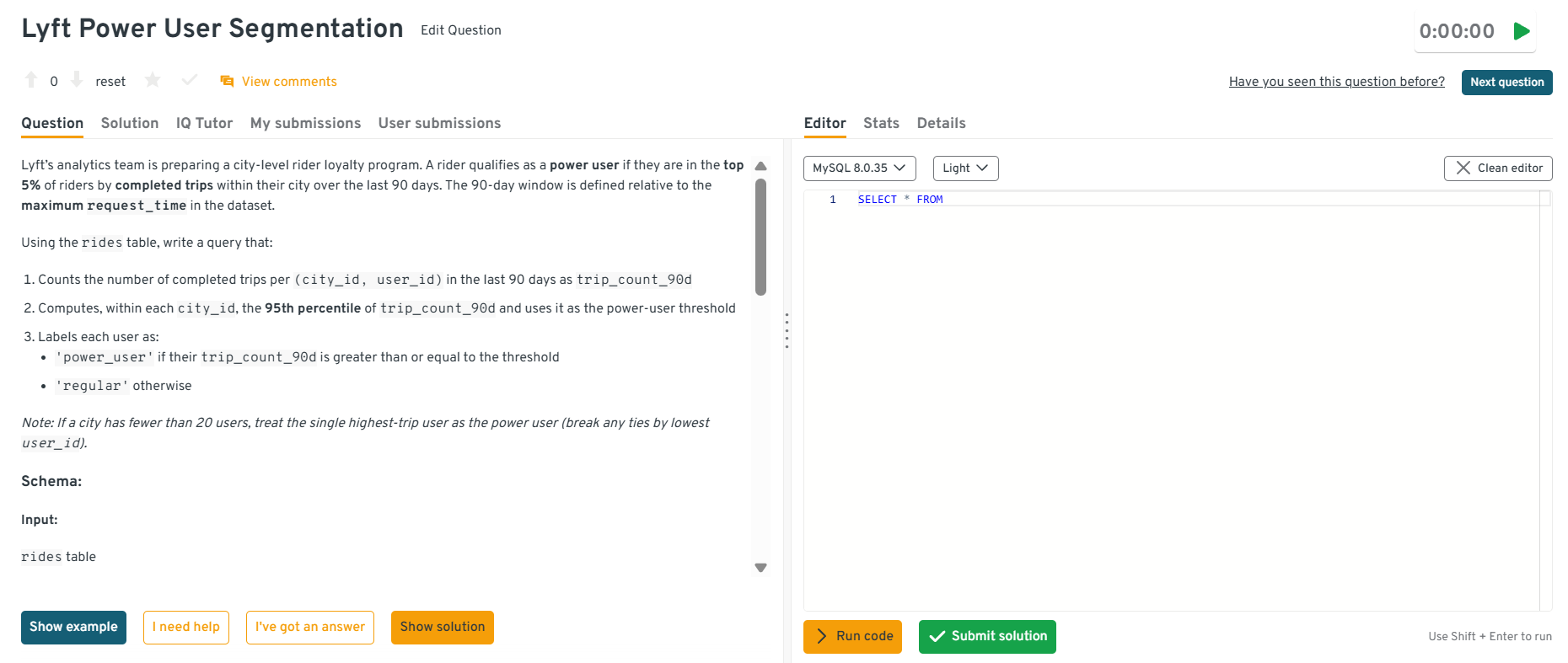
Head to the Interview Query dashboard to practice Rivian business intelligence interview questions in one place. Work through SQL, metrics, operational case studies, and behavioral questions with built-in code execution and AI-guided feedback to prepare for the level of judgment Rivian interviews expect.
Write a query to find facilities where overtime hours are increasing faster than production output.
This question evaluates how well you combine multiple metrics to assess efficiency. Rivian uses this type of analysis to surface operational strain or process breakdowns. You would calculate trends for overtime hours and production output over the same period, then compare growth rates by facility. The real signal comes from explaining what action this insight enables, not just producing the query.
Tip: Tie the result to decisions like staffing changes or process audits. This demonstrates impact-driven thinking and an understanding of how analytics informs operations.
Want to master SQL interview questions? Start with our SQL Question Bank to drill real-world scenario questions used in top interviews.
Business Intelligence and Metrics Interview Questions
These questions evaluate how well you think beyond queries and dashboards to define the right metrics, frame trade-offs, and support leadership decisions. At Rivian, business intelligence analysts are expected to design measurement systems that reflect real operational goals, adapt as the business scales, and avoid misleading signals that can slow execution.
How would you design a dashboard for tracking manufacturing efficiency at Rivian?
This question tests your ability to select metrics that actually drive decisions, not just describe activity. Rivian asks this to see whether you understand how throughput, downtime, yield, and cost interact on the factory floor. A strong answer explains choosing a small set of efficiency metrics, defining them clearly, and structuring the dashboard to highlight trends, exceptions, and action points rather than raw volume.
Tip: Always explain which metric triggers which action. This shows decision-oriented thinking and empathy for how leaders consume data.
-
This question tests trade-off reasoning and metric prioritization. Rivian uses similar thinking when evaluating cost reductions that may affect supplier behavior, delivery timelines, or quality. To answer, walk through defining success metrics, identifying second-order effects, and comparing short-term gains versus long-term sustainability. The emphasis is on structured thinking, not platform-specific knowledge.
Tip: Call out at least one unintended consequence and how you would monitor it. This demonstrates risk awareness and mature business judgment.
What metrics would you use to monitor supply chain health week over week?
This question evaluates your ability to balance leading and lagging indicators in a complex system. Rivian looks for analysts who understand that on-time delivery alone is not enough. A strong answer covers lead times, variability, backlog risk, supplier reliability, and early warning signals that help teams act before disruptions escalate.
Tip: Explain how you would combine metrics into a narrative. This shows you can guide action, not just report status.
-
This question tests your understanding of incentives, behavior, and metric feedback loops. Rivian asks analogous questions to assess how operational incentives affect supplier performance or facility output. A strong response focuses on defining success metrics, avoiding gaming, and ensuring incentives align with long-term system stability rather than short-term spikes.
Tip: Emphasize how you would test and adjust incentives over time. This signals adaptability and systems-level thinking.
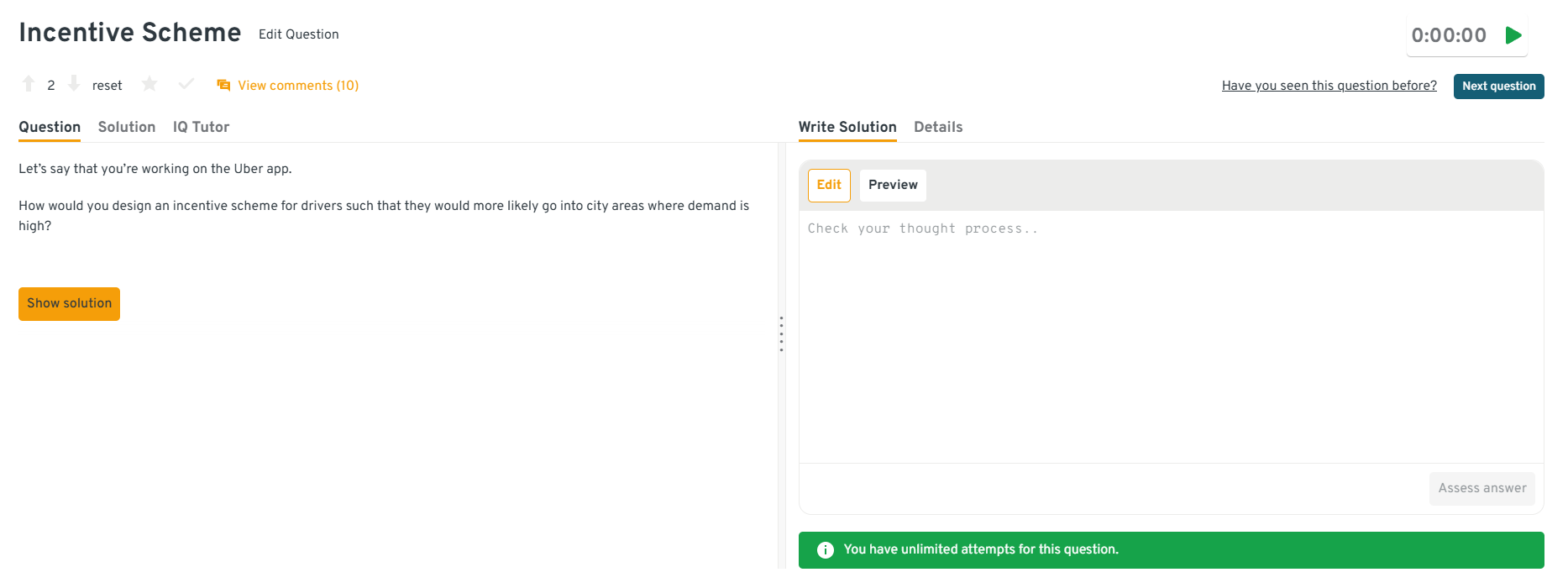
Head to the Interview Query dashboard to practice Rivian business intelligence interview questions in one place. Work through SQL, metrics, operational case studies, and behavioral questions with built-in code execution and AI-guided feedback to prepare for the level of judgment Rivian interviews expect.
How do you decide when a dashboard needs to change as the business scales?
This question evaluates ownership and adaptability. Rivian wants analysts who recognize when metrics no longer reflect reality due to scale, complexity, or shifting goals. A strong answer discusses reviewing usage, aligning with evolving decisions, and simplifying dashboards to keep them relevant and trusted.
Tip: Mention removing or consolidating metrics intentionally. This shows discipline and respect for stakeholder attention, which is critical at scale.
Watch next: 10+ Business Intelligence Interview Questions!
In this companion video, Interview Query founder Jay Feng breaks down how business intelligence interviews are evaluated from an interviewer’s perspective. He explains the types of questions candidates can expect, the differences between business intelligence analysts and business intelligence engineers, and the core categories that most BI interviews focus on. Jay also walks through how strong candidates structure their answers, communicate clearly, and demonstrate sound judgment, making this a valuable resource for understanding what interviewers look for and how to approach BI interviews with confidence.
Case Study and Operational Scenario Questions
Case study questions assess how you break down ambiguous, high-impact problems that mirror real challenges faced by Rivian teams. Interviewers are looking for structured reasoning, sound assumptions, and the ability to connect data analysis to operational decisions under uncertainty.
Production output dropped at one facility last week. How would you investigate?
This question tests your ability to structure an investigation under pressure. Rivian asks this because production disruptions have immediate cost and delivery implications. A strong answer starts with validating the data, then comparing output against historical baselines, shifts, and downtime logs. From there, you would segment by line, time window, or input constraints to isolate likely root causes before proposing next steps.
Tip: Explain how you would sequence the investigation to get quick answers first. This shows prioritization skills and operational maturity.
Logistics costs increased sharply this quarter. What data would you analyze first?
This question tests prioritization and business intuition. At Rivian, logistics costs can shift due to volume changes, routing decisions, or supplier performance. A strong answer starts by decomposing total cost into volume, rate, and mix effects, then drilling into lanes, partners, and time trends to identify primary drivers.
Tip: Clearly separate cost increases you can influence from those you cannot. This shows practical judgment and executive-level framing.
-
This question evaluates forecasting logic and cohort reasoning. Rivian asks similar questions when estimating supplier longevity or equipment utilization. To answer, explain how early behavior predicts retention, how you would segment cohorts, and how uncertainty changes over time. The focus is on modeling assumptions and interpretation, not perfect precision.
Tip: Emphasize how you would communicate uncertainty in the estimate. This signals maturity and credibility when forecasting future outcomes.
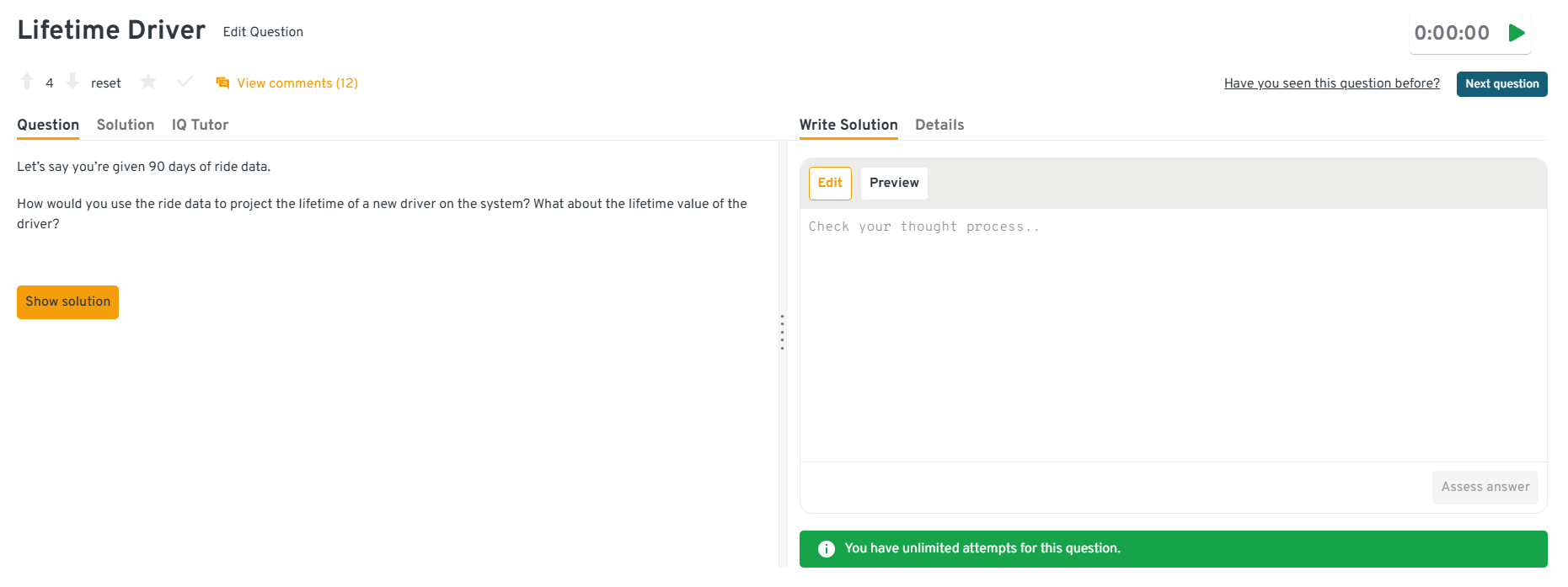
Head to the Interview Query dashboard to practice Rivian business intelligence interview questions in one place. Work through SQL, metrics, operational case studies, and behavioral questions with built-in code execution and AI-guided feedback to prepare for the level of judgment Rivian interviews expect.
Leadership wants a single metric to summarize operational performance. What do you recommend?
This question tests judgment and confidence. Rivian uses it to see whether you can push back thoughtfully when oversimplification creates risk. A strong answer explains why no single metric captures performance, then proposes a small, balanced set that reflects efficiency, quality, and risk while staying easy to interpret.
Tip: Show how you would guide leaders toward better decisions without saying no outright. This demonstrates influence and stakeholder management skills.
Looking for hands-on problem-solving? Test your skills with real-world challenges from top companies. Ideal for sharpening your thinking before interviews and showcasing your problem solving ability.
Behavioral Interview Questions
Behavioral questions evaluate how you operate as a business intelligence partner in a fast-moving, cross-functional environment. At Rivian, interviewers look for ownership, sound judgment under ambiguity, and the ability to influence decisions with data while maintaining strong stakeholder relationships.
Tell me about a time your analysis changed a business decision.
This question evaluates whether your work actually influenced outcomes. Rivian asks this to distinguish analysts who report metrics from those who drive action. Interviewers want to hear how you framed the problem, earned stakeholder trust, and stayed involved through execution.
Sample answer: In a previous role, I noticed a recurring drop in production output during shift transitions that was being attributed to staffing shortages. I analyzed line-level downtime across four weeks and showed that handoff delays accounted for nearly 15 percent of lost output. I validated the finding with operations managers, proposed a standardized handoff checklist, and supported a two-week pilot. Output improved by 11 percent, and the process was rolled out across the facility.
Tip: Explicitly describe how you stayed involved after sharing the insight. At Rivian, follow-through shows ownership and signals that you can be trusted with operational decisions.
What are you looking for in your next job?
This question assesses alignment and intent. Rivian wants analysts who are motivated by operational impact, not just tooling or career progression. Your answer should show that you understand the nature of the work and are choosing it deliberately.
Sample answer: I am looking for a role where analytics directly informs execution. In my current position, my most impactful work involved partnering with operations leaders to improve metrics that affected daily decisions. That experience made me want to work in an environment like Rivian, where business intelligence sits close to manufacturing and cost decisions rather than operating in isolation.
Tip: Tie your motivation to decision proximity. Rivian values analysts who want responsibility and accountability, not just visibility.
Describe a situation where your data conflicted with stakeholder expectations.
This question tests how you handle tension and protect data integrity without damaging relationships. Rivian analysts frequently surface insights that challenge assumptions in fast-moving environments.
Sample answer: I once shared an analysis showing that a cost overrun was driven by routing decisions rather than supplier pricing, which contradicted leadership expectations. I walked stakeholders through the assumptions, shared validation checks, and invited them to pressure-test the logic. After aligning on the data, we adjusted routing strategy and reduced quarterly logistics costs by 7 percent.
Tip: Emphasize how you made stakeholders part of the validation process. At Rivian, collaborative truth-building matters more than being right quickly.
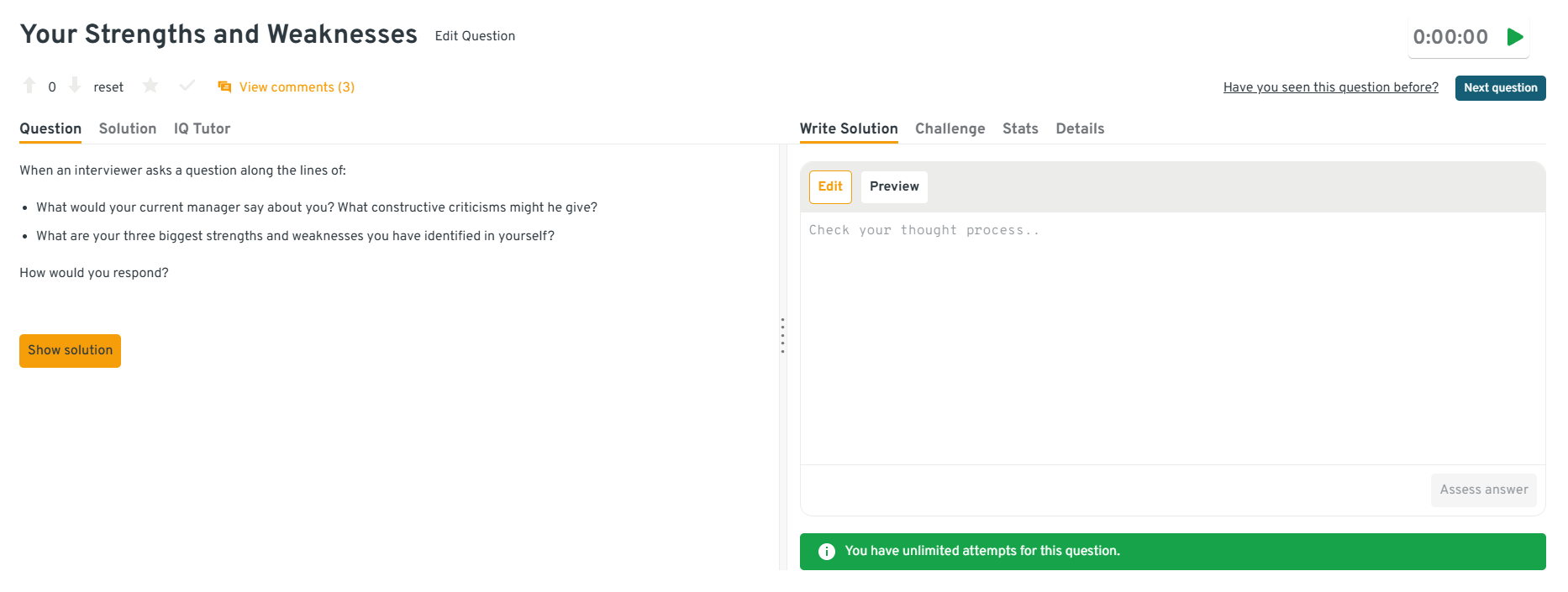
What are your three biggest strengths and weaknesses you have identified in yourself?
This question assesses self-awareness and growth. Rivian looks for analysts who actively refine how they work as the business scales.
Sample answer: My strengths are structured problem-solving, strong metric judgment, and clear stakeholder communication. One weakness I identified was spending too much time perfecting edge cases early. I addressed this by time-boxing analysis and focusing first on decision-critical insights, which improved speed and alignment with leadership needs.
Tip: Show how your weakness evolved into a better working habit. Rivian values analysts who improve how they operate, not just what they produce.
Head to the Interview Query dashboard to practice Rivian business intelligence interview questions in one place. Work through SQL, metrics, operational case studies, and behavioral questions with built-in code execution and AI-guided feedback to prepare for the level of judgment Rivian interviews expect.
How do you handle incomplete or messy data under tight deadlines?
This question evaluates realism and judgment. Rivian operates with fast-changing operational data, and leaders often need direction before perfect accuracy is possible.
Sample answer: When faced with incomplete logistics data under a tight deadline, I delivered a directional analysis with clearly stated assumptions and risk flags within 24 hours so leaders could act. I then scheduled a follow-up once additional data arrived, refining the recommendation. This approach prevented delays while maintaining trust in the numbers.
Tip: Clearly separate what you know from what you assume. Rivian leaders value analysts who manage risk transparently rather than waiting for perfect data.
Need 1:1 guidance on your interview strategy? Explore Interview Query’s Coaching Program that pairs you with mentors to refine your prep and build confidence.
What Does a Rivian Business Intelligence Analyst Do?
A Rivian business intelligence analyst turns operational, financial, and supply chain data into insights that guide real decisions across the company. The role sits close to execution, supporting teams in manufacturing, logistics, facilities technology, and finance as Rivian scales production and tightens cost controls. Rather than producing static reports, analysts are expected to define the right metrics, surface risks early, and translate complex data into clear narratives leaders can act on.
| What They Work On | Core Skills Used | Tools And Methods | Why It Matters At Rivian |
|---|---|---|---|
| Manufacturing performance tracking | Metric definition, variance analysis | SQL, dashboards, operational KPIs | Helps leaders identify bottlenecks and improve throughput |
| Supply chain and logistics analytics | Trend analysis, root cause analysis | SQL, data modeling, reporting layers | Improves delivery timelines and supplier reliability |
| Financial and cost analytics | Forecasting, scenario analysis | SQL, spreadsheets, BI tools | Supports cost discipline and margin management |
| Facilities and operations reporting | Data validation, stakeholder communication | Automated reporting, dashboards | Enables faster decisions at the plant and site level |
| Executive and stakeholder insights | Data storytelling, prioritization | Clear visuals, concise summaries | Aligns teams around the same source of truth |
Tip: At Rivian, strong business intelligence analysts show ownership of the metric, not just the query. In interviews, explain how you validated data sources, aligned definitions with stakeholders, and turned insights into decisions. This demonstrates business judgment and the ability to operate independently in a fast-moving environment.
How to Prepare for a Rivian Business Intelligence Interview
Preparing for the Rivian business intelligence interview requires more than brushing up on SQL or reviewing dashboard examples. You are preparing for a role that supports manufacturing scale, cost discipline, and supply chain execution in a highly operational environment. Success depends on strong metric judgment, comfort with imperfect data, and the ability to communicate insights that drive action across finance and operations. Below is a focused guide to help you prepare effectively.
Build deep intuition for operational metrics and trade-offs: Rivian business intelligence teams work with throughput, downtime, cost per unit, and delivery metrics that directly affect execution. Spend time understanding how these metrics are defined, how they interact, and what can distort them during rapid scale.
Tip: Be ready to explain why a metric moved, not just that it moved. This shows operational judgment and an ability to think beyond surface-level reporting.
Practice reasoning with incomplete or noisy data: Manufacturing and supply chain data is rarely clean or perfectly timed. Practice making reasonable assumptions, calling out limitations, and explaining how you would validate or improve data quality over time.
Tip: Clearly stating assumptions signals maturity and builds trust, which is critical for analysts supporting high-stakes operational decisions.
Strengthen your executive communication skills: Rivian interviewers care deeply about how you explain insights to non-technical stakeholders. Practice summarizing complex analyses into clear, concise takeaways that answer “so what” for leaders.
Tip: Focus on decisions and risks, not methodology. This demonstrates business acumen and readiness to partner with leadership.
Prepare concise stories from past business intelligence work: Review your prior projects and refine how you explain problem framing, metric choice, trade-offs, and outcomes. Rivian values analysts who show ownership from question to decision.
Tip: Highlight moments where you pushed back or refined a request. This shows confidence, judgment, and the ability to protect data integrity.
Rehearse full interview loops under realistic conditions: Simulate a complete mock interview loop with a SQL exercise, a metrics discussion, a case scenario, and a behavioral round back to back. Practicing this flow helps improve pacing and clarity under pressure.
Tip: After each mock, note where explanations felt unclear or rushed. Improving those moments often has the biggest impact on interview performance.
Want to level up your BI interview prep? Practice hands-on SQL problems and real take-home assignments on the Interview Query Dashboard.
Rivian Business Intelligence Analyst Salary
Rivian’s compensation framework is designed to reward analysts who can support operational scale, improve cost visibility, and enable data-driven decisions across manufacturing, finance, and supply chain teams. Business intelligence analysts typically receive competitive base pay, annual performance bonuses, and meaningful equity grants. Total compensation varies based on level, location, scope of responsibility, and the function you support, such as finance analytics, facilities technology, or logistics. Most candidates interviewing for business intelligence roles fall into mid-level or senior bands, especially if they bring experience working closely with operations or executive stakeholders.
Read more: Business Intelligence Analyst Salary
Tip: Clarify the scope of the role early, including which function you will support, since responsibility breadth directly influences leveling and compensation expectations at Rivian.
Rivian Business Intelligence Analyst Compensation Overview (2026)
| Level | Role Title | Total Compensation (USD) | Base Salary | Bonus | Equity (RSUs) | Signing / Relocation |
|---|---|---|---|---|---|---|
| BI Analyst I | Business Intelligence Analyst (Entry Level) | $105K – $135K | $90K–$110K | Performance based | Standard RSUs | Occasional |
| BI Analyst II | Business Intelligence Analyst (Mid Level) | $125K – $165K | $105K–$130K | Performance based | RSUs included | Offered case-by-case |
| Senior BI Analyst | Senior Business Intelligence Analyst | $150K – $195K | $120K–$150K | Above target possible | Larger RSU grants | More common |
| Staff / Lead BI | Staff or Lead Business Intelligence Analyst | $180K – $230K+ | $140K–$170K | High performer bonuses | High RSUs + refreshers | Frequently offered |
Note: These estimates are aggregated from data on Levels.fyi, Glassdoor, public job postings, and Interview Query’s internal salary database.
Tip: Pay attention to equity refreshers after your first year, since Rivian uses stock to reward sustained impact and long-term ownership.
Negotiation Tips that Work for Rivian
Negotiating compensation at Rivian is most effective when you align your expectations with market benchmarks and clearly articulate your operational impact. Recruiters value candidates who approach negotiations with preparation, transparency, and a long-term mindset.
- Confirm your level early: Rivian’s leveling from mid-level to senior or staff has a significant impact on base salary, bonus targets, and equity. Always confirm level alignment before final compensation discussions.
- Use credible market benchmarks: Anchor your expectations using sources like Levels.fyi, Glassdoor, and Interview Query salaries. Frame your value through measurable outcomes such as cost savings, efficiency improvements, or improved decision speed.
- Account for location and role scope: Compensation can differ across California, Illinois, and remote roles, and between finance, operations, and supply chain teams. Ask for location-specific and role-specific bands.
Tip: Request a full compensation breakdown including base salary, bonus target, equity vesting schedule, and any signing or relocation incentives. This demonstrates financial diligence and helps you negotiate from a well-informed position.
FAQs
How long does the Rivian business intelligence interview process take?
Most candidates finish the process within three to five weeks from the recruiter screen to final decision. Timelines can extend if multiple business intelligence teams are reviewing your profile or if onsite scheduling takes longer. Recruiters usually communicate expected timelines clearly after each stage.
Does Rivian use take-home assignments for business intelligence roles?
Some teams include a take-home assignment or live case exercise, while others rely entirely on interview rounds. These assignments focus on metric definition, analysis clarity, and business reasoning rather than complex modeling. The format depends on the team and seniority of the role.
What technical skills does Rivian prioritize for business intelligence interviews?
Rivian places the most weight on SQL proficiency, metric thinking, and analytical reasoning. Experience with dashboards and reporting tools is important, but interviewers care more about how you interpret data and validate results than about specific platforms.
How difficult are Rivian’s SQL interview questions?
Rivian’s SQL questions are moderately challenging and rooted in real operational scenarios. You can expect joins, aggregations, window functions, and time-based analysis tied to production, costs, or logistics. Clear logic and clean structure matter more than clever tricks.
Is automotive or manufacturing experience required to succeed at Rivian?
Industry experience is helpful but not required. Candidates from finance, supply chain, or operations analytics backgrounds can perform well if they demonstrate strong business judgment and the ability to quickly learn new operational contexts.
How important is stakeholder communication during the interview?
Communication is a core evaluation area. Rivian business intelligence analysts regularly present insights to non-technical leaders, so interviewers assess how clearly you explain assumptions, risks, and recommendations without overloading on detail.
Are interviews customized by team or function at Rivian?
Yes. While the overall interview structure is consistent, questions are often tailored to the team you are interviewing with, such as finance analytics, facilities technology, or supply chain. Recruiters usually clarify the team focus early in the process.
What qualities help candidates stand out in Rivian interviews?
Strong candidates show ownership of metrics, thoughtful data validation, and decision-oriented thinking. Rivian looks for analysts who can be trusted to influence high-impact operational decisions, not just produce reports.
Become a Rivian Business Intelligence Analyst with Interview Query
Preparing for the Rivian business intelligence interview means building strong SQL fundamentals, sharp metric judgment, and the ability to translate operational data into decisions that matter. By understanding Rivian’s interview structure, practicing real-world analytics scenarios, and refining how you communicate insights to cross-functional partners, you can approach each stage with confidence. For targeted preparation, explore the full Interview Query question bank, practice with the AI Interviewer, or work one-on-one with an expert through Interview Query’s Coaching Program to sharpen your strategy and stand out in Rivian’s business intelligence hiring process.
Discussion & Interview Experiences