

Rivian Machine Learning Engineer Interview Guide: Process, Questions & Salary


Introduction
What happens when a machine learning model makes the wrong decision at 70 miles per hour?
At Rivian, that question is not hypothetical. Each Rivian vehicle processes multiple gigabytes of sensor data per hour across cameras, radar, and vehicle systems, and the models interpreting that data run continuously in safety-critical conditions. As Rivian pushes deeper into software-defined vehicles and autonomy-adjacent features, machine learning engineers sit directly on the line between perception, infrastructure, and real-world outcomes.
That reality defines the Rivian machine learning engineer interview. This is not a role about training a model once and handing it off. Interviewers are evaluating whether you can design ML systems that survive production constraints: latency budgets, hardware limits, noisy data, deployment failures, and cross-team dependencies. In this guide, we break down how the Rivian machine learning engineer interview process works, what each stage is designed to assess, and how candidates should prepare for production-grade ML roles where correctness, scalability, and judgment matter as much as accuracy.
Rivian Machine Learning Engineer Interview Process
The Rivian machine learning engineer interview process typically spans three to five rounds, depending on team and seniority. The process blends coding, machine learning fundamentals, and system design, with a strong emphasis on production readiness rather than research depth alone. Rivian interviewers focus on how candidates reason through trade-offs, design scalable ML pipelines, and collaborate across autonomy, platform, and software teams.
Many candidates prepare by practicing applied problems and live explanation using Interview Query’s existing resources, such as mock interviews and real-world challenges, which closely mirror Rivian’s follow-up-heavy and discussion-driven interview style.
Interview Process Overview
Candidates usually progress from an initial recruiter screen into technical rounds, followed by a virtual onsite composed of panel interviews. Compared with consumer-tech ML roles, Rivian places heavier emphasis on systems thinking, deployment constraints, and collaboration with hardware-adjacent teams.
| Interview stage | What happens |
|---|---|
| Recruiter screen | Background, motivation, and alignment with Rivian’s mission |
| Hiring manager call | Role scope, project discussion, and expectations |
| Technical screen | Coding (Python or C++), ML fundamentals, or algorithms |
| Virtual onsite (panel) | Coding, ML deep dives, system design, and behavioral interviews |
| Behavioral or leadership round | Collaboration, ownership, and decision-making |
Recruiter Screen
The recruiter screen is a short call focused on your background, interest in Rivian, and general fit for a machine learning engineering role. Interviewers assess whether you understand how ML at Rivian differs from research-only or experimentation-heavy positions.
Tip: Be ready to explain why working on production ML systems in vehicles is more compelling to you than offline modeling or academic research.
Hiring Manager Call
This conversation dives deeper into your resume and past projects. Hiring managers often probe how you’ve handled trade-offs between model quality, latency, infrastructure cost, and reliability.
Tip: Anchor answers around decisions you made under constraints, not just models you trained.
Technical Screen (Coding And ML Fundamentals)
Technical screens often include LeetCode-style coding questions, Python or C++ exercises, and core ML concepts such as overfitting, regularization, evaluation metrics, and error analysis. Some teams emphasize algorithmic efficiency, while others focus more on ML fundamentals.
Interviewers evaluate clarity of reasoning as much as correctness.
Tip: Always talk through time and space complexity and how your solution would behave in a production pipeline.
Virtual Onsite (Panel Interviews)
The virtual onsite is the most decisive part of the Rivian machine learning engineer interview. Candidates usually complete three to four back-to-back panel interviews, each designed to test a different dimension of production-grade ML engineering. These are not redundant rounds. Each panel evaluates a distinct failure mode Rivian wants to avoid when shipping ML into vehicles.
| Panel interview | What the session looks like | What Rivian is really testing | How to prepare |
|---|---|---|---|
| Coding (Python or C++) | Live coding in a shared editor; LeetCode-style problems or data-processing tasks | Core DSA fundamentals, code correctness, and performance under time pressure | Practice explaining logic aloud, discuss time and space complexity, and relate choices to production constraints |
| Machine learning deep dive | Conceptual and applied ML questions tied to your resume or Rivian use cases | Whether you truly understand model behavior, failure modes, and evaluation | Be ready to justify model choice, metrics, and how you would debug poor performance |
| ML system design | Design an end-to-end ML system (data → training → deployment → monitoring) | Systems thinking, MLOps maturity, and trade-offs between latency, accuracy, and cost | Practice structuring answers around constraints first, then architecture and iteration |
| Project or experience deep dive | Walkthrough of a past ML system you built or shipped | Ownership, decision-making, and ability to operate end to end | Focus on why decisions were made, not just what tools you used |
| Behavioral / collaboration | Scenario-based questions on teamwork, conflict, and ambiguity | Communication style, judgment, and cultural fit | Prepare examples showing influence without authority and calm decision-making |
| Product and mission fit | Discussion around Rivian’s vehicles, autonomy direction, or software stack | Genuine interest in Rivian’s problem space and long-term alignment | Research a specific Rivian system and propose how ML could improve it |
How to think about the panel as a whole
Rivian does not expect perfection in every session. Instead, the panel evaluates whether you can consistently reason under constraints, communicate clearly, and make defensible trade-offs across coding, modeling, and systems. Strong candidates treat each interview as a design conversation, not a test to rush through.
Tip: Treat each panel as a design conversation. Clarify constraints early, articulate trade-offs clearly, and connect decisions back to latency, safety, and scalability.
Behavioral Or Leadership Round
Behavioral interviews assess how you collaborate across autonomy, infrastructure, and software teams. Rivian values engineers who can influence decisions without direct authority and operate calmly in high-stakes environments.
Tip: Prepare examples where your ML decisions affected system reliability, deployment success, or downstream teams.
Challenge
Check your skills...
How prepared are you for working as a ML Engineer at Rivian?
Rivian Machine Learning Engineer Interview Questions
Rivian machine learning engineer interview questions are designed to evaluate whether you can build reliable, production-grade ML systems that operate under real constraints such as latency, hardware limits, noisy data, and safety requirements. Interviewers care less about perfect answers and more about how you reason, explain trade-offs, and connect ML decisions to system behavior.
Coding And Data Structures Questions
These questions assess your ability to write correct, efficient code under time pressure while reasoning about performance and edge cases. Rivian uses these to evaluate whether candidates can translate logic into production-safe implementations.
How would you merge two sorted lists efficiently, and what is the time complexity of your approach?
This question tests fundamental algorithmic thinking and clean implementation. Interviewers look for clarity of logic and whether you understand why a linear-time solution is optimal.
Tip: State time and space complexity upfront and explain how your approach avoids unnecessary comparisons.
How would you merge N sorted lists while keeping the solution scalable as N grows?
This evaluates your ability to choose appropriate data structures as scale changes. It mirrors situations where multiple data partitions or streams must be combined efficiently.
Tip: Explain why a heap-based approach improves performance compared with repeated pairwise merges.
How would you count the number of triplets in an array that sum to a given value?
This question assesses how you handle combinations, duplicates, and efficiency trade-offs. Interviewers are evaluating structured reasoning rather than brute-force coding.
Tip: Clarify how you will avoid double counting before writing code.
-
This tests your understanding of prefix sums and invariants. Rivian interviewers often use it to see whether you can reason about state instead of recomputing values repeatedly.
Tip: Clearly articulate the invariant you maintain during iteration.
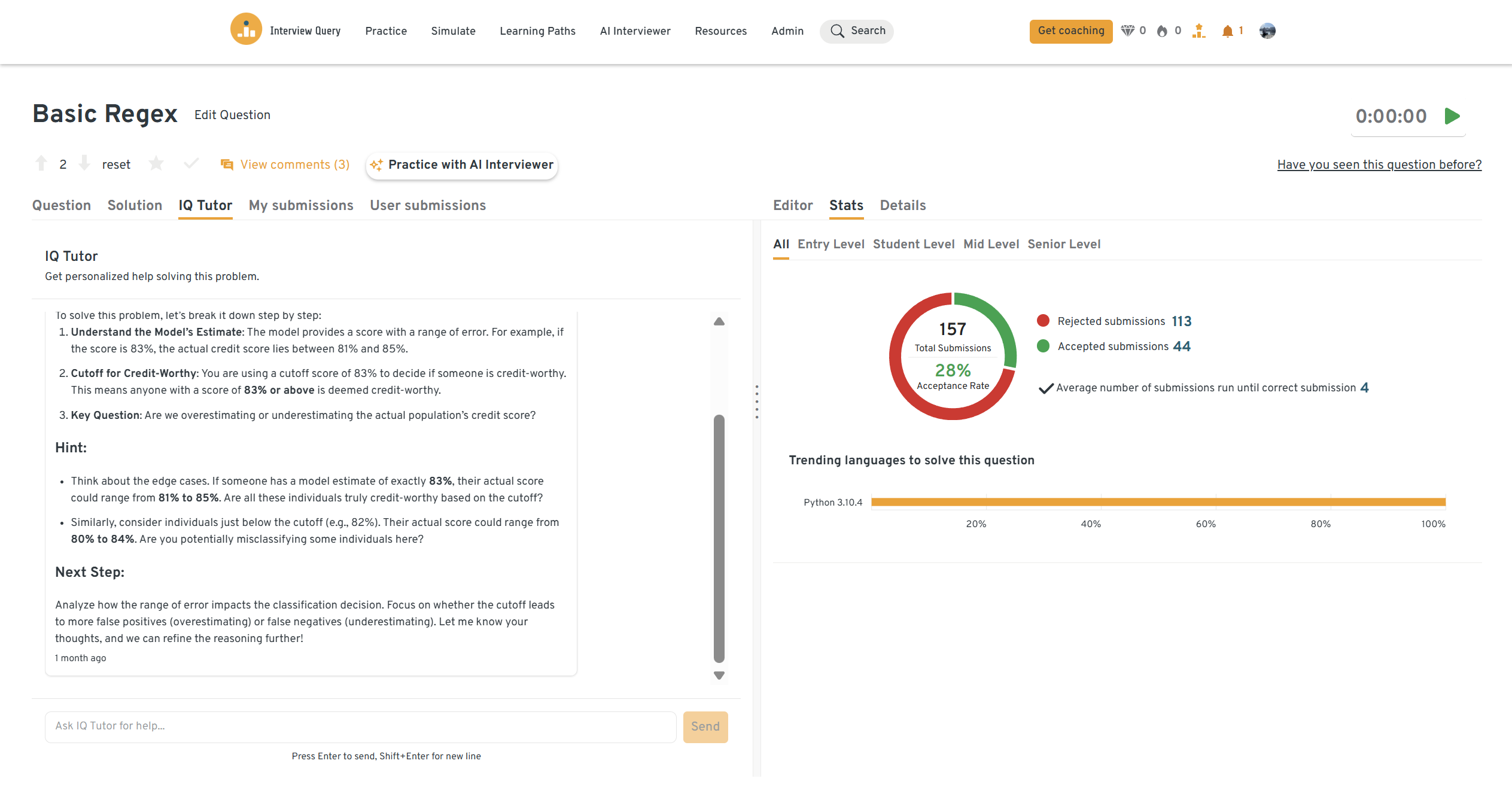
How would you implement a basic regular expression matcher that supports wildcard characters?
This evaluates recursive or dynamic programming thinking and careful edge-case handling. These skills translate directly to building robust logic inside ML pipelines.
Tip: Clarify matching rules (entire string versus partial match) before designing the solution.
You can practice this exact problem on the Interview Query dashboard, shown below. The platform lets you write and test SQL queries, view accepted solutions, and compare your performance with thousands of other learners. Features like AI coaching, submission stats, and language breakdowns help you identify areas to improve and prepare more effectively for data interviews at scale.
Machine Learning Fundamentals Questions
These questions test whether you understand how models behave, not just how they are trained. Rivian interviewers care about interpretability, failure modes, and how theoretical choices affect real systems.
What are the key differences between Lasso and Ridge regression, and when would you use each?
This question evaluates your understanding of regularization and how it affects feature selection and model stability. Interviewers want to see whether you can connect theory to practical modeling decisions.
Tip: Discuss both mathematical behavior and interpretability trade-offs.
How does softmax regression differ from logistic regression, and when is each appropriate?
This assesses whether you understand multi-class versus binary classification beyond surface-level formulas. Rivian values engineers who understand downstream implications of model choice.
Tip: Tie your explanation to loss functions and decision boundaries.
How should the coefficients of a logistic regression model be interpreted?
This tests model interpretability, which is critical when debugging or explaining behavior to stakeholders. Interviewers want clarity, not jargon.
Tip: Translate coefficients into odds ratios and explain the baseline case.
What happens when a dataset is perfectly separable, and how does that affect logistic regression?
This question evaluates your understanding of optimization behavior and numerical stability. Rivian uses it to see whether you recognize pathological cases in real data.
Tip: Mention coefficient divergence and how regularization mitigates it.
When would it make sense to train separate models for different user or data segments?
This assesses your ability to reason about bias-variance trade-offs and model complexity. Interviewers want to see data-driven justification rather than intuition alone.
Tip: Propose a measurable criterion for deciding whether segmentation helps.
Machine Learning System Design And MLOps Questions
System design questions are central to Rivian’s evaluation, especially for mid-level and senior ML engineers. These assess whether you can design end-to-end ML systems that scale and operate reliably.
How would you design a recommendation system like YouTube’s from data ingestion to ranking?
This evaluates your ability to decompose large ML systems into components. Interviewers look for clarity around candidate generation, ranking, and evaluation.
Tip: Separate offline training from online serving concerns.
How would you design a type-ahead search system with low latency?
This tests retrieval, personalization, and performance trade-offs. Rivian values candidates who think about latency and failure modes early.
Tip: Discuss caching, fallback behavior, and monitoring.
How would you design a real-time parking availability system end to end?
This assesses ingestion, storage, and serving architecture. Interviewers want to see whether you think about SLAs and data freshness.
Tip: Call out assumptions explicitly before proposing architecture.
How would you design an ML pipeline to detect anomalies in vehicle telemetry data from fleet-scale ingestion to deployment?
This mirrors Rivian’s real-world use cases around reliability and diagnostics. Interviewers evaluate how you define anomalies operationally.
Tip: Explain who acts on alerts and what false positives cost.
How would you version, validate, and safely roll back ML models deployed to vehicles?
This tests MLOps maturity and safety-first thinking. Rivian looks for engineers who design for failure, not just success.
Tip: Mention canarying, shadow deployments, and kill switches.
In this ML system design walkthrough, Sachin, a senior data scientist, tackles a common question: how would you architect YouTube’s homepage recommendation system? You’ll learn how to approach real-time vs. offline recommendation pipelines, handle user context, optimize for different devices, and incorporate metrics like NDCG and MRR, ideal for machine learning engineers preparing for design rounds at Rivian.
Product, Metrics, And Applied Case Questions
These questions evaluate how you connect ML outputs to decisions, metrics, and business or operational impact.
How would you compare two delivery-time prediction models and decide which to deploy?
This tests evaluation strategy beyond accuracy alone. Interviewers want to see how you account for business cost and risk.
Tip: Define what “better” means operationally.
How would you model and evaluate food delivery times using historical data?
This assesses feature selection, leakage awareness, and evaluation design. Rivian values engineers who proactively guard against flawed assumptions.
Tip: Call out leakage risks before feature brainstorming.
How would you explain a model’s rejection decision to a user or stakeholder?
This tests explainability and communication under constraints. Interviewers want practical approaches, not perfect transparency.
Tip: Discuss surrogate explanations or reason codes.
How would you identify and merge duplicate product entries at scale?
This evaluates entity resolution, thresholds, and QA thinking. Rivian looks for awareness of precision-recall trade-offs.
Tip: Explain how you would validate results without perfect labels.
A reliability metric worsens after a firmware update. How would you determine whether this is real behavior, logging changes, or model drift?
This mirrors real Rivian investigations under ambiguity. Interviewers assess structured triage and falsification thinking.
Tip: Break the problem into instrumentation, segmentation, and counterfactual analysis.
Behavioral And Collaboration Questions
Behavioral questions assess judgment, communication, and how you operate within Rivian’s cross-functional engineering culture.
-
This evaluates your ability to defend decisions without damaging trust. Rivian values calm, evidence-based alignment.
Tip: Focus on how you aligned on a decision rule.
Sample answer:
In a previous role, a stakeholder favored a more complex model due to higher offline accuracy, but I was concerned about latency in production. I presented a side-by-side comparison of accuracy gains versus operational risk and proposed a staged rollout. This allowed us to validate impact safely and built long-term trust.
How do you explain complex machine learning concepts to non-technical stakeholders?
Interviewers use this to assess clarity and empathy. ML engineers at Rivian regularly work with product and operations teams.
Tip: Anchor explanations around outcomes, not algorithms.
Sample answer:
I focus on what changes as a result of the model rather than how it works internally. I explain inputs, outputs, and confidence in plain language, which keeps discussions decision-focused.
Tell me about a time your analysis or model influenced a key decision.
This tests whether your work drives action. Rivian values engineers who move teams forward.
Tip: Lead with the recommendation.
Sample answer:
I presented a clear recommendation first, then used one chart to support it. This helped leadership focus on the decision rather than debating methodology.
Why do you want to work here, and how does this role fit your goals?
This evaluates motivation and long-term fit. Interviewers look for genuine interest in Rivian’s problem space.
Tip: Tie your answer to a specific Rivian system or challenge.
Sample answer:
I’m motivated by ML systems that operate under real constraints. At Rivian, models directly affect vehicle behavior and reliability, which makes engineering decisions tangible and meaningful.
What is one weakness in your engineering approach, and how have you addressed it?
This tests self-awareness and growth mindset.
Tip: Choose a weakness you’ve actively mitigated.
Sample answer:
Earlier, I focused too heavily on model performance without considering operational complexity. I now incorporate deployment and monitoring considerations earlier, which has reduced production issues.
How To Prepare For A Rivian Machine Learning Engineer Interview
Preparing for a Rivian machine learning engineer interview requires more than grinding LeetCode or reviewing ML theory in isolation. Rivian evaluates whether you can engineer ML systems that work in production, reason through constraints, and communicate trade-offs clearly in safety-critical environments.
Train For Systems Thinking, Not Just Models
Rivian interviews frequently move beyond “which model would you use” into questions about latency, hardware constraints, monitoring, and failure modes. Strong candidates think in terms of end-to-end systems rather than isolated components.
Tip: When practicing problems, force yourself to articulate assumptions, constraints, and downstream impact before proposing an architecture. This mindset matters more than naming the “best” algorithm.
Balance Coding Practice With Explanation
Coding rounds often resemble LeetCode-style exercises, but Rivian interviewers care just as much about how you explain your solution. Clear reasoning, correctness, and performance awareness matter more than clever tricks.
Tip: Practice narrating your thought process while coding, including time and space complexity. Live mock interviews are especially useful for pressure-testing this skill.
Practice ML Fundamentals With Real Failure Modes In Mind
ML questions at Rivian often probe why models fail, not just how they’re trained. Expect follow-ups on overfitting, data drift, noisy labels, and evaluation under imperfect conditions.
Tip: When reviewing ML concepts, always ask how they break in production and how you would detect or mitigate those failures.
Prepare For ML System Design Conversations
System design interviews are central for mid-level and senior MLE roles. Interviewers want to see whether you can design pipelines that scale, deploy safely, and evolve over time.
Tip: Practice end-to-end design using real-world challenges that require you to reason from data ingestion through deployment and monitoring.
Develop Strong Behavioral Stories Around Ownership
Behavioral interviews focus on ownership, judgment, and collaboration. Rivian values engineers who take responsibility for outcomes, not just code quality.
Tip: Prepare STAR stories where your ML decisions affected reliability, deployment success, or cross-team alignment. Practice delivering them concisely and confidently.
Role Overview: Rivian Machine Learning Engineer
A Rivian machine learning engineer sits at the intersection of machine learning, software engineering, and vehicle systems. The role goes beyond model development and focuses on deploying, monitoring, and optimizing ML systems that run in production environments with real-world constraints.
Day to day, Rivian machine learning engineers design and train models for perception, sensor fusion, anomaly detection, or vehicle optimization, then work closely with autonomy, platform, and infrastructure teams to deploy those models safely. Success in the role depends as much on engineering judgment and communication as on ML depth.
Core responsibilities
- Algorithm development: Design and train ML models for perception, prediction, or optimization tasks.
- Production deployment: Integrate models into real-time systems, often with strict latency and reliability requirements.
- MLOps and lifecycle management: Build pipelines for training, evaluation, versioning, and monitoring.
- Hardware-aware optimization: Adapt models for embedded or resource-constrained environments.
- Cross-functional collaboration: Partner with autonomy, simulation, and software teams to deliver end-to-end solutions.
- Monitoring and iteration: Track model performance in production and iterate based on real-world feedback.
Culture And What Makes Rivian Different
Rivian’s machine learning engineering culture is hands-on, execution-driven, and safety-aware. Engineers are expected to own problems end to end, from modeling decisions to production behavior.
What Rivian interviewers look for
- Systems thinkers: Engineers who reason about full pipelines, not isolated models.
- Production mindset: Comfort deploying, monitoring, and debugging ML in real environments.
- Clear communicators: Ability to explain technical trade-offs to diverse stakeholders.
- Ownership and accountability: Willingness to stand behind decisions and outcomes.
- Mission alignment: Genuine interest in EVs, autonomy, and building reliable software-defined vehicles.
Because Rivian operates at the intersection of software and hardware, candidates who balance ML rigor with pragmatic engineering judgment tend to stand out.
Average Rivian Machine Learning Engineer Salary
Machine learning engineer compensation at Rivian reflects the company’s focus on production-grade, safety-critical ML systems, with pay skewed higher at senior and staff levels, especially in high-cost locations like the San Francisco Bay Area.
Based on aggregated compensation data, a Machine Learning Engineer at Rivian earns an average base salary of approximately $208,209 per year, according to reported figures on Indeed. This represents a blended average across levels and locations, meaning individual offers may land meaningfully above or below this figure depending on seniority, specialization, and geography.
Rivian also publicly discloses base salary ranges in many of its job postings. For roles based in Palo Alto, California, employer-provided ranges listed on Rivian’s official careers site show the following base salary bands:
| Role | Base Salary Range |
|---|---|
| ML Compiler Engineer | $162,000 – $203,000 |
| Senior Machine Learning / AI Engineer | $162,800 – $205,300 |
| Senior / Staff Machine Learning Engineer, Perception | $179,000 – $285,000 |
| Staff Machine Learning Compiler Engineer | $206,500 – $258,100 |
| Staff Software Engineer, ML Training & Inference Infrastructure | $228,000 – $285,000 |
| Senior Staff AI Engineer, Enterprise Applied AI | $265,000 – $331,300 |
These ranges come directly from Rivian’s employer-disclosed postings, such as this Machine Learning and AI role on the Rivian Careers page, and reflect base salary only, excluding equity, bonuses, or sign-on incentives.
Average Base Salary
Average Total Compensation
What Drives Rivian Machine Learning Engineer Compensation
Several factors strongly influence where candidates land within these ranges:
- Location: Bay Area roles command a premium compared with Rivian’s Normal, Illinois hub, where senior ML and AI roles are often posted closer to the mid–high six-figure range.
- Level and scope: Staff and senior staff engineers see the steepest increases due to ownership of end-to-end systems, infrastructure, or safety-critical components.
- Domain specialization: Roles tied to perception, ML infrastructure, compiler optimization, or large-scale inference typically sit at the top of Rivian’s compensation bands.
- Total compensation mix: While this section focuses on base salary, Rivian commonly supplements cash compensation with equity and bonuses, especially at senior IC levels.
If you are benchmarking an offer, it is critical to anchor discussions around leveling and scope, not just job title. Practicing senior-level ML system design and calibration-style interviews through mock interviews can be especially helpful, since leveling decisions often drive substantial differences in total compensation at Rivian.
FAQs
How hard is the Rivian machine learning engineer interview?
The Rivian machine learning engineer interview is considered challenging, particularly because it combines coding, ML depth, and system design in one process. Candidates are evaluated not just on correctness, but on how well they reason through constraints like latency, hardware limits, and deployment risk. Many strong candidates find the virtual onsite demanding due to multiple back-to-back interviews that probe different failure modes.
What technical skills does Rivian prioritize for machine learning engineers?
Rivian prioritizes strong Python (and sometimes C++), solid data structures and algorithms, and deep understanding of machine learning fundamentals. For many teams, especially autonomy- or infrastructure-adjacent ones, Rivian also values ML system design, MLOps, and experience deploying models into production rather than research-only work.
Are Rivian machine learning engineer interviews more ML-heavy or coding-heavy?
They are intentionally balanced. Early rounds often emphasize coding and algorithmic thinking, while later rounds shift toward ML system design, model behavior, and production trade-offs. Senior candidates should expect heavier focus on architecture, monitoring, and ownership rather than isolated coding problems.
Do I need autonomous driving or automotive experience to pass?
No. Rivian does not require prior automotive or autonomy experience. However, interviewers expect you to reason clearly about physical systems, noisy data, and safety constraints. Candidates who can logically break down unfamiliar domains tend to perform just as well as those with direct industry experience.
What differentiates strong Rivian machine learning engineer candidates?
Strong candidates consistently demonstrate systems thinking, clear communication, and ownership. They clarify assumptions before coding, explain trade-offs calmly, and connect ML decisions to real-world outcomes. Rivian values engineers who can ship reliable systems, not just train high-performing models.
Turning Machine Learning Into Real-World Impact at Rivian
The Rivian machine learning engineer interview is designed to test whether you can move beyond models and help build systems that work reliably in the real world. Successful candidates show they can write correct code, design scalable ML pipelines, and make sound engineering decisions under real constraints like latency, hardware limits, and safety considerations.
To prepare effectively, focus on end-to-end practice rather than isolated drills. Working through realistic coding and ML scenarios builds technical confidence, while pressure-testing your explanations through live mock interviews helps you refine clarity and judgment. Combined, these steps mirror how Rivian evaluates machine learning engineers and help you walk into the interview confident, structured, and ready to ship production-grade ML systems.
Rivian Interview Questions
| Question | Topic | Difficulty |
|---|---|---|
Behavioral | Medium | |
Tell me about a data project that didn’t go the way you expected. What did you set out to do, what surprised you, and how did you handle it? | ||
AI & Agentic Systems | Medium | |
Behavioral | Easy | |
SQL | Easy | |
Machine Learning | Medium | |
Statistics | Medium | |
SQL | Hard | |
Machine Learning | Medium | |
Python | Easy | |
Deep Learning | Hard | |
SQL | Medium | |
Statistics | Easy | |
Machine Learning | Hard |
Discussion & Interview Experiences