
PayPal Interview Guide 2026 — Process, Questions, Cases & Tips


Introduction
Preparing for PayPal interview questions means competing in one of the fastest growing areas of tech. Digital payments continue to expand at more than a 15 percent compound annual growth rate, and PayPal sits at the center of this ecosystem with products spanning checkout, Braintree, Venmo, and global merchant services. As the industry scales, so does the bar for talent. PayPal screens candidates for clarity of thinking, risk awareness, and the ability to design systems and decisions that protect user trust.
Because PayPal’s acceptance rates are similar to those of top tech companies, roles such as Data Scientist, Data Engineer, Machine Learning Engineer, and Software Engineer require more than strong fundamentals. Successful candidates demonstrate structured reasoning, precise communication, and the ability to solve real payment and fraud scenarios under uncertainty. This guide gives you everything you need to prepare by breaking down how the interview process works, the question types used across roles, and strategies that consistently stand out to PayPal interviewers.
The PayPal Interview Process
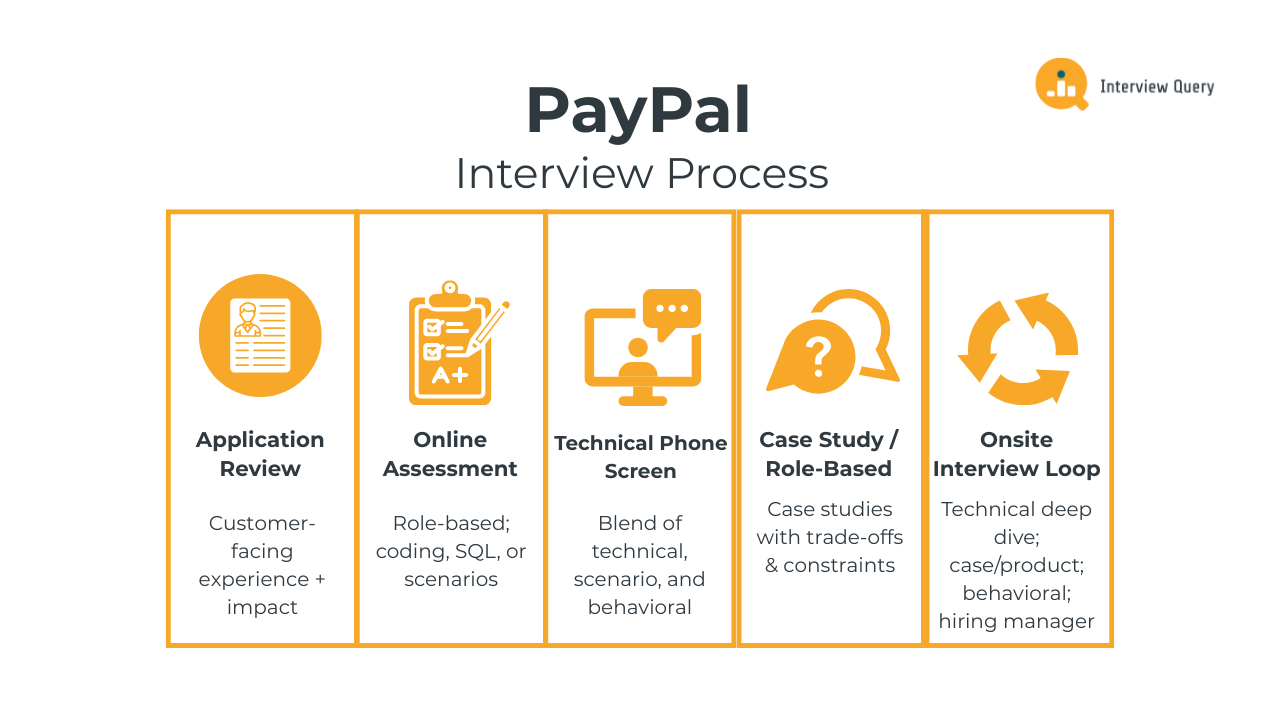
PayPal’s interview process is structured to evaluate how you think, how you communicate, and how you apply judgment in a fast moving fintech environment. Each step of the process is designed to reveal a different dimension of your problem solving skills, from your technical fundamentals to your ability to reason about risk, trust, and large scale payment flows. Candidates who succeed demonstrate clarity of thought, strong domain awareness, and the ability to collaborate across engineering, analytics, product, and risk functions.
Below is a clear breakdown of each stage, along with practical guidance to help you prepare effectively.
Application Review
The application review identifies candidates who communicate impact clearly and understand the complexity of working in a global payments ecosystem. PayPal looks for experience with secure systems, data-driven decision making, and customer-facing product improvements. Recruiters prioritize resumes that highlight ownership and measurable outcomes, especially in environments that balance reliability with rapid iteration.
What stands out:
- Experience improving performance, reliability, fraud detection accuracy, or customer conversion
- Clear writing that emphasizes structured reasoning and business impact
- Evidence of ownership in cross-functional or ambiguous situations
- Projects tied directly to financial accuracy, risk reduction, or operational efficiency
Tip: Rewrite your resume bullets to emphasize measurable outcomes and customer value. PayPal wants candidates who understand the real business impact of their work, not just the tools they used.
Online Assessment
The online assessment is PayPal’s first filter for technical readiness. It is used for engineering, analytics, and early career roles and reflects real scenarios you might encounter in production. These tasks are time bound, which helps PayPal evaluate your ability to think under pressure while maintaining accuracy and consistency. Strong performance demonstrates that you can translate logic into reliable code or queries without relying on advanced tools.
Common formats:
- Software Engineering: coding problems involving data structures, string manipulation, or payment flow logic
- Data roles: SQL transformations, analytical reasoning, dataset interpretation
- Risk and Operations: scenario-based questions that test pattern recognition, escalation logic, and decision making
Tip: Practice in a plain text environment. PayPal evaluates clarity and correctness, not your ability to rely on autocompletion or debugging shortcuts.
Technical or Functional Phone Screen
The phone or video screen validates whether you have the technical depth and communication clarity needed to move forward. PayPal interviewers focus on whether you can break down a problem, articulate assumptions, and reason about systems that affect money movement and customer trust. Expect a blend of technical questions, scenario prompts, and focused behavioral questions tied to accountability and collaboration.
Role based expectations:
- Engineering: coding exercises, handling edge cases, and small design prompts
- Data and Analytics: SQL, metrics analysis, experimentation logic, and interpretation of ambiguous data patterns
- Product Management: customer thinking, prioritization, risk assessment, and tradeoff reasoning
- Risk and Operations: decision-making frameworks, pattern detection, and stakeholder alignment
Tip: Prepare a concise, two-minute overview of your career path and the problems you enjoy solving. It provides context and helps interviewers understand your strengths before diving into questions.
Case Study or Role Specialization Round
This round mirrors real PayPal scenarios and evaluates your ability to apply structured reasoning under realistic constraints. Case studies often revolve around fraud detection, merchant onboarding, payment routing, or checkout performance. Interviewers want to understand how you think through ambiguous information and how you connect technical decisions to customer outcomes.
Examples of common themes:
- Diagnosing a drop in conversion during checkout
- Reasoning about risk signals during account creation
- Designing metrics to evaluate merchant quality or transaction anomalies
- Proposing solutions to reduce false positives in fraud models
Tip: Segment your approach into clear components such as data, constraints, decisions, and expected outcomes. PayPal values candidates who demonstrate methodical thinking rather than jumping to conclusions.
Onsite Interview Loop
The onsite or virtual loop is the core of PayPal’s evaluation process. It typically includes multiple interviews with engineers, product partners, data experts, and a hiring manager. Each interviewer evaluates a different competency before feedback is compiled, which helps maintain fairness and reduce bias. Expect deep dives into past work, layered follow-up questions, and scenario-based prompts that test both judgment and technical fluency.
Loop Structure and Expectations:
Before diving into the specific interview types, it helps to understand the overall structure. Each round targets a unique area of evaluation. Interviewers do not compare notes until feedback is formally submitted, which keeps the assessment independent and fair. You should treat each conversation as a fresh opportunity to demonstrate your strengths.
| Interview Type | What They Test | How It Differs by Role | Tip |
|---|---|---|---|
| Technical Deep Dive | Technical fundamentals, structured reasoning, and ability to clarify ambiguous requirements | Engineers receive coding or system design prompts. Data roles explore SQL, modeling, or analytics. PMs focus on feasibility and product tradeoffs. | Clarify constraints before solving. It shows intentional decision making. |
| Case or Product Scenario | Ability to break down complexity, identify constraints, and prioritize effectively | Analysts may diagnose metric drops. PMs explore product or merchant scenarios. Risk roles handle anomaly or fraud challenges. | Connect every decision back to customer trust and payment reliability. |
| Behavioral Interview | Judgment, ownership, communication, and consistency of decision making | All roles are expected to show strong ownership and structured reasoning. Senior candidates discuss team influence and long term impact. | Use STAR stories with specific metrics and clear outcomes. |
| Hiring Manager Conversation | Long term fit, leadership style, and ability to operate autonomously | Engineers and PMs may discuss roadmaps or system decisions. Data roles may discuss influence and stakeholder management. | Show how you bring clarity to loosely defined goals. |
Tip: Prepare a balanced set of examples that highlight technical competence, decision making, collaboration, and resilience. PayPal interviewers expect candidates to communicate their reasoning clearly, especially when discussing choices that influence trust and financial accuracy.
Need tailored guidance for your PayPal interview prep? Interview Query’s Coaching Program pairs you with mentors who have experience across PayPal style loops in engineering, data, ML, and product roles, helping you refine your strategy and walk into each round with confidence.
Challenge
Check your skills...
How prepared are you for working at Paypal?
Types of Questions Asked in PayPal Interviews
Across roles, PayPal interview questions generally fall into four major categories: technical questions, problem solving and case questions, metrics and analytical reasoning, and behavioral questions tied to integrity, ownership, and customer impact. The mix varies by role, but the structure remains consistent. PayPal wants to understand how you think, how you make decisions with imperfect information, and how you communicate under pressure. Since PayPal operates in a high trust financial environment, interviewers pay close attention to the clarity of your reasoning and your awareness of risk, security, and user impact.
Role Specific PayPal Interview Guides
PayPal interviews differ significantly by function. Technical depth, cross-functional communication, and system level thinking matter in every loop, but the way they are evaluated changes from role to role. If you want targeted preparation, start with guides tailored to your path:
- PayPal Software Engineer Interview Guide
- PayPal Data Scientist Interview Guide
- PayPal Data Analyst Interview Guide
- PayPal Data Engineer Interview Guide
- PayPal Product Manager Interview Guide
- PayPal Machine Learning Engineer Interview Guide
- PayPal Product Analyst Interview Guide
- PayPal Business Analyst Interview Guide
Problem Solving and Case Questions
Case questions simulate real PayPal challenges. These scenarios require you to structure ambiguity, isolate the most important variables, and reason about financial, technical, and customer implications. Interviewers want to see a clear framework for investigation and an understanding of how system level changes ripple across checkout, fraud models, merchant performance, and user trust.
| Sample Question | Where It Appears | How To Approach It |
|---|---|---|
| Checkout conversion drops 20 percent for web users. How do you diagnose it? | Product, analytics, engineering, risk | Break the funnel into stages, compare device and region segments, check error logs, and examine recent experiments or code pushes. Distinguish technical issues from behavioral or merchant side factors. |
| A spike in false positives is causing legitimate transactions to be declined. What would you investigate? | Data science, risk, analytics | Analyze model thresholds, new data signals, rule interactions, and recent customer patterns. Show how you balance fraud reduction with user experience. |
| A merchant onboarding flow is seeing high abandonment. What is your approach? | PM, analytics, operations | Map the application steps, analyze drop off points, check friction in required documentation, and prioritize fixes that directly improve completion rate. |
| PayPal needs to recommend the right risk score for cross border transactions. How do you design a solution? | Data science, machine learning | Discuss features, model design, data gaps, labeling challenges, and how you validate fairness and accuracy. |
| A payment routing service is overloaded. How do you triage it? | Engineering, SRE, systems | Identify bottlenecks, check recent deploys, evaluate failover behavior, and propose both short term fixes and long term architectural improvements. |
Tip: Use a clear structure for every case. Begin by clarifying the goal, list the key variables, outline your investigation steps, and close with metrics you would track to measure success.
Technical and Role Specific Questions
Technical questions vary by function, but PayPal consistently evaluates your ability to think clearly, apply fundamentals, and design solutions that support secure, global scale payments. Below are the most common patterns for each major interview track.
Software Engineering Interview Questions
Software engineering interviews test your mastery of algorithms, data structures, system design, and the fundamentals of building reliable financial systems. Interviewers look for clean reasoning, thoughtful tradeoffs, and awareness of how code behaves in real time payment flows.
| Sample Question | Link | What It Tests |
|---|---|---|
| Implement a function that finds the shortest path between two nodes in a 2D grid where each cell has a traversal cost. | Shortest Path Algorithms | Weighted graph search, optimal path reasoning, and dynamic programming intuition. |
| Write a function that finds all the triplets in the array that sum up to the query number k. | Triplet Counting | Sorting, two pointer logic, and handling combinatorial edge cases efficiently. |
| How would you write a function that returns all duplicate numbers from a list of integers? | Find Duplicate Numbers in a List | Hashing strategy, memory constraints, and consistent treatment of duplicates. |
| Build an automated system to enforce repository policies and block disallowed file types or code patterns from being pushed. | Repository Policy Enforcement | Static analysis patterns, rule based filtering, and secure automation design. |
| How would you infer a customer’s home location from their credit card purchases to support a fraud detection system? | Infer Location from Activity | Feature extraction, geolocation logic, and working with noisy real world data. |
Tip: PayPal engineers are evaluated on both correctness and clarity. Talk through assumptions and failure modes before coding.
For deeper practice, explore the PayPal Software Engineer Interview Guide, which includes coding patterns, debugging examples, and system design strategies sourced from real PayPal loops.
Data Science Interview Questions
Data science interviews focus on statistical reasoning, experimentation, fraud modeling, and analytical problem solving. PayPal expects you to tie modeling decisions to real-world financial outcomes.
| Sample Question | Link | What It Tests |
|---|---|---|
| Given a table with event logs, find the top five users with the longest continuous streak of visiting the platform. | Longest Streak Users | Window functions, session logic, and interpreting behavioral patterns. |
| How would you determine whether the difference in click through rates from a landing page AB test is statistically significant? | Statistically Significant Test | Hypothesis testing, confidence intervals, and experiment validity. |
| Explain how you would analyze a sudden increase in claims and chargebacks. | New UI Effect | Root cause analysis, segmentation, and anomaly detection. |
| Design a two week AB test to evaluate a subscription price increase at a B2B SaaS company and determine if the change is a good business decision? | Testing Price Increase | Experiment design, revenue impact evaluation, and statistical rigor. |
Tip: Show that you understand the cost of false positives and false negatives. PayPal deeply values risk aware modeling.
For deeper practice, explore the PayPal Data Scientist Interview Guide which includes modeling patterns, experimentation walkthroughs, and case based reasoning aligned with PayPal’s interview style.
Watch Next: Uber Data Scientist Mock Interview: Ride Requests Model
In this mock data science interview, Chinmaya, a Data Scientist and AI Product Manager at Microsoft, walks through how he would build a model to predict whether Uber drivers accept ride requests. He breaks down problem framing, key features, labeling choices, and evaluation strategy while demonstrating clear, structured reasoning under ambiguity. This walkthrough is extremely helpful for PayPal data scientist interview prep, as it mirrors the modeling, feature engineering, and decision-making skills PayPal tests in fraud, risk, and behavioral prediction case studies. Practice with the Interview Query dashboard to master your next PayPal interview!
Data Engineer Interview Questions
Data engineering interviews assess your ability to build reliable pipelines, handle streaming data, and support analytics and machine learning workloads at scale.
| Sample Question | Link | What It Tests |
|---|---|---|
| Write an SQL query to retrieve each user’s last transaction | Last Transaction | Window functions, ordering logic, and efficient SQL retrieval. |
| Given a table of product subscriptions, write a query to determine if each user has overlapping subscription date ranges with any other completed subscription. | Subscription Overlap | Interval joins, date logic, and data consistency checks. |
| How would you explain event time vs processing time and design a real time pipeline that handles late arriving transactions without producing incorrect fraud metrics? | Real time fraud detection system | Distributed processing fundamentals and cluster execution mechanics. |
| How would you use the MapReduce framework to process petabytes of user event logs and design the transformation pipeline end to end? | MapReduce for Log Analysis | Batch processing design, parallelization, and scalable data transformation. |
| How would you build an ETL pipeline to get Stripe payment data into the database so analysts can build revenue dashboards and run analytics? | Payment Data Pipeline | ETL design, schema modeling, and ensuring idempotent processing. |
Tip: Emphasize reliability and correctness. PayPal systems must never misrepresent financial data.
For deeper practice, explore the PayPal Data Engineer Interview Guide, which includes pipeline patterns, distributed processing concepts, and real PayPal style ETL scenarios.
Watch Next: Top 10+ Data Engineer Interview Questions and Answers
In this video, Jay, the co-founder of Interview Query, highlights 10+ core data engineering interview questions and answers, covering SQL, pipelines, and distributed systems. It’s especially useful for your PayPal data engineer prep because it reinforces the reliability, data quality, and system design thinking PayPal looks for. Watch and practice with the Interview Query dashboard to sharpen your explanations, improve your troubleshooting approach, and build confidence for real PayPal style technical rounds.
Data Analyst Interview Questions
Data analyst interviews gauge your SQL fluency, metric intuition, and ability to explain trends that influence customer or merchant outcomes.
| Sample Question | Link | What It Tests |
|---|---|---|
| Write a query to find projects where actual spend exceeds budget | Over-Budget Projects | Aggregations, joins, and comparing budget versus actuals. |
| Compute month-over-month growth in revenue | Month Over Month | Time series calculations and trend interpretation. |
| Identify metrics that measure ride demand, detect high-demand and low-supply conditions, and determine the threshold where demand becomes too high in a ride-sharing marketplace. | Demand Metrics | Metric design, segmentation, and threshold logic. |
| Design an A/B test to allocate budget efficiently across multiple new marketing channels like YouTube ads, Google search ads, Facebook ads, and direct mail. | Marketing Dollar Efficiency | Experiment design and performance evaluation. |
| How would you measure whether Uber Eats provides a net positive impact on Uber’s overall business? | Uber Eats Success | Framing business impact and selecting meaningful KPIs. |
Tip: Interviewers want clear logic and defensible metrics. Avoid vague terminology and explain why each metric matters.
For deeper practice, explore the PayPal Data Analyst Interview Guide which covers SQL patterns, product metrics, and real PayPal style analytical scenarios.
Watch Next: Top 5 Insider Interview Questions Data Analysts Must Master Before Any Interview!
In this video, Jay, the co-founder of Interview Query, breaks down five essential data analyst interview questions that appear across top tech companies, making it especially valuable for your PayPal data analyst prep. The examples reinforce skills PayPal evaluates heavily including SQL accuracy, metric intuition, experiment reasoning, and clear communication. Watch and practice with the Interview Query dashboard to adopt structured thinking, refine how you explain analytical insights, and build confidence for PayPal’s product-focused and risk-aware analyst interviews.
Product Manager Interview Questions
PM interviews test your ability to make strategic, customer focused decisions in a complex financial landscape where trust, risk, and usability intersect.
| Sample Question | Link | What It Tests |
|---|---|---|
| How would you analyze Dropbox user data to determine whether automatically deleting trash after 30 days is a good idea? | Permanent Deletion Change | User behavior analysis and impact evaluation. |
| How would you determine whether an optional location sharing feature is actually causing lower user happiness in the app? | Location Feature Sharing | Experimentation, causal reasoning, and metric design. |
| You notice that the credit card payment amount per transaction has decreased. How would you investigate what happened? | Decreasing Payments | Root cause analysis across user, merchant, and system factors. |
| How would you investigate why weekly active users increased while email notification open rates declined? | WAU vs Open Rates | Cohort analysis and interpreting conflicting signals. |
| How would you analyze fraud trend graphs to identify emerging patterns and use those insights to improve fraud detection processes? | Interpreting Fraud Detection Trends | Pattern recognition and risk-driven product decisioning. |
Tip: Always tie decisions back to user trust, merchant reliability, and financial accuracy. These are core PayPal principles.
For deeper practice, explore the PayPal Product Manager Interview Guide which covers product sense frameworks, prioritization exercises, and real PayPal style case scenarios to help you prepare with confidence.
Product Analyst Interview Questions
Product analyst interviews evaluate your ability to translate data into product insights, define metrics, and partner with product managers to improve user experiences across PayPal’s checkout, wallet, and merchant surfaces.
| Sample Question | Link | What It Tests |
|---|---|---|
| Retrieve each user’s total PayPal transaction cost and order users by total spend in descending order. | Total Transactions | SQL aggregation, spend ranking, and identifying high value users. |
| Count total PayPal transactions, distinct transacting users, high-value paid transactions (≥$100), and identify the top-revenue product. | Count Transactions | Multi metric reporting, classification logic, and summarization accuracy. |
| Calculate the average customer lifetime value for a subscription-based PayPal product with given churn and retention metrics. | Revenue Retention | LTV modeling, retention math, and interpreting financial drivers. |
| Conduct a user journey analysis on PayPal-like app event data to recommend improvements to the interface. | User Journey Analysis | Funnel construction, drop off detection, and UX insight generation. |
| Design and analyze an A/B test to identify which version of a PayPal payment page maximizes conversion. | A/B Test Results for Conversion | Experiment setup, conversion metrics, and test result interpretation. |
Tip: Product analysts should connect every insight to product and customer value. Prioritize clarity over breadth.
For deeper practice, explore the PayPal Product Analyst Interview Guide for metric frameworks, case examples, and product analytics scenarios modeled after real PayPal loops.
Business Analyst Interview Questions
Business analyst interviews assess your ability to structure ambiguous problems, model business scenarios, and communicate insights that drive operational, financial, and strategic decisions across PayPal’s global teams.
| Sample Question | Link | What It Tests |
|---|---|---|
| Compute total spend per product by PayPal merchants who registered in 2022. | Total Spent on Products | Cohort analysis, revenue calculations, and trend interpretation. |
| ChatGPT said:How would you write a SQL query to find the top five product pairs that users frequently purchase together, with product names included? | Paired Products | Market basket analysis, join logic, and identifying cross sell patterns. |
| Calculate the three-day rolling average of PayPal user deposit amounts by day. | Rolling Bank Transactions | Time series smoothing, volatility interpretation, and pattern detection. |
| Design a real-time branch-level sales leaderboard system for PayPal-affiliated merchants, including data modeling and system architecture. | Sales Leaderboard | System requirements, metrics definition, and real time reporting design. |
| What are the top five metrics you would track to evaluate the overall health and performance of Google Docs? | Docs Metrics | KPI selection, product health framing, and strategic impact thinking. |
Tip: Business analysts are expected to think in systems. Show how your insights connect to revenue, risk, and customer trust.
For deeper practice, explore the PayPal Business Analyst Interview Guide which includes financial modeling cases, strategic reasoning prompts, and PayPal style business scenarios.
Machine Learning Engineer Interview Questions
Machine learning engineer interviews evaluate your ability to design, deploy, and scale models that support fraud detection, anomaly detection, personalization, and real time decision systems across PayPal’s global payments network.
| Sample Question | Link | What It Tests |
|---|---|---|
| How would you handle the data preparation for building a machine learning model using imbalanced data for a fraud scoring model? | Data Preparation for Imbalanced Data | Sampling strategies, class balance techniques, and fraud feature engineering. |
| Let’s say you have a categorical variable with thousands of distinct values, how would you encode it? | Encoding Categorical Features | High cardinality encoding methods and model performance tradeoffs. |
| How would you explain the bias-variance tradeoff with regards to building and choosing a model to use? | Bias vs. Variance Tradeoff | Model complexity reasoning and generalization behavior. |
| Build a fraud detection model, given a dataset of 600,000 credit card transactions. | Credit Card Fraud Model | End to end modeling, evaluation metrics, and handling imbalanced fraud data. |
| How would you decide whether to prioritize click through rate or conversion rate to maximize ad revenue, and which machine learning algorithm would you choose for matching ads to users? | Advertisement Matching | Objective selection, ranking models, and practical ML algorithm choice. |
Tip: Machine learning engineers should always consider latency, interpretability, and safety in addition to predictive performance.
For deeper practice, explore the PayPal Machine Learning Engineer Interview Guide for modeling problems, risk-focused case studies, and system-level ML reasoning aligned with PayPal interviews.
Looking for hands-on problem-solving? Test your skills with real-world challenges from top companies. Ideal for sharpening your thinking before interviews and showcasing your problem solving ability.
How To Prepare For A PayPal Interview
Preparing for a PayPal interview means developing the technical depth, analytical clarity, and collaborative mindset required to work across global payment systems. Since PayPal supports consumer wallets, merchant solutions, fraud defenses, and large scale transaction infrastructure, your preparation should combine strong fundamentals with a clear understanding of how financial systems behave in the real world.
Below are targeted strategies to help you build the mindset PayPal interviewers look for.
Build familiarity with payment flows and financial data: Learn how authorization, capture, settlement, refunds, and chargebacks work so you can reason about root causes during case and debugging questions.
Tip: Study patterns like retries, declines, and asynchronous updates because they appear often in PayPal system questions.
Strengthen your analytical and problem solving rigor: PayPal interview prompts often include messy data or limited information. Show structure by clarifying assumptions, identifying key variables, and outlining immediate and long term paths.
Tip: Practice thinking aloud to build confidence in explaining your reasoning.
Deepen your technical fundamentals across core areas: Role specific assessments vary, but foundational skills matter across engineering, data, and product tracks.
- Engineers should review data structures, distributed systems, API design, and consistency models.
- Data candidates should refine SQL, metrics design, experimentation logic, and data storytelling.
- Product candidates should practice journey mapping, prioritization, and clear technical intuition.
Tip: When questions shift into deeper technical detail, prioritize clarity and assumptions instead of overcomplicating your answer.
Improve collaboration and communication patterns: PayPal teams work across product, risk, compliance, and engineering. Interviewers evaluate how you align stakeholders and explain decisions.
Tip: Use examples that show how your communication improved clarity or outcomes across teams.
Build confidence handling tradeoffs in high stakes systems: Many questions involve balancing risk, conversion, accuracy, speed, or cost. Show comfort choosing between imperfect options.
Tip: Highlight how your decisions protect user trust or system reliability.
Prepare examples demonstrating ownership and judgment: Behavioral rounds focus on how you act during failures, ambiguity, or system issues. Strong stories demonstrate initiative, reflection, and measurable results.
Tip: Include at least one example where you learned from a failure and improved a process or decision.
Run realistic interview simulations: Mock interviews help build endurance, structure, and comfort with follow ups. They are especially valuable for system design, analytical cases, and communication under pressure.
Tip: After each session, evaluate where your structure or clarity slipped and refine those areas before the next round.
Want realistic interview practice without scheduling or pressure? Try Interview Query’s AI Interviewer to simulate PayPal style coding, modeling, and system design questions and get instant, targeted feedback.
Salaries at PayPal
PayPal offers competitive compensation across engineering, analytics, product, machine learning, and business roles. Total compensation increases sharply at senior and staff levels, where equity grants and bonus multipliers become a larger share of annual earnings. Pay varies by team, location, and level, but the ranges below reflect the most common compensation bands seen across PayPal’s technical and analytical functions.
PayPal Compensation Overview by Role
| Role | Typical Total Compensation Range | Notes |
|---|---|---|
| Software Engineer | $140K – $310K | Higher upside for teams managing large scale merchant, checkout, and payments infrastructure. |
| Data Scientist | $145K – $320K | Fraud, risk, and identity teams often receive stronger equity and bonus packages. |
| Data Engineer | $135K – $265K | Roles supporting streaming ingestion, risk scoring, and real time data systems earn toward the upper range. |
| Product Manager | $150K – $300K | Merchant platform and infrastructure PMs see higher equity tied to multi year initiatives. |
| Business Analyst / Risk Analyst | $100K – $165K | Compensation grows with specialization in compliance, chargebacks, and merchant analytics. |
| Machine Learning Engineer | $160K – $340K | Higher ranges for fraud detection, anomaly detection, and production model deployment teams. |
| Product Analyst | $110K – $170K | Compensation increases quickly when working on checkout optimization, metrics frameworks, and growth surfaces. |
| Data Analyst | $105K – $160K | Upper ranges typical for analysts supporting revenue, merchant health, or risk insights. |
Note: Ranges are aggregated from 2025 data across Levels.fyi, Glassdoor, TeamBlind, and Interview Query’s internal salary database. Compensation varies significantly across locations, especially between San Jose, New York, Austin, and remote roles.
Average Base Salary
Average Total Compensation
How PayPal Levels Work
Leveling at PayPal determines both compensation and the expectations placed on your role. Although titles vary by team, the structure generally aligns to the following progression. Understanding these levels can help you interpret interview expectations and evaluate offers accurately.
| Level | Who This Level Fits | Total Compensation Range | What PayPal Expects |
|---|---|---|---|
| L1 / Entry Level | New grads or early career candidates | $100K–$150K | Ability to learn systems, follow clear guidance, and execute reliably. |
| L2 / Mid Level | 2 to 5 years of experience | $135K–$210K | Independent ownership of projects, problem solving clarity, and strong collaboration. |
| L3 / Senior Level | 5 to 10+ years of experience | $170K–$260K | End to end ownership, deeper technical judgment, and measurable business impact. |
| L4 / Staff or Principal | ~Top 5 percent of ICs | $220K–$340K+ | Cross team influence, long term strategy, and high visibility problem solving. |
| L5 / Director | Senior leadership | Varies by org | Leading large programs, shaping vision, and driving complex cross org outcomes. |
How PayPal Structures Compensation
PayPal’s compensation packages typically include four elements that apply across engineering, analytics, business, and product functions. Evaluating each component together gives a complete view of the offer and long term growth potential.
| Component | What It Means | Why It Matters |
|---|---|---|
| Base salary | Fixed annual pay based on role, location, and level. | Provides predictable income and anchors the compensation package. |
| Annual bonus | Performance based cash bonus paid yearly. | Rewards business impact and consistent execution across teams. |
| Equity (RSUs) | Restricted Stock Units that vest over several years. | A major driver of long term upside, especially at senior levels. |
| Signing bonus or relocation support | One time incentives based on role or location. | Helps offset transition costs and strengthens early year compensation. |
Tip: Weigh base, bonus, and equity collectively. Stock refreshers and annual bonus multipliers can meaningfully increase long term earnings beyond the initial offer.
Negotiation Tips That Work for PayPal
Negotiating PayPal offers effectively requires understanding how compensation is calibrated across levels and how market benchmarks shape recruiter expectations. Clear, data driven communication is valued and typically leads to smoother negotiations.
| Tip | Why It Matters |
|---|---|
| Clarify your level early | Leveling determines compensation bands, expectations, and future growth paths. |
| Use reliable salary benchmarks | Data from Levels.fyi, Glassdoor, or Interview Query helps set realistic expectations. |
| Share competing offers when appropriate | Transparent comparisons build trust and accelerate decision making. |
| Emphasize measurable achievements | PayPal rewards candidates who communicate the impact of their work rather than years alone. |
| Ask for location specific compensation data | PayPal adjusts compensation based on region, so accurate context is essential. |
Tip: Request a detailed offer summary listing base salary, bonus targets, equity vesting schedules, and any signing incentives so you can compare total compensation across companies with confidence.
FAQs
How long does the PayPal interview process take?
Most candidates complete the PayPal interview process in three to six weeks. Timelines vary based on team availability, the number of technical rounds, and whether multiple groups review your profile. Recruiters usually provide updates after each stage and share if additional conversations are required.
Does PayPal use online assessments?
Yes. Some PayPal teams use online assessments for early career or high volume roles, typically covering coding, SQL, or scenario based problem solving. Mid level and senior candidates often move directly to technical phone screens. The focus is always on practical reasoning rather than trick questions.
Is payments or fraud experience required?
Not required, but helpful. PayPal values candidates who can reason through risk, reliability, and customer impact. Experience in fraud detection, financial systems, or high scale data environments gives you an advantage, but strong fundamentals and structured thinking matter more than domain history.
How many rounds are in a typical PayPal onsite loop?
Most onsite loops include four to six rounds covering technical ability, problem solving, behavioral depth, and cross functional communication. Each interviewer evaluates a distinct competency, and decisions are made after independent feedback is submitted.
What does PayPal evaluate most during interviews?
PayPal emphasizes structured reasoning, clarity, and sound judgment in ambiguous scenarios. Interviewers look for candidates who consider risk, customer experience, and system reliability while proposing solutions.
Can you interview for multiple PayPal teams at once?
Yes. Candidates with strong profiles may be considered by more than one team, especially in engineering, analytics, and risk. This can extend timelines slightly, but it increases the number of potential matches.
Does PayPal allow remote interviews and roles?
Most interviews are virtual, and many roles support remote or hybrid options depending on the team and location. Recruiters typically clarify location flexibility early in the process.
What level do most candidates enter at?
Candidates commonly join at mid level or senior levels depending on experience, scope of past work, and technical performance. Strong interview performance can help increase level recommendations.
How should I prepare for behavioral rounds?
Prepare clear STAR stories that demonstrate ownership, communication, and decision making. PayPal interviewers probe deeply, so include metrics, challenges, and tradeoffs to show thoughtful reasoning.
Land your Next PayPal Role with Interview Query
Preparing for PayPal interviews means building the technical depth, analytical judgment, and communication clarity required to operate in a global payments environment. By understanding PayPal’s interview structure, practicing role specific scenarios, and refining how you explain decisions under pressure, you can approach each stage with confidence.
To accelerate your preparation, explore Interview Query’s full Question Bank, sharpen your skills with the AI Interviewer, or work directly with an expert through Interview Query’s Coaching Program. These resources will help you strengthen your reasoning, master PayPal style questions, and boost your hiring journey from application to offer.
Discussion & Interview Experiences