

Goldman Sachs Product Manager Interview Questions + Guide in 2025


Introduction
Preparing for a Goldman Sachs product manager interview means stepping into a company that is rapidly transforming its technology stack and scaling its digital platforms. As Goldman shifts more of its markets, risk, and client-facing workflows into unified products like Marquee and its Transaction Banking platform, product managers play a central role in shaping tools used daily by global institutions.
This guide outlines each stage of the Goldman Sachs product manager interview, highlights common questions, and shares proven strategies to help you stand out and prepare effectively with Interview Query.
What does a Goldman Sachs product manager do?
A Goldman Sachs product manager works at the intersection of finance and technology, shaping the tools that power client analytics, trading workflows, and digital banking experiences. In roles like the Marquee platform product manager, PMs define the vision for data and workflow products used by institutional clients for market insights and risk analysis.
On the banking side, PMs in Transaction Banking pricing and payments build digital-first cash management, payments, and liquidity solutions. Day to day, the goldman sachs product manager role includes initiatives like shipping new Marquee analytics dashboards, streamlining trading automation, and improving digital onboarding.
To see how these responsibilities show up in interviews, you can pair this overview with targeted product manager interview preparation below.
Challenge
Check your skills...
How prepared are you for working as a Product Manager at Goldman Sachs?
Why the Product Manager role at Goldman Sachs?
Choosing a product manager role at Goldman Sachs means joining a culture built on collaboration, disciplined execution, and long-term product thinking, making this path especially compelling for anyone exploring a goldman sachs pm career or asking why work at Goldman Sachs. You work closely with engineering, quants, and business leaders to solve problems that connect user experience, data, and financial impact. This environment builds strong technical and strategic skills that accelerate long-term growth.
Goldman Sachs Product Manager interview process
The Goldman Sachs product manager interview process evaluates how you think, collaborate, and communicate in a high-stakes, highly regulated environment. Candidates typically complete several rounds that assess product strategy, analytical depth, stakeholder alignment, and clarity of thought under pressure.
While each team varies slightly in format, the goal is always the same: determine whether you can lead products that support global markets, banking operations, and institutional clients with sound judgment and strong execution.
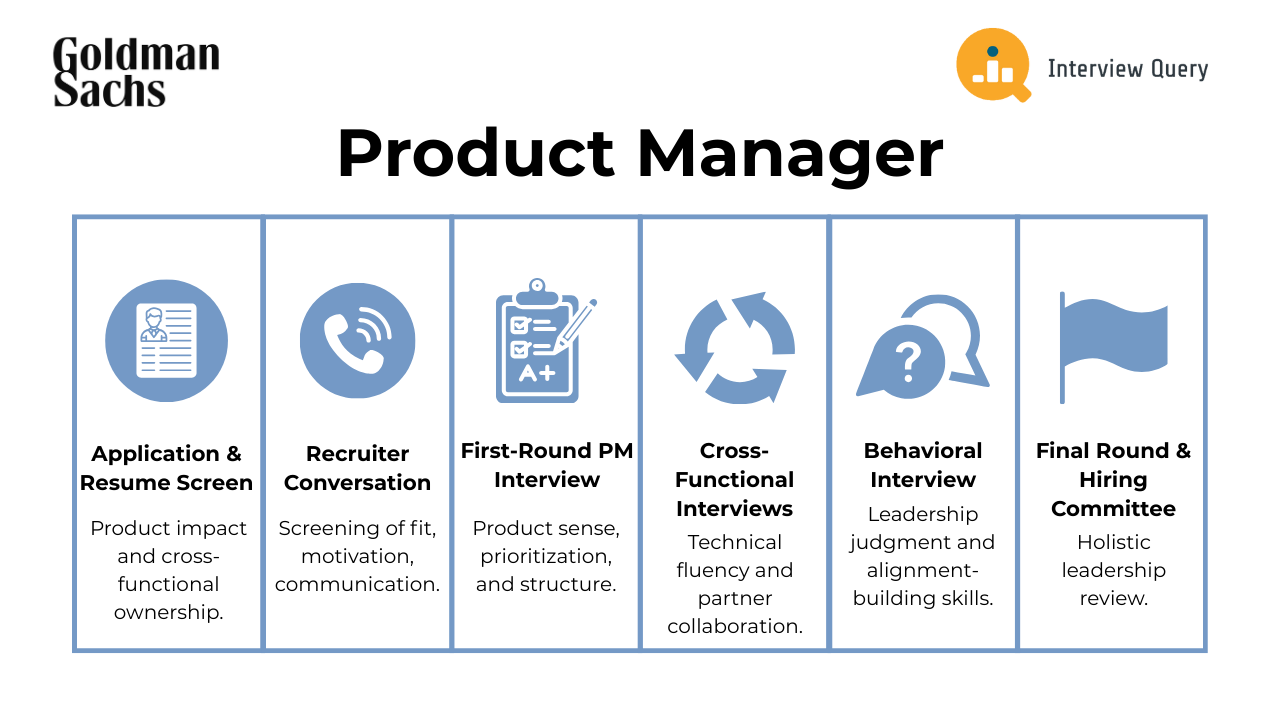
1. Application and resume screen
Recruiters and hiring managers look for candidates who demonstrate product ownership, measurable impact, and experience working across engineering and business teams. Strong resumes highlight clear outcomes, strategic decision making, and familiarity with data-driven environments such as fintech, analytics, or platform development. Showing that you have delivered high-quality features with quantifiable results is essential, particularly when those outcomes connect to improvements in financial performance, operational efficiency, or risk reduction.
2. Recruiter conversation
The recruiter screen introduces the role, confirms your background, and evaluates your communication style and motivation for joining Goldman Sachs. You can expect questions about your experience leading cross-functional teams, launching products, and navigating technical or organizational constraints. Recruiters may also explore your interest in financial technology and how your long-term goals align with the product organization. Demonstrating familiarity with key Goldman Sachs digital platforms helps signal that you understand the scope of the work.
3. First-round PM interview (product and strategy)
This round focuses on product sense, prioritization, and your ability to solve ambiguous problems with structured reasoning. Interviewers may walk through features on your resume or introduce cases involving onboarding flows, analytics tools, workflow automation, or risk-related products. You will define user needs, outline pain points, propose solutions, and explain how you would measure success. Strong candidates show a clear understanding of segmentation, thoughtful trade-offs, and the realities of designing for a regulated financial environment where data integrity and compliance shape product decisions.
4. Technical and cross-functional interviews
Depending on the team, this stage may include discussions with engineering leaders, technical partners, or quantitative stakeholders. Some conversations explore comfort with technical concepts such as APIs, system behavior, or data flows, while others emphasize how you partner with specialized teams to translate business goals into technical requirements. You may also discuss backlogs, prioritization frameworks, and key performance indicators. Interviewers look for a grounded understanding of how technical decisions affect reliability, latency, and overall product value.
5. Behavioral interview (values and leadership)
The behavioral round evaluates how you lead, make decisions, and operate under pressure. Questions often explore conflict navigation, resilience, ethical reasoning, and how you build alignment with engineering, compliance, and business stakeholders. Interviewers look for clarity, ownership, and thoughtful reflection when discussing past challenges. They want to see that you can balance competing priorities while maintaining momentum and supporting your team’s direction.
6. Final round and hiring committee
In the final stage, senior leaders or partners may hold short conversations to understand your leadership approach and long-term potential within the organization. All interview feedback is then consolidated into a hiring committee review that evaluates overall readiness and cultural alignment. Successful candidates demonstrate consistent reasoning, strong communication, and the ability to partner effectively across technical and business teams.
What questions are asked in a Goldman Sachs product manager interview?
Product Strategy & Design Interview Questions
These Goldman Sachs product sense questions evaluate how well you break down user problems, frame trade-offs, and design solutions within complex financial or operational environments. Interviewers use these scenarios to see whether your reasoning is structured, data driven, and aligned with the expectations of Goldman Sachs product teams.
Identify the Analytical Flaw in Using Lead Volume Trends to Justify Product Value
The problem challenges your ability to spot faulty causal inference—specifically why comparing different-tenure cohorts cannot prove that more leads improve retention. Goldman Sachs PMs must catch analytical gaps like survivorship and cohort bias and reframe analyses using proper comparisons. Interviewers want to see whether you guide stakeholders toward more defensible, data-driven decisions.
How Can You Prioritize Merchant Outreach to Maximize Partnership Value?
Here, you’re asked to structure a prioritization system grounded in merchant value, customer overlap, and partnership economics. Strong GS PMs approach this by turning open-ended outreach decisions into quantifiable frameworks. The goal is to show that you can evaluate opportunities logically rather than relying on intuition.
How Would You Determine the True Business Value of Renewing This Licensed Show?
The scenario prompts you to evaluate investment value by quantifying incremental acquisition, retention, and engagement. Goldman Sachs expects PMs to assess partnerships with disciplined financial thinking and clear assumptions. Interviewers look for your ability to translate behavioral data into a credible, negotiation-ready valuation.
How Would You Analyze Retention and Break-Even Economics When Shifting to a Subscription Model?
You’re asked to think through recurring revenue, payback periods, and retention thresholds when moving from one-time sales to subscriptions. GS PMs often evaluate pricing and business-model shifts that carry long-term financial impact. A strong answer shows structured logic around break-even calculations and clarity on trade-offs.
How Would You Determine Which Products to Discount for Maximum Black Friday Profit?
The prompt pushes you to identify which discounts drive real incremental profit using elasticity, margin structure, and demand patterns. Goldman Sachs values PMs who justify promotional decisions analytically. Interviewers assess whether you can design a data-backed, ROI-focused discount strategy.
Analytical & Metrics Interview Questions
These Goldman Sachs PM interview questions assess your ability to interpret metrics, diagnose issues, and translate data into actionable product decisions. Strong candidates show comfort with financial reasoning, KPI selection, and analytical frameworks used across Goldman Sachs platforms.
How Would You Derive the Lifetime Value Formula for a Subscription Product With Known Churn?
This asks you to derive LTV using churn and recurring revenue rather than relying on observed average tenure. GS PMs routinely use LTV to guide investment and acquisition decisions. Interviewers want simple, defensible financial reasoning.
How Would You Define and Use Demand–Supply Metrics in a Two-Sided Marketplace?
Here you’re expected to identify metrics—like fulfillment rate, wait time, or demand/supply ratios—that reveal marketplace balance. PMs at Goldman Sachs work with similar concepts in liquidity and throughput environments. The emphasis is on choosing meaningful metrics and explaining how they guide operational decisions.
How Would You Investigate a 10% Drop in Ad Fill Rate?
You’re asked to deconstruct a ratio metric and identify whether supply, demand, or system behavior caused the decline. GS PMs must diagnose critical metric changes quickly and logically. Interviewers look for a structured, slice-and-isolate investigation approach.
How Would You Diagnose Rising Weekly Active Users but Falling Email Open Rates?
The situation pushes you to analyze funnel shifts, segment users, and evaluate whether behavior is migrating to other entry channels. Goldman Sachs PMs are expected to interpret engagement patterns holistically. Strong answers connect the metrics and propose data-driven next steps.
How Would You Analyze Monthly vs Annual Subscriber Churn?
You’re prompted to compare churn patterns using cohort plots, survival curves, and CLV differences across plans. GS PMs must communicate retention insights clearly for pricing and revenue strategy. Interviewers look for sound method selection and concise explanations.
Technical & Cross-Functional Interview Questions
These questions test whether you can navigate technical systems, communicate clearly with engineering, and reason about long-term reliability in regulated environments. Goldman Sachs PMs often work across risk, compliance, operations, and engineering, so interviewers expect precision without jargon.
Explain an API Integration to a Non-Technical Stakeholder
This tests your ability to break down technical systems into simple, business-relevant language. Goldman Sachs PMs frequently work with risk, compliance, and operations, so clarity matters. Interviewers want to see whether you can communicate impact without jargon.
How Would You Set the Decision Threshold of a Default Risk Model to Minimize Financial Loss?
You’re asked to balance false positives and false negatives using real financial impacts. GS PMs think in terms of expected loss, not just model accuracy. Interviewers look for an explanation that ties modeling choices to business outcomes and risk tolerance.
How Would You Ensure a Recommendation Algorithm Stays Reliable Over Time?
This focuses on model governance—validating features, monitoring drift, retraining pipelines, and setting quality controls. Goldman Sachs treats ML systems with the same rigor as financial models. The goal is to show you understand long-term stability, not just initial deployment.
Design a Notification System for a Reddit-Style App
You’re asked to translate product requirements into data models, backend workflows, and scalable architecture choices. GS PMs often discuss system design with engineering teams. Interviewers want clear reasoning about trade-offs and extensibility.
Walk Through a Data Project and Its Biggest Challenges
This explores how you scope, execute, and manage a real data project, including ambiguity, data quality issues, and cross-functional coordination. At Goldman Sachs, PMs operate in complex technical environments. Interviewers value structured storytelling, ownership, and lessons learned.
Hint: Project questions give you a chance to show off your iterative process and how well you work with stakeholders.
Behavioral Interview Questions
Behavioral questions help interviewers understand how you lead, communicate, and operate under pressure in cross-functional settings. Goldman Sachs values PMs who demonstrate ownership, structured decision making, and the ability to maintain alignment across diverse stakeholders.
How Do You Handle Communication Breakdowns With Stakeholders?
You’re evaluated on how you diagnose misalignment and restore clarity with partners who have different expectations or technical backgrounds. GS PMs must prevent communication issues from derailing progress. Interviewers want to see emotional intelligence and process maturity.
How Have You Aligned Multiple Teams With Conflicting Priorities?
This highlights your ability to mediate between engineering, design, legal, risk, and business teams. Goldman Sachs PMs regularly operate under competing constraints. A strong answer shows structured prioritization and clear trade-off communication.
Describe a situation where you disagreed with leadership on product direction.
You’re assessed on your ability to use data and customer insights to challenge assumptions respectfully. GS PMs often engage with senior stakeholders and must influence without friction. Interviewers look for balanced reasoning and upward communication skills.
Tell me about a time you delivered under a tight deadline.
This reveals how you simplify scope, remove ambiguity, and execute effectively when time is constrained. Goldman Sachs faces market-driven or regulatory deadlines. Interviewers look for calm focus, prioritization, and reliability.
Describe a failure in a product you owned and what you learned.
You’re evaluated on ownership, reflection, and your approach to preventing repeat issues. GS PMs must think in terms of systems and long-term resilience. Interviewers want candid insights and actionable improvement steps.
How to prepare for a Goldman Sachs Product Manager interview
Strong goldman sachs interview prep requires mastering product strategy, technical reasoning, financial domain context, and clear communication. Because Goldman Sachs builds products that operate within strict regulatory and operational constraints, you will need to show that you can design solutions that are innovative yet disciplined, user focused, and reliable at institutional scale.
1. Strengthen your product strategy fundamentals
- Review frameworks for defining user problems, prioritizing features, evaluating trade-offs, and establishing success metrics.
- Practice applying these frameworks to financial scenarios such as onboarding flows, analytics dashboards, transaction workflows, or internal risk tools.
- Focus on clear segmentation, structured reasoning, and metrics that tie product decisions to measurable business outcomes.
2. Build technical fluency for regulated financial systems
- Refresh your understanding of systems, APIs, data flows, and how changes affect reliability and performance.
- Know how to reason about latency, throughput, error handling, and compliance constraints.
- Practice explaining technical concepts in simple, precise language that engineering leaders will respect.
You can read about official Goldman Sachs documentation for more familiarity.
3. Prepare for behavioral, cross-functional, and leadership questions
- Reflect on examples where you led without authority, navigated ambiguity, or balanced competing priorities.
- Use a structured format to describe challenges, decisions, and results.
- Emphasize collaboration with engineering, design, compliance, and quantitative partners, since alignment is critical at Goldman Sachs.
To make your preparation most effective, practice with repeatable frameworks, focus on GS-specific product scenarios, and refine your ability to explain decisions with clarity and confidence.
Average Goldman Sachs Product Manager salary
Average Base Salary
Average Total Compensation
Goldman Sachs product managers earn competitive compensation across levels, with pay varying by team, location, and product area. According to Levels.fyi, monthly compensation ranges from Analyst roles supporting early product responsibilities to Vice President roles leading large-scale platforms across markets, banking, and internal systems.
Total compensation includes base salary, annual bonus, and restricted stock units that vest over three years. Location also influences pay, with New York City offering the highest median ranges and Dallas providing slightly lower but still competitive compensation. Stock vesting increases total earnings meaningfully after year two.
Compensation by level
| Level | Total / Month | Base / Month | Stock / Month | Bonus / Month |
|---|---|---|---|---|
| Analyst | ~$9K | ~$8.2K | $0 | ~$884 |
| Associate | ~$12K | ~$11K | ~$188 | ~$1.3K |
| Vice President | ~$22K | ~$17K | ~$274 | ~$5.6K |
| Managing Director | Data not available | — | — | — |
Compensation typically rises significantly in years two and three as stock vests.
Regional salary comparison
| Region | Salary Range (Total / Month) | Notes | Source |
|---|---|---|---|
| New York City Area | ~$10K to ~$23K | Highest-paying market with strong stock and bonus components | Levels.fyi |
| Greater Dallas Area | ~$7.8K to ~$17K | Lower cost of living; compensation skews more toward base and bonus | Levels.fyi |
| United States (Overall Median) | ~$15K | Reflects median compensation across Analyst–VP levels | Levels.fyi |
Goldman Sachs compensation data shows clear progression tied to seniority, technical leadership, and impact on regulated financial products.
FAQs for Goldman Sachs Product Manager Interviews
These Goldman Sachs PM interview FAQs address the most common questions about timelines, expectations, and what Goldman Sachs hiring teams look for in strong product candidates. Use them as a quick checklist to ensure your preparation is complete.
1. How long does the Goldman Sachs product manager interview process usually take?
Timelines vary by team, but most candidates experience a process that runs from three to eight weeks. You can expect a resume screen, recruiter call, two to four interview rounds, and a final committee review, with internal candidates sometimes moving slightly faster.
2. How technical is the Goldman Sachs product manager interview?
You are not expected to write production code, but you should be comfortable discussing systems, APIs, data flows, and how technical decisions affect reliability. Teams that focus on platforms or analytics may go deeper into data and systems, while internal tooling teams emphasize workflows and stakeholder alignment.
3. Do I need a finance background to succeed in the interview?
A formal finance background is not required. Interviewers care more about your ability to reason through risk, constraints, incentives, and business impact, as well as your willingness to learn the financial specifics of your product area.
4. What does Goldman Sachs look for in strong PM candidates?
Successful PMs show structured product thinking, crisp communication, and a track record of owning measurable outcomes. Goldman Sachs hiring teams also look for candidates who can handle ambiguity, negotiate trade-offs, and work effectively with engineering, compliance, and business partners.
5. How should I prepare for behavioral questions?
Start with 8 to 10 stories that highlight leadership, conflict resolution, pressure-tested decision making, and learning from failure. Keep your structure tight and show how your choices led to measurable impact, especially in cross-functional or constrained environments.
6. What should I focus on for product sense and case questions?
Emphasize defining the user, clarifying constraints, and tying your solution to metrics that matter. Review goldman sachs pm interview questions that involve risk, onboarding, analytics, and workflow automation to build realistic preparation context.
Conclusion
Preparing for a Goldman Sachs PM interview requires mastering product strategy, analytical depth, and clear communication while understanding how financial and regulatory constraints shape product decisions. Use structured frameworks, practice realistic scenarios, and review targeted exercises like the Product Metrics Interview Learning Path to build confidence. For inspiration, explore Chandini’s story in our Interview Query success spotlight. To go further, review our full set of Goldman Sachs interview questions and continue preparing with Interview Query to strengthen every part of your goldman sachs pm interview process.
Goldman Sachs Interview Questions
| Question | Topic | Difficulty |
|---|---|---|
Data Structures & Algorithms | Easy | |
Given a string, find the first non-repeating character in it and return its index. If it doesn’t exist, return -1. Example questions: Consider a string where all characters are lowercase alphabets. Example 1: Input: Output: In the string ‘helloworld’, the first non-repeating character is ‘h’, which is at index 0. Example 2: Input: Output: In the string ‘concussion’, the first non-repeating character is ‘u’, which is at index 4. | ||
SQL | Medium | |
Product Sense & Metrics | Easy | |
SQL | Easy | |
Machine Learning | Medium | |
Statistics | Medium | |
SQL | Hard | |
Machine Learning | Medium | |
Python | Easy | |
Deep Learning | Hard | |
SQL | Medium | |
Statistics | Easy | |
Machine Learning | Hard |
Discussion & Interview Experiences