

Goldman Sachs Data Engineer Interview Guide: Process, Questions, and Tips


Introduction
Preparing for a Goldman Sachs data engineer interview means stepping into one of the most selective engineering pipelines in finance. With more than 15,000 technologists globally, Goldman Sachs relies on data engineers to build the systems that power trading, risk, reporting, and real-time analytics. This makes the Goldman Sachs data engineer interview highly technical, fast-paced, and focused on real-world problem solving across distributed systems and large-scale data platforms.
In this guide, you’ll learn what data engineers do at Goldman Sachs, how the Goldman Sachs data engineer interview process works, and the types of data engineer interview questions you can expect—covering CoderPad, SQL, Spark, system design, and behavioral rounds. You’ll also find preparation strategies and compensation benchmarks to help you prepare with structure and confidence.
What a Goldman Sachs data engineer does
Data engineers at Goldman Sachs design, build, and maintain the firm’s large-scale data platforms used across trading, risk, asset management, and internal analytics. Analysts and associates typically work within embedded engineering teams and collaborate with software engineers, quantitative strategists, and product groups. Core responsibilities include:
- Building scalable ETL and streaming pipelines that support front-office and middle-office systems.
- Designing data models for distributed storage systems such as HDFS, S3, or internal warehouses.
- Developing Spark, Python, and SQL workflows to transform structured and unstructured datasets.
- Implementing data governance, security controls, quality validation, and lineage tracking.
- Optimizing data workflows for reliability, observability, and low-latency processing.
- Partnering with traders, quants, and business stakeholders to move raw market data into production-ready form.
- Using containerized environments, cloud infrastructure, and internal developer tooling to deploy pipelines at scale.
- Supporting cross-functional engineering initiatives related to analytics, ML platforms, and system modernization.
If you want a structured way to build the skills tested in the Goldman Sachs data engineer interview, you can follow a dedicated data engineering interview learning path or browse the broader set of Interview Query learning paths to round out your SQL, modeling, and machine learning foundations.
Why this role at Goldman Sachs
The Goldman Sachs data engineer role gives you an unusual combination of scale, complexity, and career mobility. You work on real time and batch data systems that support high stakes decisions in trading, risk, and asset management, while still having access to an apprenticeship style culture where junior engineers learn directly from senior technologists. Analysts and associates can grow into platform engineering, quant data engineering, or ML infrastructure, and many engineers rotate across different businesses over time. If you are serious about building deep expertise in distributed systems and data platforms, this role offers both the technical challenge and the mentorship to accelerate that growth, especially when paired with a focused prep plan such as the data engineering interview learning path.
Goldman Sachs Data Engineer Interview Process
The Goldman Sachs data engineer interview process is designed to assess how well you can reason about data systems, write clean and efficient code, and collaborate with engineering and business partners. Across analyst and associate levels, the loop tests problem solving, distributed systems knowledge, SQL fluency, and your ability to design scalable pipelines. The structure below reflects the most common path for data engineering candidates.
Candidates searching for how to prepare as a data engineer Goldman Sachs typically face the same multistage pipeline, which includes CoderPad, SQL, distributed systems, and system design evaluations.
To prepare for a multi stage process like this, candidates often benefit from interactive practice such as mock interviews or structured preparation through the data engineering interview learning path.
| Stage | What it Covers | Format |
|---|---|---|
| Recruiter screen | Background, experience, role alignment | Phone |
| Technical screen | Coding and core CS fundamentals | CoderPad |
| Second technical interview | Distributed systems, SQL, Spark, modeling | Virtual |
| On-site loop | Coding, design, data modeling, system design | Multi round |
| Hiring committee review | Final assessment and decision | Internal |
Recruiter screen
The process begins with a conversation that clarifies whether your technical experience, preferred languages, and project background align with the demands of Goldman Sachs’ engineering teams. Recruiters typically ask about your exposure to distributed systems, ETL pipelines, object oriented coding, and your reasons for targeting Goldman Sachs specifically. This stage also sets expectations for the technical interviews that follow, including CoderPad formats and the types of skills they will test.
Tip: Highlight data engineering accomplishments that demonstrate scale, reliability, or clear business impact to build early confidence.
Technical screen (CoderPad)
The first technical evaluation focuses on your coding fundamentals. This round closely mirrors common Goldman Sachs CoderPad interview questions and includes algorithmic problems involving arrays, trees, recursion, and simple graph traversal. Interviewers look for clarity of thought, structured problem solving, and correctness—making this one of the most important coding interview stages in the entire process.
This stage is also where strong preparation in CS fundamentals pays off, especially if you reinforce it with hands on practice like the SQL interview learning path or AI-powered interview simulations.
Tip: Before coding, summarize your approach so the interviewer understands your logic and can guide you if needed.
Many candidates also encounter Goldman Sachs data structure interview questions, so reviewing stacks, queues, heaps, and hash maps is helpful during prep.
Second technical interview
This round evaluates the applied skills that matter on the job. Expect a mix of distributed systems, SQL, Spark internals, modeling tradeoffs, and scenario based reasoning. Interviewers may explore how you would partition large datasets, tune Spark jobs, compare Parquet and Avro, optimize joins, or structure a multi stage pipeline. You may also walk through schema design decisions or diagnose bottlenecks in an existing workflow. The conversation blends conceptual depth with practical engineering judgment.
| Focus Area | What They Test |
|---|---|
| Spark fundamentals | Partitioning, shuffles, execution planning |
| Distributed systems | HDFS, S3 behavior, replication, cluster dynamics |
| SQL proficiency | Window functions, query tuning, normalization |
| Data modeling | Schema design, ER diagrams, tradeoffs |
| Pipeline design | Batch vs streaming, orchestration, dependencies |
Tip: When answering, articulate at least one tradeoff to show that your thinking goes beyond mechanics and into scalable design.
Candidates who want guided system design practice often use Interview Query challenges to simulate real world scenarios or explore the broader data engineering interview learning path.
On-site interview loop
The on-site loop is the most comprehensive stage of the process and includes multiple sessions covering coding, SQL, modeling, and architecture. These rounds contain some of the most challenging Goldman Sachs data engineer interview questions, especially around pipeline design and distributed systems.
Advanced coding round
You will solve a more complex programming problem that requires structured thinking, optimization, and careful handling of edge cases. Interviewers pay close attention to whether you can improve an initial solution, justify decisions, and communicate tradeoffs.
Tip: Write a straightforward solution first, then optimize once correctness is established.
Data modeling and SQL round
This round explores how you translate business requirements into robust data structures. You may design a schema, normalize tables, discuss indexing, and write SQL queries that test both analytical and operational reasoning.
Tip: Always state the assumptions behind your schema and call out how it scales with volume or query patterns.
Distributed systems deep dive
You will discuss how large scale systems behave under load, how Spark handles execution plans, how storage formats impact performance, and how to build resilient pipelines. Expect to explain ingestion strategies, error handling, and workload optimization.
Tip: Ground your answers in real problems you solved, especially performance or reliability fixes.
End to end design and architecture round
This session evaluates your ability to design a complete data platform from ingestion to serving. The interviewer wants to see clear logical components, thoughtful data flow, and attention to observability, quality, and maintainability.
Tip: Use a consistent structure such as ingestion, storage, processing, and serving to keep your design easy to follow.
Behavioral and collaboration round
Engineering at Goldman Sachs is highly collaborative, so this round explores how you handle ambiguity, communicate tradeoffs, resolve conflicts, and work across teams. Examples from pipeline rebuilds, data migrations, or cross functional projects fit well here.
Tip: Use concrete examples and focus on the specific actions you took to move a project forward.
To sharpen your problem solving and communication before the on-site, many candidates use mock interviews for realistic practice or take-home test prep if their process includes assignment style assessments.
Hiring committee review
The hiring committee reviews feedback from each interviewer and evaluates whether your performance shows consistent strengths across coding, system design, data modeling, and communication. They look for patterns that suggest long term growth potential, ability to partner with senior engineers, and readiness for Goldman Sachs’ fast paced environment. Once aligned, the committee finalizes the decision and the recruiter communicates the outcome.
Tip: Treat every individual round as equally important since the committee makes decisions based on consistency across the entire loop.
Challenge
Check your skills...
How prepared are you for working as a Data Engineer at Goldman Sachs?
Goldman Sachs Data Engineer Interview Questions
Goldman Sachs evaluates data engineers across three major dimensions: product and strategy thinking, analytical and technical depth, and behavioral alignment with the firm’s collaborative culture. This section breaks down each category with sample questions, explanations, and targeted tips designed to mirror real interview expectations. To strengthen your preparation, you can explore structured practice resources like the data engineering interview learning path or schedule realistic mock interviews to simulate the actual loop.
Product and strategy interview questions
Goldman Sachs expects data engineers to understand how data systems support traders, risk teams, and internal product groups. These questions assess whether you can design scalable solutions, justify tradeoffs, and connect engineering decisions to business priorities. Reviewing frameworks in the data engineering interview learning path can help you strengthen your system thinking for this portion of the interview.
Choosing between batch and streaming ingestion for trading analytics
Interviewers want to understand how you choose the right ingestion model based on latency, cost, complexity, and downstream usage. Your answer should connect ingestion choices to how traders or risk teams actually consume data.
Tip: Base your recommendation on timing requirements rather than technical preferences.
Design a schema for trades and orders for analytics and compliance
This question evaluates your ability to create a structured data model that supports both flexible querying and regulatory requirements. Interviewers expect you to reference concepts like grain, normalization, immutability, and auditability.
Tip: Prioritize timestamp accuracy and unique identifiers since they are essential in financial systems.
Detecting and resolving corrupted financial data in critical pipelines
This assesses your approach to maintaining data integrity in systems that feed sensitive models. You should discuss validation checks, anomaly detection, monitoring, and safe rollback strategies that protect downstream processes.
Tip: Highlight proactive detection methods to show reliability focused thinking.
Prioritizing engineering work across competing stakeholder needs
Interviewers want to hear how you balance urgency, impact, and feasibility when several teams require engineering support. You should frame your approach around business value, risk mitigation, and effort estimation.
Tip: Reference a simple prioritization method to show consistent and structured decision making.
Evaluating the success of a new data platform feature for traders or risk teams
This question examines whether you can connect engineering improvements to measurable outcomes. Strong responses focus on latency reductions, reliability gains, adoption metrics, or improved decision quality.
Tip: Choose two or three quantifiable indicators so your evaluation feels concrete.
Design a real time market data ingestion pipeline
This question tests whether you can build reliable, low latency ingestion flows that support trading and analytics. Interviewers want to see clear thinking around ingestion, validation, processing, storage, and serving while also addressing schema drift and fault handling.
Tip: Organize your design into simple stages so the flow remains easy to follow.
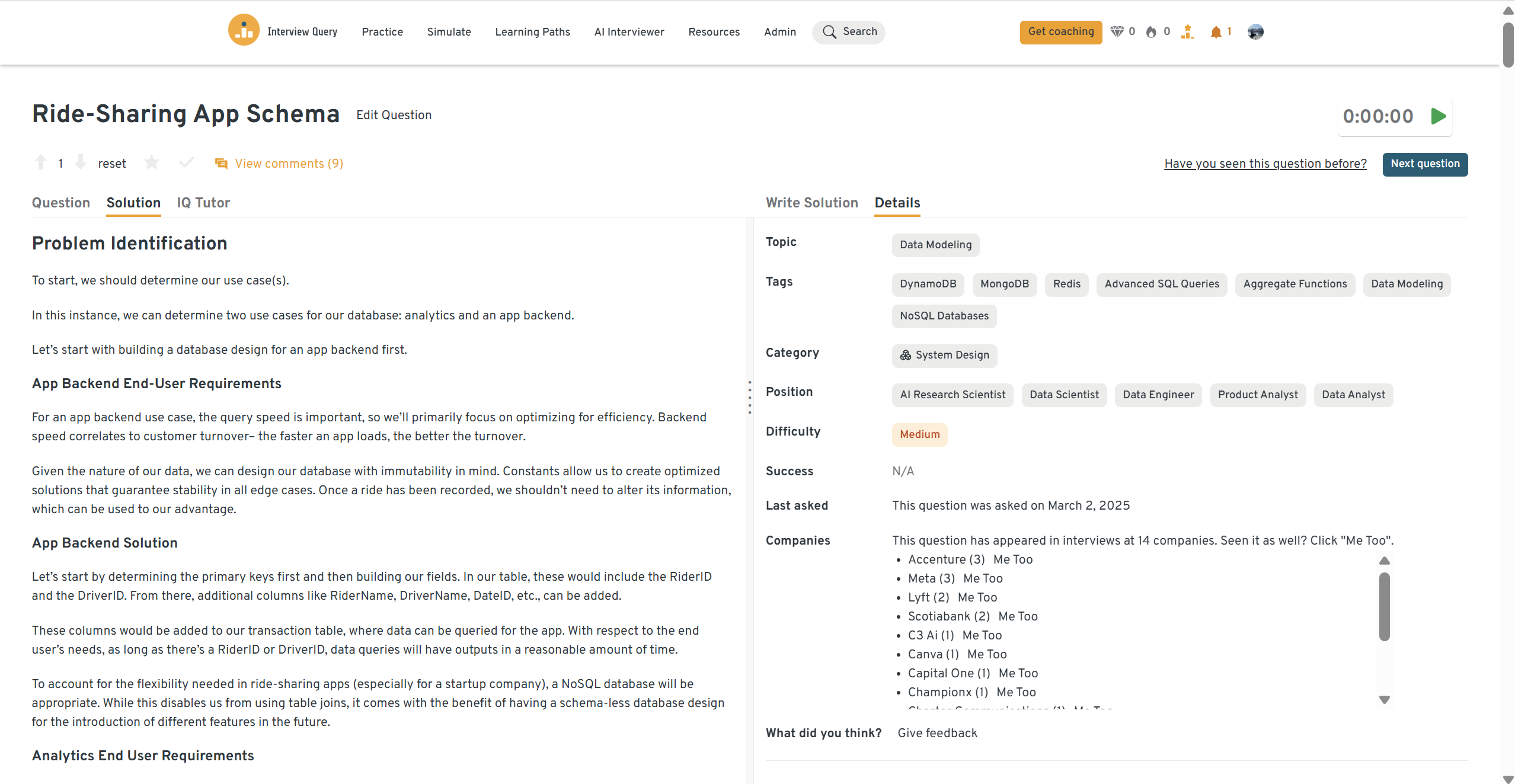
You can practice this exact problem on the Interview Query dashboard, shown below. The platform lets you write and test SQL queries, view accepted solutions, and compare your performance with thousands of other learners. Features like AI coaching, submission stats, and language breakdowns help you identify areas to improve and prepare more effectively for data interviews at scale.
Analytical and technical interview questions
Goldman Sachs evaluates data engineers on their ability to write efficient SQL, reason about distributed systems, and handle algorithmic challenges under time pressure. These questions reflect the style of the CoderPad screen, virtual technical rounds, and onsite system design sessions. Reinforcing your fundamentals through the SQL interview learning path or practicing with Interview Query challenges can help build the fluency needed for this part of the process.
-
This question tests your ability to clean up history style tables and recover the latest value using window functions or grouped ordering. Interviewers want to see if you can correctly isolate the most recent record while preventing outdated entries from leaking into the output.
Tip: Make sure to explain how your ordering column ensures accuracy in selecting the latest salary.
-
This evaluates your understanding of temporal sequences and how to identify consecutive roles with lag or lead functions. You must show precision in filtering out transitions with intervening titles to avoid miscounting.
Tip: Reference role ordering logic clearly to demonstrate control over temporal joins.
-
This question assesses your ability to apply ranking functions and perform multi column sorting. Strong responses show awareness of ties, departmental grouping, and how to produce consistent ranked results.
Tip: Use dense rank to illustrate how you maintain clean output even when salaries match.
-
This question tests date extraction, grouping, and aggregate calculations. Interviewers look for a structured approach that isolates a single year while producing accurate month level summaries.
Tip: Clarify how you extract the month component to prevent grouping inconsistencies.
How would you get the distribution of conversations created per user per day?
This evaluates your ability to transform transactional data into frequency distributions using grouping and filtering. The focus is on choosing the correct granularity and expressing distribution logic clearly.
Tip: Highlight why grouping at the user-day level prevents overcounting.
How would you optimize a slow Spark job reading a large Parquet dataset?
This question examines your understanding of distributed performance issues such as partitions, shuffles, and file sizes. Interviewers want to see if you can relate optimization steps to execution plan improvements.
Tip: Mention measurable impacts like reduced shuffle volume or improved stage completion time.
How would you detect and mitigate data skew in a Spark job?
This tests your ability to diagnose uneven key distributions that slow down distributed workloads. Strong answers include identifying skewed keys and applying solutions such as salting, repartitioning, or revising joins.
Tip: Reference how skew affects the slowest task because it determines the entire job duration.
Behavioral interview questions
Behavioral interviews at Goldman Sachs evaluate how you communicate, collaborate, and operate under pressure in an environment where engineering, risk, and business teams work closely together. These questions test whether you can navigate ambiguity, manage expectations, and contribute to high stakes projects. Practicing frameworks like STAR through mock interviews or refining responses through Interview Query coaching can help you deliver structured and confident answers.
Describe a data project you worked on. What were some of the challenges you faced?
This question evaluates how you approach complex data work, especially when dealing with uncertainty, constraints, or shifting requirements. Interviewers want to understand how you break problems down and sustain progress despite obstacles.
Tip: Highlight one specific challenge and the direct action you took to resolve it.
Sample answer: I worked on a pipeline that consolidated multiple upstream sources into a unified dataset for analytics. One challenge was inconsistent schemas causing frequent validation failures. I introduced schema checks and automated fallback logic, which reduced breakages and made the workflow more reliable.
What are some effective ways to make data more accessible to non technical people?
This explores your communication skills and ability to translate technical concepts for broader audiences. Interviewers want to see if you can empower business teams by simplifying tools and presenting information clearly.
Tip: Show that you prioritize clarity, usability, and stakeholder trust.
Sample answer: I focus on using intuitive dashboards, clear naming conventions, and documentation that explains not just how data is structured but why it matters. I also run short walkthroughs so non technical teams can use the tools confidently. This usually leads to higher adoption and fewer back and forth clarifications.
What are your strengths and weaknesses?
This question assesses self awareness and whether you can reflect honestly without undermining your candidacy. Interviewers look for strengths that align with the role and weaknesses paired with concrete improvement steps.
Tip: Choose a weakness that is real but actively being improved.
Sample answer: One of my strengths is my ability to structure problems and communicate them clearly to teammates. A weakness I have been working on is delegating tasks during fast moving projects. I addressed this by planning work collaboratively and sharing ownership earlier in the process.
Talk about a time when you had trouble communicating with stakeholders. How did you overcome it?
This evaluates your ability to manage expectations and maintain alignment across teams. Communication gaps often arise in data projects, so the interviewer wants to hear how you handle misunderstandings constructively.
Tip: Emphasize what you changed in your approach rather than blaming the stakeholder.
Sample answer: I once worked with a team that needed reporting updates but was unclear about data definitions. I scheduled a short alignment session to clarify terminology and created a simple glossary to guide future discussions. This resolved the confusion and made future collaboration smoother.
Why do you want to work with us?
This question reveals how well you understand Goldman Sachs’ environment, engineering culture, and long term opportunities. Interviewers want to see motivation grounded in substance rather than generic statements.
Tip: Connect your answer directly to Goldman’s engineering values or data ecosystem.
Sample answer: I want to work at Goldman Sachs because the engineering teams operate at the intersection of data, finance, and high scale systems. I am excited by the opportunity to build pipelines that support trading, risk, and analytics in fast moving environments. The apprenticeship culture also aligns with how I like to grow as an engineer.
Tell me about a time you had to quickly learn a new system or tool to deliver on a tight deadline.
This assesses how you operate when adapting to unfamiliar systems under pressure. The interviewer wants evidence that you can ramp up quickly while maintaining reliability and accuracy.
Tip: Focus on how your learning approach reduced risk and accelerated delivery.
Sample answer: When joining a project mid cycle, I had to learn an internal orchestration tool within a few days. I set aside focused blocks to read documentation and paired with a teammate to validate my understanding. This allowed me to complete my tasks on time and contribute to stabilizing the pipeline.
If you want deeper practice, you can explore the full set of 100+ data engineer interview questions with answers. This walkthrough by Interview Query founder Jay Feng covers 10+ essential data engineering interview questions—spanning SQL, distributed systems, pipeline design, and data modeling.
How To Prepare For A Goldman Sachs Data Engineer Interview
Succeeding in the Goldman Sachs data engineer interview means combining strong fundamentals with clear communication and domain awareness. The most effective prep plan blends targeted practice in SQL, distributed systems, and data modeling with realistic interview simulations through tools like the data engineering interview learning path and focused practice resources on Interview Query.
Master SQL and window functions
SQL is central to the interview, especially queries involving time series, ranking, and history style tables. Focus on joins, aggregates, window functions, and scenario based problems using resources like the SQL interview learning path and dedicated SQL scenario questions.
Tip: Practice explaining each query in plain language so you can walk interviewers through your logic confidently.
Drill distributed systems and Spark fundamentals
You will be expected to reason about partitions, shuffles, file formats, and performance tuning on large datasets. Review how Spark plans queries, handles skew, and interacts with storage formats such as Parquet, and reinforce these concepts through the data engineering interview learning path.
Tip: When studying any Spark concept, pair it with a concrete example of a performance issue and how you would fix it.
Practice data modeling and schema design
Many questions require designing schemas for orders, trades, or logs that support both analytics and compliance. Work through modeling exercises and use Interview Query challenges to practice structuring data for real world scenarios.
Tip: Always state the grain of each table and how it supports downstream use cases to keep your designs grounded.
Sharpen your coding problem solving
Coding rounds still test arrays, strings, maps, and algorithmic thinking, even for a data engineer. Use challenges on Interview Query and, if relevant, explore broader practice via the AI powered interview tools to build speed and reduce errors.
Tip: Solve problems in stages, first aiming for correctness, then discussing possible optimizations once you have a working approach.
Rehearse behavioral answers with structure
Behavioral questions often determine how strongly you are recommended by interviewers. Prepare stories around pipeline failures, stakeholder communication, and process improvements, then refine them using STAR in mock interviews or with mentors through Interview Query coaching.
Tip: For each story, be explicit about your individual contribution rather than only describing the team’s work.
Simulate full interview flow with mocks and take homes
Practicing in conditions that resemble the real loop helps reduce anxiety and reveal weak spots. Combine live mock interviews with targeted take home test practice so you can handle both live problem solving and longer form case style assignments.
Tip: After each simulation, write down one technical skill and one communication habit to improve before the next session.
Build intuition for financial data workflows
Even without deep finance experience, understanding basic trading, risk, and reporting workflows will make your answers more relevant. Skim case studies about data in banks and browse different company profiles on the Interview Query companies page to see how data roles show up in practice.
Tip: Learn a few concrete examples of how bad data or delayed data could affect financial decisions and reference them when discussing tradeoffs.
Average Goldman Sachs Data Engineer Salary
Goldman Sachs offers competitive compensation for data engineers, and many candidates specifically search for Goldman Sachs data engineer salary ranges before interviewing. According to Levels.fyi, data engineer compensation in the United States ranges from $113K per year for Analysts to $235K per year for Vice Presidents, with a median yearly package of $210K. Compensation typically includes a mix of base salary and annual bonus, with stock appearing more frequently at senior levels.
| Level | Total Compensation | Base Salary | Stock Value | Bonus |
|---|---|---|---|---|
| Analyst (Entry Level) | $113K | $90K | $0 | $23K |
| Associate | $157K | $132K | $0 | $25K |
| Vice President | $235K | $180K | $3.9K | $51K |
Data reflects U.S. compensation as reported on Levels.fyi and may vary depending on team, office location, and year.
Average Base Salary
Average Total Compensation
FAQs
What skills does Goldman Sachs look for in data engineers?
Goldman Sachs prioritizes strong SQL fundamentals, distributed systems knowledge, and data modeling experience. They also value communication skills since data engineers collaborate closely with traders, risk teams, and software engineering groups.
How technical is the Goldman Sachs data engineer interview?
The interview is highly technical and includes SQL challenges, distributed systems questions, Spark optimization scenarios, and CoderPad coding rounds. You should expect a balanced focus on both conceptual understanding and hands on problem solving.
Do I need a finance background to apply?
A finance background is not required. However, familiarity with concepts like market data, trades, orders, and reporting workflows helps you connect technical decisions to business impact. Demonstrating domain curiosity is beneficial but not mandatory.
How many interview rounds are typical?
The Goldman Sachs interview process for data engineers typically includes a recruiter screen, CoderPad round, one or two virtual technical interviews, an onsite loop, and a final hiring committee review.
What languages should I use in the CoderPad round?
Goldman Sachs allows mainstream languages such as Python, Java, and Scala. Choose the language you are fastest and most accurate in, especially for algorithmic problems. Python is common because of its readability and speed during interviews.
How can I prepare for the SQL portion of the interview?
Focus on joins, window functions, ranking, and time based filtering, which show up frequently in GS interview questions. Practicing through the SQL interview learning path or the SQL scenario question set helps reinforce these patterns.
Are take home assignments part of the process?
Some teams include a take home assessment focused on SQL analysis, data modeling, or pipeline design. You can practice similar case studies using Interview Query’s take home test prep to build familiarity.
How important are behavioral interviews at Goldman Sachs?
Behavioral interviews carry significant weight because the firm values collaboration and communication. You will be assessed on how you work with stakeholders, resolve conflicts, and respond under pressure. Practicing with mock interviews can help refine your delivery.
Does Goldman Sachs expect system design knowledge for junior roles?
Yes. Even at the analyst and associate levels, you’re expected to understand ingestion pipelines, storage strategies, and validation layers. The designs do not need to be complex, but they must be logical, scalable, and structured.
How long does the interview process usually take?
Most candidates complete the process within three to six weeks depending on scheduling, team availability, and number of interview rounds. Recruiters typically outline the full timeline during the initial screen.
Start Your Goldman Sachs Data Engineer Interview Prep Today
Preparing for Goldman Sachs data engineer interviews is much easier when you follow a structured path and practice the exact skills the role demands. Whether you want to sharpen your SQL fundamentals, refine your system design intuition, or strengthen your behavioral storytelling, Interview Query gives you the tools to move with confidence.
Explore targeted learning through the data engineering interview learning path, practice SQL and analytical problems with curated Interview Query challenges, or build real interview readiness through live mock interviews. Start preparing today and walk into your Goldman Sachs interviews with clarity, structure, and momentum.
Goldman Sachs Interview Questions
| Question | Topic | Difficulty |
|---|---|---|
Data Structures & Algorithms | Easy | |
Given a string, write a function Treat upper and lower case letters as distinct characters. You may assume the input string includes no spaces. Example 1: Input: Output: Example 2: Input: Output: | ||
Data Structures & Algorithms | Easy | |
Data Structures & Algorithms | Medium | |
SQL | Easy | |
Machine Learning | Medium | |
Statistics | Medium | |
SQL | Hard | |
Machine Learning | Medium | |
Python | Easy | |
Deep Learning | Hard | |
SQL | Medium | |
Statistics | Easy | |
Machine Learning | Hard |
Discussion & Interview Experiences