

Walmart Product Manager Interview Guide – Process, Questions, and Tips


Introduction
If you’re preparing for a Walmart product manager interview, you’re targeting a role at the heart of global retail innovation. Walmart’s PMs shape digital and physical product experiences for millions of weekly shoppers, driving impact at a scale few companies can match. The interview process is designed to assess your ability to blend data-driven decision-making, cross-functional leadership, and customer-centric strategy in a fast-paced, tech-enabled environment. You’ll face questions that test your product sense, technical acumen, and ability to deliver measurable results, reflecting Walmart’s commitment to operational excellence and continuous improvement. Mastering this process positions you to influence the future of omnichannel retail, leveraging the latest AI and data platforms to solve complex, real-world problems.
Role Overview & Culture
In this role, you’ll own the end-to-end lifecycle of omnichannel retail products, from ideation to launch, impacting both customer and associate experiences at a massive scale. You’ll leverage Walmart’s deep data assets and AI-powered analytics to inform strategy, drive rapid experimentation, and iterate on solutions that span online, in-store, and mobile channels. The culture prizes speed, adaptability, and a willingness to challenge conventions, empowering you to test bold ideas and learn quickly from outcomes. You’ll collaborate closely with engineers, designers, and business partners, fostering a culture of innovation, knowledge-sharing, and continuous improvement. Your ownership extends to defining product vision, prioritizing roadmaps, and ensuring measurable results, all within a data-driven, customer-first environment.
Why This Role at Walmart?
Joining Walmart as a product manager means operating at unparalleled scale—serving over 255 million customers weekly across 10,750+ stores and a rapidly growing e-commerce platform. You’ll harness cutting-edge AI tools and robust data infrastructure to deliver seamless, personalized experiences, while supporting 1.5 million associates with next-generation technology. Compensation is highly competitive, with total packages ranging from $109K to $769K, and a median of $285K, reflecting the company’s commitment to attracting top talent and supporting career growth through clear advancement ladders. Walmart’s focus on innovation, operational excellence, and measurable ROI creates an environment where your impact is both immediate and far-reaching. If you’re ready to shape the future of retail, the next step is to excel in Walmart’s rigorous, multi-stage interview process, where your product vision, technical expertise, and leadership will be put to the test.
What Is the Interview Process Like for a Product Manager Role at Walmart?
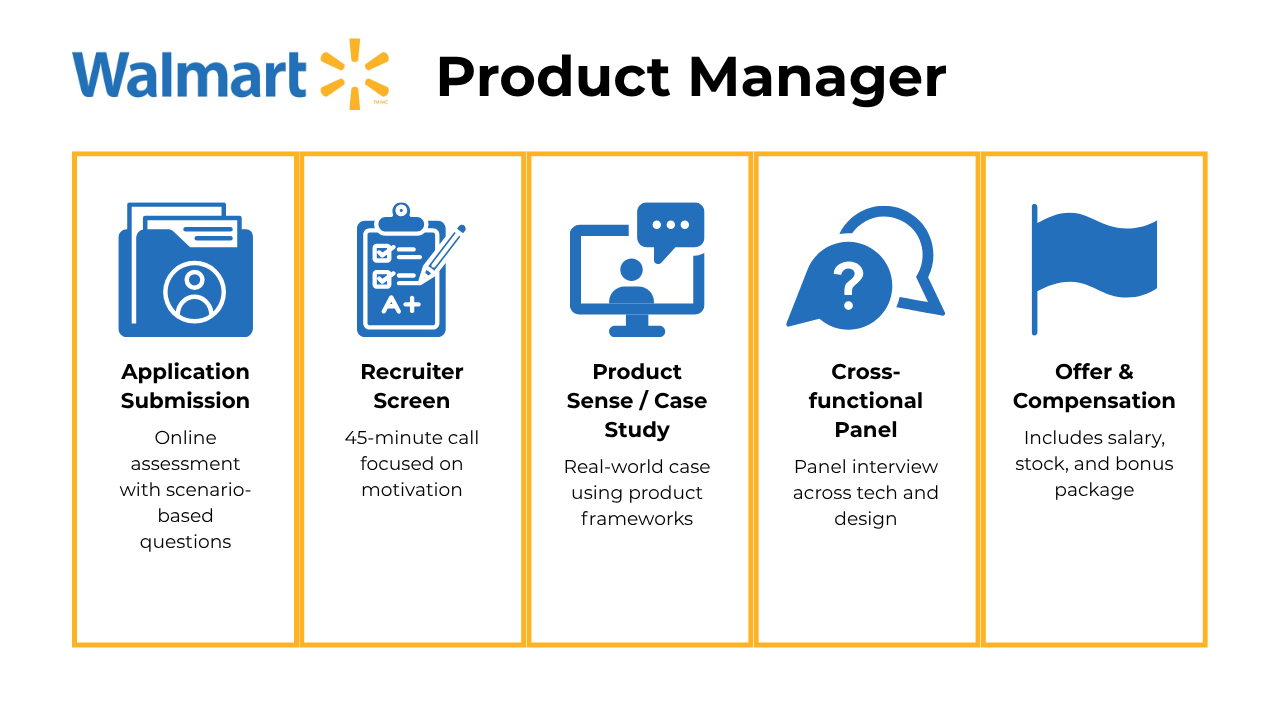
The Walmart product manager interview process is a rigorous, multi-stage evaluation designed to assess your technical expertise, leadership, and cultural fit. The interview process for Walmart PMs blends behavioral, case-based, and cross-functional assessments, ensuring you can thrive in a fast-paced, data-driven environment. You’ll navigate through several structured rounds like:
- Application Submission
- Recruiter Screen
- Product Sense / Case Study (virtual)
- Cross-functional Panel (engineering, design, analytics)
- Offer & Compensation
Application Submission
You start by submitting your application through Walmart’s official careers portal, targeting roles that match your experience and aspirations. Here, you’ll upload your resume and complete a detailed assessment that gauges your fit for the product manager role, including scenario-based questions on leadership, problem-solving, and customer empathy. The system uses advanced screening algorithms to filter for candidates with a strong background in tech-driven product management, especially those who demonstrate experience with AI, data analytics, or large-scale e-commerce. Given Walmart’s high application volume, ensure your application is tailored to highlight measurable outcomes and leadership in cross-functional projects. If shortlisted, your application is reviewed by a personnel associate before proceeding to the next stage.
Recruiter Screen
In this 30–45 minute phone interview, you’ll engage with a recruiter focused on your background, motivation, and alignment with Walmart’s mission. Expect questions about your product management journey, major projects, and why you want to join Walmart at this point in your career. You’ll need to articulate your experience driving impact at scale, managing ambiguity, and collaborating across functions. The recruiter will probe your understanding of Walmart’s customer-centric culture, omnichannel strategy, and recent tech innovations. This is your opportunity to show enthusiasm for Walmart’s growth and readiness for the challenges of a global retail leader.
Product Sense / Case Study (virtual)
This round is a deep dive into your product thinking, problem-solving, and customer empathy, typically conducted virtually. You’ll tackle a real-world case—such as designing a new feature for Walmart’s mobile app or improving retention—using structured frameworks like CIRCLES or RICE. Interviewers expect you to break down complex problems, prioritize features, and justify decisions with data and customer insights. You’ll be evaluated on your ability to balance business goals, technical feasibility, and user experience, reflecting Walmart’s focus on rapid experimentation and measurable outcomes. Prepare to discuss trade-offs, metrics, and how you’d leverage AI or analytics to drive results.
Cross-functional Panel (engineering, design, analytics)
In this high-stakes round, you’ll face a panel of Walmart leaders from engineering, design, and analytics. Each session tests your ability to collaborate, influence, and communicate across disciplines. You’ll field behavioral and situational questions, present solutions to technical challenges, and demonstrate how you align product strategy with Walmart’s omnichannel vision. Expect to discuss stakeholder management, conflict resolution, and how you’ve driven innovation in past roles. This round is critical for assessing your leadership, adaptability, and ability to thrive in Walmart’s fast-paced, data-driven environment.
Offer & Compensation
If you excel in the previous rounds, you’ll receive a formal offer detailing base salary, stock, and bonus, ranging from $109K to $769K depending on level, with a median package of $285K. The offer process includes final reference checks and may involve a discussion with senior leadership or a bar-raiser to ensure rubric alignment and cultural fit. You’ll review Walmart’s career ladders, growth opportunities, and onboarding steps, setting the stage for your impact on the world’s largest retailer. The process closes with background checks and orientation, preparing you for a high-impact start.
Challenge
Check your skills...
How prepared are you for working as a Product Manager at Walmart?
What Questions Are Asked in a Walmart Product Manager Interview?
Preparing effectively for your Walmart product manager interview involves becoming familiar with typical Walmart product manager interview questions, as well as understanding broader Walmart product management interview questions that emphasize strategic thinking and execution.
Product Sense & Vision Questions
These questions evaluate your ability to empathize with users, size markets, and prioritize trade-offs effectively:
1. Explain what is unique about the Adam optimization algorithm
The Adam optimization algorithm is unique because it combines the benefits of two other optimization methods: RMSProp and Momentum. It uses adaptive learning rates for each parameter and incorporates momentum to accelerate convergence. This makes Adam particularly effective for training deep neural networks, as it handles sparse gradients and noisy data well. Benefits include faster convergence, robustness to hyperparameter tuning, and suitability for large-scale problems.
To solve this, use techniques like fuzzy string matching or machine learning algorithms to identify similar product names, such as “iPhone X” and “Apple iPhone 10.” This may include using libraries like Python’s fuzzywuzzy, NLP-based similarity measures, or embedding-based approaches, coupled with manual verification for ambiguous cases.
3. Given a SaaS company, calculate the formula for average lifetime value (LTV)
To calculate LTV, use the formula (LTV = \sum_{i=0}^{\infty} 100 \cdot 0.9^i), where 100 is the monthly subscription cost and 0.9 represents the retention rate after accounting for 10% churn. This infinite geometric series converges to (LTV = 100 \cdot 10 = $1000). The calculation accounts for the expected value of retained customers over time.
4. Given a call center scenario, build a model to allocate the correct number of agents
To address this, a predictive model such as a time-series forecasting model or a queuing model can be used to estimate the number of agents required based on historical call volume data, time of day, and other factors. Metrics like service level (percentage of calls answered within a specific time), average wait time, and agent utilization rate can be used to evaluate the model’s effectiveness. Over-allocation ensures customer satisfaction but may increase costs, while under-allocation risks poor service quality. Balancing these trade-offs is key.
To create a refund policy, start by categorizing refund scenarios (e.g., late delivery, incorrect order, poor food quality) and defining clear guidelines for each. Balance customer goodwill by offering refunds or credits for valid complaints while minimizing revenue loss by setting thresholds or limits. Use data to analyze the impact of refunds on customer retention and satisfaction, and iterate the policy based on feedback and outcomes.
Execution & Metrics Questions
These questions test your analytical abilities, focusing on KPIs, A/B testing strategies, and your skill in performing root-cause analysis:
6. Why would the number of applicants on a job board steadily decrease despite consistent job postings?
To investigate this, start by asking clarifying questions about the scope, timing, and user journey. Analyze external factors like economic conditions, competitor actions, or industry trends, and internal factors such as changes in the application process or user experience. Consider the job board as a two-sided marketplace and perform funnel analysis to identify where users might drop off.
7. How would you determine what percentage of pins should be videos?
To determine the percentage of pins that should be videos, analyze user engagement metrics such as click-through rates, time spent on video pins, and overall retention compared to static pins. Conduct A/B tests with varying proportions of video pins to identify the optimal percentage that maximizes engagement and audience growth. For search results, evaluate user behavior and preferences, ensuring video pins enhance search relevance and user satisfaction.
To validate the decline, perform a hypothesis test (e.g., t-test) to determine if the observed reduction is statistically significant. Structure the analysis by first defining the null hypothesis (the decline is random), then collecting DAU data over multiple weeks, and finally testing for significance. Additionally, analyze trends, seasonality, and external factors to rule out other explanations.
9. What business-relevant hypotheses can you think of based on out-of-stock inventory metrics?
To analyze the out-of-stock inventory data, you could hypothesize that companies completely free of stock-outs have better supply chain management or demand forecasting. For companies with stock-outs in only one country, you might investigate regional supply chain inefficiencies or localized demand surges. For companies with simultaneous stock-outs in multiple countries, global supply chain disruptions or systemic issues could be the cause. These hypotheses can guide further investigation into operational or logistical improvements.
10. What metrics would you use to determine the value of each marketing channel?
To determine the value of each marketing channel, focus on the key metric of marketing ROI (revenue over expenses). First-level metrics include Customer Lifetime Value (CLV), calculated as average revenue per customer divided by churn rate, and Customer Acquisition Cost (CAC), which accounts for expenses incurred to acquire one customer. Second-level metrics such as cost per view, conversion rates, and upgrade rates further refine the analysis.
Technical Collaboration Questions
Expect these Walmart product management interview questions to explore your proficiency in collaborating closely with engineers and clearly explaining technical concepts:
11. How do you work with engineers to scope a technically complex feature?
Approach: Begin by outlining the user or business need. Partner with engineering to explore different implementation paths, constraints, and dependencies. Ask for trade-off scenarios and effort estimates. Your role is to clarify requirements, prioritize scope based on business value, and ensure everyone is aligned on the definition of done.
12. Describe a situation where engineering pushed back on your product idea. How did you handle it?
Approach: Highlight listening and mutual respect. Share how you invited engineering input early, sought to understand technical constraints, and discussed alternatives. If a compromise was reached, explain how it still met core business goals. If not, describe how you documented trade-offs and re-prioritized effectively.
13. How do you ensure the product you’re building is technically scalable and maintainable?
Approach: During planning, consult engineers about potential technical debt, performance bottlenecks, and long-term maintainability. Ask questions about architecture and scaling strategies. You don’t need to design the system, but you should guide priorities around MVP vs. scalability trade-offs and advocate for testing and monitoring frameworks.
Leadership & Behavioral Questions
Interviewers use these questions to assess your skills in aligning stakeholders, resolving conflicts, and demonstrating leadership in challenging scenarios:
14. Why Do You Want to Work With Us
Walmart looks for candidates who resonate with its mission to help people save money and live better. When answering this question, research Walmart’s digital transformation efforts, investments in omnichannel commerce, and leadership in supply chain innovation. Align your skills and goals with Walmart’s initiatives, such as improving the online shopping experience, scaling technology across stores, or leveraging data for personalization. Your response should reflect genuine enthusiasm and demonstrate that you’re not just applying broadly but see a specific fit between your background and Walmart’s vision.
15. Describe an analytics experiment that you designed. How were you able to measure success?
Walmart values PMs who apply structured thinking to solve business problems at scale. Talk about an experiment you led, such as testing a new feature in a shopping app or optimizing a checkout flow. Define the hypothesis clearly, outline how you chose success metrics (like conversion rate or average basket size), and explain how you validated results with A/B testing or statistical models. Highlight how your analysis led to concrete business decisions, and if possible, tie the outcome to user or revenue impact.
16. How would you convey insights and the methods you use to a non-technical audience?
In a large and cross-functional company like Walmart, product managers often need to align engineering, marketing, operations, and leadership. Use this question to show how you break down complex analyses into business-friendly narratives. Share an example where you translated metrics or experimental results into insights that helped drive alignment. Emphasize using frameworks, visual aids, or analogies that help non-technical stakeholders engage with the data and make confident decisions.
17. Describe a data project you worked on. What were some of the challenges you faced?
Data is central to Walmart’s product decision-making. In your response, walk through a data project from start to finish. This could involve analyzing customer feedback to inform product prioritization or building a dashboard to monitor operational KPIs. Focus on challenges like data quality, stakeholder buy-in, or changing requirements. Show how you navigated these issues through collaboration, iteration, and adaptability—skills essential in Walmart’s fast-paced, high-scale environment.
How to Prepare for a Product Manager Role at Walmart
To excel in a Walmart product manager interview, candidates must thoroughly prepare by mastering essential product management frameworks. Familiarize yourself with the product sense framework, starting from clearly defining the problem, understanding target users, identifying key value propositions, and determining a viable MVP.
Additionally, Walmart’s scale demands the ability to quantify impact using relevant, large-scale metrics, such as user engagement, sales volumes, or efficiency gains. Practicing timed case studies, especially those completed within 45 minutes, sharpens your skills in structured thinking, prioritization, and decision-making under pressure. Engaging in mock interview panels with cross-functional stakeholders provides critical feedback and simulates real-world collaboration, further enhancing communication and presentation skills.
Moreover, refreshing your knowledge of retail trends, ecommerce operations, and supply-chain logistics is essential, as these domains significantly influence product strategies at Walmart. Understanding the company’s unique business environment and its focus on operational excellence allows you to contextualize your insights effectively.
By systematically combining frameworks, quantitative reasoning, practice with AI Interviewer, and industry-specific knowledge, you can confidently demonstrate the holistic and strategic thinking Walmart seeks in successful product managers.
FAQs
What salary range can PMs expect at Walmart?
Average Base Salary
Average Total Compensation
How long is the Walmart PM hiring timeline?
The Walmart product manager interview process typically spans about 4–6 weeks, from initial recruiter screening to final interviews and offer decisions. Timelines can vary based on team urgency, role seniority, and candidate availability, but most candidates report a timeframe within this range.
Are there coding questions for PMs?
Walmart product manager roles generally do not include coding questions during interviews. Instead, interviews strongly emphasize technical collaboration skills. You should be ready to discuss technical concepts clearly, collaborate with engineering teams effectively, and demonstrate a strong understanding of product-technology intersections.
Where can I read candidate experiences?
For detailed candidate experiences and insights, you can explore our forum threads specifically tagged with “Walmart product manager interview.” These forums provide firsthand accounts of interview questions, processes, and practical advice from those who have previously applied.
Conclusion
By thoroughly reviewing key Walmart product manager interview questions and consistently practicing structured product sense drills, you position yourself effectively for success in Walmart’s rigorous hiring process. To further strengthen your preparation, explore our structured Product Metrics Learning Path tailored specifically for Walmart product management roles. You can also gain confidence by reading through Simran Singh’s success story detailing her journey from interview prep to offer acceptance. Moreover, deepen your preparation by browsing our extensive question collection covering product management scenarios, strategic thinking, and analytical insights that Walmart highly values.
Walmart Interview Questions
| Question | Topic | Difficulty | ||||||||||||||||||||||
|---|---|---|---|---|---|---|---|---|---|---|---|---|---|---|---|---|---|---|---|---|---|---|---|---|
SQL | Easy | |||||||||||||||||||||||
We’re given two tables, a Write a query that returns all neighborhoods that have 0 users. Example: Input:
Output:
| ||||||||||||||||||||||||
SQL | Medium | |||||||||||||||||||||||
SQL | Medium | |||||||||||||||||||||||
SQL | Easy | |
Machine Learning | Medium | |
Statistics | Medium | |
SQL | Hard | |
Machine Learning | Medium | |
Python | Easy | |
Deep Learning | Hard | |
SQL | Medium | |
Statistics | Easy | |
Machine Learning | Hard |
Discussion & Interview Experiences