

Deloitte Growth Marketing Analyst Interview Guide: Process, Questions, and Prep


Introduction
A Deloitte growth marketing analyst interview is built for a world where marketing is no longer “creative plus budget,” but an operating system measured in experiments, attribution, and incremental lift. Global advertising revenue is projected to reach about $1.08 trillion, and digital accounts for roughly 73% of that total, which means the fastest way to win is often the fastest way to measure.
Deloitte sits at the center of that shift. The firm recently reported aggregate global revenue of $70.5B and a workforce of more than 470,000 people, serving organizations that run complex, multi-channel growth problems at scale. In the interview, Deloitte is not just looking for someone who can build dashboards or pull SQL, but someone who can translate messy performance signals into clear decisions: what to test next, what to stop funding, and what story the data actually supports.
Deloitte Growth Marketing Analyst Interview Process
The Deloitte growth marketing analyst interview process is designed to assess whether you can translate marketing data into decisions in complex, client-facing environments. Rather than testing marketing theory in isolation, Deloitte evaluates how you analyze performance, structure ambiguous growth problems, and communicate insights to stakeholders who care about ROI, scale, and execution.
While the exact structure varies by geography and team, most candidates complete the process in four to six weeks and move through several distinct stages.
Interview Process Summary
| Interview stage | What happens |
|---|---|
| Recruiter screen | Background, motivation, communication, and baseline fit |
| Online assessment (if applicable) | Quantitative reasoning, logic, and data interpretation |
| Technical or analytics interview | SQL, Excel, dashboards, KPIs, and performance diagnosis |
| Marketing or growth case interview | Structured problem-solving for real marketing scenarios |
| Final leadership round | Judgment, client readiness, and executive communication |
Recruiter Screen
This is typically a 30-minute conversation with Talent Acquisition focused on understanding your background, interest in Deloitte, and alignment with the growth marketing analyst role. Expect questions about your experience with marketing data, analytics tools, and how you have supported decision-making in past roles.
Interviewers are also evaluating communication clarity and whether you understand what working in a consulting environment entails, including client-facing work and fast-paced delivery.
Tip: Be ready to explain why Deloitte’s consulting-led marketing work appeals to you, not just why you enjoy analytics.
Online Assessment (If Applicable)
Some candidates are asked to complete an online assessment that tests numerical reasoning, logical thinking, and judgment. These assessments are not marketing-specific but are designed to evaluate how cleanly you reason with data under time pressure.
You may encounter questions involving percentages, ratios, trends, or interpreting short data scenarios. Accuracy and clarity matter more than speed alone.
Tip: Write out what each question is actually asking before calculating anything to avoid misreading the problem.
Technical or Analytics Interview
This round focuses on whether you can do the core analytical work required for the role. You may be asked to walk through how you would analyze campaign performance, define KPIs, clean a dataset, or explain how you would build a dashboard for stakeholders.
SQL and Excel are common in this stage, along with questions about funnels, attribution, A/B testing, and ROI measurement. Interviewers care about how you structure analysis and explain results, not just whether you get the “right” number.
Candidates often prepare for this round using Interview Query’s SQL interview questions and marketing analytics questions.
Tip: Always connect your analysis to a decision, such as what to scale, fix, or test next.
Marketing or Growth Case Interview
This stage evaluates how you apply analytics to real growth problems. You may be given a scenario such as declining conversion rates, rising customer acquisition costs, uneven channel performance, or unclear attribution across touchpoints.
Interviewers assess how you clarify the objective, segment the problem, form hypotheses, and propose analyses or experiments. The goal is not to list tactics, but to show structured thinking and prioritization under ambiguity.
Practicing similar scenarios through Interview Query’s marketing analytics case studies can help build confidence.
Tip: Start by isolating whether the issue is measurement, audience, channel, creative, or experience before suggesting solutions.
Final Leadership Round
The final round is often conducted with a manager, director, or partner and focuses on judgment, communication, and client readiness. You may be asked to walk through a past project end to end, explain trade-offs you made, or defend recommendations when data was incomplete.
Interviewers want to see whether you can present insights clearly, handle pushback, and maintain credibility with senior stakeholders.
Tip: Lead with your recommendation first, then support it with data and reasoning.
If you want to know more, here is a video that breaks down the career growth opportunities, highlights what makes marketing analytics unique, and shares expert tips on navigating common interview questions for aspiring analysts. Whether you’re exploring marketing analytics for the first time or preparing for your next big interview, this video will help you understand exactly what it takes to succeed in one of tech’s most data-driven marketing roles.
Challenge
Check your skills...
How prepared are you for working as a Marketing Analyst at Deloitte?
Deloitte Growth Marketing Analyst Interview Questions
Deloitte growth marketing analyst interview questions are designed to evaluate how you use data to diagnose performance issues, prioritize growth opportunities, and communicate insights in client and enterprise contexts. Interviewers care less about marketing buzzwords and more about whether you can connect analysis to decisions that improve ROI, customer experience, and long-term growth.
Questions typically span three areas: analytics and SQL fundamentals, growth and marketing strategy, and behavioral judgment in stakeholder-heavy environments. Many candidates prepare using applied prompts from Interview Query’s analytics and marketing question banks, then refine delivery through mock interviews.
Analytics, SQL & Measurement Questions
These questions assess whether you can work with real marketing data, extract insights cleanly, and translate metrics into actions. Deloitte interviewers pay close attention to how you structure queries and explain results to non-technical stakeholders.
How would you identify users who are likely to churn based on recent activity?
This question tests your ability to translate behavioral signals into actionable segments. Interviewers look for how you define inactivity, choose thresholds, and connect findings to retention or reactivation strategies.
Tip: Clearly define churn signals before writing queries, then explain how the output would change a marketing decision.
How would you calculate monthly retention for a subscription or recurring user base?
This evaluates cohort analysis and lifecycle thinking. Deloitte expects you to explain not just how to calculate retention, but why it matters for forecasting growth and ROI.
Tip: Tie retention cohorts to downstream metrics like lifetime value or campaign effectiveness.
How would you design a dashboard to track performance across multiple marketing channels?
Interviewers assess whether you can prioritize the right KPIs for decision-makers. The goal is clarity, not comprehensiveness.
Tip: Anchor the dashboard around decisions stakeholders need to make, not every metric available.
What is the downside of relying only on R-squared to evaluate model performance?
This tests statistical judgment rather than math. Deloitte uses questions like this to see if you understand limitations and risks in analytical conclusions.
Tip: Explain how misusing the metric could lead to poor budget or targeting decisions.
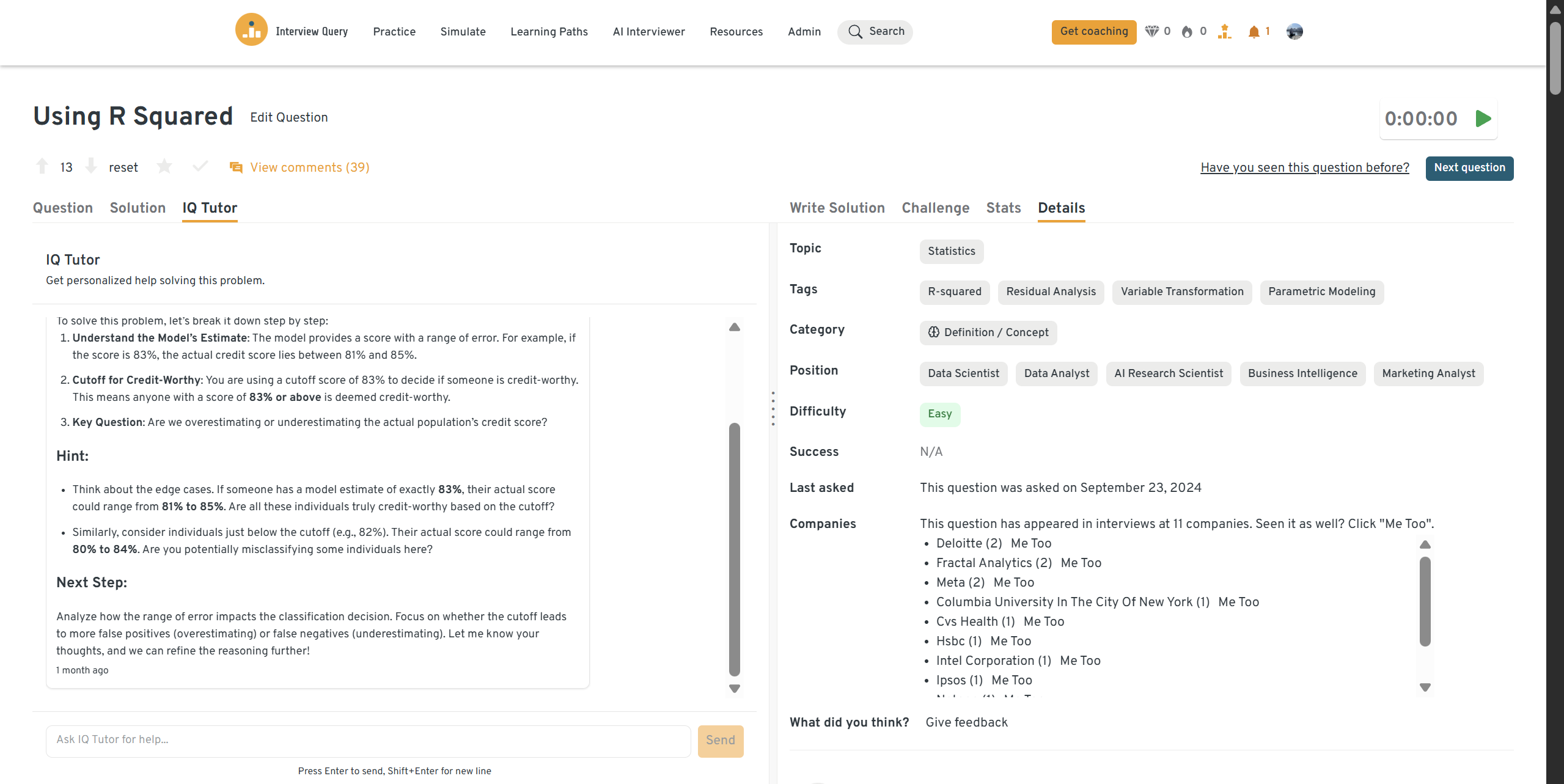
You can practice this exact problem on the Interview Query dashboard, shown below. The platform lets you write and test SQL queries, view accepted solutions, and compare your performance with thousands of other learners. Features like AI coaching, submission stats, and language breakdowns help you identify areas to improve and prepare more effectively for data interviews at scale.
Growth & Marketing Strategy Questions
These questions focus on how you apply analytics to real growth problems, especially where attribution is messy and trade-offs are unavoidable.
-
This tests ROI thinking, attribution awareness, and experimentation logic. Interviewers care about how you isolate impact, not whether you favor a specific channel.
Tip: Compare platforms using consistent attribution windows and include downstream quality metrics, not just conversions.
Weekly active users are up, but email open rates are down. What would you investigate?
This evaluates how you reason through conflicting signals. Strong candidates segment users and channels before drawing conclusions.
Tip: Separate behavior change from channel fatigue before proposing fixes.
How would you measure the success of a community or engagement-driven product?
Deloitte uses this type of question to test metric judgment. Interviewers want to see whether you can distinguish surface-level engagement from durable value.
Tip: Pair activity metrics with retention or contribution depth to reflect long-term health.
Revenue is up after increasing ad load, but usage is down. Is this good or bad?
This question assesses trade-off reasoning and long-term thinking. Interviewers care about how you balance short-term gains with sustainability.
Tip: Explicitly discuss time horizon and risk to customer experience.
Behavioral & Stakeholder Questions
Behavioral interviews for Deloitte growth marketing analyst roles focus on judgment, influence, and how you turn analysis into action in stakeholder-heavy environments. Interviewers care about how you frame decisions, handle ambiguity, and communicate insights to clients and senior leaders, not just whether your analysis was technically correct.
Describe a data project you worked on and the challenges you faced.
This question evaluates how you handle incomplete data, shifting requirements, or operational constraints. Deloitte interviewers want to understand how you adapted your approach and kept the work moving forward.
Tip: Anchor your answer around a decision your analysis ultimately supported.
Sample answer: I worked on a campaign performance analysis where conversion data was incomplete due to tracking gaps. Instead of delaying recommendations, I validated trends using proxy metrics like click-through rate and session depth. I clearly flagged assumptions to stakeholders and proposed a short-term optimization while tracking was fixed. That approach allowed the team to reallocate budget without waiting weeks for perfect data.
How comfortable are you presenting insights to different audiences?
This question assesses communication maturity. Growth analysts at Deloitte often present to marketers, product teams, and senior client stakeholders with very different levels of data fluency.
Tip: Show how you adapt structure and depth, not just visuals.
Sample answer: I tailor presentations based on the audience’s decision needs. For marketing teams, I walk through methodology and assumptions. For executives, I lead with the recommendation and impact, then offer supporting data if needed. In one project, this approach helped leadership quickly approve a budget shift that improved ROI by 12 percent.
Describe a time when a growth experiment did not deliver the expected results. What did you learn?
Interviewers use this to assess learning mindset and iteration discipline. Deloitte values analysts who treat experiments as signals, not failures.
Tip: Focus on what changed in your approach after the result.
Sample answer: I ran an A/B test on landing page copy that showed no lift in conversion. After reviewing session behavior, I realized the bottleneck was page load time, not messaging. We paused copy testing and prioritized performance improvements, which led to a measurable conversion increase the following month. The experience taught me to validate assumptions earlier.
Tell me about a time you had to persuade a stakeholder who disagreed with your analysis.
This evaluates influence without authority. Deloitte interviewers want to see how you use data to build alignment rather than force agreement.
Tip: Emphasize shared goals before defending methodology.
Sample answer: A stakeholder questioned my recommendation to reduce spend on a high-traffic channel. Instead of debating immediately, I reframed the discussion around cost per retained user rather than clicks. Walking through the data together helped align us on the outcome we cared about. We adjusted the mix and improved overall efficiency without damaging reach.
Tell me about a time you led or influenced an initiative that directly impacted growth.
This question assesses ownership and impact. Interviewers want to see measurable results tied to your actions.
Tip: Quantify the outcome and your specific contribution.
Sample answer: I identified a drop-off in the onboarding funnel and proposed testing a simplified flow for high-intent users. I partnered with marketing and product to launch the experiment and tracked performance daily. The new flow increased activation by 18 percent and became the default experience. I documented the learnings so the team could replicate the approach elsewhere.
How do you manage competing priorities across multiple projects or stakeholders?
This evaluates organization, prioritization, and expectation management. Deloitte analysts often juggle multiple workstreams simultaneously.
Tip: Explain how you make trade-offs explicit.
Sample answer: I prioritize work based on impact, urgency, and reversibility. When deadlines conflict, I align stakeholders early on what will be delayed and why. In one case, I paused a lower-impact report to focus on an experiment tied to a live campaign. Communicating the trade-off upfront kept trust intact and ensured the highest-impact work shipped on time.
How To Prepare For A Deloitte Growth Marketing Analyst Interview
Deloitte growth marketing analyst interviews reward candidates who can connect data to decisions in complex, client-facing environments. Preparation should reflect how the role actually operates: diagnosing performance issues across channels, prioritizing growth opportunities with imperfect attribution, and communicating insights clearly to stakeholders who care about ROI and execution. The strategies below focus on building those exact muscles.
Frame marketing problems as business decisions, not reporting tasks
Deloitte interviewers expect you to start from the decision that needs to be made, not the dataset you were given. Whether the problem involves declining conversion, rising CAC, or uneven channel performance, strong candidates clarify the business objective, define what success looks like, and then explain what analysis would inform the next action. Practicing decision-first thinking using realistic prompts from Interview Query’s marketing analytics questions helps reinforce this habit.
Tip: Begin answers by stating the decision the client or team needs to make before describing metrics or analysis.
Practice structured diagnosis for growth and performance issues
Growth marketing problems rarely have a single root cause. Deloitte looks for candidates who can systematically break issues down across funnel stages, channels, audiences, and measurement limitations. Interviewers want to hear how you would segment data, form hypotheses, and prioritize which questions to answer first. Working through end-to-end scenarios in Interview Query’s marketing analytics case studies helps you practice this structure.
Tip: Explicitly separate measurement issues from true performance issues before proposing optimizations.
Strengthen SQL and Excel for marketing use cases
Technical interviews often test SQL and Excel in applied marketing contexts, such as funnel analysis, retention tracking, or campaign comparisons. Deloitte cares less about obscure syntax and more about whether you can write clean logic, explain assumptions, and interpret results accurately. Practicing core queries through Interview Query’s SQL interview questions helps ensure fluency under pressure.
Tip: When walking through queries, explain what each step is doing and why it matters for the business question.
Prepare examples that show stakeholder influence, not just analysis
Because Deloitte work is stakeholder-heavy, interviewers want to see how you influence decisions with data. Strong preparation includes stories where your analysis changed a recommendation, reallocated budget, or altered strategy despite initial resistance. Practicing articulation and follow-up handling through mock interviews helps ensure your examples stay decision-focused rather than overly technical.
Tip: Anchor each example on the recommendation you made and how stakeholders acted on it.
Practice communicating insights at different levels
Growth marketing analysts at Deloitte regularly communicate with marketers, product teams, and senior leaders. Interviewers assess whether you can tailor depth, framing, and language to your audience. Practicing live explanation using Interview Query’s AI interview can help refine clarity without sounding scripted.
Tip: Lead with the takeaway first, then support it with data only as needed.
Role Overview And Culture At Deloitte
A Deloitte growth marketing analyst sits at the intersection of marketing strategy, data, and client decision-making. The role focuses on using analytics to diagnose growth challenges, evaluate marketing performance, and guide recommendations across channels such as paid media, web, email, and CRM. Rather than operating as a standalone analyst, growth marketing analysts work closely with marketing strategists, product teams, and client stakeholders to ensure insights translate into action.
Day to day, the role typically includes:
- Marketing performance analysis: evaluating campaign effectiveness across channels, identifying drivers of conversion, engagement, and ROI, and surfacing opportunities for optimization.
- Reporting and visualization: building dashboards and presentations using tools like Tableau or Power BI to communicate insights clearly to both technical and non-technical audiences.
- Experimentation and optimization: supporting A/B tests, funnel analysis, and attribution work to improve customer acquisition, retention, and lifetime value.
- Cross-functional collaboration: partnering with marketing, sales, digital, and technology teams to align data insights with execution plans.
- Client-facing communication: translating complex analyses into clear recommendations that senior stakeholders can act on.
Culturally, Deloitte emphasizes structured thinking, professionalism, and credibility with clients. Growth marketing analysts are expected to be precise with data, clear in communication, and thoughtful about trade-offs, especially in environments where attribution is imperfect and decisions affect multiple teams. The firm values analysts who can explain not just what the data shows, but what should be done next and why.
The pace of work can be fast, with multiple workstreams running in parallel. Analysts are trusted to manage ambiguity, prioritize effectively, and ask the right questions early. Attention to detail matters, but so does judgment: knowing when data is directionally sufficient to move forward versus when deeper analysis is required.
From a growth perspective, the role offers exposure to a wide range of industries, marketing challenges, and transformation initiatives. Analysts develop strong foundations in marketing analytics, stakeholder management, and consulting-style problem solving. Over time, many grow into senior analyst, manager, or specialized strategy roles, building expertise in areas such as growth strategy, MarTech, or customer analytics.
FAQs
How long does the Deloitte growth marketing analyst interview process take?
Most candidates complete the process in four to six weeks. Timelines vary by team and region, with additional rounds sometimes added for analytics exercises or senior stakeholder interviews.
How technical is the Deloitte growth marketing analyst interview?
The role is analytics-forward but not engineering-heavy. You should be comfortable with SQL, Excel, KPI definition, funnels, and A/B testing, and be able to explain results clearly to non-technical stakeholders.
What types of marketing problems does Deloitte focus on in interviews?
Interview scenarios often involve real growth challenges such as declining conversion, rising CAC, uneven channel performance, or unclear attribution. Interviewers care about how you structure the problem and connect analysis to decisions.
Does Deloitte expect prior consulting experience?
Consulting experience is helpful but not required. Deloitte looks for candidates who can think in a structured way, communicate clearly, and operate effectively in client-facing environments.
What skills matter most for succeeding in this role?
Strong SQL and analytics fundamentals, structured problem-solving, and the ability to influence decisions with data are critical. Clear communication and stakeholder awareness are just as important as technical accuracy.
Prepare Like A Growth Analyst Trusted By Clients
Deloitte growth marketing analyst interviews are designed to identify candidates who can turn marketing data into confident, defensible decisions. Interviewers are evaluating how you diagnose performance issues, prioritize growth opportunities, and communicate insights in environments where attribution is imperfect and stakeholders expect clarity.
The strongest preparation mirrors that reality. Practice real-world analytics and growth scenarios using Interview Query’s marketing analytics questions and case studies. Refine how you explain trade-offs and recommendations under pressure through mock interviews. For candidates who want targeted feedback on communication and judgment, personalized coaching can help you pressure-test your thinking before the actual interview loop.
With structured preparation and a decision-first mindset, you can walk into the Deloitte growth marketing analyst interview ready to deliver insights that clients trust and act on.
Deloitte Interview Questions
| Question | Topic | Difficulty | ||||||||||||||||||||||
|---|---|---|---|---|---|---|---|---|---|---|---|---|---|---|---|---|---|---|---|---|---|---|---|---|
SQL | Easy | |||||||||||||||||||||||
Write a SQL query to select the 2nd highest salary in the engineering department. Note: If more than one person shares the highest salary, the query should select the next highest salary. Example: Input:
Output:
| ||||||||||||||||||||||||
Behavioral | Medium | |||||||||||||||||||||||
SQL | Medium | |||||||||||||||||||||||
SQL | Easy | |
Machine Learning | Medium | |
Statistics | Medium | |
SQL | Hard | |
Machine Learning | Medium | |
Python | Easy | |
Deep Learning | Hard | |
SQL | Medium | |
Statistics | Easy | |
Machine Learning | Hard |
Discussion & Interview Experiences