
Deloitte Product Manager Interview Guide: Process, Questions, and Prep


Introduction
Preparing for a Deloitte product manager interview means getting ready for product work in a very different environment than most consumer-tech loops. Deloitte operates at enterprise scale, spanning 150+ countries and territories, serving nearly 90% of the Fortune Global 500, and recently reported US$70.5B in aggregate global revenue with a workforce of 470,000+ people.
That scale shapes how Deloitte evaluates PMs. You are not only judged on product sense, but on whether you can translate messy business goals into a roadmap, align stakeholders who do not report to you, and ship solutions that hold up across governance, security, and delivery constraints. In this guide, we break down the Deloitte product manager interview process, explain what each stage is designed to assess, and share prep tactics that map to how Deloitte actually builds and delivers products.
Deloitte Product Manager Interview Process
The Deloitte product manager interview process is built to assess three things: structured problem framing, stakeholder judgment, and execution discipline in enterprise contexts. The exact loop varies by geography and practice area, but candidates commonly move through a screen, one or more case or product rounds, and a final conversation with senior leadership.
Interview process summary
| Interview stage | What happens |
|---|---|
| Recruiter or hiring manager screen | Background, role fit, motivation, and communication clarity |
| Product or case round | Ambiguous problem framing, prioritization, and solution trade-offs |
| Technical or delivery-focused discussion | Feasibility thinking, collaboration with engineering, and operating cadence |
| Final leadership round | Executive communication, judgment, and long-term fit |
Recruiter or hiring manager screen
This is typically a short conversation to confirm role alignment and baseline product maturity. Expect questions about what you have owned end to end, how you make trade-offs, and why Deloitte’s product environment appeals to you specifically (client complexity, transformation programs, internal platforms, regulated delivery).
Deloitte-specific tip: Have one story ready where your biggest challenge was not feature design, but stakeholder alignment. Be explicit about how you created a decision, not just a consensus.
Product or case round
This stage tests how you structure unclear problems and make decisions with constraints. Prompts often resemble enterprise realities: multiple stakeholders, shared platforms, competing priorities, adoption risk, and delivery dependencies.
A strong answer usually sounds like: clarify the goal, define the user and decision-maker, identify constraints, propose a scoped approach, then explain what you would measure and what you would ship first.
If you want reps on realistic prompts, practice with Interview Query’s product challenges and pressure-test your communication through mock interviews.
Deloitte-specific tip: Say your assumptions out loud. Deloitte interviewers tend to reward candidates who make ambiguity explicit, then reduce it systematically.
Technical or delivery-focused discussion
Not every loop includes a formal “technical” round, but many interviews probe whether you can operate closely with engineering. Expect questions about agile delivery, backlog hygiene, defining MVP scope, trade-offs between speed and quality, and how you handle risks like integration, security, and dependencies.
Deloitte-specific tip: When asked “how would you build it,” do not default to architecture diagrams. Start with delivery sequencing, risk reduction, and what you need to learn in the first sprint.
Final leadership round
This stage focuses on senior judgment: how you influence, how you handle conflict, how you present trade-offs, and whether you can communicate clearly with executives. It often revisits earlier answers to test consistency and depth.
Candidates who want to simulate this pressure usually benefit from coaching, especially for crisp executive communication.
Deloitte-specific tip: Keep your answers outcome-driven. Lead with the decision, the rationale, and the impact. Then go deeper if prompted.
Challenge
Check your skills...
How prepared are you for working as a Product Manager at Deloitte?
Deloitte Product Manager Interview Questions
Deloitte product manager interview questions are designed to assess how you operate in complex, enterprise, and stakeholder-heavy environments. Interviewers are less interested in polished consumer-tech frameworks and more focused on how you structure ambiguous problems, align decision-makers, and ship solutions under delivery, governance, and client constraints.
Because Deloitte product managers often work on internal platforms, client-facing products, or transformation programs, questions tend to emphasize prioritization, feasibility, and communication as much as ideation. Many candidates prepare for these rounds using applied prompts from Interview Query’s product challenges and refine their delivery through mock interviews.
Product Sense & Problem Framing
These questions evaluate how you define problems, identify the real decision to be made, and scope solutions appropriately for enterprise settings.
How would you design a product used by multiple stakeholders with conflicting needs?
This question tests your ability to frame problems in environments where users, sponsors, and decision-makers are not the same. Interviewers look for how you identify common workflows, isolate non-negotiables, and avoid building overly customized solutions.
Tip: Start by defining the shared objective across stakeholders before addressing differences.
How would you approach building an MVP when requirements are unclear?
This evaluates comfort with ambiguity and iterative delivery. Strong answers explain how you reduce risk through scoping, validation, and learning loops rather than waiting for perfect requirements.
Tip: Emphasize what you would intentionally leave out of the first version.
Design an internal tool to improve decision-making for senior leadership.
Interviewers assess whether you can translate complex inputs into decision-ready outputs. They care more about clarity and actionability than feature richness.
Tip: Anchor the design around decisions leaders need to make, not metrics volume.
How would you diagnose low adoption of an enterprise product?
This tests diagnostic thinking rather than solution jumping. Strong candidates separate product issues from change management, incentives, and process friction.
Tip: Segment users by role and workflow before proposing fixes.
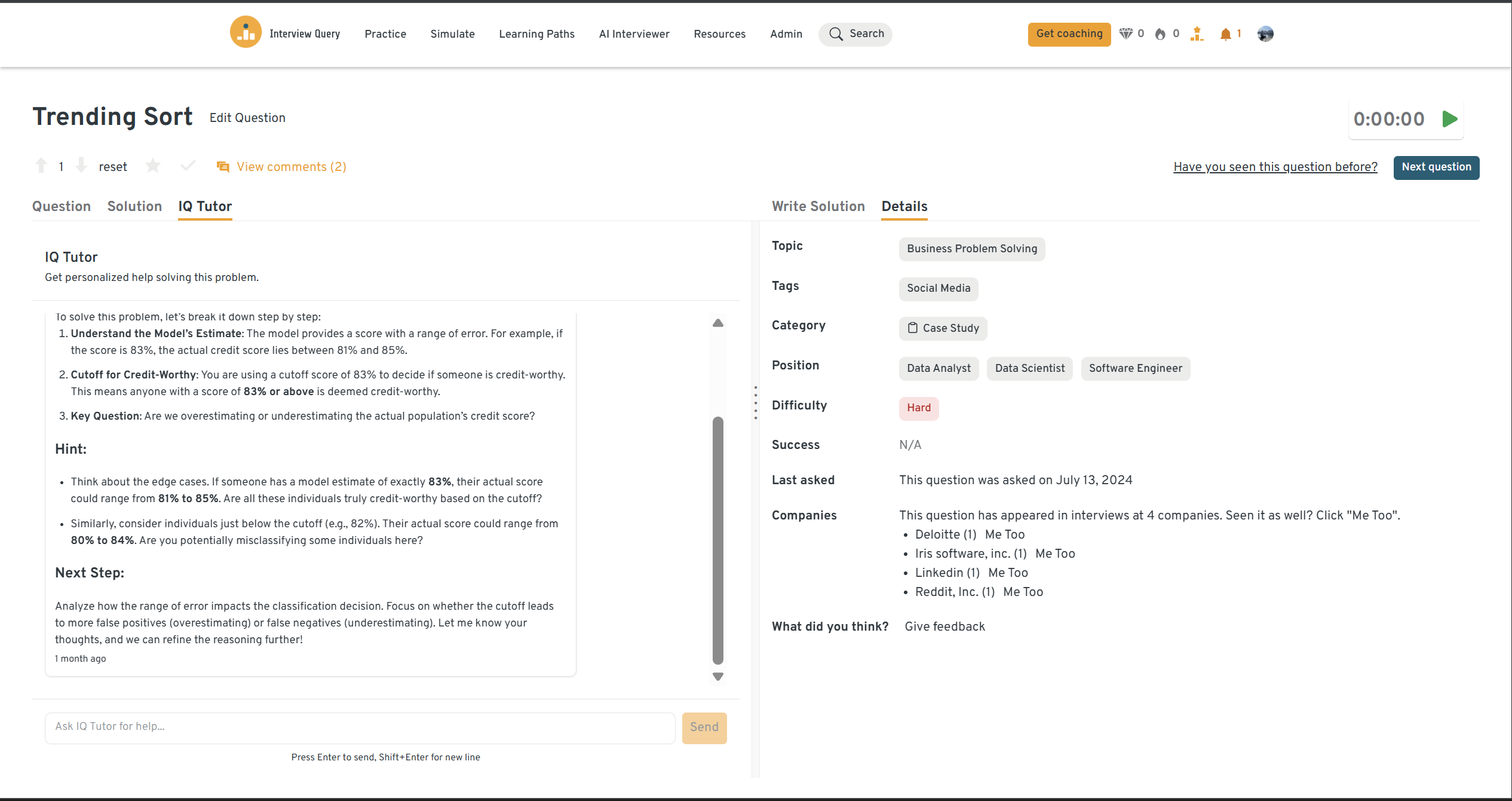
How would you approach building a “trending” or “hot content” sort feature to increase engagement?
Although this question is framed around Reddit, interviewers use it to test first-principles product thinking that applies equally to Deloitte contexts. They want to see how you clarify the goal, define success metrics, and reason about trade-offs between relevance, fairness, and operational complexity.
Tip: Start by clarifying what “engagement” means for the business before discussing algorithms or ranking logic.
You can practice this exact problem on the Interview Query dashboard, shown below. The platform lets you write and test SQL queries, view accepted solutions, and compare your performance with thousands of other learners. Features like AI coaching, submission stats, and language breakdowns help you identify areas to improve and prepare more effectively for data interviews at scale.
Metrics, Analytics & Prioritization
These questions assess how you define success, reason with imperfect data, and make trade-offs in capacity-constrained environments.
What metrics would you use to measure success for an enterprise product?
Interviewers want to see how you balance adoption, usage quality, and business impact. Pure engagement metrics are rarely sufficient in consulting-led contexts.
Tip: Include at least one outcome metric tied to business value.
Two stakeholders request high-priority features with limited capacity. How do you decide?
This evaluates prioritization discipline and communication. Interviewers care about how you explain trade-offs, not just the framework you use.
Tip: Make opportunity cost explicit and tie decisions back to agreed objectives.
A product launch misses its adoption targets. What do you investigate first?
This tests structured debugging under pressure. Strong answers start with segmentation and hypothesis generation before proposing changes.
Tip: Separate awareness, access, and value issues before iterating.
How do you prevent metrics from being gamed in enterprise environments?
Interviewers assess governance and risk awareness. Deloitte PMs are expected to think about unintended consequences early.
Tip: Mention counter-metrics or qualitative validation loops.
Behavioral & Leadership Questions
Behavioral interviews for Deloitte product manager roles focus on ownership, influence, and decision-making in complex environments. Interviewers want to understand how you operate when authority is indirect, timelines are tight, and outcomes affect multiple stakeholders or clients.
Tell me about a time you aligned multiple stakeholders with competing priorities.
This question evaluates influence without authority and structured communication. Interviewers look for how you created clarity and moved decisions forward.
Tip: Focus on how you framed the decision, not just how you managed relationships.
Sample answer: I worked on a platform used by delivery teams and leadership, each with different priorities. I facilitated sessions to surface core needs, then mapped them to a phased roadmap. By separating must-haves from enhancements, we aligned on scope and shipped incrementally. Adoption improved over time, and stakeholders gained confidence in the process. The structure prevented scope creep while keeping flexibility.
Describe a time you had to make a product decision with incomplete data.
Interviewers assess judgment under uncertainty and risk management. They care about how you moved forward responsibly.
Tip: Explain what signals you used and how you limited downside.
Sample answer: I had to prioritize a feature without reliable usage data. I combined partial analytics with qualitative feedback and scoped a narrow MVP. We launched to a small group, monitored early indicators, and iterated quickly. This allowed progress without over-committing resources. The approach met the core objective within one quarter.
Tell me about a time you disagreed with a senior stakeholder.
This evaluates professionalism, confidence, and influence. Deloitte interviewers value respectful challenge backed by reasoning.
Tip: Emphasize alignment on outcomes rather than winning the argument.
Sample answer: A senior stakeholder pushed for a feature that would delay delivery. I presented data showing limited impact and proposed a smaller experiment. We agreed to test before scaling. The results supported the alternative approach. The outcome protected timelines and strengthened trust.
How do you handle changing requirements mid-delivery?
This tests adaptability and execution discipline. Interviewers want to see how you protect outcomes without being rigid.
Tip: Show how you reframe scope rather than restarting entirely.
Sample answer: When requirements changed mid-sprint, I revisited the underlying goal with stakeholders. We adjusted scope while preserving the original outcome. I communicated trade-offs clearly to the team and updated expectations. This kept delivery moving without sacrificing trust.
To build confidence in metrics, experimentation, and data-driven product thinking, watch this short breakdown from Interview Query founder Jay Feng. It explains how product data science questions work, common analytical traps, and how to structure your reasoning—all skills that map directly into the analytical portion of the Deloitte PM interview.
How To Prepare For A Deloitte Product Manager Interview
Deloitte product manager interviews are designed to evaluate how you operate in enterprise, client-driven environments where problems are ambiguous, stakeholders are misaligned, and delivery constraints are real. Preparation should mirror that reality. Rather than optimizing for polished frameworks or feature ideation, strong candidates focus on structured problem framing, defensible trade-offs, and clear communication of decisions. The strategies below reflect how Deloitte expects product managers to think, prioritize, and execute in consulting-led product roles.
Frame problems like a consultant, not a feature owner
Deloitte product manager interviews expect you to approach problems the way consultants do: clarify the objective, define the decision to be made, surface constraints, and only then move into solution space. Interviewers want to see whether you can turn vague business or client goals into a structured problem statement that is actionable under real-world constraints like governance, delivery timelines, and stakeholder alignment. Practicing open-ended, ambiguous prompts using Interview Query’s product challenges helps build comfort with this style of reasoning.
Tip: Start every answer by restating the problem as a decision Deloitte or the client needs to make before proposing any solution.
Practice prioritization in stakeholder-heavy environments
At Deloitte, product managers rarely prioritize for a single user group or metric. Interviewers look for how you navigate competing stakeholder needs across delivery teams, leadership, and clients, especially when capacity is limited. Strong candidates show how they anchor prioritization to agreed outcomes and explain trade-offs clearly rather than relying on abstract scoring frameworks. Pressure-testing this communication in mock interviews helps ensure your reasoning stays clear under follow-up questions.
Tip: Explicitly state who the decision-maker is and what trade-off you are accepting when you prioritize one request over another.
Tie metrics to enterprise and transformation outcomes
Deloitte PM interviews place less emphasis on pure engagement metrics and more on whether a product drives meaningful business or transformation outcomes. Interviewers want to see that you can define success in contexts where adoption, value realization, and impact are not always immediate or linear. Practicing metric articulation aloud using Interview Query’s AI interview helps refine how you explain these connections without sounding rehearsed.
Tip: Pair every usage or adoption metric with a concrete outcome metric that reflects business value or decision quality.
Choose product examples that reflect complexity and constraints
The strongest candidates use examples that mirror Deloitte’s reality: shared platforms, internal tools, client-facing systems, or long-running programs with dependencies and governance. Interviewers value realism over polish and want to understand how you made progress despite ambiguity, constraints, or incomplete information. Reviewing case-style prompts in Interview Query’s takehomes can help you practice telling these stories with structure.
Tip: Highlight how you reduced risk or scope to keep delivery moving rather than aiming for a perfect solution.
Prepare behavioral stories around judgment and influence
Behavioral rounds at Deloitte focus on how you make decisions when authority is indirect and outcomes affect multiple stakeholders. Interviewers care less about conflict itself and more about how you framed decisions, influenced alignment, and took responsibility for outcomes. Practicing these stories in a structured setting like mock interviews helps ensure your answers stay decision-focused.
Tip: Anchor each story on a specific decision you made and the impact it had, not just the situation you managed.
Role Overview And Culture At Deloitte
A product manager at Deloitte operates in an enterprise and consulting-led environment where products are often built to support large transformation programs, internal platforms, or client-facing digital solutions. The role emphasizes clarity, execution, and alignment rather than standalone feature ownership. Success depends on how well you translate business objectives into product direction while navigating governance, delivery constraints, and diverse stakeholder needs.
Day to day, Deloitte product managers typically work across several dimensions:
- Defining product vision and strategy that align with client goals or firm-wide priorities
- Translating ambiguous business problems into scoped roadmaps and delivery plans
- Partnering closely with engineering, design, data, and delivery teams in agile environments
- Managing backlogs, sequencing releases, and balancing speed with quality and risk
- Tracking success through adoption, outcome, and impact metrics rather than engagement alone
Unlike consumer technology companies, Deloitte PMs often serve multiple user groups at once. These may include internal teams, client stakeholders, leadership sponsors, and external end users. As a result, the role requires strong judgment around trade-offs, clear communication, and comfort making decisions without perfect information.
Culturally, Deloitte values structured thinking, accountability, and collaboration. Product managers are expected to operate with autonomy while staying closely aligned with leadership expectations and client realities. The environment rewards people who can simplify complexity, create alignment across functions, and move work forward under constraint.
From a growth perspective, the role offers exposure to enterprise-scale systems, regulated environments, and high-impact transformation work. Product managers may deepen their expertise within a specific industry or platform, expand into broader program or portfolio ownership, or transition into senior product leadership roles as scope and responsibility grow.
Deloitte Product Manager Salary
Compensation for product managers at Deloitte reflects the firm’s enterprise scope, client-facing responsibility, and expectation of ownership across complex delivery environments. Based on aggregated self-reported data from Levels.fyi for product manager roles in the United States, pay is primarily driven by base salary and bonus, with limited equity components compared to Big Tech product roles.
The table below converts reported monthly compensation into approximate annual totals to provide a clearer comparison across levels.
| Level | Approximate role scope | Total compensation (annual) |
|---|---|---|
| L1 | Analyst/entry-level product role | ~$108,000 |
| L2 | Consultant/associate product manager | ~$120,000 |
| L3 | Senior consultant/product manager | ~$168,000 |
| L4 | Manager/senior product manager | ~$192,000 |
| L5 | Senior manager/lead product manager | ~$216,000 |
These figures represent total annual compensation, including base pay and bonuses, and are derived from reported monthly packages on Levels.fyi. Unlike consumer tech companies, Deloitte compensation is typically cash-heavy, with limited or no equity at most levels. Increases in compensation are closely tied to scope expansion, leadership responsibility, and the ability to manage complex stakeholder and delivery environments rather than pure product line ownership.
Average Base Salary
Average Total Compensation
While absolute pay may be lower than top-tier consumer tech firms, Deloitte product manager roles offer exposure to enterprise-scale systems, regulated industries, and transformation programs that can accelerate career growth into senior product leadership, consulting leadership, or broader strategic roles.
FAQs
How long does the Deloitte product manager interview process take?
Most candidates complete the Deloitte product manager interview process in four to six weeks. Timelines vary by practice area and seniority, with additional rounds sometimes added for stakeholder or leadership evaluation.
Is the Deloitte product manager interview case-heavy?
Yes. Deloitte PM interviews are heavily scenario- and case-driven, especially compared to consumer tech PM interviews. Candidates are evaluated on how they frame ambiguous problems, manage trade-offs, and communicate decisions in enterprise and client-facing contexts.
What types of product work do Deloitte product managers typically do?
Deloitte product managers often work on internal platforms, client-facing digital products, and large-scale transformation initiatives. The role frequently involves shared platforms, regulated environments, and coordination across multiple delivery teams and stakeholders.
Does Deloitte expect product managers to be technical?
Product managers at Deloitte are not expected to write production code, but technical fluency is important. Interviewers expect candidates to discuss feasibility, system constraints, agile delivery, and collaboration with engineering and data teams.
What skills matter most for succeeding as a Deloitte product manager?
Structured problem-solving, stakeholder alignment, and execution discipline are critical. Strong Deloitte PMs are comfortable making decisions under ambiguity and explaining trade-offs clearly to senior leaders and clients.
Prepare Like An Enterprise Product Owner
Deloitte product manager interviews are designed to surface how you operate when problems are ambiguous, stakeholders are misaligned, and delivery constraints are real. Interviewers are evaluating whether you can frame the right problem, make defensible trade-offs, and lead execution in enterprise and client-driven environments rather than idealized product scenarios.
The strongest preparation mirrors that reality. Start by practicing realistic, open-ended prompts in Interview Query’s product challenges to sharpen problem framing and prioritization. Refine how you explain decisions and trade-offs under pressure through mock interviews. For candidates aiming to polish executive-level communication and judgment, personalized coaching can help you pressure-test your thinking before the real interview loop.
With disciplined preparation and a focus on structured decision-making, you can enter the Deloitte product manager interview ready to deliver products that balance strategy, execution, and stakeholder trust.
Deloitte Interview Questions
| Question | Topic | Difficulty | ||||||||||||||||||||||
|---|---|---|---|---|---|---|---|---|---|---|---|---|---|---|---|---|---|---|---|---|---|---|---|---|
SQL | Easy | |||||||||||||||||||||||
Write a SQL query to select the 2nd highest salary in the engineering department. Note: If more than one person shares the highest salary, the query should select the next highest salary. Example: Input:
Output:
| ||||||||||||||||||||||||
SQL | Medium | |||||||||||||||||||||||
Data Structures & Algorithms | Medium | |||||||||||||||||||||||
SQL | Easy | |
Machine Learning | Medium | |
Statistics | Medium | |
SQL | Hard | |
Machine Learning | Medium | |
Python | Easy | |
Deep Learning | Hard | |
SQL | Medium | |
Statistics | Easy | |
Machine Learning | Hard |
Discussion & Interview Experiences