

Deloitte Business Intelligence Interview Guide: Process, Questions & Prep


Introduction
A Deloitte business intelligence interview reflects how the role itself has evolved. Business intelligence is no longer just about dashboards or reporting; it sits at the center of enterprise decision-making. Global data creation is projected to exceed 180 zettabytes, and organizations increasingly rely on BI teams to turn fragmented, fast-moving data into signals leaders can actually act on. In parallel, adoption of analytics and AI-enabled decision tools continues to accelerate across industries, pushing BI roles closer to strategy, transformation, and execution.
Deloitte operates squarely in that environment. BI professionals at Deloitte support large, complex organizations that need reliable metrics, scalable data models, and clear narratives across finance, operations, marketing, and technology. As a result, the Deloitte business intelligence interview is designed to assess more than tool proficiency. Interviewers evaluate whether you can translate business requirements into data solutions, reason through ambiguity, collaborate with technical and non-technical teams, and communicate insights that influence decisions. This guide breaks down what the interview process looks like and how each stage is meant to evaluate those capabilities.
Deloitte Business Intelligence Interview Process
The Deloitte business intelligence interview process is designed to assess how effectively you turn business questions into scalable, client-ready data solutions. Rather than testing isolated BI features, Deloitte evaluates whether you can apply technical skills, structured thinking, and clear communication to real enterprise and client scenarios.
Most candidates complete the process in two to four stages, typically within four to six weeks, depending on the service line and seniority.
Interview Process Summary
| Interview stage | What happens |
|---|---|
| HR or recruiter screen | Motivation, role fit, communication, and baseline experience |
| Technical or functional interview | BI tools, SQL, data modeling, and prior project discussion |
| Case study or scenario interview | Structured problem-solving using client-relevant BI scenarios |
| Manager or partner round | Judgment, cultural fit, and client-readiness |
HR Or Recruiter Screen
This is usually a short 10–20 minute call focused on confirming your background, interest in Deloitte, and alignment with the business intelligence role. Interviewers typically ask about your experience with BI tools, data analytics, and stakeholder-facing work.
They also assess communication clarity and whether you understand Deloitte’s consulting environment, where BI professionals support client decisions rather than operate as internal report builders.
Tip: Be ready to explain why you want to do BI work in a consulting and client-facing context, not just why you enjoy dashboards or analytics.
To practice concise, structured explanations, many candidates use mock interviews.
Technical Or Functional Interview
This round focuses on your hands-on BI capability and technical foundations. Expect in-depth discussion of your past projects, including how you modeled data, built dashboards, and ensured data accuracy.
Common topics include SQL joins and keys, Power BI concepts such as DAX, Power Query, and Row-Level Security, and Python usage for data wrangling or exploratory analysis. Interviewers care less about memorized syntax and more about whether you can explain why you designed a solution a certain way.
Candidates often prepare for this stage using SQL interview questions and applied analytics practice.
Tip: Walk interviewers through your thinking step by step and explicitly call out trade-offs in your design choices.
Case Study Or Scenario Interview
This stage evaluates how you apply BI skills to realistic client problems. You may be given a scenario such as inconsistent KPIs across teams, unclear executive reporting, or a performance issue that requires better data modeling and visualization.
Interviewers assess how you clarify requirements, define metrics, choose appropriate data structures, and communicate insights clearly. Strong candidates treat BI as a decision-support function, not just a reporting exercise.
Practicing structured, ambiguous prompts through analytics challenges can help build confidence.
Tip: Start by clarifying the business decision the dashboard or analysis is meant to support before discussing tools or visuals.
Manager Or Partner Round
The final round is often conducted with a manager, director, or partner and focuses on judgment, cultural fit, and client-readiness. You may be asked to walk through a BI project end to end, explain how you handled ambiguous requirements, or discuss how you would add value in an AI-driven analytics environment.
Interviewers want to see whether you can communicate clearly with senior stakeholders, adapt to changing inputs, and maintain credibility under scrutiny.
Tip: Lead with the insight or recommendation first, then support it with data and reasoning.
Challenge
Check your skills...
How prepared are you for working as a Business Intelligence at Deloitte?
Deloitte Business Intelligence Interview Questions
Deloitte business intelligence interview questions are designed to evaluate how well you translate business requirements into scalable data models, dashboards, and insights that support real decisions. Interviewers care about structured thinking, data integrity, and your ability to communicate clearly with both technical teams and client stakeholders.
Questions typically fall into three categories: SQL and data transformation, dashboarding and visualization, and analytics or case-style problem solving.
SQL And Data Transformation Questions
These questions assess whether you can work confidently with enterprise datasets, structure queries correctly, and support reporting logic used across multiple stakeholders.
How would you calculate month-over-month changes for a key business metric?
This question evaluates your ability to compute period-over-period KPIs that are commonly used in executive dashboards. Interviewers look for correct use of aggregation, window functions, and handling of missing periods.
Tip: Call out how you validate incomplete months or missing data before interpreting trends.
How would you identify customers who made repeat purchases after their first transaction?
Deloitte uses questions like this to assess customer journey and behavioral analysis skills. Strong answers show how you establish the correct data grain and avoid double counting.
Tip: Explicitly state how you define “first” and “subsequent” transactions to avoid logic errors.
How would you return the last transaction for each day from a transactions table?
This tests your ability to extract daily snapshots, which are common in operational and performance reporting. Interviewers care about clean window function logic and correct date handling.
Tip: Mention how you handle timestamps and time zones when converting to business dates.
How would you calculate a rolling average over time for a performance metric?
Rolling metrics are frequently used in BI to smooth volatility and highlight short-term trends. Interviewers look for correct window framing and performance awareness.
Tip: Explain why you choose a specific window size and what business question it answers.
-
This question evaluates data quality and remediation skills. Deloitte expects BI professionals to recognize and correct upstream data issues before building dashboards.
Tip: Emphasize auditability and explain how you identify the “current” record reliably.
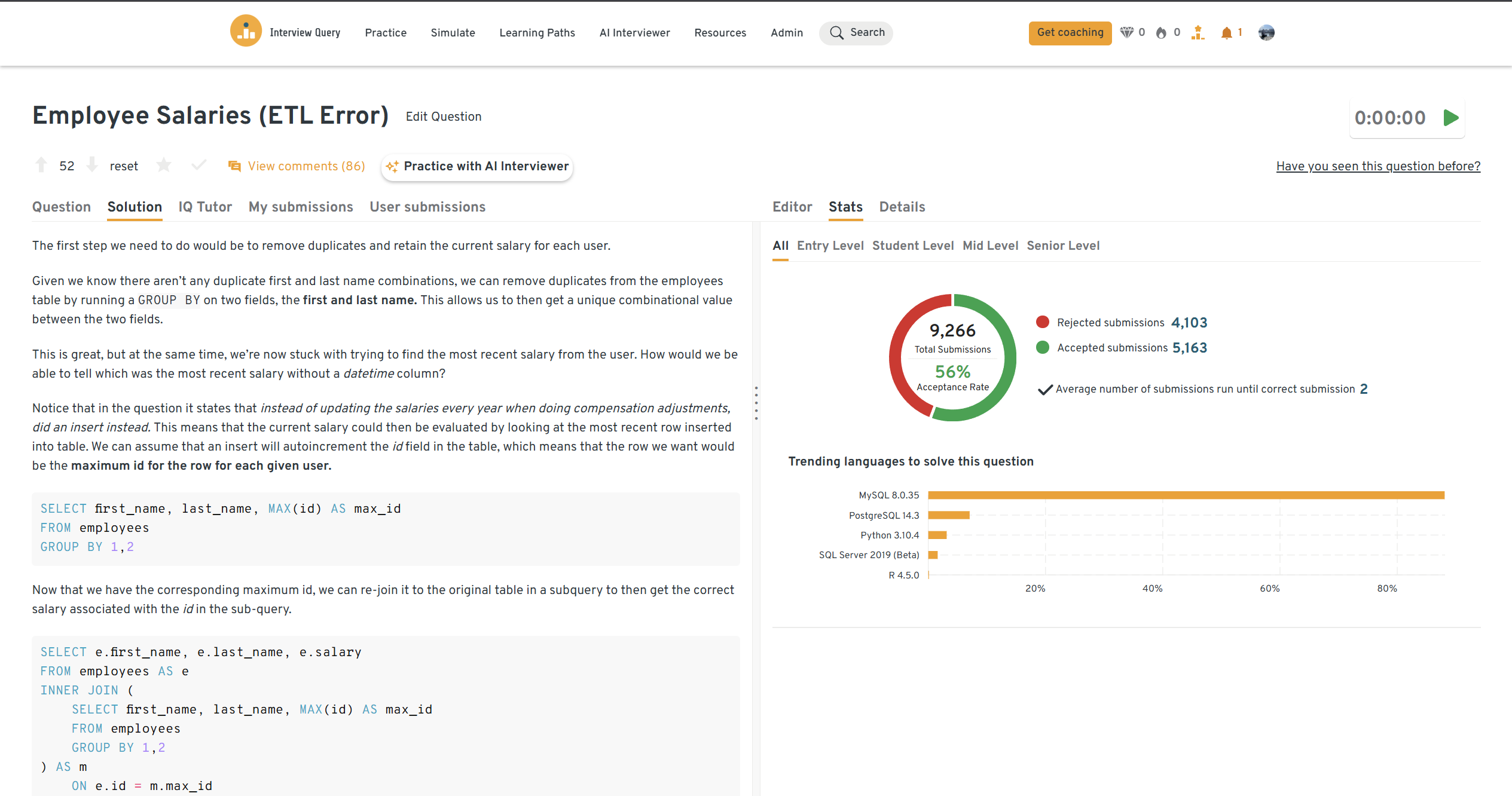
You can practice this exact problem on the Interview Query dashboard, shown below. The platform lets you write and test SQL queries, view accepted solutions, and compare your performance with thousands of other learners. Features like AI coaching, submission stats, and language breakdowns help you identify areas to improve and prepare more effectively for data interviews at scale.
Dashboarding And Visualization Questions
These questions test how well you design dashboards that support decisions rather than overwhelm users with metrics.
Walk through how you would design a KPI dashboard for senior leadership.
Interviewers want to see whether you design dashboards starting from business questions, not available data. Strong answers focus on clarity, hierarchy, and narrative flow.
Tip: Start by stating the decisions leadership needs to make using the dashboard.
Explain how you would diagnose and optimize a slow-performing Power BI or Tableau dashboard.
This evaluates both BI tool understanding and analytical reasoning. Interviewers care about whether you investigate backend queries, data volume, and calculation logic before adjusting visuals.
Tip: Always check data model design and query efficiency before optimizing the front end.
How would you choose the right metrics and visuals for a dashboard used by different business units?
This tests whether you can adapt dashboards to multiple stakeholder needs. Deloitte values segmentation and role-based views over one-size-fits-all reporting.
Tip: Prioritize comparisons and exceptions rather than static totals.
-
Although framed around trend interpretation, this question tests analytical skepticism. Deloitte interviewers want to see that you validate visual insights with supporting queries.
Tip: Pair every visual insight with a validation step using underlying data.
Analytics And Case-Style Questions
These scenarios evaluate structured problem solving, ambiguity handling, and how you connect BI work to enterprise decisions.
How would you add and backfill a new column in a very large table without disrupting reporting?
This question tests your understanding of scalable data changes and coordination with engineering teams. Deloitte expects awareness of performance, sequencing, and risk.
Tip: Mention phased backfills and coordination with data engineering teams.
Identify the root cause of a sudden spike in service volume or operational workload.
Interviewers use this to assess structured diagnostic thinking. Strong candidates segment by time, channel, and upstream events before jumping to conclusions.
Tip: Explicitly separate demand-driven causes from system or process issues.
How would you investigate a noticeable decline in an average transaction or usage metric?
This evaluates your ability to distinguish real behavioral change from data artifacts. Interviewers care about sequencing and hypothesis validation.
Tip: Always check data quality and reporting changes before interpreting business impact.
How would you prioritize which insights to surface when stakeholders ask for “everything”?
This tests judgment and stakeholder management. Deloitte values BI professionals who can push back thoughtfully and focus on decision-relevant insights.
Tip: Anchor prioritization to the specific decision or action the analysis should inform.
Want to practice more? In this mock interview session, Jay Feng interviews a data scientist and business intelligence engineer at Amazon, who walks through how to solve a commonly asked Amazon BI case study on identifying duplicate products. We break down an open-ended business problem, explore how to structure clarifying questions, and design a scalable analytical approach that can help you build confidence and elevate your BI interview performance.
Behavioral And Collaboration Questions
Behavioral questions in Deloitte’s Business Intelligence interviews focus on how you operate in ambiguous, client-facing environments, communicate insights, and influence decisions without direct authority. Interviewers look for structured thinking, judgment, and ownership, not just technical skill.
Why do you want to work in Business Intelligence at Deloitte?
This question evaluates your motivation and whether you understand BI as a decision-support function rather than pure reporting. Deloitte looks for candidates who connect analytics to transformation and client impact.
Tip: Anchor your answer on client outcomes and cross-functional influence.
Sample Answer: I’m interested in Business Intelligence at Deloitte because it allows me to use data to shape real decisions across organizations, not just optimize internal metrics. In my previous role, dashboards only mattered when they changed prioritization or behavior, and that mindset aligns closely with Deloitte’s consulting model. I’m excited by the opportunity to work across industries and help clients translate complex data into actions that drive measurable impact.
Tell me about a time you had to explain a complex analysis to a non-technical stakeholder.
This assesses your ability to simplify complexity and communicate insights clearly, a core requirement for BI roles that support senior clients.
Tip: Focus on how you reframed the insight, not the technical details.
Sample Answer: I once presented a performance analysis to a leadership team with limited technical background. Instead of explaining SQL logic, I framed the findings around three business questions supported by simple visuals. By focusing on trends and implications rather than methodology, the team aligned on next steps and used the analysis to reprioritize initiatives that improved performance the following quarter.
Describe a time when your data contradicted a stakeholder’s expectations.
This question tests judgment, influence, and how you handle pushback while maintaining analytical integrity.
Tip: Show empathy and evidence, not confrontation.
Sample Answer: A stakeholder believed a drop in performance was seasonal, but the data pointed to a recent process change. I walked them through a before-and-after comparison and validated the findings with an independent dataset. By positioning the conversation as a shared investigation, we aligned on reversing the change, which led to a measurable improvement the next month.
Tell me about a time you worked with messy or incomplete data.
Deloitte uses this to assess how you operate in real-world conditions where data is imperfect but decisions still need to be made.
Tip: Emphasize structure and prioritization over perfection.
Sample Answer: I worked on a dashboard where several key fields were inconsistently populated across systems. Rather than delay delivery, I documented assumptions, flagged risks, and delivered a version that answered the core business question. Over subsequent iterations, we improved data quality, but the initial dashboard was already valuable for leadership decisions.
Describe a time you had to manage competing priorities or tight deadlines.
This evaluates prioritization, communication, and decision-making under pressure.
Tip: Highlight trade-offs and impact-based prioritization.
Sample Answer: During a client engagement, I supported multiple dashboards while handling urgent ad hoc requests. I prioritized based on decision impact, aligned expectations early, and automated recurring work where possible. As a result, all critical deliverables were completed on time and adopted by stakeholders without compromising quality.
How To Prepare For A Deloitte Business Intelligence Interview
Deloitte business intelligence interviews are designed to assess how well you translate data into decisions in complex, client-facing environments. Preparation should reflect that reality. Strong candidates focus on structured reasoning, data judgment, and communication under ambiguity rather than tooling alone.
Anchor every analysis to a business decision
Deloitte BI interviewers care less about how polished a dashboard looks and more about whether it enables a clear decision. You are expected to articulate who the decision-maker is, what choice they are facing, and how the analysis informs that choice. Practicing decision-led prompts from business intelligence interview questions helps reinforce this framing.
Tip: Open each answer by stating the decision your analysis is meant to support before discussing metrics or visuals.
Strengthen SQL for real-world, messy data
SQL questions at Deloitte test how you reason through data structure, grain mismatches, missing records, and edge cases. Interviewers expect you to explain assumptions, validate outputs, and justify joins as if the results will be used in a client deliverable. Working through applied scenarios in the SQL question bank helps simulate this expectation.
Tip: Always explain how you would sanity-check your results before sharing them with stakeholders.
Be ready to explain data models, not just use them
BI roles at Deloitte often bridge business teams and data engineers. Interviewers evaluate whether you understand why certain schemas, joins, or security rules exist and how they affect reporting accuracy. Reviewing database and data modeling interview questions helps sharpen your ability to explain these trade-offs clearly.
Tip: When discussing models, explicitly call out trade-offs between performance, flexibility, and governance.
Practice structured thinking for client-style scenarios
Case-style questions are common in Deloitte BI interviews and focus on how you break down ambiguous client problems using data. Interviewers value hypothesis-driven structure and practical reasoning over exhaustive analysis. Practicing analytics and BI case questions helps build comfort with narrating your thinking step by step.
Tip: State your assumptions early so interviewers can follow and challenge your logic.
Prepare behavioral stories around influence and judgment
Behavioral rounds focus on how you communicate insights, manage disagreement, and influence outcomes without direct authority. Deloitte values candidates who can show ownership of decisions and accountability for impact, not just collaboration. Pressure-testing these stories in mock interviews helps ensure clarity under follow-up questions.
Tip: Anchor each story around a specific decision you made and the outcome it produced.
Role Overview And Culture at Deloitte
A Deloitte business intelligence professional supports client and internal teams by transforming complex data into insights that inform decisions. The role blends technical analytics work with structured problem-solving and stakeholder communication, often in fast-paced, client-facing environments.
Core Responsibilities
- Gather and clarify business and client requirements, translating them into measurable KPIs and reporting needs
- Design, validate, and maintain data models in collaboration with data engineering teams
- Build interactive dashboards and reports using tools such as Tableau and Power BI
- Analyze large, multi-source datasets to identify trends, risks, and performance gaps
- Ensure data accuracy, consistency, and governance across reporting outputs
- Communicate insights clearly to both technical and non-technical stakeholders
- Support decision-making in Agile delivery environments through iterative analysis
Culture And Ways Of Working
Deloitte’s Business Intelligence teams operate in highly collaborative, consulting-led environments. Analysts are expected to work comfortably with ambiguity, apply structured thinking to open-ended problems, and communicate trade-offs clearly. The culture values professionalism, ownership, and judgment, especially in client-facing contexts where insights directly influence strategic decisions. Success in the role depends as much on clarity of communication and stakeholder alignment as on technical expertise.
FAQs
Is Deloitte Business Intelligence more technical or business-focused?
Deloitte Business Intelligence roles sit between technical analytics and business decision-making. While SQL, data modeling, and visualization skills are essential, interviewers place equal weight on how clearly you translate insights into actions for clients and stakeholders. Success depends on judgment, communication, and structured thinking, not just tools.
What tools should I prioritize when preparing?
You should be comfortable with SQL and at least one major BI tool such as Tableau or Power BI. Interview questions often test how you reason about data structure, KPI design, and performance rather than tool-specific shortcuts. Practicing applied SQL and BI scenarios from business intelligence interview questions is more valuable than memorizing syntax.
Are case interviews common for Deloitte BI roles?
Yes. Many Deloitte BI interviews include case-style scenarios where you diagnose a problem using data and explain your reasoning. These cases focus on ambiguity, prioritization, and client relevance rather than arriving at a single correct answer. Reviewing BI case-style questions helps you practice structuring your approach.
How important is communication in the interview?
Communication is critical. Deloitte BI analysts frequently present insights to non-technical stakeholders, including senior clients. Interviewers evaluate how clearly you explain assumptions, trade-offs, and recommendations. Practicing insight storytelling in mock interviews helps sharpen this skill.
Does Deloitte BI require prior consulting experience?
Prior consulting experience is helpful but not required. Deloitte looks for candidates who demonstrate structured thinking, comfort with ambiguity, and ownership of decisions. Strong examples from analytics, operations, or product roles can be equally compelling if framed around impact.
Final Thoughts And Next Steps
A Deloitte business intelligence interview goes beyond testing dashboards or SQL syntax. Interviewers evaluate how you structure ambiguous problems, translate data into decisions, and communicate insights in client-facing environments where trade-offs, governance, and credibility matter. Strong candidates demonstrate judgment, clarity, and the ability to explain why an insight matters, not just what the data shows.
The most effective preparation mirrors that reality. Practice applied SQL and analytics problems from Interview Query’s business intelligence interview questions to strengthen your technical reasoning, then work through real-world challenges that require interpretation and prioritization rather than memorization. To sharpen communication and structure under follow-up questions, mock interviews are especially valuable for simulating Deloitte’s case-driven interview style.
If you want deeper feedback on decision-making and stakeholder communication, pairing BI practice with coaching can help pressure-test your thinking before the real loop. With disciplined preparation and a decision-first mindset, you can walk into the Deloitte business intelligence interview ready to deliver insights that stand up in front of managers, partners, and clients.
Deloitte Interview Questions
| Question | Topic | Difficulty | ||||||||||||||||||||||
|---|---|---|---|---|---|---|---|---|---|---|---|---|---|---|---|---|---|---|---|---|---|---|---|---|
SQL | Easy | |||||||||||||||||||||||
Write a SQL query to select the 2nd highest salary in the engineering department. Note: If more than one person shares the highest salary, the query should select the next highest salary. Example: Input:
Output:
| ||||||||||||||||||||||||
Data Structures & Algorithms | Easy | |||||||||||||||||||||||
SQL | Medium | |||||||||||||||||||||||
SQL | Easy | |
Machine Learning | Medium | |
Statistics | Medium | |
SQL | Hard | |
Machine Learning | Medium | |
Python | Easy | |
Deep Learning | Hard | |
SQL | Medium | |
Statistics | Easy | |
Machine Learning | Hard |
Discussion & Interview Experiences