
Citadel Data Analyst Interview Guide: Process, Questions & Prep (2026)


Introduction
Data analyst roles remain in demand, with its faster-than-average growth of over 30% being evident across industries like finance. An example of this is at Citadel, a top-performing multi-strategy hedge fund where data analysts contribute to investment decisions by transforming complex trading data into insights for trading strategies, risk management, and portfolio performance.
Given these responsibilities, the Citadel data analyst interview is intentionally demanding. You’re evaluated on far more than technical correctness, as interviewers look for sharp analytical reasoning, fluency in SQL and statistics, comfort working under pressure, and the ability to connect data insights to real financial outcomes. Questions often mirror real-world hedge fund scenarios, testing how quickly and clearly you can reason through ambiguous problems with high stakes.
Through this guide, you will learn how the Citadel data analyst interview process is structured, the most common question types asked across technical and behavioral rounds, and how successful candidates prepare effectively with Interview Query.
Citadel Data Analyst Interview Process
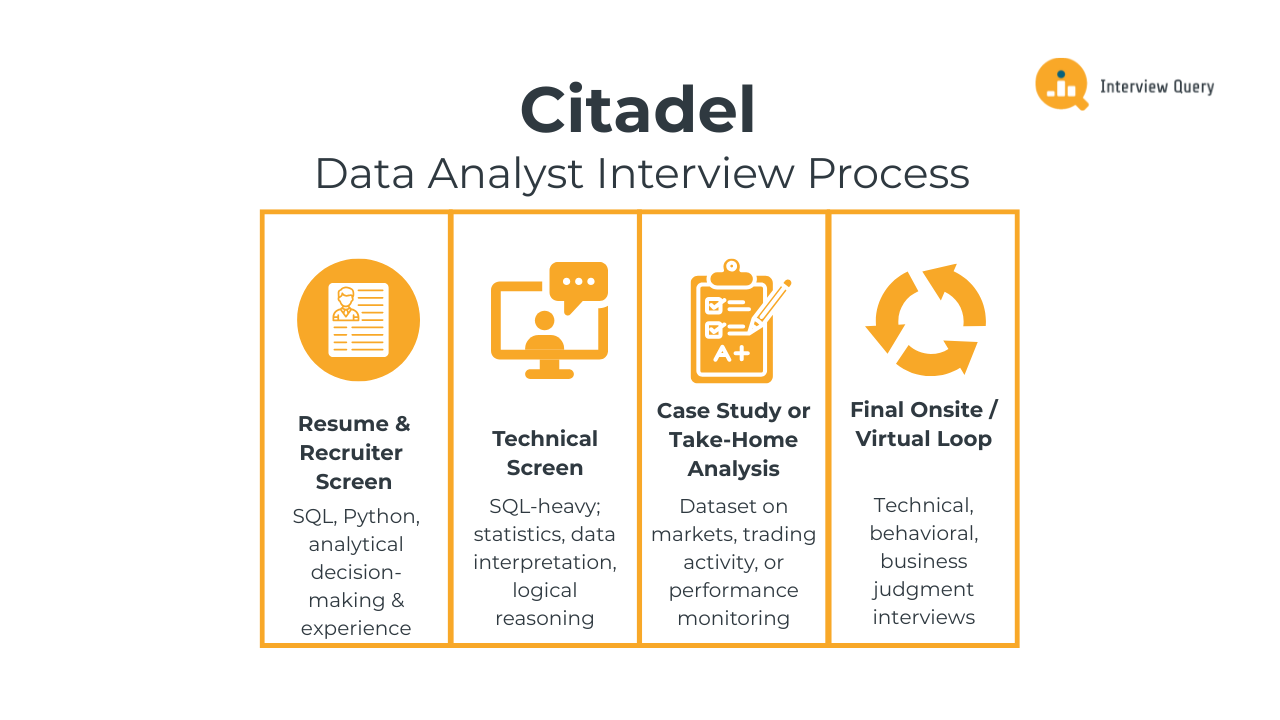
The Citadel data analyst interview process is built to evaluate how quickly and accurately you can turn data into decisions in a high-stakes environment. As one of the world’s most sophisticated hedge funds, Citadel relies on analysts who combine analytical precision with sharp commercial judgment. Interviews are designed to test not just whether you can write correct SQL or analyze a dataset, but whether you can reason under pressure, spot risk, and connect insights directly to trading or portfolio outcomes.
Across stages, interviewers consistently look for structured thinking, speed balanced with accuracy, and an ability to explain complex analysis in plain, decision-oriented language. Understanding how each stage fits together helps you prepare deliberately rather than reactively.
Resume screen and recruiter call
The process begins with a resume screen followed by a recruiter call, which filters for baseline fit before technical evaluation. Recruiters focus heavily on strong academics, clear analytical progression, and evidence that you have worked with data in fast-moving or high-impact settings. Experience in finance, trading, market analytics, or risk-related work is a strong signal, but not strictly required if your projects demonstrate comparable rigor. Fluency in SQL and Python is assumed, and resumes that highlight real analytical decision-making stand out quickly.
The recruiter call itself is usually concise and focused. You will walk through your background, explain why Citadel appeals to you specifically, and discuss the types of teams or problems that interest you. Expect high-level questions about how you have used data to influence decisions and how you handle tight timelines or ambiguous goals.
Tip: Quantify both impact and speed on your resume. Phrases like “reduced latency by 30 percent” or “delivered insights within one trading session” signal alignment with Citadel’s operating tempo.
Technical screen
The technical screen is where the Citadel interview process starts to differentiate itself. This round is typically SQL-heavy, with additional emphasis on statistics, data interpretation, and logical reasoning. You may be asked to write queries that resemble production analytics, such as calculating performance metrics, identifying anomalies, or comparing cohorts under specific constraints. Correctness matters, but so does how you structure the solution.
Interviewers probe edge cases deliberately. They want to see how you handle missing data, outliers, or ambiguous definitions, and whether you can explain why your approach is robust. Meanwhile, statistical questions often focus on interpreting results rather than deriving formulas, for example assessing whether a signal is meaningful or whether a change is likely noise.
Communication is evaluated continuously. You are expected to talk through your logic clearly, justify assumptions, and adjust when challenged. Silence or purely mechanical query writing is usually a red flag.
Tip: Practice narrating your thinking as you write SQL, e.g. why you chose a specific join, how you’re handling nulls, and what trade-offs you’re making between accuracy and performance. Interview Query’s SQL drills are particularly effective for building this muscle under pressure.
Case study or take-home analysis
Many candidates complete a case study or take-home analysis that mirrors the type of work analysts do on the job. The dataset is often framed around markets, trading activity, or performance monitoring, even if it is anonymized. You are expected to explore the data independently, surface key patterns, and present conclusions in a clear, decision-focused way.
Follow-up discussions matter as much as the analysis itself. Interviewers ask detailed questions about your assumptions, how sensitive your conclusions are to different inputs, and what risks or blind spots might remain. They are less interested in flashy visuals and more interested in whether your analysis would hold up in a real trading or investment context.
Tip: Explicitly connect insights back to profit, loss, or risk exposure. Even exploratory findings should be framed in terms of how they would influence a trading or portfolio decision.
Tip: Anchor every insight (even exploratory findings) to profit, loss, or risk. Practicing end-to-end case studies from Interview Query’s Data Analytics 50 study plan can help you internalize this framing.
Final onsite or virtual loop
The final stage is a multi-round loop conducted onsite or virtually, depending on location and team. You will meet with several interviewers across technical, behavioral, and business judgment interviews. Technical rounds may revisit SQL, statistics, or case-style reasoning, often with increased complexity or time pressure.
Behavioral questions focus on how you operate in high-expectation environments. Interviewers look for ownership, intellectual honesty, and how you respond when your analysis is challenged. Business judgment interviews push you to think like an investor or risk manager, weighing trade-offs with incomplete information.
Above all, Citadel values consistency. Strong candidates demonstrate the same clarity, rigor, and accountability in every conversation, not just in one standout round.
Tip: Answer as if real capital is on the line. Acknowledge uncertainty, articulate risks explicitly, and explain how you’d monitor outcomes after making a decision. Interview Query’s mock interviews are a practical way to rehearse this mindset before the real thing.
By understanding how each stage evaluates technical skill, reasoning speed, and commercial awareness, you can tailor your preparation to what actually matters in the loop. Level up your prep with the Data Analytics Interview learning path on Interview Query, which offers targeted lessons, real-world practice problems, and expert guidance to help you stand out across all rounds.
Challenge
Check your skills...
How prepared are you for working as a Data Analyst at Citadel Llc?
What Questions Are Asked in a Citadel Data Analyst Interview?
Citadel’s data analyst interviews are designed to mirror the environment you’d be stepping into: fast-moving, detail-sensitive, and unforgiving of sloppy thinking. Across technical and behavioral rounds, interviewers evaluate structured problem solving, numerical intuition, and your ability to decide and communicate clearly under pressure.
Many questions are intentionally underspecified, pushing you to ask clarifying questions, select tradeoffs, and explain why your approach makes sense in a real-world financial context.
The video below provides a helpful framework for understanding the core categories of data analyst interview questions you’re likely to face, many of which closely align with Citadel’s interview style.
Watch Next: Data Analyst Interview Questions
In this video, Interview Query cofounder and data scientist Jay Feng highlights question categories such as SQL/problem-solving challenges, case-style analytical scenarios, and behavioral prompts. Across all types, he also emphasizes the value of structured responses and clear communication, which are skills that directly align with what Citadel interviewers assess.
Now, we break down the major categories of Citadel data analyst interview questions and what interviewers are truly looking for in each.
SQL and data manipulation interview questions
SQL questions at Citadel go well beyond basic joins and aggregations, while focusing on correctness, performance, and analytical intent. You are expected to write clean queries, reason about edge cases, and explain how your logic would scale on large, time-sensitive datasets. Clean structure, defensible reasoning, and awareness of tradeoffs are all signals of readiness.
How would you write a SQL query to calculate daily profit and loss by trading strategy?
This tests your ability to aggregate transactional data, apply grouping logic, and translate raw records into financial performance metrics. The approach involves grouping trades by strategy and trade date, summing realized and unrealized P&L components as needed, and ensuring timestamps are normalized to a consistent trading day. Strong answers also account for edge cases like partial fills or late-reported trades that could skew daily results.
Tip: Be ready to explain how this P&L would actually be used, such as spotting strategy drift or flagging intraday risk. Interviewers often push beyond the query to test whether the metric would meaningfully influence trading decisions.
-
This question evaluates comfort with time-series analysis, window functions, and precise filtering in SQL. A typical solution first aggregates deposits at the daily level per user, filters out negative transaction values, and then applies a rolling window function ordered by date. Careful handling of date formatting and missing days is essential to ensure the rolling average reflects actual activity rather than gaps in the data.
Tip: Call out whether the rolling window should be calendar-based or activity-based, as clarifying that assumption signals an understanding of how subtle choices can materially change downstream interpretations.
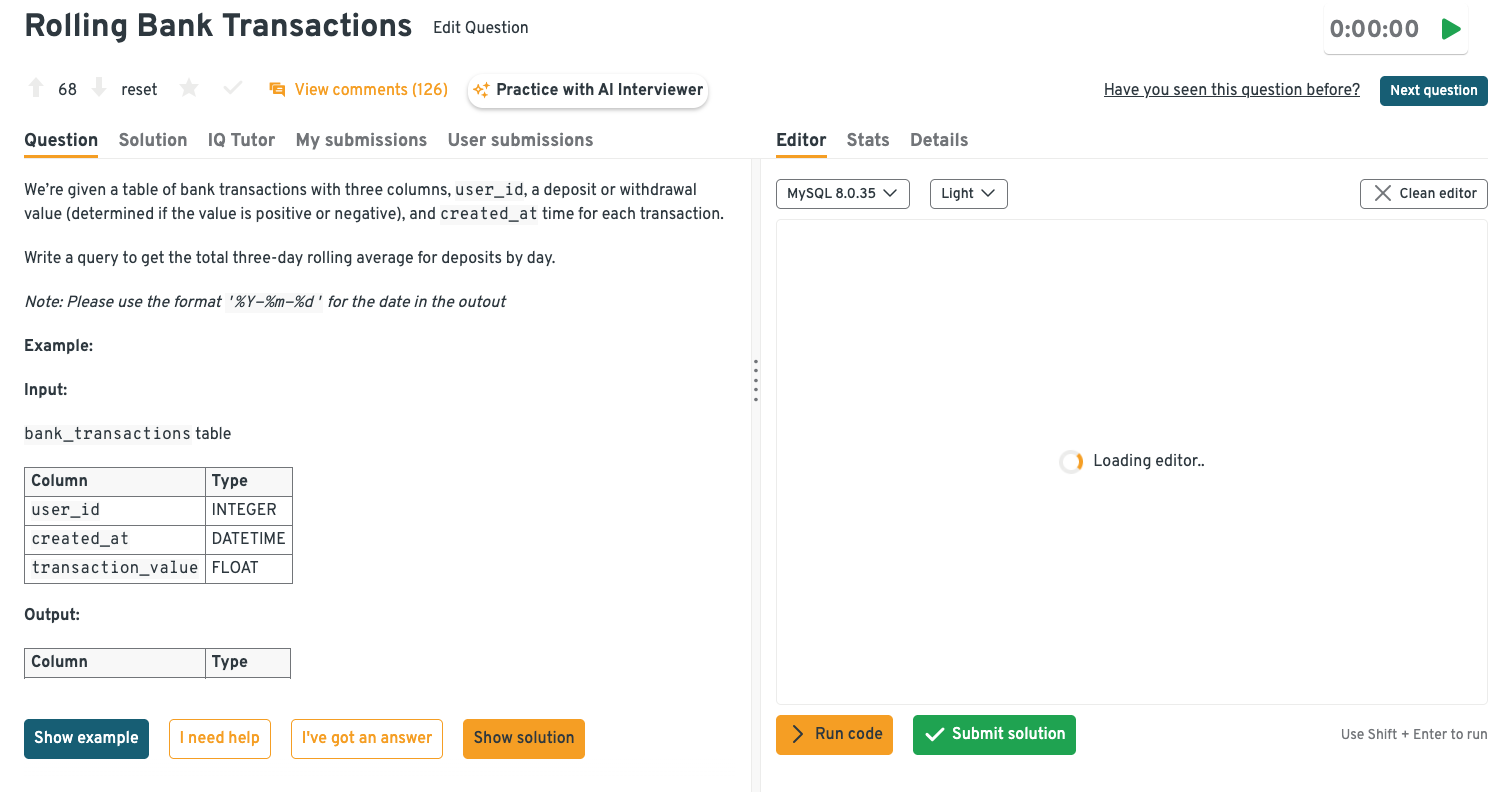
Build confidence on questions like this by practicing directly in the Interview Query dashboard, where you can write and run SQL in a built-in editor and immediately validate your approach. Each problem includes a step-by-step solution walkthrough, making it easy to compare strategies, catch edge cases, and refine your thinking the way interviewers expect.
How would you identify duplicate records in a large trade log table?
The core skills here include data quality validation, grouping, and understanding what uniquely defines a record in a production system. You would identify a natural or composite key, such as trade ID, timestamp, instrument, and quantity, and group by those fields to surface counts greater than one. In more complex systems, analysts may also use window functions to flag duplicates while preserving one canonical record for downstream analysis.
Tip: Strong candidates proactively discuss the risk of false duplicates caused by system retries or trade amendments, showing awareness of how trading infrastructure behaves in real market conditions.
-
This tests your ability to combine aggregation, date logic, and ratio-based metrics into a coherent result. The solution typically involves identifying the minimum and maximum years in the dataset, summing revenue for those periods, and dividing by total cumulative revenue. A strong answer also rounds appropriately and ensures the logic holds even if data for intermediate years is incomplete.
Tip: Frame this metric as a way to detect concentration or growth risk, not just as a reporting exercise. Connecting the calculation to strategic insight tends to resonate strongly with Citadel interviewers.
How would you optimize a slow-running aggregation query on billions of rows?
This question assesses practical SQL performance tuning and systems-level thinking at scale. An effective approach might include filtering early to reduce data volume, indexing or partitioning on frequently grouped or filtered columns, and pre-aggregating data where possible. Advanced candidates also discuss execution plans, join order, and whether the query should be moved to a summary table or batch process for repeated use.
Tip: Discuss how you’d profile the query during peak market hours versus off-hours, since latency that’s acceptable overnight can become unacceptable when markets are volatile. This shows awareness of how performance constraints shift when analytics directly support live trading or risk monitoring.
Want to master SQL for interviews? The SQL Interview Learning Path on Interview Query provides step-by-step guidance, real-world practice problems, and expert strategies to write efficient, accurate queries under time pressure. Work through structured lessons that cover window functions, aggregations, joins, and query optimization to demonstrate both speed and analytical insight in your interviews.
Statistics and probability interview questions
Statistics and probability questions at Citadel emphasize interpretation over memorization. Citadel evaluates how well you reason through uncertainty, variability, and risk, especially in scenarios where you don’t have perfect information or time for exhaustive analysis. Expect questions around distributions, expectation, hypothesis testing, or experimental design, often framed in practical or market-driven contexts.
-
The question evaluates applied regression diagnostics and model stability. Detection typically involves examining correlation matrices or variance inflation factors to identify highly correlated predictors. Addressing the issue may include removing redundant features, combining signals, or using regularization techniques that penalize unstable coefficients.
Tip: Stand out by explaining how multicollinearity can create false confidence in a strategy, especially when signals appear to diversify risk but actually respond to the same underlying market factor.
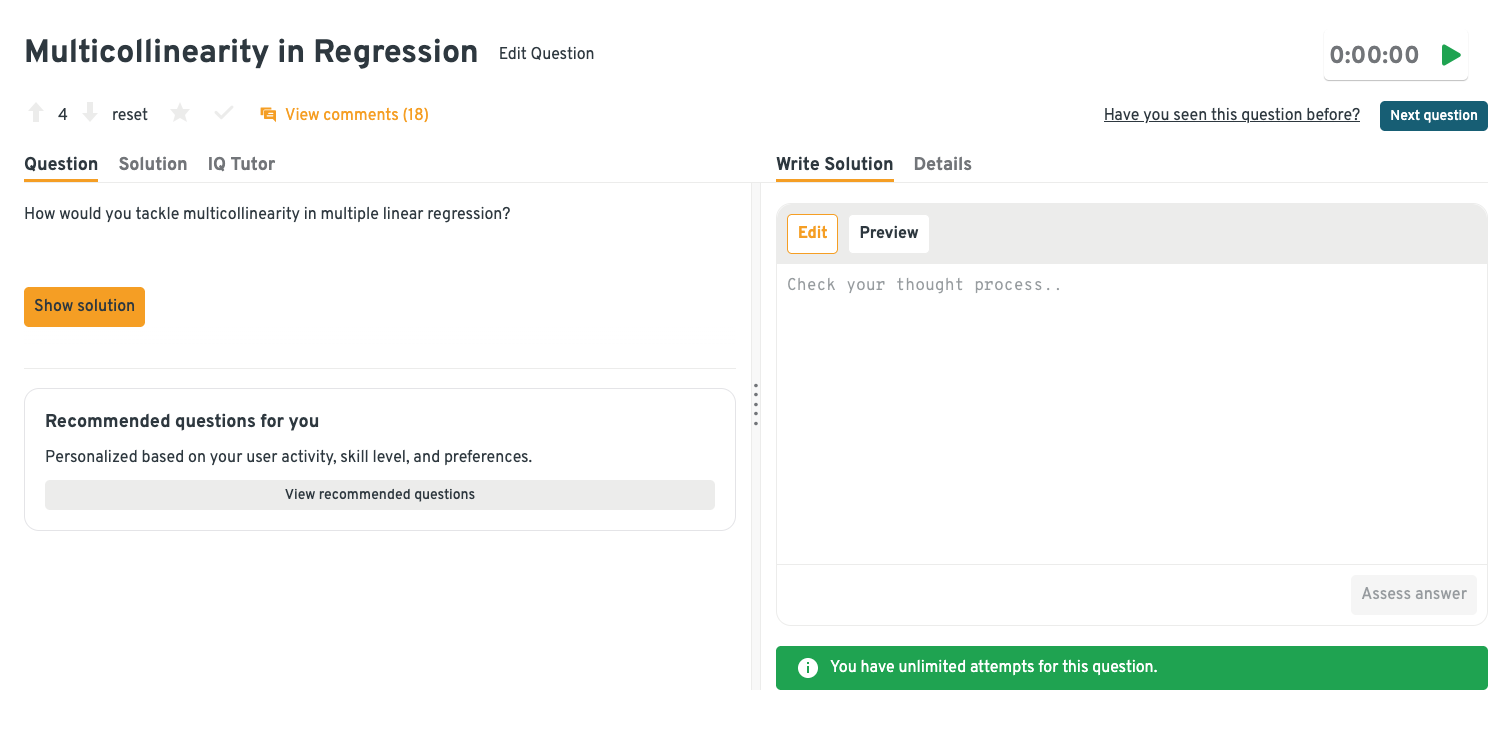
Working through statistics and probability problems like this using the Interview Query dashboard. With tools like IQ Tutor, you can get AI-guided hints, explanations, and alternative approaches, helping you understand why a method works, not just how to state it in an interview.
-
This tests foundational understanding of dependence and scale in statistical relationships. Covariance indicates the direction of joint movement between two signals but is sensitive to units, making comparisons difficult across features. Correlation standardizes that relationship, allowing analysts to compare strength and direction across different signals on a consistent scale.
Tip: When discussing this, anchor the explanation in signal selection. Interviewers are often listening for whether the candidate understands why correlation is preferred when ranking or pruning features across vastly different scales.
How would you determine whether a change in strategy performance is statistically significant?
This assesses your ability to apply hypothesis testing and interpret uncertainty in performance metrics. The approach involves defining an appropriate null hypothesis, selecting a test based on the distribution and sample size, and computing a p-value or confidence interval. Analysts also consider the economic magnitude of the change alongside statistical significance to avoid over-interpreting small effects.
Tip: Explicitly mention regime shifts or changing market conditions, showing awareness that statistical significance can break down when historical assumptions no longer hold.
How would you compare two strategies with different risk profiles?
This tests understanding of risk-adjusted performance and distributional characteristics. Rather than comparing raw returns, analysts typically use metrics like Sharpe ratio, drawdown, or volatility-adjusted returns to normalize for risk. In practice, examining tail behavior and performance during stressed market conditions adds important context beyond summary statistics.
Tip: Interviewers are impressed when candidates highlight asymmetry, such as downside skew or crash exposure, since these often matter more than average risk metrics in capital allocation decisions.
-
The skill being tested is depth of statistical understanding combined with communication flexibility. For non-technical audiences, the focus is on intuition and directional relationships; for junior analysts, on coefficients, assumptions, and interpretation; and for quantitative researchers, on estimation methods, diagnostics, and underlying statistical properties. Strong answers demonstrate the ability to adjust precision and abstraction without changing the core model.
Tip: Practice shifting explanations midstream when challenged, as Citadel interviews often simulate real conversations where insights must be reframed on the fly for traders, PMs, and quants with very different priorities.
Business and market sense interview questions
These questions assess whether you can bridge analysis and action. Citadel wants analysts who understand how data informs trading decisions, risk management, and strategic choices. You may be asked to evaluate a hypothetical strategy, interpret a trend, or prioritize which signals matter most.
-
This question evaluates financial intuition, strategic thinking, and the ability to assess risk-adjusted returns. Start by comparing growth trajectories, cash flow stability, and execution risk while factoring in valuation, synergies, and capital constraints. The decision should ultimately tie back to expected returns under different scenarios and how each acquisition fits Citadel’s broader investment objectives.
Tip: Explicitly call out one scenario where your recommendation would flip, and explain why. Citadel values candidates who recognize when a conclusion is conditional rather than absolute.
How would you prioritize which metrics to monitor in a volatile market?
This tests judgment around signal selection and the ability to focus on what matters when conditions change quickly. An effective approach starts by identifying metrics most directly linked to risk exposure and portfolio performance, then filtering out lagging or redundant indicators. Emphasis should be placed on forward-looking signals that help anticipate regime shifts rather than react to them.
Tip: Mention how often you would reassess the metric set and what would trigger a change. Showing awareness that metric relevance decays over time signifies strong market intuition.
How would you use data to decide whether to scale a trading strategy?
This question probes analytical rigor and comfort with uncertainty in high-stakes decisions. A thoughtful response examines performance consistency, drawdowns, and sensitivity to market conditions while stress-testing assumptions with out-of-sample data. Beyond returns, candidates should address capacity constraints, liquidity impact, and how scaling could alter the strategy’s risk profile.
Tip: Highlight one leading indicator that would make you pause scaling even if recent returns look strong. Citadel values analysts who can protect capital, not just chase performance.
-
Here, interviewers assess pattern recognition, statistical reasoning, and applied decision-making. The answer should explain how to distinguish structural changes from random fluctuation using baselines, seasonality checks, or confidence thresholds. Strong candidates also connect insights to action, such as adjusting alert thresholds, retraining models, or reallocating investigative resources.
Tip: Discuss how you would validate a suspected shift before acting on it. Demonstrating restraint and verification discipline is especially compelling in risk-sensitive environments that Citadel operates in.
How would you communicate a negative finding to a portfolio manager?
This question evaluates communication skills, professionalism, and ownership in a performance-driven environment. A solid approach frames the finding clearly and objectively, explains its implications for risk or returns, and avoids defensiveness. The message should focus on impact and next steps, offering data-backed options rather than just presenting the problem.
Tip: Structure the message so the key takeaway is clear in the first 10 seconds. Senior stakeholders value concise delivery that respects time while still preserving analytical depth.
Want to sharpen these skills in real interview conditions? Explore Interview Query’s real-world challenges to practice market-driven cases, data tradeoffs, and decision-making scenarios that mirror what Citadel interviews actually test.
Behavioral interview questions
Behavioral interviews focus on how you operate in high-expectation, feedback-heavy environments. Citadel looks for ownership, resilience, and intellectual honesty.
-
Citadel uses this question to assess motivation, role clarity, and whether a candidate understands the firm’s performance-driven culture. Strong answers quantify alignment by referencing outcomes achieved in similar environments, such as improving returns, reducing risk, or accelerating decision-making.
Sample answer: “Citadel appeals to me because it operates in an environment where data directly informs capital allocation and performance. In my current role, I supported a trading team by building analytics that reduced intraday risk exposure by 12%, and I’m looking to apply that same rigor at a larger scale. The data analyst role aligns with my goal of working closer to investment decisions rather than purely reporting. Citadel’s emphasis on accountability and feedback matches how I’ve performed best historically.”
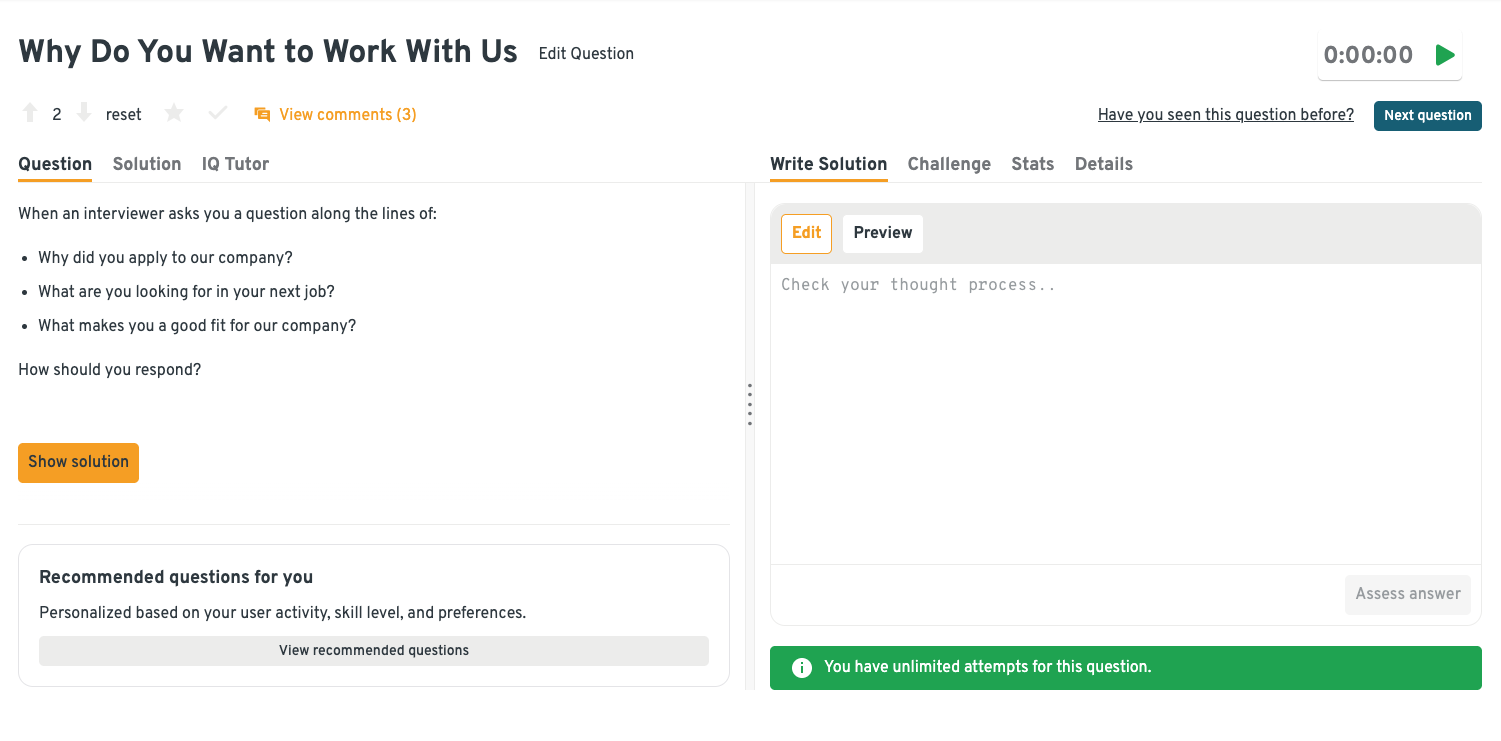
Refine answers like this by exploring behavioral questions in the Interview Query dashboard. User comments helps you see multiple perspectives and calibrate tone, depth, and specificity, ultimately making your answers sound authentic, well-reasoned, and aligned with what top firms like Citadel look for.
Tell me about a time you had to make a decision with incomplete data.
This question evaluates judgment under uncertainty and comfort with imperfect information, both critical in fast-moving markets. Candidates stand out by quantifying constraints, explaining risk tradeoffs, and describing the measurable outcome of the decision.
Sample answer: “During a market volatility spike, I had to recommend whether to pause a strategy despite only having partial intraday data. I identified the most stable indicators available, estimated downside risk using historical drawdowns, and flagged assumptions clearly. Based on this, we temporarily reduced exposure by 20%, which limited losses while preserving upside once conditions normalized. The decision was revisited once more complete data became available.”
Describe a time your analysis was challenged by a senior stakeholder.
Citadel wants to see how candidates defend their work, respond to scrutiny, and adapt without becoming defensive. Impact-driven answers highlight how feedback led to better decisions, improved models, or changes in strategy.
Sample answer: “A portfolio manager questioned the assumptions behind a performance attribution model I built. I walked through the data sources, sensitivity tests, and showed how alternative assumptions changed results by less than 2%. After incorporating their feedback, I added scenario comparisons that made the output clearer and more actionable. The revised analysis became a standard input for weekly reviews.”
-
This question tests communication skill and business framing, especially the ability to translate technical work into decisions that affect capital. Candidates can quantify impact by referencing time saved, faster decisions, or improved outcomes from clearer communication.
Sample answer: “I would start by focusing on the decision the model informs rather than the mechanics behind it. For example, instead of describing model architecture, I’d explain how the signal increased expected returns by 8% while keeping drawdowns flat. I’d use one or two visuals to show the tradeoff clearly and leave technical details for follow-up. This approach has helped reduce back-and-forth and speed up decision-making in past roles.”
Tell me about a time you improved an existing analysis or process.
Citadel looks for candidates who take ownership and continuously raise the bar. Strong answers quantify efficiency gains, accuracy improvements, or downstream business impact.
Sample answer: “I inherited a daily reporting process that took over two hours and often produced inconsistent metrics. After auditing the logic, I standardized definitions and automated the workflow, reducing runtime to 15 minutes. The improved accuracy eliminated recurring discrepancies that had been flagged by stakeholders. As a result, the report became a reliable input for daily trading discussions.”
To tailor your prep further and meet Citadel’s standards throughout the loop, the Interview Query Data Analytics 50 study plan covers SQL, statistics, business intuition, and interview-style questions, allowing you to practice in a structured, time-efficient manner.
How to Prepare for a Citadel Data Analyst Interview
Effective Citadel interview preparation requires a deliberate focus on precision, speed, and decision-quality under pressure. The interviews are intentionally demanding and designed to resemble how decisions are made on the desk: under time pressure, with imperfect data, and real consequences. Strong preparation goes beyond memorizing concepts and focuses on building instincts you can rely on when the stakes are high.
Build technical muscle memory in SQL and statistics. Practice writing concise, performant queries that handle edge cases and scale cleanly, especially with joins, window functions, and time-based aggregations. You should be able to reason about performance trade-offs and explain why one approach is preferable to another. Pair this with a statistics refresh that emphasizes probability, distributions, hypothesis testing, and interpreting variance.
Tip: Time yourself solving SQL problems end-to-end, including explaining your logic out loud. This is where Interview Query’s 14 Days of SQL study plan pays off through its intentional, structured approach that includes timed practice to improve both speed and correctness.
Develop intuition for time-series and market-style data. Many Citadel questions involve trends, regime changes, or shifting distributions, even if they aren’t explicitly framed as trading problems. Practice analyzing rolling metrics, detecting structural breaks, and reasoning about whether a signal is durable or transient. Always tie statistical results back to real-world implications for decision-making.
Tip: When practicing, force yourself to answer “what would you do next?” after every analysis, since Citadel interviewers care as much about actionability as correctness. Interview Query’s analytics and cases question bank is particularly useful for building this intuition.
Study Citadel-specific signals and context. Review Citadel’s company news, earnings calls and public commentary to understand how the firm talks about data, risk, and performance. Incorporating this context into your answers shows preparation beyond generic interview practice and signals genuine interest in how the firm operates.
Tip: Build a short personal “Citadel lens” document that maps common analytics tasks to how the firm measures risk and performance; this makes it easier to tailor answers during practice.
Train for pressure, not just correctness. Citadel interviews are high-stakes and move quickly, but partial credit matters. Get comfortable structuring answers out loud, stating assumptions early, and choosing a reasonable path rather than searching for a perfect one. When something goes wrong, acknowledge it and adjust decisively; how you recover is often more revealing than the mistake itself.
Tip: Simulate real interview pressure by practicing with a timer and verbalizing your thinking, since many candidates underestimate how much delivery and composure affect interviewer signal.
Practice with case-style, open-ended problems. Citadel favors ambiguity, so work through analytics cases that force you to clarify goals, select tradeoffs, and defend conclusions with limited information. Treat each case as if capital or risk exposure depends on your recommendation.
Tip: After each case, write a short “investment memo–style” summary of your recommendation and risks. This habit aligns well with how Citadel evaluates analytical judgment and decision quality.
If you want realistic practice, Interview Query’s mock interviews are especially valuable for sharpening your communication and decision-making under pressure. These sessions can help you identify gaps early and walk into the real interview with confidence in your process, not just your answers.
Role Overview and Culture at Citadel
The data analyst role at Citadel is not about passive reporting or maintaining dashboards, but about transforming large, often messy datasets into signals that directly shape trading strategies, risk decisions, and investment theses. Analysts are embedded with investment, research, or sector-focused teams and are expected to develop a deep understanding of both the data and the market questions it’s meant to answer.
Day to day, the work blends technical execution with judgment and communication by validating assumptions and surfacing insights that hold up under scrutiny from senior investors.
Typical responsibilities include:
- Sourcing, cleaning, and validating large structured and unstructured datasets from internal and external providers
- Writing performant SQL and Python workflows to explore data, test hypotheses, and generate repeatable analyses
- Identifying patterns, anomalies, or inflection points that support or challenge investment views
- Partnering with data engineers and quantitative researchers to ensure data quality and consistency
- Communicating findings, limitations, and risks clearly to portfolio managers and senior stakeholders
Culture and impact-wise, Citadel offers an environment where strong analytical work is noticed and acted on immediately. In this meritocratic culture, feedback is direct and impact is measurable. Analysts gain early exposure to elite investors, alternative data, and production-grade analytics systems, compressing years of learning into a short, demanding window. Compensation and progression reflect that intensity, making the role a powerful accelerator for analytically driven careers in finance.
Want personalized guidance to prepare for a role like this? Interview Query’s coaching services pair you with experienced data professionals who sharpen communication for high-stakes interviews and tailor your preparation specifically for firms like Citadel.
Average Citadel Data Analyst Salary
Citadel data analysts are among the highest-paid in the industry, with compensation reflecting both the firm’s performance-driven culture and the proximity of analytics work to real trading and investment outcomes. Pay at Citadel is not linear or tenure-based, and instead scales sharply with impact. Analysts who influence P&L, improve execution, or reduce risk exposure are rewarded disproportionately through bonuses and long-term incentives.
Read more: Data Analyst Salary
Based on aggregated data from sources like Levels.fyi, total compensation spans a wide range depending on seniority, team, and geography. While base salary anchors overall pay, bonuses often make up the fastest-growing portion of compensation, especially after the first one to two years. For high performers, year-over-year upside can be substantial, even without a formal title change.
Compensation by Level
| Level | Total / Year | Base / Year | Stock / Year | Bonus / Year |
|---|---|---|---|---|
| Junior Data Analyst | ~$180K | ~$130K | ~$15K | ~$35K |
| Data Analyst | ~$240K | ~$160K | ~$25K | ~$55K |
| Senior Data Analyst | ~$320K | ~$185K | ~$45K | ~$90K |
| Lead / Principal Analyst | ~$400K+ | ~$210K | ~$70K | ~$120K+ |
One notable pattern is that compensation accelerates meaningfully after year two, when analysts are more directly tied to desk-level outcomes and long-term incentive structures begin to vest.
Average Base Salary
Average Total Compensation
Regional Salary Comparison
| Region | Salary Range | Notes |
|---|---|---|
| United States (New York, Chicago) | ~$220K–$380K+ | Highest upside due to trading hub concentration and bonus leverage |
| United States (Other Hubs) | ~$200K–$330K | Slightly lower bonus bands depending on desk and strategy |
| Europe (London) | ~$170K–$280K | Strong base compensation; bonuses vary significantly by team |
| Asia (Hong Kong, Singapore) | ~$160K–$260K | Adjusted for regional market dynamics and role scope |
Across levels and regions, the data is clear: Citadel rewards impact, not tenure. Analysts who consistently deliver accurate, timely insights see the fastest compensation growth, especially those tied directly to profit generation, execution efficiency, or risk management.
If you’re evaluating an offer or planning your next move, understanding how your compensation compares by level, location, and peer firms is critical. Explore Interview Query’s salary guides to benchmark your offer and make data-backed decisions about your career trajectory.
FAQs
How difficult is the Citadel data analyst interview?
The Citadel data analyst interview is known for being challenging, but it’s also very learnable with the right preparation. Citadel sets a high bar for analytical rigor, speed, and clarity of thinking, especially under time pressure. Interview questions are often open-ended and designed to evaluate how you reason through uncertainty rather than how many formulas you can memorize. Candidates who prepare effectively tend to focus on structuring their thinking, communicating assumptions clearly, and staying composed when problems evolve.
Do you need a finance background to get hired?
A formal finance background is not required, but financial intuition is expected. Many successful candidates come from data science, analytics, mathematics, engineering, or economics backgrounds. What matters most is your ability to connect data insights to real-world outcomes such as risk, returns, or decision trade-offs. Interviewers often probe whether you understand how metrics would influence investment or trading decisions. Candidates without finance experience should be prepared to explain how they would learn domain context quickly and validate assumptions before acting on data.
How technical is the SQL portion of the interview?
SQL is a core evaluation area in Citadel data analyst interviews, and the bar is high. You should expect multi-step queries involving joins, aggregations, window functions, and edge-case handling. Interviewers care about correctness first, but they also evaluate query efficiency and clarity. You may be asked to optimize an approach verbally or explain how a query would scale on large datasets. Writing syntactically correct SQL is table stakes. Explaining your logic clearly and anticipating data quality issues is what differentiates strong candidates.
Are statistics and probability heavily tested?
Yes. Statistics and probability questions are common and often embedded within practical scenarios. Rather than asking purely academic questions, interviewers test whether you can interpret variance, reason about distributions, and explain uncertainty in plain language. You may be asked to compare metrics over time, assess whether a change is meaningful, or decide how much confidence to place in a noisy signal. The emphasis is on judgment and interpretation, not memorization.
What is the interview timeline like, and how long does feedback take?
The Citadel data analyst interview process typically moves quickly once it starts. After an initial recruiter screen, candidates usually progress through technical interviews and final rounds within two to four weeks, depending on scheduling. Feedback is often delivered faster than at large technology companies, sometimes within days of a round. However, timelines can vary by team and hiring urgency. Candidates are expected to stay responsive and flexible, as delays or slow follow-ups can be viewed negatively in a fast-paced hiring environment.
How should candidates prepare differently for Citadel compared to tech companies?
Citadel places more weight on decision quality under pressure than many traditional technology firms. Preparation should focus on practicing concise explanations, rapid problem structuring, and defending assumptions confidently. Overly academic answers or long-winded explanations tend to work against candidates. The strongest performers treat each question as if real capital were at stake and communicate accordingly.
Ace the Citadel Data Analyst Interview with Interview Query
The Citadel data analyst interview stands apart for its emphasis on speed, precision, and decision quality under pressure. Citadel evaluates whether you can translate complex data into clear, defensible insights that influence real capital allocation. Success requires disciplined preparation, strong technical fundamentals, and the ability to think clearly when stakes are high.
To prepare at the level Citadel expects, use Interview Query’s question bank for tailored prep across all rounds from technical to behavioral, mock interviews to mirror the pace and stakes of actual interviews, and analytics-focused learning paths to sharpen both your technical execution and real-world judgment.
Discussion & Interview Experiences