

Citadel Data Scientist Interview Guide: Real Question Patterns, Skills & Tips (2026)


Introduction
Preparing for a Citadel data scientist interview means stepping into one of the most demanding and high-impact data science environments in the world. At Citadel and Citadel Securities, data science sits at the core of how trading strategies are researched, evaluated, and deployed. As markets become more automated and signal-driven, Citadel continues to invest heavily in statistical modeling, large-scale data infrastructure, and quantitative research to maintain its competitive edge. Data scientists here work directly on problems where precision, speed, and judgment materially affect real financial outcomes.
The Citadel data scientist interview reflects this responsibility. You are not assessed on technical knowledge alone. Interviewers evaluate how you reason under uncertainty, structure ambiguous research problems, and balance statistical rigor with practical constraints. Expect deep coverage of probability, statistics, Python, SQL, and modeling concepts, alongside questions that probe your research instincts and decision-making discipline. This guide outlines each stage of the Citadel data scientist interview, highlights the most common data science specific questions, and shares proven strategies to help you stand out and prepare effectively with Interview Query.
Citadel Data Scientist Interview Process
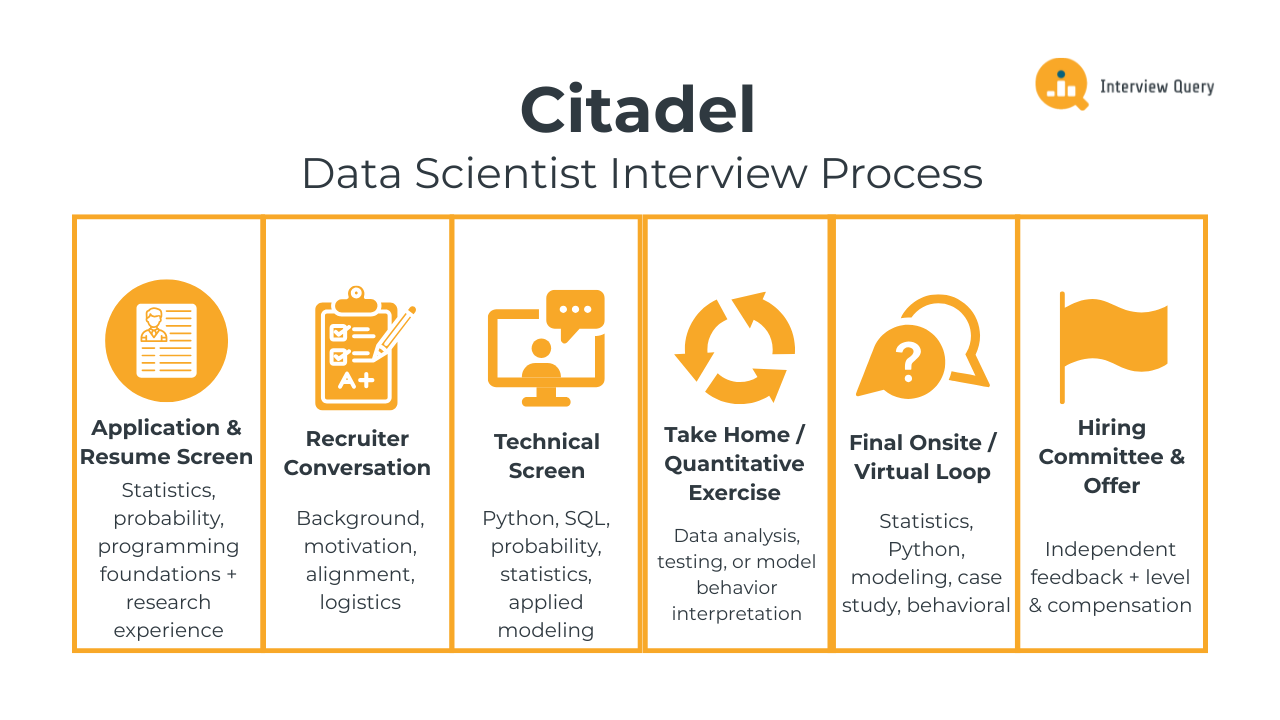
The Citadel data scientist interview process is designed to assess how you think, not just what you know. At Citadel and Citadel Securities, data scientists are evaluated on statistical rigor, research judgment, and the ability to operate under real market uncertainty. The process typically includes multiple rounds focused on probability, statistics, Python, SQL, modeling intuition, and behavioral decision-making. Most candidates complete the full loop within three to six weeks, depending on team needs and scheduling.
Below is a breakdown of each stage and what Citadel interviewers consistently look for throughout the process.
Application and Resume Screen
During the initial resume review, Citadel recruiters screen for strong foundations in statistics, probability, and programming, with particular attention to research-oriented experience. Resumes that stand out clearly demonstrate signal discovery, model evaluation, or analytical work tied to measurable outcomes. Experience working with noisy data, time series, simulations, or large-scale experimentation is especially relevant. Citadel places less emphasis on dashboards or reporting and more on evidence of deep analytical thinking and research ownership.
Tip: Highlight moments where your analysis changed a decision or invalidated an assumption. This signals research maturity and shows that you can separate real signal from noise, a core skill at Citadel.
Initial Recruiter Conversation
The recruiter conversation focuses on understanding your background, motivations, and alignment with Citadel’s work. You will discuss your experience with data science fundamentals, prior research or modeling projects, and why you are interested in quantitative finance. Recruiters also confirm logistics such as role level, location preferences, and compensation expectations. While non-technical, this stage filters for clarity of thinking and seriousness about the domain.
Tip: Be precise about why markets interest you from a data perspective. Connecting uncertainty, probabilistic reasoning, or optimization problems to your past work shows genuine alignment with Citadel’s research culture.
Technical Screen
The technical screen usually consists of one or two interviews covering Python, SQL, probability, statistics, and applied modeling concepts. You may be asked to reason through probability puzzles, analyze distributions, write queries to extract insights, or discuss how you would validate a predictive signal. Interviewers care as much about how you structure the problem as the final answer. Clear assumptions, logical flow, and error checking are heavily emphasized.
Tip: Talk through your reasoning step by step, even for questions you find simple. This demonstrates disciplined thinking and reduces the risk of hidden mistakes, a trait strongly valued in research roles.
Take Home Assignment or Quantitative Exercise
Some teams include a take home exercise or a live quantitative task. These assignments often resemble real research problems, such as analyzing a dataset for predictive signal, testing robustness, or interpreting model behavior under different assumptions. Your evaluation is based on rigor, clarity, and how thoughtfully you communicate limitations and next steps, not just numerical results.
Tip: Treat the exercise like internal research. Clearly state assumptions, show how you validated results, and explain what you would test next. This reflects strong ownership and scientific thinking.
Final Onsite or Virtual Loop
The final loop is the most comprehensive stage of the Citadel data scientist interview process. It typically includes four to five interviews, each lasting around 45 to 60 minutes. These rounds evaluate your ability to reason through complex, ambiguous problems, communicate research clearly, and demonstrate sound judgment under uncertainty.
Probability and statistics round: This interview focuses on distributions, expected values, conditional probability, hypothesis testing, and statistical intuition. Questions often involve mental math and reasoning rather than heavy computation. Interviewers look for clarity, correctness, and comfort operating without formulas.
Tip: State your assumptions out loud before solving. This shows control over uncertainty and highlights your ability to reason rigorously, even when information is incomplete.
Python and data analysis round: You will work through Python problems involving data manipulation, simulations, or analytical logic. The emphasis is on correctness, readability, and efficiency rather than clever tricks. You may also be asked to debug or improve an existing approach.
Tip: Write clean, simple code and explain why you chose that approach. This signals reliability and makes it easier for others to trust your work in production research settings.
Modeling and research judgment round: This round evaluates how you think about building, evaluating, and deploying models. You may discuss feature selection, overfitting, validation strategies, or failure modes of predictive signals. Citadel interviewers care deeply about how you decide whether a model is usable.
Tip: Emphasize how you test robustness and detect false signal. Strong skepticism and validation discipline are hallmarks of successful Citadel researchers.
Case study or open ended problem round: You may be given an ambiguous scenario related to market behavior, performance degradation, or unexpected results. The goal is to see how you structure the problem, identify relevant data, and prioritize investigations.
Tip: Start by narrowing the problem space before proposing solutions. Structured problem framing demonstrates strong analytical leadership.
Behavioral and collaboration round: This interview focuses on communication, ownership, and decision-making under pressure. Expect questions about past failures, disagreements, or high-stakes decisions. Interviewers assess how you learn, adapt, and work with others in intense environments.
Tip: Be honest about mistakes and focus on what changed in your approach afterward. Self-awareness and growth mindset are critical for long-term success at Citadel.
Hiring Committee and Offer
After the final interviews, each interviewer submits independent feedback. A hiring committee reviews your performance holistically, evaluating technical depth, research judgment, communication quality, and long-term potential. If approved, the team determines level and compensation, and candidates may be matched to a specific group based on strengths and interests.
Tip: If you have preferences across teams or research areas, communicate them clearly during the process. Thoughtful alignment helps ensure a strong long-term fit for both you and the team.
Looking for hands-on problem-solving? Test your skills with real-world challenges from top companies. Ideal for sharpening your thinking before interviews and showcasing your problem solving ability.
Challenge
Check your skills...
How prepared are you for working as a Data Scientist at Citadel Llc?
Citadel Data Scientist Interview Questions
The Citadel data scientist interview includes a rigorous mix of probability and statistics, Python and SQL, modeling judgment, and research-oriented behavioral questions. These interviews are designed to evaluate how well you reason under uncertainty, validate signal in noisy data, and communicate complex analysis clearly to quantitative stakeholders. The goal is not only to test technical depth, but to understand whether you can operate with discipline and skepticism in an environment where small errors can have outsized impact.
Read more: Top 110 Data Science Interview Questions
Below are the main question categories you should expect and how Citadel interviewers evaluate each.
Probability and Statistics Interview Questions
Probability and statistics form the backbone of Citadel’s interview process. These questions test whether you can reason precisely about randomness, distributions, and uncertainty without relying on memorized formulas. Interviewers care deeply about logical structure, assumptions, and correctness.
Read more: Top Probability Interview Questions for Data Scientists
Explain how a probability distribution could not be normal and give an example scenario.
This question tests whether you understand that real-world data often violates clean theoretical assumptions. At Citadel, returns, errors, and signals frequently show skewness, heavy tails, or multi-modality due to regime shifts and rare events. A strong answer explains why the normal distribution fails in practice and gives a concrete example such as financial returns with fat tails or execution latency with long right skew, then discusses the implications for risk and modeling.
Tip: Always connect non-normality to consequences like underestimated tail risk. This shows you think about model failure, not just distribution shape.
-
This question evaluates your understanding of regression assumptions and error structure. Citadel asks it to see if you recognize that ordinary least squares assumes noise only in the dependent variable. Regressing Y on X yields an unbiased slope near one, while regressing X on Y shrinks the coefficient due to error in the regressor. Explaining this clearly shows you understand why naïve regression can mislead in noisy financial data.
Tip: Explicitly state where the noise lives. That clarity signals statistical discipline and prevents incorrect inference in research settings.
Explain the difference between bias and variance in the context of financial time series.
This question tests whether you can move beyond textbook definitions and reason about real model behavior. At Citadel, bias often shows up as overly simplistic models that miss structure, while variance appears as strategies that look great in backtests but collapse live. A strong answer ties bias and variance to regime changes, overfitting, and instability across time, emphasizing why balance matters more than minimizing either alone.
Tip: Anchor bias and variance to live performance decay. That connection demonstrates applied research judgment, not academic recall.
-
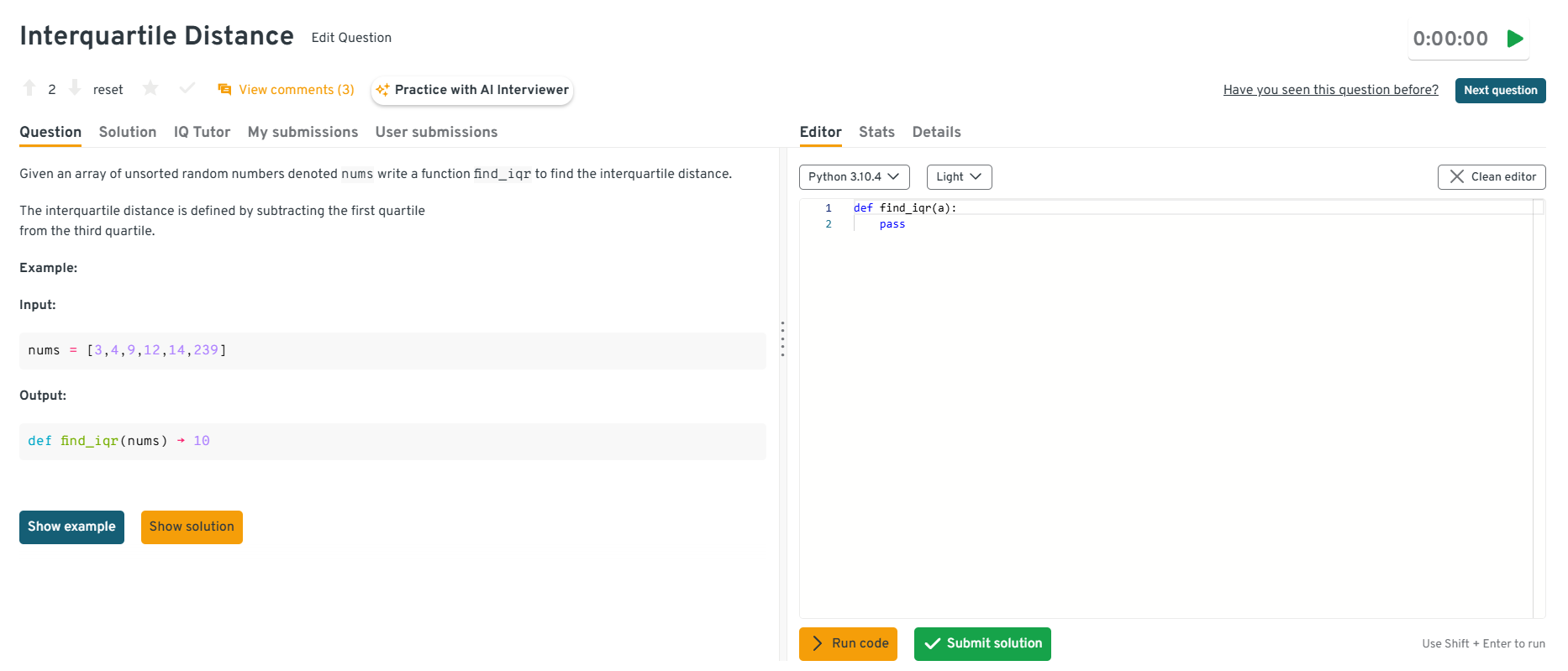
This question tests your ability to combine statistical understanding with clean implementation. Citadel uses it to see whether you handle data preparation correctly before drawing conclusions. A solid answer explains sorting the data, computing first and third quartiles carefully for even and odd lengths, and subtracting them to get IQR, while noting why IQR is robust to outliers in noisy datasets.
Tip: Explicitly explain why you would choose IQR over variance or standard deviation in noisy data. This signals that you know how to protect downstream conclusions from outliers, which is critical at Citadel where a few extreme observations can distort an entire research direction.
Head to the Interview Query dashboard to practice Citadel-specific data science interview questions in one place. You can work through SQL, probability, modeling, and behavioral prompts with built-in code execution and AI-guided feedback, making it easier to prepare for the depth of reasoning and statistical judgment Citadel interviews demand.
When would you prefer Bayesian methods over frequentist approaches?
This question probes how you think about uncertainty and prior information. Citadel values candidates who understand that Bayesian methods shine when data is sparse, sequential, or when prior knowledge matters, such as early signal evaluation. A strong answer contrasts this with frequentist methods and explains how Bayesian updating supports disciplined learning as new data arrives.
Tip: Tie Bayesian methods to decision-making with limited data and real downside risk. Explaining how priors stabilize early conclusions shows interviewers that you understand how Citadel evaluates signals before they have long performance histories.
Watch next: Top Statistics Questions in 2025 for Data Scientists
In this statistics-focused deep dive, Jay, the founder of Interview Query, breaks down the recurring patterns behind statistics questions asked at top companies like Google, Netflix, and leading quantitative finance firms, and shows how to approach each with confidence. This breakdown is especially valuable for Citadel data scientist candidates, as it sharpens intuition around hypothesis testing, variance, and experiment interpretation, all of which are critical when validating signals, managing uncertainty, and evaluating model performance at Citadel.
Python and Modeling Interview Questions
Python and modeling questions at Citadel test how you translate mathematical reasoning into reliable analysis. These problems emphasize clarity of logic, correctness under edge cases, and performance awareness rather than production engineering. Interviewers want to see whether you can reason about trade-offs, control randomness, and write code that supports trustworthy research conclusions.
-
This question tests whether you understand algorithmic efficiency and can reason about time and space trade-offs. At Citadel, the goal is not the Fibonacci sequence itself, but whether you recognize that naïve recursion is exponential, iteration is linear and memory-efficient, and memoization trades memory for speed. A strong answer explains all three, compares their complexity, and articulates when each approach is appropriate.
Tip: Explicitly state why uncontrolled recursion is dangerous at scale. This shows you think defensively about performance and reliability, which matters in research pipelines.
How would you debug a Python analysis that produces inconsistent results?
This question evaluates your discipline around reproducibility and randomness. Citadel asks it because inconsistent results often indicate hidden bugs like uncontrolled random seeds, data leakage, or mutable state. A good answer walks through checking data inputs, fixing random seeds, isolating components, and validating intermediate outputs to systematically narrow the issue.
Tip: Emphasize isolating one source of randomness at a time. This signals calm, methodical debugging under uncertainty, a key research skill at Citadel.
-
This question tests your ability to reason about sequences efficiently. A strong solution explains scanning from the right while tracking the maximum seen so far, returning values that exceed it. Citadel uses questions like this to see whether you can derive linear-time solutions instead of relying on brute force, which often hides inefficiency in research code.
Tip: Explain why the right-to-left scan works before coding. That reasoning-first approach signals strong algorithmic intuition.
-
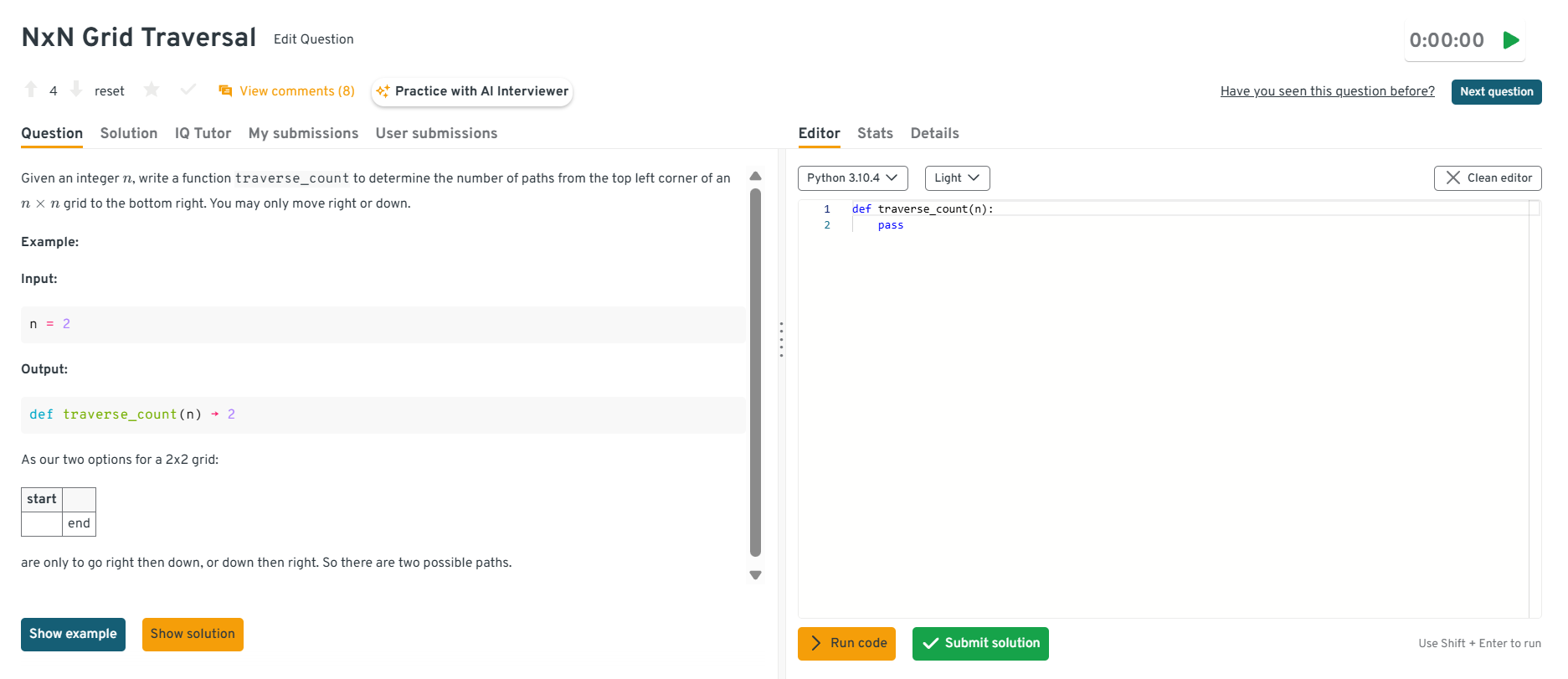
This question evaluates whether you can recognize structure and apply dynamic programming or combinatorics. At Citadel, interviewers want to see if you can identify overlapping subproblems and reason about growth rates. A good answer explains the recurrence relation or combinatorial interpretation and why it scales better than naïve enumeration.
Tip: Tie your solution to how complexity grows with n. This shows awareness of scalability, not just correctness.
Head to the Interview Query dashboard to practice Citadel-specific data science interview questions in one place. You can work through SQL, probability, modeling, and behavioral prompts with built-in code execution and AI-guided feedback, making it easier to prepare for the depth of reasoning and statistical judgment Citadel interviews demand.
How would you optimize a slow Python data pipeline?
This question tests whether you understand performance bottlenecks in analytical workflows. Citadel looks for candidates who start by profiling, then reduce unnecessary passes, use vectorization, and simplify logic before reaching for complexity. A strong answer emphasizes diagnosing the root cause before optimizing and preserving correctness throughout.
Tip: Say explicitly what you would measure before changing code. That discipline shows you optimize based on evidence, not instinct.
Want to strengthen your end-to-end data science skills? Explore our Data Science 50 learning path to practice a curated set of real-world data science interview questions designed to sharpen your SQL, statistics, experimentation, and modeling judgment, the exact skills Citadel evaluates in data scientists.
SQL and Data Reasoning Interview Questions
SQL questions for data scientists at Citadel are designed to test how you reason about data under real constraints, not whether you remember syntax patterns. Interviewers care about how you define metrics, handle edge cases, and ensure correctness when data is imperfect or evolving.
Write a query to compute rolling volatility over time.
This question tests your ability to work with time series data using window functions and correct aggregation logic. At Citadel, rolling metrics like volatility are used to understand regime shifts and stability, so interviewers look for clear window definitions, correct ordering, and thoughtful handling of missing or irregular timestamps. A strong answer explains how you compute returns first, define the rolling window, and ensure consistency across time.
Tip: Clearly state your assumptions about time granularity and missing days. This signals analytical rigor and prevents silent errors in downstream research.
-
This question evaluates whether you understand performance beyond surface-level metrics. Citadel asks it to see if you can reason about query plans, joins, data skew, and unnecessary scans. A strong answer discusses examining execution plans, checking join cardinality, filtering earlier, and validating whether logic can be simplified rather than throwing more compute at the problem.
Tip: Emphasize reading the query plan before changing code. This shows you optimize based on evidence, not guesswork.
-
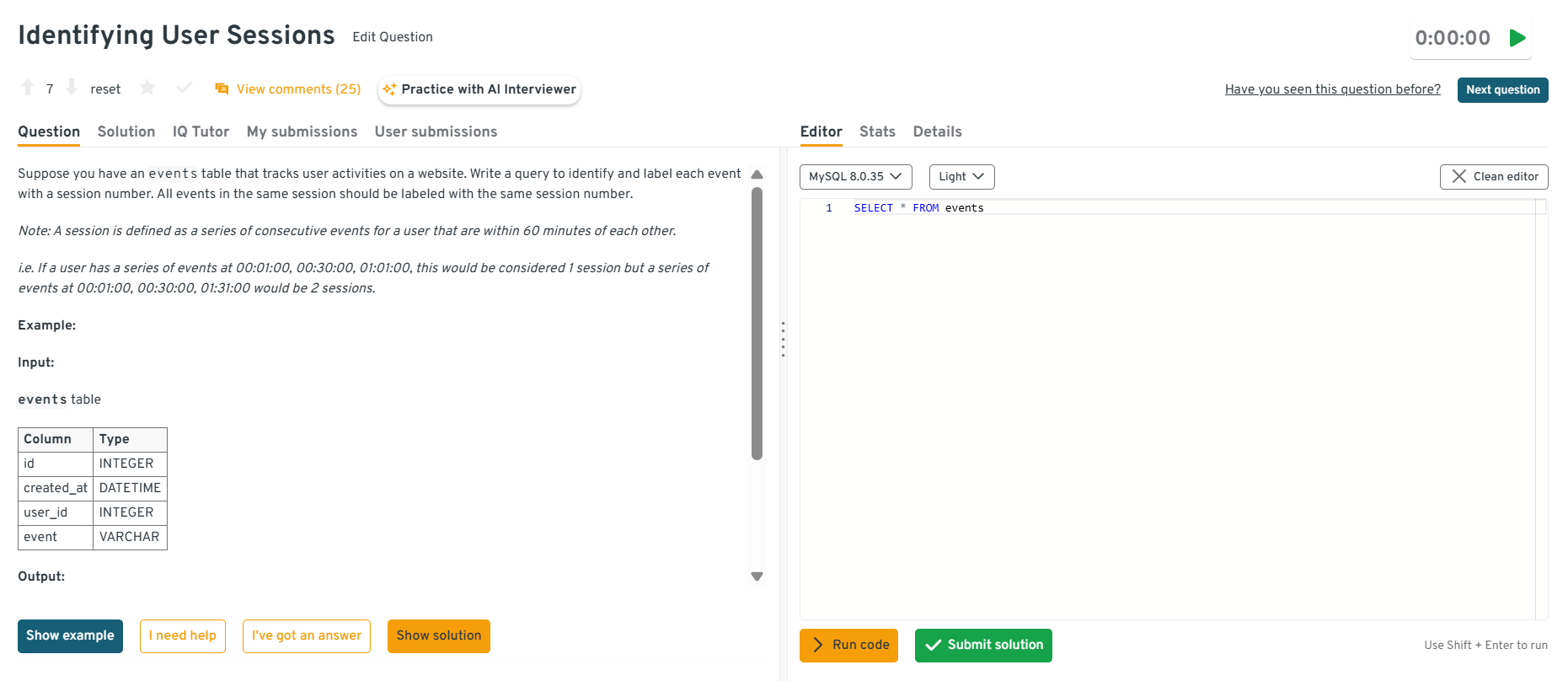
This question tests your ability to reason about ordered event data using window functions. A good answer explains partitioning by user, ordering by timestamp, using LAG to detect gaps greater than 60 minutes, and cumulatively summing session breaks. Citadel values this because similar logic is used when analyzing sequences where timing defines structure.
Tip: Explain the logic in words before writing SQL. That clarity shows strong analytical control and reduces logical bugs.
Head to the Interview Query dashboard to practice Citadel-specific data science interview questions in one place. You can work through SQL, probability, modeling, and behavioral prompts with built-in code execution and AI-guided feedback, making it easier to prepare for the depth of reasoning and statistical judgment Citadel interviews demand.
How would you verify data integrity across multiple related tables?
This question assesses your data hygiene and skepticism. At Citadel, incorrect joins or missing records can create false signal, so interviewers expect systematic checks such as row count reconciliation, key uniqueness validation, referential integrity tests, and aggregate comparisons across sources. A strong answer treats validation as a required research step, not an afterthought.
Tip: Frame validation as protecting research conclusions, not just cleaning data. This signals responsibility and trustworthiness.
Write a SQL query to select the 2nd highest salary in the engineering department.
This question tests whether you understand ranking, ties, and edge cases. A strong answer explains using window functions like DENSE_RANK or ROW_NUMBER with proper filtering by department, and discusses why handling duplicate salaries matters. Citadel uses questions like this to see if you think beyond the happy path.
Tip: Explicitly address how ties should be handled. That attention to definition signals precision, which is critical in research queries.
If you want to master SQL interview questions, join Interview Query to access our 14-Day SQL Study Plan, a structured two-week roadmap that helps you build SQL mastery through daily hands-on exercises, real interview problems, and guided solutions. It’s designed to strengthen your query logic, boost analytical thinking, and get you fully prepared for your next data science interview.
Behavioral Interview Questions
Behavioral questions at Citadel are used to evaluate how you think when results are uncertain, assumptions fail, or communication breaks down. Interviewers look for ownership, intellectual honesty, and the ability to learn quickly from imperfect outcomes. Strong answers demonstrate how you reasoned through ambiguity, adjusted your approach, and improved future decisions in high-stakes research environments like Citadel.
Tell me about a model or analysis that failed. What did you learn?
This question assesses how you respond when research does not perform as expected. Citadel interviewers want to see whether you diagnose root causes, adjust methodology, and improve decision-making rather than defending flawed work.
Sample answer: I built a predictive signal that showed strong backtest performance but degraded quickly in live evaluation. I investigated feature stability across time and found that a key input was regime-dependent. I removed it, revalidated on multiple periods, and deployed a more stable version that traded lower but consistent returns. That experience changed how I stress-test features before trusting results.
Tip: Focus on what changed in your research process after the failure. This signals growth, accountability, and long-term research maturity.
-
This question evaluates your ability to adapt communication while maintaining trust. Citadel data scientists work with traders and researchers who need precise, actionable insight, not abstract explanations.
Sample answer: I presented a model result that stakeholders felt was difficult to act on. I followed up by reframing the analysis around decision thresholds and risk scenarios they cared about, then walked through assumptions using concrete examples. That alignment led to a revised implementation that was easier to trust and ultimately adopted.
Tip: Show that you adjusted framing, not conclusions. This demonstrates judgment and the ability to translate research into decisions.
How would you explain what a p-value is to someone who is not technical?
This question tests whether you truly understand statistical concepts or just repeat definitions. Citadel values researchers who can explain uncertainty clearly to decision-makers.
Sample answer: I would explain that a p-value measures how surprising the data would be if nothing real were happening. For example, if we saw extreme results by chance alone. I would emphasize that it does not measure truth, only how consistent the data is with a baseline assumption.
Tip: Avoid jargon and clarify common misinterpretations. This signals depth of understanding and responsible statistical communication.
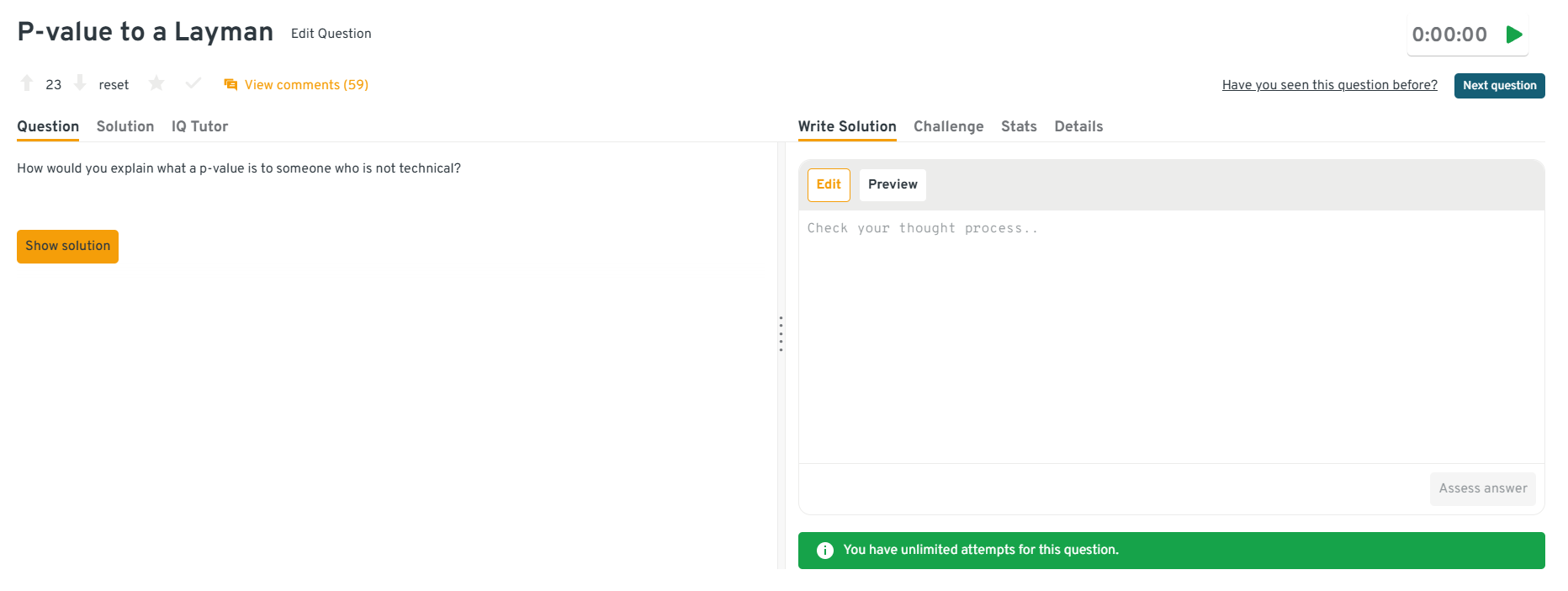
Head to the Interview Query dashboard to practice Citadel-specific data science interview questions in one place. You can work through SQL, probability, modeling, and behavioral prompts with built-in code execution and AI-guided feedback, making it easier to prepare for the depth of reasoning and statistical judgment Citadel interviews demand.
Describe a time when data contradicted your intuition.
This question probes intellectual honesty and evidence-based decision-making. Citadel looks for researchers who let data change their beliefs, especially when stakes are high.
Sample answer: I expected a feature to improve performance based on domain intuition, but validation showed consistent degradation. I rechecked data quality, reran tests across periods, and ultimately removed it. That decision improved stability and changed how I prioritize evidence over instinct in future work.
Tip: Emphasize how you validated the contradiction before changing course. This shows discipline, not overreaction.
What makes you a good fit for the Citadel data scientist position?
This question evaluates self-awareness and alignment with Citadel’s research culture. Interviewers want to hear how your habits and mindset match the role, not generic enthusiasm.
Sample answer: My strength is disciplined research under uncertainty. I focus on validating assumptions, stress-testing results, and communicating risk clearly. In past roles, that approach helped prevent false signal from reaching production and improved long-term performance, which aligns closely with how Citadel evaluates research impact.
Tip: Tie your fit to how you work, not where you worked. Citadel values mindset and judgment over pedigree.
If you want to practice these question types in a realistic setting, the Interview Query question bank and mock interviews are some of the most effective ways to build speed, confidence, and research-level thinking before a Citadel data scientist interview.
What Does a Citadel Data Scientist Do?
A Citadel data scientist works on research-driven problems where statistical rigor and speed directly influence trading performance and risk outcomes. At Citadel and Citadel Securities, data scientists partner closely with quantitative researchers, traders, and engineers to develop signals, evaluate predictive models, and improve decision-making across portfolios and market-making systems. The role is closer to applied quantitative research than traditional product analytics, with a strong emphasis on probability, time series behavior, data quality, and disciplined experimentation under real-world market constraints.
| What They Work On | Core Skills Used | Tools And Methods | Why It Matters At Citadel |
|---|---|---|---|
| Signal research and validation | Probability, statistics, hypothesis testing | Backtesting, cross-validation, simulation | Determines whether a signal is robust enough to deploy |
| Predictive modeling | Feature engineering, model evaluation | Python, custom research frameworks | Improves forecast accuracy under shifting market regimes |
| Data quality and analysis | Data integrity checks, exploratory analysis | SQL, Python, distributed compute | Prevents false conclusions from noisy or incomplete data |
| Risk and performance analysis | Statistical attribution, error analysis | Diagnostics, stress testing | Helps teams understand drawdowns and model failure modes |
| Research communication | Structured thinking, clarity of explanation | Written summaries, live discussions | Ensures research insights translate into trading decisions |
Tip: Treat every modeling task as a research question, not a coding exercise. In interviews, explicitly explain why a signal should exist, where it might fail, and how you validated assumptions. This shows strong research judgment and statistical discipline, two traits senior Citadel interviewers value more than raw model complexity.
How to Prepare for a Citadel Data Scientist Interview
Preparing for the Citadel data scientist interview requires a different mindset than standard product or analytics roles. You are preparing for an environment where decisions are driven by uncertainty, data is noisy by default, and research quality directly affects real financial outcomes. Success depends on developing strong statistical judgment, disciplined validation habits, and the ability to communicate complex reasoning clearly to quantitative stakeholders.
Read more: How to Prepare for Data Science Interviews
Below is a focused preparation framework designed specifically for Citadel-style interviews.
Sharpen your statistical intuition under uncertainty: Citadel interviews place heavy emphasis on reasoning about randomness, distributions, and tail risk without relying on memorized formulas. Practice explaining expected value, variance, confidence, and robustness in plain language, especially when assumptions are imperfect or data is limited.
Tip: Get comfortable stating assumptions explicitly and adjusting your reasoning when those assumptions change. This shows statistical maturity and mirrors how real research discussions happen at Citadel.
Practice research-style problem framing: Many Citadel questions are intentionally open ended. Train yourself to slow down, clarify the objective, identify unknowns, and outline a validation plan before jumping into solutions. Strong candidates treat each question like a research brief, not a puzzle.
Tip: In practice sessions, force yourself to articulate what would convince you that an idea is wrong. This demonstrates healthy skepticism, a trait senior researchers value highly.
Build intuition for signal validation and failure modes: Preparing well means understanding how false signal appears and how models break in practice. Review examples of overfitting, look-ahead bias, regime shifts, and data leakage, and practice explaining how you would detect and mitigate them.
Tip: Be ready to explain why a promising signal might stop working. This shows you think beyond backtests and understand real-world deployment risks.
Polish how you communicate past research work: Citadel interviewers care less about tools and more about how you reasoned through a problem. Prepare concise narratives that explain the question you were answering, why it mattered, how you validated results, and what you learned when things did not go as expected.
Tip: Highlight decisions you chose not to make and why. Demonstrating restraint and judgment is often more impressive than showcasing complexity.
Simulate realistic interview pacing: Practice back-to-back sessions that include probability reasoning, Python analysis, and open-ended discussion. Use realistic time pressure and practice explaining your thinking out loud throughout.
Consider using Interview Query’s mock interviews and coaching to rehearse Citadel-style questions with targeted feedback.
Tip: After each mock, write down where your reasoning felt rushed or unclear. Tightening those moments is one of the fastest ways to improve interview performance.
Struggling with take-home assignments? Get structured practice with Interview Query’s Take-Home Test Prep and learn how to ace real case studies.
Average Citadel Data Scientist Salary
Citadel’s compensation framework is built to reward data scientists who deliver durable research insights, manage uncertainty effectively, and contribute to sustained performance in live trading environments. Data scientists receive a competitive base salary alongside performance-driven bonuses, with upside increasing significantly as scope and impact grow. Total compensation varies by level, location, and how closely the role aligns with alpha research or trading support. Most candidates interviewing for Citadel data scientist roles fall into mid-level or senior bands, particularly if they have strong statistical foundations and experience working with noisy, high-stakes data.
Read more: Data Scientist Salary
Tip: Confirm your target level early with your recruiter. At Citadel, leveling has a larger impact on bonus structure and long-term upside than base salary alone.
| Level | Role Title | Total Compensation (USD) | Base Salary | Bonus | Equity / Profit Share | Signing / Relocation |
|---|---|---|---|---|---|---|
| DS II | Data Scientist (Mid Level) | $200K – $280K | $150K–$180K | Performance based | Limited or discretionary | Occasional |
| Senior DS | Senior Data Scientist | $280K – $420K | $180K–$220K | Above target possible | Meaningful participation | Common |
| Principal DS | Principal / Lead Data Scientist | $400K – $600K+ | $200K–$250K | High variability | Significant upside | Frequently offered |
Note: These estimates are aggregated from data on Levels.fyi, Glassdoor, TeamBlind, public job postings, and Interview Query’s internal salary database.
Tip: Expect compensation to skew heavily toward bonus as you move senior. Citadel rewards sustained live performance more than short-term project delivery.
Average Base Salary
Average Total Compensation
Negotiation Tips That Work for Citadel
Negotiating compensation at Citadel is most effective when you demonstrate market awareness, role clarity, and a long-term mindset. Recruiters expect candidates to be informed and precise, especially at senior levels.
Confirm your level before negotiating numbers:
Citadel’s leveling strongly influences bonus range and upside potential. A small level difference can materially change total compensation over time.
Anchor discussions in performance and scope, not just base pay:
Use benchmarks from Levels.fyi, Glassdoor, and Interview Query salaries, but frame your value around research impact, robustness, and judgment rather than tools or titles.
Account for location and team differences:
Compensation varies meaningfully between New York, Chicago, London, and Asia-based roles, as well as between research-heavy and trading-adjacent teams. Ask for location-specific bands.
Tip: Ask for a complete breakdown including base salary, bonus mechanics, evaluation criteria, and vesting or profit-sharing timelines. Understanding how performance is measured is more important at Citadel than negotiating a slightly higher base.
FAQs
How long does the Citadel data scientist interview process take?
Most candidates complete the process within three to six weeks, depending on interviewer availability and team alignment. Timelines can extend if multiple research groups are reviewing your profile or if additional calibration rounds are needed. Recruiters usually communicate next steps clearly after each stage.
Does Citadel use online coding tests or platforms like HackerRank?
Citadel generally does not rely on standardized platforms like HackerRank for data scientist roles. Most technical evaluation happens through live interviews, whiteboard-style discussions, or research-focused exercises that emphasize reasoning over speed.
How finance-specific does my background need to be for Citadel?
A finance background is not required, but comfort with probabilistic thinking and uncertainty is essential. Candidates from physics, mathematics, engineering, or applied machine learning often perform well if they demonstrate strong statistical judgment and research discipline.
What level of math and probability is expected in Citadel interviews?
Citadel interviews expect a strong grasp of probability, distributions, expected value, and statistical reasoning. Questions often require mental math and logical derivation rather than formulas. Clear assumptions and step-by-step reasoning matter more than memorization.
Are Citadel data scientist interviews more research-focused or engineering-focused?
The interviews are more research-oriented than engineering-heavy. While Python and SQL are tested, the emphasis is on validating signal, avoiding false conclusions, and explaining why an approach works or fails rather than building production systems.
How are candidates evaluated during open-ended or ambiguous questions?
Interviewers look for structure, skepticism, and clarity of thought. Strong candidates ask clarifying questions, define success criteria, and outline validation steps before proposing solutions. How you reason is weighted more heavily than the final answer.
Can I interview for both Citadel and Citadel Securities at the same time?
Yes, many candidates are considered across both Citadel and Citadel Securities depending on fit. Recruiters often guide this process internally, so it is helpful to communicate your interests and strengths clearly early on.
What differentiates strong candidates in Citadel behavioral interviews?
Strong candidates demonstrate ownership, intellectual honesty, and learning from failure. Interviewers value clear reflection on past decisions, especially situations where assumptions were challenged or results did not match expectations.
Become a Citadel Data Scientist with Interview Query
Preparing for the Citadel data scientist interview means developing strong statistical intuition, disciplined research habits, and the ability to reason clearly under uncertainty. By understanding Citadel’s interview structure, practicing probability-driven thinking, refining your Python and SQL analysis, and learning how to communicate research judgment effectively, you can approach each stage with confidence. For targeted preparation, explore the full Interview Query’s question bank, practice with the AI Interviewer, or work one-on-one with experienced mentors through Interview Query’s Coaching Program to sharpen your reasoning and stand out in Citadel’s highly selective data science hiring process.
Discussion & Interview Experiences