
BCG Software Engineer Interview Guide – Coding & Design


Introduction
“You’re Not Just Building Code—You’re Building the Future”
That’s how one BCG X engineer described their role after launching a real-time analytics system for drone fleet management.
At BCG X, software development is mission-driven and deeply integrated into frontline innovation. Whether you’re developing scalable APIs or optimizing cloud-native microservices, your work impacts global strategy.
From embedded AI for smart logistics to full-stack platforms that control physical infrastructure, software engineers are expected to operate across abstraction layers.
Sensor integration, drone orchestration, and predictive systems are not future goals. To succeed, you’ll need more than syntax, levelling up to systems thinking.
This guide unpacks everything from BCG software engineer interview experience insights to the toughest BCG interview questions software engineer candidates face, so you can walk into the interview prepared.
What is the Software Engineer Interview Process at BCG?
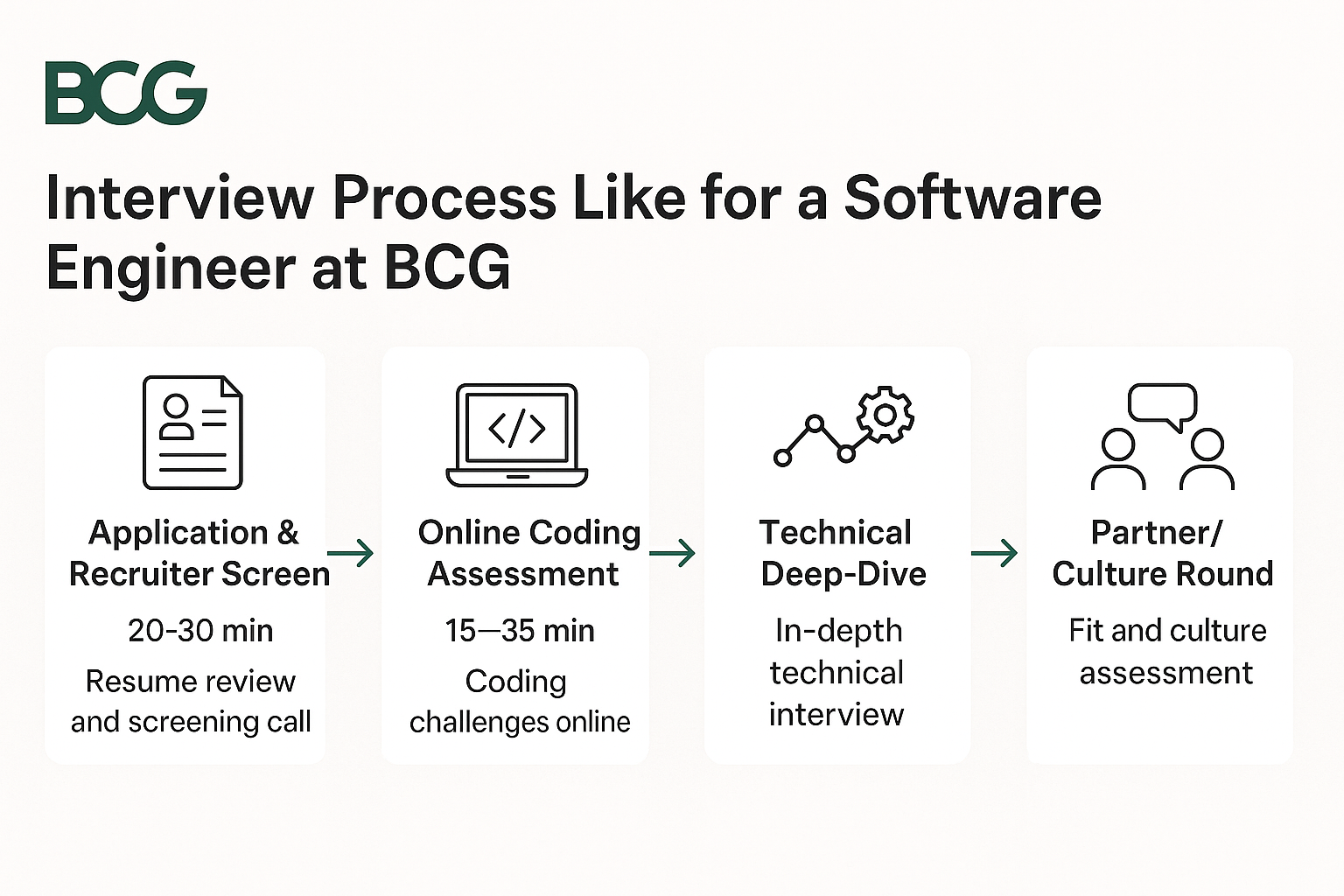
The BCG software engineer interview process is structured, technical, and consulting-influenced. You’ll move through several rounds that test not only your coding and system design skills but also your ability to think like a consultant. Here are the typical steps involved:
- Application & Recruiter Screen
- Online Coding Assessment
- Technical Deep-Dive & Design
- Partner/Culture Round
Application & Recruiter Screen
The first hurdle is your resume and cover letter. And yes, they matter a lot. BCG doesn’t do casual reviews here. If your resume doesn’t show strong alignment with the role’s tech stack (think Kubernetes, Docker, React, .NET, or cloud platforms), you’re unlikely to make it to the next step.
Highlight your experience with DevOps tools, full-stack projects, or AI-driven development if you have it.
Next, you’ll typically hop on a 20- to 30-minute call with a recruiter or HR rep—video or phone.
Expect a mix of resume deep-dive, light technical screening, and behavioral questions. This isn’t a deep technical interview, but you should be fluent in the tools listed on your resume.
Also, recruiters want to hear your enthusiasm for BCG’s mission, especially around digital transformation. Perhaps “pretend to be super passionate about what the company does.”
Optional Online Assessment
Some candidates, especially in AI roles, report an online assessment (OA) that includes LeetCode-style problems. It might appear before or after the recruiter call.
Online Coding Assessment
Once you’re past the recruiter screen, the next step is often a fast-paced online coding assessment, especially for BCG X software engineer roles.
Most candidates report taking it on platforms like CodeSignal, with durations ranging from 15 to 35 minutes, depending on your region and role. Expect a mix of coding challenges and technical concept checks.
These assessments aren’t meant to trick you, but they do move fast. You won’t need a perfect score—candidates confirm that a perfect 600 score on CodeSignal isn’t a must—but strong fundamentals, clean code, and efficient logic are key.
There’s also a growing trend toward case-style assessments. These may be chatbot-based and ask you to solve a scenario using code, logic, and written analysis. For software engineers, the test leans technical with a slight tilt toward problem-solving.
Technical Deep-Dive & Design
Once you pass the coding assessment, BCG moves into technical deep-dive and system design rounds. These interviews test how you solve real-world problems, design scalable systems, and explain your thinking.
You’ll likely face a mix of live coding, architecture design, and a walkthrough of a past project. Be ready to discuss technical trade-offs, system bottlenecks, and how you handled complexity.
BCG X interviews often blend software and consulting challenges. You might be asked to design a self-service chatbot with AWS Bedrock or optimize infrastructure for scale. Candidates say there’s a strong emphasis on AI, cloud, and data integration, especially in BCG X roles.
Recent candidates recommend prepping one strong project for the deep dive, reviewing system design basics, and practicing how to explain your choices in a business context.
Partner/Culture Round
The Partner or Culture Round at BCG focuses on your fit within the firm’s consulting culture, including your motivation for joining, alignment with client-facing work, and openness to relocation. It’s less about technical depth and more about demonstrating clarity of purpose, adaptability, and enthusiasm for BCG’s mission and team environment.
Challenge
Check your skills...
How prepared are you for working as a Software Engineer at The Boston Consulting Group?
What Questions Are Asked in a BCG Software Engineer Interview?
Here are a couple of sample problems for a BCG software engineer interview from our questions collection:
Coding/Algorithm Questions
These coding and algorithm questions are asked in a BCG software engineer interview to evaluate your ability to apply fundamental graph and search algorithms in practical scenarios:
1. Implement Dijkstra’s shortest path algorithm for a given graph with a known source node.
To implement Dijkstra’s algorithm, initialize the shortest distance to the source node as zero and all others as infinity. Use a priority queue to explore nodes, updating the shortest path estimates and previous nodes as you find shorter paths. Continue until all nodes have been processed.
To solve this problem, use a breadth-first search (BFS) approach to explore all possible transformations from the begin_word to the end_word. At each step, change one letter at a time and check if the new word exists in the word_list. Continue this process until the end_word is reached, counting the number of transformations.
3. Find the longest increasing subsequence in a list of integers
To solve this, use dynamic programming to keep track of the longest increasing subsequence ending at each element. Initialize a list dp with 1s, representing the minimum subsequence length for each element. Iterate through the list, updating dp[i] by comparing it with previous elements, and return the maximum value in dp as the result.
4. Write a function to return the maximal substring shared by two strings
To solve this problem, iterate through all possible substrings of the first string and check if they exist in the second string. Keep track of the longest substring found that is common to both strings. If multiple substrings have the same maximum length, return any one of them.
To solve this, first join the transactions and products tables to associate each transaction with a product name. Then, use a self-join on the resulting table to find pairs of products purchased together by the same user on the same date. Ensure that the first product in the pair is alphabetically less than the second to avoid duplicate pairs, and finally, group and order the results to find the top five pairs by count.
6. Implement a basic LRU cache
To implement an LRU cache, create a class LRUCache with methods for initialization, retrieving values, and inserting values. Use a dictionary to store key-value pairs and maintain the order of usage to ensure the least recently used item is removed when the cache reaches its capacity.
7. Write a function that finds the top K frequent elements in a data stream.
To solve this problem, you can use a dictionary to count the frequency of each element in the data stream. Once you have the frequency count, you can sort the elements based on their frequency and return the top K elements. The sorting step will determine the overall time complexity, which is (O(n \log n)), where (n) is the number of unique elements in the data stream.
8. Write a query to identify and label each event with its corresponding session number
To identify and label each event with a session number, use SQL window functions to compare timestamps of consecutive events for each user. A session starts when the time difference between events exceeds 60 minutes. Use LEAD to fetch the next event’s timestamp and SUM to assign session numbers.
To solve this, split the sentence into words and check each word for a prefix that matches any root in the dictionary. Replace the word with the shortest matching root and join the words back into a sentence.
System/Product Design Questions
System and product design questions in a BCG software engineer interview assess your ability to architect scalable, efficient solutions for real-world challenges, demonstrating your skills in data handling, infrastructure planning, and trade-off analysis critical for delivering robust software systems:
10. Design a solution to store and query raw data from Kafka on a daily basis
To design a cost-effective data analytics solution for storing and querying 600 million daily events from Kafka with a two-year retention period, consider using Amazon Redshift for data storage due to its scalability and data retention capabilities. The data pipeline can be managed using Spark Streaming to transfer data from Kafka to Redshift, ensuring scalability and cost efficiency. Additionally, implement an orchestrator like Airflow to automate the data pipeline and handle potential bottlenecks or failures.
11. Create a schema to keep track of customer address changes
To track customer address changes, design a schema with three tables: Customers, Addresses, and CustomerAddressHistory. The Customers table holds customer details, the Addresses table contains address details, and the CustomerAddressHistory table records each occupancy period with move-in and move-out dates. This setup allows tracking of both historical and current address data, using a Slowly Changing Dimension Type II approach.
12. How would you build an ETL pipeline to get Stripe payment data into the database?
To build an ETL pipeline for Stripe payment data, start by extracting data from Stripe’s API, then transform it to match the schema of your internal data warehouse. Finally, load the transformed data into the database, ensuring it is optimized for analytics and dashboard creation.
To handle a 100GB CSV file that cannot be loaded into memory, you can process the file in chunks using Python’s built-in CSV module or libraries like Dask or PySpark. These tools allow you to read and process the file in smaller, manageable parts, enabling data cleaning and transformation without exceeding memory limits.
14. We want to build an application that allows anyone to review restaurants.
To design the database schema for a Yelp-like system, create tables for users, restaurants, and reviews. Each table should include relevant fields such as user ID, restaurant ID, and review ID, with appropriate data types and constraints like primary and foreign keys. Ensure that the tables are joined logically, for example, linking reviews to users and restaurants through foreign keys.
To design a digital classroom system, identify critical entities such as User, Course, Enrollment, Assignment, Submission, and Interaction. Ensure scalability by using data types like BIGINT for user IDs and indexing tables like Interaction for efficient querying. For data consistency, use foreign keys to maintain relationships between entities and design an ETL process to extract, transform, and load interaction data for analytics. Implement a ParticipationMetrics table to provide insights into student participation, and use SQL queries to track assignment submission trends.
16. Design a data pipeline for hourly user analytics
To build this data pipeline, you would need to extract data from the data lake, transform it to calculate hourly, daily, and weekly active users, and then load it into a system that supports real-time dashboard updates. This could involve using tools like Apache Spark for processing and a database like PostgreSQL or a data warehouse like Snowflake for storage.
Behavioral & Consulting Scenarios
Behavioral and consulting scenario questions at BCG evaluate your teamwork, communication, and problem-solving skills in complex, cross-functional environments:
At BCG X, software engineers often work in cross-functional teams where technical and business priorities can clash. Share a story where you faced disagreement on a technical solution, explaining how you facilitated discussion, gathered feedback, and aligned the team toward a consensus. Highlight how you balanced technical rigor with stakeholder needs to drive the project forward.
18. Describe a project where you surpassed expectations, detailing your actions and achievements.
BCG X values engineers who deliver outsized impact. Give an example where you went beyond your core responsibilities—perhaps by automating a manual process, improving system reliability, or mentoring others—and quantify the results. Emphasize your proactive mindset and how your work advanced the team’s or client’s goals.
19. Explain how to prioritize and stay organized with multiple deadlines.
BCG X projects often run on tight timelines with shifting priorities. Describe your framework for managing competing deadlines—such as using agile methodologies, backlog grooming, or stakeholder alignment, and provide an example of how you delivered on time without sacrificing quality. Show your ability to communicate progress and adapt to changes.
Working at BCG X requires collaborating with diverse personalities, sometimes under pressure. Share a story where you managed a difficult relationship, focusing on how you maintained professionalism, sought common ground, and ensured team objectives were met. Reflect on what you learned and how it improved your future collaborations.
21. Tell me about a time you had to learn a new technology or domain quickly. How did you approach it, and what was the impact?
To quickly learn a new technology or domain, immerse yourself in available resources such as tutorials, documentation, and community forums. Apply hands-on practice to reinforce learning, and seek feedback from peers or mentors to ensure understanding and effective application, ultimately leading to successful project contributions.
How to Prepare for a BCG Software Engineer Interview
Breaking into a software engineering role at BCG X requires more than just coding knowledge—it’s about demonstrating strong technical skills alongside a business-aware mindset. Here’s how you can structure your preparation.
1. Master core coding skills. Start with the fundamentals. Practice coding problems in Python, Java, or C++—the languages most commonly used in BCG projects. Platforms like Interview Query or LeetCode can help you sharpen problem-solving, debugging, and optimization skills. The key isn’t just to solve problems, but to write clean, efficient, and scalable code.
2. Build system design expertise. Beyond coding, BCG expects engineers to think at a systems level. You should be comfortable with system design scenarios involving APIs, microservices, and cloud architectures. Work through case-based examples where you design scalable systems for millions of users, and practice explaining your choices clearly. This shows both technical strength and communication ability.
3. Strengthen your knowledge of emerging tech. If you’re aiming for software or data-focused roles, understanding machine learning fundamentals is a major asset. Be able to explain how algorithms apply to real-world problems, such as demand forecasting or personalization. Additionally, gain familiarity with cloud platforms like AWS or Azure, and learn to use tools such as Docker or Kubernetes for deployment. These skills make you stand out as someone who can design, build, and scale modern solutions.
4. Think like a consultant. Technical ability is only half the equation at BCG. On the case side, you’ll need to solve problems with a structured, business-aware mindset. Use consulting-style frameworks to break down challenges, quantify the business impact of your solutions, and always explain your reasoning in simple terms that non-technical stakeholders can understand.
5. Prepare for behavioral and cultural fit. Don’t underestimate the behavioral interview. Use the STAR method (Situation, Task, Action, Result) to structure your answers and highlight impact. Show that you can work in cross-functional teams, communicate clearly, and thrive in a collaborative culture. Remember, BCG places a strong emphasis on fit with its mission and values.
6. Leverage prep tools and mock interviews. Finally, practice under realistic conditions. Candidates who succeed often credit mock interviews, practice cases, and AI-driven feedback tools for giving them an edge. These resources help you refine both your technical responses and your communication style before the actual interview.
Conclusion
To succeed in the BCG software engineer interview experience, you’ll need more than just strong coding and system design skills—you’ll also need to think like a consultant. Practice mock interviews regularly to refine both your technical clarity and business communication.
Ready to dive deeper?
Explore our 100+ Engineering Questions for practice, check out the Success Story of Keerthan Reddy, and follow our Step-by-Step Python Tutorial to sharpen your prep. All the best!
BCG X Software Engineer Jobs
The Boston Consulting Group Interview Questions
| Question | Topic | Difficulty | ||||||||||||||||||||||||||||||||||||||||||
|---|---|---|---|---|---|---|---|---|---|---|---|---|---|---|---|---|---|---|---|---|---|---|---|---|---|---|---|---|---|---|---|---|---|---|---|---|---|---|---|---|---|---|---|---|
SQL | Medium | |||||||||||||||||||||||||||||||||||||||||||
Over budget on a project is defined when the salaries, prorated to the day, exceed the budget of the project. For example, if Alice and Bob both combined income make 200K and work on a project of a budget of 50K that takes half a year, then the project is over budget given 0.5 * 200K = 100K > 50K. Write a query to forecast the budget for all projects and return a label of Note: Assume that employees only work on one project at a time. Example: Input:
departments table
Output:
| ||||||||||||||||||||||||||||||||||||||||||||
Data Modeling | Medium | |||||||||||||||||||||||||||||||||||||||||||
Data Structures & Algorithms | Easy | |||||||||||||||||||||||||||||||||||||||||||
SQL | Easy | |
Machine Learning | Medium | |
Statistics | Medium | |
SQL | Hard | |
Machine Learning | Medium | |
Python | Easy | |
Deep Learning | Hard | |
SQL | Medium | |
Statistics | Easy | |
Machine Learning | Hard |
Discussion & Interview Experiences