

BCG Data Engineer Interview Guide (2025) – Coding Test, System Design & Questions


Introduction
The BCG data engineer interview is your entry point into projects where data meets deep purpose. Whether enabling Telefónica to reinvent its tech stack or helping NASA experiment with generative AI, BCG X data engineers are builders of systems that shape entire industries. Whether you’re working on climate modeling for global governments or enabling generative AI for space research, data engineers at BCG X are trusted to deliver mission-critical platforms.
BCG X, the firm’s tech and design unit, is at the core of BCG’s innovation strategy. In 2025, it launched the AI Science Institute with 3,000 professionals and over 200 PhDs focused on frontier work in materials science, drug discovery, and sustainable systems. Engineers here operate in a hybrid model—shipping products with real autonomy while collaborating closely with consulting teams.
This guide dives deep into what the role involves and walks you through BCG X data engineer interview questions to expect.
What Is the Interview Process Like for a Data Engineer at BCG / BCG X?
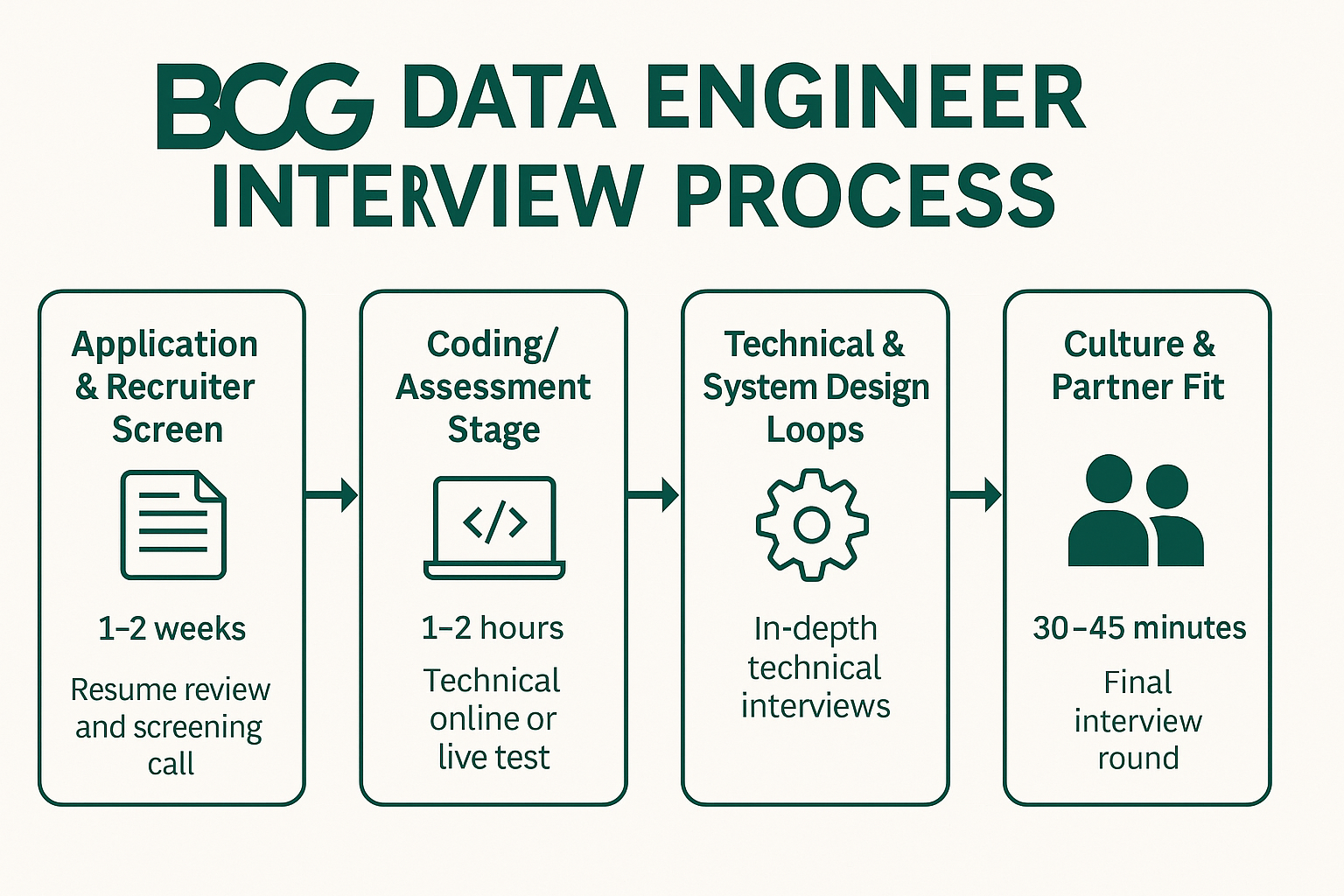
The BCG data engineer interview process is structured, fast-paced, and designed to assess both technical depth and strategic thinking. Whether you’re applying to core BCG or the more tech-driven BCG X, expect a multi-stage process that evaluates your ability to deliver impact through data. Here’s a breakdown of the typical journey from application to offer:
- Application & Recruiter Screen
- Coding/Assessment Stage
- Technical & System Design Loops
- Culture & Partner Fit
Application & Recruiter Screen
The first checkpoint is the resume screen, and it’s more than a formality. Tailor your application to highlight end-to-end ownership, outcomes, and projects that mirror the hybrid tech-consulting nature of BCG X. Most people hear back in one to two weeks.
If your resume makes the cut, you may be asked to complete a one-way video interview before speaking with a recruiter. This async round asks you to record short video responses to preset behavioral and fit questions. You’ll get a few moments to prepare before each one, then typically 1–2 minutes to respond.
After that comes the recruiter screen, a 20 to 30-minute live call that’s part resume walk-through, part chemistry check. It’s usually light on technicals but heavy on fit. Expect questions about your background, key projects, and what draws you to BCG now.
Coding/Assessment Stage
If you proceed further into the BCG data engineer interview, be ready for a mix of live technical depth and fast-paced coding fluency. The assessment usually comes as either an online test or a live session with an engineer, typically lasting one to two hours. Expect a blend of Python-heavy questions, SQL logic, and data engineering scenarios that feel pulled straight from real-world product pipelines. One candidate summed it up well: “We’re just specialized software engineers—why should the bar be different?”
Increasingly, interviewers are blending coding with case-style thinking, asking candidates not only to solve a problem but also to explain the business context or suggest pipeline improvements. So while correctness counts, clarity matters just as much.
Assessment Deep Dive
The BCG X engineering assessment deep dive is a 45-minute, high-pressure sprint through data-heavy case problems. Delivered via platforms like CodeSignal, the test blends Python coding, SQL queries, and business context into 23 fast-paced questions.
You’ll tackle string operations, joins, and logic-heavy data transformations—sometimes with a clunky notebook UX and no calculator allowed.
Expect both multiple-choice and short answers, all tightly packed into a time-boxed challenge. Success hinges on time management, test-first thinking, and keeping your code clean and quick.
Technical & System Design Loops
Technical interviews at BCG and BCG X are fast-paced but thoughtfully structured to test not just your coding fluency, but your ability to think like an engineer in a business-first world. Expect live coding rounds that lean heavily on Python and SQL.
Data engineering questions dive into real-life architecture through ETL flows, stream vs. batch tradeoffs, and tool-specific decisions using Snowflake, dbt, or Airflow.
System design interviews are more about collaborative problem-solving. You’ll design end-to-end pipelines, explain why you’d pick Kafka over Kinesis, and be ready to defend your trade-offs around cost, latency, and resilience.
In case-style rounds, technical questions get business-wrapped: “Why does reducing pipeline latency help our client’s bottom line?” or “An e-com client’s conversion rate tanked after a pipeline change—how do you debug it?”
Culture & Partner Fit
BCG places a strong emphasis on cultural fit and alignment with its values, especially during the final interview stages—often called the “partner round” or “fit interviews.” This is where BCG assesses not just your technical skills, but your ability to thrive in their collaborative, high-impact, and people-focused environment. This is typically a 30 to 45-minute conversation with a BCG partner or senior leader. This may be one-on-one or with a small panel before you’re notified about your acceptance to BCG as a data engineer.
Challenge
Check your skills...
How prepared are you for working as a Data Engineer at The Boston Consulting Group?
What Questions Are Asked in a BCG Data Engineer Interview?
Here are some of the recurring questions that get asked in a BCG or BCG X Data Engineer Interview:
Coding/Technical Questions
These questions test your fluency with real-world data manipulation—how quickly and accurately you can transform, filter, and analyze information using SQL and Python under realistic constraints:
1. Write a query to get the total three-day rolling average for deposits by day
To calculate the three-day rolling average for deposits, filter the transactions to include only deposits (positive values) and group them by day. Use a window function to compute the rolling average over a three-day window, ensuring the date format in the output is ‘%Y-%m-%d’.
2. Create a new dataset with summary level information on customer purchases.
To create a summary dataset from a sales data DataFrame, group the data by customer ID and gender. Calculate the most recent sale date and the total number of purchases for each customer. This can be achieved using pandas functions like groupby, agg, and max.
3. Write a SQL query to select the 2nd highest salary in the engineering department.
To find the second-highest salary in the engineering department, join the employees and departments tables on the department_id and filter for the engineering department. Use a subquery to rank the salaries and select the second-highest value.
4. Write a query that returns all neighborhoods that have 0 users
To find neighborhoods with no users, perform a LEFT JOIN between the neighborhoods table and the users table on the neighborhood_id. Filter the results where the user_id is NULL, indicating no users are associated with those neighborhoods.
To solve this, group the search results by query and filter those groups where all ratings are less than 3. Calculate the percentage of such queries out of the total number of queries, and round the result to two decimal places.
Architecture & Pipeline Design Questions
These questions assess your ability to translate real-world systems into scalable data models, balancing normalization, query efficiency, and future flexibility in design:
6. Design a database for a stand-alone fast food restaurant.
To design a database for a fast food restaurant, consider tables for menu items, orders, customers, and transactions. Each table should have relevant fields such as item ID, order ID, customer ID, and transaction details to efficiently manage and query restaurant operations.
7. Design a database to represent a Tinder style dating app
To design a Tinder-style dating app database, you need to create tables for users, swipes, matches, and messages. Optimizations might include indexing frequently queried fields and using efficient data types to improve performance.
To handle a 100GB CSV file that cannot be loaded into memory, you can process the file in chunks. Use Python’s built-in CSV module or libraries like Dask or PySpark, which are designed for handling large datasets by processing them in smaller, manageable parts.
9. How would you build an ETL pipeline to get Stripe payment data into the database?
To build an ETL pipeline for Stripe payment data, start by extracting data from Stripe’s API, then transform it to match the schema of your internal data warehouse. Finally, load the transformed data into the database, ensuring it is optimized for analytics and dashboard creation.
10. How would you create or modify a schema to keep track of address changes?
To track address changes, design a schema that includes a table for addresses with fields for customer ID, address details, move-in date, and move-out date. This allows you to maintain a history of addresses for each customer and track who moves in after them.
To design a system for processing and displaying real-time data across multiple platforms, you need to ensure that comments are persistent and support interactive features like reactions. The system should update and display reaction counts in real-time to all viewers, requiring a robust architecture that can handle simultaneous data streams and user interactions across platforms like Instagram, Facebook, and WhatsApp.
Behavioral & Consulting Scenarios
These questions explore how you navigate team dynamics, influence without authority, and adapt your communication style to drive alignment—critical skills in BCG X’s collaborative, client-facing environment:
At BCG X, data engineers often collaborate with cross-functional teams, which can sometimes lead to interpersonal friction. When faced with conflict, it’s important to remain professional, actively listen to the other party’s perspective, and seek common ground that aligns with project and client objectives. For example, if a stakeholder disagrees with your proposed data pipeline design, you might facilitate a meeting to clarify requirements, propose data-driven solutions, and focus on the shared goal of delivering high-quality, scalable analytics.
As a data engineer at BCG X, you may propose a novel architecture or toolset that others are hesitant to adopt. In such cases, it’s crucial to transparently explain your rationale, back your suggestions with evidence or prototypes, and invite constructive feedback. Engaging your team through open dialogue and iterative experimentation builds trust and often leads to more robust, consensus-driven solutions.
14. Describe a project where you surpassed expectations, detailing your actions and achievements.
BCG X values data engineers who take initiative and deliver beyond the baseline. For example, you might have automated a manual data ingestion process, reducing turnaround time by 50% and enabling real-time analytics for the client. Detailing how you identified the opportunity, implemented the solution, and measured its impact demonstrates your proactive mindset and technical excellence.
When answering this question, focus on how the company’s values, projects, or reputation align with your personal values or career goals. Highlight specific aspects of the company that resonate with you, such as their mission, culture, or industry, and explain how these factors motivated your decision to choose them.
At BCG X, self-awareness and growth are highly valued. When discussing feedback, share a concrete example of constructive criticism you received, such as improving documentation or communication, and the steps you took to address it. Balance this with a strength relevant to the data engineer role, like problem-solving or technical leadership, and emphasize your commitment to ongoing development.
To effectively communicate complex technical information to a non-technical stakeholder, it is crucial to tailor the presentation to the audience’s level of understanding. This involves using simple language, visual aids, and relatable examples to convey the message clearly. Additionally, engaging the audience by encouraging questions and feedback ensures that the information is understood and aligns with their expectations.
How to Prepare for a Data Engineer Role at BCG
Getting ready for a data engineer role at BCG or BCG X means more than brushing up on code. Start with the tech stack. Python and SQL are non-negotiable—expect heavy use of Pandas, PySpark, and advanced SQL features like window functions.
Cloud fluency is critical too, especially with AWS, GCP, or Azure. BCG X often works across multi-cloud environments, so knowing Terraform, Airflow, and dbt gives you a serious edge.
Projects tend to involve scalable, production-ready pipelines, so practice building ones that process real-time data or optimize for cost and reliability.
System design interviews will test your ability to build pipelines at scale and justify your architecture choices. You might be asked to design a platform for processing millions of IoT events per second or walk through a migration from Hadoop to Snowflake.
Go in with a clear framework—define assumptions, ask clarifying questions, and always tie technical decisions to client value. As one insider said, “Interviewers love when you start with clarifying questions and tie decisions to revenue or cost impact.”
Don’t ignore the behavioral side. BCG looks for engineers who are collaborators and lean towards their values and culture.
Be ready to explain how you handled tough feedback, contributed to cross-functional teams, or helped stakeholders make data-informed decisions. Use the STAR method—Action, Situation, Task, (Result), and Example—to structure your stories.
Moreover, mock interviews and professional coaching from data engineers can help you refine your resume and real-world responses with personalized feedback and AI refinement.
Salary Bands for BCG Data Engineer Roles
Average Base Salary
Average Total Compensation
FAQs
Is there a take-home vs. live test?
You’ll typically face a live, timed assessment rather than a take-home project. The bcg data engineer interview questions often come during scheduled sessions using platforms like CodeSignal. These include real-time coding, SQL queries, and short business case responses under pressure. While some candidates report notebook-style formats, you won’t be sending back a project asynchronously.
Do junior candidates have fewer rounds?
Not necessarily. While the depth of technical grilling may scale with experience, bcg junior data engineer interview questions still cover core data manipulation, SQL, and system design basics. The number of interview rounds is usually consistent—screening, technical, case/business, and culture fit—even for junior roles. What changes is the expected level of depth, not the structure.
How many lines of code are acceptable in the X test?
There’s no hard cap, but clarity and efficiency matter. In the bcg x data engineer coding test, solutions that are too long may signal inefficiency or poor planning. Candidates report writing compact, modular functions—typically under 30–40 lines per question. It’s better to write concise, testable code with clear variable names than to over-engineer. Focus on readability and correctness within the time limit.
Conclusion
Landing a role as a data engineer at BCG or BCG X takes more than technical skill—it requires clarity in problem-solving, an eye for business value, and the ability to communicate your thinking under pressure. To master your BCG data engineer interview, the key is structured preparation and real-world practice.
Start with our focused Data Engineering Learning Path tailored to the tools and frameworks you’ll actually use. See how successful candidates navigated the process by reading the success story of Alex Dang. Then dive into our full Data Engineer Question Bank to sharpen your skills with real examples from past candidates. Good luck!
The Boston Consulting Group Interview Questions
| Question | Topic | Difficulty | ||||||||||||||||||||||||||||||||||||||||||
|---|---|---|---|---|---|---|---|---|---|---|---|---|---|---|---|---|---|---|---|---|---|---|---|---|---|---|---|---|---|---|---|---|---|---|---|---|---|---|---|---|---|---|---|---|
SQL | Medium | |||||||||||||||||||||||||||||||||||||||||||
Over budget on a project is defined when the salaries, prorated to the day, exceed the budget of the project. For example, if Alice and Bob both combined income make 200K and work on a project of a budget of 50K that takes half a year, then the project is over budget given 0.5 * 200K = 100K > 50K. Write a query to forecast the budget for all projects and return a label of Note: Assume that employees only work on one project at a time. Example: Input:
departments table
Output:
| ||||||||||||||||||||||||||||||||||||||||||||
Data Modeling | Medium | |||||||||||||||||||||||||||||||||||||||||||
Data Structures & Algorithms | Easy | |||||||||||||||||||||||||||||||||||||||||||
SQL | Easy | |
Machine Learning | Medium | |
Statistics | Medium | |
SQL | Hard | |
Machine Learning | Medium | |
Python | Easy | |
Deep Learning | Hard | |
SQL | Medium | |
Statistics | Easy | |
Machine Learning | Hard |
Discussion & Interview Experiences