
BCG Product Manager Interview Guide (2025) – Case Questions, Strategy & Fit


Introduction
The BCG product manager role is reshaping how defense and climate technologies go from vision to reality. At BCG X, the firm’s 3,000-person digital and tech unit, PMs lead the full product lifecycle, from building roadmaps to shipping client-ready pilots across industries. Their day-to-day includes coordinating cross-functional squads, defining strategy, and driving measurable impact for Fortune 500 partners.
That level of responsibility opens serious doors. PMs benefit from access to $13.5 billion in BCG-backed global consulting infrastructure and get to work where innovation moves fast. Moreover, 75% of executives now rank AI as a top-three priority, and BCG X is meeting that demand head-on.
Product management jobs at BCG are expanding rapidly in key X Tech locations as more clients seek execution-focused digital leaders. Here’s how the interview journey unfolds…
What Is the Interview Process Like for a Product Manager at BCG?
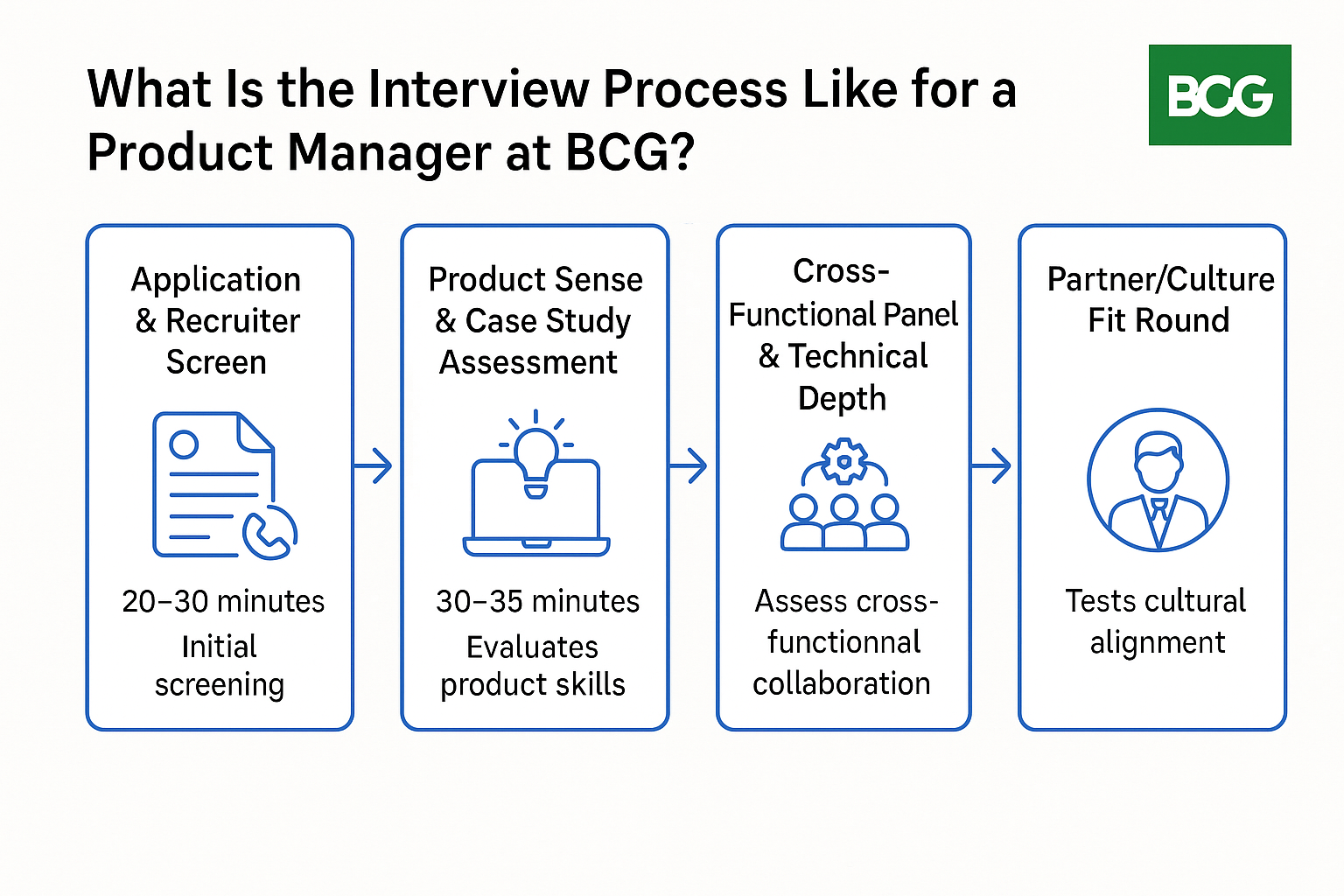
Here is an overview of the interview process for a product manager role at BCG:
- Application and Recruiter Screen
- Product Sense and Case Study Assessment
- Cross-Functional Panel and Technical Depth
- Partner/Culture Fit Round
Application & Recruiter Screen
The BCG product manager interview process begins with the application and recruiter screen, a stage that filters out approximately 90% of candidates.
Recruiters prioritize tailored submissions that reflect the understanding of BCG’s mission and the specific nuances of product management in a consulting context.
Openings are active across the US and EU, particularly in BCG X tech hubs and for product management consultant roles in Boston.
The recruiter screen typically follows within one to two weeks of applying and lasts 20 to 30 minutes.
This stage is designed to assess motivation, cultural fit, and basic role alignment. For BCG X roles, you might be lightly probed into product thinking, digital fluency, or high-level business logic.
Increasingly, BCG uses Spark Hire for asynchronous, one-way interviews. Candidates report that while this round is conversational, it is strictly evaluative.
Product Sense & Case Study Assessment
Once you pass the recruiter screen, the next step in the BCG product manager interview is the Product Sense and Case Study Assessment. This round typically lasts 30 to 35 minutes and follows a consistent structure: a quick intro, about five minutes of behavioral questions, then a 25-minute deep dive into the case and product discussion, followed by a short Q&A.
You’ll be expected to show strong product sense by working through open-ended problems—segmenting users, identifying pain points, and brainstorming creative but realistic solutions.
On the case side, your business judgment, analytical skills, and ability to structure ambiguity will be tested. You’ll need to lead the conversation, propose next steps, and guide the discussion as new information is introduced.
If you’re interviewing for a BCG X role, expect digital and AI-related themes to come up, with added emphasis on how you’d turn strategy into execution. It’s not just about big ideas—you’ll need to show how they get built and scaled.
Cross-Functional Panel & Technical Depth
You’ll face 3 to 5 interviewers representing functions like engineering, design, data science, and leadership in this round. These interviews focus less on hypotheticals and more on how you’ve navigated real-world product challenges.
You’ll be asked how you align competing priorities, resolve friction between stakeholders, and push forward with decisions when perspectives diverge. You may be asked how you used SQL or Tableau to guide product choices, or how you structured a product roadmap when engineering bandwidth was constrained.
The process is highly selective. While 68% of candidates describe the experience as positive, most note that BCG probes deeper than other firms.
Partner/Culture Fit Round
This final round emphasizes client-facing communication, executive presence, and cultural alignment. Expect senior partners to test your storytelling, judgment, and how you represent BCG in high-stakes settings. Decisions are typically made within 48 hours.
Challenge
Check your skills...
How prepared are you for working as a Product Manager at The Boston Consulting Group?
What Questions Are Asked in a BCG Product Manager Interview?
Here are some of the recurring questions asked in a BCG Product Manager Interview:
Product Strategy/Sense Questions
These questions assess how you evaluate product performance, identify opportunities, and make decisions grounded in strategic thinking:
To investigate the underperformance of the Calm meditation app in a new country, consider analyzing user engagement metrics, cultural differences, and localization issues. Additionally, assess the marketing strategy, competition, and any technical barriers that might be affecting user experience.
To measure the health of the Mentions app, you could track metrics such as user engagement, frequency of use, and user retention rates. To attribute increases in celebrity-fan interaction, you could use A/B testing or causal inference methods to distinguish between the effects of using the Mentions app and a celebrity’s natural inclination to engage more with fans.
3. How would you evaluate whether a 50% rider discount promotion is a good or bad idea?
To evaluate a 50% rider discount, start by stating assumptions such as the goal being to increase retention and revenue. Implement an AB test with control and test groups, track long-term revenue versus the average cost of the promotion, and consider user lifetime revenue models to extrapolate results beyond the test period.
The recommendation involves weighing the costs and benefits of hiring a Customer Success Manager (CSM) against implementing a free trial. A free trial can be effective for user acquisition, while a CSM can enhance engagement and retention by providing personalized support and feedback. The decision should consider the company’s goals, user characteristics, and the software’s complexity.
5. Given three international markets with different levels of competition and customer demand, how would you prioritize one for product expansion and what frameworks would you use?
To prioritize a market for product expansion, evaluate factors such as market size, growth potential, competitive landscape, and customer demand. Use frameworks like SWOT analysis to assess strengths, weaknesses, opportunities, and threats in each market. Additionally, consider financial metrics and strategic alignment with company goals to make an informed decision.
6. If user engagement is dropping on a key community feature, how would you evaluate whether to improve, replace, or sunset the feature?
To evaluate whether to improve, replace, or sunset a feature with dropping engagement, first analyze user feedback and engagement data to identify the root causes of the decline. Consider conducting user interviews or surveys to gather qualitative insights, and explore potential improvements or alternatives that align with user needs and business goals. If the feature no longer serves its purpose or aligns with strategic objectives, consider sunsetting it while ensuring a smooth transition for users.
Execution & Metrics Questions
This category of questions focuses on your ability to define KPIs, investigate trends, and use data to drive product improvements:
To measure acquisition success for Netflix’s 30-day free trial, key metrics include conversion rate (percentage of trial users who become paying customers), retention rate (how long users stay subscribed after the trial), and customer lifetime value (CLV). Analyzing these metrics helps determine the effectiveness of the free trial in acquiring and retaining new users.
8. How would you determine the success of a new payment structure for delivery drivers?
To determine the success of the new payment structure, you would need to compare key performance indicators (KPIs) such as driver retention rates, average earnings per driver, and delivery completion rates before and after the implementation. Additionally, gathering feedback from drivers and analyzing customer satisfaction levels could provide insights into the effectiveness of the new structure.
9. How would you investigate a decline in the average number of comments per user?
To investigate the decline in average comments per user, consider factors such as user engagement, content quality, and changes in user demographics. Analyze metrics like user activity levels, comment distribution, and content interaction rates to identify potential causes.
To assess potential biases in Jetco’s boarding time results, consider factors such as the sample size, selection of flights, and time of day when the study was conducted. Investigate whether the study accounted for variables like passenger load, boarding procedures, and airport infrastructure, which could influence boarding times.
11. How would you measure the success of Facebook Groups?
To measure the success of Facebook Groups, consider metrics such as user engagement, growth in membership, frequency of posts and interactions, and the quality of discussions. Additionally, user satisfaction surveys and retention rates can provide insights into the group’s success and areas for improvement.
12. What are the top five metrics that you would start tracking to understand the health of Google Docs?
To assess the health of Google Docs, consider tracking metrics such as user engagement (e.g., daily active users), feature usage (e.g., frequency of collaboration features), performance metrics (e.g., load times), user satisfaction (e.g., Net Promoter Score), and retention rates. These metrics provide insights into user behavior, satisfaction, and the overall performance of the product.
To investigate the increase in rider cancellations, analyze recent changes in the app, service, or external factors that could affect user behavior. Examine data on ride requests, cancellations, and user feedback to identify patterns or anomalies. Consider factors such as driver availability, wait times, pricing changes, or external events that may have influenced cancellations.
14. How can you statistically validate that a DAU drop is not random and is worth investigating?
To statistically validate the DAU drop, you can perform a hypothesis test to determine if the observed decline is statistically significant. Structure your analysis by collecting data over a period, calculating the mean and variance, and using a t-test or z-test to compare the observed decline against a null hypothesis of no change.
15. How would you measure the success of Linkedin’s newsfeed ranking algorithm?
To measure the success of LinkedIn’s newsfeed ranking algorithm, consider metrics such as user engagement rates, time spent on the platform, click-through rates, and user satisfaction surveys. These metrics can provide insights into how effectively the algorithm is delivering relevant content to users.
16. What KPIs would you use to assess whether a product redesign was successful?
To assess a product redesign’s success, track KPIs such as user engagement, user retention, conversion rates, and customer satisfaction. Additionally, monitor metrics like feature adoption and feedback from user surveys to evaluate the redesign’s impact on user experience and business goals.
Behavioral & Leadership Questions
These questions reveal how you lead teams, resolve conflict, and align stakeholders through clear communication and sound judgment:
At BCG, product managers often lead cross-functional teams with diverse perspectives. When colleagues disagree with your approach, it’s essential to listen actively, understand their concerns, and facilitate a collaborative discussion to align on the best path forward. Demonstrate how you fostered open communication and achieved consensus or a productive compromise.
BCG product managers frequently navigate complex stakeholder relationships. Share how you separate personal feelings from professional responsibilities, focusing on shared goals and constructive dialogue. Provide a specific example where you maintained professionalism and achieved a positive outcome despite interpersonal challenges.
Self-awareness and growth are vital at BCG. Reflect on feedback you’ve received, highlighting both your strengths and areas for improvement. Use concrete examples to show how you’ve acted on feedback and your commitment to continuous development.
BCG seeks candidates who are passionate about both product management and consulting. Articulate your understanding of BCG’s mission and values, and connect them to your career aspirations. Share specific reasons why BCG’s environment and product challenges excite you.
21. Share an example of balancing short-term results with long-term vision in product management.
BCG values strategic thinking. Describe a situation where you had to make trade-offs between immediate impact and sustainable growth, and how you communicated your reasoning. Reflect on the business and team outcomes.
How to Prepare for a BCG Product Manager Role
Preparing for a BCG product manager interview requires mastering both traditional product management competencies and the unique demands of a consulting-driven environment.
To prepare effectively, start by studying BCG’s dual product-consulting model. Unlike standard in-house PM roles, you’ll be expected to influence external clients and shape digital products that align with broader goals. Read BCG case studies and note how strategic thinking and business impact are emphasized alongside user needs.
Next, build fluency in structuring your product thinking like a consultant. This means practicing product cases in the format of a consulting slidedeck—using MECE logic, clearly communicating trade-offs, and developing hypotheses supported by data. Interviewers will expect concise synthesis and clarity under pressure, so rehearse summarizing your thinking as if you were presenting to a C-suite audience.
Behavioral preparation is equally important. Use the STAR or ASTAR(E) framework to build stories that showcase leadership, adaptability, and stakeholder alignment. As the questions reflect, focus especially on conflict resolution, data-driven influence, and how you’ve led cross-functional teams to outcomes under uncertainty.
Technically, while you won’t need to code, you should be confident discussing technical architecture, trade-offs, and implementation challenges. For BCG X roles, stay current on topics like edge AI, sensor fusion, and digital transformation frameworks. Review your experience with tools like Tableau or SQL and be ready to connect technical insights to strategic decisions.
Finally, prepare with Mock Interviews and AI Interviews. Most successful candidates report doing 40 to 50 mock cases. Your preparation should be active. This level of discipline reflects the high bar and ensures you show up ready to think and lead like a BCG PM.
FAQs
Do I need to relocate to Boston?
Not necessarily. While BCG’s product consulting work is heavily anchored in Boston and many BCG X teams are based there, the firm supports a hybrid and distributed model. Depending on the client and project, some roles may require travel or periodic onsite presence. However, not all BCG product consulting Boston positions mandate full relocation.
How many rounds for senior PMs?
Senior product manager candidates typically go through four to five rounds. These include a recruiter screen, a product sense and case interview, cross-functional panel interviews, and a final partner round focused on leadership and cultural fit.
What industries does BCG X PM cover?
BCG X product managers work across sectors including healthcare, financial services, industrial goods, consumer, energy, and technology. Projects often focus on digital transformation, AI enablement, or building data-driven platforms for Fortune 500 clients.
Conclusion
If you’re ready to lead innovation at a global scale, now is the time to apply. Explore open product management jobs at BCG to find roles that align with your background and goals.
The BCG interview process is strict, but candidates who prepare deliberately—by mastering product frameworks, sharpening their storytelling, and understanding how consulting informs execution—stand out from the start. To help yourself get there, begin with our Product Metrics Learning Path.
Once you’re deep in prep mode and feeling a bit lost, read Hoda Noorian’s Success Story to understand the approach you need to take. And, when you’re ready to drill down, practice with our full BCG Product Analyst Questions covering product sense, execution, and leadership problems.
The Boston Consulting Group Interview Questions
| Question | Topic | Difficulty | ||||||||||||||||||||||||||||||||||||||||||
|---|---|---|---|---|---|---|---|---|---|---|---|---|---|---|---|---|---|---|---|---|---|---|---|---|---|---|---|---|---|---|---|---|---|---|---|---|---|---|---|---|---|---|---|---|
SQL | Medium | |||||||||||||||||||||||||||||||||||||||||||
Over budget on a project is defined when the salaries, prorated to the day, exceed the budget of the project. For example, if Alice and Bob both combined income make 200K and work on a project of a budget of 50K that takes half a year, then the project is over budget given 0.5 * 200K = 100K > 50K. Write a query to forecast the budget for all projects and return a label of Note: Assume that employees only work on one project at a time. Example: Input:
departments table
Output:
| ||||||||||||||||||||||||||||||||||||||||||||
Machine Learning | Medium | |||||||||||||||||||||||||||||||||||||||||||
Data Modeling | Medium | |||||||||||||||||||||||||||||||||||||||||||
SQL | Easy | |
Machine Learning | Medium | |
Statistics | Medium | |
SQL | Hard | |
Machine Learning | Medium | |
Python | Easy | |
Deep Learning | Hard | |
SQL | Medium | |
Statistics | Easy | |
Machine Learning | Hard |
Discussion & Interview Experiences