
BCG X AI/ML Engineer Interview Guide (2025) – ML Questions, System Design & Python Tips


Introduction
The BCG X AI Engineer interview is designed to find rare engineering talent capable of driving large-scale transformation through AI. From Generative AI models used in product innovation to scientific breakthroughs in fields like drug discovery and climate systems, BCG X is building platforms that merge business and science. Its AI Science Institute, launched in April 2025, is already influencing global research.
And with 48 patents and partnerships in AI, BCG is investing in real technical depth. This creates a high bar for candidates preparing for the BCG AI Engineer interview—and a unique chance to shape solutions with reach.
The perks aren’t just in compensation. You’ll own projects from design to deployment, gain exposure to advanced frameworks like Autogen and CrewAI, and use cloud stacks like AWS and Azure for scale.
Engineers at BCG X regularly publish, present, and influence the tech landscape across industries. And the company’s focus on inclusion, wellness, and career growth makes it a standout environment.
Let’s unpack the interview process and see how the common BCG AI/ML Engineer interview questions should be approached…
What Is the Interview Process Like for an AI/ML Engineer at BCG?
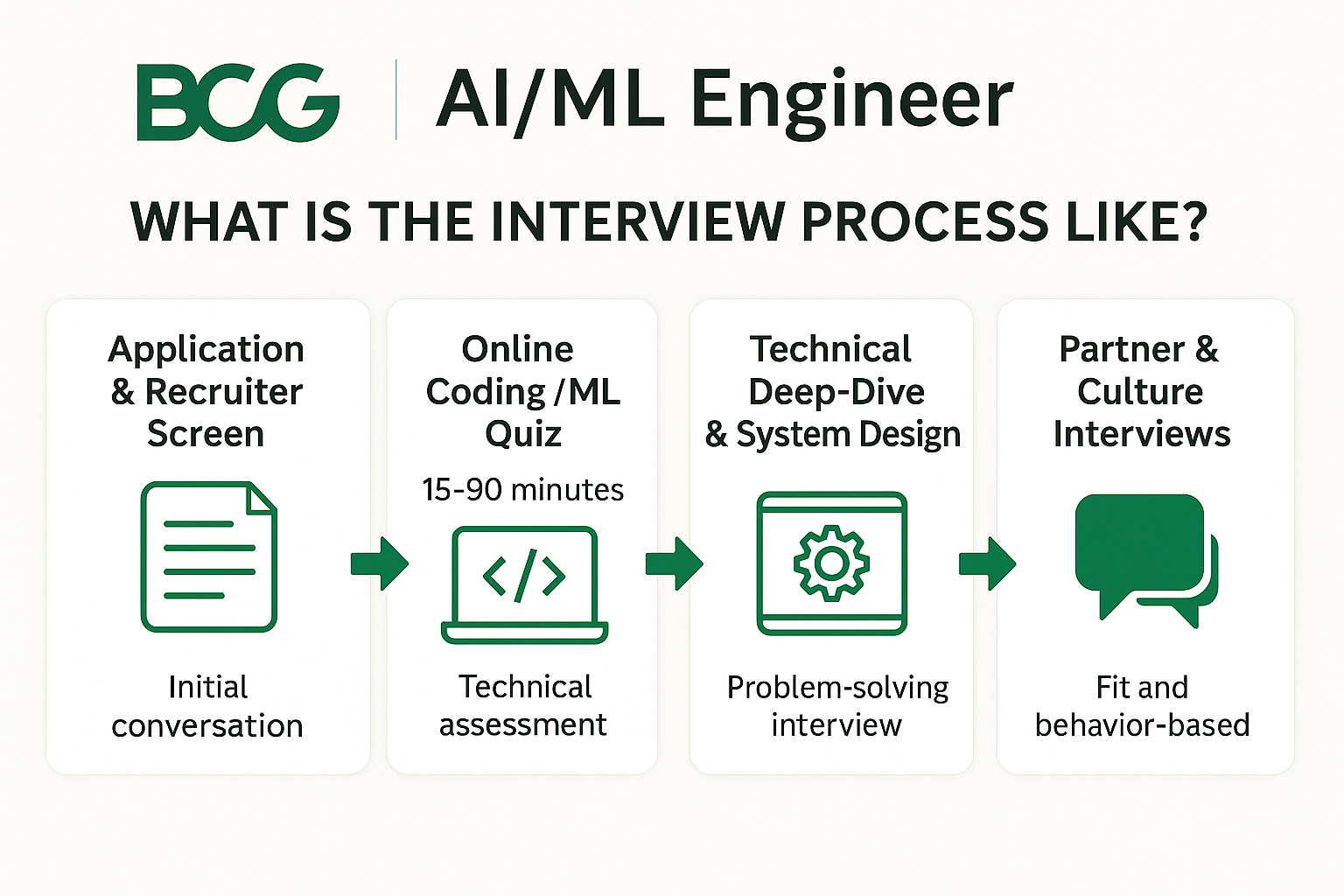
The BCG AI/ML Engineer interview process is structured to assess both your technical expertise and your fit within BCG’s client-driven culture. It unfolds across four key stages:
- Application & Recruiter Screen
- Online Coding / ML Quiz
- Technical Deep-Dive & System Design
- Partner & Culture Interviews
Application & Recruiter Screen
The BCG AI/ML Engineer interview process begins with either a direct application or recruiter outreach, often triggered by LinkedIn profiles showing AI, MLOps, or cloud experience. If shortlisted, the first live step is a 30-minute recruiter screen. This is not just a formality. It explores your past roles and how well your experience aligns with BCG X’s emphasis on production-ready ML and scalable infrastructure.
You can expect questions about your familiarity with Kubernetes, Docker, Terraform, and platforms like AWS or GCP. Some candidates report a strong focus on DevOps, even when the role title is AI/ML. It is a good idea to clarify the role’s scope early since BCG tends to favor hybrid skill sets.
If the call goes well, you will advance to a coding or aptitude test. Use the screen to make a strong technical and cultural impression. Some candidates also encounter a one-way video interview between the recruiter call and the coding test, though this is not always part of the process.
Online Coding/ML Quiz
The online coding and ML quiz for the BCG AI/ML Engineer role is a serious filter, and it’s gotten more nuanced in recent cycles. You might take this test through platforms like CodeSignal or HackerRank, and the format can vary, from a short 15-minute coding screen to a full 90-minute technical assessment.
You’ll typically see a mix of coding problems in Python or R, conceptual ML questions, and sometimes short SQL exercises. However, there’s been a recent noticeable shift toward hybrid questions that test both algorithmic thinking and applied ML skills, like building a quick pipeline or evaluating a model with dirty data.
The coding part tends to stay in the easy to medium zone, but don’t be surprised if you’re asked to manipulate real datasets, engineer features, or explain ML metrics under time pressure. Some candidates also mention small, practical machine learning tasks—things like imputing missing values or selecting models based on evaluation results.
Technical Deep-Dive & System Design
Once you’re past the coding screen, the BCG AI/ML Engineer interview shifts gears into deeper, more open-ended territory.
In the technical deep-dive and system design rounds, you’ll work through problems with senior engineers or cross-functional partners. They’ll evaluate both your technical skillset and how you think through complex, real-world systems.
Expect live coding tasks where you manipulate data, build simple algorithms, or walk through ML workflows. Most often in Python. These interviews dig into how you approach model evaluation, make architecture trade-offs, and deal with challenges like latency or data drift in production environments.
System design is a big part of the conversation, especially around building scalable ML pipelines or integrating models into broader platforms. Interviewers often pose business-aligned case studies where you’ll need to balance technical rigor with practical decision-making. Think about designing a real-time fraud detection system or proposing how to scale a data pipeline for a global retail client.
Partner & Culture Interviews
Stage 4 at BCG is all about alignment with clients, teams, and culture. You’ll meet with Partners or Principals who assess your communication style, business judgment, and ability to translate technical solutions into client value. Feedback usually arrives within 48 hours, so the process moves quickly.
Knowing the path, let’s examine the exact questions you’ll face.
Challenge
Check your skills...
How prepared are you for working as a ML Engineer at The Boston Consulting Group?
What Questions Are Asked in a BCG AI / ML Engineer Interview?
Here are a few recurring question patterns that often get asked in BCG and BCG X AI/ML Engineer Interview Questions:
Coding/Algorithm Questions
These coding and algorithm questions matter in a BCG AI/ML Engineer interview because they test your ability to write clean, efficient code and handle data structures in ways that mirror real-world tasks:
1. Flatten N-Dimensional Array to 1D Array
To flatten an N-dimensional array into a 1D array, you can use a recursive approach to iterate through each element. If an element is a list, recursively flatten it; otherwise, add it to the result list. This method ensures that all nested elements are extracted and appended to the final 1D array.
To impute missing values using the median, calculate the median of the feature column and replace all missing values with this median. This can be efficiently done using pandas’ median() method to find the median and fillna() to replace missing values in the dataframe.
To normalize grades, find the minimum and maximum grades in the list. Then, apply the normalization formula (grade - min_grade) / (max_grade - min_grade) to each grade to scale it between 0 and 1.
To solve this, iterate through each word in the sentence and check if it starts with any of the roots. Replace the word with the shortest matching root. This approach ensures that each word is stemmed to its simplest form based on the provided roots.
To flatten a JSON string with nested objects, you can use a recursive function that traverses each key-value pair. If a value is a dictionary, the function should recursively call itself, appending the current key to the keys of the nested dictionary, separated by an underscore. This process continues until all nested structures are flattened into a single key-value dictionary.
To compute the average value of a specific column in a large dataset that doesn’t fit into memory, you can process the data in chunks. Read the dataset in smaller, manageable parts, calculate the sum and count of the column values for each chunk, and then aggregate these results to compute the overall average. This approach allows you to handle large datasets efficiently without requiring the entire dataset to be loaded into memory at once.
ML & System Design Questions
These ML and system design questions matter in the BCG AI/ML Engineer interview because they reflect the kinds of client-facing challenges you’ll tackle:
7. Design a podcast search engine with transcript and metadata
To design a podcast search engine, you need to create a system that indexes both the transcripts and metadata of podcasts. This involves setting up a database to store the metadata and using a text search engine to index the transcripts for efficient searching. The search engine should support queries that can filter results based on metadata attributes and transcript content.
To build a model for bidding on a new, unseen keyword, you can start by analyzing the relationship between keywords and their bid prices using historical data. Machine learning models like regression can be employed to predict the optimal bid price for new keywords based on features such as keyword relevance, competition, and historical performance.
9. How would we build a bank fraud detection model with a text messaging service?
To build a bank fraud detection model, you would start by collecting and preprocessing transaction data, then selecting appropriate features for the model. You would choose a suitable machine learning algorithm, train the model, and evaluate its performance. Additionally, you would integrate a text messaging service to notify customers of potential fraud, allowing them to approve or deny transactions via text response.
Measuring bias in the model is crucial to ensure fairness and accuracy in predictions. Bias can lead to systematic errors, affecting the reliability of the model’s predictions and potentially disadvantaging certain groups or scenarios. Identifying and mitigating bias helps in building a robust model that generalizes well across different data subsets.
11. How do we deal with missing data to construct a housing price prediction model?
To handle missing square footage data in the housing price prediction model, you can use techniques such as imputation, where missing values are filled in using statistical methods like mean, median, or mode. Alternatively, you can use machine learning models to predict the missing values based on other available features, or simply exclude the incomplete data if it doesn’t significantly impact the dataset’s size or representativeness.
To design this pipeline, start by converting images and PDFs into text using image-to-text models. Then, store the text data in a data mart for machine learning models and a data product for keyword tracking. Finally, create a search API for recruiters to use specific keywords to scout candidates.
13. How to model merchant acquisition in a new market?
To model merchant acquisition in a new market, you would need to identify key factors that influence merchant success and use historical data to predict which merchants are likely to be successful. This involves data collection, feature engineering, and selecting a suitable predictive model to identify potential merchants for acquisition.
14. How would you use customer churn models to identify which subscription segments are at risk and communicate those insights to a business executive?
Customer churn models can identify at-risk segments by analyzing factors like usage patterns, engagement levels, and demographic data. Communicating these insights involves presenting data-driven findings through visualizations and reports, highlighting key risk indicators and suggesting targeted retention strategies to executives.
15. How would you design a real-time recommendation engine for an e-commerce client, and what tradeoffs would you consider in terms of latency, accuracy, and scalability?
Designing a real-time recommendation engine for e-commerce involves balancing latency, accuracy, and scalability. The system should use efficient algorithms to provide quick and relevant recommendations while handling large-scale data. Trade-offs include optimizing for fast response times without compromising recommendation quality and ensuring the system can scale with increasing user and product data.
Behavioral & Consulting Scenarios
Behavioral and consulting scenario questions are crucial in the BCG AI/ML Engineer interview because they assess how well you fit into BCG’s collaborative culture, communicate complex ideas, and translate technical skills into impactful business solutions:
When interviewing for BCG’s AI/ML Engineer role, emphasize your alignment with BCG’s mission to drive digital transformation and strategic impact for clients. Discuss how your technical expertise in machine learning and passion for solving complex business problems fit with BCG’s collaborative and client-focused culture. Highlight your eagerness to contribute to high-impact AI solutions that help BCG clients achieve measurable business outcomes.
Frame your strengths in the context of BCG’s AI/ML projects, such as technical leadership, stakeholder communication, or rapid prototyping. For weaknesses, choose an area you’ve actively improved, like learning new cloud tools or enhancing project management skills, and tie it to BCG’s culture of continuous learning. Reference feedback from previous roles to demonstrate self-awareness and your commitment to professional growth in a consulting environment.
At BCG, cross-functional teamwork is essential; describe a project where you proposed a novel ML solution and faced skepticism from team members with different backgrounds. Explain how you facilitated open discussion, incorporated their feedback, and collaboratively refined the approach to ensure both technical rigor and business alignment. Emphasize the positive outcome, such as improved model adoption or client satisfaction, which reflects BCG’s values of collaboration and impact.
19. Describe a project where you surpassed expectations, detailing your actions and achievements.
Choose a project where you delivered an AI/ML solution that exceeded client KPIs or enabled a new business capability, such as deploying a real-time recommendation engine or automating a critical process. Detail how you identified opportunities for added value, proactively addressed challenges, and communicated results to both technical and non-technical stakeholders. Connect your initiative and results-driven mindset to BCG’s reputation for delivering exceptional client outcomes.
20. Explain how to prioritize and stay organized with multiple deadlines.
In BCG’s fast-paced consulting environment, describe how you use agile project management tools and regular check-ins to manage competing priorities across multiple client engagements. Discuss your approach to breaking down complex AI/ML tasks, setting clear milestones, and communicating proactively with both your team and clients. Illustrate with an example where your organization enabled the successful, on-time delivery of a high-stakes project.
How to Prepare for the BCG ML Interview
Cracking the BCG AI/ML Engineer interview takes more than strong coding chops—it requires technical depth, business thinking, and confident communication.
The process includes online assessments, technical rounds, case interviews, and culture fit checks, so your prep should mirror that structure. Start by mastering Python and PyTorch, and be ready for algorithmic challenges alongside theory questions on ML concepts.
Practice building scalable ML systems, deploy models using cloud tools like AWS or GCP, and polish your SQL for data manipulation tasks.
On the consulting side, develop a habit of explaining your solutions with business impact in mind. Use structured frameworks in behavioral and case interviews, and rehearse how you’d respond under pressure.
Mock interviews and Interview Query AI Interviewer and real-time practice—especially for system design and technical cases—can dramatically boost confidence. Don’t forget to clarify the ML vs. DevOps split during recruiter calls so you’re aligned on expectations from day one.
Conclusion
Landing a role through the BCG X AI Engineer Interview is about more than just passing a technical screen. It’s about showing you can build scalable systems, think clearly under pressure, and communicate like a consultant.
BCG wants engineers who can move fast, own outcomes, and collaborate across disciplines—traits that can’t be faked with surface-level prep.
Ready to go further? Explore the Python AI/ML Interview Questions to test yourself under pressure. And get inspired by Alex Dang’s Success Story. Or follow our step-by-step prep path for BCG ML roles and start building the skills that matter.
The Boston Consulting Group Interview Questions
| Question | Topic | Difficulty |
|---|---|---|
Data Structures & Algorithms | Easy | |
You’re given a string that may contain the characters Task: Verify that the string is balanced. A balanced string is one where every opening character, Write a function called Example: | ||
Data Structures & Algorithms | Medium | |
Machine Learning | Medium | |
SQL | Easy | |
Machine Learning | Medium | |
Statistics | Medium | |
SQL | Hard | |
Machine Learning | Medium | |
Python | Easy | |
Deep Learning | Hard | |
SQL | Medium | |
Statistics | Easy | |
Machine Learning | Hard |
Discussion & Interview Experiences