
Airbnb Machine Learning Engineer Interview Guide | Prep Tips + Questions


Introduction
The Airbnb machine learning engineer role puts you at the center of Airbnb’s most critical product experiences, from dynamic pricing and search ranking to trust & safety. As an Airbnb machine learning engineer, you’ll own the full model lifecycle—from data collection and feature engineering to deployment and monitoring—powering seamless, data-driven decisions at global scale. Airbnb’s “Data-informed, Design-led” culture means you’ll work in autonomous squads, collaborating with product, design, and engineering to rapidly ship and iterate on ML solutions. The company’s fast A/B testing cadence ensures your work directly shapes the guest and host journey. If you thrive on end-to-end ownership and rapid impact, this is your stage.
Role Overview & Culture
As an Airbnb machine learning engineer, you’ll architect, build, and deploy advanced ML models that drive key business functions, including real-time fraud detection, personalized recommendations, and automated pricing. You’ll work with petabyte-scale feature stores and leverage both structured and unstructured data to solve high-impact problems. The role demands technical excellence in Python, TensorFlow, or PyTorch, and hands-on experience with distributed data pipelines and production ML systems. You’ll collaborate in cross-functional, autonomous squads, embodying Airbnb’s culture of creativity, rapid experimentation, and shared ownership. Your contributions will directly enhance trust, safety, and user experience for a global community.
Why This Role at Airbnb?
Airbnb machine learning engineer positions offer you the chance to impact hundreds of millions of bookings by building models that operate at petabyte scale, powering everything from instant search to fraud prevention. You’ll be working in a high-ownership environment where your models are shipped rapidly and measured through live A/B tests, ensuring direct and visible business impact. The technical challenges are immense, but so are the rewards: career growth paths lead to Staff ML Architect, and compensation includes generous RSU refreshes and top-tier salaries, with the average total package exceeding $580k. If you want to accelerate your career and shape the future of travel technology, this role is your launchpad.
What Is the Interview Process Like for a Machine Learning Engineer Role at Airbnb?
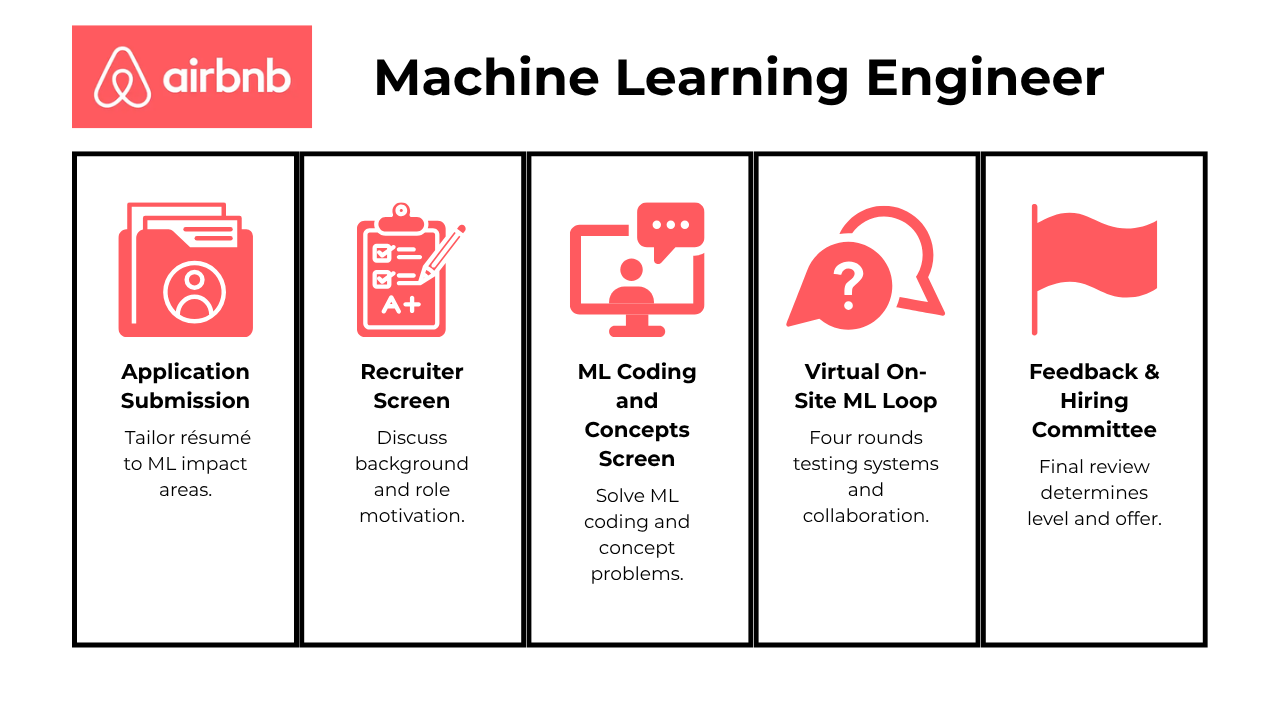
The Airbnb machine learning engineer interview process typically spans four to five stages, each designed to assess your technical depth, problem-solving skills, and cultural fit. Here is how it typically goes:
- Application Submission
- Recruiter Screen
- ML Coding and Concepts Screen
- Virtual On-Site ML Loop
- Feedback and Hiring Committee
Application Submission
Your journey begins with a targeted résumé that demonstrates your alignment with Airbnb’s mission and technical needs. Highlight your experience with machine learning deployment, data-driven insights, and end-to-end model ownership. The application portal will prompt you to share your motivation for joining Airbnb, as well as your openness to relocation or remote work. Recruiters look for a clear narrative that connects your past ML projects to Airbnb’s business challenges, such as dynamic pricing or trust & safety. Taking the time to tailor your application and showcase relevant impact will set you apart and increase your chances of advancing to the next stage.
Recruiter Screen
During the recruiter screen, you’ll have a 30–45 minute conversation focused on your background, technical skills, and motivation for becoming an Airbnb machine learning engineer. Expect questions about your previous projects, how you embody Airbnb’s core values, and your understanding of the company’s mission. The recruiter will also outline the interview process and answer your questions about team culture, role expectations, and relocation support. This is your opportunity to clarify your fit, share your passion for solving large-scale ML problems, and demonstrate strong communication skills that are essential for success at Airbnb.
ML Coding & Concept Screen
The technical screen is a 45-minute HackerRank assessment designed to evaluate your hands-on ML and coding proficiency. You’ll face questions on data manipulation using Pandas, as well as foundational machine learning concepts like gradient boosting, feature engineering, and model evaluation. The problems are data-backed and reflect real challenges at Airbnb, such as optimizing recommendation systems or detecting anomalies in large datasets. Excelling here requires you to write efficient, readable code and explain your thought process clearly. Practicing on our platform and reviewing ML fundamentals will help you stand out in this critical round.
Virtual On-Site “ML Loop”
The virtual on-site ML loop consists of four technical rounds, each lasting about 45–60 minutes. You’ll tackle a data-manipulation coding challenge, design an end-to-end ML system, debug a model with unexpected behavior, and engage in a Core Values behavioral interview. Each round simulates real-world scenarios you’ll encounter as an Airbnb machine learning engineer, such as scaling a fraud detection pipeline or iterating on a search ranking model. Interviewers assess your technical rigor, collaboration style, and ability to communicate complex ideas. Preparation and confidence in both technical and behavioral aspects are key to excelling in this stage.
Feedback & Hiring Committee
After your interviews, feedback is collected and reviewed by a hiring committee within 24 hours to ensure a fair and unbiased decision. The committee calibrates your level (L4 vs L5) based on technical depth, leadership, and business impact, then aligns compensation accordingly. Offers are typically extended within a week and include competitive salary, RSU refreshes, and relocation support if needed. Airbnb’s data shows that this transparent, committee-driven process leads to higher satisfaction and retention for new hires, ensuring you join a team where your skills and contributions are truly valued.
Challenge
Check your skills...
How prepared are you for working as a ML Engineer at Airbnb?
What Questions Are Asked in an Airbnb Machine Learning Engineer Interview?
Airbnb machine learning engineer interviews feature a mix of technical and behavioral questions designed to assess your end-to-end ML expertise, collaboration skills, and alignment with Airbnb’s product-driven culture.
ML Coding / Data Manipulation Questions
Expect data-heavy coding problems that test your ability to implement efficient algorithms, manipulate large datasets, and solve real-world challenges relevant to an Airbnb machine learning engineer:
To find the nearest common ancestor, traverse the binary tree to locate paths to both nodes. Compare the paths to identify the last common node, which is the nearest common ancestor. If either node is not found, return -1.
To solve this, use a recursive approach with dynamic programming. Start at the top-left corner and recursively explore paths moving either right or down. Base cases include reaching the bottom-right corner (valid path) or exceeding grid boundaries (invalid path). Sum the results of recursive calls to count all possible paths.
3. Detect a cycle in a singly linked list
To detect a cycle in a singly linked list, use Floyd’s Tortoise and Hare algorithm. Initialize two pointers, slow and fast, at the head of the list. Move slow one step and fast two steps in each iteration. If they meet, a cycle exists; otherwise, if fast or fast.next becomes None, the list is acyclic.
4. Find the Index with Equal Left and Right Sum
Given a list of integers, write a function to find the index where the sum of the integers to the left of the index equals the sum of the integers to the right. If no such index exists, return -1.
To solve this, calculate the total sum of the list and iterate through the list while maintaining a running sum of the left side. For each index, compute the right side sum using the formula total - leftsum - current_element. If the left and right sums match, return the index; otherwise, return -1 after the loop.
To solve this, simulate the robot’s movement in the matrix by iterating through its steps. The robot moves forward until it encounters a wall or block, then turns right. Track its path using a list of coordinates, stopping when it reaches the final destination or starts repeating its path.
To solve this, iterate through the array while maintaining a pointer (non_zeros) for the position of non-zero elements. Swap zeros with the non-zero elements as you encounter them, ensuring all zeros are moved to the end of the array. This approach achieves (O(n)) time complexity and (O(1)) space complexity.
ML System-Design Questions
System design questions assess how you architect scalable, production-grade ML solutions, covering feature stores, real-time inference, retraining pipelines, and personalization systems:
7. How would you build the recommendation algorithm for type-ahead search for Netflix?
To build a type-ahead search recommendation algorithm for Netflix, start with a prefix matching system using a TRIE structure for efficient lookups. Address dataset bias by focusing on user-typed corpus and incorporating Bayesian updates based on user interactions. Enhance recommendations by leveraging user profiles and clustering features, such as preferences for specific directors or genres. Scale the system using Kubernetes for mapping user profiles and caching condensed feature sets to ensure global uptime and efficient performance.
8. How would you design the YouTube video recommendation system?
To design the YouTube recommendation system, focus on user engagement metrics like watch time, click-through rates, and user preferences. Incorporate collaborative filtering, content-based filtering, and deep learning models to predict user interests. Ensure scalability and address biases, while continuously validating the model with A/B testing and user feedback.
9. How would you build the TikTok ForYou page recommendation engine?
For TikTok’s FYP algorithm, use collaborative filtering with features like user interaction history, video metadata, and engineered features such as engagement scores. Validate the model through techniques like cross-validation and A/B testing, ensuring it adapts to user preferences and provides personalized recommendations.
To design a chatbot for Thomson Reuters’ news division, Retrieval-Augmented Generation (RAG) is recommended due to its ability to dynamically retrieve real-time, verifiable news content without frequent retraining. Fine-tuning can complement RAG by aligning the chatbot’s tone and outputs with editorial standards, but RAG remains the core approach for handling high-velocity, time-sensitive news data.
11. Designing a machine learning system for unsafe content detection
To design an ML system for detecting unsafe content, start by defining the types of content to be identified (e.g., hate speech, violent imagery). Collect and preprocess data, extract relevant features, and select appropriate models like NLP-based models for text or CNNs for images. Address imbalanced data using techniques like resampling or adjusting class weights, and evaluate using metrics like F1 score and precision/recall. Ensure compliance with legal requirements, monitor bias, and establish feedback mechanisms for continuous improvement.
Model Debugging & Evaluation Questions
These questions focus on your ability to troubleshoot underperforming models, monitor production drift, and evaluate effectiveness using appropriate metrics in high-stakes environments:
12. How would we build a Bank Fraud Model?
To build a fraud detection model, start by creating a binary classifier optimized for an imbalanced dataset. Consider the accuracy of the data, the interpretability of the model, and the costs of misclassification. Tree-based models like LightGBM are effective for imbalanced datasets, and techniques like SMOTE or ADASYN can help generate synthetic examples of the minority class. Optimize for recall to minimize false negatives, as undetected fraud can lead to significant financial losses.
13. What key metrics would you track to design an enhanced fraud detection system?
Track metrics like precision, recall, and F1 score to balance the detection of fraudulent transactions while minimizing false positives. These metrics help identify fraud in real-time and improve platform security by ensuring the model captures fraudulent activity effectively without overwhelming users with false alerts.
14. How would you approach building a Credit Card Fraud Model?
Analyze the dataset to understand fraud frequency and reporting mechanisms. Feature engineering is crucial, focusing on transaction time, location, amount, and distance from the user’s home. Use boosting algorithms like Adaptive Boosting to handle class imbalance and iteratively improve predictive power. Perform a cost-benefit analysis to determine the optimal probability threshold for flagging transactions as fraudulent.
15. How would you redesign batch ingestion to real-time streaming for financial transactions?
Transition to real-time streaming using a distributed messaging system like Apache Kafka for event ingestion. Implement stream processing frameworks like Apache Flink for real-time fraud detection and analytics. Ensure data integrity with idempotent producers and transactional delivery, and design the system for scalability, reliability, and compliance. Integrate storage solutions for historical analysis and real-time OLAP stores for immediate reporting.
16. When are SVMs preferable to deep learning models?
SVMs are preferable when there is limited data for training, as deep learning models require large datasets and significant computational resources. SVMs are easier to train, deploy, and maintain, making them cost-effective for scenarios where “good enough” performance is sufficient.
Behavioral & Core-Values Questions
Behavioral questions at Airbnb evaluate how you communicate, collaborate, and demonstrate ownership, all while staying aligned with the company’s mission and values:
17. How comfortable are you presenting your insights?
At Airbnb, machine learning engineers are expected to translate complex models into actionable insights for diverse audiences. You should describe how you prepare presentations, simplify findings through visual tools like dashboards or notebooks, and tailor your message for both technical peers and business stakeholders. Airbnb values engineers who can communicate effectively in cross-functional settings, so share examples where you’ve clearly explained model results or experiment outcomes during team syncs or executive reviews.
Since Airbnb fosters collaboration between engineering, design, and product, misunderstandings can arise when technical and non-technical teams misalign. Share a situation where communication barriers emerged, and explain how you identified the gap—whether it was due to jargon, assumptions, or timing—and adapted your communication style. This shows your ability to bridge disciplines and build consensus, which is essential at Airbnb.
19. Why Do You Want to Work With Us
In 2025, Airbnb continues to emphasize values like belonging, sustainability, and innovative use of data to personalize experiences. Your answer should reflect an understanding of Airbnb’s mission, ML-driven initiatives like dynamic pricing or trust signals, and how your skills align with their direction. Emphasize how you connect with their culture and how you see yourself contributing to long-term projects in ethical AI or guest-host personalization.
Choose strengths that highlight your impact as an ML engineer—like strong experimentation skills, cross-functional communication, or robust model deployment experience—and support them with specific examples. For weaknesses, reflect honestly on an area you’ve actively improved, such as over-indexing on performance over interpretability. Airbnb appreciates self-aware engineers who show growth and adaptability rather than perfection.
21. How would you convey insights and the methods you use to a non-technical audience?
At Airbnb, machine learning engineers must align with customer-centric thinking and democratized data use. You should describe how you contextualize models by focusing on the problem being solved, explaining the impact in plain language, and using storytelling or visual aids to simplify concepts. This shows that you value shared understanding and that your work can drive product decisions across roles.
How to Prepare for a Machine Learning Engineer Role at Airbnb
To excel as an Airbnb machine learning engineer, focus first on mastering Airbnb-style data and feature engineering. Practice complex SQL joins, window functions, and aggregations at scale, as Airbnb’s feature platforms like Chronon and Zipline rely on these techniques to power models with over 100 features per prediction.
You’ll need to build robust pipelines that handle evolving feature schemas, ensure online-offline consistency, and monitor for feature drift and data failures—skills Airbnb expects you to demonstrate in interviews and on the job.
Next, stand out by building end-to-end ML projects using Airbnb’s open datasets. Deploy a ranking or price prediction model, log drift and latency metrics, and automate retraining workflows. This hands-on experience mirrors real production challenges, such as deploying models that serve 150 million users and 1.25 billion searches per month, and will help you confidently discuss system design, model monitoring, and incident response.
Deepen your system-design skills by studying feature stores, online inference infrastructure, and rollout strategies that minimize downtime and ensure reliable A/B testing. Finally, perfect your storytelling: draft 4–5 STAR-format anecdotes that connect your ML impact to Airbnb’s core value of “Being a Host.” Practice mock interviews to refine your delivery, as Airbnb’s data shows strong value alignment predicts long-term success and is a key differentiator in the final interview loop.
FAQs
What Is the Average Salary for an Airbnb Machine Learning Engineer?
Average Base Salary
Average Total Compensation
How Long Does the Airbnb Machine Learning Engineer Interview Process Take?
The interview process usually takes about three to five weeks from your first recruiter screen to receiving an offer. It typically begins with an initial call, followed by one or two technical or phone screens, and wraps up with an on-site or virtual loop. You can expect 4–6 interviews, including coding, system design, ML-specific rounds, and behavioral assessments focused on culture fit.
Does Airbnb Hire Machine Learning Engineer Interns?
Yes, Airbnb regularly hires Machine Learning Engineer interns, particularly during their summer internship loop. The internship application process usually opens in late fall, with interviews conducted in winter or early spring. Internships typically span 10–12 weeks over the summer, offering hands-on ML projects and close mentorship from full-time engineers.
Conclusion
With the right preparation, the Airbnb machine learning engineer interview becomes a powerful opportunity to demonstrate your end-to-end ML skills—from scalable pipelines to impactful communication. To guide your prep, start with this step-by-step ML Learning Path that mirrors Airbnb’s technical expectations. You can also explore Dania’s success story for insights into what works in interviews and study our curated questions collection to practice with the actual ML system design problems asked in ML loops. Confident prep leads to confident interviews—your next big role could start here.
Airbnb Interview Questions
| Question | Topic | Difficulty |
|---|---|---|
Behavioral | Medium | |
Tell me about a data project that didn’t go the way you expected. What did you set out to do, what surprised you, and how did you handle it? | ||
ML Ops | Medium | |
Data Structures & Algorithms | Easy | |
SQL | Easy | |
Machine Learning | Medium | |
Statistics | Medium | |
SQL | Hard | |
Machine Learning | Medium | |
Python | Easy | |
Deep Learning | Hard | |
SQL | Medium | |
Statistics | Easy | |
Machine Learning | Hard |
Discussion & Interview Experiences