
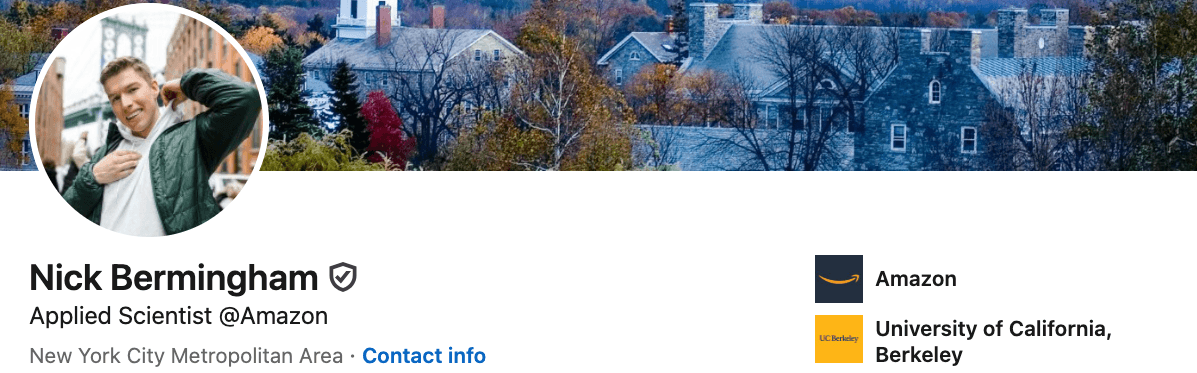
How Nick Bermingham Turned Rejections into an Amazon Applied Scientist Role


Overview
Breaking into Amazon is challenging even in stable markets, but in a year marked by layoffs and hiring freezes, the bar has been even higher. Nick Bermingham’s journey illustrates how persistence, structure, and the right resources can turn setbacks into success.
After months of rejections, he doubled down by pursuing a master’s degree in data science, rebuilding his technical foundation, and adopting a structured system of preparation. Six months later, he landed an applied scientist (L4) role on Amazon’s Sponsored Products team.
The challenge: “super crazy” market conditions
The search was emotionally draining. Every rejection raised the stakes for the next one. Career growth felt stalled, and even with a new degree, he needed to prove—to both himself and recruiters—that he was truly ready.
This is where structure became the turning point.
Building a System of Preparation
Random grinding would not cut it. To compete at the FAANG level, Nick needed a system that measured progress, recreated real pressure, and exposed him to daily feedback. He built this system on three layers: breadth and depth of practice, accountability through mock interviews, and reinforcement with AI-driven feedback.
Breadth and depth through Interview Query
Instead of guessing what to study, he leaned on Interview Query’s structured question bank. He filtered by difficulty (mostly medium-level SQL, statistics, A/B testing, and ML problems) and aimed to complete almost everything in those sets.
This gave him two advantages: coverage across domains (so he was not surprised by curveballs in interviews) and speed (solving medium questions fast enough that harder ones did not shake his confidence).
It was not about memorizing answers but about building a flexible toolkit he could adapt under pressure.
Daily mock interviews and a study partner
Studying alone has limits. Through Interview Query’s mock interview queue, he found an accountability partner. For 90 minutes every day, they drilled problems, exchanged feedback, and simulated interviews under strict time limits.
Explaining logic aloud while someone else evaluated it transformed how he communicated under pressure. By the time he sat in Amazon’s loop, verbalizing code and tradeoffs felt natural.
AI feedback loops for weak spots
To reinforce learning, he leaned on ChatGPT and Interview Query’s AI Interviewer. These tools simulated live questioning, identified weak spots instantly, and allowed him to revisit theory until he could explain and apply it.
By combining human accountability (study partner) with machine-driven practice (AI tools), he closed gaps much faster.
Why the system worked
What made the system powerful was not just the volume of practice. It was the layering:
- Broad coverage built confidence.
- Daily peer drills improved communication and resilience.
- AI-driven feedback turned weaknesses into strengths.
Together, this created a repeatable framework that carried him through months of rejections and ultimately into Amazon.
Inside the Amazon Loop
Amazon’s applied scientist interviews are known for being rigorous, multi-round, and designed to test both technical depth and cultural fit. The candidate faced challenges across system design, machine learning theory, coding, and behavioral alignment with Amazon’s Leadership Principles. Some rounds went smoothly, while others were tough—but overall, his persistence and structured preparation carried him through.
For official details on the process and how to prepare, check Amazon’s own applied scientist interview prep guide.
Lessons for Candidates
Nick’s story proves that success does not come from perfection—it comes from structure, collaboration, and persistence.
- Build a system, not a cramming schedule. A layered approach (breadth practice + peer drills + AI reinforcement) gives resilience across all interview types.
- Do not chase flawless answers. Interviewers care just as much about how you think, explain, and recover.
- Simulate the real thing daily. Mock interviews, strict timers, and peer critique accelerate growth more than passive study.
- Remember culture matters. At Amazon, weaving Leadership Principles into stories is just as critical as solving technical problems.
Looking Forward
For Nick, the Amazon offer was more than just a new job—it was validation of a process. Months of rejections turned into confidence that can carry forward into any challenge.
“I thought I had to get everything right. Turns out, you don’t. Showing your reasoning and resilience matters more than perfection.”
As he steps into his role as an applied scientist on Amazon’s Sponsored Products team, he brings sharper technical skills and a repeatable playbook for tackling the challenges ahead.