


How to Ace the Amazon Interview: Full Process, Questions, Salary, and Insider Prep Tips


Introduction
Amazon operates at a scale that few companies on the planet can match. The company reports serving over 300 million active customers, and industry analysis shows it now delivers more than 9 billion items with same-day or next-day speed every year. AWS holds about 30% of the global cloud infrastructure market, according to Synergy Research Group, which means many of the world’s largest apps and enterprises depend on Amazon technology every single day. With this level of influence, Amazon maintains one of the toughest hiring bars in tech, and recruiting-industry estimates place acceptance rates at around 1% to 2%.
In this guide, you will learn why candidates around the world pursue Amazon roles, how each interview stage works, and the types of questions that consistently appear across engineering, analytics, product, operations, and marketing interviews.
Why Work at Amazon? Culture, Impact, and Perks
Amazon is built on a culture that rewards ownership, customer obsession, and data-driven decision-making. Employees are trusted with meaningful responsibility early in their careers, and teams are encouraged to challenge assumptions, propose new ideas, and measure everything with clear metrics. The pace can be intense, but many candidates are drawn to the opportunity to work on products that influence global behavior and customer expectations. Beyond the work itself, three factors often stand out to candidates evaluating a role at Amazon:
- Culture: A fast-moving environment that values clear thinking, independent ownership, and mechanisms like “working backwards” that push teams to stay focused on customer needs. Employees are encouraged to take initiative, simplify complex problems, and drive ideas from proposal to launch.
- Impact: Decisions scale quickly. Whether you work in retail, AWS, operations, or product, a single insight or feature can affect millions of customers or global enterprise clients. This level of reach and speed gives employees a rare chance to see their work influence real-world behavior at scale.
- Perks: Compensation is competitive across big tech, combining base salary, performance bonuses, and significant RSUs that contribute heavily to long-term rewards. Employees also gain access to comprehensive medical coverage, wellness programs, parental leave, and flexible work arrangements across many business units.
The Amazon Interview Process: Step-by-Step Timeline
Amazon’s interview process is designed to uncover how you think, how you solve problems, and how you operate under ambiguity. The structure is intentional. Each stage highlights a specific dimension of your judgment and your ability to apply the Leadership Principles in practical, measurable ways. Below is a refined and more comprehensive breakdown of each step, along with tips to help you navigate them effectively.
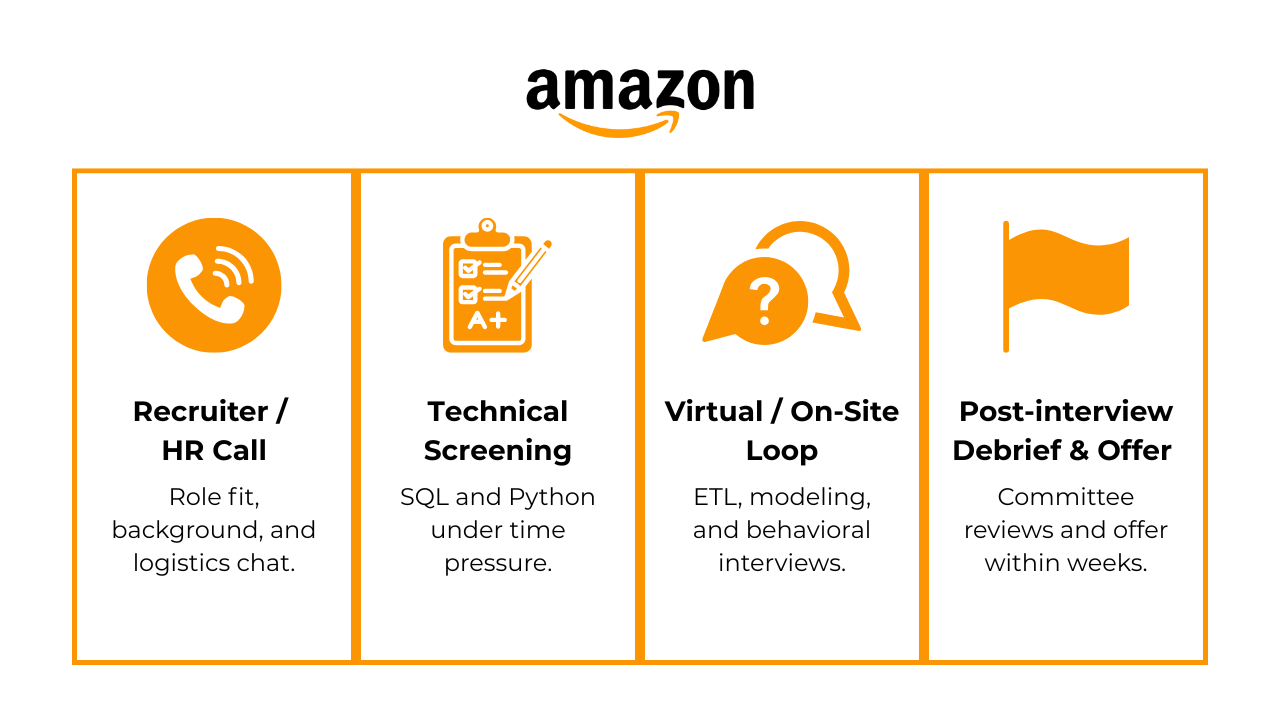
Application Review
The application review identifies candidates who can communicate impact clearly and concisely. Amazon prioritizes resumes that show ownership, progression, and quantifiable results. Recruiters skim for examples of measurable improvement, structured thinking, and experience working in environments where ambiguity is normal. A strong resume demonstrates initiative rather than task completion, and it highlights outcomes that directly influenced customer experience or internal performance.
What stands out:
- Metrics such as revenue growth, reduced latency, improved conversion, or increased efficiency
- Clear and direct writing that reflects structured reasoning
- Evidence of taking ownership rather than assisting passively
- Projects with measurable customer or business impact
Tip: Convert each bullet into a simple formula: what you improved, by how much, and why it mattered. Amazon values candidates who present their work like a concise business case.
Online Assessment (OA)
The OA is Amazon’s first filter for role-specific competency. It reflects the real tasks you might handle at work and helps the hiring team assess whether you have the baseline technical or analytical skills required. The assessments vary significantly by role and are designed to test your ability to operate under time pressure while maintaining clarity and accuracy. Strong performance here shows that you can translate logic into action without relying on tools or prompts.
If you want to get a sense of the OA difficulty, explore common Amazon SQL and data reasoning problems here, which include patterns that regularly appear in take-homes and timed assessments.
Examples of OA formats:
- Software Engineering: coding challenges, debugging tasks, logic, and data structure scenarios
- Data roles: SQL transformations, analytics reasoning, dataset interpretation
- Product Management: situational judgment tasks, feature prioritization, customer-impact scenarios
- Operations and Business: simulations involving communication, escalation, and decision making
Tip: Practice in a plain text environment. Amazon evaluates your thinking, not your IDE, and candidates who can reason through code or decisions without tool support tend to score higher.
Phone or Video Screen
The screen evaluates whether you have the fundamentals to advance to the loop. It tests both technical depth and communication clarity, two skills Amazon considers essential for every role. Interviewers want to see whether you can articulate assumptions, break down your reasoning step-by-step, and apply Leadership Principles naturally through your behavior. This stage typically mixes technical questions, scenario prompts, and behavioral questions.
Role-based expectations:
- Engineering: coding questions, clarifying edge cases, small design prompts
- Analytics: SQL, metric analysis, experimentation logic, and business interpretation
- Product: customer thinking, feature tradeoffs, prioritization, and roadmap reasoning
- Business & Operations: structured decision making, stakeholder alignment, and communication under pressure
Tip: Prepare a two-minute narrative that explains your career path, what motivates your work, and why Amazon makes sense as your next step. This sets a strong context for the rest of the interview.
For SQL-heavy or analytics-focused screens, the targeted Amazon SQL Interview Prep Guide provides walkthroughs, sample queries, and explanations that match real Amazon interviewer expectations.
Onsite or Virtual Loop
The loop is the core of Amazon’s evaluation system. It consists of several interviews with a mix of hiring managers, peers, cross-functional counterparts, and a Bar Raiser. Each interviewer assesses a specific competency, and no one discusses your performance with others until feedback is formally submitted. This ensures that decisions are balanced and objective. Expect deep dives into your past work, layered follow-up questions, and scenarios that test how you think when stakes are high and information is incomplete.
Below is a clear breakdown of the typical loop structure, including nuances by role and practical tips for each interview type.
Loop Structure and Expectations
| Interview Type | What They Test | How It Differs by Role | Tip |
|---|---|---|---|
| Technical Deep Dive | Evaluates core technical skill, structured reasoning, and ability to clarify ambiguous requirements | Engineers receive algorithms or design problems. Data roles see SQL, modeling, or analytical cases. PMs may answer feasibility questions or explain tradeoffs behind architectural decisions. | Pause before you start solving. Clarify requirements and constraints aloud to show deliberate thinking. |
| Problem Solving / Case Round | Measures how you break down complexity, identify constraints, and prioritize under pressure | Analytics roles may troubleshoot metric drops. PMs explore product scenarios. Ops candidates handle logistics or cost challenges. | Segment the problem into clear components. Always connect your decisions back to customer experience. |
| Leadership Principles Behavioral Round | Tests judgment, ownership, communication style, and consistency of your decision making | All roles are held to the same behavioral bar. Senior candidates receive questions about long-term ownership and cross-team influence. | Prepare layered STAR stories with numerical results. Interviewers will ask multiple follow-ups to reach root causes. |
| Hiring Manager Interview | Assesses long-term fit, autonomy, and alignment with team expectations | PMs and engineers may discuss roadmaps or systems. Data roles may be asked how they manage stakeholders or influence decisions. | Demonstrate that you can take a loosely defined goal and generate clarity without waiting for instruction. |
| Bar Raiser Interview | Ensures your performance exceeds the bar for the role and level | Questions often feel broader and explore the reasoning behind your choices. The focus is on repeatable impact and cultural alignment. | Highlight quantifiable business results. Bar Raisers want to see patterns of strong judgment, not isolated wins. |
If you are interviewing for a technical or research-driven role, reviewing the Amazon research scientist interview guide is helpful because many loop scenarios come from modeling, experimentation, or ML deployment challenges that researchers frequently encounter.
Additional Notes About the Loop
The loop often reveals how deeply you understand your own work. Interviewers will ask follow-up questions again and again to test whether your decision making is genuine, consistent, and grounded in real experience. Some candidates find this challenging because it requires more than a prepared script. You need to recall details, explain your tradeoffs, and defend your choices with confidence and humility.
Role nuances also matter. Engineers and data candidates typically see two or more technical rounds. PMs often receive two product rounds, one behavioral round, and one technical or cross-functional round. Senior candidates can expect heavier emphasis on scaling decisions, leadership during ambiguity, and long-term strategy.
Tip: Prepare at least eight strong STAR stories, each with rich detail, specific numbers, and clear learning moments. Amazon interviewers may revisit the same story from different angles, so depth is more important than quantity.
Hiring Committee and Offer
After the loop, every interviewer submits written feedback without discussing it with others. A hiring panel then reviews your packet to decide whether you meet or exceed the bar for the role and level. The panel evaluates consistency across interviews, strength of technical and behavioral signals, and alignment with the expectations for the role. If approved, leveling is finalized and compensation is built using Amazon’s calibrated pay bands.
This stage is where Amazon balances your interview results with the business needs of the team. Strong candidates show a blend of technical competence, clear communication, and behavioral consistency. Recruiters then present the offer package and walk you through the next steps.
Tip: Communicate timelines, competing offers, or constraints early. Recruiters can often expedite internal reviews if they know your deadlines ahead of time.
Challenge
Check your skills...
How prepared are you for working at Amazon?
Types of Questions Asked in Amazon Interviews
Across roles, Amazon interview questions cluster into four main buckets: problem solving and case questions, technical questions, metrics and analytical reasoning, and behavioral questions grounded in the leadership principles. The mix and difficulty vary by role, but the pattern stays consistent. Amazon is testing how you think, how you make decisions with limited information, and how you behave when the stakes are high.
Role Specific Amazon Interview Guides
Amazon’s interviews vary significantly by role, especially in how technical depth, behavioral signals, and problem-solving frameworks are scored. If you want targeted preparation, start with the guide that matches your path:
- Amazon Data Scientist Interview Guide
- Amazon Growth Marketing Analyst Interview Guide
- Amazon Product Manager Interview Guide
- Amazon Data Analyst Interview Guide
- Amazon Business Analyst Interview Guide
- Amazon Data Engineer Interview Guide
- Amazon Machine Learning Engineer Interview Guide
- Amazon Business Intelligence Engineer Interview Guide
Problem Solving and Case Questions
Problem solving questions simulate messy, real Amazon scenarios. You are expected to structure ambiguity, identify the right data, and work backward from the customer or business goal.
| Sample question | Where it appears | How to approach it |
|---|---|---|
| You observe a sudden 30 percent drop in Prime sign ups this month. How do you investigate? | Product, analytics, business, growth marketing | Break the funnel into stages, segment by device, region, and channel, then distinguish external causes from product issues. Talk through quick triage steps and longer term fixes. |
| You notice delivery times have increased in one fulfillment center region. How do you respond? | Operations, data roles, PM, senior roles | Start with metrics like on time delivery, backlog, and staffing, then map potential bottlenecks upstream and downstream. Propose both short term interventions and process changes. |
| Your product team is shipping late because priorities are unclear. What would you do? | PM, EM, senior IC roles | Clarify goals, define a prioritization framework, and reset the roadmap with stakeholders. Highlight how you communicate trade offs and keep execution moving. |
| A competitor launches a price war. How would you evaluate Amazon’s response strategy? | PM, business, growth marketing, senior roles | Lay out options such as promotions, selective discounts, or feature differentiation, then weigh them against margin impact, customer trust, and long term positioning. |
| You are asked to grow a zero budget internal tool by 10 times in six months. What is your approach? | PM, growth, data roles | Focus on virality, internal champions, and workflow embedding rather than spend. Describe experiments and usage metrics you would track. |
Tip: For all case questions, speak in a clear structure. One simple pattern is: clarify the goal, outline a framework, walk through the first two or three moves you would take, then close with how you would measure success.
Technical and Role Specific Questions
Technical questions vary most by role. Below are common patterns for each major family of Amazon roles.
Software Engineering Interview Questions
Coding and system design questions test whether you can reason precisely under time pressure.
| Sample question | Link | Signal it tests |
|---|---|---|
| How do you find the missing integer from an array of 1 to N? | Find the missing number | Ability to compare brute force and optimal solutions, use math or XOR, and reason about time and space. |
| How would you search for a target value in a sorted 2D matrix? | Target value search | How you adapt binary search to non trivial constraints and confirm assumptions about input shape. |
| How do you rotate an array by k positions? | Matrix rotation | Comfort with index arithmetic and clean in place implementations. |
| How would you implement a basic LRU cache? | LRU cache | Understanding of combining data structures such as hash maps and linked lists and designing clean APIs. |
Tip: Amazon expects you to discuss trade offs before coding. Say how a naive approach works, why it fails at scale, then move to the optimized version.
For deeper practice, explore the Amazon Software Engineer Interview Guide which includes coding patterns, debugging examples, and system design strategies sourced from real Amazon loops.
Data Analysts and Data Scientists
Most technical interviews here are SQL heavy, with analytics and experimentation layered on top. If you are preparing specifically for these paths, the Data Analyst and the Data Scientist Interview Guide break down the exact themes Amazon tests, from SQL patterns and metric interpretation to experiment design and stakeholder communication.
Core SQL patterns
| Sample SQL question | Link | Key idea |
|---|---|---|
| Return all neighborhoods that have zero users. | Empty neighborhoods | Use a left join and filter on nulls to find entities with no matches. |
| Calculate daily sales of each product since the last restocking. | Cumulative sales since last restocking | Combine joins, date filters, and window functions to create running totals. |
| Display which shipments were delivered during membership periods. | Completed shipments | Correct date range logic with membership windows and shipment timestamps. |
| Find the average number of downloads for free versus paying accounts, by day. | Download facts | Grouping, segmentation, and average calculations across account types. |
| Identify customers who placed more than three transactions in both 2019 and 2020. | Customer orders | Aggregation by user and year, then filtering with a having clause. |
Tip: When you answer these, always add one sentence on what business question this query supports. Amazon cares about interpretable queries tied to real decisions.
To practice more SQL questions that match Amazon’s expected difficulty, review the Top 13 Amazon SQL Interview Questions with step-by-step solutions, business interpretations, and query optimizations. For an even more realistic experience, try them using the AI Interviewer (simulate a live SQL round) or continue exploring the full library of Amazon-tagged questions to broaden your coverage.
Analytics and experimentation examples
For candidates targeting data science roles, the Amazon Data Scientist Interview Guide covers metrics design, experiment critique, anomaly investigation, and ML-heavy cases that often appear in senior DS loops.
| Sample analytics question | Link | What they want to hear |
|---|---|---|
| You are testing hundreds of hypotheses with many t tests. What should you consider? | Hundreds of hypotheses | Awareness of multiple comparison problems, false discovery rate, and practical trade offs. |
| How would you assess the validity of an A/B test with a p value of 0.04? | Experiment validity | Difference between statistical and practical significance, and sanity checks on setup. |
| Given an A/B test, how do you decide if a CTR lift is statistically significant? | Statistically significant test | Comfort with tests on proportions, confidence intervals, and experiment design. |
| How would you make a control group and test group that account for network effects? | Network experiment design | Understanding of cluster randomization and contamination risks between users. |
Business Intelligence Engineers and Data Engineers
These roles overlap with data analysts and data scientists on SQL, but go deeper on modeling, ETL, and performance.
For a full breakdown of ETL, modeling, and warehouse architecture questions, explore the Amazon Data Engineer Interview Guide and the Amazon Business Intelligence Engineer Guide which provide patterns for DE and BIE system problems.
| Sample DE or BIE question | Link | Focus area |
|---|---|---|
| Write a query to select the top 3 departments with at least 10 employees and rank them by percent earning over 100K. | Employee salaries | Aggregation, window functions, and performance considerations on large tables. |
| Retrieve the highest salary within each department. | Largest salary by department | Window ranking versus max aggregation, and how each affects downstream joins. |
| Design a reporting data model for delivery times across cities and fulfillment centers. | Retailer data warehouse | Choosing the correct grain for fact tables and building dimensions that support drill downs. |
| Design an ETL pipeline to ingest and transform Stripe transaction data. | ETL Stripe data | Thinking through ingestion, schema evolution, idempotency, and data quality checks. |
Tip: In DE and BIE interviews, always describe how you would monitor, alert, and backfill when something goes wrong. Reliability is part of the technical bar.
Product Managers and Growth Roles
PM questions emphasize product sense, execution, and metrics. To understand how Amazon evaluates product sense, metrics, and execution across levels, the Amazon Product Manager Interview Guide outlines common frameworks and sample answers tailored to Amazon’s culture.
| Sample PM question | Signal it tests |
|---|---|
| How would you design a new shopping experience for Prime members? | Ability to define a target segment, identify pain points, propose features, and pick success metrics. |
| How would you validate an idea for a new Amazon device before building it? | Use of working backwards, MVP definition, early demand signals, and customer feedback loops. |
| How would you improve the Alexa experience for multi user households? | Personalization thinking under constraints like privacy and shared devices. |
| How do you decide what not to build? | Prioritization frameworks, strategic focus, and comfort with saying no using data. |
You can treat these almost like mini product cases. Show that you understand Amazon scale and customer obsession, not just feature brainstorming.
Metrics and Analytical Reasoning Questions
Across roles, metrics questions test whether you can define success, design dashboards, and interpret results in a way that drives decisions.
| Sample metrics question | Link | Angle to emphasize |
|---|---|---|
| How would you forecast next quarter’s revenue for a major Amazon product line? | Forecasting new year revenue | Decomposing revenue into drivers, handling seasonality, and tying forecasts to planning decisions. |
| Which products should Amazon discount during a major sale to maximize profit? | Effectiveness of sales | Using elasticity, margin, and inventory to select a target list and test it safely. |
| Design a KPI dashboard to track conversion across multiple storefronts. | Search CTR | Funnel thinking from impression to purchase, cross region comparability, and drill down views. |
Tip: For metrics questions, always name at least one north star metric and two or three guardrail metrics. Explain why each protects the customer or the business.
If you are preparing for analyst or marketing analytics roles, pair this section with the Amazon Growth Marketing Analyst Guide or the Amazon Data Analyst Guide to see how metrics are scored in these paths.
Behavioral and Leadership Principles Questions
Behavioral questions are constant across all Amazon interviews. Every story is mapped to one or more Leadership Principles such as Customer Obsession, Ownership, Dive Deep, and Deliver Results.
| Sample behavioral question | Link | Leadership principles in play |
|---|---|---|
| Why do you want to work at Amazon and what makes you a good fit? | Why do you want to work with us? | Customer Obsession, Ownership, Learn and Be Curious. |
| What would your current manager say about you and what constructive criticism would they give? | Your strengths and weaknesses | Earn Trust, Bias for Action, Strive to be Earth’s Best Employer. |
| How do you resolve conflicts with others at work? | Handling conflicts | Earn Trust, Have Backbone, Disagree and Commit. |
| Tell me about a time you made a difficult prioritization decision. | Prioritizing deadlines | Ownership, Bias for Action, Deliver Results. |
| Describe a time you disagreed with a stakeholder. How did you resolve it? | Disagreeing colleagues | Have Backbone, Disagree and Commit, Customer Obsession. |
| Tell me about a time you exceeded expectations on a project. | Exceeding expectations | Insist on the Highest Standards, Deliver Results. |
| Describe a data or technical project you worked on. What were some challenges? | Hurdles in data projects | Dive Deep, Ownership, Invent and Simplify. |
Tip: Prepare two or three strong stories that can flex across multiple questions by changing which details you highlight. Always quantify your impact where possible.
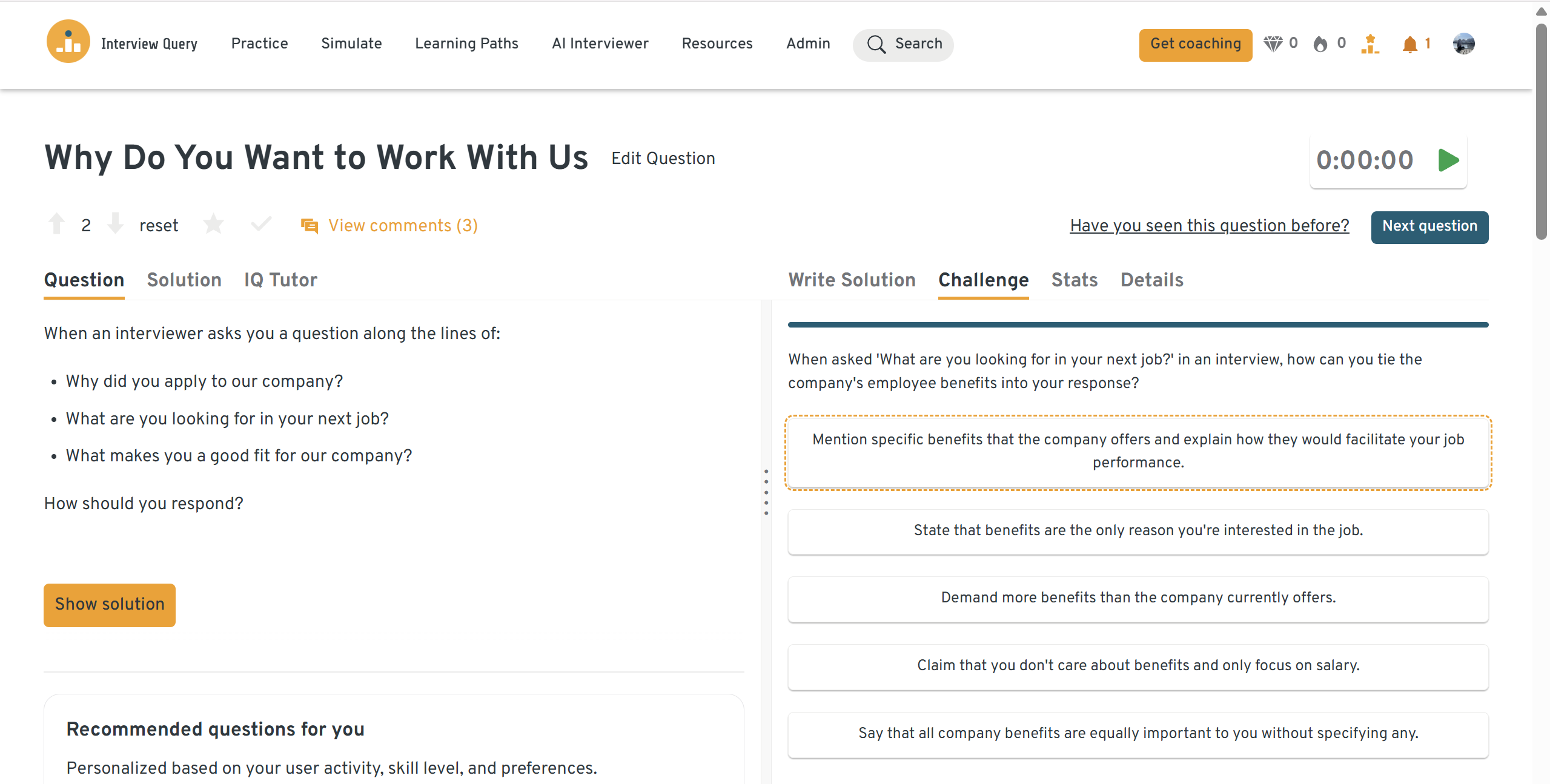
You can practice interview questions on the Interview Query dashboard, shown below. The platform lets you write and test SQL queries, view accepted solutions, and compare your performance with thousands of other learners. Features like AI coaching, submission stats, and language breakdowns help you identify areas to improve and prepare more effectively for data interviews at scale.
Senior Level Questions
For senior candidates such as L6 and above, interviewers push harder on scope, long-term thinking, and cross team leadership.
Typical senior prompts include:
- How do you manage trade-offs between short term delivery goals and long term architectural investments
- Describe a time you led a team through an ambiguous technical or product challenge. How did you drive clarity
- How have you influenced teams you do not directly manage
- Tell me about a time your team failed. What did you do as a leader
- Describe a major cost reduction or efficiency initiative you led. What was the outcome
Senior answers should show that you set direction, build systems, and raise the bar beyond your immediate team. To strengthen your preparation for Amazon interviews, begin by reviewing the collection of Amazon-tagged questions available on Interview Query. These questions are curated from real interview experiences and are categorized by role, difficulty, and topic area. Browsing this set gives you direct insight into the types of problems Amazon frequently asks in technical and analytical interviews.
6 Strategies to Answer Amazon Interview Questions
Amazon interviews test how well you think, not how well you memorize. Interviewers want to see structure, clarity, and customer focus across every answer. These frameworks help you approach problems consistently across all roles, whether you are interviewing for engineering, analytics, product, operations, or business functions.
Each framework below includes a short explanation, a structured breakdown, and a mix of bullets and tables so the section is readable and not visually repetitive.
Clarify, Structure, Execute
This is the most universal framework for answering ambiguous Amazon questions. Interviewers expect you to bring order to messy scenarios, define what matters, and then reason logically through a solution. It is useful for metric drops, product design, debugging, analytical reasoning, and system behavior questions.
Step What You Do Why It Matters to Amazon Clarify Identify the customer, the goal, constraints, and definitions. Shows you can avoid assumptions and ground the problem. Structure Outline a clear plan before diving into details. Demonstrates organized thought and high signal communication. Execute Walk through analysis, tradeoffs, and expected impact. Lets interviewers evaluate your reasoning process end to end. Using this framework helps you stay focused, eliminates rambling, and makes your thought process transparent. It also mirrors the way Amazon teams solve real operational and product challenges at scale.
Leadership Principles Matrix
The Leadership Principles are the core of Amazon’s behavioral interviews. Instead of preparing one story per principle, a matrix method gives you deeper, more flexible stories that can handle follow ups. It also helps you avoid running out of examples during multi hour interview loops.
A simple way to build your matrix:
- Select 8 to 10 high impact stories that each have measurable results.
- Map each story to two or three Leadership Principles.
- Prepare deeper layers of detail that you can reveal when probed.
- Balance your story bank with examples of conflict, failure, ownership, delivery, and customer problem solving.
This approach makes your storytelling much stronger. Interviewers will quickly notice that your examples are rich, authentic, and adaptable instead of memorized or shallow.
STAR with a Two Sentence Situation
STAR is mandatory across Amazon behavioral rounds, but most candidates lose points by oversharing context. The two sentence rule forces clarity and helps the interviewer focus on your thinking, actions, and results.
Here is the structure:
- Situation: Two sentences with only essential details.
- Task: A clear statement of what you needed to achieve.
- Action: Your reasoning, decisions, and steps taken.
- Result: Quantified impact and what changed because of your actions.
This formatting shows that you understand how to prioritize information. It also keeps the interviewer engaged and creates space for the deeper follow ups Amazon is known for.
Metrics First Thinking
Amazon values candidates who define measurable success before proposing solutions. Whether you are asked a product question, an operational scenario, an analytics prompt, or a systems tradeoff, you are expected to anchor the problem in metrics before solving it.
A simple way to apply this:
Metric Type What It Represents Example North star metric Core measure of success Retention lift, on time delivery rate Guardrail metrics Protect customer trust and system health Defect rate, latency, CS contacts Segments Reveal deeper patterns By region, device, user cohort Thinking in metrics immediately elevates your answers. It shows that you understand scale, customer impact, and how real decisions get evaluated at Amazon.
Tradeoff Narratives
Tradeoff thinking is one of the strongest signals of good judgment. Amazon interviewers listen for candidates who can evaluate multiple options, articulate the risks, and justify a recommendation grounded in impact.
A strong tradeoff narrative typically includes:
- Two or three realistic options you considered.
- The benefits and risks of each option.
- A clear recommendation with supporting metrics.
- A fast experiment or validation plan you would run.
This framework is particularly important for PMs, engineers, analysts, and operational roles. Amazon wants to know how you reason when there is no perfect answer.
Customer Backwards Thinking
Every Amazon interview, regardless of role, evaluates whether you think from the customer’s perspective. This framework helps anchor your answers in customer value and makes your reasoning more aligned with Amazon’s culture.
Ask yourself in every question:
- Who is the specific customer in this scenario
- What pain point matters the most
- How you would measure improvement from their perspective
- Which decision best protects or enhances the experience
This mindset helps you sound more Amazon like. It also brings clarity to your answers because customer needs become the basis for every decision you make.
Preparation Tips for Amazon Interviews
Once you master the frameworks, you can focus on how to prepare effectively. Amazon interviews require stamina, clarity, and depth across multiple rounds. These preparation strategies reflect actual interviewer feedback, which means they help eliminate common failure points.
Build a Strong STAR Story Bank
Your stories should show depth, measurable change, and range. They are your foundation for all behavioral rounds.
- Prepare 8 to 10 stories that cover ownership, collaboration, delivery, conflict, and failure.
- Make sure each story can expand or contract depending on follow ups.
- Quantify outcomes wherever possible, even with reasonable estimates.
A strong story bank helps you stay consistent across interviews and prevents you from repeating examples, which can hurt your final evaluation.
Practice Thinking Aloud
Amazon wants to hear your reasoning process, not just your final answer. Thinking aloud helps interviewers score your structure, clarity, and judgment.
A simple practice routine:
| Question Type | What You Should Verbalize |
|---|---|
| Coding | Approach, edge cases, complexity, tradeoffs |
| Product | Customer, problem, metrics, options |
| Analytics | Assumptions, hypotheses, segmentation |
| System design | Constraints, scaling paths, choices |
Doing this makes your answers feel transparent and well reasoned. It also reassures interviewers that you are not guessing.
Simulate a Full Interview Loop
Real loops can last several hours. Many candidates perform well in the first interview but drop in quality by the third or fourth. Simulating a full loop helps you build endurance and consistency.
You can practice by:
- Scheduling four back to back mock rounds with minimal breaks.
- Mixing behavioral, technical, and problem solving questions.
- Reviewing your clarity and structure at the end of each round.
- Practicing your reset routine between interviews.
This dramatically improves your ability to stay sharp throughout the actual loop.
Prepare Deep Follow Ups
Amazon interviewers use follow ups to evaluate authenticity. If your stories are shallow or overly rehearsed, they will unravel under deeper questioning.
Prepare by reviewing each story and asking yourself:
- What exact metrics were used
- What alternatives you considered
- What risks and mistakes happened
- What you would do differently today
Deep layers of detail make you sound credible and self aware. Interviewers will notice immediately.
Craft High Quality Reverse Interview Questions
Interviewers evaluate your questions too. They signal how you think, what you value, and whether you understand Amazon’s culture.
Good questions include:
- How the team measures success during high pressure periods
- What the biggest customer pain point is today
- How they prioritize technical or operational debt
- What distinguishes high performers on the team
Strong reverse questions help you stand out as a thoughtful, long term contributor.
Use Role Specific Guides for Targeted Practice
Once the universal frameworks are solid, move on to role specific preparation using Interview Query’s Amazon guides below.
- Amazon Data Scientist Interview Guide
- Amazon Growth Marketing Analyst Interview Guide
- Amazon Product Manager Interview Guide
- Amazon Data Analyst Interview Guide
- Amazon Business Analyst Interview Guide
- Amazon Data Engineer Interview Guide
- Amazon Machine Learning Engineer Interview Guide
- Amazon Software Engineer Interview Guide
- Amazon Business Intelligence Engineer Interview Guide
These guides cover role specific technical questions, evaluation themes, and sample answers so your preparation becomes more focused and efficient.
Amazon Salary and Compensation Overview
Compensation at Amazon varies significantly by role, level, and business unit, but the overall trend is consistent: base salary remains stable, while long-term upside comes from stock. Because RSUs vest slowly (5 percent, 15 percent, 40 percent, 40 percent), total compensation becomes meaningfully higher after year two. This structure rewards candidates who stay and grow within the company.
Below is a consolidated view of salary ranges across Amazon’s major technical and analytical roles based on verified data from Levels.fyi. All ranges represent total annual compensation in the United States.
Average Amazon Compensation by Role
| Role | Typical Range (Total Annual Comp) | Notes | Source |
|---|---|---|---|
| Data Analyst | $120K to $240K | Most hires enter at L4–L5. Stock becomes meaningful at L6. | Levels.fyi |
| Software Engineer (SDE) | $180K to $684K+ | Steep increases after L6. Principal and above exceed $600K. | Levels.fyi |
| Data Engineer | $144K to $264K | Comp tracks complexity of owned pipelines and systems. | Levels.fyi |
| Data Scientist | $180K to $630K | Senior and principal DS roles carry large equity packages. | Levels.fyi |
| Business Analyst | $105K to $175K | Strong growth for analysts who transition into PM or BIE tracks. | Levels.fyi |
| Product Manager | $192K to $540K+ | Compensation rises sharply at L7. Director roles exceed $800K. | Levels.fyi |
| Business Intelligence Engineer | $144K to $228K | Often a bridge role into DS or DE paths. | Levels.fyi |
Average Base Salary
Average Total Compensation
Across roles, the largest compensation jumps happen when candidates move from L5 to L6 and from L6 to L7. These transitions correspond to shifts from execution to ownership, and from ownership to long-term strategy.
How Amazon Levels Work
Amazon’s leveling system is one of the most important pieces of context for understanding your interview performance, offer package, and long-term growth. Levels at Amazon determine not only compensation, but also scope, expectations, and how fast you can move through the organization.
Unlike some companies where titles are loosely defined, Amazon’s levels are tied to explicit behavioral and impact thresholds. Knowing these helps you understand what interviewers are looking for and how offers are calibrated.
| Level | Typical Title | Who This Level Fits | What Amazon Expects |
|---|---|---|---|
| L4 | Entry-level (Analyst, Engineer, PM) | New grads or early career professionals | Ability to execute with guidance, learn systems, and deliver reliable work. |
| L5 | Mid-level (Engineer II, PM II, Analyst II) | 3–6 years of experience | Independent ownership of projects, ability to simplify problems, and consistent delivery. |
| L6 | Senior-level (Senior Engineer, Senior PM, Senior Analyst) | 6–10+ years of experience | End-to-end ownership, long-term thinking, mentorship, and measurable business impact. |
| L7 | Principal-level | ~1 percent of employees | High-scale leadership, cross-org influence, and shaping multi-year strategy. |
| L8 | Director | Senior leadership | Org-level strategy, vision setting, and leading large complex portfolios. |
| L10 | VP | Executive leadership | Company-wide decisions and long-term business direction. |
How Amazon Levels Affect Your Interview and Offer
Amazon assigns a target level before interviews begin, and every question is evaluated against that expected bar. Interviewers look for scope, judgment, and ownership that match the level you are being considered for, not your previous title. This is why some candidates feel the interview is harder than anticipated: the bar reflects Amazon’s internal calibration, not your past role.
How leveling shapes the interview
- Interviewers evaluate all answers through the lens of the target level.
- An L5 candidate who demonstrates L6 ownership may be considered upward.
- An L6 candidate who shows L5-level scope will not be leveled down. They simply do not pass.
- Behavioral stories must show the scale and decision-making expected at that level.
How leveling shapes your offer
- Level determines the size of your stock package.
- It influences your long-term compensation growth.
- It affects promotion velocity and how quickly your scope expands.
- It determines visibility with senior leadership and cross-org influence.
Because level dictates both expectations and compensation, many candidates ask: “Can you help me understand how I was benchmarked for this level?” This helps ensure alignment between your experience, Amazon’s bar, and your long-term growth inside the company.
How to Negotiate an Amazon Offer
Negotiating with Amazon works differently from many companies. Base salary is capped by location, so most of the movement happens in stock and sign-on bonuses. These five steps summarize the negotiation strategy Amazon responds to best.
Know what Amazon can flex
Your leverage varies by component:
Compensation Component Flexibility Notes Base salary Low Amazon follows strict location-based salary caps. RSUs (Stock) Medium to high The most adjustable part of total compensation. Year 1 sign-on bonus Very high Used to offset slow early vesting. Year 2 sign-on bonus High Helps balance total compensation over two years. Level (L4, L5, L6…) Hard to change If you are close to the threshold, ask for clarification. Focus your negotiation on what Amazon can realistically increase.
Use a data-backed anchor
Reference market data and competing offers to set expectations. Keep it factual and focused on total compensation instead of individual components.
Ask how you were leveled
If you believe your scope aligns with a higher level, ask:
“Can you help me understand how I was benchmarked for this level?”
This is often the only moment to correct misalignment before the offer is finalized.
Communicate the ask clearly
A concise message works best:
“Based on the role’s scope, our conversations, and market ranges for this level, I was targeting a total compensation closer to X. Is there flexibility in stock or sign-on to align with that range?”
This keeps the conversation constructive and opens room for movement.
Check final alignment before accepting
Review the offer with these filters:
- Does the total compensation make sense after the slow vesting schedule
- Is the level appropriate for your experience and expected scope
- Does the team’s impact match the compensation band
- Are you comfortable with the long-term upside
These five steps help you negotiate effectively without friction and ensure the offer supports your long-term growth.
FAQs About Amazon Interviews
Is the Amazon interview process hard?
Yes, but not because of trick questions. The challenge comes from depth. Amazon interviewers expect structured thinking, measurable results, and strong alignment with the Leadership Principles. Even technical roles are judged heavily on behavioral performance. Candidates who prepare real stories and practice thinking aloud tend to outperform those who focus only on technical drills.
How important are Amazon’s Leadership Principles?
Extremely important. They shape every hiring decision, especially in ambiguous or high-stakes scenarios. Leadership Principles are not soft-skill guidelines — they are evaluation criteria. Showing clear ownership, customer obsession, and long-term thinking significantly increases your chances of passing.
Do I need to know the STAR method?
Yes. Amazon interviewers are trained to look for STAR formatting because it creates clarity and allows them to score your story accurately. The biggest mistake candidates make is spending too long on the Situation instead of the Actions and Results. Keep your context brief and focus on the decisions you made.
How long does Amazon’s interview process usually take?
Most candidates complete the hiring process within four to six weeks. However, timelines vary depending on role, level, and the hiring team’s urgency. Technical roles often progress faster, whereas senior roles require more rounds and more discussion between interviewers.
Can I negotiate my offer at Amazon?
Yes, but negotiation focuses on stock and sign-on bonuses, not base salary. Amazon has firm caps on base pay, so the most flexible components of your offer are RSUs and sign-ons. Candidates who come prepared with data from Levels.fyi and competing offers typically secure stronger packages.
Does Amazon hire across all backgrounds or only top-tier schools and companies?
Amazon hires from everywhere. While many candidates come from large tech firms, Amazon places more weight on demonstrable impact, strong storytelling, and deep alignment with its values. Many successful candidates come from nontraditional or self-taught backgrounds.
What happens if I fail the Bar Raiser round?
If the Bar Raiser says no, the entire interview becomes a no-hire. They exist to maintain consistency and quality across teams. In many cases, the feedback from this round can help guide your preparation for a future re-interview after the cooldown period.
Start Your Amazon Interview Prep Today
Amazon interviews reward clarity, structure, and the ability to think at scale. The fastest way to build those skills is through focused practice. Interview Query’s Amazon ecosystem gives you curated learning paths, role-aligned questions, and realistic mock challenges that mirror the pace and ambiguity of an actual loop. These resources help you master the exact competencies Amazon screens for, from problem-solving depth to leadership-aligned storytelling.
If you want to see what success looks like, explore stories like Jayandra Lade’s, who used consistent mock loops and structured prep to secure his Amazon offer. When you’re ready to practice, dive into the full library of Amazon interview questions or build momentum through step-by-step learning modules. Start today—each rep compounds, and the clarity you build now becomes your edge on interview day.
Discussion & Interview Experiences