

Finland Is Fast-Tracking Tech Visas to Attract AI Talent


The Global Tech Job Market Is Splitting
The tech job market in the United States has become harder to break into than it was even a year or two ago, as today’s workers can feel that hiring is evidently slower and more selective. Moreover, open roles are scarcer and interview loops are longer, with standards even for entry-level positions continuing to rise. At the same time, other countries are actively recruiting the same talent the US market seems to be sidelining.
Finland is one of the clearest examples. The country is fast-tracking tech visas in as little as two weeks and openly targeting AI, data, and advanced engineering roles, according to recent reporting from Business Insider. While top tech roles haven’t completely disappeared and are instead becoming geographically selective, it’s becoming more crucial for tech workers to understand where demand is shifting.
Finland’s Pitch to Tech and AI Workers
Finland’s offer is straightforward but unusually aggressive by global standards. The government has reduced bureaucracy to streamline visa approvals for tech workers and their families, with the timeline ranging from an average of 10-14 days. The country is also positioning itself as an easy landing spot for experienced engineers through factor that emphasize stability, such as predictable hours, strong labor protections, and a culture that prioritizes work-life balance.
That messaging stands in sharp contrast to how tech work has been changing in the US. Return-to-office mandates and growing expectations around availability, which sometimes drift toward “always on” cultures, are reshaping how many engineers experience their jobs. A recent Interview Query article on tech firms’ RTO policies has documented this shift, including how productivity metrics for office presence are altering tech work norms.

It’s worth noting that Finland’s timing isn’t accidental. Like many European countries, it faces an aging population and a shortage of specialized technical talent. Scaling AI, cloud infrastructure, and digital public services requires skills that the local labor market can’t supply fast enough.
Thus, the target audience is clear. Senior engineers, AI specialists, data scientists, and applied machine learning professionals are being lured beyond salary; lifestyle, predictability, and immigration certainty matter just as much.
Why The US Tech Slowdown Is Part of the Story
While hiring hasn’t collapsed in the US, it has evidently tightened with fewer open roles and more intense competition. Recent tech jobs reporting shows productivity rising while headcount growth stagnates, with a pattern that particularly favors experienced specialists over generalists.
This environment makes US-based tech workers more visible to foreign recruiters. Countries trying to build AI capacity or modernize infrastructure see an opportunity to attract proven talent that’s underutilized at home.
 Source: SThree
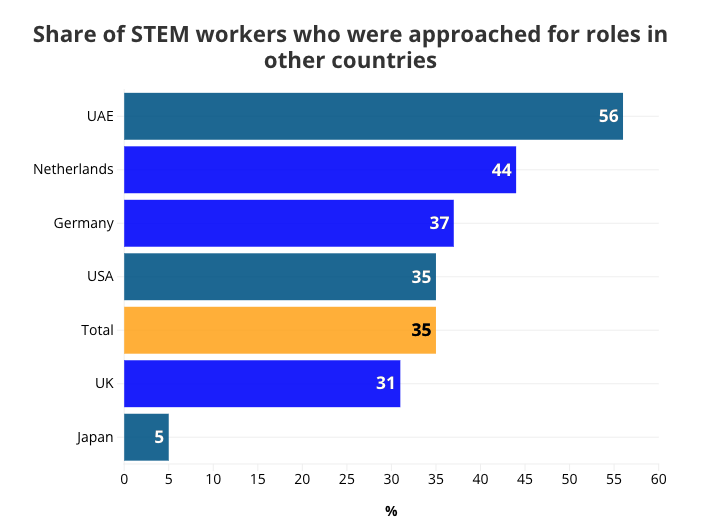
A report from the staffing firm SThree supports this insight, noting that 35% of science, technology, engineering, and mathematics (STEM) workers in the US, a major STEM nation, were approached for roles in other countries.
This creates tension: the US remains the global leader in tech innovation, but uncertainty around hiring cycles, visa policy, and workplace expectations is growing. When domestic markets tighten, global mobility becomes more attractive, especially as alternatives abroad now come with fewer trade-offs than they used to.
Why Global Demand Still Favors Specialized Tech Roles
The biggest misconception about the current tech job market is that demand has vanished. Yet in reality, it has only narrowed; roles tied directly to measurable business impact continue to travel well across borders.
Echoing Interview Query’s previous analysis of AI engineering expansion, the role remains in especially high demand. Applied machine learning specialists who can deploy models in production environments are similarly sought after. And despite broader tech hiring pullbacks, data scientists remain an exception in many markets, including internationally. Cloud and infrastructure engineers round out the list for in-demand AI talent, as companies everywhere race to modernize systems without rebuilding teams from scratch.
These roles are portable because output matters more than location. Smaller markets like Finland need high-impact specialists who can accelerate teams quickly. Their immigration programs reflect that selectivity. Increasingly, countries are competing on policy, including isa speed, family relocation, work culture, and not just pay.
What This Means for Tech Workers Right Now
For tech workers watching this unfold, the takeaway isn’t the abandonment of a career in the US. It’s that geographic flexibility is becoming an advantage again. Immigration policy is now a hiring signal, and work-life balance is part of the global competition for talent.
For US-based engineers, this means paying attention to where demand is being actively cultivated, not just where it used to be concentrated. For international candidates, it means the tech opportunity landscape is widening, but in-demand roles are becoming more specialized as countries and economies all bid for the AI race.
This moment looks less like a collapse and more like a rebalancing. As the global tech market becomes more selective and policy-driven, workers may need to think beyond borders—even if they ultimately decide to stay right where they are.