

Visa Data Engineer Interview Guide (2025): Process, Questions & Salary


Introduction
Breaking into Visa as a Data Engineer means operating at a scale few engineers ever experience. Every tap, swipe, or online purchase flows through systems processing more than 65,000 transactions per second, where milliseconds matter and reliability is non-negotiable.
Preparing for Visa data engineer interview questions isn’t just about knowing Spark or SQL; it’s about proving you can design infrastructure that holds up under extraordinary complexity and strict PCI compliance. In this guide, we’ll break down what the role actually looks like, highlight Visa’s unique culture, and walk you through the interview process, question types, and strategies to stand out in one of fintech’s most competitive engineering paths.
Role Overview & Culture
A Visa data engineer spends each day building and maintaining the pipelines that keep global payments flowing. This includes developing robust ETL systems, enabling real-time insights from payments data, and ensuring every workflow adheres to strict PCI compliance standards. You’ll balance performance with security as you optimize Spark batch jobs, manage Flink streaming processes, and support downstream analytics in Snowflake.
What makes the role distinctive is Visa’s “One Visa, One Data” principle. Collaboration is central, and engineers are expected to partner closely with product, risk, and analytics groups. The culture is both data-driven and impact-focused: every engineering decision contributes to a system that underpins global commerce and keeps billions of transactions moving securely each day.
Why This Role at Visa?
This role offers the rare combination of scale, technical depth, and career trajectory. With salaries often ranging from $125K to $177K in the U.S., Visa Data Engineers gain not only competitive compensation but also exposure to datasets and throughput on par with the largest cloud companies.
The modern stack, such as Spark for high-volume batch jobs, Flink for streaming analytics, and Snowflake for warehousing, gives you the tools to operate at the frontier of data engineering.
For many candidates, preparing for Visa data engineer interview questions means not only mastering technical concepts but also demonstrating the ability to think at scale: how to reduce latency, how to ensure resilience, and how to maintain compliance under constant load.
In the next section, we’ll dive into the interview process itself, breaking down the rounds and expectations so you can prepare with confidence.
What Is the Interview Process Like for a Data Engineer Role at Visa?
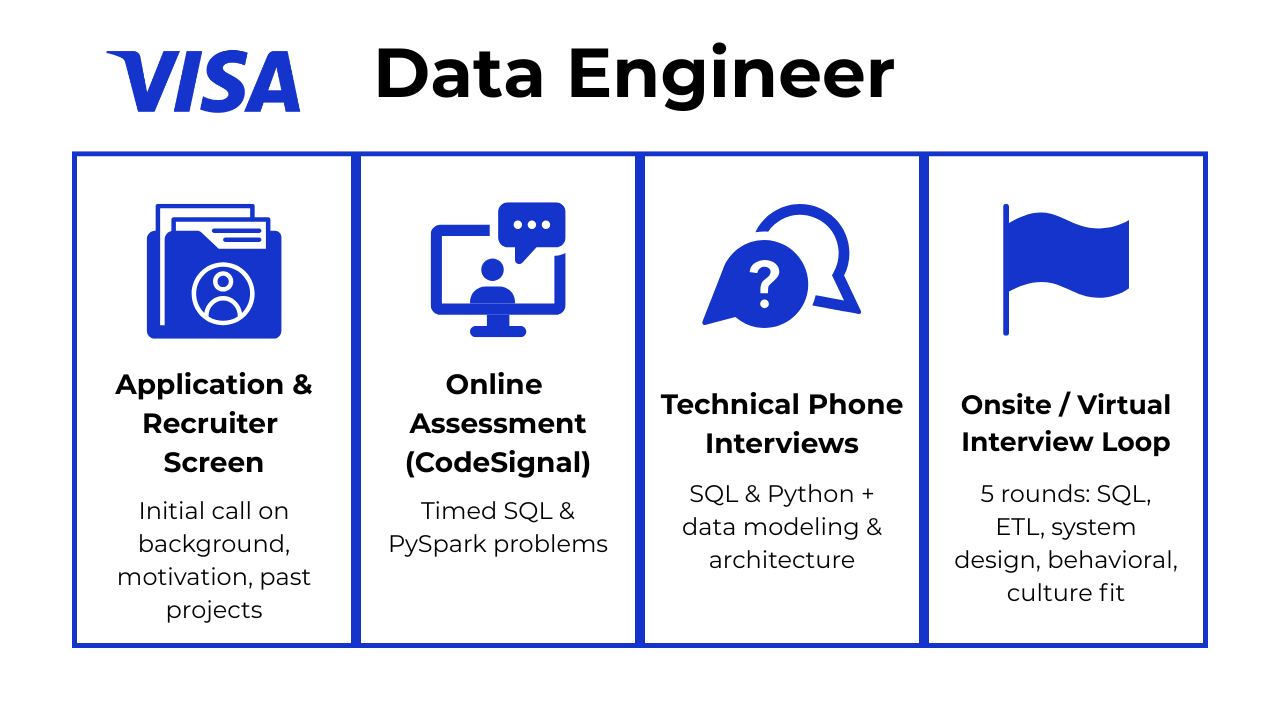
The Visa data engineer interview process is structured to measure not just whether you can code, but whether you can design and communicate systems that hold up under Visa’s massive scale. Across multiple stages, you’ll be evaluated on technical fluency, scalability mindset, and collaborative ability. Here’s what to expect:
Application & Recruiter Screen (30 minutes)
This is your entry point: a phone call where the recruiter reviews your background, recent projects, and motivation for joining Visa. They’re looking for clarity in how you’ve built or optimized data pipelines in past roles. Bigger picture, Visa wants to know if your trajectory aligns with their global payments mission.
Tip: Be ready to connect your past work to Visa’s scale. This shows you’ve done your homework.
Online Assessment (60 minutes, CodeSignal)
You’ll complete timed SQL and PySpark problems that test data wrangling, aggregations, and transformations. Expect difficulty in the LeetCode easy–medium range, with some logic puzzles to gauge problem-solving speed. What’s tested is precision under time pressure. The goal is to see if you can handle the foundational tasks of pipeline development.
Tip: Review SQL functions, such as JOIN and window function, and Spark DataFrame vs. RDD trade-offs. Seniors may see extra emphasis on optimizing queries for performance.
Technical Phone Interviews (2 × 45–60 minutes)
One call often centers on SQL and Python problem solving, while the other explores data modeling and architecture. You might design a small ETL pipeline or normalize schemas on the fly. What’s really tested here is your ability to think out loud and explain trade-offs.
Tip: Treat this like pair-programming; collaboration is as important as correctness. For senior candidates, expect more focus on scalability decisions and throughput estimation.
Onsite / Virtual Interview Loop (5 sessions, half-day)
This is where depth and stamina are tested. Rounds typically include:
- SQL/Algorithms: Short-format coding tasks in SQL or Python; tested for accuracy and efficiency.
- Data System Design: Design scalable systems (fraud detection, tokenized payments); focus on architecture trade-offs.
- ETL + Data Quality: Explain how you ensure data integrity, lineage, and resilience under failure.
- Behavioral: STAR-format questions about teamwork, deadlines, and conflict resolution.
- Visa Values & Culture Fit: High-level check for alignment with the “One Visa, One Data” principle.
Tip: Prepare examples where you balanced precision, security, and performance under pressure. Seniors may face an additional round on stakeholder communication or roadmap planning.
Behind the Scenes
Post-interview, feedback is consolidated by a hiring committee. They look not only at technical strength but also at communication and cultural alignment. Decisions are usually shared within 24 hours, keeping the process efficient.
Differences by Level
Expectations rise with seniority. For example, candidates preparing for a Visa senior data engineer interview can expect deeper focus on system scalability, architectural trade-offs, and leadership in cross-functional settings, compared to junior candidates who may be evaluated more on SQL and data modeling fundamentals.
Next up, we’ll break down the types of Visa Data Engineer interview questions you can expect across SQL, coding, system design, and behavioral categories.
Challenge
Check your skills...
How prepared are you for working as a Data Engineer at Visa?
What Questions Are Asked in a Visa Data Engineer Interview?
Coding/Technical Questions
The Visa data engineer interview questions often test your ability to manipulate data efficiently using SQL and Python. Expect queries related to attribution modeling, transactional data insights, and data transformation. For senior candidates, Visa senior data engineer interview questions may include expectations around mentoring junior engineers or optimizing ETL systems at scale.
Select the top 3 departments with at least ten employees with the highest average salary
Use
GROUP BYandHAVINGto filter departments, followed byORDER BYandLIMITfor ranking. Watch out for NULL salaries and ensure data types support aggregation. This tests your ability to distill insights from a large employee dataset. It’s relevant because Visa manages complex HR and organizational data systems.Tip: Always validate your filters with a quick
COUNT(*)check before ranking, so you don’t accidentally exclude edge cases.Calculate the first touch attribution channel for a list of user journeys
Parse events to identify the earliest touchpoint using window functions like
ROW_NUMBER(). The challenge lies in handling event tie-breakers and filtering correctly. Attribution logic is common in marketing and conversion analysis. This reflects Visa’s interest in customer funnel optimization via data.Tip: If multiple events share the same timestamp, define a clear secondary sort (e.g., event priority) to avoid inconsistent results.
Write a query to count users who made additional purchases after buying a subscription
Use CTEs or subqueries to identify users with follow-up purchases post-subscription. Leverage
JOINlogic and time-based filtering. Visa uses these metrics to assess customer lifetime value. Upselling analysis connects directly to their product strategy and personalization.You can practice these questions on Interview Query dashboard, where you’ll get step-by-step solutions, personalized hints, and explanations.
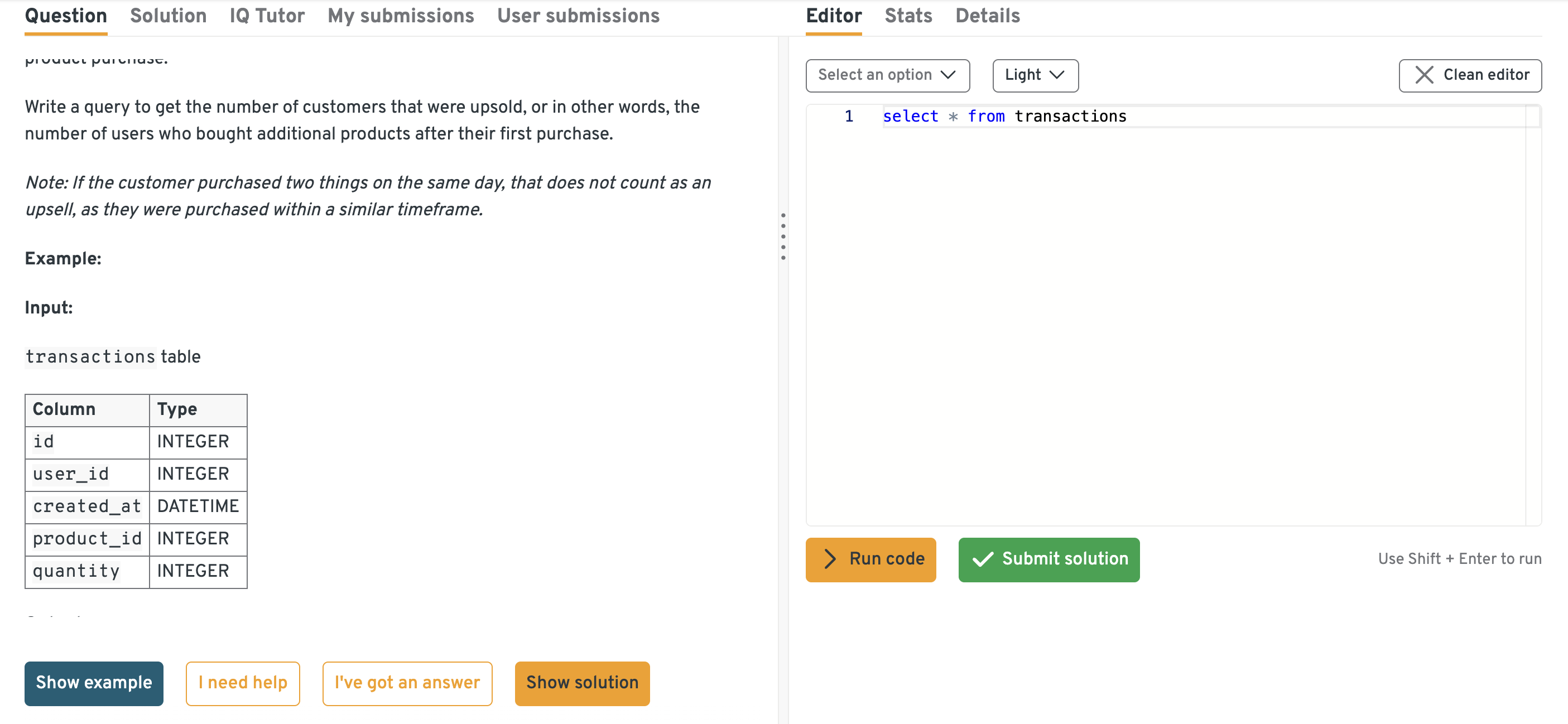
This not only helps you strengthen fundamentals but also exposes you to the type of real-world, large-scale problems Visa cares about.
Tip: Pay attention to edge cases where a subscription and another purchase happen on the same date.
Write a SQL query to calculate the average number of swipes per day per user
You’ll aggregate swipes per user per day, then average across users. Be precise with date formatting and distinct swipe logic. This is a solid test of multi-level aggregation. Visa processes millions of transaction “swipes,” so efficiency here reflects real-world scale.
Tip: Start with a per-user-per-day CTE to simplify logic before averaging. This prevents nested aggregation errors.
Group a list of sequential timestamps into weekly lists starting from the first timestamp
Approach this with date arithmetic and slicing in Python. You want to iterate through the list while maintaining buckets that restart every 7 days. Pay attention to edge cases like timezone-aware timestamps or gaps. This type of logic could power Visa’s weekly fraud monitoring tools.
Tip: Normalize all timestamps to UTC before grouping to avoid subtle errors from daylight savings or regional offsets.
Stem words in a sentence using the shortest root forms
Implement a prefix tree (Trie) to match words with roots. Iterate through each word and replace it with the shortest root available. This problem tests efficient text preprocessing in pipelines. It mirrors data normalization tasks for user-generated content at Visa.
Tip: Pre-sort your root words by length before building the trie. This ensures shorter roots always take priority during replacement.
System / Pipeline Design Questions
Design questions for a Visa Data Engineer interview often test your ability to architect scalable, fault-tolerant data pipelines. You’ll need to understand real-time streaming, ETL optimization, and recommendation or search systems. Many data engineer visa roles require deep fluency in balancing latency, cost, and complexity. These questions probe how you’d structure systems that support Visa’s global transaction infrastructure.
Describe the process of building a restaurant recommendation engine
Start by segmenting users by behavior and geographic preference. Use collaborative filtering or embedding models for similarity, then deploy a real-time API. Incorporate user feedback for ranking and model retraining. This question tests architecture and personalization, which are valuable skills in Visa’s merchant analytics.
You can practice similar system design interview questions on Interview Query. This can give you hands-on exposure to architectures Visa engineers actually build.
Tip: Always discuss how feedback loops keep recommendations fresh and relevant at scale.
Design a recommendation algorithm for Netflix’s type-ahead search
Emphasize autocomplete latency and scalable search indexing (e.g. trie, prefix trees). Support personalization with ranked query suggestions. Ensure failover and caching for high-throughput access. Visa relies on similar systems to improve UX for its card products and offers.
Tip: Stress the trade-off between query freshness and response time, since interviewers want to hear how you balance the two.
Design a podcast search engine with transcript-based indexing
Focus on NLP processing pipelines for transcription, followed by inverted index or vector embedding retrieval. Add filters by episode length, genre, and user profile. This models Visa’s document and support search systems.
Tip: Highlight how you’d manage storage and indexing costs when transcripts reach terabyte scale.
Scale a recommender system from thousands to millions of users
Cover online/offline hybrid architectures, horizontal sharding, and caching strategies. Stress test with simulated loads and failover mechanisms. Visa engineers often work on global-scale recommendation systems, e.g., merchant offers and fraud alerts.
Tip: Don’t just say “add more servers”. Talk about monitoring and load balancing to prove you understand real-world scaling.
Real-time fraud detection pipeline that flags suspicious transactions within milliseconds of a card swipe
Use a Kafka-based streaming pipeline with Flink or Spark Streaming for real-time scoring. Incorporate a feature store and model inference layer with low-latency caching. Add a manual override or alerting system. This is highly relevant to Visa’s core payments and fraud monitoring services.
Tip: Emphasize the importance of exactly-once processing guarantees, which is critical for payments.
How would you design a scalable ETL architecture that handles schema drift and late-arriving data?
Use schema registry tools like Apache Avro and partitioned storage in S3 or Delta Lake. Employ idempotent transformation stages and watermarking for latency guarantees. Schema drift is a daily concern in fintech ingestion pipelines like those at Visa.
Tip: Talk about how you’d document and communicate schema changes across teams, not just how you’d handle them technically.
Behavioral Questions
Behavioral rounds for the Visa data engineer role aim to assess how you collaborate, take ownership, and align with the company’s values of inclusion and innovation. The interview may include questions about navigating ambiguity, fixing data issues, and working cross-functionally. Prepare to reflect on situations that showcase your growth mindset and communication style.
Tell me about a time you collaborated with product or business stakeholders to deliver a data pipeline or dashboard
Describe how you balanced technical feasibility with business requirements. Highlight how you communicated tradeoffs and iterated on feedback. Show that you understand how data enables strategic decisions. This illustrates collaboration and alignment with Visa’s cross-functional product development.
Sample Answer: “On a past project, I worked with product managers to define metrics for a customer dashboard. I iterated quickly on feedback and explained trade-offs between real-time versus batch updates.”
Tip: Highlight how you translated technical details into business impact. Visa wants to see engineers who can bridge both worlds.
Describe a situation where you had to build a data solution without having clearly defined requirements
Talk about asking the right questions, creating prototypes, or documenting assumptions. Show how you made progress despite uncertainty. Include how you validated your approach later. Visa values initiative and structured thinking under ambiguity.
Sample Answer: “I created a prototype pipeline with clear documentation of assumptions, then validated it with stakeholders before scaling. This helped reduce rework later.”
Tip: Stress structured thinking under ambiguity; Visa values proactive clarification and risk mitigation.
Tell me about a time you discovered a data issue in production. How did you handle it?
Explain how you detected the issue, contained the damage, and communicated transparently. Describe what long-term fixes you put in place. Make it clear that you value data integrity and accountability. Visa expects engineers to protect mission-critical systems.
Sample Answer: “When I spotted a duplicate ingestion bug, I quickly rolled back, notified stakeholders, and built validation checks to prevent recurrence.”
Tip: Show accountability and long-term prevention. Visa cares deeply about protecting mission-critical systems.
Share an example of how you took ownership of a project and ensured cross-functional inclusion
Describe how you drove execution while keeping stakeholders aligned. Highlight communication, documentation, and loop-closing behavior. Inclusion can also mean mentoring or enabling others to contribute. This connects to Visa’s leadership principles around ownership and collaboration.
Sample Answer: “I led a migration project, kept stakeholders updated with weekly check-ins, and paired with a junior teammate to ensure they felt included.”
Tip: Demonstrate ownership with inclusive practices. Visa’s culture rewards leaders who raise others up.
Tell me about a time you mentored a junior engineer or helped someone grow technically
Explain what you taught, how you adjusted your guidance, and what impact it had. Emphasize empathy and long-term thinking. If you helped formalize documentation or onboarding, even better. Senior Visa Data Engineers are expected to level up their peers.
Sample Answer: “I helped a new hire debug their first ETL pipeline and wrote a quick-start guide to shorten onboarding for future teammates.”
Tip: Frame mentorship as scaling knowledge across teams. Senior Visa engineers are expected to multiply impact.
Describe a time when you had to deliver a data project on a tight timeline. What did you prioritize?
Talk about scoping the MVP, managing expectations, and ensuring data accuracy. Explain what you left out and why. Fast execution under pressure is crucial in real-time data environments like Visa’s.
Sample Answer: “Faced with a two-week deadline, I focused on building an MVP pipeline with accurate core metrics while postponing secondary features.”
Tip: Show how you balance speed with accuracy. Visa looks for engineers who can execute fast without compromising data quality.
How to Prepare for a Visa Data Engineer Role
To stand out in a Visa Data Engineer interview, you’ll need to go beyond solving SQL queries or writing clean PySpark scripts. Success comes from understanding Visa’s scale, system complexity, and commitment to secure, real-time data processing. Since the Visa Data Engineer interview process tests both breadth and depth—technical execution and architectural thinking—your prep should mirror that rigor.
Study Visa’s Payments Data Architecture
Understand how Visa processes 65K+ transactions per second. Read up on real-time payment pipelines, PCI compliance, and how data flows through systems like Flink and Kafka. You’ll need this knowledge for system design rounds.
Drill Leetcode-Style SQL & Spark Problems
Focus on problems involving window functions, joins, and aggregations in SQL. For Spark, be ready to switch between RDDs and DataFrames and handle distributed transformations. Practice in notebooks or plain editors as no auto-complete allowed during interviews.
Practice STAR Stories for “Failures”
Behavioral interviews at Visa often dig into how you handle setbacks, like failed ETL jobs, missed deadlines, or poor data quality. Use the STAR method to structure your answers: Situation, Task, Action, Result.
Mock Design: 1 B TPS Pipeline
Simulate designing a system that could handle Visa-level data throughput. Practice tradeoff questions (batch vs. stream, S3 vs. Snowflake, fault tolerance vs. speed) and diagram your solution on whiteboards or Miro.
Request Feedback After Each Mock
Whether with peers or mentors, get clear, critical feedback. Focus especially on communication, assumption validation, and clarity under pressure. These soft skills are just as critical as code quality.
For cross-preparation, explore our Visa Data Scientist and Visa Software Engineer guides. You will find them useful if you want to strengthen advanced analytics skills, coding patterns, or system design.
FAQs
What is the Average Salary for a Visa Data Engineer?
Average Base Salary
Average Total Compensation
The Visa data engineer salary in the U.S. spans a broad range depending on level and location.
- Compensation range across all levels: $125K-$175K per year
- Entry-level (L3): Total compensation $90K-$130K per year.
- Staff Data Engineer: Total compensation $179K-$238K per year
- San Francisco Bay Area: Salaries range from $143K to $200K per year
- Austin Texas: Salaries range from $130K - $181K per year
How many rounds are there for the Visa data engineer interview process?
You can expect 5 to 6 rounds in total:
- Recruiter Screen: Resume, project fit, role overview
- Online Assessment (CodeSignal): SQL + PySpark
- Technical Interview 1: SQL + data transformation
- Technical Interview 2: Data modeling + architecture
- Onsite Loop: 3 to 5 rounds (system design, coding, behavioral)
- Hiring Committee Review: Final decision and offer
What coding concepts are important for Data Engineering interviews at FAANG+ companies?
In FAANG+ interviews, data engineers are expected to demonstrate strong coding fundamentals. This means mastering SQL for complex joins, aggregations, and window functions, as well as proficiency in Python, Java, or Scala for data transformation.
Candidates are also tested on data structures and algorithms, such as arrays, hash maps, trees, and graph problems often appear in coding rounds. Beyond that, system design concepts like partitioning, distributed processing, and pipeline optimization are essential, since interviews often simulate real-world big data challenges.
Is it hard to become a data engineer?
Becoming a data engineer can feel challenging because the role sits at the intersection of software engineering, databases, and business data needs. You’re expected to know not just how to write queries, but how to design pipelines that scale across millions of records without breaking.
The difficulty lies in the breadth of knowledge required, from SQL and coding to big data tools and cloud platforms. However, it’s achievable with steady practice, strong projects, and a focus on the fundamentals that most companies test.
What data engineering skills are required to crack a Visa interview?
Visa’s interview process emphasizes both technical depth and practical application at scale. Candidates should be confident with SQL and PySpark for data wrangling, transformations, and performance tuning.
They’re also tested on ETL pipeline design, schema evolution, and data quality checks, as well as tools like Snowflake, Kafka, or Flink that power Visa’s real-time transaction infrastructure. Just as important are communication and collaboration skills, since Visa values cross-functional teamwork under its “One Visa, One Data” philosophy.
How long does it take to become a data engineer?
The timeline depends on your starting point. If you’re already working in analytics or BI, six to twelve months of focused learning in Python, SQL, and Spark may be enough to transition into data engineering. For those starting with little technical background, it can take one and a half to two years to build coding skills, understand distributed systems, and get interview-ready for large companies. Hands-on projects, like building a streaming pipeline or data warehouse, are the fastest way to prove readiness and shorten that timeline.
How can I access Interview Guides, and what are they about?
Interview guides are detailed prep resources that walk you through the interview process, common questions, and strategies for specific roles and companies. They cover everything from SQL challenges and system design exercises to behavioral questions, with context on what interviewers are really testing.
To access them, simply visit the Interview Query interview guides hub, where you’ll find step-by-step guides for roles at Visa as well as top FAANG companies like Google, Meta, and Amazon. These guides are designed to save you time by consolidating key information and providing realistic practice problems, so you know what to expect and how to prepare effectively.
Conclusion
The Visa Data Engineer interview process is thorough, but with the right preparation, it’s entirely conquerable. From mastering SQL and PySpark to articulating scalable data architectures, each round is a chance to showcase your technical clarity and systems thinking. The more you rehearse these skills, the more confident you’ll feel in every round.
Bookmark this guide as your prep companion, and don’t underestimate the value of mock interviews. Practicing with experienced data professionals will sharpen your technical communication and reveal blind spots before the real interview.
To get a complete picture of what to expect, check out the Visa Interview Questions & Process. With structured practice and the right resources, you’ll be ready to stand out and take the next step in your data engineering career.
Visa Interview Questions
| Question | Topic | Difficulty | ||||||||||||||
|---|---|---|---|---|---|---|---|---|---|---|---|---|---|---|---|---|
SQL | Hard | |||||||||||||||
We’re given a table of bank transactions with three columns, Write a query to get the total three-day rolling average for deposits by day. Note: Please use the format Example: Input:
Output:
| ||||||||||||||||
SQL | Medium | |||||||||||||||
SQL | Medium | |||||||||||||||
SQL | Easy | |
Machine Learning | Medium | |
Statistics | Medium | |
SQL | Hard | |
Machine Learning | Medium | |
Python | Easy | |
Deep Learning | Hard | |
SQL | Medium | |
Statistics | Easy | |
Machine Learning | Hard |
Discussion & Interview Experiences