
Visa Interview Questions & Process (2025) – Codesignal, Behavioral, and Case Prep


Introduction
Visa is one of the world’s leading digital payments companies, processing over 260 billion transactions annually across more than 200 countries. Its massive global reach, strong brand, and commitment to innovation make it a top destination for candidates in product, data, and engineering roles. That’s why so many job seekers search for Visa interview questions and insights into the Visa interview process—preparing for a company that expects analytical precision, product intuition, and cross-functional collaboration.
In this guide, we’ll walk you through Visa’s interview structure step by step, from recruiter screen to final offer. Whether you’re targeting a role in product, analytics, or engineering, you’ll find tips tailored to your path—with links to role-specific guides so you can prep with confidence.
Why Work at Visa?
Here are a few reasons why we believe you should consider a role at Visa:
Mission-Driven Payments Platform
Why do you want to work for Visa Inc is a question many applicants face—and the answer often lies in Visa’s mission. As a global payments platform, Visa empowers financial inclusion and drives commerce for billions. Working here means helping shape a more connected, secure, and accessible economic future.
Innovation at Visa Technology & Operations LLC
Visa Technology and Operations LLC is the innovation engine behind Visa’s global infrastructure. This R&D arm drives breakthroughs in payments, AI, and cybersecurity—making it a launchpad for engineers, analysts, and technologists who want to build at scale and accelerate their technical careers in a high-impact environment.
Growth Paths for Business & Technical Leaders
Preparing for Visa business leader interview questions or Visa director interview questions? You’ll find clear, structured career ladders at Visa. From analyst to VP, employees are supported with mentorship, mobility programs, and leadership training to grow into senior roles across product, strategy, and operations.
High-Impact Consulting & Analytics Teams
Acing the Visa Consulting and Analytics interview opens the door to one of Visa’s most influential teams. This unit partners with global clients and internal stakeholders to shape product launches, market entry strategies, and customer segmentation, making it a core driver of business and product innovation.
Challenge
Check your skills...
How prepared are you for working at Visa?
What’s Visa’s Interview Process Like?
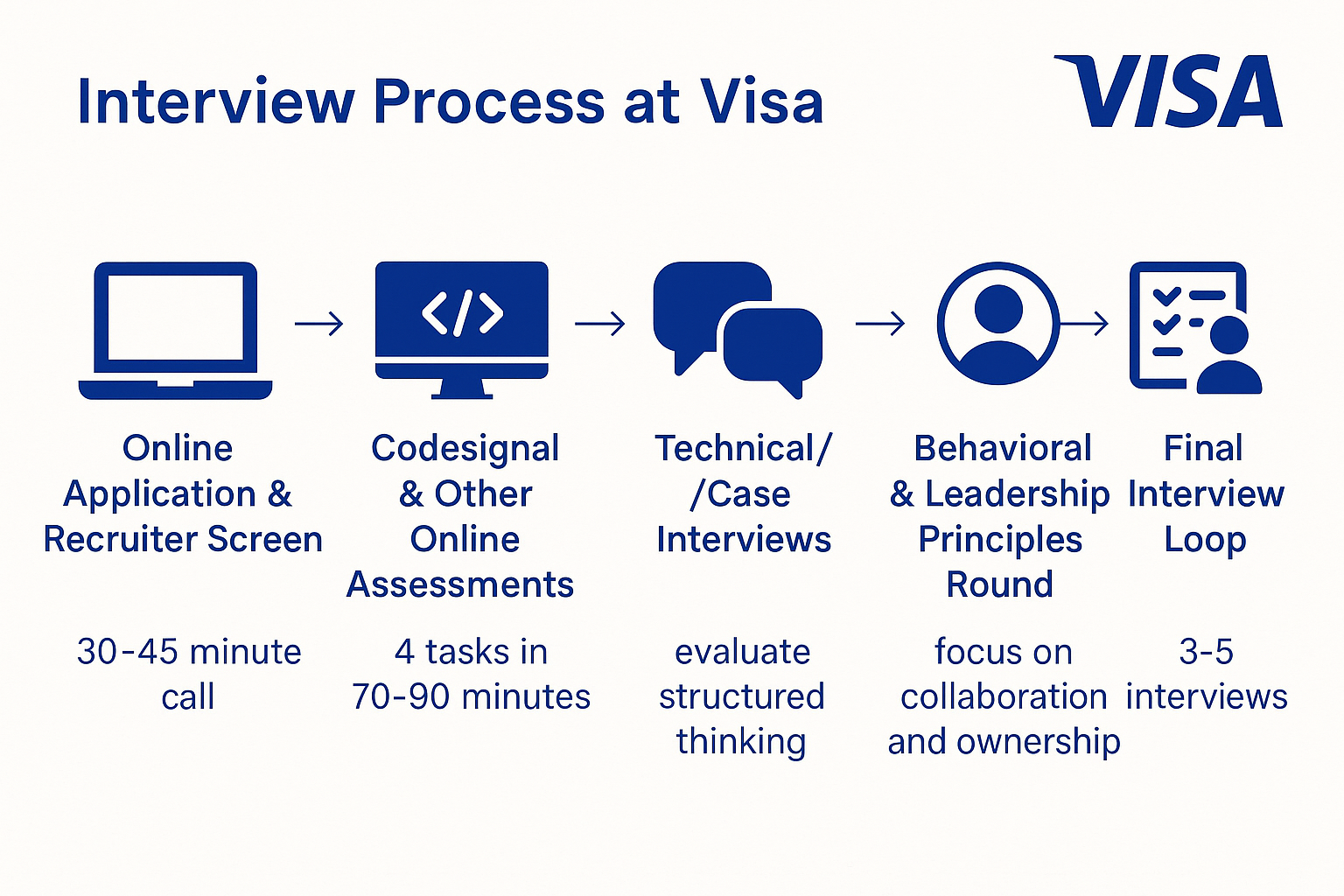
Visa’s interview process is structured, fast-paced, and tailored to evaluate both technical depth and leadership potential. Most roles follow a consistent path—from online assessments to final panel interviews—though timelines and content can vary slightly by role and level. Here’s what to expect across each stage:
- Application
- Codesignal OA
- Technical / Case
- Behavioral & Leadership
- Final Loop
Online Application & Recruiter Screen
Once you submit your application, expect a response within 1–2 weeks if your profile aligns. The recruiter screen is a 30–45 minute call focused on your resume, timeline availability, and role interest. It’s also your chance to ask about team structure, tech stack, and what to expect in the upcoming stages.
Codesignal & Other Online Assessments
Visa Codesignal questions and Visa Codesignal assessment questions are a common filter for technical roles, especially for early-career candidates. These timed assessments evaluate your coding ability, problem-solving speed, and grasp of algorithms under pressure. Expect 4 tasks in 70–90 minutes, often within a few days of the recruiter call.
For a full walkthrough, check out our Visa Software Engineer Interview Guide.
Technical / Case Interviews
The Visa case study interview is used across product, data, and engineering roles to evaluate structured thinking and practical judgment. Depending on the role, you may be asked to build data pipelines, design payment systems, or analyze product metrics. Expect at least one system design or case-driven round focused on logic, clarity, and stakeholder communication.
For prep, see our Visa Data Engineer and Visa Product Analyst guides.
Behavioral & Leadership Principles Round
This round will include both Visa behavioral interview questions and Visa leadership principles interview questions, with a strong focus on collaboration, ownership, and results. You’ll be evaluated on how you align with Visa’s core values—using structured STAR (Situation, Task, Action, Result) responses to show how you’ve influenced decisions, resolved conflict, or driven outcomes in past roles.
Final Interview Loop & Hiring Committee
The final loop includes 3–5 interviews with product managers, engineers, analysts, or senior leaders—testing both functional expertise and cross-functional influence. For senior roles like Staff Engineer or Director, you may face extra rounds on strategy, org design, or executive communication.
Most Common Visa Interview Questions
This guide covers the most frequently asked questions in Visa interviews and explains how to approach them with practical frameworks and examples. If you are preparing for a specific role at Visa, follow these interview guides offering tailored insights, tips, and question breakdowns to help you succeed.
Role-Specific Interview Guides
- Data Engineer → Visa Data Engineer Interview Guide
- Data Scientist → Visa Data Scientist Interview Guide
- Machine Learning Engineer → Visa Machine Learning Engineer Interview Guide
- Software Engineer → Visa Software Engineer Interview Guide
- Product Manager → Visa Product Manager Interview Guide
- Data Analyst → Visa Data Analyst Interview Guide
- Business Analyst → Visa Business Analyst Interview Guide
- Product Analyst → Visa Product Analyst Interview Guide
Behavioral & Leadership Principle Questions
Visa places a strong emphasis on cultural fit and leadership values, so these behavioral questions help assess how well your experiences align with their core principles.
1. Why do you want to work for Visa Inc?
Ground your answer in Visa’s mission to connect the world through secure, fast digital payments. Mention specific initiatives like Visa Direct or their sustainability goals. Show how your background supports these goals. This is one of the most common Visa product analyst interview questions testing cultural fit.
2. Describe a time you led a project across functions without formal authority.
Use the STAR format to detail how you influenced stakeholders, aligned incentives, and drove delivery. Emphasize communication and cross-team buy-in. Demonstrate outcome with metrics or success signals. This maps closely to Visa’s emphasis on leadership through collaboration.
3. What Visa leadership principle resonates most with you, and why?
Choose a principle like “inclusive collaboration” or “customer-first design.” Illustrate with a personal story or career moment. Relate it back to Visa’s culture and the analyst role. Visa interviewers look for alignment with core values here.
4. Tell me about a time you faced resistance when driving a new idea.
Set up the situation clearly and focus on how you addressed concerns. Show empathy, persistence, and adaptability. Close with what you learned and how the outcome changed. This tests leadership under friction—important in large matrixed orgs like Visa.
5. How have you balanced short-term execution with long-term strategy?
Highlight prioritization, roadmap thinking, and stakeholder alignment. Tie in frameworks like OKRs or strategic themes. Give an example where you adjusted course. Visa seeks analysts who can zoom in and out effectively.
6. Describe a failure you learned from.
Keep it focused on learning, iteration, and resilience. Use data or outcomes to show growth post-failure. Show how that experience shaped your future decisions. Visa values humility and continuous learning.
7. How do you stay inclusive when working with global or remote teams?
Discuss timezone empathy, async processes, or translation efforts. Share tools and rituals that help. Give a moment where inclusiveness led to better results. Visa is a global company, so inclusion is a leadership priority.
8. How do you ensure your decisions are data-driven but still human-centric?
Mention triangulating quant data with qualitative research or user interviews. Talk about when data conflicted with user sentiment and how you resolved it. Show thoughtfulness and curiosity. Visa values analysts who blend numbers with empathy.
Codesignal & OA Questions
These are common coding and online assessment questions that test your problem-solving, SQL fluency, and data structuring skills, often used in Visa’s technical screening process.
9. Group a list of sequential timestamps into weekly lists starting from the first timestamp
Approach this with date arithmetic and slicing in Python. Iterate through the sequence and reset the bucket every 7 days using the initial timestamp as an anchor. Consider edge cases like missing dates or daylight saving time. This question mirrors the temporal grouping challenges common in Visa Codesignal assessments.
10. Count the number of liker’s likers from a table
Use a self-join in SQL to model the second-degree connections between users. Think of it as building a graph of likes and finding the two-hop neighbors. Be sure to eliminate duplicates and filter edge conditions. This question reflects the kind of relationship logic used in Visa’s fraud detection pipelines.
11. Parse a list of poem sentences to return a dictionary of word frequency
Tokenize sentences into words, strip punctuation, and normalize case. Use a dictionary or collections.Counter to tally frequencies. This is a classic NLP preprocessing task. It aligns well with Visa’s data enrichment and keyword tagging processes.
12. Create a function to generate a histogram dictionary from a list of integers
Traverse the input list and increment counts using a dictionary or Counter. Consider memory usage and avoid unnecessary computation. Add optional binning logic for grouped histograms. Histogramming is a frequent requirement in Visa’s metric dashboards and fraud profiling.
13. Calculate how many users logged in the same number of times across a week
First group by user to count their weekly login frequency, then group by that count. Use subqueries or CTEs in SQL to structure this. Make sure to handle users with zero logins if applicable. This mirrors workload normalization problems found in Visa’s login and session analysis.
14. Write a SQL query to find users who have sent messages every day in a given time period
Generate a date range and cross it with users, then find which users have full coverage. Use COUNT(DISTINCT date) compared to the number of days. It’s a classic completeness check. Visa tests this to gauge your ability to detect engagement gaps.
15. Check if a string has all unique characters
This is an algorithmic question often tested in Codesignal. Use a set or boolean array for efficient checks. Discuss time and space complexity. Visa wants to see fluency in basic string logic under pressure.
16. Find the second largest value in a binary search tree
Traverse the tree with in-order or reverse in-order logic. Carefully handle edge cases with only one child. Use recursion or iterative traversal. This problem reflects tree traversal fluency tested in Visa coding rounds.
Strategy & Case-Study Questions
Visa frequently includes strategy and case questions to evaluate your analytical thinking and business acumen, especially for roles focused on data-driven decision-making.
17. Calculate the average lifetime value for a SaaS product
Define retention rate and average revenue per user, then apply the LTV formula. Consider segmentation for more accuracy and model uncertainty with sensitivity analysis. Frame it in business terms like CAC and ROI. This is a foundational case for Visa’s financial modeling.
18. Evaluate the effectiveness of a 50% rider discount campaign
Define your control and treatment groups. Track changes in ride volume and revenue, and estimate incrementality. Include cannibalization and user churn considerations. Visa would expect this type of analysis for partnership incentives.
19. Determine the mouse’s location in a 4x4 grid using directional movements
Convert the movement instructions into coordinate shifts. Simulate or trace the position updates while avoiding out-of-bound errors. Discuss how you would validate input. This exercise tests your ability to implement rule-based logic for structured simulations, similar to Visa operations planning.
20. Determine the percentage of fake news on Facebook given user reports
Define priors and apply conditional probability. Propose a validation set or feedback loop to refine accuracy. Consider biases in user flagging behavior. Visa values this reasoning in trust, fraud, and signal classification scenarios.
21. Calculate ride profitability given discounting and fixed driver costs
Set up a unit economics model with inputs for fare, discount, driver cost, and variable cost. Create breakeven scenarios. Recommend pricing or threshold strategies. These financial trade-off cases are typical in Visa’s strategic product planning.
22. Forecast TV ad ROI for a streaming service
Model customer acquisition using uplift from ad spend and match it to churn-adjusted revenue. Normalize for ad viewership and targeting segments. Show how to iterate the model with real-world data. Visa case interviews may include paid media measurement frameworks.
23. Estimate the cost-benefit of launching a referral program
Define key levers like referral rate, referral value, and virality coefficient. Model customer LTV and compute program ROI. Consider fraud mitigation mechanisms. Visa uses such models in go-to-market launch assessments.
24. Evaluate if users who receive location-based alerts engage more with the app
Use a matched cohort analysis or regression framework. Track engagement before and after enabling the feature. Control for time-based and behavioral confounders. This reflects Visa’s data science interview style when evaluating new feature rollouts.
Tips When Preparing for a Visa Interview
Preparing for a Visa interview requires resilience and proficiency in both technical and behavioral aspects of the interview. Here is how you may approach the preparation:
Rehearse Codesignal-Style Assessmemts
Search for Visa Codesignal assessment LeetCode to practice problems that mirror Visa’s OA. Focus on time-efficient solutions to graph, array, and string problems. Build fluency with 70–90 minute sets under pressure, and review edge cases to avoid common pitfalls.
Master STAR for Behavioral Questions
Be ready to tackle Visa behavioral interview questions by structuring your answers using the STAR method. Prioritize examples where you influenced cross-functional teams, navigated ambiguity, or delivered results despite setbacks. Clear, outcome-driven stories resonate best.
Study Visa’s Leadership Principles
Prepare for questions about Visa’s values by reviewing their leadership principles—like collaboration, integrity, and customer focus. Interviewers often probe how your actions align with these principles, especially in high-pressure or team-driven scenarios.
Prepare Data-Driven Case Studies
For Consulting and Analytics roles, interviewers expect structured thinking, metric design, and stakeholder insights. Build a few concise case studies (e.g., payment conversion, fraud analysis, product launch impact) to showcase both data fluency and business intuition.
Align Answers to Visa’s Mission
When asked why do you want to work for Visa Inc, speak to the company’s role in advancing global financial inclusion. Tie your interests—whether in product, tech, or strategy—back to Visa’s mission of connecting the world through secure, innovative payments.
Salaries at Visa
Average Base Salary
Average Total Compensation
Conclusion
Visa’s interview process is structured, fast-moving, and designed to assess both your technical skills and alignment with the company’s mission. Whether you’re preparing for a Codesignal assessment, a case study interview, or a behavioral round, focused preparation makes all the difference.
Bookmark this page as your go-to resource, and don’t forget to explore the role-specific guides linked above for deeper, tailored insights.
Text
Why do you want to work for Visa Inc?
Visa’s mission to enable global financial inclusion through secure, innovative payments deeply resonates with me. I’m excited by Visa’s scale, but even more by its culture of experimentation and its investment in technology to drive meaningful, real-world impact.
What is the Visa Codesignal assessment like?
The Visa Codesignal assessment is a timed online test (typically 70–90 minutes) with four coding problems of increasing difficulty, similar to LeetCode Easy to Hard. It assesses algorithmic thinking, edge-case handling, and speed. Competitive candidates need to achieve a passing score to move to the next round.
Which leadership principles does Visa test in interviews?
Lead courageously, Obsess about customers, Collaborate as one Visa, Execute with excellence.
How is the Consulting & Analytics interview different?
The Visa Consulting and Analytics interview places extra emphasis on structured case studies. You’ll be asked to analyze client data, generate business insights, and communicate recommendations clearly—often with a slide or whiteboard component.
Does Visa Technology & Operations LLC have a separate process?
While part of Visa’s R&D arm, Visa Technology & Operations LLC generally follows the same interview framework. The difference lies in deeper technical rounds—expect more emphasis on system design, infrastructure, or platform-scale problem-solving.
Discussion & Interview Experiences