

Scale AI Interview Questions (2025): Process, Common Questions & Prep Tips


Introduction
Preparing for Scale AI interview questions means understanding how the company sits at the center of today’s rapid shift toward data-centric artificial intelligence. Scale AI builds the infrastructure that powers modern model development, from high-quality annotation pipelines to multimodal evaluation systems used by leading enterprises and government organizations.
Candidates search for Scale AI interview guidance because the hiring process is intentional and selective. Each stage assesses how you handle ambiguity, communicate structured reasoning, and think about data quality, which remains one of the company’s core differentiators.
Whether you are applying for software engineering, data science, operations, or AI evaluator roles, interviewers consistently look for clarity, ownership, and a strong understanding of how reliable data shapes model performance.
Why Work at Scale AI?
Working at Scale AI gives you the chance to contribute directly to the infrastructure that powers enterprise artificial intelligence. The company partners with Fortune 500 organizations, government programs, and leading research labs to deliver the data, evaluations, and safety testing that shape how foundation models perform in the real world. This level of impact attracts people who want their work to influence high-stakes systems used across healthcare, finance, logistics, and national security.
Teams at Scale AI grow quickly because the environment emphasizes ownership, speed, and problem solving in ambiguous settings. Employees describe the culture as a high-stakes, high-reward environment where autonomy is the norm and meaningful contributions are highly visible. Whether you join engineering, data science, operations, or AI evaluation, you gain hands-on experience with rapidly evolving model architectures, multimodal evaluation pipelines, and data-quality challenges that define the emerging AI industry.
Compensation at Scale includes competitive salaries and meaningful equity tied to the company’s growth in the broader AI ecosystem. If you’re exploring technical or operations roles, you can learn more in our Scale AI data scientist interview guide or Scale AI software engineer interview guide, both of which outline the skills each team prioritizes.
Challenge
Check your skills...
How prepared are you for working at Scale?
What’s Scale AI’s interview process like?
The Scale AI interview process is structured around several core stages that test both technical depth and how you work under pressure. Across roles, candidates typically move from a recruiter screen into one or more technical evaluations, then a case or work sample, and finally a multi round onsite loop. Glassdoor experiences describe the process as fast moving for some candidates and quite lengthy for others, especially in more senior or research focused tracks. While the structure is consistent, the difficulty level and content vary by role, especially between software engineering, machine learning, AI evaluators, and operations.
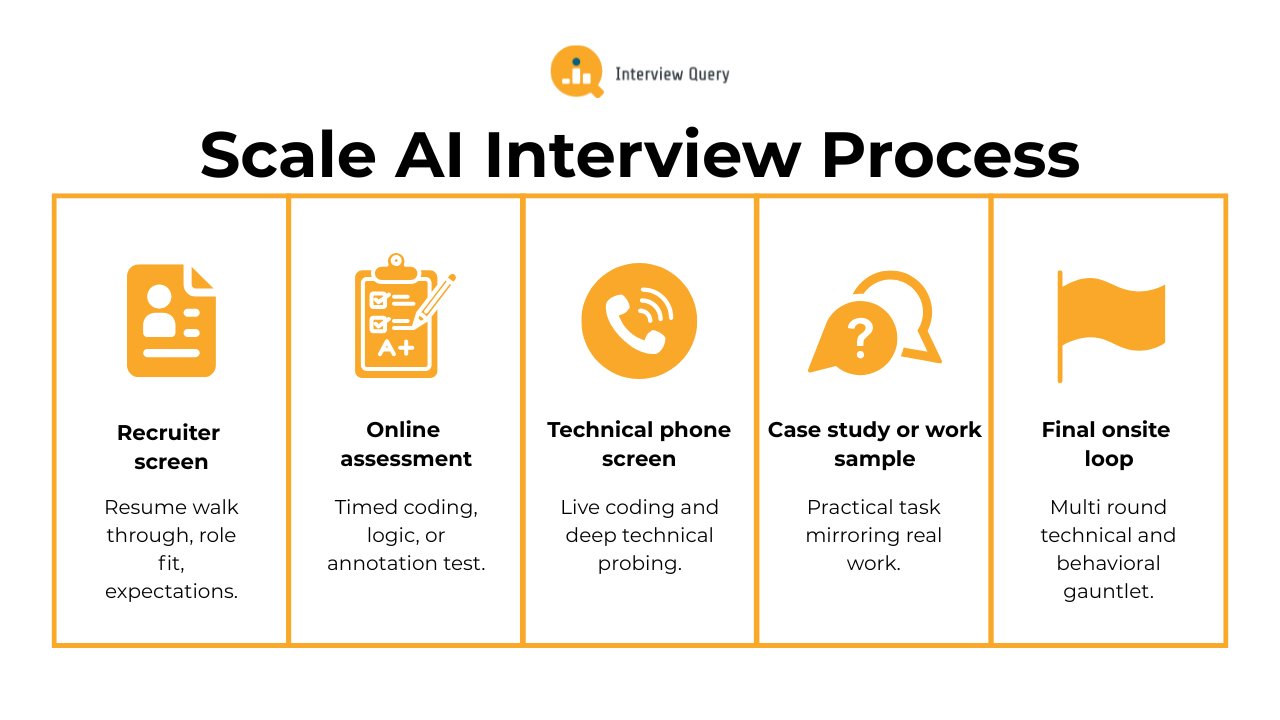
Most candidates report some combination of the following stages:
- Recruiter screen
- Online assessment (role dependent: coding, logic, annotation evaluation)
- Technical or functional phone screen
- Case study or practical task
- Final onsite loop (technical, behavioral, cross functional)
Below is how each stage usually works and what you can expect before you start studying specific Scale AI interview questions.
Recruiter screen
The process almost always starts with a short conversation with a recruiter. For many candidates this is a 20 to 30 minute call focused on your background, why you are interested in Scale AI, and how your experience maps to the specific role. Glassdoor reviews describe these calls as straightforward and often non technical, especially for early stages in software engineer and operations roles. You can expect to walk through your resume, clarify your level, locations, and compensation expectations, and get an overview of the next stages and timelines. For some candidates, there is also a quick prep call before the first technical round, where the recruiter sets expectations about style and difficulty.
Online assessment
After the recruiter screen, many roles include an online assessment. For software engineers, candidates report Hackerrank style questions or custom card game problems that emphasize implementation speed, handling many edge cases, and clean code under time pressure. Some describe these as not classic LeetCode questions but still detailed and easy to get lost in if you do not manage time well. For machine learning roles, there may be a take home exam in computer vision or natural language processing that focuses on working with raw data, building simple pipelines, and evaluating model behavior. AI evaluator or operations roles may see logic, annotation, or scenario based tests aligned with evaluation work.
Technical or functional phone screen
If you pass the assessment, the next step is usually a technical or functional phone interview. For software engineers, candidates describe practical algorithm questions, object oriented design exercises, and coding tasks in a shared environment that require both correctness and speed. Some Glassdoor reviews mention questions involving intervals, JSON processing, or card game style logic, as well as discussions about balancing scale and maintainability. Research and machine learning candidates report deeper sessions on topics like sampling methods, attention mechanisms, and model fundamentals, often alongside a live coding segment that manipulates data for a vision or language task. Across roles, communication and clear reasoning are scored as heavily as final answers.
Case study or work sample
Many technical and machine learning roles include a case study or work sample that mirrors day to day work. For machine learning engineers, this can look like a notebook based task where you read data, build simple utilities, and compare provided models using appropriate metrics. Research oriented roles may dig into how you would approach a lightly specified project or ask you to explain complex concepts such as model architectures or evaluation strategies. The goal here is to see how you structure problems, make trade offs, and reason about data quality rather than only solving abstract puzzles. This stage often determines whether you advance to the full onsite loop.
Final onsite loop
The final stage is usually a multi round onsite or virtual loop. Glassdoor experiences mention four to five interviews in a single day for software engineers, spanning hard algorithm questions, system design, and behavioral conversations that sometimes shift into design discussions. Machine learning candidates report a mix of coding on realistic data tasks, model fundamentals, and behavioral interviews that probe how you handle disagreement, low direction, or motivation over long projects. Some candidates find the loop quite difficult and intensive, while others note that expectations are clear and interviewers are sharp but collaborative. Performance here ultimately drives hiring decisions.
Most common Scale AI interview questions
Preparing for Scale AI interview questions means understanding how the company evaluates judgment, clarity of thought, and technical fundamentals across teams. Whether you are interviewing for engineering, data science, AI evaluation, product, or operations, you can expect questions that probe how you approach ambiguous problems, how you reason about data quality, and how you communicate tradeoffs in fast-moving environments. Technical interviews often emphasize practical coding or model evaluation skills, while behavioral rounds focus heavily on ownership, collaboration, and how you navigate complex or loosely scoped scenarios. Studying the themes below will help you prepare for the structure and difficulty of Scale’s interview process before diving into role-specific guides.
Role-specific interview guides
- Scale Software Engineer Interview Questions
- Scale Research Scientist Interview Questions
- Scale Machine Learning Engineer Interview Questions
- Scale Product Manager Interview Questions
- Scale Data Engineer Interview Questions
- Scale Data Scientist Interview Questions
- Scale Product Analyst Interview Questions
- Scale Business Analyst Interview Questions
Behavioral and values questions
Scale AI relies heavily on behavioral interviews to understand how candidates operate in ambiguous, fast-moving environments. Interviewers look for ownership, structured thinking, and the ability to balance speed with precision. These questions often probe collaboration, conflict resolution, and decision-making under real production pressure.
Tell me about a time you had to make progress with very little direction.
Interviewers use this to assess how you handle ambiguity and whether you can create structure without detailed guidance. This reflects daily work at Scale AI, where problem definitions often evolve alongside rapidly changing models and client needs.
Describe a disagreement you had with a teammate and how you resolved it.
This explores communication style and collaboration under tension. At Scale AI, cross-functional disagreements between engineers, researchers, and operators are common, and the goal is to resolve them without slowing critical data or model workflows.
How do you balance speed and accuracy when delivering work?
This tests how you manage execution tradeoffs in environments where fast iteration is essential but data quality cannot slip. Your answer signals how you protect downstream ML performance while still moving quickly.
What motivates you during long or complex projects?
Interviewers want to understand your resilience and long-term execution habits, especially for extended model training cycles, large annotation efforts, and multi-phase system builds.
Describe a situation where you identified an issue others missed.
This gauges your ability to spot subtle risks early. At Scale AI, small labeling errors, edge cases, or silent pipeline failures can quietly propagate into large production systems.
How do you decide when to escalate a concern?
This evaluates judgment and ownership under uncertainty. Interviewers look for candidates who can balance autonomy with responsibility in production ML systems where delayed escalation can lead to costly failures.
Technical depth questions
Technical interviews at Scale AI focus on applied problem solving, system reasoning, and writing maintainable code. Rather than abstract puzzles, many questions mirror real production workflows such as data transformations, pipeline reliability, and API design. SQL, modeling tradeoffs, and debugging scenarios are also common depending on the role.
Representative questions include:
Simulate normal samples to estimate the expected gap between the 5th and 6th smallest values.
This tests your ability to translate a probabilistic idea into correct and efficient simulation code using Python. It mirrors how engineers and data scientists evaluate uncertainty, model behavior, and variability in real ML workflows.
Define the functional and non-functional requirements for a large-scale API-driven data system.
Here, interviewers evaluate how well you distinguish between what a system must do and how it must behave under load, reliability, security, and compliance constraints. This is critical for annotation and data platforms that operate at enterprise scale.
How would you clean, join, and analyze multiple data sources to improve system performance?
This assesses your ability to integrate fragmented datasets, resolve inconsistencies, and surface actionable insights across complex pipelines involving labeling, user behavior, and quality signals.
How would you choose between two models with 85 percent vs 82 percent accuracy?
This evaluates whether you look beyond headline metrics to factors like class imbalance, business impact, false positive costs, and generalization when selecting models for production use.
-
This probes your debugging approach across logs, schemas, and upstream data sources, as well as your ability to stabilize pipelines that feed large annotation and training workflows under strict SLAs.
AI evaluation and data quality questions
Scale AI places heavy emphasis on model evaluation and annotation quality. These questions test how you reason about correctness, uncertainty, bias, and safety across large-scale human and automated evaluation systems. Many scenarios focus on subtle errors that only appear under production workloads.
Examples include:
-
Interviewers assess your ability to communicate model reliability using prediction intervals, confidence bounds, and historical error behavior to guide human-in-the-loop thresholds and automation decisions.
How would you modify an inference pipeline to reduce toxic outputs from a text-to-image model?
This evaluates your understanding of production safety controls such as filtering, safety classifiers, prompt conditioning, and rejection strategies to balance usability with responsible AI constraints.
How would you design an algorithm to score the reading difficulty of text for non-native speakers?
This question tests your ability to combine linguistic features and model-based representations into scalable scoring systems used for data labeling, ranking, and evaluation workflows.
How would you detect and evaluate bias in AI-generated feedback summaries?
Interviewers look for structured evaluation frameworks that combine controlled test sets, stratified analysis, and human review to surface demographic and outcome-based bias.
What steps would you take to ensure annotation consistency across reviewers?
This focuses on process design using clear guidelines, calibration rounds, inter-annotator agreement metrics, and continuous audits to keep large distributed labeling teams aligned and training data reliable.
Tips when preparing for a Scale AI interview
Effective Scale AI interview prep starts with understanding how the company evaluates clarity of thinking, data quality awareness, and the ability to operate in fast-moving environments. Preparation should balance technical practice, communication strategy, and familiarity with Scale’s mission. The goal is to show that you can reason through ambiguous problems, explain your decisions clearly, and maintain high standards of accuracy even when working quickly. The tips below apply across engineering, data, operations, and evaluation roles, giving you a foundation before diving into specific practice for your target position.
- Study Scale AI’s products and mission. Understand how the company supports model development, evaluation, and safety so you can anchor your examples in relevant themes.
- Clarify the role and expectations early. Use the recruiter conversation to confirm scope, required skills, and interview structure so you prepare with intent.
- Practice explaining your reasoning out loud. Scale values clear logic and communication as much as correct answers, especially in ambiguous scenarios.
- Refresh fundamentals. Review core concepts such as problem decomposition, data validation strategies, and structured troubleshooting.
- Expect speed and precision. Many candidates describe time-boxed tasks, so practice writing clean solutions under realistic constraints.
- Be ready to highlight ownership. Prepare examples showing how you solved problems without direction and maintained quality under pressure.
- Review how you handle tradeoffs. Interviewers routinely probe how you balance accuracy, clarity, and efficiency in fast-paced environments.
- Prepare thoughtful questions. Strong questions demonstrate that you understand Scale’s challenges and want to contribute meaningfully.
Salaries at Scale AI
Most data science positions fall under different position titles depending on the actual role.
From the graph we can see that on average the Data Scientist role pays the most with a $215,000 base salary while the Software Engineer role on average pays the least with a $158,909 base salary.
Scale AI salary packages are highly competitive, and publicly reported data on Levels.fyi shows that total compensation varies significantly by level, experience, and job family. For software engineers, Scale AI salary ranges typically fall between US $183,000–190,000 for junior roles and rise to about US $314,000 for mid-level engineers. Senior engineers report total compensation in the US $439,000–468,000 range, with some high-level packages exceeding US $720,000 per year. These figures include base pay, stock grants, and annual performance bonuses.
Data and operations roles tend to have wider variation. For example, data analyst roles show reported totals starting around US $49,000 annually, while more technical positions with modeling or evaluation responsibilities land higher on the compensation spectrum. Equity is a meaningful part of most offers, especially for technical roles tied to the company’s long-term growth.
Compensation depends on factors such as role scope, seniority, specialization, and location, making it critical to benchmark your offer. Many candidates use Levels.fyi salary pages for Scale AI to understand how much Scale AI pays across positions and levels.
FAQs
Is the Scale AI interview hard?
Many candidates describe the Scale AI interview as challenging, especially for software engineering and machine learning roles. Technical rounds often emphasize speed, precision, and real-world problem solving, while behavioral sessions probe ownership and decision making. Reviewing the full Scale AI interview process and practicing both coding and reasoning questions will help you prepare effectively.
What is the online assessment like at Scale AI?
The online assessment varies by role. Coding candidates often encounter detailed implementation questions or custom problem scenarios. AI evaluator and operations candidates may receive logic or annotation-style tasks that test consistency and judgment. Understanding how Scale AI evaluates data quality will help you perform well in this stage.
How long does the Scale AI interview process take?
Timelines differ by role and level, but many candidates report a process lasting one to three weeks from recruiter screen to final onsite loop. Machine learning and research roles may include additional stages, such as a take-home assignment or deeper technical interviews.
What is the culture like at Scale AI?
Candidates frequently describe Scale AI culture as fast moving, high ownership, and impact driven. The environment is ideal for people who thrive in ambiguity, enjoy solving complex problems, and want to contribute to critical AI infrastructure and evaluation systems. Understanding this culture will help you prepare your behavioral interview answers.
Does Scale AI pay well?
According to public reports, Scale AI salary ranges remain competitive across technical and analytical roles, and compensation often includes meaningful equity. Reviewing Levels.fyi salary benchmarks is a reliable way to understand how much Scale AI pays and how compensation varies by location and level.
For more personalized preparation, try Interview Query’s mock interviews, coaching sessions, and technical challenges to refine your skills before your interview.
Conclusion
Preparing for Scale AI interview questions is ultimately about demonstrating clarity, structured reasoning, and a deep appreciation for how high-quality data powers modern artificial intelligence. Understanding the interview process, practicing the most common behavioral and technical themes, and studying Scale’s role in the broader AI ecosystem will help you stand out across engineering, data, evaluation, and operations roles. For a deeper dive into skills, formats, and example questions tailored to your position, explore our Scale AI software engineer, data scientist, and machine learning engineer interview guides.
To go further, use Interview Query’s role-specific guides and practice resources to prepare with confidence and improve your performance in every stage of the interview.
Discussion & Interview Experiences