
Irobot Data Scientist Interview Guide


1. Introduction
Getting ready for a Data Scientist interview at iRobot? The iRobot Data Scientist interview process typically spans a wide range of question topics and evaluates skills in areas like machine learning, algorithms, analytics, probability, and practical data problem-solving. At iRobot, interview preparation is especially important, as Data Scientists are expected to not only demonstrate technical expertise, but also articulate their approach to real-world data challenges, communicate complex insights clearly, and design solutions that align with the company’s innovative approach to consumer robotics.
In preparing for the interview, you should:
- Understand the core skills necessary for Data Scientist positions at iRobot.
- Gain insights into iRobot’s Data Scientist interview structure and process.
- Practice real iRobot Data Scientist interview questions to sharpen your performance.
At Interview Query, we regularly analyze interview experience data shared by candidates. This guide uses that data to provide an overview of the iRobot Data Scientist interview process, along with sample questions and preparation tips tailored to help you succeed.
1.2. What iRobot Does
iRobot is a leading robotics company best known for designing and manufacturing consumer robots, including the popular Roomba vacuum series. Operating at the intersection of robotics, artificial intelligence, and smart home technology, iRobot’s mission is to empower people to do more both inside and outside the home through practical, intelligent solutions. With millions of robots sold worldwide, the company emphasizes innovation, user-centric design, and data-driven product development. As a Data Scientist, you will contribute to advancing iRobot’s capabilities by leveraging data analytics and machine learning to enhance product performance and user experience.
1.3. What does a Irobot Data Scientist do?
As a Data Scientist at iRobot, you will be responsible for leveraging advanced analytics and machine learning techniques to analyze data generated from robotic devices and user interactions. You will collaborate with engineering, product, and software teams to develop predictive models, optimize algorithms, and extract actionable insights that enhance product performance and user experience. Core tasks include data cleaning, feature engineering, model development, and evaluating the impact of data-driven solutions on iRobot’s products. This role is integral to driving innovation in smart home robotics, supporting iRobot’s mission to create intelligent, autonomous devices for consumers.
Challenge
Check your skills...
How prepared are you for working as a Data Scientist at Irobot?
2. Overview of the iRobot Interview Process
2.1 Stage 1: Application & Resume Review
The process begins with a thorough review of your application materials, focusing on your experience in machine learning, statistical modeling, algorithm development, and analytics. The hiring team specifically evaluates your background in data-driven problem solving, experience with large datasets, and proficiency in programming languages such as Python or R. Expect this stage to be conducted by the recruiting coordinator and the data science team lead, who will assess both technical fit and your ability to contribute to iRobot’s product analytics and innovation.
2.2 Stage 2: Recruiter Screen
You’ll typically have an initial phone call with an iRobot recruiter. This conversation covers your motivation for joining iRobot, your understanding of the company’s mission, and a high-level overview of your data science experience. The recruiter may probe into your resume, clarify your technical skills, and discuss your knowledge of analytics, probability, and machine learning concepts. Preparation for this step should include concise storytelling about your career journey and clear articulation of your interest in robotics and consumer technology.
2.3 Stage 3: Technical/Case/Skills Round
This round is often multifaceted, including a take-home assignment and/or live technical interviews. The take-home assignment typically involves a real-world data science problem, such as cleaning and analyzing raw sensor data, developing predictive algorithms, or building a simple machine learning model. During technical interviews, you’ll be asked to discuss your approach to algorithms, analytics, and probability—potentially including coding exercises, statistics knowledge checks, and case studies relevant to robotics. These sessions are conducted by data scientists and analytics managers, and you should prepare by reviewing core machine learning concepts, practicing algorithm design, and being ready to explain your technical decisions.
2.4 Stage 4: Behavioral Interview
Following the technical rounds, you’ll meet with team members for behavioral interviews. These conversations focus on your collaboration style, communication skills, and adaptability within cross-functional teams. You’ll be expected to provide examples of how you’ve handled challenges in data projects, communicated complex insights to non-technical stakeholders, and contributed to a positive team environment. Preparation should include reflecting on your experiences with data-driven decision-making, overcoming project hurdles, and working in dynamic settings.
2.5 Stage 5: Final/Onsite Round
The final round may be conducted onsite or virtually and generally consists of several back-to-back interviews with senior data scientists, analytics directors, and product managers. You’ll encounter a mix of technical deep-dives, strategic case discussions, and additional behavioral assessments. This stage is designed to assess your holistic fit for the iRobot data science team, including your ability to innovate, problem-solve, and drive impact through analytics and machine learning. Be ready to discuss end-to-end data projects, demonstrate your technical expertise, and showcase your alignment with iRobot’s values.
2.6 Stage 6: Offer & Negotiation
Once you’ve successfully completed all interview rounds, the recruiter will reach out with an offer. This stage involves discussing compensation, benefits, team structure, and start date. You’ll have the opportunity to ask questions and negotiate terms with the recruiting team and hiring manager.
2.7 Average Timeline
The iRobot Data Scientist interview process typically spans 3-6 weeks from initial application to offer. Fast-track candidates may complete the process in as little as 2-3 weeks, especially if scheduling aligns smoothly and take-home assignments are submitted promptly. Standard pacing often involves a week or more between each round, with some variability depending on team availability and the complexity of the technical assignment.
Now, let’s dive into the types of interview questions you can expect throughout this process.
3. Irobot Data Scientist Sample Interview Questions
3.1 Machine Learning & Modeling
Expect questions that probe your ability to design, implement, and evaluate machine learning models for real-world applications. Focus on demonstrating structured problem-solving, thoughtful metric selection, and awareness of model limitations.
3.1.1 Building a model to predict if a driver on Uber will accept a ride request or not
Start by outlining the prediction problem, discussing relevant features, model selection, and evaluation metrics. Emphasize handling class imbalance and the importance of interpretability for business stakeholders.
3.1.2 Identify requirements for a machine learning model that predicts subway transit
Discuss the data inputs, potential features, and modeling approaches. Highlight challenges such as time-series forecasting and integrating external factors like weather or events.
3.1.3 Creating a machine learning model for evaluating a patient's health
Frame the problem as a classification or regression task, specify data preprocessing steps, and describe how you’d validate model performance. Address ethical considerations and explainability.
3.1.4 Implement logistic regression from scratch in code
Explain the mathematical foundations and step-by-step algorithm, then discuss how you would structure the implementation and validate correctness.
3.2 Experimentation & Analytics
These questions assess your ability to design experiments, analyze business metrics, and translate findings into actionable recommendations. Focus on clarity in hypothesis formulation, metric selection, and stakeholder impact.
3.2.1 You work as a data scientist for ride-sharing company. An executive asks how you would evaluate whether a 50% rider discount promotion is a good or bad idea? How would you implement it? What metrics would you track?
Describe how you’d set up an experiment (A/B test), define success metrics, and track both short- and long-term effects on revenue, retention, and user behavior.
3.2.2 The role of A/B testing in measuring the success rate of an analytics experiment
Clarify how you’d design and interpret an A/B test, including sample size calculation, significance testing, and business impact analysis.
3.2.3 Write a query to calculate the conversion rate for each trial experiment variant
Explain how to aggregate and compare conversion rates, account for missing data, and communicate findings to non-technical stakeholders.
3.2.4 Assessing the market potential and then use A/B testing to measure its effectiveness against user behavior
Describe a holistic approach: initial market analysis, experimental design, and post-experiment evaluation of user engagement and business outcomes.
3.3 Data Cleaning & Quality
These questions test your proficiency in handling messy, real-world datasets and ensuring data quality for downstream analysis. Focus on systematic approaches to cleaning, validation, and documentation.
3.3.1 Describing a real-world data cleaning and organization project
Walk through your process for profiling, cleaning, and structuring data, mentioning tools and specific techniques for handling missing or inconsistent entries.
3.3.2 Ensuring data quality within a complex ETL setup
Explain your strategy for validating data integrity across multiple sources, implementing automated checks, and communicating quality issues.
3.3.3 How would you approach improving the quality of airline data?
Discuss methods for profiling, identifying common errors, and implementing scalable solutions for ongoing quality assurance.
3.3.4 You’re tasked with analyzing data from multiple sources, such as payment transactions, user behavior, and fraud detection logs. How would you approach solving a data analytics problem involving these diverse datasets? What steps would you take to clean, combine, and extract meaningful insights that could improve the system's performance?
Outline your approach to data integration, normalization, and feature engineering, emphasizing reproducibility and documentation.
3.4 Probability & Statistical Reasoning
These questions evaluate your foundation in probability, hypothesis testing, and statistical inference. Demonstrate your ability to apply statistical rigor to business and product challenges.
3.4.1 Find a bound for how many people drink coffee AND tea based on a survey
Describe how you’d use principles of set theory and probability to estimate the overlap, clarifying any assumptions about independence.
3.4.2 How would you analyze the dataset to understand exactly where the revenue loss is occurring?
Explain your approach to segmenting the data, identifying trends, and applying statistical tests to pinpoint root causes.
3.4.3 How to present complex data insights with clarity and adaptability tailored to a specific audience
Discuss strategies for simplifying statistical concepts and tailoring the depth of explanation to the audience’s background.
3.4.4 How would you differentiate between scrapers and real people given a person's browsing history on your site?
Describe your approach to modeling user behavior, leveraging statistical thresholds or anomaly detection to distinguish patterns.
3.5 Communication & Data Accessibility
Expect questions on translating technical insights for stakeholders, making data actionable, and ensuring accessibility across teams. Focus on clarity, empathy, and the ability to drive decisions.
3.5.1 Demystifying data for non-technical users through visualization and clear communication
Explain your approach to choosing visualizations and simplifying complex findings for diverse audiences.
3.5.2 Making data-driven insights actionable for those without technical expertise
Discuss techniques for distilling recommendations and focusing on business impact.
3.5.3 How would you answer when an Interviewer asks why you applied to their company?
Showcase your knowledge of the company’s mission and products, and align your answer with your own values and interests.
3.5.4 Describing a data project and its challenges
Walk through a project where you overcame obstacles, emphasizing communication and collaboration with stakeholders.
3.6 Behavioral Questions
3.6.1 Tell me about a time you used data to make a decision.
Describe the business context, the analysis you performed, and how your insights impacted outcomes. Focus on your problem-solving and communication skills.
3.6.2 Describe a challenging data project and how you handled it.
Highlight the complexity, how you approached obstacles, and the value delivered. Emphasize adaptability and teamwork.
3.6.3 How do you handle unclear requirements or ambiguity?
Share your process for clarifying goals, iterating with stakeholders, and managing changes. Demonstrate resilience and proactive communication.
3.6.4 Tell me about a time when your colleagues didn’t agree with your approach. What did you do to bring them into the conversation and address their concerns?
Explain how you facilitated dialogue, presented evidence, and found common ground. Show your openness to feedback and collaboration.
3.6.5 Describe a time you had to negotiate scope creep when two departments kept adding “just one more” request. How did you keep the project on track?
Discuss your prioritization framework, communication strategies, and how you protected data integrity and delivery timelines.
3.6.6 Give an example of how you balanced short-term wins with long-term data integrity when pressured to ship a dashboard quickly.
Describe your approach to maintaining quality while meeting deadlines, and how you communicated trade-offs to stakeholders.
3.6.7 Tell me about a situation where you had to influence stakeholders without formal authority to adopt a data-driven recommendation.
Share how you built trust, used evidence, and tailored your message to drive consensus and action.
3.6.8 Walk us through how you handled conflicting KPI definitions (e.g., “active user”) between two teams and arrived at a single source of truth.
Explain your process for aligning stakeholders, standardizing definitions, and documenting decisions for consistency.
3.6.9 Describe a time you delivered critical insights even though 30% of the dataset had nulls. What analytical trade-offs did you make?
Highlight your approach to handling missing data, quantifying uncertainty, and communicating limitations transparently.
3.6.10 Give an example of automating recurrent data-quality checks so the same dirty-data crisis doesn’t happen again.
Discuss the tools and processes you implemented, and how automation improved reliability and freed up team resources.
4. Preparation Tips for Irobot Data Scientist Interviews
4.1 Company-specific tips:
Immerse yourself in iRobot’s mission and its focus on consumer robotics, artificial intelligence, and smart home innovation. Understand how data science contributes to product development, especially in enhancing autonomous features and user experience in devices like the Roomba. Be ready to discuss how your skills can impact iRobot’s vision of practical, intelligent solutions for everyday living.
Review iRobot’s product portfolio, including recent advancements in robotics, connectivity, and AI-driven features. Familiarize yourself with the types of data generated by these devices, such as sensor data, user interaction logs, and operational performance metrics. This knowledge will help you contextualize your technical answers and show your genuine interest in the company’s products.
Research iRobot’s approach to cross-functional collaboration among engineering, product, and data teams. Prepare to articulate how you would work with diverse stakeholders to translate data insights into actionable product improvements. Demonstrating your ability to communicate complex analytics to both technical and non-technical audiences is highly valued.
Stay up to date on industry trends in robotics, machine learning, and smart home technology. Reference recent innovations or challenges in the field, and be ready to discuss how iRobot could leverage data science to stay ahead of competitors. This will help you stand out as a candidate who thinks strategically about both the company and the broader market.
4.2 Role-specific tips:
4.2.1 Practice structuring machine learning problems using real-world robotics data. Expect interview questions that require you to design predictive models using sensor logs, device usage patterns, and environmental data. Focus on outlining your approach to feature engineering, model selection, and evaluation metrics—especially in scenarios where data may be noisy or incomplete. Be prepared to discuss the trade-offs between model complexity, interpretability, and deployment constraints in embedded systems.
4.2.2 Be ready to demonstrate your data cleaning and integration skills for complex, multi-source datasets. iRobot Data Scientists frequently work with data from various sources, such as device telemetry, user feedback, and cloud services. Practice describing your process for cleaning, merging, and validating these datasets. Highlight your use of reproducible workflows, documentation, and automated quality checks to ensure robust analytics and reliable model training.
4.2.3 Deepen your expertise in experimentation and analytics for product optimization. Prepare to design and analyze experiments, such as A/B tests for new features or firmware updates. Emphasize your ability to define clear hypotheses, select meaningful success metrics, and interpret both short- and long-term impacts on user engagement and product performance. Be ready to communicate how you would translate experimental results into actionable recommendations for product teams.
4.2.4 Strengthen your foundation in probability and statistical reasoning for robotics applications. Expect to answer questions on hypothesis testing, anomaly detection, and statistical inference using real-world device data. Practice segmenting data, identifying patterns, and quantifying uncertainty—especially when dealing with missing or noisy data. Develop clear strategies for presenting statistical findings to stakeholders with varying levels of technical expertise.
4.2.5 Prepare compelling examples of communicating complex insights to diverse audiences. iRobot values Data Scientists who can bridge the gap between analytics and business impact. Practice explaining technical concepts—such as machine learning models, data quality issues, or experiment results—in simple, actionable terms. Use visualizations and storytelling to make your insights accessible to product managers, engineers, and executives.
4.2.6 Reflect on behavioral scenarios that showcase collaboration, adaptability, and stakeholder influence. Be ready with stories about overcoming ambiguous requirements, negotiating scope creep, or aligning teams around a single source of truth for key metrics. Highlight your approach to building consensus, handling disagreements, and balancing short-term delivery with long-term data integrity. Show that you thrive in dynamic, cross-functional environments.
4.2.7 Demonstrate your ability to automate data-quality checks and streamline analytics workflows. Share examples of how you’ve implemented automation to prevent recurring data issues, improve reliability, and free up team resources. Discuss the tools and processes you used, and quantify the impact on data integrity and operational efficiency.
4.2.8 Show your strategic thinking by connecting data science projects to iRobot’s business goals. Prepare to discuss how your work can drive innovation, improve product performance, and enhance the user experience. Frame your answers in terms of measurable impact, such as increased device reliability, higher customer satisfaction, or reduced operational costs.
4.2.9 Practice coding interview questions that require implementing algorithms from scratch. Expect to be asked about the mathematical foundations and practical implementation of algorithms like logistic regression. Be confident in walking through your code, explaining your reasoning, and validating correctness—especially as it relates to real-world robotics data.
4.2.10 Prepare for discussions on ethical considerations and explainability in data science. iRobot values responsible innovation. Be ready to address challenges related to data privacy, algorithmic bias, and model transparency, especially in the context of consumer devices. Articulate your approach to building trustworthy and interpretable solutions that align with user expectations and regulatory standards.
5. FAQs
5.1 “How hard is the iRobot Data Scientist interview?”
The iRobot Data Scientist interview is considered moderately to highly challenging. Candidates are evaluated on a broad spectrum of skills, including advanced machine learning, analytics, probability, and real-world problem solving with robotics data. The process also places a strong emphasis on communication, collaboration, and your ability to translate technical insights into actionable business recommendations. Candidates with hands-on experience in robotics, smart home technology, or consumer electronics will find some aspects more familiar, but the interviews are designed to push your problem-solving and data science expertise.
5.2 “How many interview rounds does iRobot have for Data Scientist?”
Typically, the iRobot Data Scientist interview process includes five to six rounds. These usually consist of an initial application review, a recruiter phone screen, one or more technical/case/skills interviews (often including a take-home assignment), behavioral interviews, and a final onsite or virtual round with senior team members. Each round is designed to assess a different aspect of your fit for the role, from technical depth to cross-functional communication.
5.3 “Does iRobot ask for take-home assignments for Data Scientist?”
Yes, most candidates for the Data Scientist role at iRobot are given a take-home assignment. This assignment is typically based on a real-world data science problem relevant to robotics, such as cleaning and analyzing sensor data, building predictive models, or solving a product analytics challenge. The goal is to assess your ability to work independently, structure your approach, and communicate your findings clearly.
5.4 “What skills are required for the iRobot Data Scientist?”
Key skills for an iRobot Data Scientist include expertise in machine learning, statistical modeling, and algorithm development—especially as applied to large and complex datasets. Proficiency in programming languages like Python or R is essential, as is experience with data cleaning, feature engineering, and experiment design. Strong communication skills, the ability to collaborate with cross-functional teams, and a strategic mindset for connecting analytics to business impact are highly valued. Familiarity with robotics, IoT, or smart home data is a significant plus.
5.5 “How long does the iRobot Data Scientist hiring process take?”
The typical hiring process for iRobot Data Scientist roles spans 3 to 6 weeks from application to offer. Fast-track candidates may complete the process in as little as 2 to 3 weeks, especially if scheduling is efficient and take-home assignments are submitted promptly. The timeline can vary based on candidate and team availability, as well as the complexity of the technical assessments.
5.6 “What types of questions are asked in the iRobot Data Scientist interview?”
Expect a diverse mix of questions, including machine learning model design, algorithm implementation, data cleaning and integration, probability and statistical reasoning, and experimentation with A/B testing. You’ll also encounter behavioral questions about teamwork, stakeholder communication, and managing ambiguity or conflicting priorities. Many technical questions are tailored to robotics and consumer device data, requiring you to demonstrate both technical depth and practical application.
5.7 “Does iRobot give feedback after the Data Scientist interview?”
iRobot typically provides high-level feedback through recruiters after the interview process. While you may receive general guidance on strengths and areas for improvement, detailed technical feedback is less common due to company policy. However, recruiters are usually open to clarifying your performance and next steps.
5.8 “What is the acceptance rate for iRobot Data Scientist applicants?”
While iRobot does not publish official acceptance rates, the process is competitive. Based on industry benchmarks and candidate reports, the estimated acceptance rate for qualified applicants is around 3-5%. Strong technical skills, relevant robotics or consumer device experience, and excellent communication abilities can significantly improve your chances.
5.9 “Does iRobot hire remote Data Scientist positions?”
Yes, iRobot does offer remote Data Scientist positions, depending on team needs and project requirements. Some roles may require occasional visits to the office for collaboration, especially if the project involves close interaction with hardware or engineering teams. Flexibility in location is becoming more common, particularly for analytics and machine learning roles that can be performed offsite.
6. Additional Resources
- Related guides:
- iRobot interview questions
- Data Scientist interview guide
- Top data science interview tips
- The 8 Best Data Science Interview Books (Updated for 2025)
- Top 110 Data Science Interview Questions (Updated for 2025)
- Six Steps to Ace the Data Science Take Home Challenge (Updated for 2025)
- Top 27 Data Science Coding Interview Questions (Updated for 2025)
- Data Science Case Study Interview Questions (2025 Guide)
- How to Become a Data Scientist (Updated in 2025)
- Top Data Science Manager Interview Questions & Answers (2025 Guide)
Irobot Data Scientist Ready to Ace Your Interview?
Ready to ace your iRobot Data Scientist interview? It’s not just about knowing the technical skills—you need to think like an iRobot Data Scientist, solve problems under pressure, and connect your expertise to real business impact. That’s where Interview Query comes in with company-specific learning paths, mock interviews, and curated question banks tailored toward roles at iRobot and similar companies.
With resources like the iRobot Data Scientist Interview Guide and our latest case study practice sets, you’ll get access to real interview questions, detailed walkthroughs, and coaching support designed to boost both your technical skills and domain intuition. Dive into sample questions on machine learning, robotics data analytics, experimentation, and stakeholder communication—all crafted to mirror the challenges you’ll face at iRobot.
Take the next step—explore more case study questions, try mock interviews, and browse targeted prep materials on Interview Query. Bookmark this guide or share it with peers prepping for similar roles. It could be the difference between applying and offering. You’ve got this!
Irobot Interview Questions
| Question | Topic | Difficulty |
|---|---|---|
Data Structures & Algorithms | Hard | |
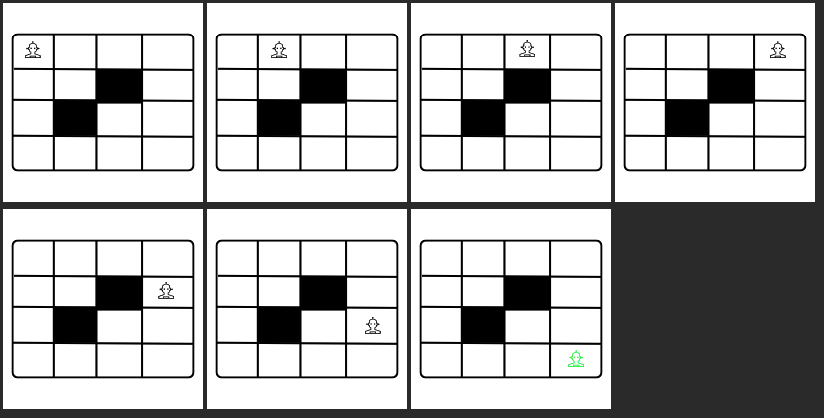
A robot has been designed to navigate a two-dimensional 4x4 matrix by only moving forward or turning right when blocked by a wall of the matrix. Its starting position is in the top left corner of the matrix, denoted by (0,0), and the robot’s final destination is the bottom right corner. Determine the full path of the robot before it hits the final destination or starts repeating the path. The ‘walls’ of the matrix are either one of the four borders of the map or any block found within. A ‘Block’ is donated by having 1 in the cell corresponding to it where an empty cell is having ‘0’. Example 1: As seen in these diagrams, the robot’s path starts with this sequence of steps:
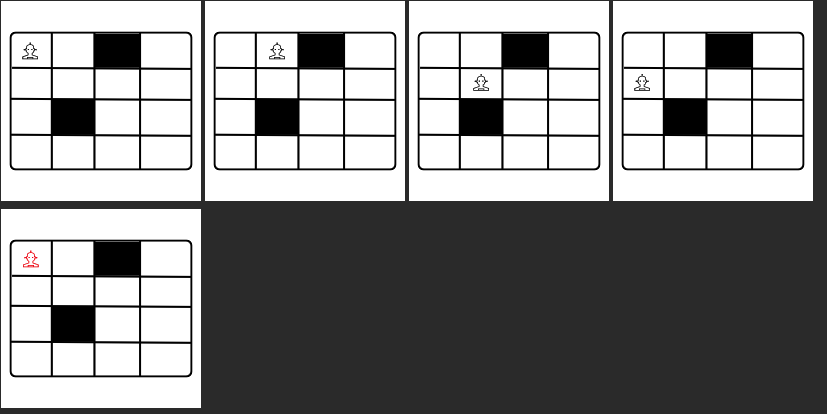
Example 2: Here, the robot moves forward one space, but hits the wall. After turning right, another wall is hit, starting a loop.
| ||
SQL | Easy | |
SQL | Medium | |
SQL | Easy | |
Machine Learning | Medium | |
Statistics | Medium | |
SQL | Hard | |
Machine Learning | Medium | |
Python | Easy | |
Deep Learning | Hard | |
SQL | Medium | |
Statistics | Easy | |
Machine Learning | Hard |
Discussion & Interview Experiences