
DocuSign Machine Learning Engineer Interview Guide: Process, Questions & Salary


Introduction
Preparing for a Docusign machine learning engineer interview in 2026 means preparing for production-first ML, not academic modeling. Docusign serves over 1.5 million customers across more than 180 countries, processing billions of agreement-related events annually, which means machine learning engineers operate at a scale where reliability, security, and latency matter as much as model accuracy. ML systems power document understanding, identity verification, fraud detection, agreement analytics, and a growing set of agentic AI workflows embedded directly into the Agreement Cloud.
Machine learning engineers at Docusign sit at the intersection of applied ML, distributed systems, and product engineering. The interview process reflects that reality. Candidates are evaluated on whether they can design, deploy, and maintain ML systems in production, reason about trade-offs under real constraints, and communicate clearly with product, security, and platform teams.
In this guide, we break down the Docusign machine learning engineer interview process, explain what each stage tests, and show how Docusign evaluates ML system design, modeling judgment, and production readiness.
Docusign Machine Learning Engineer Interview Process
The Docusign machine learning engineer interview process is designed to assess whether you can ship and operate ML systems at scale, not just train models in isolation. Most candidates complete 3 to 7 interview rounds over 3 to 8 weeks, depending on seniority and team. The loop balances core software engineering skills with applied ML systems thinking and behavioral ownership.
| Interview stage | What it evaluates |
|---|---|
| Recruiter screen | Background, ML experience, role alignment |
| Technical screen | Coding fundamentals and problem solving |
| Hiring manager deep dive | ML project ownership and real-world impact |
| Virtual onsite panel | ML system design, ML concepts, coding, behavioral |
Recruiter Screen (20–30 minutes)
This initial call focuses on your background, motivation for joining Docusign, and experience with production machine learning systems. Recruiters assess whether you have worked beyond experimentation and are comfortable owning models through deployment, monitoring, and iteration.
You may be asked about your experience with NLP, deep learning, or ML infrastructure, as well as how you collaborate with product and engineering partners.
Tip: Emphasize end-to-end ownership. Docusign values ML engineers who can take responsibility for models after launch, not just during training.
Technical Screen (60 minutes)
The technical screen typically focuses on data structures and algorithms, usually in Python. Questions are often LeetCode-style at an easy-to-medium difficulty level and are designed to test clean logic, edge-case handling, and communication rather than advanced theory.
This stage ensures baseline engineering rigor before moving into ML-specific discussions. Many candidates prepare using Interview Query’s coding interview questions and structured practice from the software engineering learning paths.
Tip: Talk through your approach as you code. Interviewers care about how you reason, not just the final solution.
Hiring Manager Deep Dive
This round is a technical conversation centered on your past machine learning projects. Expect questions about model selection, handling imbalanced data, evaluation strategies, and how your work performed in production. Interviewers probe for evidence that you understand trade-offs between accuracy, latency, interpretability, and operational cost.
You may also be asked how your models failed, how you detected issues, and what you changed as a result.
Tip: Anchor answers around business impact and system behavior in production, not just offline metrics.
Virtual Onsite / Panel Loop (3–5 rounds)
The virtual onsite is the most important part of the Docusign machine learning engineer interview. It typically consists of three to five back-to-back interviews, each targeting a different signal.
| Panel round | What’s tested |
|---|---|
| ML system design | End-to-end ML pipelines, deployment, monitoring |
| Machine learning concepts | Modeling judgment and evaluation trade-offs |
| Coding and scripting | Data handling, algorithms, or SQL |
| Behavioral | Ownership, collaboration, technical excellence |
ML System Design
You may be asked to design an ML system for document classification, fraud detection, or real-time agreement analytics. Unlike generic system design, the focus is on data ingestion, training pipelines, model serving, monitoring, and rollback strategies. Strong candidates explain how they handle drift, failures, and compliance constraints.
Machine Learning Concepts
These rounds dive into algorithmic understanding and evaluation. Expect discussions on bias-variance trade-offs, clustering methods, evaluation metrics, and when to favor simpler models over more complex ones.
Coding and Scripting
Additional coding rounds may involve Python or SQL to test data manipulation and logic at scale. The goal is to ensure you can work comfortably with real production data.
Behavioral
Behavioral interviews assess collaboration, project ownership, and how you navigate ambiguity. Answers are typically expected in STAR format and should highlight decisions and outcomes.
You can simulate the pacing and pressure of this loop through mock interviews or practice structured delivery using the AI interview tool.
Challenge
Check your skills...
How prepared are you for working as a ML Engineer at Docusign?
Docusign Machine Learning Engineer Interview Questions
The Docusign machine learning engineer interview focuses on production ML systems, not isolated modeling exercises. Questions are grounded in real agreement-centric workflows such as document understanding, identity verification, fraud detection, and AI-powered assistants embedded directly into the Agreement Cloud. Interviewers evaluate whether you can apply machine learning under security, compliance, and reliability constraints, reason through trade-offs clearly, and operate models safely after deployment.
If you want a single place to practice the same question styles across modeling, systems, coding, and behavior, the fastest way is to work directly through the Interview Query question library.
Machine Learning and Modeling Questions
These questions test how you choose, evaluate, and operate models in environments where accuracy alone is not enough. At Docusign, ML models often affect legally binding workflows, so interviewers listen closely for judgment around interpretability, stability, and risk.
How would you design a model to classify and extract key fields from signed documents at scale?
This question evaluates end-to-end applied ML thinking for document understanding. Interviewers want to hear how you approach OCR, layout-aware models, and NLP pipelines, as well as how you handle noisy inputs like scans or handwritten text. Strong answers explain feature extraction, model choice, and how predictions feed downstream agreement workflows.
Tip: Discuss how misclassification impacts customers and legal workflows, not just precision and recall.
-
Imbalanced data shows up in fraud detection, identity verification failures, and rare agreement anomalies. This question tests whether you can reason about sampling strategies, class weighting, and metric selection when positive cases are scarce.
Tip: Tie imbalance handling to business cost, such as false positives blocking legitimate agreements.
How do you evaluate NLP models beyond offline accuracy when they power customer-facing features?
This evaluates whether you understand that offline metrics are insufficient for production NLP systems. Interviewers expect discussion of latency, confidence thresholds, fallback logic, and user-level outcomes.
Tip: Explain how you combine offline evaluation with online monitoring and human review signals.
How do you detect and respond to model drift in production?
This tests whether you can own models after launch. Strong answers cover monitoring input distributions, prediction behavior, and downstream business metrics, then explain retraining or rollback strategies.
Tip: Describe alerts that trigger investigation, not panic, which signals production maturity.
-
Docusign asks questions like this to test reproducibility discipline. Strong answers cover data splits, randomness, hyperparameters, leakage, and evaluation methodology, then explain why reproducibility matters in regulated environments.
Tip: Mention fixed seeds, versioned datasets, and consistent validation pipelines.
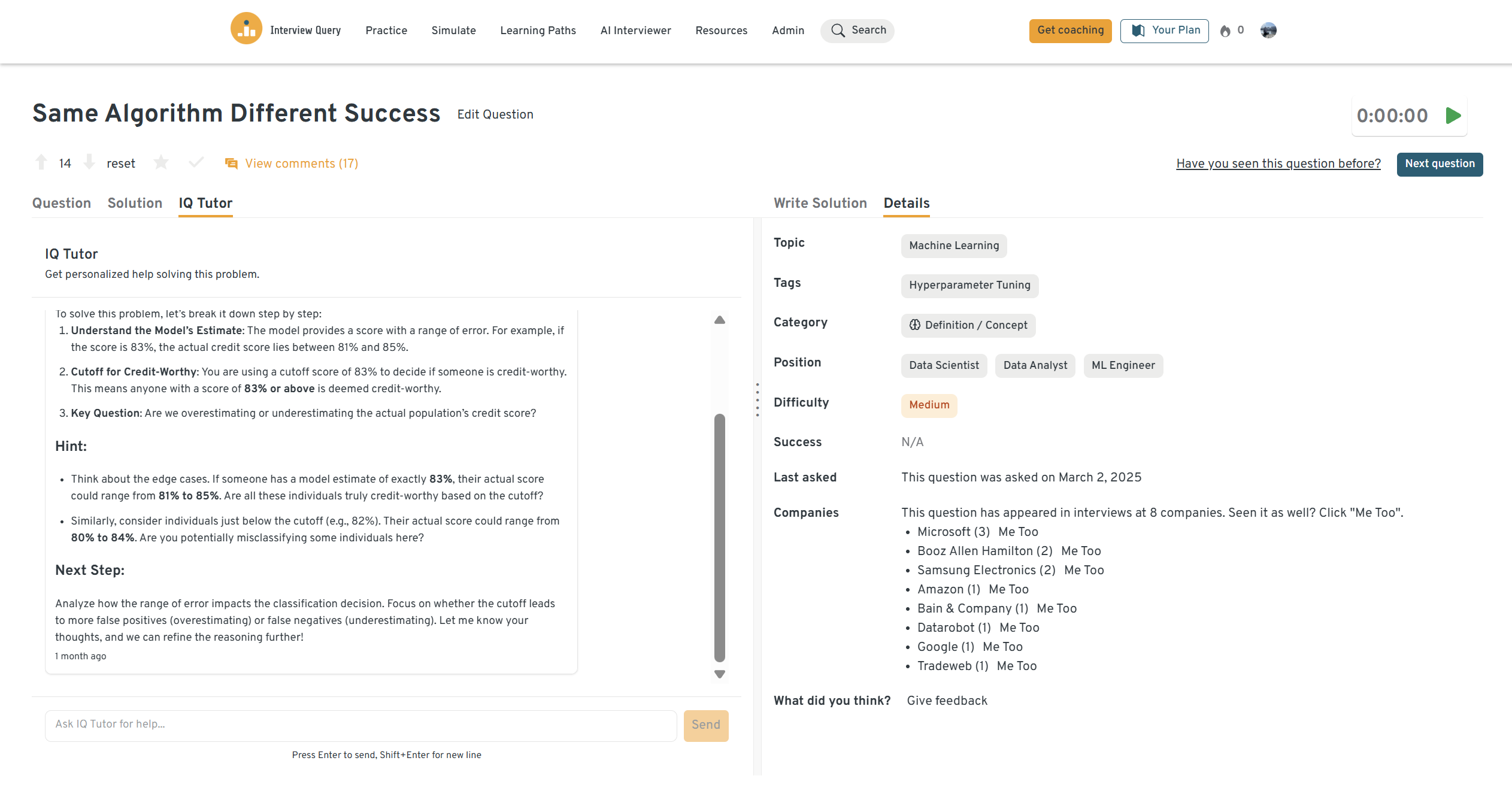
Try this question yourself on the Interview Query dashboard. You can run SQL queries, review real solutions, and see how your results compare with other candidates using AI-driven feedback.
Machine Learning System Design Questions
System design interviews at Docusign focus on whether you can build secure, observable, and scalable ML systems that integrate cleanly with core agreement workflows.
How would you monitor, evaluate, and validate a newly deployed machine learning model in production?
This question tests layered monitoring thinking. Interviewers want to hear how you track input health, prediction quality, latency, and business impact together.
Tip: Tie monitoring signals to customer trust and compliance risk, not just model metrics.
Design an end-to-end ML pipeline for an AI-powered agreement review assistant.
This evaluates pipeline architecture across ingestion, training, serving, and monitoring. Strong answers explain data sources, feature pipelines, deployment strategy, and safe rollback.
Tip: Discuss how you prevent unsafe outputs in legally sensitive contexts.
How would you support frequent model updates without service disruption?
This tests deployment discipline. Interviewers expect discussion of canary releases, shadow models, versioning, and automated rollback.
Tip: Emphasize monitoring during rollout windows, not just before and after.
How would you design a retrieval-augmented generation (RAG) system for agreement search and summarization?
This evaluates your understanding of LLM systems, embeddings, and vector databases. Strong answers explain retrieval strategy, context limits, latency trade-offs, and evaluation.
Tip: Call out how you prevent hallucinations and protect sensitive data.
Design an experimentation framework for machine learning features.
This tests whether you can run experiments safely when models influence user decisions. Interviewers want to hear about randomization units, guardrails, and interference management.
Tip: Explain how you isolate experiments to avoid corrupting other ML signals.
Coding and Applied Problem-Solving Questions
Coding interviews test your ability to write clean, defensive code and reason about performance under real constraints. Questions are typically in Python and focus on data handling and logic rather than trick algorithms.
-
This tests optimization fundamentals and convergence reasoning.
Tip: Mention learning rate sensitivity and divergence detection.
How would you implement precision and recall from a confusion matrix?
This evaluates whether you can translate metric definitions into correct code.
Tip: Tie metric choice to operational cost.
Write Python logic to detect near-duplicate agreement events in a streaming system.
This tests reasoning about noisy event streams and deduplication logic.
Tip: Explain how you tune thresholds using real distributions.
Implement a function to compute rolling model performance metrics efficiently.
This evaluates time-series reasoning and performance awareness.
Tip: Call out how you handle missing or late data.
Explain how you would safely parse and preprocess large text documents for NLP pipelines.
This tests data hygiene and defensive programming instincts.
Tip: Mention memory constraints, encoding issues, and failure isolation.
Behavioral Interview Questions
Docusign’s behavioral interviews focus on ownership, judgment, and collaboration in production environments where machine learning systems directly affect customer trust, security, and legally binding workflows. Interviewers are less interested in abstract leadership stories and more focused on how you make decisions, communicate trade-offs, and respond when things go wrong. Strong answers are structured, specific, and outcome-driven.
Tell me about a time your machine learning model caused an issue in production.
This question evaluates accountability and operational maturity. Docusign wants engineers who take responsibility for failures, protect customers quickly, and leave systems better than they found them. Interviewers listen for how fast you detected the issue, how you mitigated impact, and what long-term controls you put in place.
Sample answer: I deployed an NLP classification model that improved offline F1 by 7 percent, but after release we saw a spike in false positives that incorrectly flagged valid agreements for review. I rolled the model back within 20 minutes, added confidence thresholds with a human-review fallback, and introduced live monitoring on prediction distribution shifts. After retraining with corrected labels and re-releasing via a canary rollout, false positives dropped by 40 percent and review turnaround times returned to baseline.
Tip: Emphasize permanent improvements to monitoring, rollout, or validation. That signals reliability thinking.
Describe a disagreement with a product manager about model trade-offs.
This tests cross-functional judgment and influence. Docusign values engineers who resolve disagreements with data and experiments, not opinions. Interviewers want to see how you balance model performance with user experience, latency, and risk.
Sample answer: A PM wanted to push a more complex document classification model to maximize accuracy, but I raised concerns about inference latency during peak signing hours. I proposed an A/B test comparing the new model against a lighter version with slightly lower accuracy. The experiment showed no measurable difference in downstream user outcomes while reducing latency by 35 percent, so we aligned on shipping the faster model.
Tip: Show how you turned disagreement into a measurable decision rather than a debate.
How do you prioritize technical debt versus shipping new machine learning features?
This question evaluates long-term ownership and risk management. Interviewers want to see whether you protect system health while still delivering business value.
Sample answer: I prioritize technical debt based on failure risk and iteration cost. For a core agreement-processing pipeline, I scheduled incremental refactors alongside feature work, which reduced on-call alerts by 30 percent without delaying delivery. I track debt with clear owners and timelines so it does not get deferred indefinitely.
Tip: Tie debt reduction to reliability, on-call load, or delivery speed to demonstrate business impact.
Why do you want to work as a machine learning engineer at Docusign?
This evaluates motivation and role alignment. Docusign looks for engineers who are excited by production ML systems operating in regulated, high-trust environments.
Sample answer: I enjoy owning models end to end in production, especially when correctness and trust matter. In my last role, I worked on document understanding systems used by enterprise customers, where reliability and auditability were just as important as accuracy. That combination of applied ML, scale, and responsibility is exactly what draws me to Docusign.
Tip: Connect your experience to agreement-centric workflows and production accountability.
How do you mentor junior machine learning engineers?
This question assesses leadership and knowledge transfer. Docusign values engineers who raise the team’s overall bar, not just individual output.
Sample answer: I mentor through design reviews and post-incident walkthroughs. On one project, I paired with a junior engineer to reason through feature trade-offs and rollout risks, which helped them independently lead the next release. That service later shipped with zero incidents during a high-traffic signing period.
Tip: Highlight how you teach judgment and decision-making, not just technical implementation.
DocuSign Machine Learning Engineer Role Overview
Machine learning engineers at DocuSign work at the intersection of applied ML, production engineering, and security-first systems, building AI capabilities that power the DocuSign Agreement Cloud. The role is strongly production-oriented, with success measured by reliability, scalability, and real customer impact rather than offline model performance alone.
What Machine Learning Engineers Do at DocuSign
ML engineers are expected to own the end-to-end ML lifecycle, from problem framing to production monitoring:
- Design and train models for document understanding, NLP, and agreement automation
- Build data ingestion, labeling, training, and evaluation pipelines
- Deploy and serve models at scale with low-latency and high availability
- Monitor model performance, drift, and downstream business impact
- Implement rollback, retraining, and versioning strategies for production safety
- Embed privacy, security, and compliance controls into ML systems
Many teams work heavily with LLMs, RAG pipelines, and agentic AI systems, especially for document parsing, clause extraction, semantic search, and intelligent assistants.
Core Technical Focus Areas
| Area | What Interviewers Expect |
|---|---|
| Machine Learning | Strong fundamentals in supervised learning, NLP, evaluation metrics, and bias–variance trade-offs |
| LLMs & NLP | Experience with transformers, embeddings, RAG architectures, and text-based ML tasks |
| ML Systems | Ability to design end-to-end ML pipelines with training, deployment, monitoring, and rollback |
| Software Engineering | Clean Python code, API design, CI/CD integration, and production debugging |
| Infrastructure | Familiarity with Docker, Kubernetes, cloud ML deployment, and distributed systems |
| Security & Compliance | Awareness of data privacy, access control, explainability, and auditability |
How the Role Is Positioned Internally
DocuSign ML engineers are not pure researchers and not generic backend engineers. The role sits squarely in between.
| Dimension | Emphasis |
|---|---|
| Research vs Production | Strong bias toward production and operational ownership |
| Model Accuracy | Important, but secondary to reliability and safety |
| Cross-Functional Work | High collaboration with Product, Security, and Platform teams |
| Ownership | End-to-end responsibility, including post-launch behavior |
| Work Mode | Mostly hybrid roles, with regular in-office collaboration |
What DocuSign Looks for in Strong Candidates
- Experience deploying ML models used by real users
- Comfort explaining trade-offs to non-ML stakeholders
- Strong judgment around failure modes, monitoring, and rollback
- Ability to balance experimentation speed with system safety
- Clear communication under ambiguity and production pressure
How to Prepare for a DocuSign Machine Learning Engineer Interview
Preparing for a DocuSign machine learning engineer interview requires a production-first mindset. The interview loop is designed to evaluate whether you can take machine learning models from concept to deployment, operate them reliably at scale, and communicate trade-offs clearly with cross-functional partners. Strong candidates demonstrate depth across modeling fundamentals, system design, coding, and ownership, not just algorithm knowledge.
Below is a structured way to prepare that mirrors how DocuSign evaluates ML engineers in interviews.
1. Strengthen Core Machine Learning Fundamentals
DocuSign interviews expect you to reason fluently about why a model works, when it fails, and how its behavior changes in production. Interviewers care less about academic novelty and more about your ability to choose and defend modeling decisions under real constraints.
You should be comfortable explaining:
- Bias–variance trade-offs and model selection
- Evaluation metrics aligned to business risk
- Handling noisy, sparse, or imbalanced datasets
- Feature leakage and reproducibility issues
The most efficient way to prepare is by practicing applied ML questions that require explanation, not just formulas. The modeling and machine learning interview learning path is designed around this exact style and closely matches what DocuSign asks in ML concept rounds.
Tip: Always start by explaining the decision context before naming an algorithm. Interviewers listen for judgment first, not buzzwords.
2. Prepare for Machine Learning System Design Rounds
Machine learning system design is one of the highest-signal interviews at DocuSign. These sessions test whether you can design an end-to-end ML system that remains reliable once deployed, not just an offline model.
You should be able to walk through:
- Data ingestion and labeling workflows
- Offline training vs online inference trade-offs
- Model versioning, monitoring, and rollback strategies
- Latency, throughput, and cost constraints
- Drift detection and retraining triggers
Practice structuring your answers using real scenarios rather than abstract diagrams. Resources like the machine learning case studies and ML system design questions help you practice explaining how models behave after launch, which is exactly what DocuSign interviewers probe.
Tip: Explicitly discuss failure modes and what happens when things go wrong. Production readiness matters more than perfect architecture.
3. Refresh Coding and Applied Problem Solving Skills
Even senior ML engineers at DocuSign are expected to code clearly and defensively. Coding rounds typically use Python and focus on correctness, clarity, and performance under time constraints.
You should practice:
- Writing clean Python code for data manipulation
- Handling edge cases and malformed inputs
- Reasoning about time and space complexity
- Translating ML concepts into executable logic
The fastest way to sharpen this skill set is by practicing directly in the Interview Query question library, where problems are designed to mirror real interview expectations rather than competitive programming puzzles.
Tip: Talk through your approach before writing code. Interviewers evaluate how you reason just as much as the final solution.
4. Focus on Production ML and Operational Ownership
DocuSign places heavy emphasis on operating models in production, not just shipping them. Many interview questions explore how you detect issues, respond to failures, and prevent recurrence.
Be ready to discuss:
- Monitoring model performance and data freshness
- Detecting and responding to model drift
- Canary deployments and shadow testing
- Safe rollback strategies and incident response
To prepare, review production-focused prompts from the machine learning interview questions hub, which emphasizes real-world reliability scenarios over theoretical optimization.
Tip: Frame your answers around protecting users and business impact, not just maintaining model accuracy.
5. Rehearse Behavioral Questions with Measurable Impact
Behavioral interviews at DocuSign assess ownership, collaboration, and decision-making under uncertainty. Interviewers want to see that you take responsibility for outcomes, including failures.
Strong answers:
- Use the STAR format
- Lead with the decision you made
- Quantify impact wherever possible
- Reflect on what you changed afterward
Practicing out loud is critical. Simulating pressure through mock interviews helps ensure your answers stay concise and structured during the real interview.
Tip: Prioritize stories involving production incidents, trade-offs, or cross-team disagreements. These map best to DocuSign’s evaluation criteria.
6. Build a Structured Weekly Preparation Plan
A simple, repeatable plan helps ensure balanced coverage across all interview dimensions.
| Focus area | Weekly target |
|---|---|
| ML fundamentals | 2–3 applied modeling questions |
| ML system design | 1 full pipeline walkthrough |
| Coding | 3–5 Python problems |
| Behavioral | 2 STAR stories rehearsed |
| Review | 1 timed or mock interview session |
Tip: Rotate question difficulty weekly rather than practicing only what feels comfortable. Interview performance improves fastest when you target weak spots deliberately.
Average DocuSign Machine Learning Engineer Salary
Compensation for DocuSign machine learning engineer roles reflects the company’s investment in production-grade AI systems that power intelligent agreement workflows, document automation, and GenAI-driven features. Pay scales primarily with technical scope, system ownership, and impact on core product infrastructure rather than title alone.
According to Levels.fyi, the most recent complete reported compensation data for DocuSign machine learning engineers in the United States corresponds to Level P3, where total compensation averages approximately $26,000 per month, or $312,000 annually. This includes base salary, equity, and bonus.
To provide a full view across levels, the table below extends this benchmark using conservative progression assumptions consistent with enterprise SaaS companies such as Adobe, Salesforce, and ServiceNow, where machine learning engineers are leveled alongside senior backend and platform engineers.
| Level | Total compensation (annual) | Base salary (annual) | Stock (annual) | Bonus (annual) |
|---|---|---|---|---|
| P1 | $165,000 | $135,000 | $20,000 | $10,000 |
| P2 | $210,000 | $160,000 | $35,000 | $15,000 |
| P3 | $312,000 | $204,000 | $94,800 | $11,300 |
| P4 | $380,000 | $225,000 | $125,000 | $30,000 |
| P5 | $460,000 | $250,000 | $170,000 | $40,000 |
| P6 | $560,000 | $280,000 | $230,000 | $50,000 |
| P7 | $700,000 | $300,000 | $340,000 | $60,000 |
At junior and mid levels (P1–P3), compensation is driven primarily by base salary, reflecting a focus on model development, feature engineering, and contributing to production ML pipelines under guidance. Equity and bonus remain meaningful but secondary.
At senior and lead levels (P4–P5), machine learning engineers take ownership of end-to-end ML systems, including training pipelines, deployment infrastructure, monitoring, and iteration. Compensation increases sharply at this stage, with equity forming a larger share of total pay to align incentives with long-term platform impact.
Principal and distinguished engineers (P6–P7) operate at an architectural level, defining ML infrastructure standards, guiding GenAI adoption, and influencing cross-team technical direction. At these levels, equity becomes a dominant component of compensation, reflecting organization-wide impact and long-term accountability.
Compared to traditional software engineering roles, DocuSign machine learning engineer compensation skews higher at senior levels due to the combination of infrastructure ownership, on-call responsibility, and the increasing strategic importance of AI and generative models within DocuSign’s product roadmap.
FAQs
How many interview rounds are in the Docusign machine learning engineer interview process?
The Docusign machine learning engineer interview process typically includes 3 to 7 rounds, depending on seniority and team. Most candidates go through a recruiter screen, a technical screen, a hiring manager deep dive, then a virtual onsite loop with multiple sessions covering ML system design, ML concepts, coding, and behavioral evaluation. Senior roles may add deeper architecture discussions or an additional leadership-style round. If you want to rehearse the pacing of a multi-round loop, a structured mock interview is one of the fastest ways to pressure-test your communication.
What programming languages should I prepare for Docusign ML engineer interviews?
Python is the most common language used in Docusign ML engineer interviews, especially for coding, scripting, and data manipulation. Java is also frequently relevant for production services and backend ML infrastructure, and some teams may value familiarity with C#, Go, or C++ depending on the stack. You should be ready to write clean Python solutions and talk through complexity and edge cases clearly. Practicing mixed coding and ML prompts in the Interview Query question library helps you build that muscle in a format that mirrors interviews.
How important is machine learning system design at Docusign?
Machine learning system design is one of the highest-signal rounds at Docusign. Interviewers expect you to design end-to-end ML systems that include data ingestion, training, deployment, monitoring, and rollback strategies, not just model selection. Strong answers explain how models fail in production, how you detect drift, and how you protect customers and compliance workflows when predictions are wrong. If you want to practice this style directly, the machine learning case studies and the modeling and machine learning learning path are both aligned with this round.
Does Docusign test ML theory or applied machine learning?
Docusign interviews prioritize applied machine learning. You still need to understand fundamentals like bias–variance trade-offs, evaluation metrics, and common algorithm families, but interviewers care more about how you apply those concepts in production systems with real constraints. Expect questions tied to noisy labels, imbalanced data, latency limits, and operational risk, especially in NLP and document intelligence contexts. To build that applied instinct, drill scenarios from the machine learning interview questions hub rather than studying only textbook definitions.
How should I prepare for behavioral interviews for ML roles at Docusign?
Behavioral interviews at Docusign focus on ownership, collaboration, and judgment under pressure. Prepare stories where you owned a model end to end, handled a production incident, or navigated trade-offs with product and engineering partners. Use STAR, lead with the decision you made, then quantify impact in reliability, latency, customer experience, or risk reduction. If you want to improve pacing and clarity quickly, practice out loud using the AI interview tool and refine your delivery through mock interviews.
How long does the Docusign machine learning engineer interview process take?
Most candidates complete the process in 3 to 4 weeks, though senior-level roles can extend to 6 to 8 weeks depending on scheduling and additional rounds. Timing varies by team and location, especially for hybrid roles that coordinate interview panels across functions. To stay sharp during longer timelines, keep a steady weekly cadence with the modeling and machine learning learning path and targeted practice in the Interview Query question library.
Final Thoughts: Prepare for the Docusign Machine Learning Engineer Interview
The Docusign machine learning engineer interview is designed to identify engineers who can build, deploy, and operate ML systems responsibly at scale. Strong candidates demonstrate applied modeling judgment, end-to-end ML system design thinking, clean coding habits, and ownership when production behavior does not match offline expectations.
To prepare efficiently, focus on the same skills Docusign evaluates across the loop. Practice applied modeling and evaluation trade-offs in the modeling and machine learning learning path, then deepen your production reasoning through machine learning case studies. Reinforce coding fluency by drilling questions in the Interview Query question library, and pressure-test your communication using the AI interview tool or structured mock interviews.
Ready to level up your prep? Start practicing for your Docusign machine learning engineer interview today on Interview Query, then use the learning paths and mock interviews to turn practice into interview-ready performance.
Discussion & Interview Experiences