
DocuSign Data Scientist Interview Guide: Process, Questions, Salary


Introduction
Preparing for a Docusign data scientist interview? This guide breaks down the interview process, the skills each round tests, and how to prepare for the kinds of product, growth, and GenAI problems Docusign teams work on. Data scientist roles at Docusign often sit close to churn reduction, activation, monetization, and intelligent agreement experiences, so interviewers pay attention to how you translate analysis and modeling into decisions that move customer outcomes.
Docusign has been investing heavily in its intelligent agreement management vision, and the scale is real. The company has said it serves more than 1.7 million customers and processes over a billion agreements annually, which is why data scientists are expected to design experiments and models that hold up in production and stakeholder scrutiny.
Docusign Data Scientist Interview Process
The Docusign data scientist interview process is designed to evaluate whether you can operate as a decision-making partner, not just a technical contributor. Across the loop, interviewers assess SQL and experimentation fundamentals, applied modeling judgment, product intuition, and your ability to communicate insights to non-technical stakeholders.
For most teams, the process spans 3 to 8 weeks and includes 4 to 7 rounds, depending on seniority and specialization (growth, product, or GenAI). While individual teams may vary slightly, the structure below reflects the most common Docusign data scientist interview flow reported by candidates and recruiters.
Interview Process Overview
| Interview stage | Format | Primary focus |
|---|---|---|
| Recruiter screen | 15–30 minutes | Role fit, motivation, and expectations |
| Technical screen | Live or take-home | SQL, statistics, and basic coding |
| Hiring manager interview | 45–60 minutes | Project ownership and product judgment |
| Virtual onsite loop | 3–5 interviews | Experimentation, modeling, and product thinking |
| Final round (director level) | 30–45 minutes | Scope, impact, and long-term fit |
To prepare efficiently, candidates often practice role-specific questions using the Interview Query SQL learning path and pressure-test communication through mock interviews.
Recruiter Screen (15–30 minutes)
The recruiter screen focuses on alignment rather than technical depth. You’ll discuss your background, why you’re interested in Docusign, and how your experience maps to the specific data scientist role (growth, product, or GenAI).
Recruiters also set expectations around team structure, interview timelines, and work setup, including Docusign’s hybrid requirements.
What’s being evaluated
- Clarity of career narrative
- Understanding of what a Docusign data scientist actually does
- Alignment with SaaS, experimentation-driven environments
Tip: Be explicit about the type of data science you do best. Docusign teams differentiate clearly between experimentation-heavy growth work, product analytics, and GenAI-focused modeling.
Technical Screen (45–60 minutes or take-home)
The technical screen typically tests SQL mastery and applied statistical thinking. Depending on the team, this may be a live interview or a short take-home assignment.
You may be asked to:
- Write SQL queries to compute retention, churn, or rolling metrics
- Interpret A/B test results or explain statistical significance
- Walk through Python logic for data processing or simple modeling
What’s being evaluated
- Clean, readable SQL logic
- Comfort with real-world data ambiguity
- Ability to explain assumptions clearly
Tip: Define metrics out loud before writing queries. Practicing with real prompts from the Interview Query challenges helps reinforce decision-first thinking.
Hiring Manager Interview (45–60 minutes)
This round goes deeper into how you work, not just what you’ve built. Hiring managers typically ask you to walk through one or two past projects end to end, focusing on problem framing, trade-offs, and business impact.
Behavioral questions often follow the STAR format, especially around ownership, prioritization, and collaboration with product or engineering teams.
What’s being evaluated
- Judgment under ambiguity
- Ability to connect analysis to business outcomes
- Communication with non-technical stakeholders
Tip: Anchor each story on the decision your work informed. Avoid walking through dashboards or models without explaining what changed because of them.
Virtual Onsite or Panel Loop (3–5 interviews)
The onsite-style loop is the most intensive part of the Docusign data scientist interview. Interviews are usually back to back and span multiple disciplines.
| Interview type | Common focus |
|---|---|
| SQL and analytics | Cohorts, funnels, segmentation, and metric design |
| Experimentation / causal inference | A/B test design, bias, and interpretation |
| Modeling or ML | Feature design, evaluation, or system reasoning |
| Product or growth case | Diagnosing KPI changes and prioritizing experiments |
| Behavioral | Collaboration, influence, and learning mindset |
What’s being evaluated
- Depth without overengineering
- Product intuition in SaaS workflows
- Ability to explain complex ideas simply
Tip: Treat every technical answer as if a PM is in the room. Practice framing results using the Interview Query dashboard, where explanations matter as much as correctness.
Final Round (Director or Senior Leadership)
Some candidates have a final conversation with a director or senior leader. This round focuses less on mechanics and more on scope, vision, and long-term impact.
Topics may include:
- How you choose what not to work on
- How you scale data science impact across teams
- How you think about GenAI, automation, or platform leverage
What’s being evaluated
- Seniority calibration
- Strategic thinking
- Cultural alignment with Docusign’s product-led mindset
Tip: Frame your answers around leverage. Senior leaders want to see how your work compounds through systems, teams, or reusable frameworks.
Challenge
Check your skills...
How prepared are you for working as a Data Scientist at Docusign?
DocuSign Data Scientist Interview Questions
The DocuSign data scientist interview includes a mix of SQL, analytics, experimentation, product reasoning, and applied modeling. These questions are designed to evaluate how well you work with SaaS lifecycle data, reason about churn and feature adoption, and translate analysis into decisions that improve customer retention and agreement completion. Interviewers care deeply about how you structure problems, validate assumptions, and communicate insights in ambiguous, cross-functional environments.
SQL and Analytics Interview Questions
DocuSign relies heavily on SQL-driven analysis to monitor agreement usage, diagnose churn risk, and evaluate product changes across enterprise and SMB customers. SQL questions often involve event tables, rolling windows, segmentation, and window functions. Interviewers look for clean query structure, correct logic, and strong instincts around data quality.
How would you calculate retention by cohort over the first 90 days?
DocuSign asks this because retention is a core signal of product value in subscription SaaS. A strong answer explains how you would define cohorts based on first agreement sent or first login, then track activity over time buckets such as day 7, day 30, and day 90. In SQL, this typically involves building a cohort table, calculating days since first activity, and dividing active users by cohort size.
Tip: Call out how you would handle accounts that send agreements sporadically due to contract cycles, not disengagement.
-
While framed abstractly, this question maps cleanly to DocuSign agreement workflows. You should propose an events table that captures agreement creation, view, and completion timestamps, then compute durations between stages. Interviewers want to see how you turn raw logs into interpretable performance metrics.
Tip: Mention guardrails such as filtering incomplete agreements and handling missing or delayed events.
How would you write a SQL query to randomly select users using weighted probabilities?
This tests your understanding of weighted sampling, which can apply to DocuSign use cases like prioritizing accounts for outreach or experimentation. A strong answer explains generating a cumulative weight distribution and selecting users based on a random draw.
Tip: Explain how you would audit the output to ensure no unintended bias across customer segments.
How would you detect duplicate agreement events in the data?
This mirrors real DocuSign instrumentation issues. You should explain defining duplication first, then using window functions like
ROW_NUMBER()orCOUNT(*) OVERto flag repeated events.Tip: Explain how you would estimate downstream metric impact before removing duplicates.
Write a query to calculate and rank total activity per user.
For DocuSign, this logic translates to ranking users or accounts by agreements sent, completed, or negotiated. You should explain joining user and agreement tables, aggregating activity, and ranking with window functions.
Tip: Add how you would sanity-check for outliers such as automated senders or duplicated events.
Try this question yourself on the Interview Query dashboard. You can run SQL queries, review real solutions, and see how your results compare with other candidates using AI-driven feedback.
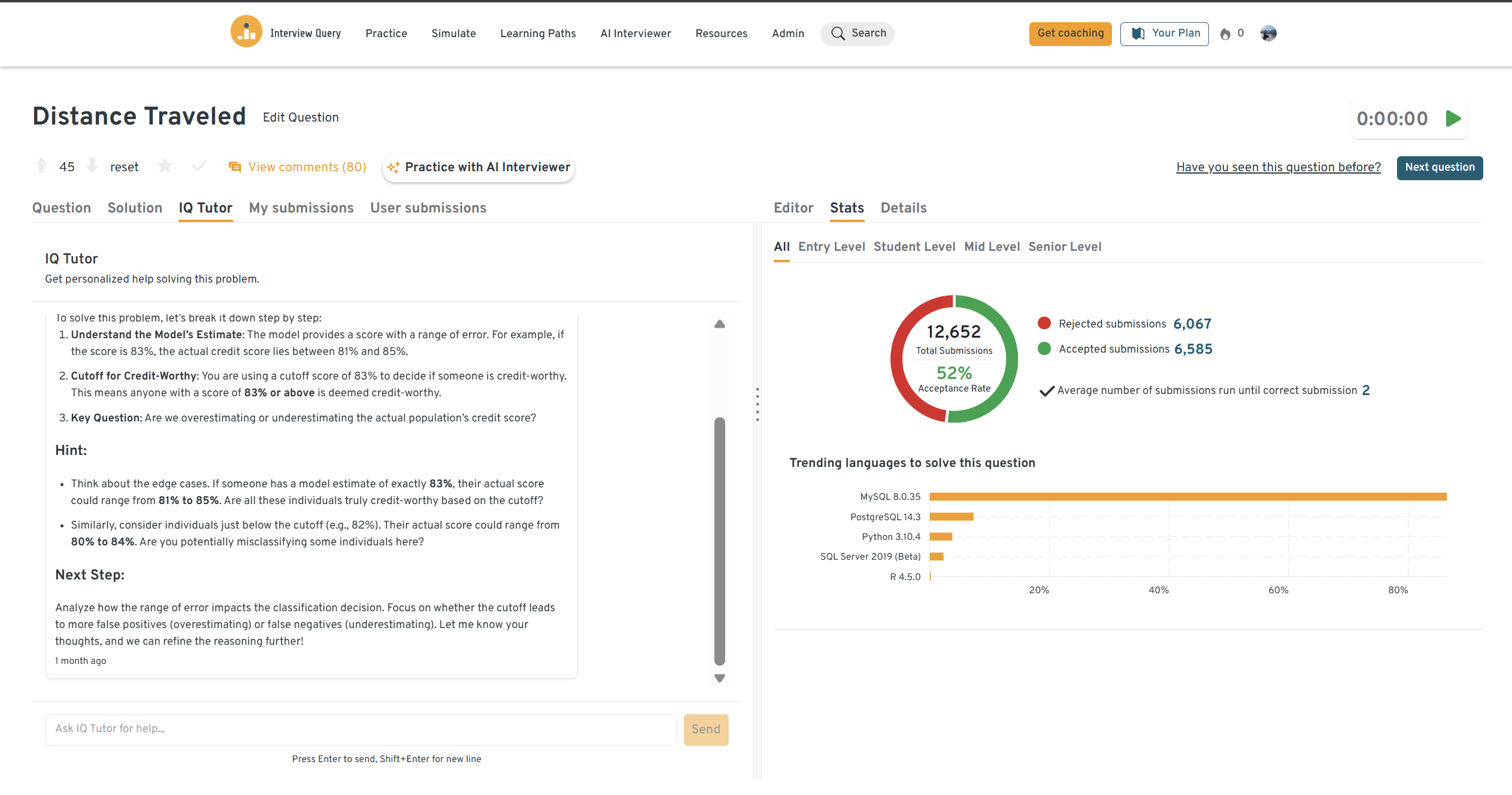
You can practice similar SQL problems in the Interview Query dashboard, where you can work through SQL questions with guided solutions and feedback.
A/B Testing and Experimentation Interview Questions
Experimentation questions at DocuSign evaluate whether you can design tests that hold up in a B2B SaaS environment, where users operate within accounts and long contract cycles introduce interference and delayed outcomes.
How would you design an experiment to test a new agreement reminder feature?
This mirrors DocuSign’s real-world problem of improving completion rates without harming customer trust. You should explain choosing the right randomization unit, defining a primary metric like completion rate, and setting guardrails such as unsubscribe or complaint rates.
Tip: Call out how you would avoid cross-account contamination when users belong to multiple teams.
-
DocuSign asks questions like this to test statistical judgment under realistic constraints. You should explain using non-parametric methods, bootstrapping, or Bayesian approaches, and focusing on effect sizes rather than p-values alone.
Tip: Explain how you would combine statistical evidence with product intuition before scaling.
How would you evaluate a pricing or policy change with multiple variants?
This applies directly to DocuSign packaging, pricing tiers, or feature gating. You should explain randomization, metric selection, and how you would assess long-term retention impact rather than short-term conversion gains.
Tip: Tie recommendations to customer lifetime value, not immediate revenue.
How would you interpret an experiment that performs well overall but poorly for certain customer segments?
This tests your ability to reason about heterogeneous treatment effects. A strong answer explains segmenting by plan type, industry, or usage maturity before deciding on rollout scope.
Tip: Emphasize learning and iteration before global launches.
In this statistics-focused deep dive, Jay, the founder of Interview Query, breaks down the recurring patterns behind statistics questions asked at top companies like Google, Netflix, and Wall Street firms, and shows how to approach each with confidence. This breakdown is especially valuable for Intuit data scientist candidates, as it sharpens intuition around hypothesis testing, variance, and experiment interpretation, all of which are critical when evaluating marketplace metrics, pricing tests, and incentive experiments at Intuit.
Product and Modeling Interview Questions
Product and modeling questions at DocuSign evaluate how you connect statistical or machine learning models to real SaaS decisions, such as churn reduction, feature adoption, pricing strategy, and intelligent agreement workflows. Interviewers care less about algorithm novelty and more about whether your modeling choices lead to safe, interpretable, and actionable outcomes for product and business teams.
-
While this question is framed generically, it maps well to DocuSign use cases such as recommending templates, workflows, or GenAI-powered agreement actions. A strong answer describes offline training using historical agreement data, real-time inference based on user context, and monitoring for performance degradation. You should also explain how experiments validate model changes before full rollout.
Tip: Emphasize safeguards and fallback logic. DocuSign interviewers value reliability and legal sensitivity over marginal accuracy gains.
How would you use early usage data to estimate customer lifetime and long-term value?
DocuSign asks questions like this to assess whether you can translate early engagement signals into forward-looking business insights. You should explain defining churn or inactivity thresholds, modeling survival probability using early usage behavior, and combining that with revenue signals to estimate lifetime value.
Tip: Highlight how these estimates would inform retention or expansion strategies, not just forecasting.
To improve customer experience, what key parameters would you focus on improving?
In a DocuSign context, this question tests product intuition. A strong answer reframes the problem around agreement completion time, error rates, signer friction, and clarity of next steps. You should also discuss trade-offs, such as automation speed versus user control, and how changes affect long-term trust.
Tip: Tie each parameter to a specific customer pain point rather than abstract metrics.
How would you define and monitor real-time demand signals in a platform?
This question evaluates metric design and operational thinking. For DocuSign, you might define demand through agreement creation volume, signer activity, or API usage. You should explain how thresholds are set, how alerts trigger investigation, and how metrics differ by customer segment.
Tip: Mention how thresholds evolve over time as usage patterns mature.
You can practice more product-oriented questions in the Interview Query dashboard, where explanations matter as much as correctness.
Behavioral Interview Questions
Behavioral interviews at DocuSign assess ownership, communication, and your ability to influence decisions in cross-functional, enterprise-focused environments. Interviewers look for clear reasoning, stakeholder empathy, and evidence that your work led to meaningful outcomes.
Tell me about a time your analysis changed a product or business decision.
This question evaluates influence through data, not just execution. DocuSign wants to see that your work affected roadmap or operational decisions.
Sample answer:
I analyzed agreement completion data and found a consistent drop-off tied to manual follow-ups. I presented a segmented analysis to product and lifecycle teams, recommended automated reminders for high-risk agreements, and supported a controlled rollout. The change improved completion rates by 6 percent and reduced support requests, and the feature was later scaled across multiple plans.
Tip: Quantify both the insight and the downstream impact.
Describe a time you disagreed with a stakeholder. How did you handle it?
This tests collaboration and conflict resolution. Interviewers want to see how you align around shared goals when data challenges assumptions.
Sample answer:
A stakeholder wanted to launch a feature globally based on early engagement gains. I showed cohort-level retention data suggesting long-term risk and proposed a phased rollout instead. We aligned on a follow-up experiment, which confirmed the concern and led to a revised launch plan.
Tip: Emphasize alignment and evidence, not winning the debate.
How would you explain complex findings to a non-technical audience?
This question evaluates communication clarity. DocuSign data scientists frequently brief product leaders and executives.
Sample answer:
I lead with the decision and business impact, then support it with one or two clear metrics or visuals. In one case, simplifying a churn model explanation helped leadership approve a targeted retention initiative that reduced churn by 4 percent.
Tip: Start with outcomes, then explain methods only as needed.
What makes you a good fit for this data scientist role?
This tests role alignment and motivation. Interviewers want to hear how your experience maps to DocuSign’s product and data environment.
Sample answer:
My background is in SaaS analytics and experimentation, where I regularly worked with lifecycle data and cross-functional partners. I enjoy translating analysis into product decisions, and DocuSign’s focus on intelligent agreement workflows aligns closely with the kinds of problems I have owned in previous roles.
Tip: Anchor your answer in DocuSign-specific problems, not generic skills.
Tell me about a failed analysis or experiment. What did you learn?
This evaluates learning mindset and accountability.
Sample answer:
I ran an experiment that initially showed no lift, later discovering uneven exposure due to a logging issue. I documented the failure, worked with engineering to fix instrumentation, and redesigned the test. The follow-up experiment produced a clear improvement, and the learnings became part of our standard experimentation checklist.
Tip: Focus on what you changed after the failure.
DocuSign Data Scientist Role Overview & Culture
DocuSign data scientist roles sit at the intersection of product analytics, experimentation, and applied machine learning. Depending on the team, your work may focus on growth and lifecycle optimization, core product analytics, or GenAI-powered agreement intelligence. Across all tracks, data scientists are expected to operate as thought partners to product, marketing, sales, and engineering teams.
A defining feature of data science at DocuSign is decision ownership. Rather than acting as a reporting function, data scientists are expected to frame problems, choose the right metrics, and recommend actions that affect retention, expansion, and customer trust. This means success is measured not just by technical correctness, but by whether insights actually influence roadmap and operational decisions.
Culturally, DocuSign emphasizes:
- Clear communication over technical theatrics
- Thoughtful experimentation over rapid but risky launches
- Cross-functional alignment in legally sensitive workflows
Because DocuSign operates in regulated, contract-driven environments, data scientists are expected to balance innovation with reliability. This is especially true for teams working on GenAI and automation, where interpretability, guardrails, and failure modes matter as much as raw model performance.
How to Prepare for the DocuSign Data Scientist Interview
Preparing for a DocuSign data scientist interview requires more than drilling algorithms. The strongest candidates prepare across four dimensions: SQL fluency, experimentation judgment, product thinking, and communication.
1. Sharpen SQL for SaaS Lifecycle Analysis
SQL remains the foundation of most DocuSign data science roles. You should be comfortable working with event-based tables, rolling windows, cohort analysis, and segmentation by account or plan.
Focus your practice on:
- Retention and churn logic
- Time-based aggregation and window functions
- Translating ambiguous questions into clean metric definitions
A structured way to prepare is the Interview Query SQL learning path, which mirrors the style and complexity of real interview questions. For timed practice, the Interview Query dashboard helps simulate interview pressure.
2. Practice Experimentation Framing, Not Just Statistics
DocuSign interviewers care more about how you design experiments than whether you can recite statistical formulas. You should be able to explain:
- Why you chose a specific randomization unit
- How you defined success and guardrails
- What you would do if results are mixed or delayed
Use resources in the broader data science learning paths to practice experiment design questions that emphasize decision-making under real-world constraints.
3. Prepare Product Narratives Around Agreements and Trust
Product and case-style questions often revolve around improving agreement completion, reducing friction, or prioritizing roadmap investments. Strong answers start with the customer problem, not the metric.
When practicing, ask yourself:
- What user behavior am I trying to change?
- What trade-offs exist between speed, accuracy, and trust?
- How would I validate impact beyond short-term gains?
Working through mixed product and analytics prompts in Interview Query coaching can help you refine this judgment with feedback.
4. Rehearse Clear, Executive-Ready Communication
Nearly every round evaluates communication. Interviewers pay attention to how you explain assumptions, limitations, and recommendations, especially to non-technical audiences.
Before the interview:
- Prepare 3 to 4 STAR stories tied to real decisions
- Practice leading with conclusions, then supporting evidence
- Get comfortable explaining models without equations
You can simulate this environment using mock interviews or the AI interview tool to stress-test clarity under pressure.
FAQs
What does a data scientist do at DocuSign?
Data scientists at DocuSign work on extracting actionable insights and building models that improve customer adoption, retention, and agreement automation. Depending on the role, this includes designing experiments, developing machine learning and GenAI models, and translating behavioral data into recommendations for product, sales, and leadership teams. Many data scientists also contribute to intelligent agreement workflows using NLP, LLMs, and retrieval-augmented generation.
How technical is the DocuSign data scientist interview?
The interview is highly technical and balanced across SQL, statistics, experimentation, and applied modeling. Candidates are expected to demonstrate strong analytical reasoning, clean SQL logic, and the ability to explain modeling or experimentation trade-offs clearly. For GenAI or senior roles, system design and ML architecture discussions are common, especially around production readiness and reliability.
What programming languages and tools should I know?
SQL and Python are mandatory for DocuSign data scientist roles. Familiarity with experimentation frameworks, statistical testing, and data modeling is expected. Many teams also work with Snowflake, cloud platforms such as AWS or GCP, and visualization tools like Tableau or Looker. GenAI-focused roles may require experience with LLMs, embeddings, and prompt engineering.
How long does the DocuSign data scientist interview process take?
Most candidates complete the DocuSign data scientist interview process within three to eight weeks. The timeline depends on scheduling availability and the number of rounds, which typically range from four to seven. While DocuSign aims to provide feedback within one week of the final interview, some candidates report longer decision timelines, especially for senior roles.
How should I prepare for a DocuSign data scientist interview?
Strong preparation focuses on SQL fluency, experimentation design, and product-oriented thinking. Practice cohort analysis, A/B testing logic, and translating metrics into decisions using Interview Query’s SQL and data science question banks. You should also be ready to discuss past projects end to end, including assumptions, trade-offs, and business impact, and to explain technical work to non-technical stakeholders.
Final Thoughts: Preparing for the DocuSign Data Scientist Interview
The DocuSign data scientist interview rewards candidates who can combine strong SQL and experimentation fundamentals with clear product reasoning. Interviewers care about how you structure problems, justify trade-offs, and translate analysis into decisions that teams can act on.
To prepare effectively, practice DocuSign-style questions using Interview Query’s data science interview questions and SQL interview questions. Refine your delivery and decision-making through mock interviews or the AI interview tool.
With focused practice and a decision-first mindset, you’ll be well prepared to succeed in the DocuSign data scientist interview.
Discussion & Interview Experiences