

Interview Query vs Data Interview: Which Platform Is Best for Data Science Prep?


Introduction
Data science interview prep can feel overwhelming with so many platforms competing for your attention, especially when things are happening rapidly in big tech interviews.
Interview Query vs Data Interview is a common debate among aspiring analysts, data scientists, and machine learning engineers looking for the best way to prepare. Both are popular resources offering practice questions, courses, and community support, but how do they truly stack up against each other? This blog takes a 360° look at their strengths and weaknesses, covering everything from content quality and platform features to pricing, user experience, and community engagement, so you can decide which one best fits your learning style and career goals.
How We’re Comparing Interview Query vs Data Interview
We evaluated Interview Query and Data Interview across five core categories that reflect the most critical aspects of the data science learning experience: UI/UX (0–10), Content Quality & Depth (0–20), Features & Innovation (0–10), and Pricing & Value (0–10). These factors capture usability, relevance, innovation, affordability, and learner support.
Ratings combine hands-on platform testing, community feedback, and social media posts from real users, then are normalized to a 5-point scale. While we keep sub-metrics confidential, our focus is on what matters most to learners: the quality, variety, and practicality of the preparation experience.
| Category | Interview Query Score | Data Interview Score | Why it Matters | Key Differentiator |
|---|---|---|---|---|
| UI/UX (0–10) | 8.5 | 7.5 | A smooth, intuitive interface reduces friction | Interview Query offers structured learning paths |
| Content Quality & Depth (0–20) | 17 | 15 | Rich, relevant content accelerates readiness | Interview Query covers more topic variety |
| Features & Innovation (0–10) | 8 | 7 | Unique tools enhance prep efficiency | Interview Query’s AI-driven recommendations |
| Pricing & Value for Money (0–10) | 7.5 | 8 | ROI matters for multi-month prep | Data Interview is more affordable |
This scoring sets the stage for the detailed feature-by-feature comparison that follows, where we’ll unpack exactly how each platform performs in these categories and what that means for different types of learners.
What Are Interview Query and Data Interview?
What is Interview Query?
Interview Query is a specialized interview preparation platform designed for data science professionals and aspirants. It emphasizes a problem-solving approach, presenting real interview datasets and scenario-based questions that mirror authentic hiring challenges. The platform provides:
A rich question bank of 30,000+ interview problems, including actual take-home exercises used by companies. Start solving interview questions here →
An in-browser Interview IDE, enabling users to write and run code directly on the platform.
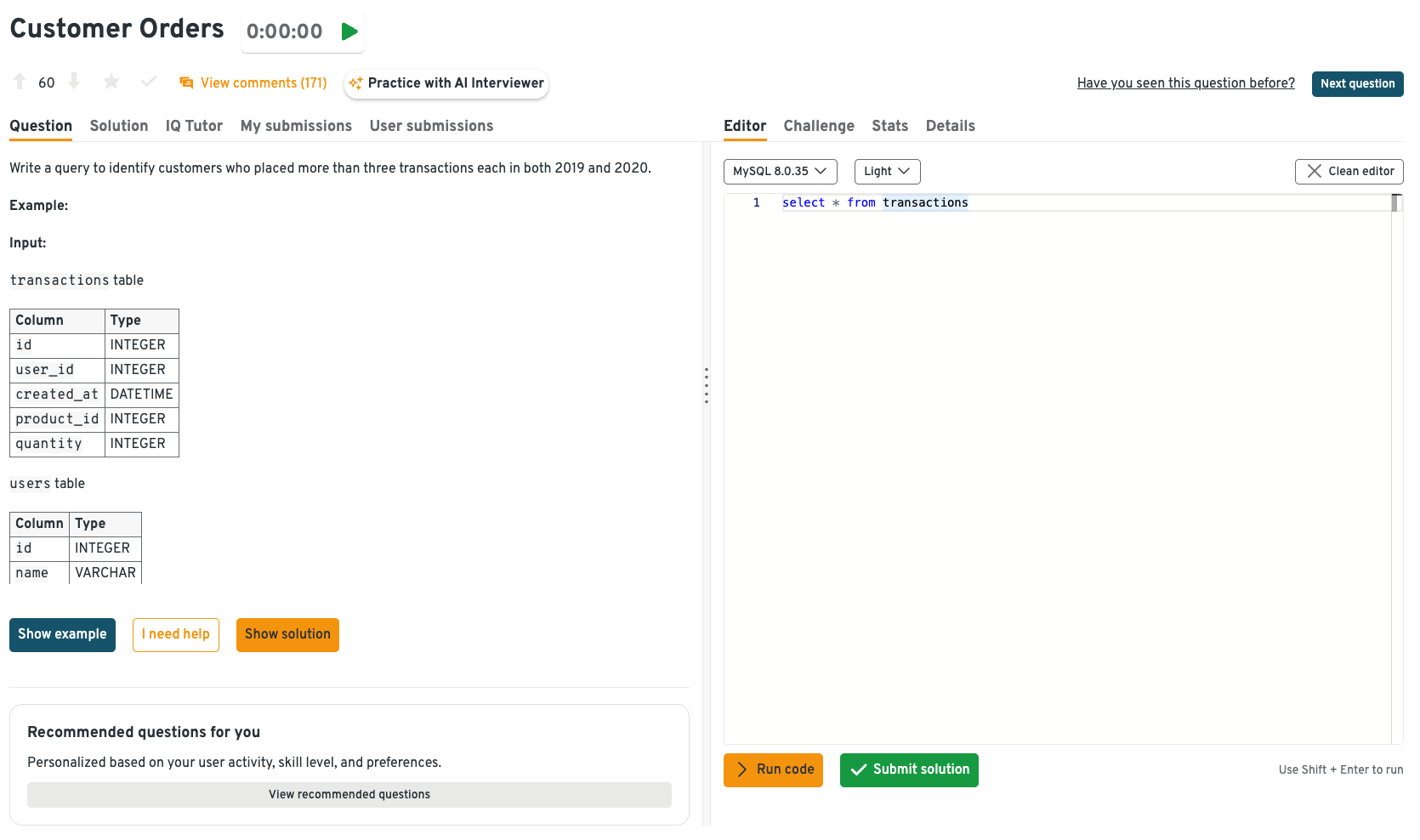
Here’s a sample SQL question from Amazon:
Customer Orders - Given a table of customer orders, write a query to find each customer’s most recent purchase date. Solve this question by yourself on the IQ dashboard →
- Adaptive content that tailors practice recommendations and study guides based on your performance.
- A suite of offerings including courses, learning paths, mock interviews, coaching, take-home challenges, and extensive interview guides.
These features are backed by user testimonials showcasing success stories, like landing roles at Lyft, Apple, DoorDash, and Google. One example is Alma Chen’s story, where she shares how Interview Query’s structured practice and company-specific questions helped her transition into a data analyst role at Lyft.
Watch the YouTube Video → What’s Happening in Big Tech Interviews in 2025 (FAANG)
What is Data Interview?
Data Interview—also presented as DataInterview—originates from a data scientist’s firsthand experience preparing applicants for high-stakes roles. It spotlights SQL-heavy problem sets, database query practice, and real company-based SQL coding challenges:
- The platform offers an interactive SQL Pad, allowing learners to practice SQL interview questions in-browser.
- It emphasizes tackling real-world company problems, spanning data science concepts, statistics, and Python alongside SQL.
- The platform includes structured courses and personalized coaching sessions, reflecting its dual emphasis on building knowledge.
Feature-by-Feature Breakdown: Interview Query vs Data Interview
| Feature | Interview Query | Data Interview |
|---|---|---|
| Platform Focus | Broad data science interview prep with multi-topic coverage | SQL-centric prep with targeted case studies and coaching |
| Types of Questions | SQL, Python, case studies, product sense, system design, take-home challenges | SQL, case studies, select Python problems, database-focused challenges |
| Mock Interviews | AI-driven simulations, live coaching, take-home assignments | Live one-on-one coaching sessions (5+ hours), mock interview packages |
| Case Studies | Company-specific, scenario-based, multi-step reasoning | Role-specific cases modeled after real industry datasets |
| SQL/DB Query Problems | 150+ SQL problems, scenario and aggregation-heavy | 100 SQL drills via SQL Pad, database optimization challenges |
| Python Problems | Multiple Python and Pandas exercises across difficulty tiers | Limited Python coverage; mostly SQL-focused |
| System Design | Included for data and ML system design | Limited or absent |
| Personalized Feedback | AI-driven recommendations plus coach feedback | Coach-led feedback in live sessions |
| Pricing | Free tier; $79/month; $199/year; $299 lifetime | $37/month; $197/year; Bootcamps ~$997–$1,297; Mock packages ~$1,047 |
Question Bank & Problem Sets
- Interview Query: Offers an extensive library of over 30,000 interview questions sourced from 9,200+ companies. Every question, whether SQL, Python, case study, take-home challenge, system design, or product sense, comes from real interview experiences, so you know exactly what companies are asking today. The database is continuously updated to reflect the latest trends, problem formats, and skill expectations in the industry. Many are scenario-based, using realistic datasets and business cases that require multi-step reasoning, just like the challenges you’ll face in real interviews.
You’ll also find structured study plans like the Data Science 50 and Data Analytics 50. These curated playlists walk you through 50 handpicked problems in a logical order, helping you build mastery step by step, stay consistent in your prep, and cover the most high-impact topics for interviews.
Feel free to test your skills with real-world analytics challenges from top companies on Interview Query. Great for sharpening your problem-solving before interviews. Start solving challenges →
- Data Interview: While smaller in scale, it is highly specialized. The platform features roughly 60 curated case questions and 100 SQL challenges via its SQL Pad. Many of these are based on real-world datasets and tasks found in interviews. The problems cover query construction, data aggregation, and some optimization scenarios, making it a solid option for candidates who want to strengthen their SQL fundamentals before branching into other areas.
Interview Query’s content spans the full range of data science topics, including company-specific and scenario-based questions. Data Interview is more specialized, with a strong emphasis on SQL drills and database-focused case studies.
Difficulty Levels & Realism
Interview Query: Problems are explicitly categorized into beginner, intermediate, and advanced tiers. This allows learners to either ramp up gradually or dive into higher difficulty if they’re already experienced. The realism factor is high—many questions are adapted from actual interview prompts at companies like Google, Meta, Tesla, and Airbnb.
Data Interview: While the platform doesn’t formally label problems with difficulty tiers, the cases are structured around realistic hiring needs. For example, a “Target Data Scientist Interview” case might require analyzing retail transaction data to make product assortment decisions, blending SQL queries with statistical interpretation.
Solution Explanations & Walkthroughs
Interview Query: Provides step-by-step walkthroughs for most problems. These include the thought process behind the solution, hints for those who get stuck, and often an explanation of why a certain approach is preferred over others. In the case of scenario-based questions, explanations often extend into business reasoning, showing how results would influence decisions. This is especially valuable for candidates preparing for product-oriented data roles.
Struggling with take-home assignments? Get structured practice with Interview Query’s Take-Home Test Prep and learn how to ace real case studies. Practice take-home tests →
Data Interview: Solutions tend to be text-based and code-centric, focusing on delivering a correct query or script. While this works well for SQL syntax learning, there’s less emphasis on exploring alternative solutions or discussing broader business implications. For some case studies, the founder’s commentary adds strategic insight, but this depth is less consistent across the library.
Mock Interviews & Scenario Practice
Interview Query: Offers a suite of mock interview options—AI-driven simulations, take-home assignments, and one-on-one coaching. The AI mock interviewer can simulate timed, multi-step interviews, prompting follow-up questions as a real interviewer might. These scenarios are often based on common data science interview flows, blending SQL/Python coding tasks with follow-up analysis questions.
Want to practice real case studies with expert interviews? Try Interview Query’s Mock Interviews for hands-on feedback and interview prep. Book a mock interview →
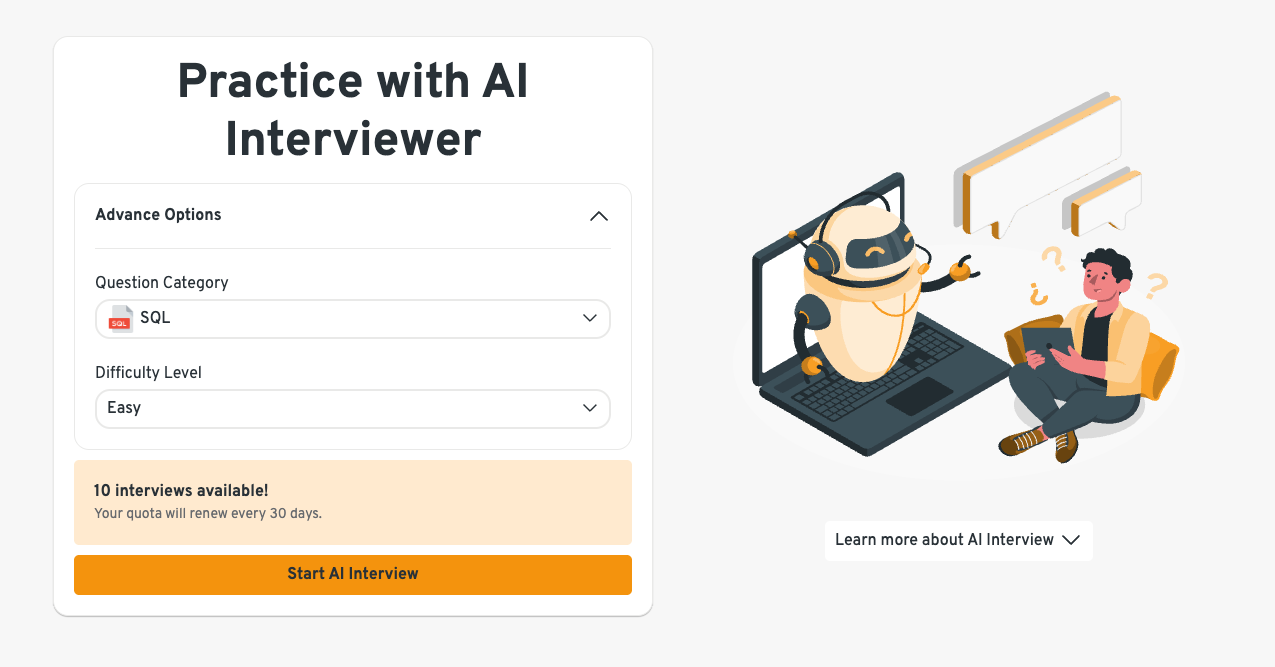
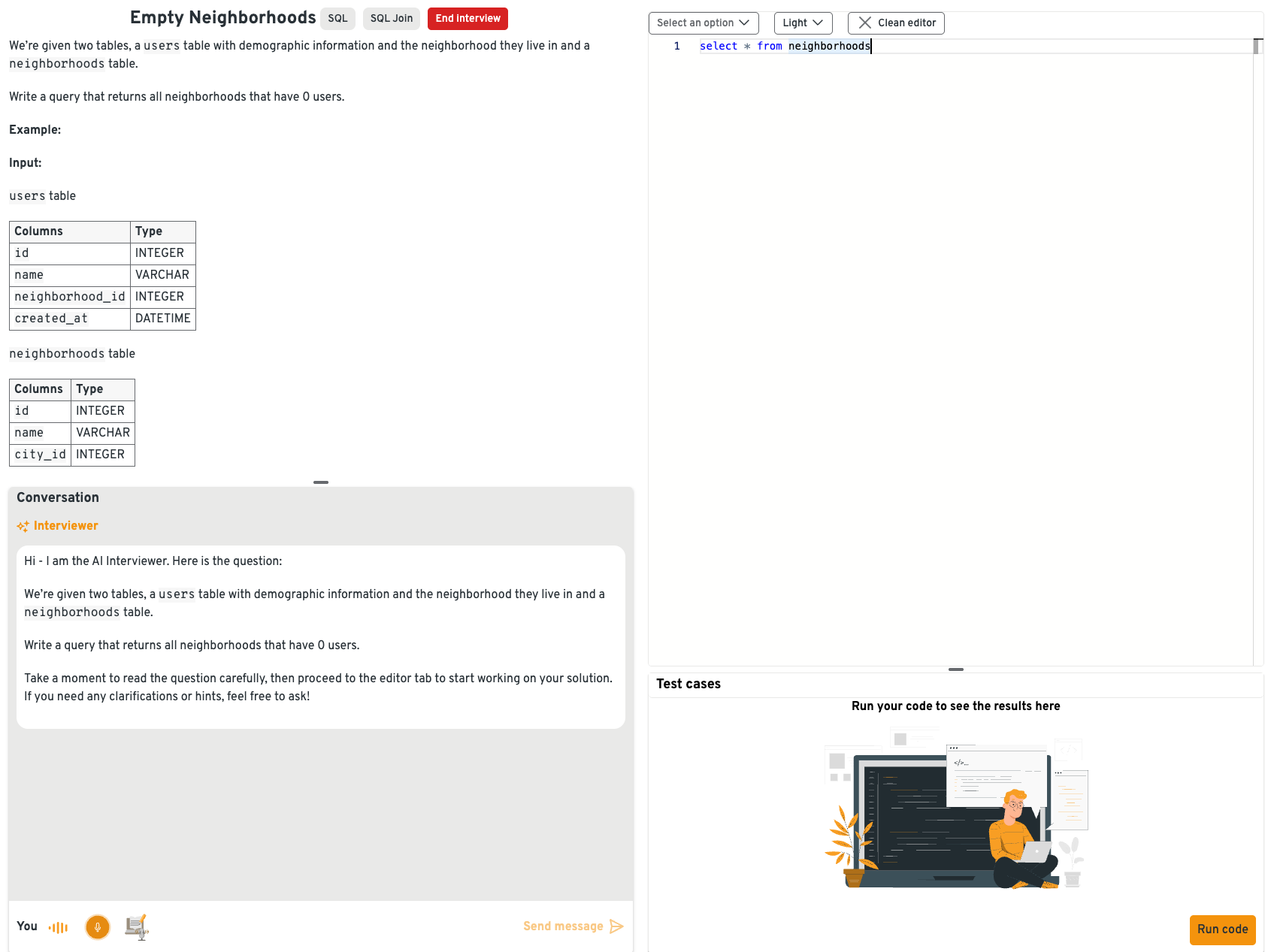
- Data Interview: While smaller in scope, it still offers over five hours of mock interview content, primarily through live coaching sessions. These are human-led, personalized interactions where the coach can tailor questions to the learner’s target role. This approach can be more flexible than a fixed simulation, but it also depends heavily on scheduling and availability.
Platform Usability & User Experience
- Interview Query: Interview Query provides a clean, modern interface with structured learning paths that take users from foundational concepts to advanced challenges. The integrated coding environment supports SQL, Python, Pandas, and R, allowing problems to be solved directly in-browser. In addition to the core question bank, the platform includes peer-to-peer mock interviews, one-on-one coaching through IQ Tutor, and SkillCheck quizzes for benchmarking progress. Users can also complete take-home challenges with guided solutions, access comprehensive salary data by company and role, and explore a curated job board for data science and analytics positions. Together, these features deliver a seamless, end-to-end preparation experience that combines learning, practice, and career insights.
- Data Interview: Keeps the interface simple and lightweight, making it easy to launch the SQL Pad or Coding Pad and begin practicing immediately. It’s particularly useful for learners who want straightforward, quick practice sessions. However, it offers fewer structured learning pathways and supplemental resources compared to Interview Query.
Analytics, Progress Tracking & Personalized Recommendations
- Interview Query: Offers performance tracking and AI-driven personalized recommendations. Based on your history, it suggests the next set of problems to tackle, ensuring a balanced mix of topics and difficulty. This system also adapts to target specific skill gaps.
- Data Interview: Tracks progress within its SQL Pad and course modules, allowing users to see completed problems and revisit past attempts. While it doesn’t have algorithmic recommendations, learners can manually choose areas to focus on, with guidance available through its structured course paths.
Pricing Comparison: Interview Query vs Data Interview
Pricing Tiers & Value for Money
| Feature | Interview Query | Data Interview |
|---|---|---|
| Free Tier | Limited quizzes & guides | N/A |
| Monthly Plan | $79/month | $37/month |
| Annual Plan | $199/year | $197/year |
| Lifetime Option | $299 one-time lifetime | N/A |
| Premium Packages | N/A | Data Science Bootcamp ~$997, MLE Bootcamp ~$1,297, Mock Interview 5-Pack ~$1,047 |
Interview Query
Interview Query offers multiple pricing options, starting with a free tier that gives limited access to challenge quizzes and selected interview guides. This is useful for exploring the platform’s interface and style before committing. The monthly plan is priced at $79, while the yearly plan costs $199, making it a more economical choice for users committed to long-term preparation. There is also a lifetime plan for $299, which grants indefinite access to all premium content, including the full question library, structured learning paths, AI interview simulations, and coaching tools. For candidates preparing for FAANG interviews (aka MAMAA), the lifetime or yearly plan offers a strong return on investment, as it provides sustained access to high-quality, scenario-based content and adaptive recommendations over multiple job cycles.
Data Interview
Data Interview’s pricing is straightforward, with a base subscription of $37 per month or $197 per year, granting access to all courses. For more intensive preparation, it also offers premium bundles, including a Data Science Bootcamp (~$990), an MLE Bootcamp (~$1,300), and a mock interview package with five live one-on-one sessions (~$1,100). While these options provide hands-on, instructor-led training and personalized feedback, they involve a higher upfront cost and separate add-ons for a complete prep experience.
From an ROI perspective, Interview Query is ideal for learners seeking a broad skill set with strong automation, adaptive learning, and FAANG-style case coverage, while Data Interview delivers more value for those prioritizing SQL mastery and live coaching. Interview Query’s bundled learning paths make it a better fit for self-directed, multi-month prep, whereas Data Interview’s bootcamp and coaching packages cater to those who want a fast-tracked, mentor-supported approach.
Which Platform Should You Choose? (Use Cases + Recommendation)
Choose Interview Query if:
- Preparing for FAANG/MAMAA interviews and other top tech companies, and need exposure to a wide variety of question types—SQL, Python, system design, product sense, and complex case studies.
- Want an all-in-one prep platform that combines structured learning paths, AI-driven recommendations, detailed solution breakdowns, peer mock interviews, live coaching, and a coding environment—all in one place.
- Value long-term career growth, with access not just to practice problems but also salary data, a job board, and resources that extend beyond interview prep.
Choose Data Interview if:
- Focused mainly on SQL practice for roles like data analyst, BI developer, or analytics engineer, with straightforward query-based challenges.
- Prefer a lightweight, no-frills tool for practicing SQL in a fast, hands-on way without additional resources or structured progression.
- Looking for short-term practice sessions rather than an end-to-end prep platform.
Final Verdict — Interview Query vs Data Interview
Both Interview Query and Data Interview bring strong value to the table, but their strengths cater to different types of learners. Data Interview shines in SQL-focused preparation with realistic database query problems and intensive, coach-led mock interviews. It’s a solid choice for candidates targeting analyst or database-heavy roles who want a streamlined, SQL-centric curriculum.
Both Interview Query and Data Interview bring strong value to the table, but their strengths cater to different types of learners. Data Interview shines in SQL-focused preparation with realistic database query problems and intensive, coach-led mock interviews. It’s a solid choice for candidates targeting analyst or database-heavy roles who want a streamlined, SQL-centric curriculum.
FAQs on Data Science Interview Prep Platforms
Is Interview Query worth it for data science interviews?
Yes—Interview Query is especially valuable if you’re targeting roles at FAANG/MAMAA or other top companies. Its combination of SQL, Python, case studies, product sense, and system design questions—alongside detailed walkthroughs, adaptive recommendations, and mock interviews—provides a realistic, comprehensive preparation experience that mirrors real hiring processes.
What are the three distinct types of interview questions?
In data science interviews, you’ll typically encounter:
- Technical questions such as SQL, Python, algorithms, and statistics.
- Case studies and scenario-based problems to apply data skills to solve business challenges.
- Behavioral questions evaluating communication, teamwork, and problem-solving approaches.
Which platform is better for SQL interview practice?
Both platforms have strong SQL coverage. Data Interview is focused on quick drills and in-browser SQL practice, making it useful for sharpening syntax and speed. Interview Query, however, offers a massive SQL library with realistic datasets, case-based scenarios, and an integrated coding environment, preparing you for SQL questions in the context of full interviews. Its structured learning paths, detailed solutions, and mock interviews ensure you not only solve problems correctly but also understand the reasoning behind them, giving you a complete, real-world-ready SQL mastery.
Does Interview Query offer company-specific interview questions?
Yes—Interview Query features company-specific interview guides with detailed questions and answers, modeled after real interviews at organizations like Google, Meta, DoorDash, and Airbnb. These often include both technical problems and behavioral or product sense components, giving candidates targeted, role-aligned practice.
How to decide which platform suits my interview needs?
Start by clarifying your target role and priority skills. If you want comprehensive coverage across technical, analytical, and product-oriented questions, plus community support, Interview Query is a strong choice. If your focus is SQL-heavy roles and you value live coaching and structured bootcamps, Data Interview may be a better fit.
What are the 5 STAR interview questions in an interview?
The STAR method stands for Situation, Task, Action, and Result, and is a common framework for answering behavioral interview questions. “STAR interview questions” are those that prompt you to tell a structured story from your past experience, such as “Tell me about a time you solved a difficult problem under tight deadlines.”
What’s the best way to answer “What is your weakness?” in an interview?
The best approach is to choose a genuine but manageable weakness, explain how you’ve worked to improve it, and connect it to professional growth. For example: “Earlier in my career, I struggled with over-analyzing data before making recommendations. I’ve since implemented a structured decision-making process to balance thorough analysis with timely execution.” This shows self-awareness, growth, and a focus on delivering results. With this kind of response, you’re demonstrating that you’ve learned from past challenges and turned them into strengths, effectively using previous shortcomings as a lever for better performance.
Ready to Practice Smarter? Start with Interview Query
If you want to land your next data science role, now is the time to level up your preparation with Interview Query. Start with a free trial to explore challenge quizzes, try sample interview problems, and experience how the platform’s clean interface and adaptive learning paths guide your progress.