
Meta Interviews 2025: Questions, Process, and Prep Playbook


Introduction
Meta is doubling down on the next era of technology, from open-source AI breakthroughs like Llama 3 to new frontiers in mixed reality and generative creation. In this landscape of rapid innovation, landing a role at Meta means joining a team shaping how billions will connect, work, and create in the coming decade.
This guide walks you through everything you need to succeed: the interview process, common questions, and proven preparation strategies so you can stand out as someone ready to build what’s next.
Why work at Meta?
Working at Meta means shaping the future of human connection at a scale few companies can match. From Facebook and Instagram to WhatsApp, Messenger, and Reality Labs, Meta’s ecosystem touches billions of people every day and continues to push the boundaries of AI, virtual reality, and digital expression.
What sets Meta apart is its culture of ownership and long-term innovation. Teams are encouraged to move fast, take bold risks, and build solutions that redefine entire industries. Engineers experiment with large-scale systems that power the metaverse and open-source AI models like Llama 3. Data scientists uncover insights that guide product evolution across global communities. Product managers and designers create seamless experiences that blend creativity, commerce, and technology.
Meta also invests deeply in personal and professional growth. Employees enjoy flexible remote work options, equity-based compensation, and opportunities to transition across roles or product lines. Every career at Meta compounds in value through continuous learning, impact, and global exposure.
If you thrive on curiosity, scale, and innovation, Meta offers more than a job. Meta offers a front-row seat to building the future of how people connect, communicate, and create.
Meta Interview Process
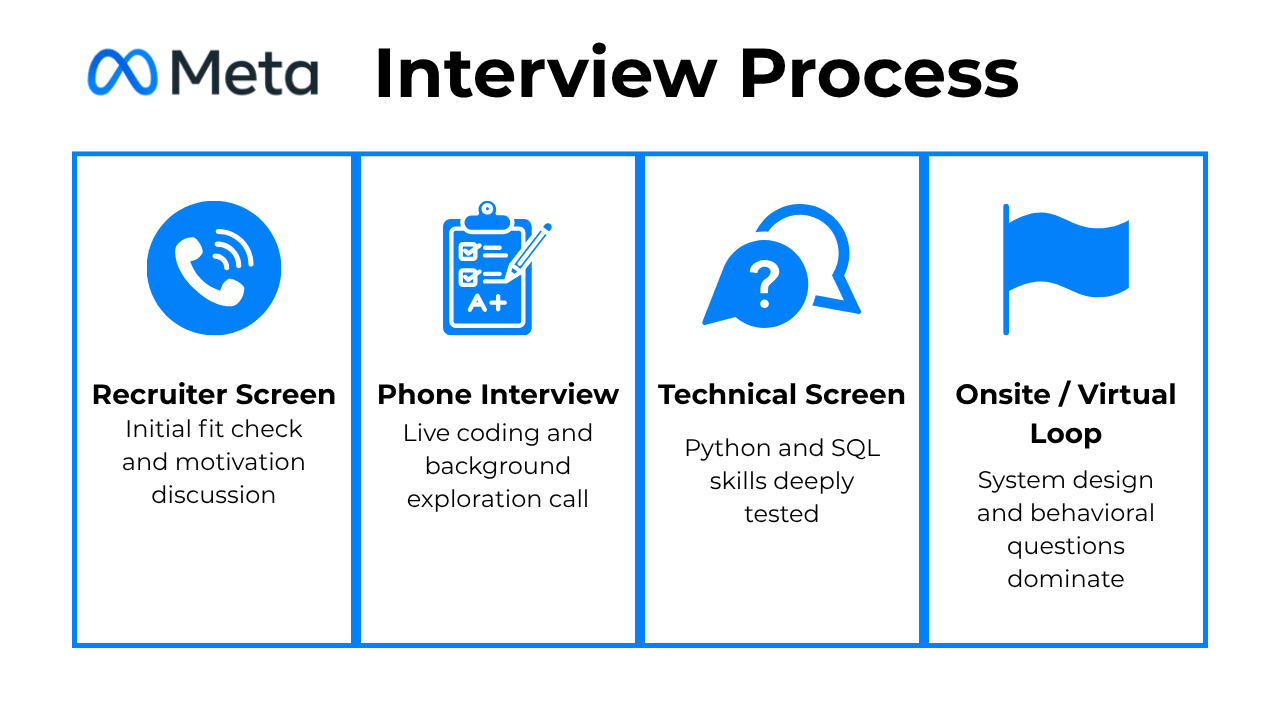
Meta’s interview process is designed to reveal not just what you know, but how you think, collaborate, and solve problems in an environment that moves at incredible speed. You’ll go through multiple rounds that test both your technical ability and your ability to communicate clearly, adapt under pressure, and connect your work to Meta’s broader mission of building technologies that bring people closer together.
The process usually takes around three to six weeks from your initial application to final offer, depending on your role and interviewer availability. Throughout, you’ll be expected to show curiosity, structure, and a genuine enthusiasm for building products at scale.
Application and resume screen
This is where everything begins. Recruiters and hiring managers scan your resume to understand your story and how it connects to the role you’re applying for. They’re looking for signals of impact, not just participation—projects where you took ownership, shipped results, and made measurable change. If you’re applying for a technical position, your GitHub or portfolio work may also be reviewed to see how you approach problem-solving.
Expect this stage to take about five to seven business days before you hear back. A clean, well-structured resume that quantifies your achievements (“improved data pipeline latency by 30%” or “increased campaign ROI by 18%”) helps you stand out instantly.
Tip: Meta loves clarity. Avoid jargon, focus on what changed because of your work, and use active language to show ownership and momentum.
Recruiter call
Once your profile catches attention, you’ll have a 20–30 minute conversation with a Meta recruiter. This isn’t a deep technical screen; it’s more of a fit assessment. Expect questions about your background, your motivations for applying, and how familiar you are with Meta’s products and mission.
Recruiters use this stage to gauge two things: whether your experience aligns with the role’s core requirements, and whether your values align with Meta’s culture. Be prepared to discuss your favorite Meta product, how you’d improve it, or what excites you about the company’s current direction (like open-source AI or Reality Labs).
Tip: Bring enthusiasm. The recruiter wants to feel that you’ve done your homework. Even simple observations like “I’ve been following Meta’s AI strategy and love how you’re scaling Llama 3” show genuine interest.
Technical or case interviews
Here’s where things start getting more intense. Depending on your role, this stage could involve coding challenges, system design questions, product cases, or data problem-solving exercises.
- For engineers, expect algorithm and data structure problems. Think trees, graphs, dynamic programming, and efficiency trade-offs.
- For data roles, you might get SQL challenges, A/B testing questions, or case-style prompts that test product intuition and storytelling.
- For business or product roles, you’ll face strategic or analytical cases focused on scaling products, prioritization, or market decisions.
Each round lasts about 45 to 60 minutes, and you’ll likely face two to four sessions depending on seniority. Interviewers want to see how you think under ambiguity: do you clarify assumptions, explain your logic, and communicate trade-offs clearly?
Tip: Don’t rush to answer. Walk the interviewer through your reasoning before coding or calculating. Meta values clarity of thought more than cleverness. How you approach a problem is just as important as getting it right.
Cross-functional or onsite loop
If you’ve made it this far, you’re entering the heart of Meta’s interview experience. This round simulates what it’s like to actually work there. You’ll meet future teammates, potential managers, or partners from other functions, and work through problems that blend technical, behavioral, and product perspectives.
Expect three to five interviews across a single day or split over two. For technical roles, this might include system design and product sense interviews. For non-technical roles, you might get deep dives into project execution, stakeholder management, or leadership stories. Every interviewer evaluates whether you demonstrate Meta’s core values: Move Fast, Focus on Long-Term Impact, and Build Awesome Things.
Tip: Treat this as a conversation, not an interrogation. Listen actively, think aloud, and show curiosity about how teams work together. Meta loves candidates who think like collaborators, not soloists.
Hiring Committee and Offer Review
Once you’ve completed your interviews, your results move into the hands of Meta’s hiring committee, a cross-functional group of senior employees who review feedback from every interviewer. Their goal isn’t to nitpick, but to ensure fairness and consistency across teams and levels. Each interviewer rates you independently, and the committee looks for patterns: Did you demonstrate strong problem-solving? Clear communication? Cultural alignment with Meta’s values like Move Fast and Focus on Long-Term Impact?
They’ll also weigh how you performed across competencies. For example, even if your algorithmic round wasn’t perfect, a strong showing in system design or product sense can balance things out. The process is deliberately holistic because Meta wants builders who are thoughtful and resilient, not just technically sharp.
If the committee approves, your recruiter will reach out within one to two weeks to discuss the offer. This is where things become both exciting and strategic. Meta’s compensation structure is famously equity-heavy, with restricted stock units (RSUs) forming a major part of your total package. Base pay is competitive, but equity is where long-term value really compounds. Senior roles also include performance bonuses tied to company milestones and personal impact.
When your recruiter walks you through the offer, you’ll typically see four components:
- Base Salary – your guaranteed monthly or annual income.
- RSUs (Equity) – Meta stock that vests over four years, rewarding you for long-term contribution.
- Sign-On Bonus – a one-time payment to offset vesting timelines or competing offers.
- Performance Bonus – usually tied to individual and company performance each year.
Tip: When negotiating, approach the conversation with curiosity, not confrontation. Ask how equity refreshers work and when performance reviews take place—they often coincide with opportunities for stock top-ups. If you have competing offers, share them transparently but focus on fit and long-term growth rather than just numbers. Meta’s recruiters appreciate candidates who think strategically and value ownership.
Remember: the goal isn’t to “win” the negotiation; it’s to align on a package that reflects your value and keeps you motivated for the long run. Meta’s best employees are those who see their equity as a shared investment in the company’s mission, not just a perk.
Challenge
Check your skills...
How prepared are you for working at Meta?
Most Common Meta Interview Questions
Meta interview questions span analytical depth, behavioral insight, and system-level reasoning. Below is a breakdown of the most common categories you’ll encounter across different roles.
Role-Specific Guides
- Meta Data Scientist Interview Guide
- Meta Product Manager Interview Guide
- Meta Data Engineer Interview Guide
- Meta Business Analyst Interview Guide
- Meta Data Analyst Interview Guide
- Meta Machine Learning Engineer Interview Guide
- Meta Research Scientist Interview Guide
Each guide dives into the role’s specific interview process, the types of questions to expect, and strategies to prepare effectively for Meta’s fast-paced and impact-driven environment.
Python coding interview questions
Python interviews at Meta test your ability to write concise, efficient, and readable code while clearly explaining your reasoning. Interviewers look for logical structure, handling of edge cases, and your ability to connect solutions to real-world scalability. Each question typically lasts 30–45 minutes, and the best candidates communicate their approach before typing a line of code.
What is the most efficient way to select students with certain favorite colors and high grades?
This question evaluates your fluency in manipulating data using libraries like pandas. You will describe how to filter rows based on multiple conditions, such as selecting students who prefer “green” or “red” and have grades above 90. Interviewers observe whether you use vectorized operations, keep your syntax clean, and think about performance when dealing with large datasets.
Tip: Explain how vectorized filtering in pandas avoids Python loops and speeds up computation on large data frames.
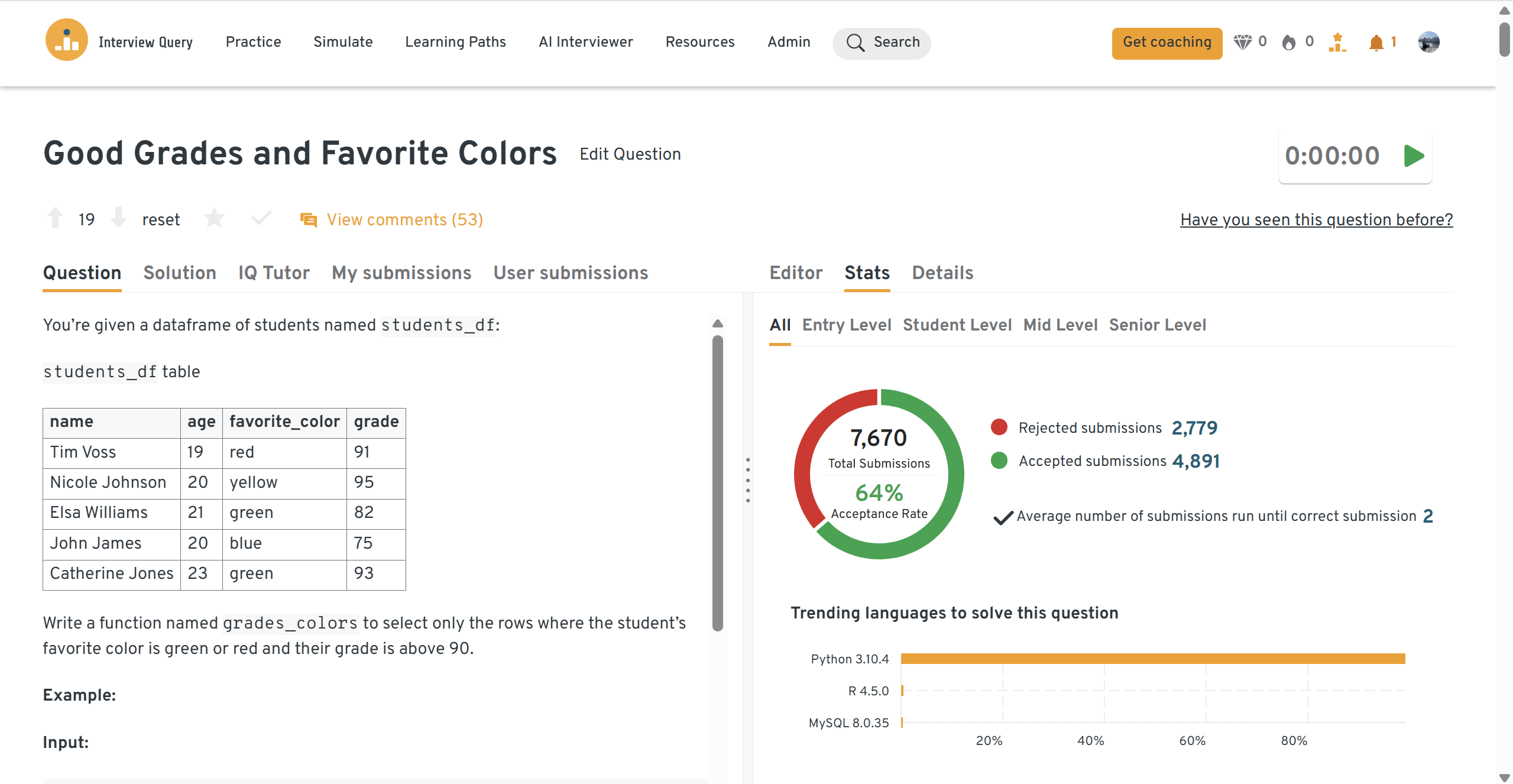
You can practice this exact problem on the Interview Query dashboard, shown below. The platform lets you write and test SQL queries, view accepted solutions, and compare your performance with thousands of other learners. Features like AI coaching, submission stats, and language breakdowns help you identify areas to improve and prepare more effectively for data interviews at scale.
-
This question tests your ability to manipulate strings efficiently. You need to explain how to count character occurrences once, store them, and reconstruct the sentence with counts appended—excluding spaces and characters on a discard list. The interviewer is assessing how you handle input constraints and optimize lookups.
Tip: Emphasize that precomputing character frequencies with
collections.Countermakes your solution linear in time and easy to read. How would you create a friendship timeline that shows when friendships start and end?
This problem tests your ability to organize event data and reason about temporal relationships. You will describe how to pair “friends added” and “friends removed” events by matching user pairs and timestamps, ensuring correct ordering and completeness. The best answers show awareness of edge cases such as multiple add–remove cycles.
Tip: Mention that sorting events chronologically and using a queue or dictionary to track open friendships ensures accuracy and scalability.
How can you extract a specific word from an encrypted string if you know the encryption formula?
This question focuses on logic, pattern recognition, and modular reasoning. You need to show how you would reverse the encryption process to rebuild the original text and locate the target word. Interviewers are looking for candidates who approach the problem methodically, separating decryption logic from text analysis.
Tip: Explain that building a standalone decryption helper keeps the function testable and flexible for future encryption variants.
How would you fill missing values in a sorted list using the most recent non-missing entry?
This question measures how you reason through sequence transformations. You will describe a linear pass through the list while keeping track of the last valid number to replace
Nonevalues. Interviewers pay attention to how you handle edge cases like when the first value is missing or when the list contains consecutiveNoneentries.Tip: Highlight that a single traversal with a running variable offers both clarity and O(n) efficiency.
How can you automatically generate a histogram with evenly distributed bins?
This problem tests your ability to convert raw data into summarized insights. You will explain how to divide a list of numbers into
xuniformly sized bins, count values per range, and exclude empty bins. Interviewers expect reasoning about bin width, rounding, and boundary handling for inclusivity.Tip: Show awareness of numerical precision and rounding errors, and describe how you would handle the last bin’s upper boundary correctly.
System design interview questions
System design questions at Meta test how you think about scale, reliability, and user experience. Whether you’re an engineer, data scientist, or product-minded builder, you’ll be asked to design systems that serve billions of users while keeping latency, consistency, and ethical responsibility in mind.
You’ll need to reason through trade-offs, justify architectural choices, and explain how your design adapts as load or complexity grows. Interviewers care less about fancy jargon and more about how you structure problems, communicate decisions, and keep the end user in focus.
Below are examples of questions that mirror Meta’s real-world challenges:
How would you design a machine learning system to detect unsafe content?
This question measures how you’d approach large-scale content moderation while balancing accuracy and fairness. Begin by outlining the multi-modal nature of the problem—text, image, and video each need dedicated detection layers. You might discuss using computer vision for images, transformer-based toxicity classifiers for text, and multimodal fusion models to capture context.
Explain your approach to data collection, labeling, and human review. Meta values practical thinking, so talk about minimizing false positives while keeping the system responsive and privacy-safe. You can also mention continuous model retraining and feedback loops that improve precision over time.
Tip: Don’t treat this purely as an ML problem. Mention scalability, latency, and ethical responsibility. Meta wants engineers who think about both performance and societal impact.
How would you design a podcast search engine using transcript and metadata?
This question explores your ability to combine natural language processing with information retrieval. Start by describing a system that uses automatic speech recognition (ASR) to generate transcripts, which are then indexed alongside metadata such as title, author, and duration.
Discuss how you’d handle query ranking with a blend of traditional keyword-based retrieval (TF-IDF, BM25) and embedding-based search for semantic relevance. Explain how the system would handle caching, query completion, and performance at scale.
Tip: Emphasize hybrid retrieval approaches that balance speed with precision. Meta interviewers appreciate when you integrate both traditional search and modern embedding methods to serve fast, relevant results.
-
This question tests how you’d balance personalization, latency, and scalability. Begin with the data pipeline: capturing historical search patterns, trending queries, and contextual inputs like location or friends’ activity. You can describe using prefix trees (tries) for rapid lookups, supported by embedding models that personalize ranking.
Then, talk about how you’d evaluate success: think click-through rate, query abandonment rate, and overall latency. Mention A/B testing as a way to validate improvements without disrupting live performance.
Tip: Meta values realism. Always acknowledge operational trade-offs—like how you’d cache frequent queries or gracefully degrade service during high traffic periods.
-
This question examines your ability to combine data science, machine learning, and platform integrity. Start with how you’d source and label data like fact-checking APIs, reputable publishers, and user reporting systems can help validate content.
From there, discuss feature extraction: text-level attributes (sentiment, entity networks, credibility scores) combined with social graph data (share velocity, network trust). You could propose an ensemble model with explainability features that flag suspicious content for review, closing with how you’d integrate human fact-checkers and feedback loops to improve model reliability.
Tip: Recognize the limits of automation. Meta interviewers respect candidates who acknowledge that no system can eliminate misinformation completely, but that layered defenses and transparency reduce harm.
-
This question challenges you to think about cross-platform scalability and user experience. Start by proposing a distributed publish-subscribe architecture that syncs updates across apps in real time. Message queues, partitioned topics, and caching layers (like Redis or Memcached) can help maintain low latency even under billions of concurrent events.
Next, explain how you’d integrate AI moderation. A hybrid approach works best: rule-based filters for known violations, paired with asynchronous NLP models for nuanced checks. Describe how the system maintains uptime even when AI services lag or fail.
Tip: Always bring reliability into the picture. Meta expects you to design graceful fallbacks so moderation issues don’t break the user experience during live moments.
Want to see how Meta interviews look in action?
This mock interview features Jay Feng, co-founder of Interview Query, alongside a Meta machine learning engineer, as they walk through a real interview question focused on illegal items detection. Together, they break down how to scope the problem, design a scalable model, and handle edge cases. It’s an inside look at how Meta evaluates structured thinking, collaboration, and problem-solving under pressure. It’s a great peek into how Meta evaluates structured thinking, collaboration, and problem-solving under pressure.
Behavioral interview questions
Behavioral interviews at Meta are deep, story-driven conversations designed to reveal how you think, adapt, and lead when faced with challenges. Rather than focusing on your job titles or credentials, interviewers want to understand how you work, how you make decisions, collaborate across teams, and learn from failure.
Expect open-ended prompts tied to Meta’s values: Move Fast, Focus on Long-Term Impact, Be Open, and Build Awesome Things. Interviewers are looking for authenticity, self-awareness, and evidence that you take initiative when things get hard.
Below are examples of the types of questions you may encounter:
Describe a data project you worked on. What were some of the challenges you faced?
This question helps Meta understand how you handle ambiguity and drive outcomes. Start by describing the project goal and the specific problem you were trying to solve. Then discuss the biggest obstacles and how you navigated them, whether through stakeholder alignment, creative technical solutions, or collaboration.
Sample answer: In my previous role, I led a project to optimize engagement reporting for an internal analytics dashboard. The main challenge was inconsistent tracking across markets, which caused gaps in performance data. I worked with engineers to standardize event schemas and created a monitoring pipeline in Airflow that flagged discrepancies in real time. As a result, we reduced data errors by 35% and built more trust in our reports. This experience taught me that clear definitions and proactive documentation can prevent recurring issues and speed up decisions.
Tip: Always end your story with what changed because of your work. Meta values measurable impact and continuous learning.
What are some effective ways to make data more accessible to non-technical people?
This question assesses how you simplify complexity for others, which is critical at Meta where collaboration spans engineers, designers, marketers, and executives. Talk about specific initiatives or tools you used to help teams self-serve insights or make better decisions.
Sample answer: At my last company, many teams struggled to access campaign metrics without technical help. I built a Looker dashboard that summarized core KPIs with simple filters and embedded tooltips explaining each metric. I also hosted short learning sessions to teach managers how to explore data independently. Within two months, dependency on data analysts dropped by 40 percent, and leadership could run reports on demand. It showed me how empowering teams through clarity creates speed and better collaboration.
Tip: Tie your example to measurable improvement, such as time saved, faster decisions, or increased adoption.
What would your current manager say about you, and what constructive criticisms might they give?
Meta interviewers value honest self-assessment. They want to see that you can reflect on your strengths while acknowledging areas where you have grown. Avoid clichés like “I work too hard.” Instead, show awareness and active improvement.
Sample answer: My manager would say I am highly dependable and good at creating structure in uncertain situations. I often take the lead in clarifying goals and ensuring that projects stay aligned across teams. She once pointed out that I can spend too much time refining deliverables before sharing them. Since then, I have started presenting earlier drafts to get feedback sooner. This has improved both my speed and collaboration with others.
Tip: Meta values progress more than perfection. Show that you respond to feedback quickly and turn it into visible change.
Talk about a time when you had trouble communicating with stakeholders. How did you overcome it?
Communication is one of the most common themes in Meta interviews. Interviewers look for examples of how you realigned a project when goals or definitions became unclear.
Sample answer: During a pricing experiment, product and finance teams were using different definitions for revenue lift. The result was conflicting analyses that delayed decisions. I created a single-page summary outlining each metric’s formula, pros, and trade-offs. We met briefly to agree on one definition, which we later added to our internal documentation. This small change prevented similar confusion in future experiments and improved our speed to launch.
Tip: Be transparent about the conflict. What matters most is that you resolved it constructively and improved collaboration afterward.
Why did you apply to Meta, and what makes you a good fit?
This is your opportunity to connect your story with Meta’s mission. Avoid broad answers like “I want to work in tech.” Instead, show that you understand Meta’s direction and how your skills can contribute to it.
Sample answer: I’ve always been drawn to Meta’s mission of connecting the world, especially through its investments in AI and immersive experiences. My background in analytics and experimentation aligns with how Meta builds and iterates based on data. I want to work on products that reach millions of people and use insights to make those experiences better. Joining Meta feels like a chance to contribute to meaningful innovation while continuing to grow alongside teams that value curiosity and scale.
Tip: Focus on the intersection between what Meta is building and what motivates you. Interviewers remember genuine enthusiasm and mission alignment.
Tips When Preparing for a Meta Interview
Preparing for a Meta interview means demonstrating not only what you know but how you think, collaborate, and deliver impact. Meta’s interviewers look for curiosity, structured reasoning, and ownership that align with the company’s fast-moving, mission-driven culture. The most successful candidates prepare holistically, balancing technical practice with personal reflection and communication clarity.
Story crafting
Before diving into technical prep, spend time reflecting on your own journey. Meta’s interviewers want to understand how you’ve grown, handled challenges, and created measurable impact. Prepare four to five stories that highlight resilience, initiative, and adaptability, especially those that show how you’ve thrived under ambiguity or scaled solutions across teams.
Tip: Frame your stories using the STAR method (Situation, Task, Action, Result). Keep each concise but rich in insight. End with how you grew from the experience. This shows the learning mindset Meta deeply values in builders and leaders.
Collaborative coding and problem solving
Meta interviews are highly interactive. Even during technical or analytical rounds, collaboration is key. Interviewers want to see how you work through problems as if you were already part of the team, asking questions, validating assumptions, and explaining trade-offs clearly.
Tip: Treat your interviewer as a partner. Talk through your logic, confirm your approach before diving in, and explain your reasoning as you code. This mirrors how Meta teams collaborate in real projects, emphasizing clarity and openness over perfection.
Time-boxed thinking
Meta interview sessions are structured and time-bound. You might not finish every task, but how you manage time and structure your approach matters just as much as the final answer.
Tip: Practice solving problems in 30–45 minute windows. Begin by restating the problem to ensure understanding, identify edge cases early, and outline your solution before coding. Interviewers appreciate when candidates demonstrate logical sequencing and focus under pressure.
System design readiness
For system design or architecture rounds, Meta looks for your ability to scale ideas globally and reason through trade-offs. These questions are not just about technical detail but also about connecting design choices to user experience, reliability, and business value.
Tip: Review fundamental design principles and think about how Meta products operate at scale. Explain your choices in simple terms, use real-world examples from Meta’s ecosystem like News Feed or Messenger, and always connect your design to user impact.
Cultural alignment and mindset
Meta places strong emphasis on values such as “Move Fast” and “Focus on Long-Term Impact.” Interviewers evaluate whether your decision-making reflects autonomy, collaboration, and a bias for action.
Tip: Read about Meta’s latest innovations and company updates to understand where the company is headed. During interviews, show how your thinking aligns with Meta’s mission to connect people and build meaningful products, even when faced with uncertainty.
Salaries at Meta
Most technical and analytical roles at Meta fall under titles such as product manager, data scientist, machine learning engineer, data engineer, business analyst, and research scientist. Each plays a key role in driving Meta’s mission to connect people, build communities, and shape the future of technology.
Based on 2025 data, senior technical roles such as machine learning engineer (Staff Level) and Research Scientist (IC6 and above) command the highest total compensation, averaging 500K to 700K per year, while Business Analysts and Data Engineers typically earn between 150K and 300K per year. Meta’s structure remains equity-heavy, rewarding long-term ownership, innovation, and measurable product impact. Below is a salary comparison across key Meta positions:
- Software Engineer (E3–E7)
- Base Salary: 130K to 260K per year
- Total Compensation: 170K to 780K+ (Levels.fyi)
- Structure: Mix of base pay, performance bonuses, and stock grants. Senior engineers often receive large equity refreshers tied to technical scope and leadership impact.
- Product Manager (L3–L7)
- Base Salary: 130K to 370K per year
- Total Compensation: 170K to 1M+ (Levels.fyi)
- Structure: Strong equity component that scales with responsibility. Senior PMs can earn over half their pay in stock, reflecting ownership of high-impact products.
- Data Scientist (IC3–IC8)
- Base Salary: 130K to 320K per year
- Total Compensation: 170K to 1.1M+ (Levels.fyi)
- Structure: Equity and bonuses linked to data-driven decision-making, experimentation, and analytics leadership.
- Machine Learning Engineer (E4–E6)
- Base Salary: 180K to 280K per year
- Total Compensation: 320K to 700K+ (Levels.fyi)
- Structure: One of Meta’s most lucrative roles, with stock making up 25–35% of total pay. Rewards innovation and long-term ownership of AI and model systems.
- Data Engineer (IC3–IC6)
- Base Salary: 130K to 220K per year
- Total Compensation: 170K to 440K+ (Levels.fyi)
- Structure: Balanced mix of salary and equity. Compensation grows with expertise in scaling infrastructure and improving reliability.
- Business Analyst (IC3–IC7)
- Base Salary: 110K to 260K per year
- Total Compensation: 140K to 460K+ (Levels.fyi)
- Structure: Includes base pay, bonuses, and RSUs. Higher levels are rewarded for business insight, analytical depth, and cross-functional impact.
- Research Scientist (IC4–IC6)
- Base Salary: 160K to 220K per year
- Total Compensation: 300K to 580K+ (Levels.fyi)
- Structure: Equity-driven compensation focused on long-term research impact. Senior scientists receive recurring stock refreshers and performance-based multipliers.
Average Base Salary
Average Total Compensation
Key Insight: Meta’s compensation philosophy emphasizes impact, ownership, and scalability. The greater your influence on product growth, research breakthroughs, or infrastructure efficiency, the higher your total earning potential. Equity plays a central role in Meta’s rewards system, making it one of the most competitive employers for long-term value creation in global tech.
FAQs
How long does the Meta interview process take?
Most candidates complete the Meta interview process within three to five weeks. You can typically expect a recruiter screen, technical or case rounds, and final interviews with a hiring manager. Scheduling between rounds may vary depending on your availability and the team’s timeline.
Can I reapply to Meta if I don’t pass the interview?
Yes. Meta allows candidates to reapply after six months. This gives you time to strengthen the areas highlighted in your feedback, expand your project experience, or build a stronger technical and analytical portfolio.
Does Meta provide feedback after interviews?
Feedback is often limited for early rounds but may be shared for final-stage candidates. If you don’t receive feedback, you can politely follow up with your recruiter and request general areas for improvement before reapplying.
What kinds of questions should I expect in a Meta interview?
You can expect a mix of behavioral, technical, and system design questions. Behavioral rounds test adaptability and ownership, while technical and system design questions assess how you structure complex problems and scale your solutions across Meta’s products.
How important are Meta’s company values in the interview?
Extremely important. Meta evaluates candidates against its core values such as Move Fast, Build Awesome Things, and Focus on Long-Term Impact. Aligning your stories and decisions to these values helps interviewers see how you fit within Meta’s culture of innovation and accountability.
What should I focus on when preparing for behavioral interviews?
Prepare stories that show growth, initiative, and measurable results. Meta’s interviewers appreciate honest reflections on challenges, failures, and how you learned from them. Practice telling your stories using the STAR method (Situation, Task, Action, Result).
How should I prepare for Meta’s technical interviews?
Practice solving coding problems and system design questions under time constraints. Focus on writing clean, readable code while explaining your logic. Meta values structured reasoning and collaboration more than just getting the correct answer.
What technical stack does Meta use?
Meta’s primary tech stack includes Python, Hack (Meta’s PHP variant), React, TypeScript, GraphQL, MySQL, and Presto. For machine learning, engineers often use PyTorch and FBLearner Flow for large-scale model training and deployment.
What’s the best way to stand out as a remote candidate?
Show that you can work effectively in asynchronous, global teams. Highlight strong written communication, initiative, and documentation skills. Mention tools you’ve used such as Notion, Slack, or Loom to manage collaboration and maintain visibility across distributed teams.
Get Ready to Land Your Meta Offer
Succeeding in the Meta interview process takes more than technical expertise. It’s about combining clear thinking, problem-solving, and collaboration while showing how your impact aligns with Meta’s mission to connect people and build technology that scales globally. To prepare effectively, focus on structure and consistency: practice coding and system design in timed settings, refine your behavioral stories with real data and measurable results, and study Meta’s products to understand how technical decisions translate into user impact. Every interview is a chance to demonstrate curiosity, ownership, and the ability to thrive in fast-paced, ambiguous environments.
If you’re ready to level up your preparation, try mock interviews for live coaching, the AI Interview Simulator for real-time feedback, or take-home challenges to build your case-solving confidence. With focused practice and the right strategy, you’ll be ready to land your Meta offer and start shaping the future of technology.
Discussion & Interview Experiences